The ability to remember and associate smells is one of the most powerful forms of memory, enhancing a sense of time and place and visual cues. The Olfactory Glands are located in the sinuses very close to a part of the brain that processes and retrieves memories and emotions, the amygdala. Scientists have isolated a thousand different enzymes that bond to odiferous chemicals in the identification of smells in humans.
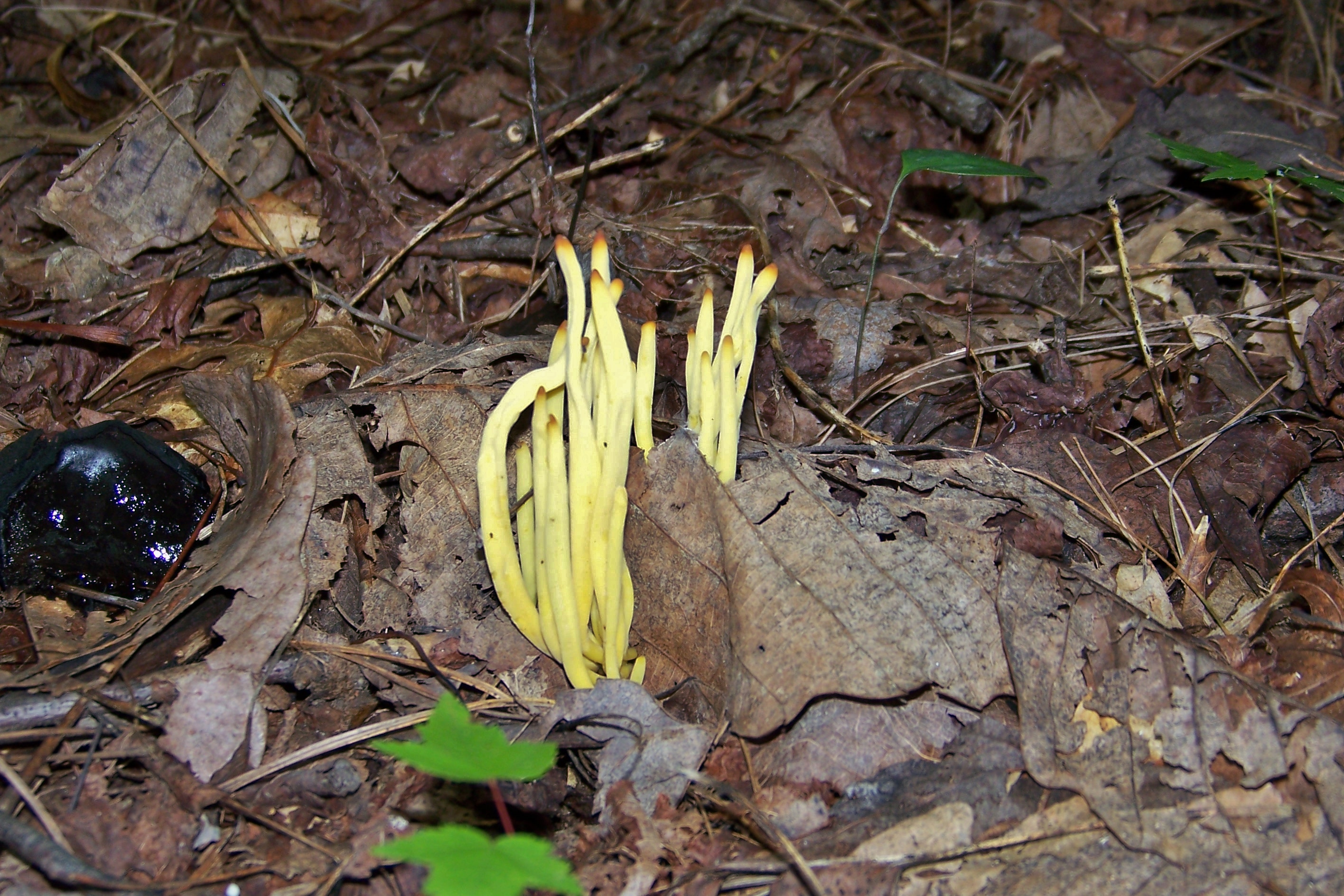
I’m originally from East Tennessee where the clay is nearly as orange as this print and hard enough so that you are not be able to stick a mattock into it more than 2 to 3 inches no matter how hard you hit it. There is abundant clay where I live now but it is most usually infused with muscovite mica (the silvery sheet mineral that you can see through) which makes it much easier to dig in. My number three son and I are building a deck for a colleague of mine. Where the deck is located there is no mica in the clay (odd) so it digs like East Tennessee clay. On the way home the other day I inadvertently put my hand on to my face and smelled the clay/dry grass mixture on my fingers. Memories began to flood in from so many times and places that I couldn’t ruminate before the next set of life experiences were upon me. Being dirty is repulsive to many but when it reminds me of things I have enjoyed doing it becomes a perfume. I immediately thought of helping friends and strangers put up hay on a hot or balmy June or September day. I thought of setting fence posts for a horse training ring and the one hole where the Sassafras root filled our noses. Or the many fences I have built or repaired over lawn and woods when the scent of clay on the posthole diggers is matched with leather warming up on the wooden handles. I thought of collecting spiders for research and digging in the back yard where I grew up to make a hide-out with my brother. I remember tilling in the garden in The Horseshoe and caving in a number of East Tennessee sinkholes or repairing pipes or foundations for many evenings and nights until a dropped into bed. All of these thoughts flooded my mind in less than a minute. Odors can be very subtle and yet bring back some of the most vivid memories. I was surprised by the sudden onset and pleased by the thoughts of life lived to the fullest.
When I was a youth, I once prayed that the Lord would let me experience life to the fullest. They say you should be careful what you pray for but I believe you should be bold in what you pray for when your heart is right. God is wise and kind enough to sort out how He should answer. God has abundantly answered that prayer, but of course, not in ways I would have ever expected or wanted. With the many good and significantly pleasant memories are the hard and mundane and heartbreaking ones. You can’t really experience all of life without difficulty. I’ve never been afraid to work hard, so many of my good memories are high energy, even difficult experiences, that only later mellow into good memories. I am thankful to God for allowing me to experience so many varied activities and interactions with people over the years. He is good to me far beyond the necessities of physical and spiritual life. I have truly enjoyed life and want to share my love of the outdoors and science and beauty and solid thinking with others. Though read by few, that is the reason I write this blog, to point to the One who creates, saves and sustains so abundantly.





 CreatorWorship
Public Reactions
Posted in Cultural commentary, General, Random thoughts, tagged Random thoughts on April 29, 2014| Leave a Comment »
I had a few random, funny and profound things happen in public school today:
1) As I was coming into my second school I overheard the chemistry teacher telling his AP students about very energetic reactions. I came to the door and said, “Like it not, Mr. V, you are going to get a reaction out of me,” to which he replied, “That was spontaneous!” I reiterated, “Yeh, that was totally spontaneous.” The students just stared in stunned silence. I went across the hall and opened up my room and settled in. Meantime, Mr. V was continuing on about changes in energy of these reactions he was describing. I came back in a few minutes to the doorway, pointing to my brain case and said, “Mr. V, I just wanted your students know that since my spontaneous reaction I am much more stable.” Again the students just stared, though two muffled laughter. Later Mr. V reported that as soon as I left the whole class broke out in laughter because they thought that I am crazy. Maybe, but I’m stable.
2) Later in the day as I was teaching, my teacher’s assistant (TA) brought a bellwork paper to me from one of my students. Bellwork is questions that student answer as review for previous day’s learning and hand in at the end of the week. Early in the week this girl had written on the bellwork, “You look nice today.” The next day she wrote, “You are looking good.” By this time I am a little embarrassed, but my TA pointed to one more entry on a bellwork at the end of the week, “I don’t understand this question,” alongside which my TA had written in red ink, “What’s wrong, is my beauty distracting you?” Oh, my goodness, I wonder what kind of reaction I’ll get out of that one? I guess I’ll have to at least explain that I have a TA.
3) The third occurrence which actually happened first is a bit more serious. I have a girl in my first period class who almost daily greets me with a question about how I am feeling. She is frighteningly perceptive about my emotional state, predicting how I feel by the way she asks about it: “Are you frustrated, Mr. F?” “Are you having a good day, Mr. F?” “Are you angry about something?” “Why do you seem so happy?” “What is bothering you?” “Are you sad?” “Things are going real well today, aren’t they?” “Are you tired?” Now I will be the first to admit that my emotions are easy to read- wear them on my sleeve, as the saying goes- but sometimes I try to hide them because I have a job to do, or I don’t want to upset my students, or because I don’t want to talk about it, or sometimes I don’t think they are even showing. She is almost always right or at least leaning in the right direction in her perceptions. It caused me to think about the saying that we should be thermostats rather than thermometers. That is, we should affect the emotional, moral, and intellectual temperature by our attitudes and actions rather than just reflect it by indicating and becoming the temperature of, giving in to, the surroundings. But I thought, thermostats are also thermometers, for if you don’t know what the temperature is, you can not affect it in a positive way for good. You may be heating things up when they should be cooled down, and vise versa. So I decided that this girl has a very notable talent that she probably acquired from a less than comfortable surroundings where she needs to read the temperature to stay out of trouble. If she uses her readings carefully, both in terms of not insisting that she is always right when she may not be and using the information to better her reaction to it rather than copying peer pressures, she may help herself and others move toward more profitable responses. For my part, I have decided to stop being annoyed at the perceptions and use them as checks on both my emotional state and how I am coming across to those I am supposed to be serving. That is humbling and challenging. And I’ve decided to give this girl the nickname, Thelma (“Thermometer Lady”). It almost works; it is a mash up after all.
4) I’m on a roll now, so here is a “foot in mouth disease” story from several weeks ago. My Physics students were discussing problems they had attempted for homework in a whiteboard session. Students collaborate in small groups to write answers to problems on 2′ x 3′ dry erase boards. Then they defend their answer before the rest of the class. Properly facilitated and fully engaged participation on the part of students makes this possibly the most fruitful form of group thinking. One of the groups had a particularly confusing problem for them that had precipitated much heated debated among the three group members. In fact, one of the students had gone so far as to prepare his own whiteboard with an alternative answer. The two other students somewhat disdainfully commented that A had drawn up his own answer. Realizing that A, who is an Asian student, had the right answer and that the whole set up had a teachable moment, I quieted the other students by saying, “Listen up, A has a minority report!” The class went totally silent and African-American Miss S looked totally shocked. I went on about how we should listen to A because sometimes the Minority Report was the correct one and that he should be heard. I could hear S mutter, “But, Mr. F…” My students just stared (or glared?) at me. Now all this while I had been thinking Majority and Minority decisions of the Supreme Court and the minority reports that the fewer justices give when they vehemently disagree with the majority. Suddenly it occurred to me how my students were perceiving what I was saying. I laughed rather uncontrollably for a few moments which further horrified my students until I explained that I had not meant at all what they had heard. We now wait for the “Minority Report” with a chuckle.
Read Full Post »