Feeds:
Posts
Comments

Archive for the ‘Cultural commentary’ Category

I had a few random, funny and profound things happen in public school today:

1) As I was coming into my second school I overheard the chemistry teacher telling his AP students about very energetic reactions. I came to the door and said, “Like it not, Mr. V, you are going to get a reaction out of me,” to which he replied, “That was spontaneous!” I reiterated, “Yeh, that was totally spontaneous.” The students just stared in stunned silence. I went across the hall and opened up my room and settled in. Meantime, Mr. V was continuing on about changes in energy of these reactions he was describing. I came back in a few minutes to the doorway, pointing to my brain case and said, “Mr. V, I just wanted your students know that since my spontaneous reaction I am much more stable.” Again the students just stared, though two muffled laughter. Later Mr. V reported that as soon as I left the whole class broke out in laughter because they thought that I am crazy. Maybe, but I’m stable.

2) Later in the day as I was teaching, my teacher’s assistant (TA) brought a bellwork paper to me from one of my students. Bellwork is questions that student answer as review for previous day’s learning and hand in at the end of the week. Early in the week this girl had written on the bellwork, “You look nice today.” The next day she wrote, “You are looking good.” By this time I am a little embarrassed, but my TA pointed to one more entry on a bellwork at the end of the week, “I don’t understand this question,” alongside which my TA had written in red ink, “What’s wrong, is my beauty distracting you?” Oh, my goodness, I wonder what kind of reaction I’ll get out of that one? I guess I’ll have to at least explain that I have a TA.

3) The third occurrence which actually happened first is a bit more serious. I have a girl in my first period class who almost daily greets me with a question about how I am feeling. She is frighteningly perceptive about my emotional state, predicting how I feel by the way she asks about it: “Are you frustrated, Mr. F?” “Are you having a good day, Mr. F?” “Are you angry about something?” “Why do you seem so happy?” “What is bothering you?” “Are you sad?” “Things are going real well today, aren’t they?” “Are you tired?” Now I will be the first to admit that my emotions are easy to read- wear them on my sleeve, as the saying goes- but sometimes I try to hide them because I have a job to do, or I don’t want to upset my students, or because I don’t want to talk about it, or sometimes I don’t think they are even showing. She is almost always right or at least leaning in the right direction in her perceptions. It caused me to think about the saying that we should be thermostats rather than thermometers. That is, we should affect the emotional, moral, and intellectual temperature by our attitudes and actions rather than just reflect it by indicating and becoming the temperature of, giving in to, the surroundings. But I thought, thermostats are also thermometers, for if you don’t know what the temperature is, you can not affect it in a positive way for good. You may be heating things up when they should be cooled down, and vise versa. So I decided that this girl has a very notable talent that she probably acquired from a less than comfortable surroundings where she needs to read the temperature to stay out of trouble. If she uses her readings carefully, both in terms of not insisting that she is always right when she may not be and using the information to better her reaction to it rather than copying peer pressures, she may help herself and others move toward more profitable responses. For my part, I have decided to stop being annoyed at the perceptions and use them as checks on both my emotional state and how I am coming across to those I am supposed to be serving. That is humbling and challenging. And I’ve decided to give this girl the nickname, Thelma (“Thermometer Lady”). It almost works; it is a mash up after all.

4) I’m on a roll now, so here is a “foot in mouth disease” story from several weeks ago. My Physics students were discussing problems they had attempted for homework in a whiteboard session. Students collaborate in small groups to write answers to problems on 2′ x 3′ dry erase boards. Then they defend their answer before the rest of the class. Properly facilitated and fully engaged participation on the part of students makes this possibly the most fruitful form of group thinking. One of the groups had a particularly confusing problem for them that had precipitated much heated debated among the three group members. In fact, one of the students had gone so far as to prepare his own whiteboard with an alternative answer. The two other students somewhat disdainfully commented that A had drawn up his own answer. Realizing that A, who is an Asian student, had the right answer and that the whole set up had a teachable moment, I quieted the other students by saying, “Listen up, A has a minority report!” The class went totally silent and African-American Miss S looked totally shocked. I went on about how we should listen to A because sometimes the Minority Report was the correct one and that he should be heard. I could hear S mutter, “But, Mr. F…” My students just stared (or glared?) at me. Now all this while I had been thinking Majority and Minority decisions of the Supreme Court and the minority reports that the fewer justices give when they vehemently disagree with the majority. Suddenly it occurred to me how my students were perceiving what I was saying. I laughed rather uncontrollably for a few moments which further horrified my students until I explained that I had not meant at all what they had heard. We now wait for the “Minority Report” with a chuckle.

Read Full Post »

Perhaps the reason I don’t have a very big following for my blog is that I mostly write for my own posterity and the comfort of getting my burning thoughts down in “black and white”, or whatever other colors I choose. I thought it was humorous and somewhat gratifying the other day when a student said to me about midway through a monologue I was giving in class, “Mr. [Leon], I could listen to you rant all day!” “That’s and interesting comment,” said I, “why do you feel that way?” “You are not afraid to be honest about what you think and always do it without being profane. There is alot of truth in what you say” Wow, so perhaps others are not so honest or insightful and are profane?

So, you might well guess that we are preparing for a rant, though this one is quite mild in delivery compared to the sarcastic and cutting version the student heard about the real deficiencies of public education (Perhaps that one will serve for another day. Oh, no, not another prescriptive education rant!). No, this one is about a significant blind spot that is preventing science education and political action from moving forward and it is not being caused by the uninformed. If after all of that you are still up for it, click on  Stop Writing Us Off    I look forward to some rousing comments.


Read Full Post »

I’ll try to refrain from too much well worn cultural commentary on this one, but it is amazing how easy and prevalent “throw away” is in this culture. I was reminded of it again today. I come home to my wife wanting me to look at the Kirby vacuum cleaner. What in the world am I doing with a Kirby vacuum cleaner, you ask? Once upon a time I was stuck in credit limbo. I had no credit, not having chosen for many years to have a credit card, so I couldn’t get credit. It is similar to being unemployed or under employed because you are over qualified for any menial job. They figure you will leave soon since you have a college degree so they won’t give you a job. Or it is even more like trying to get a job and being told that you must have two years experience but you can’t get experience without a job. Anyway, the carpet brush attachment activates a clutch that may either be turned on to drive the vacuum forward and back or shifted into neutral so you get a better workout. If it is broken throw it away, right?

This reminds me of ever so many appliances that are or once were in my places of residence. Take for instance the dryer we still use. The temperature selection switch “tore up”. I don’t know why since my wife, as far as I knew, never used that switch. Without it the dryer didn’t dry. I went to the parts store of the local appliance dealer. “That part is no longer available.” You mean to say that I have to buy a new dryer for $300+ for a $7.99 switch that only cost the manufacturer $0.87 to make? That reminds me (We’ll never get through this story if I keep regressing.) of when I used to rebuild aircraft alternators, generators, starters, and magnetos. Did you know that most of the time an alternator that has quit functioning only needs less than $10 in parts to fix it but about 20 years ago the manufacturers disallowed any but the licensed manufacturer re-builders to get the parts so that they could charge customers anywhere from $80 to $200+ for re-manufactured alternators? Back to the dryer. I am a scrapper and scrounger from way back. Call it a survival technique if you like. I began asking around and calling every yellow page appliance repairman in my county and the next. I found a retired (figures) appliance repairman who has a shed out back of his house with 50+ washers and dryers that he sells the parts off of. After some friendly talk and a few pointers as to where the appropriate models reside, I crawled into the shed and sampled 6-8 dryers for temperature switches. As you might imagine, several were missing, probably due to failures of dryer switches on other dryers of that make. I used my adjustable jaw wrench to extract several switches only to find out from the owner when I crawled back out that part number switch would not work, a fact I suspected with four electrical connection prongs instead of three (I love talking trash in run-on sentences.) Undaunted, I crawled back in and extracted that last switch (of course it was; I wasn’t going to keep taking them out after I found the one I needed.). But when I brought it out and checked the resistance, it operated backwards. The owner said it didn’t matter. To this day the switch sits pretty much unused with a paper label reversing the original markings and attached by clear packing tape. The dryer works fine. We call that jury rigging (Look it up.).

I guess I was desperate to write a blog entry this month and didn’t want to expend the energy of thinking about some of the deeper and more difficult issues going on at the moment. I hope you relate to this desire to fix things and not waste money and material. It is not always possible, but it feels good when you can. For me it is a matter of stewardship and finances. Maybe I’ll tell how I’ve revamped the dishwasher 3 times with small parts for less than $35, or recently replaced a broken coupling on the clothes washer. Actually, it isn’t fun when you are troubleshooting the problem of replacing the part in an awkward spot, but it sure is satisfying afterwards. Did I say that already?

Read Full Post »

A student “set me off” thinkin’ about old sayings yesterday in class when she arrived, sat down and ask me how I was doin’. “Fair to midland”, I replied, “I’m tired from running and not sleeping.” She laughed, “That’s the first time I’ve ever heard anyone say that other than my grandfather.” (Regretfully, I’m old enough to be her grandfather, but I left that out of the conversation.) “So is that good?” she inquired. “It’s OK, I reckon.” “Well,” I began, “I don’t wish my life away, but everybody needs a Friday now and then.”

Then I began thinking of some of the sayings I learned from my mother, but I got “bumfuzzled” tryin’. Oh, well, “six of one, half-a-dozen of the other”. My mother was not much for sayings involving “outlandish” people like “faster than a one armed paper hanger” but she could “teach an old dog new tricks”. I wish I could remember more of her sayings; “one will come to me” “every once in a blue moon”. When they do and I voice them, my students think that they are funny or they just look at me “sigogglin'” like I’m “a few bricks minus a load.” My father-in-law was a good one for sayings. He’d “treed more than a few pole cats” “in his day”, been “up the creek without a paddle” on a few occasions, and gone a whole day with “narey a bite to eat” “more times than he cared to remember.” That was because his father was known to “not hit a lick”, working “narey abit” for “as long as he could remember”, better than “a month of Sundays.” 

Youth have sayings, too, but for the most part they lack the richness of the old sayings. I suppose that is because language is far less isolated to regions, changes faster, and is abbreviated electronically down to acronyms and buzz words, the sayings of the day that “I can’t make hide nor hair of.”I wish I could remember a few more of my mother’s sayings but “for the life of me” I can’t think of another one “even if my life depended on it.” I wish you’d “help me out” and suggest a few you know in the comments. “Whewee!” I guess I did remember one more “by the skin of my teeth”. Let’s hear a few of your sayings.

Read Full Post »

The end of the school year is upon us. It is time for a little reflection and cultural commentary. Caution and disclaimer: This poem might make you mad, or conversely, you might shake your head sadly and say, ‘yes, it’s true’. If we do not take part in the last verse I fear we will not be tolerated very much longer. As one teacher said to me yesterday unprovoked, “We are not approaching crisis; we are in crisis.”

It is a moral issue
Lack of motivation
Rejecting what is true
Rules retaliation
Tolerance the only view

It is a moral issue
Say neither bad nor good
Be careful what you do
Even watch thoughts you should
Or we will certainly sue

It is a moral issue
Immodesty of dress
Crudeness of speech in lieu
Of more polite address
What I want to say and do

It is a moral issue
Lack of hygiene and care
Knowledge, no want or clue
All perversion laid bare
Gratification my due

It is a moral issue
Stealing what is not yours
Cheating and lying too
Coveting brings detours
Not earn what belongs to you

It is a moral issue
With rank and uniform
And age and gender too
Disrespect is the norm
Not even give God His due

It is a moral issue
Death is the focus now
Black the favorite hue
To dark stories they bow
Tattoos and piercings not few

It is a moral issue
Cry out to God, repent
Trust Christ the Savior Who
By grace from wraths relent
Our hope and nation renew

Read Full Post »

Americans are getting both what they want and what they deserve. Unless there is a widespread and deep repentance whereby we acknowledge God and obey His commands the United States will continue to slide toward immorality, infamy, impotence, and instability. The immorality is obvious in all that we vote to support and ignore and participate in that is clearly contrary to the Word of God. Infamy comes in the form of hatred from more and more countries of the world, self-hatred over increased oppression of rights and helpless people, and a growing history of blasphemy toward God. We think we are surely not impotent since we still have a strong military, but small troops of bandits are frustrating our every move worldwide, we can’t solve economic problems, natural catastrophe problems are on the increase threatening our personal security and economic viability, and the world will soon ditch our currency since we are so far in debt we can most likely never pay it off. Our instability shows in the aforementioned problems but really manifests itself in our increased suicide rates and divorce rates, debt, disregard of human life inside and outside the womb, educational lethargy, and lawlessness. It occurs to me that slide may not be the correct term for what is happening. Sliding assumes some small degree of frictional force opposing the direction of motion. We seem instead to be free-falling toward a morally corrupt, hating, powerless, unsustainable existence and loving the trip. There are brakes that can be applied but they are not in “how to”, Herculean efforts or renewed resolve. The only opposing force that could overcome this fall and the sudden stop at the bottom is found in God’s grace gained by agreeing with God we are rebelling against Him and receiving the payment Jesus made for those sins when He died on the cross.

Read Full Post »

Without a trace of homophobia and not a rant in sight, Rick Perry simply conveyed his beliefs about an example of where this country has gone wrong. The result should have been anticipated. He is not ashamed to call himself a Christian but many others are and more still hate the name of the God they try to live for. If you speak of a God of love but never challenge anyone with what is right or wrong you are not truly showing love. Instead you are condemning people to a hell that exists because they live on in the ignorance and defiance of their wickedness. You are in fact clinging to an idol or your own making, a god quite contrary to the God of the Bible.  Are there other sins that secure a place for sinners in hell? Yes, all of them, but such ones as prostitution and murder are still generally recognized as wrong. Mr. Perry is simply pointing out a sin that has been forcibly deemed as acceptable in our society, even desirable. The “viral” response and hatred of such public discussion assures that such wickedness will persist and grow. Our nation is already paying the consequences of this denial of God’s truth along with many others. We are weakened by this and many other hatreds of God and His Law. Unless we repent as a nation and a large number turn to Christ as Savior, our days are numbered. I do not believe Mr. Perry is so ignorant as to not anticipate such a reaction, but he does know and hopes that the many who agree with him will stand up and say so before our nation is overrun with more wickedness than God will tolerate. The time is short.

Read Full Post »

Have you noticed something missing from conversations in all forms of media- personal, electronic, written-about the debacle at Penn State? How about from the discussion of failed politicians, NFL or Hollywood celebrities, or riots or divorces in hometown America?  Euphemistically entitled a condition, exceptionality, syndrome, genetic disposition, problem, societal ill, disease, tendency, aberration, failure, inequity, mistake, debacle, addiction, heinous crime against humanity, acting out to name a few, this banned word denies the similarities of the list above. These replacements share two qualities, one for most of the words in the list and a second for all of them.  In the smaller group, including terms like genetic disposition, syndrome, and tendency,  blame is shifted to a different cause.  The similarity of all of the words is a denial of the real cause.  Have you guessed the true identity and name of the banned word?  Am I allowed to write it?  The word is sin.  The problem it so clearly points out is rebellion against God perpetrated by the sinner. Because of our pride resulting in selfishness we don’t want to admit to sin.  But ignoring and denying the problem does not allow for the recognition of the solution, so we Christians must talk about it. But beware because you may talk about God and that He is love and that He is good and that we should act nice and so on but if you mention sin you will be shunned or worse.   But since “through the Law comes the knowledge of sin,” (Romans 3:20) sinners will not recognize their need for a Savior or be saved if they are not taught that there is a righteous standard that all have failed to meet from a righteous God to whom they are responsible. 

If you don’t believe me that this word is banned try bringing it up in conversation. You need not be so direct as to mention a particular sin or even a particular person’s sin. Just talk about sin in your community resulting in some ill like family break-up or eventual death or even flowers wilting and see how far it gets you. Why?  “Let no one find fault, and let none offer reproof; for your people are like those who contend….” (Hosea 4:4)  But be warned, “Since you have forgotten the law of your God, I also will forget your children.” Hosea 4:6)

If you can add to my euphemistic list it would be instructive as to the depth of our….. tendency.

Read Full Post »

Does this sentence seem strange and yet all too common to anyone else besides me?

“Tip: Be the master of your own domain – make this blog creatorworship.me for just $24 per year.”

Thus goes the ad at the top of my Dashboard on this blog. I want to say, “No, please read the subtitle of the blog and comprehend that though I struggle with self-absorption like the rest of the planet, I am fighting the tendency by way of the influence of the Spirit within.”

Pointing to the One who made, saved, and sustains.

Read Full Post »

I was asked the following in an interview recently: “What does it mean to be educated?” After clarifying that the interviewer actually meant “well educated” I directed him to Psalm 119:97-100 and Proverbs 1:7:

 
“O how I love Your law!  It is my meditation all the day.
Your commandments make me wiser than my enemies, For they are ever mine. I have more insight than all my teachers, For Your testimonies are my meditation. I understand more than the aged, because I have observed Your precepts.”

“The fear of the LORD is the beginning of knowledge; Fools despise wisdom and instruction.”

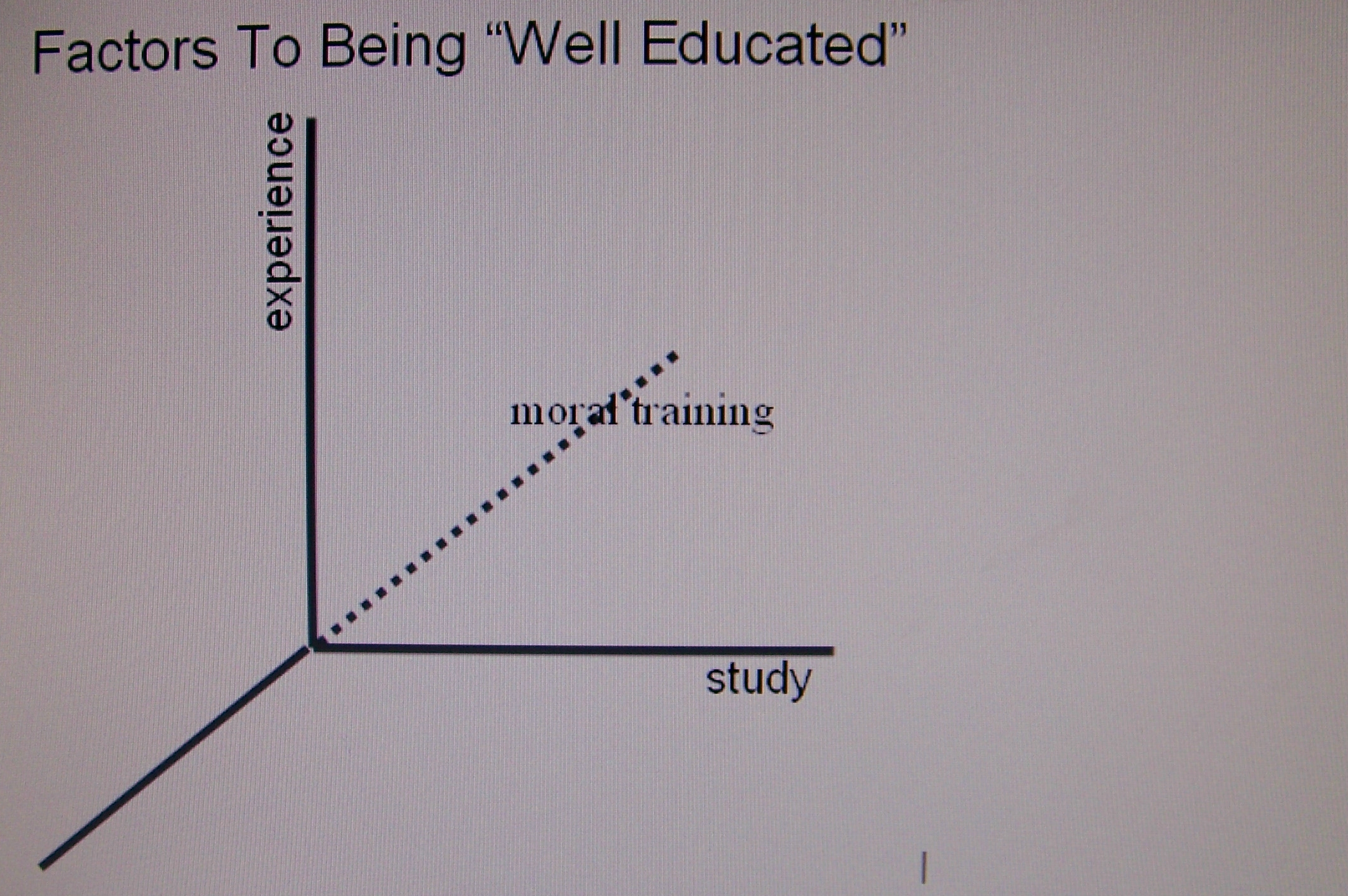
His summary question caused me to think of all that might be needed to be “well educated”: “Is it possible to have a large amount of schooling but not be well educated?”   I have made some small additions to what I responded to him but essentially here is the graph I came up with then to answer his question and explain what I considered “well educated” to mean:

x-axis: study includes both depth (specialization) and breadth (number and variety of subjects);  study may be acquired through schooling, tutoring, or self-study      
y-axis: experience involves interaction with the surroundings and skills training and practice                  
z-axis: moral training begins with God’s Word and proceeds to thought application to all of life events         
x and y axes begin a zero and may be positive however z-axis factors may either be positive or negative; factors are multiplied together.

Read Full Post »

If the students at the school where I teach selected me to be their faculty speaker at graduation, here is the speech I would deliver to them.
    Class of 2010, congratulations on the progress of your education to this point of graduation from high school.
Congratulations to your parents and relatives and friends who have loved you and encouraged you and helped you to this place and time.
    As you mark this occaision and move on to other pursuits I would like to look back and review with you some lessons I believe you should have learned in school and look forward to apply them to wherever you may find yourself….
[details in the next post….a list of the topics here]
1. Life is full of tests.
2. Integrity is the glue of society.
3. Atoms are real but cannot be touched.
4. You cannot touch without being touched.
5. Bored is not a circumstance; it is a state of mind.
6. The scientific method is a useful tool in everyday life.
7. The speed of light is constant and so are many other things.
8. Proper grammar is useful for your progress.
9. You are more than the sum of your parts.
10. History does not repeat itself; it is linear.
I can’t much imagine being asked to speak but if I did are you curious about what I’d say?

Read Full Post »

The young man was serious. “We can’t know what is true.” He was asked if there is any objective truth, that is, things that are always true regardless of your opinion or mine? “No, I don’t think so.” Furthermore, “all religion is just man-made ideas about who God is,” and “logic may not be right”, that is, may not lead us to the right conclusions in evaluating whether an idea is true. Do you agree even in part with the statements above? Probably many of you do because these ideas are taught in various forms of media, schools, conversation, and even from pulpits. But is it really true that we cannot know anything, and is there nothing that is always true in every situation?

It is very hard to discuss worldviews or beliefs if the other party is not willing to admit reason as a trusted way to evaluate truth. I suspect that such a disbelief in reason does not really exist. First of all, people act on what they believe. I don’t know of anyone who refuses reason consistently to run traffic lights, or jump off of high places unprotected, or ignore all social norms, or break the law totally unrestrained. It is simply too difficult to consistently ignore all reason, and one who does ignore it probably does not live long. Secondly, I think the fact that people operate on reason otherwise but refuse it on issues of worldview suggests they don’t want answers. Reason is necessary for survival and well proven by experience and practice in such areas as science and law to work well in evaluating truth claims.

Logically, then, “we can’t know what is true” is a self-defeating argument because it says there is one thing we do know, namely, “we can’t know what is true.” An even more self-defeating argument states that there is not anything that is always true, that is, absolute. If you say there are no absolutes then that is an absolute statement. If you think there may not be absolutes, or we can’t know for sure, then there is the possibility of absolutes about which you are ignorant and which may be found. And saying all things are true breaks the law of non-contradiction, which states that two contradictory statements cannot at the same time and in the same sense be true. For instance, stating that ‘God exists’ and ‘God does not exist’ cannot both be true.

So then, does God exist? In a recent talk at a local church entitled “God and Science”, Prem Isaac showed the reasonableness of God’s existence. One way he did this was by applying the Law of Causality: If an object had a beginning it must have had a cause. A corollary law states that the cause cannot be the same as the effect. Now people as diverse as Big Bang theorists, ancient cultures, all of the major religions, and primitive cultures all say that the universe had a beginning. Therefore, according to the Law of Causality, the universe had a cause. And because the universe has space, time, matter, and energy, the cause of it cannot have any of these. If you say that the cause does have these characteristics it is a mere secondary cause and not the ultimate cause itself. Unless you simply give up on the law and declare an endless chain of causes, there must be an un-caused Cause which is eternal (outside of time), immutable (not made of matter), without size or shape (doesn’t occupy space), immutable (does not change as the universe does), powerful (to create all), and intelligent (since there are laws, information, and design). This infinite cause is what we call God.

There are many more logical steps from there to the God of the Bible, based on the reliability of Scripture. Perhaps we can develop a few of these, but here is what God declares in Isaiah 45:5 about Himself, “I am the Lord, and there is no other; besides Me there is no God.” And Peter says of “the name of Jesus Christ the Nazarene”, “there is salvation in no one else, for there is no other name under heaven that has been given among men by which we must be saved.” (Acts 4:10,12) He is the eternal, transcendent Cause who also showed up personally in time to save those who would receive His gift. The mind (reason), the universe, and the Scripture testify to Him for those who will listen.

Read Full Post »
On the hallway wall next to the door is posted “Room 417 Storage”.  In this fairly new facility it is used as an occasional office.  The majority could not tell you where it is or for what purpose it is utilized.  I was assigned to sit in silence in Room 417 with three other people for two and a half hours.  I’m a teacher; you figure it out.  Here are my impressions of the space, the activity, and our path.

In a claustrophobic room
Painted white no decor there
Neither flower nor mind could bloom
Though florescent lights and vented air


 White noise from conditioned air
Abundant plastic, metal too
Nothing the senses would find fair
Though clean and bright and also new


Sanitized of all that harms
Disease, sharp corners, tanning rays
Not a thing the spirit alarms
Though emergency exits map ways


Thus the danger to our lives
All is well but dead inside
No awareness that life never thrives
Except in Sonshine and change of tide

Read Full Post »

      On my classroom wall is posted the statement, “Bored is not a circumstance; it’s a state of mind.”  From the frequency of gaming, surfing the web and channels, and various other vicarious pursuits of entertainment coupled with short attention spans and lack of excitement for anything short of amazing I would say it is a common state of mind.  Other evidences may be harder to see: boredom with marriage, the job, the church, or life itself.  As Thomas Dubay puts it in The Evidential Power of Beauty boredom is “an insipid tedium with existence itself. Reality [is] a colossal blah.” (p.73)  What is the cause of this state of mind?  Part of Dubay’s answer is as follows: “The personal inability to perceive truth and beauty is related as first cousin, if not sibling, to a lack of wonder, which in turn, often if not always, arises from jadedness, from a perduring and even disgusting boredom caused by excess and overindulging” (p.72)  He is in fact repeating himself because jadedness means dullness brought on by excess.  So many people are seeking out more amazing, more sensually beautiful, or more violent stimulation to stave off boredom but these things are causing it.  In fact, “fully jaded men and women, old or young, marvel at nothing.” (p.73)  One area where this dullness is resulting in a desire to ramp up the stimulation is the immodesty of dress in public and in every form of media.  I think that the following statement relates to this idea: “It is one of the notable sadnesses of our time that so many are incapable of fascination with the deeper levels of human beauty, especially those rooted in the spirit, levels that far transcend physical attractiveness.” (Dubay, p.64) To summarize, boredom occurs because over stimulation dulls the mind so that it cannot in turn “perceive truth and beauty”.

          But if over stimulation were the primary cause would it not be eventually self-correcting when the stupor of dullness persists?  Would not the bored soul stop pushing forward into continued boredom?  I believe the answers are no.  The bored person is addicted to the stimulation of senses because he or she is trying to fill a great void, an emptiness in their soul brought on by their own sin or very frequently the hurt caused by someone else’s sin.  Jeremiah 2:13 says that people “hew for themselves cisterns, broken cisterns that can hold no water.”  Obviously the answer is not pouring in more stimulation to relieve the boredom or hurt because the void can never be filled that way.  As a friend of mine said recently, when people are so focused on themselves they cannot help but become bored.  They need to focus on something outside themselves. 

       You may say, “What’s the big deal.  Someone is bored.  Get up and do something; get over it.”  I am not referring to a momentary Tuesday afternoon lack of something to do.  As I have observed it this boredom is a growing disease that is robbing people of purpose and happiness.  To the unbeliever I would say, you need Jesus who can heal your sin and your hurts.  As He has said, “Come to Me, all who are weary and heavy-laden, and I will give you rest.” (Matthew 11:28)  God’s salvation is sufficient but that salvation will need to be worked into a person’s life through a growing relationship with God that will heal hurts.  The believer who is bored has either given up ground or never taken it from the enemy.  The first part of the verse above about broken cisterns says, “My people have committed two evils: The have forsaken Me, the fountain of living waters”.  Our primary focus must be God.  Part of the solution for the believer may be to fast from mere entertainments and seek more profound beauty.  “Cease striving and know that I am God.” (Psalm 46:10)  Seeking God will increase your thankfulness and erase the dullness of reaction to beauty and truth.  The dullness of boredom can be erased by knowing and serving God rather than things or ideas or self.

Read Full Post »

The United States is not a Christian nation any more than the Northern Kingdom of Israel was a godly nation in the days of Elijah.  King Ahab and his father had made sure of that by not merely carelessness with God’s commands but actually having ”forsaken the commandments of the Lord” (I Kings 18:18).  As it says in Nehemiah 9:26, “they…cast Your law behind their backs.”


          So Elijah comes along to chide Israel, God’s people for turning godless, right?  No, hear what he said: “Elijah came near to all the people and said, ‘How long will you hesitate between two opinions?  If the Lord is God, follow Him; but if Baal, follow him.  But the people did not answer him a word.” (v.21)  The challenge that Elijah gives these wayward people is actually an idiom, or word picture, in the original language.  As Charles Ryrie conveys it the question should read literally, “How long are you hopping between two forks?”  Picture someone, who is not well endowed with balance high up in a tree, trying not to fall as he jumps between two branches, wanting to discover which is easier to perch upon.  Their choice was between the covenant keeping God, the Creator, Who was the Originator and Sustainer of Israel on the one hand.  On the other hand is Baal, whose name means ‘lord’, an idol who is the fertility god and rainmaker and highly favored in the palace to the risk of life and property if you did not worship him.  So the people ‘play both sides’ or ‘ride the fence’ as we say.  “The people did not answer him a word.”  What can they say?  He has described their procedure.  When you are desperate or needy apply to this God for help; when it’s safe and convenient declare for that one. 


And how is it different in America?  “I believe in God.  I go to church.  I’m a Christian.”  But all too frequently under the surface you will find a humanist, who is one who “upholds human [as opposed to God’s] reason, ethics, and justice, and rejects supernaturalism.”  Based on this stance they are apt to say things like the following. “If it’s an unwanted child wouldn’t everyone be better off if it were aborted?”  “God could have created using evolution.”  “How I dress is my own business.”  “I just couldn’t live with him/her.”  And in numerous other ways we ignore God’s Word for our own preference.  Elijah’s challenge to you, America, is declare for God and live for Him or stop pretending and live for your idol, yourself.  God hates vacillation, for He says, “I know your deeds, that you are neither cold nor hot.  I wish that you were cold or hot. So because you are lukewarm…I will spit you out of My mouth” (Revelation 3:15-16). 


See where complete departure from God gets you.  Of course, many are refusing to acknowledge God and our society is coming apart at the seams, beginning with the family.  Elijah challenges those people as well:  “Elijah said to the people, “let them [the prophets of Baal] choose one ox for themselves and cut it up, and place it on the wood, but put no fire under it; and I will prepare the other ox and lay it on the wood, and I will not put a fire under it. Then you call on the name of your god, and I will call on the name of the LORD, and the God who answers by fire, He is God.” And all the people said, ‘That is a good idea.’” (v.22-24)  The prophets of Baal dance and sing, pray and yell and cut themselves all day long, “but there was no voice and no one answered” (v.26).  The path we as a people are taking is failing as fast as the day comes to an end.  We will not succeed apart from God because there is no truth for living life there.  And we will not succeed in wavering between two opinions.

Americans, Burke County residents, “Repent, then, and turn to God, so that your sins may be wiped out, that times of refreshing may come from the Lord” (Acts 3:19).  It is a good way and a way of life and truth.

Read Full Post »

A common thought and pronouncement in our culture is, “That’s not fair.”  But we don’t really want fair ultimately because then we would all be in a world of hurt.  And that world is called hell.  What we want is privilege. Privilege is offered to all who will accept it by admitting they have done wrong and trusting the Savior to rescue them from fairness, that is, hell.  Without hell there would be no need for a Savior.


          So why not choose to believe that there is no hell and no Savior?  There are several problems with that decision.  First of all, if there is no hell it is not fair or logical.  If there is no hell then God is not just because everyone who does bad things no matter how heinous gets away with it.  If you execute them they either go to heaven or cease to be.  This lack of belief in hell is one of the reasons I believe there is an ongoing occurrence of mass murders followed by suicides.  If someone kills a dozen people and then kills himself he thinks he has avoided all punishment while expressing his deep anger and controlling his own destiny.  We need to teach people about hell so they will have a vague sense of the torture that awaits those who neglect the Savior for control of their own destiny.  God says, “He will by no means leave the guilty unpunished” (Exodus 34:7) and “The soul that sins will die” (Ezekiel 18:4). 


          So how about having a Savior?  Is that fair?  Is that just?  An evil person does a horrendous crime to another individual or to a whole nation and later believes that “if we confess our sins, He is faithful and just to forgive us our sins, and to cleanse us from all unrighteousness” (1 John 1:9).  How can God be just to let this monster off the hook?  He is just because Jesus took the punishment on the cross by being “marred more than any man” (Isaiah 52:14) and by being “sin on our behalf, so that we might become the righteousness of God in Him” (2 Corinthians 6:21).  On the other hand, why should someone who told a “little white lie” be committed to hell?  It is because “whoever keeps the whole law and yet stumbles in one point, he has become guilty of all” (James 2:10).  So, if you want fairness you cannot eliminate hell and if you want privilege you cannot eliminate the Savior.


          Secondly, you cannot arbitrarily refuse the existence of hell and believe in God because God’s Word says it exists.  Jesus speaks of hell frequently in His great sermon as when He says that anyone who speaks to his brother “’you fool’ shall be guilty enough to go into the fiery hell” (Matthew 5:22).  Later in Matthew 10:28 Jesus warns us, “Do not fear those unable to kill the soul; but rather fear Him who is able to destroy both soul and body in hell.”  You may object that you do not believe the Bible or do not accept all parts of it.  Then you are creating your own god.  How do you know this god exists and what is your basis of authority for this belief?  My authority is the Bible.


          Maurice Rawlings, an initially skeptical emergency room doctor, corroborates the evidence for hell in his book, “To Hell and Back”, by chronicling a number of near death experiences of those claiming to have been in hell.  Why do the popular accounts record “warm lights” but never include these horror stories?  Dr. Rawlings notes, “If the interview is delayed just a little bit…only the positive experiences will be found.  The negative experiences have long since been relegated to the painless portions of the memory, the victim apparently unable to coexist with this painful memory.” (p.33)  His most striking story is about a man whose treadmill test was shortened.  Several times he collapsed and was revived by Dr. Rawlings applying CPR.  He says, “I would reach over and start him up again.  But this time he was screaming the words, ‘Don’t stop! I’m in hell! I’m in hell!’  Hallucinations, I thought…But he was saying the opposite: ‘For God’s sake, don’t stop!  Don’t you understand?  Every time you let go I’m back in hell!’  When he asked me to pray for him, I felt downright insulted.  In fact, I told him to shut up…” (p.36-37).  After the patient’s pleading and the nurse’s “expectant look” he makes up a prayer, “Jesus Christ is the Son of God…keep me out of hell, and if I live, I’m on the hook. I’m yours.” (p.37)  Dr. Rawlings reports, “A religious conversion experience took place…He was no longer the wild-eyed, screaming, combative lunatic who had been fighting me for his life.  He was relaxed and calm and cooperative.  It frightened me.”  He confides that besides converting the patient “this miserable prayer of mine had opened the road to my own salvation.” (p.37)


          You can have fair if you like but I prefer the privilege of rescue from hell through my Lord and Savior Jesus Christ.

Read Full Post »

Some old sayings recycled and rehashed for the

days we are in:

Desperate times require desperate measures

          So the old saying goes

But are we willing to take the cure

          Before we’re in the throes


If it were a snake beside the path

          We’d all been bit for sure

But will we extract the poison there

          So each one can be pure


Pulling ourselves up by our bootstraps

          Cannot happen nor would

Since Eve was deceived, Adam rebelled

          We can’t do what we should


Problem older than Methuselah

          Recent as your last breath

If not rescued by the Redeemer

          You have no hope but death


Right as rain, pure as the driven snow

          Our sin gone by His blood

The Christ has made His beloved so

          By grace’s abundant flood


Imitation’s th’best flattery

          Be pleasing in His sight

Now we will and can live for Jesus

          Evidence of His might


Oh, lost ones know that the gig is up

          Unless you trust Him too

He died on the cross to rescue you

          And give you life anew

Read Full Post »

Let me say it up front. I see most movies after they have gone DVD. I hear most news from a biweekly magazine.  I find out how the ball team did after the season.  By the time I try it out it’s gained the adjective “classic”. That way someone can tell me if it’s worth seeing or hearing or doing. So a friend prevailed upon me recently to read The Shack by Wm. Paul Young, saying it was so good and profoundly affected her (couldn’t stop crying or laughing).  I had intended not to read it after several unfavorable reviews.  But she sent it to me and I agreed to read it, so I decided I could evaluate it objectively given the positive and negative input I had received.

          I was struck early in the story with how compelling his tale is, so real and wrenching.  But my first and subsequent contacts with “God” in the story compelled me in a different way.  Mr. Young’s theology is atrocious, in a word, unbiblical. I believe his misrepresentation of the triune Godhead is deepened by the heart rending story and the excellent points he makes about relationship, reconciliation, restoration, and spiritual strongholds. Because he does such a good job of dealing with these ideas many people may be accepting of or overlooking his falsehoods about God. You cannot have a proper or full relationship with a God who does not exist, a figment of Mr. Young’s and perhaps American Christianity’s imagination.

          Consider the following quotes and how they align with Scripture. Papa (the name he uses for Father God) says to Mack, “I don’t need to punish people for sin” (p.120).  Scripture says, “Your sins have made a separation between you and your God” (Isaiah 59:2); “I will by no means clear the guilty” (Exodus 34:7).  Next he follows up by saying, “It is not my purpose to punish sin” (p.120).  It is His purpose for He is “the One forming light and darkness, causing well-being and creating calamity; I am the Lord who does all these” (Isaiah 45:7).

          Young rejects authority structures as un-needed among Christians and nonexistent within the Godhead: There is “no need for hierarchy” (p.124).  Ephesians 1:10 says, “He purposed in Him [Jesus] with a view to an administration suitable to the fullness of the times.”  Jesus said, “We must work the works of Him who sent me” (John 9:4).  Hebrews 5:8 instructs us that “although He was a Son He learned obedience from the things which He suffered.”  But Young has his Jesus saying, “We are submitted to you in the same way” (p.145), referring to sacrificial love.  But the Bible says, “He has put all things in subjection under His feet” (I Corinthians 15:27).  It is true that doing things for people out of a sense of obligation is not love but that does not negate roles and responsibilities.  As an example Young’s Jesus character says, “Fulfilling roles is the opposite of relationship” (p.148).  “Husbands, love your wives just as Christ also loved the church” (Ephesians 5:25); “Wives be submissive to your own husbands…so that…they may be won without a word” (I Peter 3:1).  Proper fulfillment of roles is a sacrifice of love pleading for relationship.

          Previously my mind and heart have flown caution flags at the idea of representing God in visual images such as “The Passion of the Christ.” This view was suggested to me by a former elder who pointed out that the second commandment warns against idols or images in the likeness of God.  I had thought little of it at the time and even thought it did not apply since the actor was representing the second person of the Godhead faithfully in the form of a man which He was.  But having read this erroneous account, red flags went up and I began to question all representations of God apart from Scripture, from a crèche to Aslan.  Then Young limits Jesus to human needs (hunger) and mistakes (like dropping a bowl of batter).  Jesus is not so limited in Revelation 19 when “He judges and wages war” (v.11) and “from His mouth comes a sharp sword, so that with it He may strike the nations” (v.15).  And what of a mere human Jesus “when the doors were shut,…Jesus came and stood in their midst (John 20:19).  God is not represented as a Father and therefore a man as Young’s character suggests because “once the Creation was broken, true fathering would be much more lacking than mothering…an emphasis on fathering is necessary because of the enormity of its absence” (p.94).  Rather, it is in His nature because He is “Eternal Father” (Isaiah 9:6).  Jesus “was calling God his own Father” (John 5:18)  and that upset the Jews.  We are only a reflection of that, poor though we be, not the cause of it. Attempts toward gender neutrality destroy pictures God determined for both man and woman.  The woman is the picture of “His bride”, the Church, who “has made herself ready” (Revelation 19:7).  And picturing God the Father as a man or woman in flesh is mistaken for “God is spirit” (John 4:24). 

          So despite Young’s insights into relationship with God and among men the ultimate result I believe will not be closeness to God because people will be disappointed as they find God is not who they thought He was.  It results in a wrong view of ourselves as well so that his Jesus says, “I have no desire to make them Christian, but I do want to join them in their transformation into sons and daughters of my Papa, into my brothers and sisters, into my Beloved” (p.182).  Certainly much referred to as Christian today is not, but it is not something to be ashamed of and retreat from.  Tremendous progress of the Gospel in and from Antioch resulted in “the disciples were first called Christians in Antioch” (Acts 11:26).  Lord, do such a work in me that I am that kind of Christian.  Help us to be “seeing that His divine power has granted to us everything pertaining to life and godliness through the true knowledge of Him who called us by His own glory and excellence” (II Peter 1:3).  Oh, Lord, give us that “true knowledge of Him” so that we might catch a fuller glimpse of Him and His promises.

Read Full Post »

I was listening to a book on CD with my son as we played Lego’s.  In the The Young Carthagian G.A. Henty has Hammilcar, the general, as he stis astride his horse overlooking Carthage after return from battle saying, “Give her but a government strong, capable, and honest; a people partriotic, brave, and devoted and Carthage would long remain the mistress of the world.”    “Surely she may yet remain so”, pleads his companion.    “‘I fear not’, said Hammilcar gravely. ‘It seems to be the fate of all nations that as they grow in wealth so they lose their manly virtues. With wealth comes corruption, indolence, a reluctance to make sacrifices, and a weakening of the feeling of patriotism. Power falls into the hands of the ignorant many instead of the destinies of the country being swayed by the wisest and best. A fickle multitude swayed by interested demagogues assumes the direction of affairs. The result is inevitable: wasted powers, gross mismanagement, final ruin.'”  I think the virtues are not merely manly or womanly for that matter, but godly.  We have left those virtues, the only true God, Who only could help us. We have voted ourselves into the public purse as I read in a summary of evaluation on how democracy self-destructs.  We are bankrupting ourselves without because we are bankrupt within.  God help us.

Read Full Post »

« Newer Posts

Myrela

Art, health, civilizations, photography, nature, books, recipes, etc.

Overflows from the Heart

"But the things that proceed out of the mouth come from the heart…" Matthew 15:18

CreatorWorship

Pointing to the One who made, saved, and sustains