Few things that I really need
Many that I want
Separating them indeed
Seems to be a taunt

This exercise brings freedom
I don't have to grasp
Holding both these in tandem
Frays nerves like a rasp

Now I am not a Buddhist
Wants I don't deny
More likely increases the list
Better not to try

But wants don't have to control me
I can walk away
He has met my needs, I'm free
In peace each new day

Out of breath and lost my way
Cling for my supply
Gratification delay
He will soon reply

(Luke 10:40-42; Matthew 6:25-34)
Archive for the ‘God Thoughts’ Category
Real Need Supplied
Posted in General, God Thoughts, Poem, Sustaining, tagged God Thoughts, Poems, Random thoughts on January 22, 2017| Leave a Comment »
Root and Branch
Posted in General, God Thoughts, Work of Jesus, tagged God Thoughts, theology, work of christ on January 15, 2017| Leave a Comment »
In Isaiah 11:1-10 the rule of the Messiah is gloriously summarized. The first and tenth verses suggest the lineage of this ruler by a plant metaphor. But at first glance it appears to be a mixed metaphor. Verse one reads, “Then a shoot will spring from the stem of Jesse, and a branch from his roots will bear fruit”, and verse ten in part reads, “Then in that day the nations will resort to the root of Jesse…” So which is he, a shoot and therefore a branch or a root? Is it a poorly played metaphor or a profound mystery?
The best place from which to better understand Scripture is Scripture. Isaiah 53:1-2 introduces the the chapter on the Suffering Servant: “Who has believed our message And to whom has the arm of the Lord been revealed? For He grew up before Him like a tender shoot, and like a root out of parched ground”. Here we see again that He is both shoot and root, and seemingly fragile and stressed. In this chapter the horrors of his demise are chronicled with such detail as to cause even the casual observer to think it must refer to Jesus on the cross. Jeremiah 23:5 states, ““Behold, the days are coming,” declares the Lord, “When I will raise up for David a righteous Branch; and He will reign as king and act wisely and do justice and righteousness in the land.” On trees trunks (or stems) shoots become branches. Now Jesse was the father of King David, so both passages imply the promises given to David in 2 Samuel 7 concerning “I will establish the throne of his kingdom forever.” (verse 13) In context the “his” of this verse is the descendant (branch) of David who will rule. Messiah will also be a priest: “Now listen, Joshua the high priest, you and your friends who are sitting in front of you—indeed they are men who are a symbol, for behold, I am going to bring in My servant the Branch.” (Zechariah 3:8) Priests symbolizing the Priest who will come, the Branch. In Revelation 5:1-5 His authority is shown: “I saw in the right hand of Him who sat on the throne a book written inside and on the back, sealed up with seven seals. And I saw a strong angel proclaiming with a loud voice, “Who is worthy to open the book and to break its seals?” And no one in heaven or on the earth or under the earth was able to open the book or to look into it. Then I began to weep greatly because no one was found worthy to open the book or to look into it; and one of the elders said to me, “Stop weeping; behold, the Lion that is from the tribe of Judah, the Root of David, has overcome so as to open the book and its seven seals.” God, the Father, sits in majesty upon His throne holding a sealed scroll. John weeps because it seems that no one may open it. But the Root of David, Jesus, has that authority and power because He has overcome sin and death and hell according to the command of His Father. But why is He characterized as a Root here? The final verse I would like to share clears up this dichotomy: “I, Jesus, have sent My angel to testify to you these things for the churches. I am the root and the descendant of David, the bright morning star.” Jesus declares He is the root and shoot (descendant). I believe that the meaning of Him being declared both Root and Branch is as follows: As God He is the Root or origin of David’s line and all things; as Man He is the Branch or descendant of David who would save His people and rule righteously forever. Messiah Jesus is the perfect God-Man, both Root and Branch.
My God, How Wonderful Thou Art
Posted in Beauty, General, God Thoughts, Grace, Poem, Song, Work of Jesus, tagged Beauty, God Thoughts, Grace, Poems, Songs, Worship on January 8, 2017| Leave a Comment »
The hymn by this name has become one of my favorites over the years because it conveys the holiness and glory of God by transporting the mind to the mercy seat both in the tabernacle and in heaven. The version I have has 5 verses. The original, written by Frederick Faber, has 8 verses: (for a choir rendition, albeit too slow for my liking, click here: https://www.youtube.com/watch?v=t4VtpEu3CDQ)
My God, how wonderful Thou art,
Thy majesty, how bright;
How beautiful Thy mercy seat
In depths of burning light!
How dread are Thy eternal years,
O everlasting Lord,
By prostrate spirits day and night
Incessantly adored!
How wonderful, how beautiful,
The sight of Thee must be;
Thy endless wisdom, boundless power,
And glorious purity!
O how I fear Thee, living God,
With deep and tender fear;
And worship Thee with trembling hope,
And penitential tears!
Yet, I may love Thee, too, O Lord,
Almighty as Thou art;
For Thou hast stooped to ask of me
The love of my poor heart!
No earthly father loves like Thee,
No mother, e’er so mild,
Bears and forbears as Thou hast done,
With me, Thy sinful child.
Only to sit and think of God,
Oh, what a joy it is!
To think the thought, to breathe the Name,
Earth has no higher bliss.
Father of Jesus, love’s Reward!
What rapture it will be
Prostrate before Thy throne to lie,
And gaze, and gaze on Thee!
As I sang this wonderful hymn, and others, and mused on Psalm 103, more verses came to me. They are not of a quality of the original but I do intend them as worship to God:
He righteous deeds each day performs
Judgments for the oppressed
Compassionate and gracious He
With love for the distressed

As high as heaven above earth
So great His steadfast love
Is toward all those who fear their God
The God who dwells above

As far as east is from the west
Transgressions He removes
A Father who compassion on
A child who his God fears

For all is peace, my soul at rest
Submitted to His will
Our God is good and great and kind
To know Him is a thrill

One day in heaven we will be
Adoring face to face
But now we see His glory great
Through His redeeming grace
“The” Prophet
Posted in General, God Thoughts, Grace, Remembering, Work of Jesus, tagged Faith, God Thoughts, Grace, Salvation, work of christ on December 25, 2016| Leave a Comment »
“But In these last days He has spoken to us by His Son.” (Hebrews 1:2) When one spoke for God in times past He was considered a prophet. Jesus taught about God. Jesus revealed hidden things about God. Jesus spoke miracles into existence. For the people who observed these things “Fear gripped them all, and they began glorifying God, saying, ‘A great prophet has arisen among us!’ and, ‘God has visited His people!’” (Luke 7:16) By late in His ministry they were convinced: “And the crowds were saying, ‘This is the prophet Jesus, from Nazareth in Galilee.’” (Matthew 21:11) It was certainly true that they were anticipating a prophet. Messianic fever had been rife for many years. When a Roman commander and his cohort seized Paul the Apostle he wanted to know the cause of the riot forming. Knowing the tendency of Jewish people to look for prophets and messiahs he responds to Paul’s request to speak in Greek: “Then you are not the Egyptian who some time ago stirred up a revolt and led the four thousand men of the Assassins out into the wilderness?” (Acts 21:38) This question also suggests that the people were perhaps looking for a revolutionary, political savior rather than a spiritual one. The spiritual leaders participated in this anticipation and probably incited it, even if not intentionally. When they asked John the Baptizer about who he was, “They asked him, ‘What then? Are you Elijah?’ And he said, ‘I am not.’ ‘Are you the Prophet?’ And he answered, No.’” (John 1:21) (underline mine) This phrase, ‘the’ Prophet, arises again: “Therefore when the people saw the sign which He had performed, they said, ‘This is truly the Prophet who is to come into the world.’” (John 6:14) They were most definitely looking for one certain prophet who would come for a specific purpose. The crowds were evidently weighing the evidence for this being the one: “Some of the people therefore, when they heard these words, were saying, ‘This certainly is the Prophet.’” (John 7:40)
But what specific prophet were they anticipating and for what reason would he be special? Moses was a one of kind prophet, as the Scripture says: “Since that time no prophet has risen in Israel like Moses, whom the Lord knew face to face, for all the signs and wonders which the Lord sent him to perform in the land of Egypt against Pharaoh, all his servants, and all his land, and for all the mighty power and for all the great terror which Moses performed in the sight of all Israel.” (Deuteronomy 34:10-12) But Moses looked forward to an even greater prophet than himself when he said: “The Lord your God will raise up for you a prophet like me from among you, from your countrymen, you shall listen to him. This is according to all that you asked of the Lord your God in Horeb on the day of the assembly, saying, ‘Let me not hear again the voice of the Lord my God, let me not see this great fire anymore, or I will die.’ The Lord said to me, ‘They have spoken well. I will raise up a prophet from among their countrymen like you, and I will put My words in his mouth, and he shall speak to them all that I command him. It shall come about that whoever will not listen to My words which he shall speak in My name, I Myself will require it of him.” (Deuteronomy 18:15-19) The Prophet would be similar to Moses but superior in that refusal on the part of anyone to listen to him would be fatal. The people of Jesus’ time were anticipating The Prophet, the great Prophet, who Moses said would come.
Jesus fit the description. He claimed to be the one: “The woman said to Him, ‘I know that Messiah is coming (He who is called Christ); when that One comes, He will declare all things to us. Jesus said to her, ‘I who speak to you am He.’” (John 4:25-26) Jesus did miracles of provision and healing and raising from the dead. He revealed the mystery that He was in fact God and had authority to explain who God is. He had the authority to condemn though He says that He was not the one who would do it: “And Jesus cried out and said, ‘He who believes in Me, does not believe in Me but in Him who sent Me. He who sees Me sees the One who sent Me. I have come as Light into the world, so that everyone who believes in Me will not remain in darkness. If anyone hears My sayings and does not keep them, I do not judge him; for I did not come to judge the world, but to save the world. He who rejects Me and does not receive My sayings, has one who judges him; the word I spoke is what will judge him at the last day. For I did not speak on My own initiative, but the Father Himself who sent Me has given Me a commandment as to what to say and what to speak. I know that His commandment is eternal life; therefore the things I speak, I speak just as the Father has told Me.’” (John 12:44-50) God said that the one who refused this prophet He would require it of him. Jesus says that the result will be judgment at the last day for not receiving words He pronounced from God the Father. The Prophet has come about 2020 years ago. A mere 30+ years later He died so that we may live and rose so we might rise. This Christmas season receive His words from the Father so that God may require your disobedience in the sacrifice of Jesus on the cross rather require it of you for eternity.
Life is Good
Posted in General, God Thoughts, Grace, Strength, Sustaining, Work of Jesus, tagged Faith, God Thoughts, Grace, Random thoughts, Strength, theology, Worship on November 11, 2016| Leave a Comment »
Yeah, man, my life motto, “Life is Good”, “livin’ the dream!” Good vibes, positive outlook, need plenty of that, right? Not so fast. What about when you are sick and you just lost your job and the dog got run over and taxes went up and there is another war and…you get the idea. So, does that mean life is bad then? Is that what I’m saying? Let’s take a closer look. If the phrase, “Life is Good” was the end of the thought, it has limited utility to help us along in life perhaps, but as used in our society at this time it has modifying thought that follows. This implied extension of the thought is also explicitly stated in places like the “Life is Good” Facebook page. It goes something like this: Life is good because I’m doing what I like and liking what I do. The implication is a totally self focused or humanist view of life and it doesn’t work on several levels. First of all, you can’t always do what you want to. Secondly, in a more narrow sense, if doing what you want to do refers to your vocation, it is an economic impossibility for everyone to have the job of their dreams. And as just pointed out, many times life is hard. The idea may well turn into life is good for some subset of the population for whom everything is falling into place, but that must surely imply that I don’t care what happens to the other half or I think they just need to get their life together, think positive, and make it happen. Or maybe we are being urged to follow blind optimism: Let’s pretend life is good and that will somehow make it better. All of these possibilities seem a bit depressing unless you happen to be riding the wave, and even then it probably won’t last.
Rather than just burst your bubble and leave you hanging, I would like to suggest a more meaningful and purposeful phrase and explain why it is not just wishful thinking: “Life is good because God is good.” Stated this way the fact that life is also at times hard is not ignored or denied. God is working blessings deeper and more lasting. In the midst of hardship God is training us to trust Him (Proverbs 3:5-6,12) and look for what is honorable, pure, and good (Philippians 4:8). He is building, reserving, and guaranteeing future blessings (1 Corinthians 2:9) that outweigh these present difficulties (Romans 8:18). Through His gifts of goodness to us and as we praise Him we are given value, comfort, and provision (Psalm 34). Our lives are filled with meaning (Romans 8:28) and purpose (Psalm 67:7); He is given glory (John 15:8). These reasons that life is good will seem foolish to those who do not know Him (1 Corinthians 1:18), but I invite you to find the peace, joy, and purpose in serving God through the knowledge of His Son, Jesus (Psalm 34:8; Colossians 1:9-13), for He is the way to God (John 14:6). “Life is good because God is good”, which means that all of life is life gained from God and lived unto God (2 Peter 1:2-4), to His glory and for our benefit.
Wordful Power
Posted in General, God Thoughts, God's Word, Strength, Sustaining, Work of Jesus, tagged God Thoughts, God's Word, Strength, Sustaining, theology, work of christ on October 9, 2016| Leave a Comment »
Hebrews 1:3 is a deeply insightful verse about our God: “And He is the radiance of His glory and the exact representation of His nature, and upholds all things by the word of His power. When He had made purification of sins, He sat down at the right hand of the Majesty on high.” I have long been fascinated by the phrase “radiance of His glory” and have written about it once upon a time here (Radiance Check out the poem, too.). “Radiance” is translated “brightness” in several versions but seems to fall short of conveying what Jesus accomplishes by revelation to us of His Father. He shines forth His glory, that is, we could not know of God without seeing His glory in Jesus’ representation of Him. You only see the sun because of the light radiating from it. Analogies can be taken too far, in this case to make Jesus out to be something or someone separate from the Father. That is heresy and not at all my intention in explaining radiance. Rather, hear what Jesus said, “Don’t you know me, Philip, even after I have been among you such a long time? Anyone who has seen me has seen the Father. How can you say, ‘Show us the Father’?” (John 14:9) That verse, of course, bears on the phrase “exact representation” also. In the ESV it reads, “exact imprint”. As an illustration I pressed my truck key into Play-Doh. I pointed out that plastic could be poured into the imprint, harden and used to open my truck door. Again, you could get into positive/negative imprint or representation being a facsimile rather than the original but that is not what the Scripture is saying. These analogies fall short because of the mystery of the Trinity, meaning our inability to understand the essential nature of God, but He gives us insight to extend our understanding even though we fall short of full understanding.
The next phrase is the one that has caught my attention most recently. I am now going to indulge in some manifest musing (or “thinking out loud” as we usually say if I were talking to you). He “upholds all things by the word of His power.” “Word of His power” is an odd construction in English. NASB, KJV, NKJV, and ESV use this phrase. NIV, HCSB, and NRSV say, “His powerful word”, and the RSV says, “his word of power”, both phrases which seem to me to have a different meaning from “word of His power”. I suspect the three newer translations (NIV, HCSB, and NRSV) made interpretative decisions for the purpose of clarity. Is this change justified? The Greek Interlinear Bible (http://www.scripture4all.org/OnlineInterlinear/NTpdf/heb1.pdf) has the literal English word order as “declaration [word] of the ability (power) of Him” (“[]” being my addition and “()” being theirs). Not claiming to know more than the slightest inkling of Greek grammar, I can at least say that the majority translations are going with the more literal wording. The interlinear translation and Strong’s help us with what the particular words mean. “Word” here is not logos, the expression of God, but rhema, a declaration. And “power” is dynamis, which means ability or potential for power or action.
The “of” is important. It denotes possession. If I say, “son of mine” I mean the same thing as “my son”. The shade of difference is the emphasis on son in the first phrase. So the reason I don’t think “word of His power” and “His powerful word” mean the same thing is that “powerful” is not possessive, but a descriptive modifier. It says His word is powerful. “Word of His power” says His power’s word. The power is expressed in a declaration (word). Rather than saying His word has power, it seems to be saying that His power has word. His power proceeds forth as that which communicates what will be (be that static (“upholds”) or dynamic (“created” Isaiah 40:26)). Word modifies power rather than power modifying word. If we had the word it could read, ‘His wordful power’. The emphasis is on declaration (word) that upholds all things but the source of that word is His power. From His power proceeds forth a word which upholds. The way his power is being exhibited is through efficacious declaration.
The Gray Areas
Posted in General, God Thoughts, Poem, Random thoughts, Science, tagged God Thoughts, Poems, Random thoughts, Science on October 5, 2016| Leave a Comment »
If you hold to objects close together with a small gap between them and peer through toward a bright light you can see the bending of the light around the two edges as an interference pattern. The result makes the two object appear to grow together if they are at the correct distance apart. You may find an example at the following link: https://www.meteoros.de/blog/pics/blackdrop2.jpg The parallel lines of dark and light are called a diffraction pattern even though the sight of them results from light interference. Seeing Venetian blinds lit up by sunshine today with blurry edges reminded me of this pattern. If you ever see the old movie “Sergeant York” you may remember him moistening the front sights of his rifle. This disturbs the diffraction pattern making for clearer sights. As I stood taking in this familiar sight on the blinds the thought of a metaphor for moral ambiguity came into focus.
At the edge of light and shadow
Is where the challenge of life is
Ambiguous scenario
Time to have a real life pop quiz

Diffraction pattern blurs the line
Blinds by alternate light and dark
Fuzzy scheme in the contrast cline
Right and wrong seem no longer stark

Are there exceptions to the rule?
Dismiss the law and moral code?
Sparse view, the way of the fool
To quit the way for your own road

There is good and bad in the gray
Right and wrong all mixed together
God has not left us with no way
To discern, know, and do better

When life does not seem black and white
Then pray to God and search His Word
Don't give up on doing the right
Don't give in or follow the herd
Poison Fruit and Root
Posted in General, God Thoughts, God's Word, Grace, Sustaining, tagged God Thoughts, God's Word, theology, Worship on October 2, 2016| 3 Comments »
My pastor taught on Jesus’s warning in the Sermon on the Mount concerning false prophets found in Matthew 7:15-20. He asked, given the teaching of 7:1, “Do not judge so that you will not be judged“, and theme of how to live in the Sermon, why is this passage about false prophets (and teachers) here? He concluded that there is a balance to not being condemningly judgmental in 7:1 that emphasized being discerning and discriminating. False Prophets destroy the church from within frequently before their presence is detected. They must be recognized and ousted. The pastor showed from the passage that they have three characteristics: 1) Inwardly Corrupt (outward appearance with no inward experience), 2) Bad Fruit (coming from deeds of the flesh), and 3) Destined for Destruction (true belief includes growth in righteousness). On the second point the pastor describe a bad tree with bad fruit. As happens on occasions my mind drifted off into a parallel illustration.
Eastern Black Walnut (Juglans nigra (I actually remembered that without looking it up, but I can’t remember people’s names. I have poor skills at people name association.)) is an easy tree to identify in the woods. As you approach it you know what it is before you can discern leaves or bark. Very little grows under a walnut tree. The fruit (really the hull of the fruit surrounding the nut) has a poison that prevents other trees and many herbaceous varieties from growing under it. A tree given wide berth by other trees in the eastern forest is rare. More frequently trunks are quite close and roots intertwine each other if sunlight is sufficient for both. When I arrived home I found that the leaves and twigs, but especially the roots, also have the poison,“juglone” (5 hydroxy-1,4 napthoquinone) (https://hort.purdue.edu/ext/HO-193.pdf). The information I read says that many trees and plants are tolerant to juglone, but my observation in the woods tells me that though tolerant in the sense that their leaves don’t turn yellow or the plant die, the plants do not evidently sprout well under walnut trees since the ground most usually looks almost as if it is mowed.
The spiritual metaphor here is the same as that of a fruit tree but more caustic perhaps? Green, developing walnuts look nice enough and are certainly abundant. The False Teacher may have the appearances of fruitfulness in quality and quantity, but they inhibit life and growth. And the source is the roots which one source said can poison the ground for several years after the tree is removed. Wow! This happens in churches so that they are still reeling years after the false teachers has been run off. “You have seen their abominations and their idols… so that there will not be among you a man or woman, or family or tribe, whose heart turns away today from the Lord our God, to go and serve the gods of those nations; that there will not be among you a root bearing poisonous fruit and wormwood. (Deuteronomy 29:17-18) And Jesus said, “Either make the tree good and its fruit good, or make the tree bad and its fruit bad; for the tree is known by its fruit. You brood of vipers, how can you, being evil, speak what is good? For the mouth speaks out of that which fills the heart.” (Matthew 12:33-34) May God multiply to His Church the grace of discernment to recognize and biblically deal with false teachers in their midst so that the sheep are not led astray and poisoned. May He strengthen and refresh those churches who have fallen prey to the poison root and fruit of false prophets that have inhibited growth among its members. May God purify us and build us up in the knowledge of Him so that we may worship Him in spirit and truth and share His glory accurately in the world.
Lasting Hope for Mankind
Posted in General, God Thoughts, Poem, Work of Jesus, Work of the Holy Spirit, tagged God Thoughts, Poems, Relationship, work of christ on July 31, 2016| Leave a Comment »
All the political hubbub with no real solutions. All the anxiety ridden news reports without real hope. All the suggested intrusions on freedom with no real security. We are not going to make progress and are going to regress rapidly without turning to the one and only solution.
This poem actually began as two conflicting thoughts and considering the circumstances under which they came about. It seems to me now the first verse does not even go with the rest of the poem so I will separate it with extra space. See what you think:
I write poetry to keep from being bored
Focus mind when feet are nailed to a floorboard
Teasing out thoughts that are both far flung and near
Sorting through the hurtful and that which is dear
When I think of all the wrong that’s in the world
Murders and abuse and war banners unfurled
My mind grabs for solutions to bring to bear
All beyond reach in a world cruel and unfair
There’s the pain to loved ones from me and others
Scarred relationships start with father, mothers
Friends and neighbors had words and are offended
Words out, actions done, cannot be rescinded
Is there no hope for mankind, is it all gloom?
Tearing down self and others, is this our doom?
No, there is hope, but it’s not in self-help plans
Nor is it in the police state or gun bans
Our hope is in God’s Son through His sacrifice
His death on the cross for sin paid the full price
By trusting in His work we have peace with God
Relationship growing in place of the rod
Repentance and forgiveness we have in Him
We may pass to others as a precious gem
When seeking to forgive and be forgiven
We have with sin and disharmony striven
This makes possible reconciliation
Moving past hurt beginning restoration
Extending peace to strangers and enemies
Doing right by neighbors knowing that God sees
Hope for the future and for the present too
Pointing people to purpose both real and true
Spending time and resources to relieve pain
Pointing to the Savior in Whom is real gain
Way Out West in Texas
Posted in General, God Thoughts, Photo, Travel, tagged God Thoughts, Photos, Travel on May 15, 2016| Leave a Comment »
I am very thankful for a weekend at home. I have been out of town six times in the last six weeks. I am also thankful that I am not a long distance truck driver or regional salesman. My back and mind would die a quick death in a vehicle seat. Last weekend I drove 32 hours in 4 1/2 days to see my fourth-born graduate from LeTourneau University in Longview, Texas. Not only was the graduation worth the trip but the Christian fellowship I experienced while there seemed like a spiritual retreat.
The couple whose house my son has lived at the last two semester was where my fourth son and I also stayed. They opened their home and their hearts. The man is an emergency transport helicopter pilot who once flew in Papua New Guinea for Wycliffe Bible Translators. He uses his technical expertise as a witness to how believers in Jesus serve people. His wife homeschooled their eight children. She explained how inadequate and fretful about teaching she felt at first until she remembered her Christian college president’s saying,”Walk with the King, and be a blessing.” That is what she wanted to teach her children and that was all that was required of her. She could relax and live the life of grace before them.
I met my son’s Senior Design Project Professor. He has an encouraging testimony of how God saved a wild red-neck and put him into service to teacher young men and women to make good use of God’s gifts while giving God the glory.
The commencement speaker was Edmund C. Moy, one time Director of the US Mint in Washington, D.C. With stories from his own experience he urged graduates to be competent and caring Christians. Following are my quick notes on the seven pieces of advice he gave:
-
Seek a Mentor.
-
Find or form a like-minded group with whom to pray and fellowship and witness.
-
Be trustworthy with the small things; integrity matters.
-
Do good work; it praises God.
-
Make a “to be list” to become spiritually mature.
-
Consider public service.
-
Many resumes have a zig-zag path. That’s OK: God is behind it.
Both at the dinner on Saturday night and Sunday afternoon the hosts, other parents, and graduates talked freely of spiritual matters. Several of the graduates led singing of spiritual songs. Another father and I were grateful for the friendship forged between our sons and the hosts’ son-in-law over the last four years, encouraging each other to live godly lives and be good students imparted life-long lessons and habits in all three of these young men. On this Mother’s Day, several mothers told stories of God’s work in their children’s lives and the graduates responded with other stories and thanks for godly mothers and fun times with Christian brothers.
In the Sunday School my son has attended the last 3 1/2 years the teacher reminded us by a survey of examples that the stories of the Bible they had been learning are examples of God’s grace and sovereign plan worked without fail in believers’ lives. The sermon following was given as a series of five sermonettes by the five elders on aspects of God’s love:
1. God is love because He is a Father in a triune relationship.
2. God’s love is expressed in the Old Testament as ‘hesed’, steadfast love.
3. God’s love is best expressed in the gift of Jesus.
4. God’s love never fails.
5. It is difficult for us to comprehend how much God loves us.
I had abundant time to think about all of these lessons as I drove 5 hours on Sunday and 10 1/2 hours on Monday by myself back to North Carolina. My back ached by the time I arrived home and my mind was dull and exhausted but my spirit was refreshed, ready to begin again at the mundane and stressful job of teaching high school science with excellence and care.

Paraphrase of the Great and Secondary Commandments

One Time “Richest Acre in the World”, Kilgore, TX

Senior Design Project and Senior Designer

An Inventor, Entrepreneur, Industrialist, Philanthropist,
Evangelist Christian

!—!—!—!

Dad, Grad, and Sib

Good Aim Matters on The Big Muddy

Waiting in Line for the upstream passage
Testing, Testing
Posted in Faith, General, God Thoughts, Grace, Poem, Sustaining, tagged Faith, God Thoughts, Grace, Poems, Sustaining on March 2, 2016| Leave a Comment »
How could I not be thinking about testing with the situation I was in. But my thoughts went to a different, more significant and substantial type of test- the test of faith. Some days I am trusting fairly well but others I am failing miserably. The thoroughly up side of this type of test though is the guaranteed perfect grade at the end of the term for those enrolled in the class.
Mark it well, this is only a test
Heaven comes after, eternal rest
Now prove the metal of who you are
It's faith in God will carry you far

It's not by works you enter the rest
Nor by your goodness you pass the test
Your goodness comes by God's work in you
Obtained by faith in the Savior true

Not one temptation can overwhelm
When you cling to God who's at the helm
Storms, wind, and hail will batter your boat
The trusted Master keeps you afloat

Saved by grace through faith in Christ alone
Scripture instructs, by this you are grown
God receives praise as only He should          (Solae Quinque)
For God passed your test, He only could
The Prize of Trusting
Posted in General, God Thoughts, Grace, Poem, Sustaining, Work of Jesus, tagged Christ Jesus, God Thoughts, Grace, Poems, Sustaining, work of christ on January 16, 2016| 2 Comments »
I listened to a youtube video as I often do, and this one was titled “Self-Efficacy”. The intent of the video was kind but the result was mistaken and really sad. It explained that “self-esteem is this idea about how you see yourself, how capable you think you are, how happy you are with yourself, but self-efficacy is something kind of different, and its rather important. It’s how you perceive your ability to accomplish something.” The video went on to explain how one must develop self-efficacy to accomplish anything and that no one else can really show you how but only inspire you to try. It went on to say that there are people that use self-efficacy for evil to gain confidence to hurt people. A sad part to me was the realization that all self actualization is bad because it emphasizes and exalts self and ignores or even rejects God. We should have Christ-esteem which then provides us with value because He created us and died for us and enables us. And we should bless His efficacy that enables each one of us to “do all things through Him who strengthens me.” (Philippians 4:13) The most sad part of the video, however, was the inadvertent admission later in the video that the speaker did not know how to bring about world peace even though he thought that it must be emphasized. I can’t bring about world peace either but I know from whence peace comes and whence world peace shall come. We may have peace with God and within ourselves now by trusting in what Jesus did on the cross. That enables us to pursue growing peace with those around us and will one day result in world peace when Jesus returns and sets the world right.
As I mulled over some difficulties within my family recently I concluded that even though life may be difficult at times, it is right and good and beneficial for us to trust God. The following poem came to me as I thought on these things:
Each new day God provides our need
He our bodies and spirits feed
Sometimes it feels like we are starved
It is then we are apt to plead
To call on Him for our supply
Is His command, He will reply
Of delay that seems not answered
Glorifies Him when we rely
Emotions raw so often we cry
Relationships have gone awry
All hope of healing seems removed
Then must we trust Him though we sigh
Good health eludes us though pursued
Accidents happen though we cared
For these struggles so unprepared
Faith does not mean we will be spared
It is then we trust God so wise
Know Him more as each moment flies
Submit, expectations altered
Temporal and eternal prize
Asa’s Blindspots
Posted in General, God Thoughts, God's Word, Sustaining, tagged God Thoughts, God's Word, Sustaining, Worship on December 28, 2015| 2 Comments »
In the fourth generation and 60 years after King David died there arose a king over Judah whose name was Asa. His father and grandfather had no heart for God, worshipping idols and allowing the people to run wild in their pursuit of idolatry. And his great-grandfather, Solomon, turned away from God in His old age because of the enticement and idolatry of his many wives. So it is a surprise the high praise Asa is given in I Kings 15: “Asa did what was right in the sight of the Lord, like David his father. He also put away the male cult prostitutes from the land and removed all the idols which his father had made. He also removed Maacah his mother from being queen mother, because she had made a horrid image as an Asherah; and Asa cut down her horrid image and burned it at the brook Kidron… the heart of Asa was wholly devoted to the Lord all his days.” (v.11-13, 14b) Much of Asa’s story is repeated in II Chronicles 14-16, but as is frequently the case the story includes more spiritually commentary on details given in Kings. Besides removing idols and their worshippers, II Chronicles 14 also says that he “commanded Judah to seek the Lord God of their fathers and to observe the law and the commandment” (v. 4) and God rewarded him in that “the land was undisturbed, and there was no one at war with him during those years, because the Lord had given him rest.” (v. 6) Asa took advantage of these benefits of time and security by fortifying cities and strengthening the number and equipment of his army. And yet he did not put his trust in these but called on God to defeat a million man Ethiopian army that came against him. In response God indeed defeated the army and sent Azariah the prophet to strengthen and encourage Asa and Judah to continue seeking God because there is reward in it (II Chronicles 15:1-7). Asa indeed took courage and increased his reforms in Israel by more idol worship removal, restoring the altar of the temple and sacrificing on it, and promoting a covenant among the people to serve God only. There was peace for 20 more years.
In all of this glowing report about Asa there are two blindspots of his that arise in the story. One is obvious and the other is not. “In the thirty-sixth year of Asa’s reign Baasha king of Israel came up against Judah and fortified Ramah in order to prevent anyone from going out or coming in to Asa king of Judah. Then Asa brought out silver and gold from the treasuries of the house of the Lord and the king’s house, and sent them to Ben-hadad king of Aram, who lived in Damascus, saying, ‘Let there be a treaty between you and me, as between my father and your father. Behold, I have sent you silver and gold; go, break your treaty with Baasha king of Israel so that he will withdraw from me.’” (II Chronicles 16:1-3) Baasha does withdraw and Asa has all of his people carry away the materials of fortification to build other fortifications. Well played, right? No, poorly played because as the prophet Hanani points out, “you have relied on the king of Aram and have not relied on the Lord your God.” (v. 7) Asa’s blindspot, indeed his sin, is pride in the form of self-reliance. This had not been a problem 20 years before when he had called on God to defeat the enemy. Three indicators that it is indeed pride and not a simple oversight follow. Asa throws the prophet into prison and oppresses some of the people, maybe because they agreed with Hanani. The third indicator of his old age pride appears three years later when God further tests him with disease in his feet. “Yet even in his disease he did not seek the Lord, but the physicians.” (v. 12) The word “yet” indicates that this activity was a continuation of the self-reliance with the scheming that trusted a king rather than God. Such self-reliance is a danger for us all. For youth it may generally fall more in the realm of strength and supposed invincibility, but for the wizened king it may have been more the bane of years of experience without continued growth in reliance upon God due to comfort. We cannot let our guard down, “For the eyes of the Lord move to and fro throughout the earth that He may strongly support those whose heart is completely His.” (v. 9) The biter was the prophet’s next words: “You have acted foolishly in this.” If Asa had repented right then and there God may not have strapped him with so much war thereafter, or not tested him with foot disease. God is more concerned with purifying us than making us comfortable.
The less obvious blindspot of Asa appears in one short phrase basically repeated in the other passage. “But the high places were not taken away,” and “…not removed from Israel.” (I Kings 15:14a; II Chronicles 15:17a) These detractors from Asa’s reputation are almost dismissed by their follow-up phrases: “nevertheless the heart of Asa was wholly devoted to the Lord all his days,” (I Kings 15:14) and “nevertheless Asa’s heart was blameless all his days.” (II Chronicles 15:17) It seems that even though the high places were an oversight in Asa’s reforms and worship, his intentions toward God in worship were always pure. But this is not quite the end of the discussion because the Chronicles passage adds some facts that seem to confuse this whole problem. One of the first things that II Chronicles 14 indicates that Asa did was “he removed the foreign altars and high places, tore down the sacred pillars, cut down the Asherim…” (v. 3). Did he remove the high places or did he not? I think that the answer is both yes and no. This latter mention of high places is surrounded by mention of “foreign altars” with specific examples. The other high places may have been of the type mentioned when God spoke to Solomon in I Kings 3: “The people were still sacrificing on the high places, because there was no house built for the name of the Lord until those days. Now Solomon loved the Lord, walking in the statutes of his father David, except he sacrificed and burned incense on the high places. The king went to Gibeon to sacrifice there, for that was the great high place; Solomon offered a thousand burnt offerings on that altar. In Gibeon the Lord appeared to Solomon in a dream at night; and God said, “Ask what you wish Me to give you.” (v. 2-5) Solomon along with the people and subsequent kings all had this blindspot. They were worshipping God but not how and where He told them to worship. In fact it was not until Hezekiah, 9 generations and over 210 years later, that “he removed the high places…” (II Kings 18:4) The Assyrian general scoffing at Judah’s confidence confirms that these are the high places of worship to God when he says, “is it not He whose high places and whose altars Hezekiah has taken away, and has said to Judah and to Jerusalem, ‘You shall worship before this altar in Jerusalem’?” (II Kings 18:22) What then is my point by all of this “high places” discussion? What may I learn? As I grow older I certainly want to avoid the glaring sin of self-reliance, and repent where it rears its ugly head. But I also want to ferret out the more subtle blindspots, sins of my culture that are dragging us down and we don’t even see it. God is gracious with us overlooking so much. When our heart is right before Him, He extends more grace, guiding us through many difficulties with help and rest on all sides. But our blindspots are not overlooked; He knows them every one. O Lord, reveal them to us so that we may go deeper with You, gain Your blessing on ourselves and our culture, and glorify Your name in every crack and cranny of life, so that “we are destroying speculations and every lofty thing raised up against the knowledge of God, and we are taking every thought captive to the obedience of Christ” (II Corinthians 10:5).
Time to Unwind and Reflect
Posted in Beauty, Climbing, General, God Thoughts, God's Word, Outdoors, Photo, tagged attributes of god, Beauty, Climbing, God Thoughts, God's Word, Outdoors, Photos, purpose in life, Relationship on August 17, 2015| Leave a Comment »
I kept wanting to go to the mountains but people, responsibility, and other priorities kept preventing it. Seeing my repeatedly frustrated efforts my wife said that I should go tomorrow. I wasn’t going to second guess the cessation of chores and her encouragement to go. Besides, after taking a walk with her early on this August 1st I knew that it was an exceptionally clear, low humidity, and cool day. (65 degrees was enough for several people to say it felt like the first Fall day- wishful thinking with August and September ahead.) So a hasty breakfast and quicker packing job and I was gone. I like solitude but I like company, too, but the whole reason I was going alone was because I couldn’t find anyone and one had even backed out.
I even enjoy the drive up on a very curvy rode in a small, good cornering car with a clutch and adequate power. The air was crisp, the sky totally blue, and my heart was light. Bouldering by yourself is considered to be quite risky by some, but I have observed others doing it with care. You only attempt climbs that are straight up over the pad with no barn door potential. The weather meant exceptional friction, almost unheard of in the humid South in the summer. I was climbing well, but I can’t say if I was climbing exceptionally well because I couldn’t try anything really hard because of the ground rules for climbing alone I’d set down. During rest breaks I took pictures of fern and tree leaves.

Rockcap Fern (Polypodium virginianum) I believe

Frazier Magnolia
I set up several videos of me climbing (I just admitted to a selfie! I will not let this become a regular event and certainly not an addiction. I must keep this under control.) You may check them out by clicking on the names below. It will be immediately obvious that I’m no rockstar, but I enjoy the challenge, nonetheless:
Disc and Throw
Chainsawleft

Trillium fruiting

American Chestnut “bush”
After bouldering around until my forearms were quite tired, I walked up to the top of the ridge, sat down, took in the view, ate lunch, and read my Bible. Actually, when I first arrived up top I lay down on the bouldering pad a prayed for awhile. There was such a rest in telling my Father all my burdens about work, family, and internal stress. I have been enjoying, not just tolerating reading Leviticus and Numbers. Numbers 2 and 3 seem like lists of camp arrangement and numbers of fighting men, and numbering religious servants, but they reveal several things about God’s character. He is orderly and efficient and given to detail. The arrangement of Levites reveals His concern for His holiness among the people and grace to not destroy them with His fierce justice. The taking of the Levites in place of the firstborn and the redemption of 273 additional Israelites by a gift of five shekels each reminds us of the depth of our sin problem and the gloriousness of God’s solution in salvation. The more I read the Pentateuch (Genesis to Deuteronomy) the more I feel like Jesus is repeating Himself when He points to God’s holiness and the Law. As a man did He have “aha!” moments of learning the Word from His parents or the synagogue teachers, moments when He said, “I remember saying that.”? All of His Word speaks of His character and what is important to Him. Are we bored with it because we have little passion for knowing Him and what He cares about? Knowledge of Him is our ultimate goal here. Beautiful days in the mountains and hard days of difficulty or frustration are profitable and meaningful if we allow them to direct us to knowing Him more. Yeah, I prefer one over the other but I am slowly learning to muse, “Hmm, I wander how this situation may draw me closer to Him?”

House Fly

Shining Clubmoss (or Shining Firmoss) Huperizia lucidula (Thanks for the ID help Sister L)
The view up top increased my enjoyment of my time concentrating on God. He created all of the beauty around us to remind us of His beauty and the enjoyment we may have from these gifts from His good hand.

Left to Right: Table Rock, Hawksbill, Gingercake

Exceptionally Beautiful August Day
Peru 3
Posted in General, God Thoughts, Photo, Travel, tagged attributes of god, God Thoughts, Photos, Travel on July 12, 2015| Leave a Comment »
In the late afternoon the bus labored up the steep, windy streets out of Cusco onto a highway and through a gap into a increasingly rural setting. The highway wound from there ever down through a steep-sided valley with occasional leveler spots where villages cling to the side of hills. Chencheros is one such village with walled adobe courtyards along both sides of its streets and no appearance of significant prosperity or poverty. The bus stopped at an open gate in one of the 7 to 8 feet walls. Here is a tourist market for the woven goods of the village, a village where the real things are made. A short distance beyond the gate are pens for llama and Guinea Pigs, the latter having come over from Africa many centuries ago are now a food delicacy and a source for fine wool. Further in young and old Quechua women were weaving various textiles and a pavilion was setup for the demonstration of cutting, washing, carding, spinning, dying, and drying yarn. Leaves and roots provide for many colors but the most fascinating is the Cochineal insect that inhabits cacti of Latin America that provides deep, crimson red colors. The woman demonstrating crushed the white remains of one she had dug out of a prickly pear cactus fruit between her thumb and forefinger. Swirling the contents into her palm revealed the deepest, purplish red. Boiled in water with the yarn these produce a very permanent dye.

Leaving Cusco

Moving Upward

Wool on Hoof

Cutting, washing, carding, spinning, dying, drying

Weaving Alpaca Wool

Sacred Valley Downstream of Temple Site above Ollantaytamba
Dusk was upon us as we left Chencheros.
It was time to head down to Urubamba.
I saw a most beautiful sight as the bus cruised across the upper reaches of the Sacred Valley of the Incas. A high, rugged peak to the west combed the rays of the setting Sun into golden strands while a sliver of the Moon looked on from the deeply violet background. A picture would have trouble doing the scene justice even if I could have stopped and attempted a time exposure, much less my words, for it was profoundly beautiful. By upper reaches of the valley I mean that it is much higher than the part down by the Urubamba River. As the twilight dimmed we came to a set of switchbacks 1000 feet above the provincial capital of Urubamba, shining by electric lights in the dark valley below, while the snow capped peaks loomed darkly above pressing down on the small village below.

Peaks ‘feel heavy’ on the small valley below

Peaks to Comb the Sun’s Rays
The next morning we headed further downstream to the village and temple site at Ollantaytamba. The temple site has pottery and stonework evidence of pre-Inca terraces and temples. The Incas never finished their temple site here because the Spanish interrupted their 100 year empire and building spree. This fact actually left abundant evidence for how it was being built. Boulders of the acceptable type to the builders (gray basalt) were quarried several thousand feet upslope on the other side of the valley and rolled down. The Urubamba River was divided into two channels by a central levee and half at a time blocked off so the blocks could be pulled across half the river at a time. A ramp on the near side of the valley provided the route up to the temple site. It was perhaps a 9% (~5 degree) slope. We were told that experiments with a 1 ton block required 180 men to drag across smooth, rounded stones lubricated with wet clay up such an incline. The estimate was that 2000 men would have been needed to pull some of the blocks resident to the site!

Ollantaytamba Temple site, terraces, and village

Temple of the Sun at Ollantaytamba with quarry site in the background
While we were at the temple site the local tour guide was telling us about the various foci of Inca worship: sun, moon, stars, earth, water, the underworld, fertility of land, animals, and wives, and more. Solstices, equinoxes, planetary conjunctions, and the like were times for worship. In their pantheon of gods and means of worship they recognized the invisible god who created all things. At this temple site they believed that this god had left them a representation of himself in the rock formations across the valley. They built a small, four parapet structure on top of this formation as a crown. Why with all of their worship of created things did they recognize an invisible god, utterly different from all of their other objects of worship? But remember what Paul said to the men at Lystra who tried to worship Barnabas and him: “We…preach the gospel to you that you should turn from these vain things to a living God, who made the heaven and the earth and the sea and all that is in them. In the generations gone by He permitted all the nations to go their own ways; and yet He did not leave Himself without witness, in that He did good and gave you rains from heaven and fruitful seasons, satisfying your hearts with food and gladness.” (Acts 14:15-17) What was this witness that He left? What the text lists is the very things that the Inca culture worshipped, physical sources of life. And God left further witness: “The heavens are telling of the glory of God; and their expanse is declaring the work of His hands. Day to day pours forth speech, and night to night reveals knowledge. There is no speech, nor are there words; Their voice is not heard. Their line has gone out through all the earth, and their utterances to the end of the world. In them He has placed a tent for the sun, Which is as a bridegroom coming out of his chamber; It rejoices as a strong man to run his course. Its rising is from one end of the heavens, and its circuit to the other end of them; and there is nothing hidden from its heat.” (Psalm 19:1-6) All that those priests were worshipping in the ridge top temples were witnesses to the very God they acknowledged exists but did not worship. How could they have known of His existence? Was it a long forgotten tradition? Perhaps it was but it need not be. They may have figured out the evidence: “…that which is known about God is evident within them; for God made it evident to them. For since the creation of the world His invisible attributes, His eternal power and divine nature, have been clearly seen, being understood through what has been made, so that they are without excuse. For even though they knew God, they did not honor Him as God or give thanks, but they became futile in their speculations, and their foolish heart was darkened. Professing to be wise, they became fools, and exchanged the glory of the incorruptible God for an image in the form of corruptible man and of birds and four-footed animals and crawling creatures.” (Romans 1:19-23) Wow! The object of their worship became the snare that prevented them from worshipping the true God that all of those things clearly pointed to. This perspective on their knowledge and lack of worshipful acknowledgement of God helped to inform my understanding of all that I saw of Inca culture in Peru.
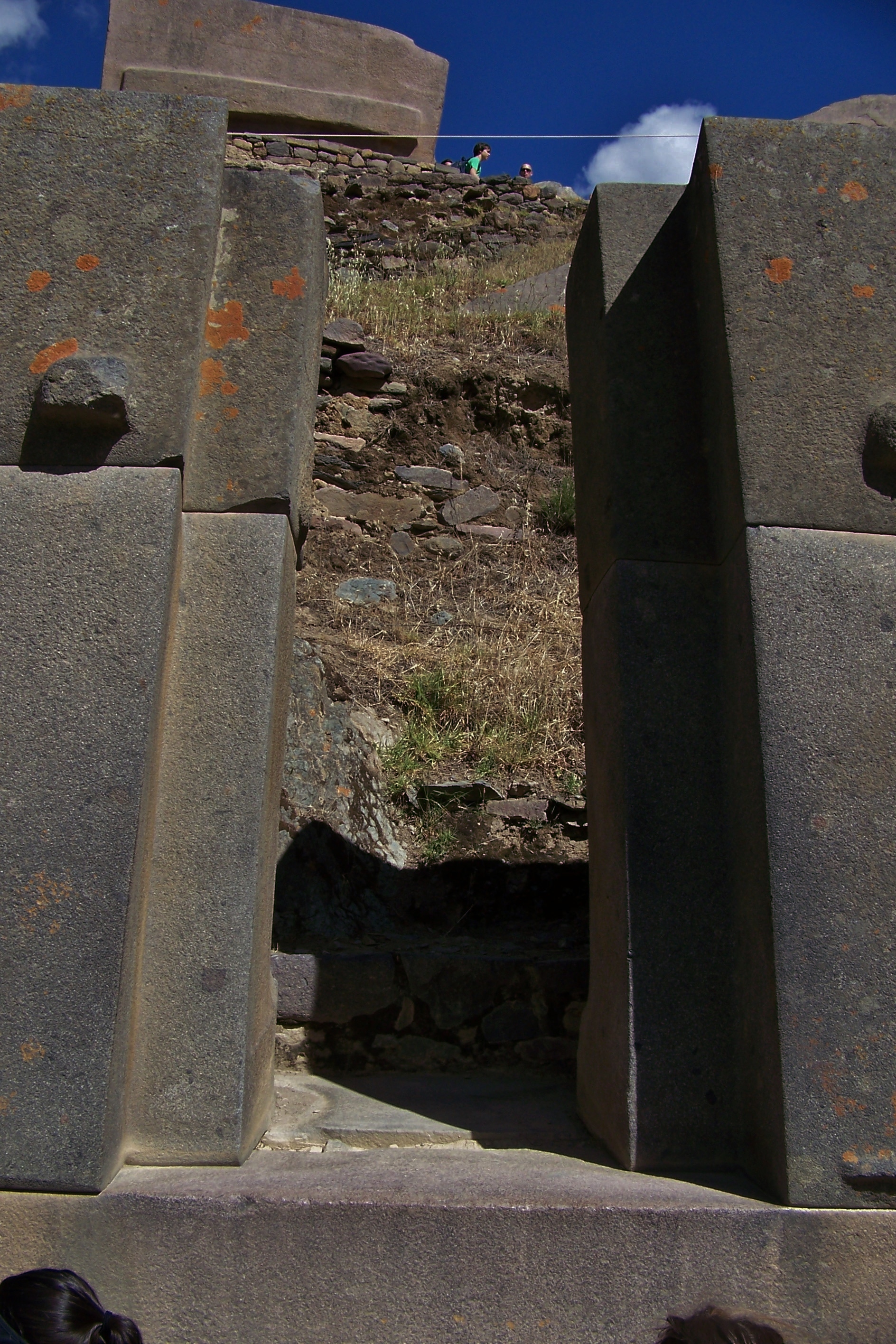
Unfinished Entryway

A Block left just short of its destination

The ancient way still practiced

No cement, no gaps, highly earthquake resistant, not eternal
If you care to come along I will explore another strand of this thought in the next Peru entry on Machu Picchu. Until then, blessed truth hunting.
Worthy of Worship
Posted in General, God Thoughts, tagged attributes of god, God Thoughts, Worship on July 2, 2015| Leave a Comment »
A blog titled this way could take many paths through Scripture and personal experience. This entry will only be an abbreviated sequence of thinking that occurred to me while reading about anointing oil and incense for the tent of meeting in Exodus 30 expanded with Scripture references.
God has appeared in the cloud and spoken to the sons of Israel from Mt. Sinai, scaring them sufficiently for them to plead with Moses, “Speak to us yourself and we will listen; but let not God speak to us, or we will die.” Exodus 20:19 But it did not scare them enough to serve the purpose for which Moses said that God spoke for: “Do not be afraid; for God has come in order to test you, and in order that the fear of Him may remain with you, so that you may not sin.” Exodus 20:20 The evidence of course is Exodus 32 when Moses is up on the mountain: “He [Aaron] took this [gold] from their hand, and fashioned it with a graving tool and made it into a molten calf; and they said, “This is your god, O Israel, who brought you up from the land of Egypt.” (v.4) The rapidity with which the Israelites turned away from God is both amazing and frightening, but it pales in comparison to what Aaron, the recently consecrated and anointed High Priest, did by way of directing and encouraging their sinful passions. There is much warning to be taken from this scene. Rather than a rabbit trail about our sinfulness, I see this as the fuller context for the comments I want to make about God.
God knew their tendencies and even warned them to watch out for them by giving them a scare at Mt. Sinai.
So what is God saying to us about worship of Him?
Is He ‘pleading’ with us to worship Him as though He will be lacking and sad without it. No, God is not in need of anything we possess or can give, as Psalm 50 says,“Hear, O My people, and I will speak; O Israel, I will testify against you; I am God, your God. I do not reprove you for your sacrifices, and your burnt offerings are continually before Me. I shall take no young bull out of your house nor male goats out of your folds.
For every beast of the forest is Mine, the cattle on a thousand hills. I know every bird of the mountains, and everything that moves in the field is Mine. If I were hungry I would not tell you, for the world is Mine, and all it contains. Shall I eat the flesh of bulls or drink the blood of male goats? Offer to God a sacrifice of thanksgiving and pay your vows to the Most High; call upon Me in the day of trouble; I shall rescue you, and you will honor Me.” (v.7-15)
Is He ‘expecting’ us to worship Him? In the sense of an expectation placed upon us I would say yes, but in the sense of surprised if we don’t, I think not.“You men who are stiff-necked and uncircumcised in heart and ears are always resisting the Holy Spirit; you are doing just as your fathers did.” Acts 7:51 “Nothing really changes; everything remains the same. We are what we are ’til the day that we die,” sang Larry Norman. God knows the true nature of our hearts. “But Jesus, on His part, was not entrusting Himself to them, for He knew all men, and because He did not need anyone to testify concerning man, for He Himself knew what was in man.” John 2:24-25
Is God “demanding” that we worship Him? No, He has left us with free will to the extent that we do what we always want to do, namely turn away from Him, for “All of us like sheep have gone astray, each of us has turned to his own way; but the Lord has caused the iniquity of us all to fall on Him.: Isaiah 53:6
Instead, I think the Scripture is saying that God is ‘commanding’ us to worship Him. He is worthy of worship, as Psalm 29:2 says, “ascribe to the Lord the glory due to His name”. Worship of God is also beneficial to the worshipper: “Sing for joy in the Lord, O you righteous ones; praise is becoming to the upright.” Psalm 33:1 “‘I will lead him and restore comfort to him and to his mourners, creating the praise of the lips.
Peace, peace to him who is far and to him who is near,’
Says the Lord, ‘and I will heal him.’” Isaiah 57:18-19 Worship trains the next generation for worship of God: “We will not conceal them from their children, but tell to the generation to come the praises of the Lord, and His strngth and His wondrous wondrous works that He has done.” Psalm 78:4
Give praise to God for Who He is; praise Him for the glory and efficacy of His name; praise God for His wonderful works in creation and beneficial works in salvation through His Son Jesus Christ.
Graduation Wisdom
Posted in General, God Thoughts, Poem, Sustaining, tagged God Thoughts, Poems, Sustaining on May 24, 2015| Leave a Comment »
About this time of year I hear well worn comments like these: “High school is the best time of your life; better make the most of it.” I’m glad that for many of us that is not true or we’d just end it right now. “Now you have to go out into the real world.” High school is real enough with its own set of challenges. “Now you can spread your wings and feel your freedom.” Yes and no. Some have far more license in high school than they should and little will change when they get out. All will continue to have constraints even if only by the law and many will have more responsibility and constraints than they ever have. So where is some wisdom that applies to all. That, of course, comes from the Scripture. For example, as I considered one relative’s graduation recently the following came to mind: “So do not worry about tomorrow; for tomorrow will care for itself. Each day has enough trouble of its own.” (Matthew 6:34) The combination of the ideas of today and trouble set me to thinking on how to give wisdom to this graduate. Following is my mean attempt:
Don't wish your life away
Looking for a better way

Don't fear difficulty
Vexing ambiguity

Don't shun caring embrace
To keep up with the rat race

Don't give up or give in
On false hopes your future pin

Hope instead in God's way
And through today's troubles pray

In His serenity
Find all your security

Care for others with grace
Taking time, slowing your pace

Fight temptation and sin
By God's power you will win
Overwhelmed
Posted in General, God Thoughts, Work of Jesus, tagged God Thoughts, Sustaining, work of christ on April 19, 2015| Leave a Comment »
The student asked a simple enough question:
Are you overwhelmed by life or overwhelmed by God?
You won’t be overwhelmed by life if you are overwhelmed by God. His mercy, grace, peace, and joy will reduce any care this world produces to a mere challenge to find more security, faith, provision, direction, peace and joy in Christ. His work on our behalf past and present and future is all sufficient. When I am underwhelmed by Him, having given in to the distractions of the world, then I am soon overwhelmed by life. The answer is not more effort but more trust, more focus on Him, more calling out, more resting in His work completed. Inhale more of Christ through His Word; exhale more of trouble in this world by prayer to Him. Make it as constant and automatic as breathing. Sure, you’ll get the wind knocked out of you now and then but that only causes you know more acutely the source of life. (source examples of rest: Romans 6:11, I Corinthians 10:13, Romans 8:1, Hebrews 4:11-16, Colossians 3:15-16)
Ebenezer Visits
Posted in General, God Thoughts, Remembering, Sustaining, Work of the Holy Spirit, tagged God Thoughts, Remembering, Sustaining, Work of the Holy Spirit on February 22, 2015| Leave a Comment »
A pastor friend of mine put this quote on Facebook that he had read from Tim Keller: “For most of us, God hasn’t become our happiness. We, therefore, pray to procure things for our happiness, and not to know him better.” Sometimes quotes are black and white, absolute, and I want to say, no, only sometimes and partially. So I started to respond to this entry but as I tried to think how to respond the depth of my own culpability increased in my eyes. Things procured may not always be material objects, and most frequently are not things I most desire or pursue. They may be accomplishments, comforts, accolades, encouragements, skills, health, entertainments, work, love, a sense of purpose, and so on. They are not knowledge of God. Neither are the bad in themselves, used as tools for knowing Him and making Him known, but I don’t frequently acquire them for that reason. So I retreated from responding to the entry, but the impact of the statement would not fade. I have resolved by the Spirit to confront such idols in the past.
As these thoughts mulled over in my mind I was reminded of the verse in the hymn that goes, “Here I raise my Ebenezer, hither by Thy help I’m come, and I hope, by Thy good pleasure, safely to arrive at home.” The Ebenezer comes from a text in I Samuel 7:8-13: “Then the sons of Israel said to Samuel, “Do not cease to cry to the Lord our God for us, that He may save us from the hand of the Philistines.” Samuel took a suckling lamb and offered it for a whole burnt offering to the Lord; and Samuel cried to the Lord for Israel and the Lord answered him. Now Samuel was offering up the burnt offering, and the Philistines drew near to battle against Israel. But the Lord thundered with a great thunder on that day against the Philistines and confused them, so that they were routed before Israel. The men of Israel went out of Mizpah and pursued the Philistines, and struck them down as far as below Beth-car. Then Samuel took a stone and set it between Mizpah and Shen, and named it Ebenezer, saying, “Thus far the Lord has helped us.” So the Philistines were subdued and they did not come anymore within the border of Israel.” The translation of Ebenezer is a “stone of help”. It is a monument raised by someone to remind them of help that God has given them. It is very easy to emphasize the act of raising the stone or the resolve that went into the help afforded but that is a totally man-centered dead end. God thundered and confused the enemy and routed and weakened to be struck down. Israel was active: pursuing, striking; Samuel set up the stone, but God did all of the heavy lifting and enabled all of the victory. So too in our victories over the temptation “we are destroying speculations and every lofty thing raised up against the knowledge of God, and we are taking every thought captive to the obedience of Christ,” (II Corinthians 10:5) by the enabling power of the Spirit.
At my age and stage of life I have set up more than a few Ebenezers in field of battle. “God is our refuge and strength, A very present help in trouble.” Psalm 46:1 I know His help, and I know how to call on Him, but in many smaller skirmishes and encampment quarrels and disease I am in great need of revisiting an Ebenezer set up where God enabled victory over evil thoughts, or the other one where victory was won over sluggish spiritual discipline, or yet another one where pride of accomplishment and tendency to show off was overcome. And on it goes. I need to take every thought captive by the power He provides, set up monuments to remind me of His victory and what was won, know Him more, and revisit those “stones of help” before or during great or prolonged battles.
 CreatorWorship

Has the World Really Changed?
Posted in 9/11, Cultural commentary, General, God Thoughts, Remembering, Why?!, tagged 9/11, Cultural commentary, God Thoughts, Remembering, Why?! on September 11, 2016| Leave a Comment »
Early in 2001 my father passed on to the next life after a slow decline resulting from many and various ailments. I believe that it was a grace that he passed without knowing of 9/11. He fought in WWII receiving a bullet and multiple pieces of shrapnel near the German border. Every 4th of July he would hang a copy of the Declaration of Independence and an American flag on the living room mantle. As the years went on he added more evidence of his love of America and its freedoms, things like a small Statue of Liberty. I used to think how much the world changed during his lifetime. Afterall, TV had not been invented when he was born in 1922. Polio was a major killer; the War to End All Wars was a fresh scar; the roaring twenties had not succumbed to the Great Depression. During my formative years airplanes, bridges, skyscrappers, atomic energy, and space travel were among the top of the list of items and ideas that he talked about and learned about and visited. How the space race had resulted in a handheld calculator was amazing to him. The world had changed so much in one lifetime.
Now we hear that the world was forever changed by 9/11. In one sense, of course it was! We collectively look over our shoulder as a nation, wondering when or if it will happen again. But did it really change the world? Hasn’t every generation had at least one event that so penetrated the minds and hearts of the populace such that each person knows where they were when it happened? If you are old enough, do you remember where you were when JFK was assassinated? For my father’s generation the event that riveted their attention was Pearl Harbor. News traveled much slower the further back you go but there were terrors and plagues and perplexities for centuries. In 79 A.D. when Pliny the Younger described the flaming bombs of Vesuvius sinking ships in the harbor off Herculaneum while Pompeii was covered in noxious gases and pyroclastic flows, the world must have seemed to be at an end.
Do I attempt to diminish the severity and pain of 9/11? Do I not see the ways in which it changed how we do freedom in our land? By no means. But the cause of terror and pain has not changed. Because of sin there is stark evil and natural disaster in the world as there has been since the Fall of Adam. These adversities should call us as a nation back to God. We deteriorate; our nation’s demise is at hand, yet we see 9/11 and Antietam and Hurricane Katrina and Pearl Harbor as totally disconnected from our spiritual condition and God’s call to repent. Evil exists in the world because there have been and are evil people in the world. We must confront the evil in ourselves so that our enemies have no excuse for their evil acts against us and we have no compunction about attacking it when it comes.
I remember where I was on 9/11, watching the screen in my classroom as the first building hit earlier was burning and as the subsequent one was hit and the towers collapsed and students came into my room who wanted someone to make sense out of the chaos. In those first moments during my planning period before that screen I prayed that God would have mercy upon us as a nation. In many respects He has and He is but we must cry for it and act in ways commensurate with receiving mercy now more than ever because we drone on in our mundane, garden variety evils as if 9/11 never happened. God have mercy on us!
The world has changed but not so much.
Read Full Post »