Feeds:
Posts
Comments

Archive for the ‘Random thoughts’ Category

I wanted to take a walk and others I usually walk with were occupied.  So, I decided to be random and go off of the paved trail, take my camera, and see if there was anything worth seeing.

What might be seen or smelled after a snow melt?

A few others had a similar idea.  Snow on the ground for a full week is rare here so we have a desire to get outdoors, even if it is muddy. Not really knowing where I was

Wonder who went along this field's edge?

going, I followed some tire tracks past a “Do not enter” sign, meant for vehicles I’m sure since it exited a parking lot.  I was still wandering what I might find that really interested me.  The sky was bright which hadn’t happened in several days, but my eye was caught by what was to the right of the path. 

OK, in the title I exaggerated for effect. It was really a channeled creek because ditch is defined as “a long, narrow excavation made in the ground by digging, as for

Channeled Creek

 draining or irrigating land; trench.” (dictionary.com)  Webster’s also defines natural watercourses of the same general shape as ditches but that confuses things signficantly. It does make a difference and can cost money and headaches as many a contractor can tell you. Frequently creeks are channeled with bulldozers to drain wet areas or reduce the space the creek uses.  In the link that follows a contractor has to follow costly rules because of history and definition, which are mentioned in the article.  (http://http://www.kitsapsun.com/news/2008/mar/11/stream-or-ditch-county-says-phinney-creek-is-the/)  How dominion of nature is to be practiced should be a subject for another time but it should matter to us all since it effects what we are responsible to steward and effects us directly as well.  So here I am. Is there anything of beauty or interest?

Cat-tail

The cat-tail suggests abundant moisture in the summer, but looks a bit strange to my sight framed in snow. 

Grass or water plants?

But if what was growing under the water was grass this is just a ditch that is flowing now because of snow melt rather than an all weather creek.  Which is it? The evidence of continuous moisture suggests that it is no ordinary terrestrial grass. I tried taking pictures of several tadpoles and fish (ranging from small minnows to perhaps 4 inches), but alas they were fast.

Rabbit tracks?

Some things that are fast may be recorded by other means.  The one at left was on snow above ice frozen on the water course. The one at right was more obvious as to its owner.

Raccoon track

At several places the small trees arched over the creek. Under one I thought as I approached that I saw blood.  But alas my imagination got the best of me. They were berries from a vine in a tree overhead.  Some will sprout where they lay and others will wash out during a storm event.

Place seeds in the freezer for better sprouting

There was far more evidence of human disturbance on the site than I am showing.  Some were careless and even abusive of the land resource and others were management that allows nature and urban small town to co-exist.

Growth rings

How many rings do you count? The little star pattern at center of the wood is curious.  The cutting must have been recent because there is no bleeding out of resin or darkening due to weathering.  At about halfway down the water course I started seeing these anchors.

Anchorage= net force of zero

Just above the bones and brown bottle deposit was a five foot diameter sewer line that ran above ground for perhaps 200 feet. That’s the reason my pictures focus close at hand. I was looking for life and beauty and sometimes that takes focus.  Speaking of focus, sometimes I almost want my analog camera (read “film camera”) back because this high end point and shoot digital focuses where it will and I missed a Tufted Titmouse taking a bath in the creek. He, yes feathers were bright blue, was quite frisky and twirpy (Hey, Shakespeare made up words and so do

Chicken and brew

Deposits of various colors

 tweeters on Twitter.) 

White Clay

 There was evidence of exposed soils and leeching as in this iron deposit seep with a blue feather (Titmouse or Bluejay?) fallen in its middle. Further downstream I spied a deposit of Potter’s clay in the bank and under the ripples.

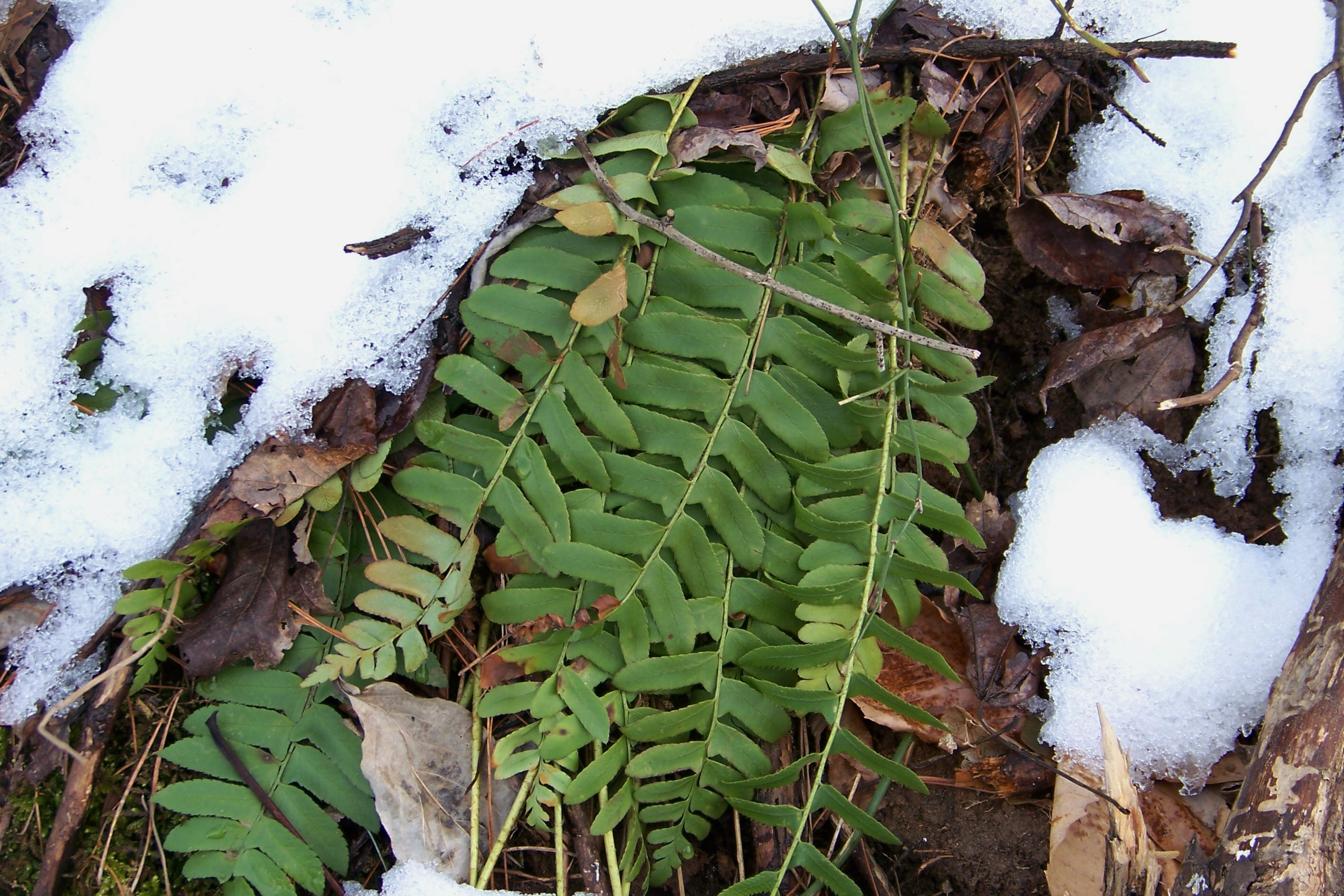
Polypodium- Resurrection Fern


This is an appropriate name for a fern

????

that is growing out of a bank and out of the snow.  Oh, I wish I knew more plants. The red berries are on a plant that grows as hedge in many people’s yards.  Red berries seem to be more abundant and bright on vine and holly and so forth this year.  What causes that?    Then the creek went under the paved path and there was life here, too, in the form of  Mud Daubers’ nests. They paralyze prey to be eaten by immerging larvae. 

Mud Dauber Nests

The other side of the pipe had a more natural watercourse winding with small sand bars and deeply  cut banks down to the river.My commentary has gone too long but my short walk down the creek revealed much to see of beauty and life even in winter on a disturbed site.
After a look around at the river I crawled back up the bank to the paved path for a short walk back to the car. I was thankful that a small detour would bring such variety of things to feast the eyes and soul upon, because I know the Maker of all the little details Who delights to show us His creativity if we will but search for it.

Less disturbed mouth of the stream

May God teach us how to enjoy and utilize His Creation to His glory.

Ah!

Observation Deck over the River
We may enjoy, utilize, and care for what the Wise Creator has given us to take dominion over. Dominion does not have to mean abuse and conservation does not have to mean locking away all that there is from use. There is a middle ground that I believe is both biblical and prudent.

Ouch!

Read Full Post »

When I was a child my father owned a National Geographic book about… well, I don’t exactly remember. However, I do remember the inside cover painting, one similar to the one below, though linear. It also based its unit of measure on the height of man, a markedly humanistic approach which at least has merit because it compares all else to something we know.  Notice that the exponents range from a mere -15 to 25 and yet this nearly emcompasses the entire known range of size in the universe (the universe is above 10^25 and elementary particles or strings (Do they have dimensions?) are below 10^-15).

Source: http://www.astrobio.nau.edu/~koerner/ast180/lectures/pic/cdrom/art_low-res/es01/figure-I-03.jpg

I loved numbers and making connections so this painting was the source of contemplation and imagination for many hours. I liked the idea of numbers and size relationships so much that one time while carrying English ivy that my father was trimming along the driveway, I asked him what the largest number was.  He replied that it was similar to an eight turned on its side. I didn’t figure out for years that this was the infinity symbol (∞). Sometime near the end of elementary school I decided to write my numbers as high as possible. Was I trying to write to infinity, or some highest number, or just a very big number? I have no idea, but frequently the young are too idealist to notice the possible failure rate of poorly laid plans. I also know that author John Piper says he believes we are drawn to bigness in its various forms because we are made in God’s image with an ability and afinity for seeing the beauty of God which we cannot clearly see at the moment. At any rate (or perhaps a specified rate within limits of one factor of ten) I had one of the old large rule writing tablets with dotted lines for teaching beginners to write their letters. I would write each number interval of 100 on a page. I don’t now know where I stopped but I do remember it was over 10,000.  Obviously these antedotes mean that I was (am?) silly, but they also partially introduce why I think “order of magnitude” thinking is important and partly explain how I know it is largely missing in education. When students crunch numbers on calculators they mindlessly accept what number it spits out not considering that perhaps they put in inappropriate numbers or incorrect key strokes. You may not immediately know what 1,549,000 times 361 equals but you should be able to know that 55,918,900,000 is not the answer by inspection because it is two orders of magnitude (100x) too large. You may not know a comparison between miles per hour and meters per second but if I tell you that a person walks at 1.5 meters per second you should be able to tell that any normal car is not likely to be traveling at 150 meters per second (unless transported to a war zone in a C-5A perhaps). If this rambling of childhood memories in any way spurs you on to consider at all or again powers of ten or orders of magnitude I have included a fun link that is useful for imparting the concept as well as firing the imagination. Enjoy it and share it with some young person who needs an introduction to magnitude so that their future answers might at least be in the ballpark.

 http://micro.magnet.fsu.edu/primer/java/scienceopticsu/powersof10/     (As I understand it I may not link this site for copyright reasons but you may go to the site by copying and pasting it into your address line. Enjoy!)

Read Full Post »

As time passes I seem to have more, not less, on my mind than I can bring to the front burner and cook. I have so many incomplete questions and thoughts that sit on back burners and in warming alcoves that some will spoil before they ever get cooked.  Rather than a source of discouragement it reminds me that there are life times of ideas to explore in God’s person and works and I shan’t ever get bored  in this one. And it encourages me also that my mind is more active, albeit somewhat slower, than at earlier times, so that I am confident of God’s continued work in my heart and mind.

After college and some number of years of self study in “true science”, unbiased by evolutionism and naturalism (OK, highly and proudly biased by biblical thinking- what of it?), I had come to the conclusion that naturalistic thinking had only two difficult to confront evidences against 6-day Creationism. The first was radiometric dating which gave a clear cut way to measure time since the formation of rocks.  After years of study and a number of different evidences to the contrary, I feel confident in saying Creationists have overcome this difficulty. Polonium halos forming is less than three minutes in granite, the possibility of additive or subtractive contamination in parent and daughter isotopes, evidence for changing decay rates in carbon-14, and most significantly the absence of large amounts of helium from the alpha decay in the uranium series strongly suggesting the youth of the rocks (Don DeYoung’s Thousands . . .Not Billions (Master Books, Green Forest, Arkansas, 2005)) have given sufficient alternative evidence and explanation of this phenomena to render great age unneccesary.  The second difficulty I saw was distant starlight as inferred from redshift data. How could the universe be less than 10,000 years old if starlight had been coming from stars for millions and billions of years? The “appearance of age ” suggestion by some Creationists was never satifactory to me since it means practically that Christians could always retreat to a “miracle” to answer unanswerable questions. Now don’t get me wrong. I not only believe God has but does interfere with Nature for His purposes to accomplish great and actual, albeit rare, miracles. But if God is the God of order and reason then His Creation reveals Him and His work in reasonable and orderly ways, though incompletely without Scripture. And though I much prefer correct explanations, that is not the main point of giving a reasonable explanation, for we can no more know if our scientific explanation is right than can the Naturalist. Sorry, it is simply the limited nature of science. However, we now have a reasonable and convincing explanation for the “starlight problem”. And as such Naturalistic explanations are unneccesary. This fact does not mean that my faith was weak before and stronger now. God said it; that is all that matters, but since I was not created with fins or scales, I get tired swimming upstream in this Naturalistic culture. A little slowing of the downward current on occasion is pleasant . It turns out that the explanation is a matter of relativistic perspective. Einstein chose a convention (rule of thumb, reference frame, or perspective if you like) that was useful and convenient for his mathematical and scientific thought experiments but is not required. Einstein was concerned with observers at different locations. In order to retain this perspective he had to consider them going at the same velocity in the chosen frame of reference. If instead the location of the observers is forfeited so that they are at the same location then the velocity may vary. The result is a new definition of simultaneous that matches the Bible’s explanation for how starlight arrived at earth on the same Day Four that it was created. For considering the age of the universe, the author argues convincingly from evidence that Einstein’s convention is not the correct one. If you are neither faint of mathematical or logical thinking you may like to read it as well:   http://www.answersingenesis.org/articles/arj/v3/n1/anisotropic-synchrony-convention    Even though I cannot revel in a complete understanding of every detail it adjusted my perspective by comparison to a new one and that is pleasant.

Read Full Post »

Genuine boards on the new bedstead

Pass me the….the….board?  It was a 1/4 inch thick by 10 inch by 12 foot piece of fiber-cement siding.  It beats vinyl siding all over the place for looks and durability.  But in stumbling over what to call it I was reminded that name and form and similarity of a thing to the actual item does not mean it has its substance.  Such are many in the church and the world:  “And he said to them, “An enemy has done this!” The slaves said to him, “Do you want us, then, to go and gather them up?” But he said, “No; for while you are gathering up the tares, you may uproot the wheat with them. Allow both to grow together until the harvest; and in the time of the harvest I will say to the reapers, “First gather up the tares and bind them in bundles to burn them up; but gather the wheat into my barn.”” (Matthew 13:27-30)  “Then you will begin to say, ‘We ate and drank in Your presence, and You taught in our streets’; and He will say, ‘I tell you, I do not know where your are from; depart from Me, all you evildoers.'” (Luke 13:26-27)  How should we react to such a word?  Test yourselves to see if you are in the faith; examine yourselves! Or do you not recognize this about yourselves, that Jesus Christ is in you- unless indeed you fail the test?” (2 Corinthians 13:5) for “Not everyone who says to Me, ‘Lord, Lord,’ will enter the kingdom of heaven, but he who does the will of My Father who is in heaven will enter.”  “For this is the will of My Father, that everyone who beholds the Son and believes in Him will have eternal life, and I Myself will raise him up on the last day.” (John 6:40) What is the substance of your heart, a believer saved by the grace of God exhibited on the cross by the death of Jesus to take away your sins, or a believer in name and assuming the form of a believer though not actually ever having had an experience with the living God? “Examine yourselves!” Are you the actual item, wood all the way through (as opposed to cement, or cork  (any baseball fans?), perhaps), or do you only bear the shape and name of the same?

Read Full Post »

The very idea of knowledge has many fascinating angles. Four examples are the wonder of discovery (Hey, just think, that old person with dementia that you feel so sorry for is really very happy because of their new discoveries each and every day, even if they are just old ones rediscovered), the satisfaction of knowing (This doesn’t have to be arrogance or pride but can be refamiliarization of an old friend, like when I eat a good peach knowing beforehand that it will be good and confirming afterwards that it was as it should be), the humility of not knowing, and the “need” to know (OK, desire to know).  For example, the other day another teacher sent several students to me with a catch they had made behind the school assuming that I was the resident spider expert.  They would only accept a quick answer so I gave one, “Wolf spider.”  I said that I was interested in looking more closely at it and satisfied, they agreed to leave it with me.  Lycosidae is indeed the family of “Wolf Spider” and I thought it would be interesting to key it down to genus or perhaps even species.  So I got out my page-darkened “How to Know the Spiders” by BJ Kaston and began keying from the beginning.  But I couldn’t get to Lycosidae.  Oh well, thought I, I’m abit rusty.  I’ll go straight to the Lycosidae family key and continue.  Try as I might every attempt ran into a dead end.  I Googled terms to get me back up to speed; I worked backwards from supposed possibilities. Perhaps this had been a bit longer ago than I thought.  Then I thought to go back and read the family description. The eyes of Lycosidae are recurved and of two different sizes. Oops, this spider definitely had eight eyes of almost identical size in two straight rows.  Now I was experiencing knowledge-based vertigo, disorientation.  Oh well, the only other similar spider family is Pisauridae, “Nursery web spiders”.  They are fequently hunters as the wolf spiders and therefore do not build webs, but I did not remember any of that family being so big.  The females build a web around the egg sac and keep watch to protect it.  Before this they carry the egg sac in their chelicerae (the projections that hold their fangs) whereas the wolf spiders carry their egg sacs with their spinerets (other end!).  I promptly keyed the spider out to Dolomedes vittatus, Fishing Spider. I definitely had a female and probably pregnant.  The males have a white band down the center of the carapace and around the margins of the same.  This speciment was dark brown with tan spot on its abdomen.  These live near streams and catch insects, spiders, and occaisional minnows!  I enjoyed discovering the true identity of the spider.  The realization of what I did know that enabled me to discover this and the use of a once well-worn key, the humility of having been wrong reminded me of how little I know compared to others and the many things only God knows, while the “need” to know drove me on to discovering the identity and habits of a backyard neighbor.  Enjoy the pictures.

Dolomedes vittatus, Fishing Spider

Some people call it too much time on your hands, but being a good teacher involves a continued love of knowledge and a solid knowledge base.  Modern educational theory rejects knowledge base as no more than a trivial side light, emphasizing the art and practice of teaching.  Without diminishing these I submit that students want teachers that know something.  It takes time and effort.

From the Kaston "Spider" Key, female on the right

The author of knowledge and wisdom must enjoy us obtaining it in whatever respectable form.  To Him be the glory!

Read Full Post »

If the students at the school where I teach selected me to be their faculty speaker at graduation, here is the speech I would deliver to them.
    Class of 2010, congratulations on the progress of your education to this point of graduation from high school.
Congratulations to your parents and relatives and friends who have loved you and encouraged you and helped you to this place and time.
    As you mark this occaision and move on to other pursuits I would like to look back and review with you some lessons I believe you should have learned in school and look forward to apply them to wherever you may find yourself….
[details in the next post….a list of the topics here]
1. Life is full of tests.
2. Integrity is the glue of society.
3. Atoms are real but cannot be touched.
4. You cannot touch without being touched.
5. Bored is not a circumstance; it is a state of mind.
6. The scientific method is a useful tool in everyday life.
7. The speed of light is constant and so are many other things.
8. Proper grammar is useful for your progress.
9. You are more than the sum of your parts.
10. History does not repeat itself; it is linear.
I can’t much imagine being asked to speak but if I did are you curious about what I’d say?

Read Full Post »

My family and I have watched a 12 part BBC series on the Charles Dickens comedy Pickwick Papers.  Many scenes are funny and others sobering.  And since it is evidently true to the book, I could recommend either.  Without giving away the story, there is a despicable character named Mr. Jingle whose oddity is speaking in one to three word phrases with dramatic intonations and short pauses.  There is a complete economy of words and yet a rich and clearly understood meaning to all that he says.  I do not encourage his actions but his speech compels me to want to learn this mode.  While reflecting on this speech the other day I attempted to write a poem in that form.  I will know if I have succeeded if you understand the poem.  If you know the subject about which the poem speaks, comment your knowledge below:
 
Temptations rife
Hazard all
Indiscretions, fall
Shame, strife
 
Blame wife
Cover all
Oh the gall
Death not life
 
Pay the fife
Lost all
Darkness fall
Sorrows rife
 
Took the knife
Once for all
Order tall
Gave us life

Read Full Post »

One of the ways that God has given us to communicate with people is through words.  Body language and acts of kindness, hatred, or neglect are other ways.  Not only kind, encouraging words, but constructive criticism words and instructive and insightful words that build someone up and demonstrate concern are helpful.  As the Proverbs say, “Anxiety in the heart of a man weighs it down, but a good word makes it glad,” (12:25) and “A man has joy in an apt answer, and how delightful is a timely word,” (15:23) and “Faithful are the wounds of a friend,” (27:6) and “Heed instruction and be wise,” (8:33) and “the tongue of the wise brings healing,” (12:18), and “he who forsakes reproof goes astray,” (10:17) and many more good words. 

But I have observed that though the eargate be open and the volume be sufficient and distractions be few, many good words are not heard.  In fact, the emotional baggage and relationship histories can shut a mind down to where it not only refuses to accept good words, rejecting them or twisting them to have some nefarious meaning or intentions, but such a mind can deny before witnesses that the words were ever spoken.  Though this is an amazement to me, I have both observed it and commited this crime of unkindness to the speaker.  So, I am resolved to hear better and attribute intentions as purer to words that are of benefit to me while understanding that discouraging or untrue words may well come from a speaker who does not fully understand the source of their own intentions.  To this end I have composed a poem:

What is the need for a stern word
From loved ones, colleagues, or stranger
A cautionary note not absurd
When it rescues one from danger


What is the use of a taught word
Is it something you need to know
Keep you from running with the herd
Help your mind continually grow


What is the goal of a wise word
Of discernment that penetrates
So that on your life you may gird
Tools for living, such worthy traits


What is the help of a kind word
With regular sincerity
Just like a beautiful song bird
A seasonal sound rarity

Read Full Post »

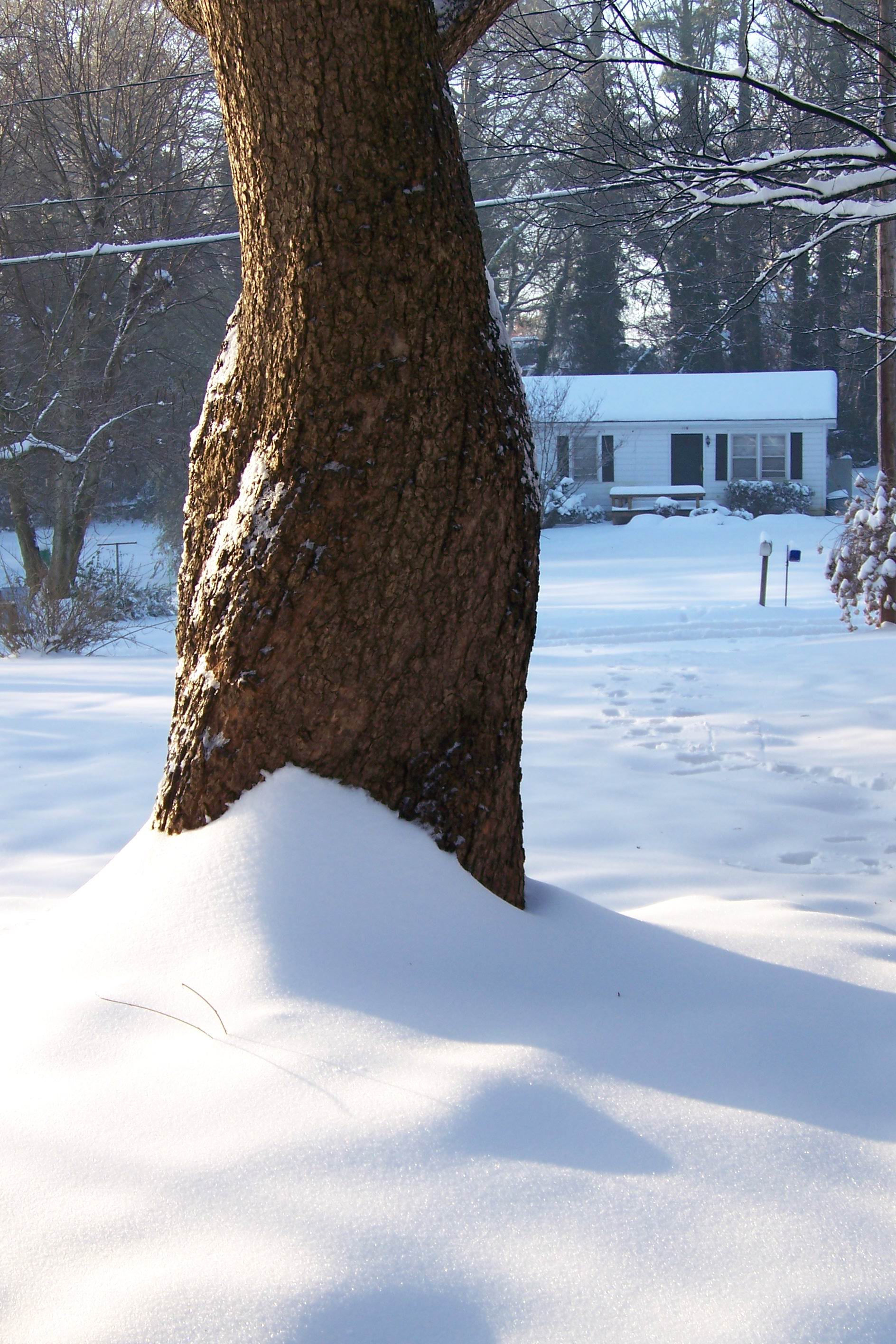
It was one of those “around the end” weather patterns that bring us the big snows.  When we more typically get a front come over the mountains, because we are in the lee, most of the snow is shed on the Tennessee side and in the mountains.  But when the cold comes over the mountains and the moisture comes from the Gulf by way of a low pressure moving around the southern end of the Appalachian chain  then near to shore or across the coastal plain, watch out.

Catalpa Drift

I went out this morning to take pictures before the temperature began to rise and the foot and road traffic began to obscure the beauty.  I discovered last evening while taking a 4 mile walk with two of my sons that they prefer frolicing while my disposition of years causes me to prefer soaking in the beauty.  The storm, of course, reminds us of the ’93 blizzard, and from a localized perspective it may be apropos in places, but the snow is nowhere near as deep and the extent of the storm does not compare.  Still it will be a snow to remember and my youngest son just saw his first 6+ inch snow of his young life.  It may have caused me to start my school break 3 days early.  If the temperature stays low enough to preserve some snow or cause icy spots on the road, we’ll stay home.  I have no lack of reading, writing, and chores to keep me busy.  Snow presents multiple opportunities for pursuits not otherwise available.  It is one of the

The evidence

 pleasures of snow days:  Time spent with family, varied activity, exercise, rest, and memories. The mystique surrounding a snow may have more to do with what else happens because of the snow rather than the snow itself.  But on the otherhand snow is refreshing to the soul and few there are that don’t get excited at its sight.  I am thankful to God for the timing, its beauty, a warm dry house, and family to enjoy it with.  I hope people are finding shelter and being prudent about travel.  I think I’ll continue my snow day activities and hope yours are pleasant to you.

A Snowball Bush

Read Full Post »

Just a Thought

        During a few sleepless moments last night a nebulous concept began to condense into a question within my mind.  What is the basic unit of a thought?   Or to put it another way, of what is a thought composed?

          In order to communicate the complexity of the question as I am considering it fully awake let me begin by relating an analogy.  As a Biology teacher at present, I teach students many parts or units of structure and function.  One example is the protein.  The protein is the basic unit of function for accomplishing tasks within a cell.  A protein is twisted into a specific shape that enables it to function properly because of an exact sequence of sub-units called amino acids.  Imagine a necklace of differing color and shape of stones all tangled up as it sits in a jewelry box.  But the amino acids have parts called atoms and atoms are made of smaller parts yet (Being an analogy I will leave it to the nuclear physicists to parse quarks and strings, and energy, what ever that is.).  Which part or piece is the basic unit?  Is it the smallest part or is it the association of parts that function as a unit?  Is it the atom that makes up the protein or the protein that functions as a whole, or is it the amino acid of which the protein is composed?

          An example of a ……. an idea might help.  Several days ago my wife and I were taking a pleasant and brisk walk on a cool evening in our small town.  As we approached an intersection near the town square someone passed us.  As I squinted in the evening sun I caught a whiff of cigarette smoke.  Now I have smelled cigarette smoke in many contexts over my nearly 50 years but at this moment I was immediately translated in mind to the pavement, crowds, rides, sounds, and sights of the Tennessee Valley A & I Fair in Knoxville, walking beside my father as a child.  I have heard that odors constitute the most thorough associations and memories and, by the way, I would not have thought any good association would be in my mind from tobacco smoke.  Was the TV A&I Fair-cigarette smoke complex a thought or was the cigarette smoke the thought that drew along in its vapors many rapid fire associations?

          If thought is as simple as a transistor switch on a microchip where one state results in an “on” switch and the other state results in an “off” switch, then the basic unit of thought is the most simple differentiation of this but not that, black not white.  But perhaps thoughts must need to be a functioning unit to exist or be remembered or be used.

          At some point in time a young child discovers the concept of two.  Perhaps his mother was carrying him to the bathtub for his Saturday evening bath.  The procedure included her handing him his yellow rubber ducky.  He gets so excited about the bath that she can hardly hold onto him.  Because this procedure is a time honored tradition in the family, the pair pass his older brother coming out of the bathroom, wrapped in a towel, carrying his yellow rubber ducky.  He squeals and raises his ducky toward his brother’s who reciprocates with a tap of the two toys together.  Having made this discovery, is the thought of “two” (of course devoid of word or Arabic numeral or math at this point) a complex association of bath, brother, mom, ducky, and so forth, or is it a mere recognition of two duckies?  It seems as though “two” generalized to number of siblings or number of dissimilar toys is a future and further association which may amend or truncate or revise “two”.  But is the thought of two from that point in the subconscious mind of this man a reflection on the set of associations surrounding rubber duckies or is it a continually revised concept that is both increasing in complexity by associations and simplified in the basic idea of what “two” is?

          Is the basic unit of thought static or dynamic, a complex association or a singular point?  And despite the consternation of the materialist is the complexity of thinking a suggestion that the whole is more than the sum of its parts?  Is there any suggestion from these musings or deeper study that thought has a deeper Source than chemical reactions, associations, and natural selection?  Just a thought.

Read Full Post »

On the hallway wall next to the door is posted “Room 417 Storage”.  In this fairly new facility it is used as an occasional office.  The majority could not tell you where it is or for what purpose it is utilized.  I was assigned to sit in silence in Room 417 with three other people for two and a half hours.  I’m a teacher; you figure it out.  Here are my impressions of the space, the activity, and our path.

In a claustrophobic room
Painted white no decor there
Neither flower nor mind could bloom
Though florescent lights and vented air


 White noise from conditioned air
Abundant plastic, metal too
Nothing the senses would find fair
Though clean and bright and also new


Sanitized of all that harms
Disease, sharp corners, tanning rays
Not a thing the spirit alarms
Though emergency exits map ways


Thus the danger to our lives
All is well but dead inside
No awareness that life never thrives
Except in Sonshine and change of tide

Read Full Post »

Physics is the way to go
Or stop or go with the flow
Or at least know how it works
Like impulse of bumps and jerks
Who cares may be your question
Each action has reaction
Energy conserved as well
Even if you cannot tell
Not effect your life you say
Neglect it and you will pay
Efficiency or power
Safety of bridge or tower
Go away leave me alone
Please change frequency and tone
Add net force and head for home
Physics guide you as you roam

Read Full Post »

During D’s Christmas break, he, P, and I went to the Linville Gorge here in our county . Well, I had a bushwhacking in mind, knowing the gorge much better than in previous years.  We went atop the ridge, down a narrow cut between 300 foot cliffs, waded the river without mishap, went upstream, waded the river with some small clothes wetting, and started up the ridge.  The uphill was so strenuous that the clothes wetting and near-freezing temperatures were no problem.  Then began the adventure.  With the shortened hours of winter pushing us, we tried to find a trail I had never been on, though marked on the map.  We didn’t find it so we started up the side of the ridge, a very steep talus field.  From the bottom we could see that it would not be hard to avoid confronting a large cliff in this section so we pushed on confidently.  About halfway up we encountered the remains of a forest fire from about 5 years ago.  No, it’s not what you expect.  The downed pine trunks were thick and thicker still were the 4 year old saplings, about wrist thickness diameter, a foot to foot and a half apart and 6 to 8 feet tall.  The going got extremely difficult, steep upslope, flexible but stiff trunks to push through, and intertwined trunks in varying degrees of rot at waist or chest deep.  The way back was not an option with dark, potential wetting, and significant distance further to go.  The way forward seemed unassailable.  I knew we simply had to make the ridge and trail by dark, though it was obvious there was a goodly hike from there to the truck in the dark.  The guys quieted down to the labor ahead with only occasional exclamations of amazement at how laden with traps the way forward had become.  We reached the ridge as the last orange glow of sunset faded.  After a quick rest we began a long, quick-paced hike out, but the adventure was far from over.  Soon I had to don my head lamp, in recent years a necessary part of any hike, day or overnight.  We surged forward, but had to rest soon after the exertions of the entangled climb.  We got up and went on, noticing that we had a curious view of an adjoining valley we did not expect.  Yes, it was dark and so far moonless, but the lights in the valleys were as jewel-like as the stars. The ridge ran over to the left and the trail began to descend.  I began to have misgivings out loud but continued on.  D stopped us and explained why this could not be the way.  We turned, emotionally fatigued by the setback.  At the point we had stopped to rest we discovered the trail had taken a 180 degree switchback.  The trail we had started down, after inspection was the other end of the one we sought to find at the bottom of the gorge.  We rushed on through open forest across the top of the ridge, up and down.  After traversing a deep gap we were to come on top of a wide-backed, straight and level ridge before a steep drop to the truck, perhaps a mile and a half left.  Soon after we reached the top of the ridge we came upon our most mentally trying difficulty.  A more recent forest fire had totally decimated the landscape (we have suffered extended, several year drought which only in the last month did the NWS say was over).  There are scatter boulders, but otherwise large areas were ashen and very moon-scape in the starlight.  Nothing appeared alive and no remains of plant material was more than knee high.  The soil was almost entirely eroded into ash flows with 100+ yard lengths having no evidence of trail.  Then brush would obscure what indention in rock and gravel suggested the remains of trail.  There is a 300 foot cliff on the right and a long slope that extends for miles through National Forest on the left.  The way is forward.  I would have the guys stand at the last perceived semblance of trail while I searched the scorched landscape for evidence of the way forward.  When I found what seemed to be the way I would call them forward.  After a 1/2 mile or so intermittent areas of unburned forest would arise with definite trail and even blazes on trees, only to be followed by burned out moonscape again.  The temperature was dropping into the mid-twenties and the wind gusted hard in the bare places.  I was thankful for the cool heads of my guys and the seemingly strong headlamp.  Finally we came to the small, tree lined bog that marks the 3/4 point of the ridge.  From here on the forest was thick until we came back to our full circle and the way down where the older fire had ruined the now slowly returning south exposure pine forest.  To say we were exhausted seems trivial but we were also thankful.  P managed to get a cell phone call out (rare on this ridge) to say we were safe and don’t send out the rescue squad.  P has not been hiking since, nor has D but he has lacked opportunity.  I was very thankful for God’s watchcare over our adventure and my unwise choices.  It was an adventure to write home about and probably to give the old man a hard time over in future years. Did I learn anything?  That depends on who you ask.

Read Full Post »

Which way?

Coming?  Going?  Staying?  Wandering?  So am I.  Read my poem about getting there.

Direction to choose the prong of the fork

Go right, go left which is the course

The pressure builds like a drink under cork

Your will be the compelling force                     


Pace to follow Your path without delay

Speed up, slow down how do I race

The course is unknown must not lose the way

Following close behind in step with grace


Destination to find, oh lead me there

Start here, stop there where is the place

Seems lost from sight the next step I will dare

May God reveal the way leave a strong trace

Read Full Post »

I was listening to a book on CD with my son as we played Lego’s.  In the The Young Carthagian G.A. Henty has Hammilcar, the general, as he stis astride his horse overlooking Carthage after return from battle saying, “Give her but a government strong, capable, and honest; a people partriotic, brave, and devoted and Carthage would long remain the mistress of the world.”    “Surely she may yet remain so”, pleads his companion.    “‘I fear not’, said Hammilcar gravely. ‘It seems to be the fate of all nations that as they grow in wealth so they lose their manly virtues. With wealth comes corruption, indolence, a reluctance to make sacrifices, and a weakening of the feeling of patriotism. Power falls into the hands of the ignorant many instead of the destinies of the country being swayed by the wisest and best. A fickle multitude swayed by interested demagogues assumes the direction of affairs. The result is inevitable: wasted powers, gross mismanagement, final ruin.'”  I think the virtues are not merely manly or womanly for that matter, but godly.  We have left those virtues, the only true God, Who only could help us. We have voted ourselves into the public purse as I read in a summary of evaluation on how democracy self-destructs.  We are bankrupting ourselves without because we are bankrupt within.  God help us.

Read Full Post »

Nevertheless

Nevertheless!  Look at it.  It looks and sounds like a word that ought to be deposited in the dust bin with archaic words like heretofore.  But look closer because this word still shows up with fair frequency, particularly if you are trying to make a strong point involving persistance or perseverance. What does it mean and why the contorted three word compound?  The dictionary says it means, “in spite of that, yet, notwithstanding” and “however, nonetheless”.  We frequently exchange the word regardless for nevertheless.  But that denotes refusal to take into account circumstances.  Nevertheless considers the circumstances but disallows them to lessen the results. An awesome or the terrifying situation happens but ‘never the less’ is my resolve or joy in completing what I ought and want to do .  Any circumstance will not ever diminish or reduce the result of my action, conviction, or His promise.  Consider a few concrete examples: 1. “I can do all things through Him who strengthens me. Nevertheless, you have done well to share with me in my affliction.” (Phillippians 4:14)  Phillippians, the help you gave me is not ever lessened by the fact that God enables me to do all things. Afterall, He may have enabled me through you, for instance.  2. “For thus says the Lord God, ‘I will also do with you as you have done, you who have despised the oath by breaking the covenant. Nevertheless, I will remember My covenant with you in the days of your youth, and I will establish an everlasting covenant with you.” (Exekiel 16:59-60)  I promise that I will punish you because you have not only not held up your end of the agreement but did it (not accidently) while hating the agreement (and Me).  That in no way ever diminishes the fact that I will carry out my agreement with you as I promised.  3. “But I say to you, the rest who are in Thyatira, who do not hold this teaching, who have not known the deep things of Satan, as they call them- I place no other burden on you. Nevertheless, what you have, hold fast until I come.” (Revelation 2:24-25)  Even though I have no reprimand for you like the rest of the church at Thyatira, do not allow that to ever reduce your watchfulness and resolve in clinging to your faith and your Lord.  4. Or consider the words of the recent song by Mercy Me, “Such a tiny offering compared to Calvary, nevertheless, we lay it at Your feet.”  My worship is so insignificant compared to your work on the cross for me, but that does not lessen at all the command or my desire to offer in the words of the Psalm 50:14, “the sacrifice of thanksgiving”.

Heretofore I have endeavored to deepen your thinking about nevertheless, notwithstanding that the language daily decays in the mouths of its users. One English teacher I know would turn over in her grave (if it were not for that the fact that she ain’t dead yet) to see me trying to cogitate on conjunctive adverbs, but I have trouble helping myself. It doesn’t seem like these words should exist, complicated as they are, but we have trouble making connections between states of being or action without them.  Words like whatsoever and hereto and so forth do the job wonderfully if only we understand how they make the connection.  I think that they are fun to explore. I hope nevertheless that the above examples will encourage you in His promises and your resolve based on them.

Read Full Post »

About a month ago my computer came up with the feared “blue screen”. It was so irreconcilable that I had to take it to “Richard, the owner”, as he introduced himself the first time I met him, at his small storefront computer shop. My biggest concern was not the computer but the files and family pictures that appeared to be lost. The problem was so bad that he had to do “raw data recovery”. Some of you are laughing, but this was all news to me. Since then I have been sorting through the 20 gigabyte file of all of the jpeg files (the file type of my pictures) he saved to my hard-drive after reformatting . As he described it every picture anyone had ever clicked on or icon or text or figure which had a cookie (a short memory file to load or track activity) associated with it was recorded on the hard-drive. Random Access Memory had been stored for future use. Read it again: 20 Gigabytes of memory. The soccer shoes my son researched; the climbing equipment I checked on e-bay; the pictures on Facebook; every thought in “click-world”. As I eliminated memory of sites that I didn’t know my children were visiting to ferret out my family pictures the reality of cataloged thoughts, actions, intentions, words, neglected actions became more real to me. “Then I saw a great white throne and Him who sat upon it, from whose presence earth and heaven fled away,and no place was found for them. And I saw the dead, the great and the small, standing before the throne, and books were opened; and another book was opened, which is the book of life; and the dead were judged from the things which were written in the books, according to their deeds. And the sea gave up the dead which were in it, and death and Hades gave up the dead which were in them; and they were judged, every one of them according to their deeds. Then death and Hades were thrown into the lake of fire. This is the second death, the lake of fire.  And if anyone’s name was not found written in the book of life, he was thrown into the lake of fire.” (Revelation 20:11-15) In the book, “To Hell and Back”, cardiologist and emergency room doctor, Maurice Rawlings, records many examples of people having near death or clinical death experiences. He says the evidence for hell is strong in experiences related by resuscitated patients, but “if the interview is delayed just a little bit… only the positive experiences  will be found. The negative experiences have long since been relegated to the painless portions of the memory, th victim apparently unable to coexist with this painful memory.” (p.33)  We certainly forget things or refuse to remember them, but there is an organized (non-random) record that will be accessed on every non-believer. They will be judged on the merits of their own deeds and will all fail because they refused to be judged on the merits of Christ and written in His book of life. Non-believers, take heed; there is still time to accept Jesus.  Believers, take heed; there is still time to share Jesus.

Read Full Post »

No, the movie wasn’t like the book, and I think some of the original intent was lost by obscuring it in more introspective and mature themes. But taken as a story alone it had merit to rightly excite the imagination on some points. Perhaps some will read the book who would not have otherwise.

I can hardly believe that I have seen two movies in the movie house in less than one month. It is amazing on several fronts. I could comment on several aspects and themes within the movie but one theme and two scenes most caught my attention. Both scenes involve the subway station. The first one, escaping out of that gray world of immature fights and flirts, was the most visually striking of the two, but it was the later that forced the deeper message on me. In that instant just before passing between the tree trunks from Narnia to the railway tunnel in London, knowing what bliss and purpose you have, to understand what mundane and ridiculous existence you return to is so stark a contrast. Then to be a moment later clothed not in royal attire, feared and loved by all, but eyeing fellow travelers with suspicion and disdain at their sad attempts. But wait. This is a narrow view of the transition. You now have a newer, higher perspective on your mundane existence. You are a king, a queen, and a son of the Most High. You are looking into this difficult world with eyes of confidence in your calling, pity for those unknown by the Most High, hope for your future, and purpose in your every choice and action. For this reason the interpretation of Susan kissing the handsome Caspian and then being accosted by the schoolboy is only half correct. For whatever distractions C.S. Lewis has Susan falling to later on, she is fully enamored of Aslan when in Narnia. In the mundane, out of control world you serve the Most High, not thoughts of blissful relationships. As Lewis said in his sermon, “The Weight of Glory” concerning “beauty, the memory of our own past [of a blissful moment]”, “they are not the thing itself; they are only the scent of a flower we have not found, the echo of a tune we have not heard, news from a country we have never yet visited…we remain conscious of a desire which no natural happiness will satisfy…For a few minutes we have had the illusion of belonging to that world.” But what does Lewis say attracts us to that world? “To please God…to be a real ingredient in the divine happiness…to be loved by God, not merely pitied, but delighted in as an artist delights in his work or a father in a son-it seems impossible, a weight or burden of glory which our thoughts can hardly sustain.” He goes on to describe a second sense of glory, “to shine as the sun”. “We do not want merely to see beauty, though, God knows, even that is bounty enough. We want something else which can hardly be put into words-to be united with the beauty we see, to pass into it, to receive it into ourselves, to bathe in it, to become part of it.” And how does that effect our everyday? Lewis says, “A cleft has opened in the pitiless walls of the world, and we are invited to follow our great Captain inside.” Ah, the retreating walls of the subway into Narnia, heaven. But no! Narnia in all the stories is not heaven. The new Narnia beyond the thatched, stable door in “The Last Battle” represents heaven. So what is Narnia and when am I going to answer my last question? Narnia is a higher plane we live on like the Promised Land (more on that another day), closer to the Savior, more attuned to our position and purpose. In the everyday existence, Lewis reminds, we must “remember that the dullest and most uninteresting person you talk to may one day be a creature which, if you saw it now, you would be strongly tempted to worship, or else a horror and a corruption such as you now meet, if at all, only in a nightmare…There are no ordinary people. You have never talked to a mere mortal…But it is immortals whom we joke with, work with, marry, snub, and exploit-immortal horrors or everlasting splendours.” We await total heaven but let us live in the higher plane of His presence looking in on the our everyday lives with new eyes of seriousness and relaxed confidence.

I urge you to read “The Weight of Glory” by C.S. Lewis. It is easily found online.

Read Full Post »

In the movie “Prince Caspian”, conflict and near ruin come because two important characters clash. The first character, Peter, is the oldest of four and was once the high king of Narnia. The other character, Caspian, is an orphaned, only child, who has had his throne robbed. The clash comes when Caspian, who’s the one who positioned his troops in and around Aslan’s How, wants to stay and defend his stronghold. However, Peter wants Caspian to move his army to attack the Telmarine’s castle. Caspian feels jealousy for Peter’s already-stated authority, feeling that he should command his own army. In the end he gives in to Peter’s plan. While the plan is already underway, Caspian decides to change Peter’s plans, feeling that his role is too small, by saving Doctor Cornelius. Caspian, after nearly killing his uncle, Miraz, gets a horse for himself, the Doctor, and one for Peter. Peter, thinking that his own skill and valor can win the battle, hangs on to that feeling at the cost of ‘his’ troops. Peter, finally seeing that the battle is lost, calls a retreat, but part of ‘his’ army gets trapped and killed by the Telmarines. When they get back to Aslan’s How, Peter and Caspian flare violently at each other. Peter, who feels the blow to his selfish pride, is somewhat humbled by his loss of his self-glory in the losing of a battle. He is angry at his own mistakes and Caspian’s, and he takes his anger out on Caspian. Caspian is angry at the loss of his troops, and thinking it useful he points out in a very bad tempered way that if they had followed his plan his troops would still be alive. Both Peter and Caspian are brave, skillful warriors, noble in action and speech and have taken upon themselves great responsibility. Peter loves his brother and sisters and the land of Narnia, but he is somewhat proud. Up until recently Caspian has not felt love for anyone except Doctor Cornelius. Caspian is somewhat bad tempered. In the end both Peter and Caspian are humbled. Peter is humbled when Edmund, not him, shatters the chance of the White Witch’s return, and when Susan and Lucy remind him that Aslan is the way to victory. Caspian is humbled when he realizes that his hate is destroying him. In the very end Caspian regains his rightful throne and Peter returns to his own world. The conflict was resolved when Peter forgives Caspian and lets him keep the High King’s sword.

Read Full Post »

Success

If failure is profitable success ought to be a real upper, right? It can be quite beneficial for “It is the blessing of the Lord that makes rich, and He adds no sorrow to it” (Proverbs 10:22), but be careful: “Pride goes before destruction, and a haughty spirit before stumbling” (Proverbs 16:18). I was thinking about the hugely rich and successful athletes and the computer dot com-mers when I wrote this poem. The point is to “Instruct those who are rich in this present world not to be conceited or to fix their hope on the uncertainty of riches, but on God, who richly supplies us with all things to enjoy. Instruct them to do good, to be rich in good works, to be generous and ready to share, storing up for themselves the treasure of a good foundation for the future, so that they may take hold of that which is life indeed” (I Timothy 6:17-19). Yes, it speaks of money and goods but success of any kind is a capital of sorts that should be spent wisely. For those who come upon it suddenly it cuts into their lives and puts them on a podium for all to see. What will you do with it? Check out my poetic reflection by clicking on success

Read Full Post »

« Newer Posts - Older Posts »

Myrela

Art, health, civilizations, photography, nature, books, recipes, etc.

Overflows from the Heart

"But the things that proceed out of the mouth come from the heart…" Matthew 15:18

CreatorWorship

Pointing to the One who made, saved, and sustains