November 28, 2017 by creatorworship
Many of the Thanksgiving traditions of my family are over 30 years old: the meal with the brothers at the oldest’s house, the flag football game, the day after hike, guests from near and far. Many of the children who are now parents don’t really remember Thanksgiving any other way. But as spouses have been added, which means extended families, the traditions have had to flex and bend to traditions and schedules of other families. The day after hike used to be on “Black Friday”, sort of a rejection of the shopping madness for a stroll in the mountains and conversation with family. But this year and last the big meal was on Friday, and this year the hike was on Thursday. Rather than brothers and spouses and children and cousins, it was trimmed down to my oldest brother and me.
We explored a few ruins and cemetery in the Sugarlands of the Great Smoky Mountains National Park. There was once a thriving community on this gentle slope below Bulls Head of the Mt. LeConte. The sugar maples upslope were a source of sugar and the name of the community. There was Pi Beta Phi settlement school begun there in 1920 with a stone house for the teachers and later a CCC Camp for workers in the young National Park.

Catching rays in the leafless Autumn before the dim winter days

The main school house? The boarding quarters or dining room?

Rest under the plush carpet

Emma

Creek crossing

Teacher’s House

Kitchen
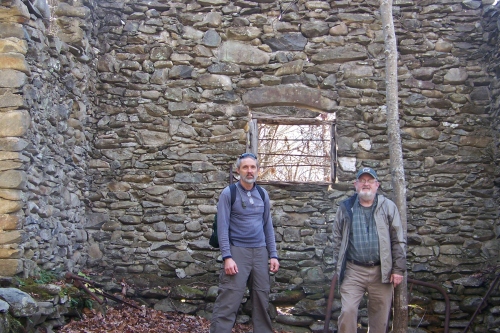
Living Room

Beech and Sourwood juxtaposed

Bedload scouring

Both lively and peaceful

Double Duty- cleared land and separated
After the hike I went to visit my 3rd born. Arriving just before dark, we went down to Kingston to see the sunset. Having already set, we walked the concrete “boardwalk” enjoying the fading colors and good conversation.

Too late and just in time

On Saturday I went bouldering at Lilly Boulders at the Obed Scenic River climbing area. I was by myself at first but met up with another climber with whom I enjoyed the day. I was climbing exceptionally well, and truth be told, the grading of climbs seems easy here than at home. The day was perfect for climbing: crisp, dry, sunny.
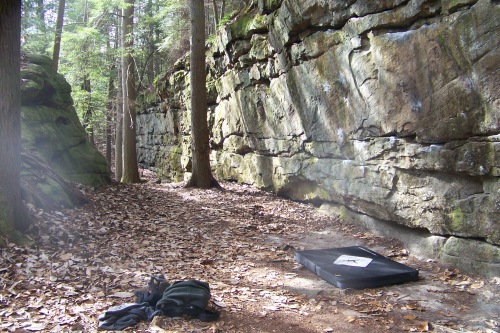
One wall at Lilly Boulders
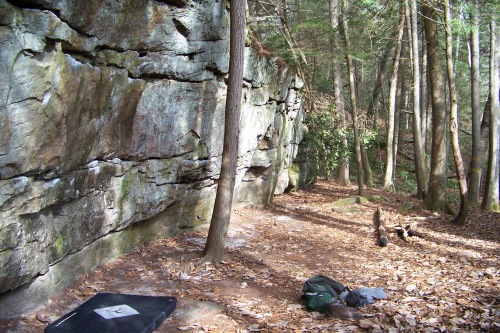
Lots of good climbing
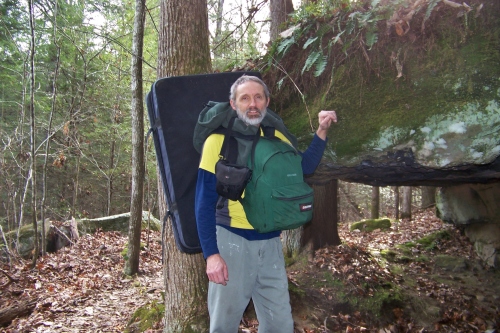
Approach Pose
Posted in Climbing, General, Outdoors, Photo, Travel | Tagged Climbing, Outdoors, Photos, Travel | 1 Comment »
November 14, 2017 by creatorworship
Equations are abbreviated definitions that simplify and clarify complex concepts and data. They may be used to calculate, which may either reveal past events or predict future outcomes. Qualitatively, they enable the understanding of interrelationships between variables, which may not be obvious otherwise. On the other hand, not all relationships within an equation are the mere product of their juxtapositions within an equation. Rather, some variables owe their interaction to feedback loops within their physical situations. For instance, according to the equation below, in order to have the best period (race time), both power and endurance must be at their maximum. But in physical reality, for a runner, when power is maximum, endurance must be low. Sprinters are not endurance runners. Conversely, when endurance is high, then power must be low. Long distance runners are not sprinters. Actually the equation does reveal this relationship, because if you move the power variable to the other side of the equation you get po = 1/e, or more accurately, power is inversely proportional to endurance. That is, as endurance increases, power decreases.
From the equation you may also see that pace and distance should be inversely proportional. But the opposite is true. A longer distance requires requires a slower pace, that is, larger number.
And when distance is increased, endurance must increase and power must decrease.
The Runner efficiency variable may not be able to be determined, though I think that athletic physiologists are trying desperately to do so with VO2 max, respiratory exchange ratio, fast twitch/slow twitch muscle, body mass, % body fat, and running mechanics. Strength training and anaerobic sprints seem to be two popular methods for increasing runner efficiency. Diet must not be discounted as a way to build better runners.
The constant, K, is a factor that converts the other five variables into a race time, T. At this level of development of the equation, it is nothing more than a fudge factor to make five variables equal to the one.
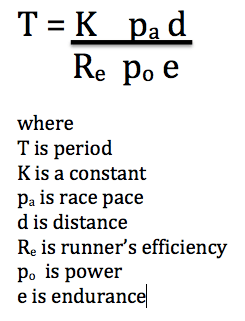
The best race time (T) is what every runner, coach, and spectator is after. Thinking through this equation might help the runner and coach better design training that will secure that result. Are you training for power, the sprint, or endurance, the long distance run? What training regimens do you need to perform to meet these goals? How much is it reasonable to increase both power and endurance? What are the limits of one, given the other?
I feel certain that good runners and their coaches have all of the relationships dialed in, so that an equation seems silly, but I benefit in my thought about running by the simple definition called an equation.
Posted in General, Random thoughts, Strength | Tagged Random thoughts, Science | Leave a Comment »
October 31, 2017 by creatorworship
On October 31, 1517, the Protestant Reformation began when Martin Luther nailed his 95 theses on to the Wittenburg Castle Church door. The Protestant Reformation was a movement in the 16th and 17th centuries in Europe, which tried to reform the Roman Catholic Church, because of perceived doctrinal and moral corruption that undermined the Christian gospel. The result was excommunication and the Protestant movement. These Latin phrases; sola scriptura (Scripture Alone), sola gratia (Grace Alone), sola fide (Faith Alone), sola Christus (Christ Alone), Soli Deo Gloria (for the glory of God Alone), were the fundamental principles of the protestant reformers. They were developed over time, to summarize the theological conviction of the reformers and are central to the doctrine of salvation. -John Piper
In April of 1518, the head of the Augustinian Order called for a formal disputation of the ideas that Martin Luther had put forth. This gave Luther an opportunity to expand upon his concerns. At the meeting, Luther put forward a “theology of the cross” as opposed to a “theology of glory.” -Editors Introduction to the Book of Concord
A theology of glory expects total success, finding all the answers, winning all the battles, and living happily ever after. The theology of glory is all about my strength, my power, and my works. A theologian of glory expects his church to be perfect and always to grow. If a theologian of glory gets sick, he expects God to heal him. And if he experiences failure and weakness, if his church has problems and if he is not healed, then he is often utterly confused, questioning the sufficiency of his faith and sometimes questioning the very existence of God. -Gene Edward Veith
To better understand the theology of glory, one need only look at the adjective included in the five Latin phrases. Alone. The use of this simple term suggests that the theology of glory, understood God’s work of Scripture, Grace, Faith and Christ were insufficient.
The Catholic Church adhered to what Martin Luther called the “theology of glory” (in opposition to the “theology of the cross”), in which the glory for a sinner’s salvation could be attributed partly to Christ, partly to Mary and the saints, and partly to the sinner himself. The reformers responded, “No, the only true gospel is that which gives all glory to God alone, as is taught in the scriptures.” -Monergism.com
This true and Biblical gospel, proclaimed by the reformers, was about how man can be justified before a holy God. Not by any merited favor, but by grace alone. Not any works a man can do such as the confession, penance or indulgences, but by faith alone. Not by any other sacrifice, such as mass, but only in Christ alone. Not found in the church, papacy or tradition, but in Scripture alone. And not for the veneration, worship or glory of Mary, Saints or Angels, but to the Glory of God Alone.
For Luther, the bottom line was the bondage of the will, or the deadness of the human soul. The Bible tells us that we are totally helpless. Ephesians 2:1-3, “And you were dead in your trespasses and sins, in which you formerly walked according to the course of this world, according to the prince of the power of the air, of the spirit that is now working in the sons of disobedience. Among them we too all formerly lived in the lusts of our flesh, indulging the desires of the flesh and of the mind, and were by nature children of wrath, even as the rest.” We were dead in our trespasses and sin and by nature children of wrath. Only grace can raise us from the dead and only Christ could be our punishment. Those two miracles, life from death and wrath removed, can only be received as a gift. Thus, it is to the glory of God alone. -John Piper
When reflecting on today’s subject of God receiving all glory, you may have thought, “I am a Baptist. I know that we do not glorify Mary, Saints or Angels.” This, I’m sure, is true for many of us here. However, these two verses may shed some light on our weakness and who we do glorify instead of God alone.
Proverbs 14:12, “There is a way which seems right to a man, But its end is the way of death.” 2 Timothy 3:2, “For men will be lovers of self, lovers of money, boastful, arrogant, revilers, disobedient to parents, ungrateful, unholy…”
The Bible tells us:
- Scripture is from God. 2 Timothy 3:16, “All Scripture is inspired by God…”
- Grace is from God. Ephesians 2:8, “For by grace you have been saved through faith; and that not of yourselves…”
- Faith comes from God. Hebrews 12:2, “looking to Jesus, the founder and perfecter of our faith”
- Christ was sent by God. John 3:17, “For God did not send the Son into the world to judge the world, but that the world might be saved through Him.”
- Genesis 1:1, “In the beginning God created the heavens and the earth.”
- Proverbs 16:9, “The mind of man plans his way, but the Lord directs his steps”
- Psalm 103: 19, “The Lord has established His throne in the heavens, And His sovereignty rules over all.”
- Psalm 19:1, “The heavens are telling of the glory of God; And their expanse is declaring the work of His hands.”
- Romans 13:1, “Every person is to be in subjection to the governing authorities. For there is no authority except from God, and those which exist are established by God.”
- Ephesians 1:11-12, “also we have obtained an inheritance, having been predestined according to His purpose who works all things after the counsel of His will, to the end that we who were the first to hope in Christ would be to the praise of His glory.”
- Colossians 1:16-17, “For by Him all things were created, both in the heavens and on earth, visible and invisible, whether thrones or dominions or rulers or authorities—all things have been created through Him and for Him. He is before all things, and in Him all things hold together.”
- Hebrews 1:3, “And He is the radiance of His glory and the exact representation of His nature, and upholds all things by the word of His power. When He had made purification of sins, He sat down at the right hand of the Majesty on high…”
- Hebrews 11:10, “for he was looking for the city which has foundations, whose architect and builder is God.”
- John 3:16, “For God so loved the world, that He sent His one and only son, that everyone believing in Him should not perish but have everlasting life.”
- 1 John 1:9, “If we confess our sins, He is faithful and righteous to forgive us our sins and to cleanse us from all unrighteousness.”
- Philippians 1:6, “For I am confident of this very thing, that He who began a good work in you will perfect it until the day of Christ Jesus.”
- Revelation 4:11, “Worthy are You, our Lord and our God, to receive glory and honor and power; for You created all things, and because of Your will they existed, and were created.”
Soli Deo Gloria
Posted in Faith, General, Glory, God Thoughts, Grace, Reformation 500, Truth | Tagged Faith, God Thoughts, Grace, Salvation, theology, Truth, Worship | 1 Comment »
October 31, 2017 by creatorworship
Our pastor has encouraged us to look at the 5 solas of the Protestant Reformation. The first Sunday was Scripture alone. The second Sunday was Grace alone. Today we look at faith alone.
When Paul explains the gospel in Romans, he says that in that gospel “is the righteousness of God revealed…as it is written, The just shall live by faith.” (Romans 1:17)
I want to begin by looking at how the Catholic church obscured the gospel, then move to how the Reformation recovered the gospel, and finally give an implication of this gospel for us today.
The Catholic church obscured the gospel of faith alone by tangling up regeneration with justification like a really bad game of twister. Biblically, Regeneration is being born again—having eternal life infused into our souls. Justification is God the judge declaring us to be legally righteous in his sight (instead of guilty). The mixing up of regeneration and justification resulted in the Catholic church teaching that in baptism a man receives an infusion of righteousness into his soul. And this infusion of righteousness is what makes a man inherently righteous before God. Consequently, the Catholic church went on to teach that the fruit of righteousness flows from divine life experienced in baptism so that a man may merit by his gracious works justification. So, the foundation of a right standing before God is what a man becomes at his baptism and what a man does after his baptism. That baptism often being an infant baptism.
This was the thinking that Martin Luther was plagued by. If there was ever a monk who could have been saved by his monkery, it would have been Martin Luther. Vigils, prayers, reading, spending much time confessing, and fasting were performed by Luther. But all of this work failed to give him the peace with God that he was desperate for. And that’s because Galatians 2:16 says “a man is not justified by the works of the law.” So, the Catholic church obscured the gospel of faith alone by tangling up regeneration and justification and in this way tortured Martin Luther.
But what the Reformation did was untangle regeneration and justification. And this resulted in clarifying what justification means: Justification is not progressive, but the instantaneous declaration of God that a sinner is righteous instead of guilty. And the instrument by which a man is justified is not man’s work, but faith alone in Christ and his work at Calvary.
Romans 4:5 says “ But to him that worketh not, but believeth on him that justifieth the ungodly, his faith is counted for righteousness.” Worketh “not”. Justifieth the “ungodly”.
But how can God declare an ungodly man righteous? He does not do this by infusing righteousness into a man’s soul (as the Catholic church taught), but by imputing the righteousness of Christ to a believing sinner. In other words, when a man believes on Christ, God considers the righteousness of Christ as belonging to the sinner.
Think of it this way—when a poor woman marries a rich man, that woman enters into a union with him so that she shares in his wealth. The poor woman becomes rich. Similarly, when a sinful man believes in Christ, that man enters into a union with Him so that he shares in His righteousness. And in this manner God considers Christ’s righteousness as belonging to the sinner and thus declares the sinner to be righteous. This is the only way that a sinful man may have peace with God.
We have seen how the Catholic church obscured the gospel of faith alone and how the Reformation recovered that gospel. Now, an implication for the church today is this: we had better get justification by faith alone right before we do any work. Another way to say it would be to say, the church had better get the gospel right before she gets to work.
When Paul reveals what the gospel means in Romans, he talks about justification by faith alone.
When the Catholic church obscured that gospel, it gave rise to an unhealthy religiosity. Germany was not being taken over by secularism—it was very religious, but it was an unhealthy religiosity that arose from the burial of justification by faith alone. Contrastingly, we here in America do see secularism taking over. And what a temptation it would be for us in our day to say “We need to get back to being religious!” But if that religiosity does not arise from justification by faith alone, then we are not standing on the gospel.
What revolutionized Europe was not increasing religious activity. It was the recovery of justification by faith alone. May it be so in our day.
Posted in Faith, General, Glory, God Thoughts, Grace, Reformation 500, Truth | Tagged Faith, God Thoughts, Grace, theology, Truth | 1 Comment »
October 30, 2017 by creatorworship
In this third installation of the 5 solae, we come to what another brother had to say about grace alone:
I want to begin with a personal testimony from January of this year…
After a brief explanation from the Lutheran pastor, I followed the funeral procession into the church—deeply moved. Why? For sure I was going to miss my wife’s aunt, who had been a dear family member to us.
But more importantly, what impacted me was the symbol on her casket that illustrated a truth most dear to me. You see, the casket was covered in a white cloth, symbolizing righteousness, which would be the only thing God would accept from her as she would be presented to Him for judgment. But…whose righteousness?
The symbolism goes further—on the cover was the shape of a cross, and the Greek symbols for Christ. Whose righteous works is God accepting? Would He see ANY of my aunt’s works?
No, for He would not accept them!
She was being presented to God, covered by the righteousness of our blessed Christ! And THIS was our family’s comfort in our loss.
Eph 2:8-10: “For by grace are you have been saved through faith, and that not of yourselves; it is the gift of God; not of works, lest anyone may boast. For we are His workmanship, created in Christ Jesus for good works, which God prepared beforehand, that we should walk in them.”
In this short statement is the sum of the Biblical teaching of the work of grace. It begins with God-working in us faith which justifies us (giving us Christ’s righteousness), which results in good works which please Him—according to His working in us.
Over time, as the Church of the Middle Ages abandoned the supreme authority of Scripture—“Sola Scriptura” in favor of traditions, other doctrines began to emerge—not only those absent from the Bible, but also changes to the understanding of grace itself.
The Medieval Church’s teaching gradually drifted to the assertion that God’s grace would help us produce the works that He would accept for justification, rather than the grace of Christ’s finished work of cross and resurrection for us.
It is in this world that Martin Luther sought to be right with a Holy God.
In keeping with church traditions, he followed the rules of the monastery, and did penance–all to a radical extreme (and even the annoyance of his fellow clergy)—all the time being under condemnation in his heart because of the majesty of God’s holiness and perfection overwhelming him.
At this point, as he studied the Bible, he discovered that it is not his righteousness that God will accept, but Christ’s, and that he should by faith abide in Him! Luther received God’s gracious gift of eternal life.
Luther and the other reformers returned to the Biblical, apostolic understanding that good works and a changed life flow from Christ’s righteousness given to us, instead of leading to it. God will not have his glorious gospel assisted by human works.
Our Christ, as God in human flesh, takes on Himself ALL of our sin and sinfulness on the cross, and gives us ALL of the righteous obedience of His perfect life. We call this teaching Sola Gratia, or “grace alone.”
In short, God’s grace justifies us completely in Christ’s work, and gives us a heart of repentance, rather than demanding we “do penance.”
Church Historian Stephen Nichols tells us that Ulrich Zwingli, the Swiss reformer, is portrayed in a portrait with an open Bible.
In an illustration of this grace to us, the Bible was opened to Matt 11:27-30:
“All things have been handed over to Me by My Father; and no one knows the Son except the Father; nor does anyone know the Father except the Son, and anyone to whom the Son wills to reveal Him.
Come to Me, all who are weary and heavy-laden, and I will give you rest. Take My yoke upon you and learn from Me, for I am gentle and humble in heart, and you will find rest for your souls. For My yoke is easy and My burden is light.”
This is Christ’s gracious invitation to us—then, and now.
On this 500th anniversary of the Reformation, we celebrate our salvation in Christ, Sola Gratia, by grace alone—in the words of the Apostle Paul: “…to the praise of the glory of His grace, which He freely bestowed on us in the Beloved…”
Posted in Faith, General, God Thoughts, Grace, Reformation 500, Work of Jesus | Tagged Faith, God Thoughts, Grace, Salvation, theology, Truth, Worship | Leave a Comment »
October 29, 2017 by creatorworship
Several weeks ago my brother in Christ shared this about the sufficiency of Scripture:
“Sola Scriptura is a reminder that God has always worked and will always work on this side of eternity through His word the Bible. Sola Scriptura deals primarily with the issue of authority. It is not a base claim that says that nothing except Scripture is helpful. It is not a claim to Scripture only in all cases. That would not be Biblical. Recognizing this is to distinguish between Sola Scriptura and Scriptura Nuda. Sola Scriptura does not argue that there is no value in anything except for Scripture standing on its own. It is an argument that Scripture is the only basis of authority.
I think a couple of verses would help us frame this discussion. Psalm 138:2 captures the sentiment of Sola Scriptura in a poetic way, but it also stresses a note of praise and worship which seems very appropriate when we are remembering God’s faithfulness over the 500 years since the Reformation. The psalmist here says:
“I bow down toward your holy temple and give thanks to your name for your steadfast love and your faithfulness, for you have exalted above all things your name and your word.”
Several translations say this slightly differently, but the idea is clear: God exalts his Word. And God exalts those who exalted his word, and God will be exalted when his word is exalted.
The Reformation, which was a great turning from the time when doctrinal error was pervasive in the church, to a time when the church was based much more on the truth of Scripture follows clearly a line or trajectory of a return to Scripture. Every individual who had a hand in the Reformation of the church was a person who had first learned to see the Scriptures as their sole authority. You can back up to 200 years earlier and look at the life of John Wycliffe in England, who was persecuted for his position on the authority and importance of Scripture. You can look in the 1400s at John Huss, who was also persecuted for a similar stand. He was martyred for his belief in Scripture. But he is the one who famously said, “you may cook this goose.” His name Huss meaning goose, “but in its stead God will raise the Swan who will sing his praises.” That Swan came 100 years later, just a few miles away, in the person of Martin Luther. Martin Luther, was ironically induced into the priesthood in the same church that the bishop who condemned Huss was buried in. And so we see consistently through history, God superintending to bring about his own glory and the reform of his church through the honoring of Scripture. Each of those men engaged in the great task of putting the Scriptures into the language of the common man of their day. Each one of them understood that one of the great tasks of their life was to put Scripture into the language of the common man, so that the English plough boy could read Scripture in English, and the German peasant could read Scripture in German.
Simply put, Sola Scriptura is the cause of the Reformation. The other principles, or rally cries of the Reformation; the other solas, whether it is Sola Gratia, Solus Christus, Sola Fide, or Soli Deo Gloria. We could not and would not have any of these were it not for return to Scripture only. Scripture is the foundation; it is the foundation upon which God’s work will always be built.
Peter reminds us in II Peter 1:16. In this passage Peter reminds us of a pivotal time during the life of Christ. A time where Peter and two other disciples are alone with Christ on a mountaintop, and there in that Transfiguration moment they see the Lord in His glory. But Peter tells us in verse 19:
“And we have the prophetic word more fully confirmed, to which you will do well to pay attention as to a lamp shining in a dark place, until the day dawns and the morning star rises in your hearts.”
The King James translation express this as “we have a more sure word of prophecy”. One of the things Peter is reminding us of here, is the fact that even if God were to reveal himself physically to us, as Christ was revealed to the disciples on that mountain Transfiguration, that appearance would not and should not be as authoritative or as significant to us as the physical pages of the word of God that we have in our hands. Peter says that what we have is a more sure word; it is a word more fully confirmed, which we do well to pay attention to. Sola Scriptura thus speaks to the authority and sufficiency of the word of God.
The threat to Scripture in the time leading up to the Reformation, came from an approach to Scripture which claimed that we could not know for sure what Scripture was saying. The scholars and some church authorities the time said that we could look to tradition and Scripture, we could look to reason and Scripture, we could look to the great leading voices of the church and Scripture, and we can look to experience and use that to temper our understanding of Scripture. And out of that mixture of endless qualifications and piles of meaningless footnotes maybe we can come up with something that in some way we could call true. Martin Luther said that that approach to truth, and approach to truth that is merely tentative, an approach to truth that denies the absolute authority of God’s word, an approach that says truth is only possible, is an approach to truth that paves the road to hell. Martin Luther said we do not need possible truth. We need therefore truths; truths that are absolute and unequivocal. We need truths that come to us with the thunderous certainty of Romans 5, “therefore there is now no condemnation for those that are in Christ Jesus.” We need truths that are absolute! And our only hope, our only source for that kind of truth comes in the revealed Word of God, Sola Scriptura.
Sola Scriptura is thus the basis of our confident joy. Every commemoration, every anniversary, every celebration, should ultimately be characterized by gratitude. A gratitude that shows that we are thankful to God. God is the only reason why good things live long. On the 500th anniversary of the Reformation our heart should be hearts that are filled with gratitude that God has kept his word. We can say with the hymn writer:
“How firm a foundation the Saints of the Lord
Is laid for your faith in His excellent Word
What more can He say than to you He has said
To you who to Jesus for refuge have fled.”
Let us be thankful for Sola Scriptura.”
Posted in Faith, General, Glory, God Thoughts, God's Word, Grace, Reformation 500, Truth | Tagged Faith, God Thoughts, Grace, Salvation, theology, Truth, Worship | Leave a Comment »
October 28, 2017 by creatorworship
My son and his wife hosted a Reformation 500th Anniversary Conference back in April. The website for the conference has history of the various states in Europe that were effected by the Reformation. They wrote and edited summaries of these histories. The website also has links to all of the conference speakers’ talks. Soon the site will have legible pictures of the 40 story boards (trifold boards) he and his wife made for the conference. All of these resources may be accessed at www.reformation500pa.com
Happy 500th and happy researching!
Posted in General, God Thoughts, God's Word, Grace, Reformation 500, Work of Jesus, Work of the Holy Spirit | Tagged Faith, God Thoughts, Grace, Salvation, theology, Truth, Worship | Leave a Comment »
October 28, 2017 by creatorworship
Some anniversaries are celebrated with much pomp. Perhaps in limited or hidden circles or isolated from one another, the 500th anniversary of the Reformation is being celebrated. But from my limited view, I am not seeing it. Perhaps this history changing event is obscured by the willful ignoring of the main purveyors of information. It is my hope that the quiet remembrance and thanksgiving of the saints for this God directed change in direction of the church and at that time will result in godly resolution to renew repentance and reformation in our time.
My church is committing some small focus to this great event and how it effects the church today. For 5 weeks leading up to the 500th anniversary, we are presenting a 5-10 minute “Reformation Moment” on the 5 solae of the Reformation. Then this coming Sunday night we have a speaker who will give us an overview of Reformation history. One of the solae for which I have a transcript is “Solus Christus”:
In these 5 weeks we are giving consideration to the 5 solae that summarize the Reformation ideas about God bringing salvation to man. As has been said, the Latin word sola means “alone” or “only”: only Scripture, only grace, only faith, only Christ, only God’s glory. There is, however, one sense in which they are not alone. The solae must be taken together to give a full picture of what God has done and evermore will do to secure our salvation. All of these solae grew out of the reformers’ realizations that the Roman Catholic Church had strayed from the true Gospel message by adding requirements and layers to what God had done, much as the Pharisees had done by the time Jesus was on Earth.
Today we focus on Solus Christus, Christ alone. That this idea is Scriptural is abundantly clear from numerous references. Jesus, Himself, proclaimed His exclusive role in salvation when He said in John 14, “I am the way, and the truth, and the life; no one comes to the Father but through Me.” (v. 6) Peter amplifies the idea when he and John are brought before the rulers and elders of the people in Acts 4: “ And there is salvation in no one else; for there is no other name under heaven that has been given among men by which we must be saved”. (v. 12) No priest, no deacon, no pastor, no pope, no mentor or prophet or holy man or saint or angel can in any way help us in salvation other than to point us to Christ because, as I Timothy 2:5-6 says, “there is one God, and one mediator also between God and men, the man Christ Jesus, who gave Himself as a ransom for all, the testimony given at the proper time.”
Furthermore, Christ is only and once sacrificed. For the celebration of the mass is said to be the true body and blood of Christ sacrificed for sins. Scripture says: “And inasmuch as it is appointed for men to die once and after this comes judgment, so Christ also, having been offered once to bear the sins of many, will appear a second time for salvation without reference to sin, to those who eagerly await Him.” (Hebrews 9:27-28)” Salvation comes through trusting in Christ alone for his once and final sacrifice on the cross. We do not need the priest as mediator or the mass as a means of applying saving grace.
Luther understood our tendencies all too well when he said, “we humans are weak and stubbornly perverse and are more likely to become attached to saints than to Christ…that it is easier for us humans to believe and trust in everything else than in the name of Christ, who alone is all in all, and more difficult for us to rely on him in whom and through whom we possess all things.”
As Huldrych [Ulrich] Zwingli proclaimed, “Christ is the only way of salvation of all who were, are now, or shall be.” In Article 54 of his Sixty-Seven Articles (1523), Zwingli explicitly contrasts the Roman sacramentalist view with solus Christus: “Christ has borne all our pain and travail. Hence, whoever attributes to works of penance what is Christ’s alone, errs and blasphemes God.”1
Joel Beeke in writing about the Solus Christus says, “The centrality of Christ is the foundation of the Protestant faith. Martin Luther said that Jesus Christ is the “center and circumference of the Bible”—meaning that who He is and what He did in His death and resurrection is the fundamental content of Scripture. Salvation is only in Jesus Christ because there are two conditions that, no matter how hard we try, we can never meet. Yet, they must be done if we are to be saved. The first is to satisfy the justice of God through obedience to the law. The second is to pay the price of our sins. We cannot do either, but Christ did both perfectly”2
In his “Institutes of the Christian Religion”, John Calvin wrote, “Christ stepped in, took the punishment upon himself and bore the judgment due to sinners. With his own blood he expiated the sins which made them enemies of God and thereby satisfied him…we look to Christ alone for divine favour and fatherly love!…Hence Christ is called “King of peace” (Is. 9:6) and “our peace” (Eph 2:14) because he quiets all agitations of conscience. If we ask the means, we must come to the sacrifice by which God has been appeased. For anyone unconvinced that God is appeased by that one atonement, in which Christ endured his wrath, will never cease to tremble. In short, we must seek peace for ourselves solely in the anguish of Christ our Redeemer.”3
Solus Christus, Christ alone. As one blogger said, “Since Rome has not changed, and since our own hearts constantly look elsewhere for salvation, the issue is still before us today. So it is still the duty of the church to clear away all helpers and assistants in salvation and preach Christ and him alone. He is all we have for salvation, but he is all that we’ll ever need.”4 Martin Luther gives us a simple summary, quote, “I must listen to the gospel. It tells me not what I must do, but what Jesus Christ the Son of God has done for me.”
- http://www.ligonier.org/blog/top-five-books-five-solas-solus-christus/
- http://www.ligonier.org/learn/articles/christ-alone/
- John Calvin, Institutes of the Christian Religion 2.16.2
- https://reformedreader.wordpress.com/2012/03/24/martin-luther-on-solus-christus/
Posted in General, God Thoughts, Grace, Reformation 500, Work of Jesus | Tagged Grace, Reformation 500, theology, Truth | 1 Comment »
October 9, 2017 by creatorworship
A worldview must be able to withstand the rigors of reality. It must match up with truth. If there is no absolute truth, then there is no basis for purpose, moral code, love, or rational thought.
I believe literally what the Bible says about our origin- created in six literal days approximately 6000 years ago, as separate and fully formed kinds of plants, animals, and humans. This view, which simply takes God at His word, leaves no room for evolution between kinds of organisms, so called macro-evolution. How should a Bible believing individual respond to the claims of evolution? Does evidence overturn the plain reading of Scripture?
In an online video, “The Making of the Fittest: Natural Selection and Adaptation”, the presenters describe what they believe to be an airtight example of modern evolution: “Thanks to Nachman [the researcher],” says the narrator, “Science has an example of evolution clear in every detail.” Michael Nachman has studied pocket mice on the lava beds of Southeast New Mexico. Based on his population field studies and laboratory DNA studies, Nachman believes that a combination of mutation and natural selection has resulted in the pocket mouse being “evolved to be dark like the rock.” He says, “When a black mouse appears in a white population of mice, that is usually going to be due to a new mutation, and those are random and rare events.” He concludes that studies of the mice at other lavabeds show that “the genetic changes that made the mice black were different in each case. What’s amazing to me is how similar the black mice are…completely different genes. The narrator concludes, “The rock pocket mice show us that evolution can and does repeat itself and why evolutionary change is never ending.”
But not so fast! First of all, before and after this event they are still pocket mice. Secondly, Nachman assumes that the genes for black fur arose by random mutation. But as Carl Wieland points out in an article about the peppered moths of England:
“Actually, even as it stands, the textbook story demonstrates nothing more than gene frequencies shifting back and forth, by natural selection, within one created kind. It offers nothing which, even given millions of years, could add the sort of complex design information needed for ameba-to-man evolution. Even L. Harrison Matthews, a biologist so distinguished he was asked to write the foreword for the 1971 edition of Darwin’s Origin of Species, said therein that the peppered moth example showed natural selection, but not ‘evolution in action.’”
Thirdly, a very simplistic understanding of genetics results in only one possible conclusion for how multiple gene variations result in black fur. Given the relatively recent understanding of epigenetics, the better explanation lies in shifts within the expression of genes already resident within the mice. As Marc Ambler says about a different mice study,
“Scientists conducting experiments on agouti mice found that by manipulating nutrition they could switch off a certain gene. When the gene is active (‘on’) the mice are normally obese and a yellowish colour; by switching the gene off the mice are of a normal, slim appearance, and brown. By feeding a combination of nutrients including vitamin B12 to the mother before mating, the gene was able to be turned off in the babies.”
Bible believer, do not give in to the wiles of evolutionary thought. We know God from His Word and our personal experience of His saving grace, and science supports rather than contradicts that knowledge. Only conclusions based on a naturalist worldview that excludes the need or possibility of God deny His plain communication about who He is and how He created all that we see. Those of you holding to a naturalist view, I challenge you to consider the possibility that God is real and evidence of nature rightly understood points toward Him.
Posted in Creation Articles, General, Science, Truth | Tagged Creationism, Science, Truth | Leave a Comment »
September 17, 2017 by creatorworship
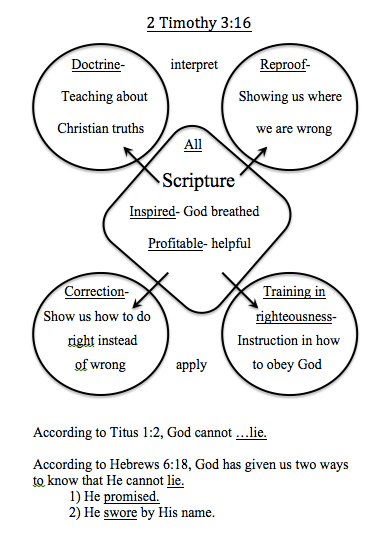
It is such a joy to teach young people about the Word of God. God’s Word is our foundation for truth and life. Trying to increase the students’ understanding and memory of what was being taught, I came up with a diagram. Perhaps it will help you, too.
Posted in General, God's Word, Truth | Tagged God's Word, theology, Truth | 1 Comment »
September 11, 2017 by creatorworship
I shared thoughts about 9/11 last year that I think still ring true. If you are interested, see “Has the World Really Changed?”
9/11 was not even mentioned at my school today. We went on as if it never happened. My students were not born until 2003. Two major hurricanes just hit back to back in the continental US. Political wrangling is more contentious than it has perhaps ever been in my lifetime. North Korea makes ever more credible threats with each passing year. Racial tension has again reared its ugly head in these United States. The economy is better and life is good. In other words, life has rendered us forgetful. No, that is a way of saying we have an excuse because some outside influence caused us to do what we would not have otherwise. No, we have either willfully forgotten or passively allowed forgetfulness. We don’t want to think about that event because it demands of us introspection about how we should react and will react. We would have to consider the continuation of dangers in the world which we know no solution for. Even more disturbing, we would have to consider that because of our own complicity we are part of the problem. Not me you say. I in no way caused 9/11. What have you done to make this a better, purer, kinder, stronger nation? Have you cried out to God for mercy? Have you sown peace and goodness in the land? Have you taken heed to God’s law and sought after His grace? I include myself. What have I done to remember the lessons of 9/11 that were never learned by this nation and forgotten by the few that did know them? I have much work to do in my personal life, but tomorrow I will convey the sense of what happened to my students who see it as textbook history, before their time. Allow your memory to lapse no more on this subject.
As to the memory of the events, I think that my daughter does them more justice than I am able just now. Here is what she said:
“My 8th grade English class was in the computer lab typing papers one Tuesday morning, when another teacher came in and told Mrs Ball (my teacher) to turn on the TV. Less than 10 minutes later, I watched in real time with shocked disbelief and trembling sadness as the Flight 175 crashed into the World Trade Center South Tower. Reports of the Pentagon being hit and speculation of other targets followed soon after. I saw the towers crumble. I saw the people running, covered in dust. I saw the NY police and firefighters. I saw the gaping hole in the Pentagon and the field in Pennsylvania. I saw the hysteria. I silently cried for those lost and prayed for our president.
The next day was so quiet. All planes were grounded.
In the following weeks however, the burst of nationalism was heard echoing across the country. “United We Stand!” “God bless America!” So many US flags appeared. So many people came together to grieve and hold each other up.
I still grieve. When I think of how easily we forget. When I consider the short lived community support. When I contemplate how quickly the crying out to God for help changed to reliance, expectation, and blame on the government.
September 11, 2001 ushered in a new era in our world. Ideas were shaken. Securities were questioned. Fear is the new normal.
So now what? Trust God.
The only way I have found to deal with truth and reality is to take all to Him who created it and me. Do I still feel the impact? Yes, but I don’t try to carry the burden.”
Posted in 9/11, Cultural commentary, General, Remembering | Tagged 9/11, Remembering | Leave a Comment »
September 3, 2017 by creatorworship
Having taught for 25 years, I have indeed seen many changes in public school. Some represent major cultural shifts while others reflect minor cycles of fad and fashion. One very curious change I have witnessed is a loss of faith in Science. Students used to almost universally confess that science and technology would eventually solve all of man’s problems. Disease will be defeated, genetic difficulties overcome, hunger eradicated, environmental problems will be historical artifacts of developing technologies, mysteries solved, a perpetual motion machine created that would solve all energy problemss, the galaxy traversed. Older minds may have written this off as so much blissful, youthful optimism and ignorance. Instead, I think that it was a product of a worldview that viewed science as the source and conduit of all truth. There were, of course, the rare skeptic that did not trust science or its message.
I see the opposite trend to be generally true today. It is the rare student that has an unflinching faith in Science, or anything for that matter, other than himself. Science and Technology have not solved all of our problems. Epidemics continue, hunger persists, climate change threatens, nuclear proliferation has rebooted, natural disasters terrorize, and people still don’t get along with each other. Unfulfilled expectations and personal discontent are on the rise. Science and technology are frequently viewed as the cause of environmental problems and stressed out living styles.
There could well be many sociological, cultural, and economic reasons for this shift, but I think that in a narrower sense of views about science as a human endeavor, both the blind faith in science and the skepticism of its merits arise from a basic misunderstanding of what the limits of science are. Science is neither the source and conduit of all truth nor the cause of the world’s most pressing problems. Science is a tool. As such it has limits. When I use my large ratchet as a hammer, I damage the tool and very poorly drive the pin I am trying to remove. In a similar way Science used in the wrong way brings harm to its prestige and to the understanding and application it is meant to drive. Science has at least 4 related limits.
Science may only be applied to things which are observable. This observation includes our 5 senses and any other remote sensing we may devise: camera, thermometer, radiation detector, ultrasound, etc. If only time, space, material, and energy exist as many insist, then this observability is not a limit. There is, however, evidence of more than the physical world (the source of beauty, information, purpose, emotions and will) and observability does not automatically exclude the spiritual realm. Scientists use inference (drawing conclusions) as a powerful tool, but it must be based on observation (quantitative data or measurement enable the observation to be unambiguous).
Science is also limited by the requirement of being testable. Scientists test hypotheses with controlled experiments to acquire a deeper understanding of the physical world. There are things that an experiment cannot test which nonetheless exist and effect our lives.
Scientific experiments must be repeatable. Other scientists must be able to use clearly set forth procedures and obtain the same results. If the results are different, some variable has not been controlled for or the experimenters were not careful enough in their observations. Therefore, scientists ask for procedures, data, and analyses from colleagues in order to determine if the conclusions are valid. The best way to do this is to repeat the experiment.
Finally, conclusions resulting from observations must be falsifiable. This does not mean that all evidence or conclusions will be falsified, but rather there must be the possibility of demonstrating that a conclusion is wrong. The essential function of Science is not to reveal truth but to eliminate falsehood. Based upon observation alone, one may never know for sure if something is true. But the ability to falsify wrong ideas narrows down what science accepts as true sufficiently to act upon it. This does not mean that there is no truth. It means that science does not have the ability to state truth in any absolute way. That must be done from other pursuits.
Many ideas are parading around, claiming to be scientific theories when they do not rise to the level of even a hypothesis, let alone a well substantiated hypothesis, that is, a theory. As an example, consider the issue of origins. How did we get here and how did it all begin? Can anyone who is living or has lived observe the beginning of the world? Since they cannot, can they possibly do an experiment on beginning a world? Is that experiment repeatable? If no experiment or observation by scientists may be done directly on the beginning of the world, then it is not a falsifiable idea. Therefore, though evidence may be given from subsequent events as to which version of origins is most likely, presuppositions are inevitably required in any discussion of origins. Another name for presuppositions, those assumptions made in order to begin a discussion or make inquiry, is beliefs. Any discussion of origins by definition is based on a worldview or belief system. It may be labeled religion or science, it does not matter, but it is essentially based on belief.
What this means for any discussion of origins is matching present evidence to the best presuppositional explanation. Does your belief about origins fit the evidence?
What this means about faith in or loss of faith in Science is a need to reconsider its value. Science is a valuable tool wielded by mechanics of varying training and skill, operating from differing worldviews. Retain a healthy skepticism that desires to understand what has been discovered and understood. Don’t throw the baby out with the bathe water. That is, don’t throw out the valuable tool of Science or the useful evidence it provides when you have to wade through false claims, poorly substantiated ‘theories’, intentionally falsified conclusions, or presuppositions that don’t match up with what you know to be true. Science is a useful tool.
Posted in Creation Articles, Faith, General, Science, Truth | Tagged Faith, Science, Truth | Leave a Comment »
August 25, 2017 by creatorworship
We were made for something bigger explains John Piper. We want to see beauty, power, symmetry, the unexplainable, the amazing, because we were made to fellowship with God. So, because of our separation from Him, we seek the beauty of His works. And those of us who know Him want more of Hm even when our tendency is to run and hide sometimes.
Today’s solar eclipse has a perceived spiritual element to it that even the most seared of conscience recognize. It points us, not to some vague internal spirituality or external, non-personal energy field of the universe, but to the Designer, the Artist, the Author, Who writes with power upon the sky this day, and in reality, every day. We are so apt to make idols of God’s works, gods in our own image, but if we would turn these deep emotional high’s into occasions of praise of the Creator, then our knowledge of and joy in Him would be deepened. I wanted to see it all and give Him praise.
When we arrived in the vicinity Huckleberry Knob around 8 AM, several thousand people and several hundred tents having preceded us. We had to park about a 1/2 mile from the beginning of the 1 mile trail. It was an easy walk, but it felt more like arriving a crowded ballpark than a mountain top wilderness area. People were quiet and polite and moving around to fix breakfast or clean up. We all shared the same objective. The top of the knob was partitioned by personal space, each little group selecting a patch of grass to sit down in. Closest to the peak dozens of tripods held telescopes, cameras, and video cameras. Neighbors swapped shop talk about equipment, procedures, and arrival challenges. The long wait was light-hearted, with much visiting, snoozing, games, and rechecking equipment
The top of the knob had a cloud slowly swirling around it. It would build and then fade, but was not going away. My sons and I made a decision about 20 minutes after C1, which was obscured, to move out from under the clouds. With just over an hour until totality we ran down the one mile trail and the older son ran on to the car about 1/2 mile along the Skyway while we watched the equipment. We stopped once about 3 miles down the mountain to see about 1/2 solar coverage, but the cloud again obscured the scene after a few minutes. We finally stopped about 8 miles away from the top at Santeetlah Gap. There were perhaps a dozen people here and at least one who had exited the top of the mountain as we had. The crowd was less intense. A man nearby had an eclipse phone app; he turned up the volume so we could all anticipate the events. My youngest son and I maintained the telescope screen alignment in order to follow the progress to totality. I spread a sheet on the ground. As totality approached the dimming light caused me to think that my eyes were mal-adjusting to light. Insects began chirping as though near sunset. Shadow bands appeared faintly on the sheet at about one minute before C2. The temperature began dropping and dimming accelerated. We saw Bailey’s Beads caused by mountains on the Moon, but we did not see the diamond ring.
Totality was simply awesome. The corona streamed out in light and dark bands to left and right at least one and one half sun diameters. My first reaction upon removing my eclipse glasses was that this did not look real but like it was airbrushed on the sky. My second thought was to want to sing the Doxology, which I did later, because here I was looking directly toward the Sun without eye protection and without damage, seeing one God’s wonders. It felt like a dim reminder of what Moses experienced when placed in the cleft of the rock seeing the afterglow of God’s glory. The corona’s silvery-white sheen with black streaks shown with an eerie, flame-like beauty. We could see stars all around the corona, including Venus to the right. My youngest son discerned a red star above the Sun. I will go back and see if that was Mars. The insects got quiet, the horizon we could see in various directions between mountains all showed of sunset colors. The older son said afterwards that it was the fastest 2:36 of our lives. People around us exclaimed “awesome” and “wow” throughout totality as if refraining from voicing amazement was not possible.
The diamond ring came without warning at C4 as a bright flash we were unprepared to see. Rushing to put the eclipse glasses back on, I saw Bailey’s Beads again, followed by shadow bands. Insects came alive again. With each passing minute the light increased.
The show was not over but after about 10 minutes we realized that there were going to be thousands of cars coming off the mountain soon and tens of thousands coming out of every tributary road toward home. We grabbed our simple equipment hastily, including the sheet which was very damp with dew, and sped off down the road. On the 4-lane we met our first 30 minutes slowdown. We began to move again and assumed we had dodged the traffic bullet. We even stopped for about 5 minutes to watch C5.
But ease of travel was not to be this day. On US74 we ran into a slowdown for 2+ hours at an average speed of less than 10 mph. After passing a major intersection we sped onward only to be stopped for 2 1/2 hours on I-40 near Ridgecrest where a semi and trailer had plunged off of an embankment and was being winched back onto the road. Certainly getting the driver to the hospital was a priority, but I wonder why during a record traffic event the truck could not have been left until the next day. My sons were about to come out of their skin, so I urged them to walk forward to see what was holding us up. They estimated that they walked 4 miles. One remembered that we were low on fuel with no reasonable way to obtain any. He saw a pick-up truck with a gas can and asked if it had fuel. He asked the man how much he wanted for it and gave him $10 for the can and about one gallon of gas. The vehicle behind him gave them another gallon of gas. Without this quick thinking and generosity we almost certainly would have been part of the cause of traffic problems. Instead, we made it home without having to get gasonline. I decided while I waited that the eclipse/traffic combination was an analogy for much of life- 2 minutes of glory sandwiched between many hours of drudgery and difficulty. But if you accept that God gives joy in the glory and contentment in the mundane, you may enjoy life and see His hand at work in both. It took us 3 hours to get to the mountain from our home and 8 1/2 hours to get back home. Was it worth it? Yes, it was in my mind for what I saw and expereinced, with whom I experienced it, and from Who’s hand it was given.

What have we gotten ourselves into?

A light-footed jaunt

Tent City
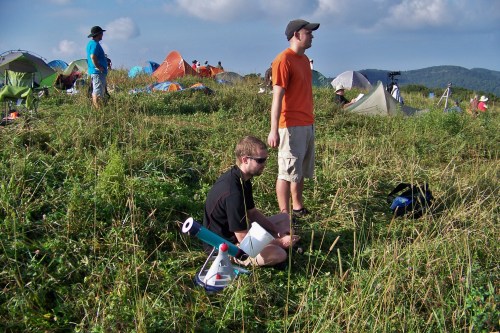
The Art of Waiting

An all too close flyby

Let’s get serious

Humble equpiment

set-up

Clouds are beautiful but this one is poorly timed

I love mountain vegetation

Ontario to Florida

Adjacent blog

OK!

The color of a partial eclipse

It takes all kinds and their pets

Now its happening

Check the secondary lens image

Just don’t have the fancy equipment

Almost there

Totality!
Posted in General | Leave a Comment »
August 11, 2017 by creatorworship
It’s a pity when life gets in the way of blogging (just kidding!). But I have so many thoughts and experiences from the summer that I could blog for quite some time. It is not likely to happen as I see more things happening soon, but that’s OK.
I did want to share a few thoughts and pictures. I don’t often suggest books for several reasons. I do more technical reading than reading for pleasure, and frankly many books don’t meet my high standard of what I would unreservedly pass on to those I call friends, or enemies for that matter since I want them to one day be friends. A book that I can enthusiastically suggest is “The Book That Made Your World, How the Bible Created the soul of Western Civilization” by Vishal Mangalwadi. Because of his culture and his faith he simultaneously looks at the West as an outsider and insider at the same time. I keep having the feeling that he is correcting much error from lies our culture has fed us about how we got to where we are. He uses personal experiences and copious quotes to show the deep imprint of the Bible on western culture. I think that you will hear more about it here once I am finished with it.
My friend, colleague, and climbing partner, CC, took me to two boulders I’d never been to before. In fact, he had only been there a few days before with another climbing buddy for the first time cleaning about ten problems, laying a thick base of branches in a wet spot, and clearing part of a large fallen tree. I was privileged to try out the new rock. I like to go back to old familiar routes, but there is a particular excitement about trying new routes, and particularly ones that haven’t been climbed before. I was definitely not climbing at the top of my game, only topping out on a V1 and 3 V2’s. I tried two V4 and got shut down. Both problems involved a gaston with my left hand that I could not stick. It has challenged me to train that weakness. On the second one I discovered that if I did a side pull with my right hand instead, I could top out to the left much easier. We both agreed that it would rate as a V2. I decided to name it “Easy Out”. The two pictures are of me on the right sidepull and the topout. We saw several Cardinal Flowers in the wet, rich spots by the creek. I definitely want to go back, and hopefully clean some problems on new rock myself. (Photo credit: CC with his phone)

Lobelia cardinalis

Taking it “Easy..”

“Easy Out”
Posted in Climbing, Cultural commentary, General, Outdoors, Photo | Tagged Climbing, Outdoors, Photos | Leave a Comment »
July 22, 2017 by creatorworship
One sentence from a comment on my last entry keeps coming back to me:
“A man was meant to be doubtful about himself, but undoubting about the truth; this has been exactly reversed.” (G.K. Chesterton)
When I came across a small poem that I had written about a year ago and considered my daily struggles, it seemed an example of how I must doubt my sinful self and cling evermore so firmly to the saving truth that brings joy and confidence. This salvation is not a past tense thing, it is a continuous present tense thing:
A deep heavy sigh
To realize I’ve failed again
How can I reply
Other than repent of sin
Only live by faith
Letting God’s grace to shine through
Jesus first of all
In all life that I pursue
Posted in Faith, General, Grace, Poem | Tagged Faith, Grace, Poems, Truth | Leave a Comment »
July 20, 2017 by creatorworship
I read an article posted on Facebook (Someone reading this article is saying, “There was your first mistake.”) recently that was titled, “Want to be Smarter? Learn to Say “I Don’t Know” by Zat Rana. I think that the sense of the article is humility, which is a valuable virtue for all of life and particularly discussions of significant topics. Humility should rule all of our discussions and particularly those on profound and sublime subjects. He says early on, “Somehow, we have decided that it’s okay to hold beliefs based on blind affiliation rather than rigorous critical thought.” Far too much of that goes on, probably because assenting to ideas by affiliation is easier than researching a topic and coming to your own conclusions. Also, he says, “more often than not, the issue lies in our inability to humbly accept that we don’t and can’t know everything; that, often, we are wrong.”
So far I am tracking with him. But immediately he charges into his defense of his position with his first point: “The Irrationality of Certainty”. His most supporting thought is that “Certainty is an illusion, and there is no shame in being wrong because, by nature, our entire perception of the world is wrong.” Now life truly is a balancing act, and we must hold many of our ideas lightly, but saying that there is nothing about which you can be certain, because it is an illusion, reduces all of life to relativism, which is illogical according the law of non-contradiction. Just because you don’t know something doesn’t mean it isn’t certain or that you can’t know it. There are things of substance that I can know for sure, not because I have all of the data, but because I know the One who does. There are absolutes and they can be known. There are many things I must hold lightly and be ready to be corrected and informed, but there are others I stake my life on.
His next sub-title is “The Disease of Blind Affiliation”. His contention is that “we form a connection to something that we fundamentally haven’t questioned.” In many scenarios of politics and tradition and even religious thinking, what he says is so very true, but don’t use this as an excuse not to make commitments about what is true. The agnostic view of the world and God is an excuse not to make a commitment that will require change and conviction. It reminds me of what the writer of Acts says about the Athenians concerning their questioning of Paul: “Now all the Athenians and the strangers visiting there used to spend their time in nothing other than telling or hearing something new.” Act 17:21 This is how many avoid commitment to the truth: “…always learning and never able to come to the knowledge of the truth.” II Timothy 3:7
“What is truth?” (John 18:38), Pilate asked Jesus. Was Pilate opened-minded? Was he seeking for truth? The evidence of the passage (John 18:29-19:18) is that he wanted to feel important, secure, popular, and in control, but he was not interested ultimately in what was true or right. His attempts to rescue Jesus were to avoid repercussions either from the crowd or some vague sense of a wrathful deity. Is it any different now? “If you continue in My word, then you are truly disciples of Mine; and you will know the truth, and the truth will make you free.” (John 8:32-33), said Jesus. If you don’t start with God’s Word you certainly can’t continue in it. I urge you, dear reader, to dig into the Word of God and plead with God to reveal to you truth. It exists; it is unchanging; it is life changing; you can know with certainty; it will keep you humble.
Posted in General, God's Word, Truth | Tagged Truth | 2 Comments »
July 1, 2017 by creatorworship
God has and does give more than enough evidence of His existence and work in the world (Psalm 19), but not for mere curiosity seekers or those looking for excuses (Matthew 12:38-39). He does give sufficient evidence (John 10:37-38). The true element preventing so many from believing is faith. And faith is in fact given to an individual by God (John 6:44). If you sense the slightest inkling of desire to know God or find truth or know if there is a God and if the Bible is true, pursue it and plead with God to open Himself to you (Mark 9:24, Matthew 7:7).
Even if evidence is as clear as can be
Without faith we will choose to not see
All that God has done in the world and in our lives
Until He comes again or death arrives
Even if great blessings light the way that we go
Without faith thanks will fail to overflow
All to luck, fate, karma will be attributed
Until no praise to Him is presented
Even if intricate design is discovered
Without faith the true meaning is covered
All is said from nature uniformly evolved
Until not one thing is from Him derived
Posted in Faith, General, God Thoughts, Poem | Tagged Faith, Poems | Leave a Comment »
June 27, 2017 by creatorworship
Being observant makes life interesting. Being intentionally observant is more interesting, and being in a group of people who enjoy discussing intentional observation is much more interesting. One evening I was walking out of the tower door of the church, which faces west, with two brothers. The sun was low and directly in our faces, making it hard to see. We were discussing what we intended to do when I pulled up short and said, “What in the world?” They both seemed surprised and said, “What’s wrong?” “How can this be?” I replied more to myself than to them, “The sun is shining in our faces but there are shadows in front of us.” I turned around to see if there were shadows behind us where they should be and discovered the truth of the bright shadows in front. The sun was equally blinding reflecting off of the glass door we had just exited. “I thought the laws of Physics were overthrown for a moment.” One of those two men still gives me a hard time about my observation and utter amazement.
I only hope that I may one day be such a good reflection of my Savior’s glory as to caste bright shadows over the lives of those who are blinded in His presence. And will there even be shadows in heaven where the light of His glory penetrates and purifies all its surroundings, where sin cannot abide, and praise arises uninterrupted before His throne? Even in the shadows of my continued sin nature, the world’s wicked system, and the devil’s devious temptations, I look forward to brighter days of knowing and serving Him through the grace He daily provides. Though shadows fall all around us, His presence brightens even these.
Posted in General, Glory, God Thoughts, Random thoughts | Tagged Glory, God Thoughts, Grace, Metaphor, Random thoughts | Leave a Comment »
June 25, 2017 by creatorworship
Following after Jesus has its many rewards and challenges. The challenges all originate from our sin nature, and “seeing that His divine power has granted to us everything pertaining to life and godliness, through the true knowledge of Him who called us by His own glory and excellence,” (2 Peter 1:3) we really have no excuse. This enabling power given to us through the agency of the Holy Spirit helps us to “enter through the narrow gate; for the gate is wide and the way is broad that leads to destruction, and there are many who enter through it. For the gate is small and the way is narrow that leads to life, and there are few who find it.” (Matthew 7:13-14)
God is at work in us for our sanctification, but He also commands us to be diligently about increasing our sanctification: “Work out your salvation with fear and trembling; for it is God who is at work in you, both to will and to work for His good pleasure.” (Philippians 2:12-13) Because of the lie of Satan that induced the original sin of Adam, “you will be like God, knowing good and evil” (Genesis 3:5), we now have a sin nature. As a result “death reigned from Adam until Moses, even over those who had not sinned in the likeness of the offense of Adam” (Romans 5:14), and there is still “nothing good dwells in me, that is, in my flesh; for the willing is present in me, but the doing of the good is not. For the good that I want, I do not do, but I practice the very evil that I do not want.” (Romans 7:18-19) To put it plainly, the lie of Satan was that you can do it on your own, that is, be good enough, be like God. Every religion is a way to work your way to heaven or attempt to please God. True Christianity is not this way, that is, works oriented, but grace oriented, because God has and is accomplishing all that is needed to please Him and secure for us a place in heaven. But we sinners by nature and by practice are hooked on the Lie and must throughout this lifetime be diligent to believe what God has said and done in and for us.
I love analogies and metaphors and thought of this situation today as I was describing a friend’s need to find a church where grace is preached. We should seek a church where truth is preached, the Gospel is preached, and the whole counsel of God is preached, right? Most definitely we should, but we are like an old pick-up truck that has a badly mis-aligned front end that constantly wants to steer us into the left ditch which we must persistently fight by holding the steering wheel to the right so that we may track straight. The mis-alignment is our works oriented sin nature; steering to the right is a constant placing of God’s grace before our eyes and in our thinking; the straight track is the narrow way that God is guiding us along toward Himself.
Or we are setting a course of the narrow way by turning the tiller of grace that has us tacking into the wind of the world, the flesh, and the devil. We are always empowered by God, but He frequently accomplishes that through the effort of faith we put forth. This “steering” or “tack” is not a new level of works, but a clinging to God, the only source of life and godliness, joy and heaven.
Posted in Faith, General, Grace, Strength, Work of the Holy Spirit | Tagged Analogy, Faith, Grace, Metaphor, Strength | Leave a Comment »
June 16, 2017 by creatorworship
Bright new day
Mockingbird has his say
Lush and green
Rain brings Spring's early sheen

Season's start
Foliage and plumage art
All dainty
Nests and blooms aplenty

All things grow
Matter, energy flow
Life's cycle
Replenish, recycle

Young ones sup
Foal, calf, kitten, and pup
Insects buzz
Peach, leaf, and mildew fuzz

Remember
God's mercies are tender
He provides
Creates, sustains, abides
Posted in Beauty, General, God Thoughts, Grace, Outdoors, Poem | Tagged Beauty, God Thoughts, Grace, Outdoors, Poems | Leave a Comment »
« Newer Posts - Older Posts »
 CreatorWorship
Memory Lapse
September 11, 2017 by creatorworship
I shared thoughts about 9/11 last year that I think still ring true. If you are interested, see “Has the World Really Changed?”
9/11 was not even mentioned at my school today. We went on as if it never happened. My students were not born until 2003. Two major hurricanes just hit back to back in the continental US. Political wrangling is more contentious than it has perhaps ever been in my lifetime. North Korea makes ever more credible threats with each passing year. Racial tension has again reared its ugly head in these United States. The economy is better and life is good. In other words, life has rendered us forgetful. No, that is a way of saying we have an excuse because some outside influence caused us to do what we would not have otherwise. No, we have either willfully forgotten or passively allowed forgetfulness. We don’t want to think about that event because it demands of us introspection about how we should react and will react. We would have to consider the continuation of dangers in the world which we know no solution for. Even more disturbing, we would have to consider that because of our own complicity we are part of the problem. Not me you say. I in no way caused 9/11. What have you done to make this a better, purer, kinder, stronger nation? Have you cried out to God for mercy? Have you sown peace and goodness in the land? Have you taken heed to God’s law and sought after His grace? I include myself. What have I done to remember the lessons of 9/11 that were never learned by this nation and forgotten by the few that did know them? I have much work to do in my personal life, but tomorrow I will convey the sense of what happened to my students who see it as textbook history, before their time. Allow your memory to lapse no more on this subject.
As to the memory of the events, I think that my daughter does them more justice than I am able just now. Here is what she said:
“My 8th grade English class was in the computer lab typing papers one Tuesday morning, when another teacher came in and told Mrs Ball (my teacher) to turn on the TV. Less than 10 minutes later, I watched in real time with shocked disbelief and trembling sadness as the Flight 175 crashed into the World Trade Center South Tower. Reports of the Pentagon being hit and speculation of other targets followed soon after. I saw the towers crumble. I saw the people running, covered in dust. I saw the NY police and firefighters. I saw the gaping hole in the Pentagon and the field in Pennsylvania. I saw the hysteria. I silently cried for those lost and prayed for our president.
The next day was so quiet. All planes were grounded.
In the following weeks however, the burst of nationalism was heard echoing across the country. “United We Stand!” “God bless America!” So many US flags appeared. So many people came together to grieve and hold each other up.
I still grieve. When I think of how easily we forget. When I consider the short lived community support. When I contemplate how quickly the crying out to God for help changed to reliance, expectation, and blame on the government.
September 11, 2001 ushered in a new era in our world. Ideas were shaken. Securities were questioned. Fear is the new normal.
So now what? Trust God.
The only way I have found to deal with truth and reality is to take all to Him who created it and me. Do I still feel the impact? Yes, but I don’t try to carry the burden.”
Posted in 9/11, Cultural commentary, General, Remembering | Tagged 9/11, Remembering | Leave a Comment »