January 16, 2016 by creatorworship
I listened to a youtube video as I often do, and this one was titled “Self-Efficacy”. The intent of the video was kind but the result was mistaken and really sad. It explained that “self-esteem is this idea about how you see yourself, how capable you think you are, how happy you are with yourself, but self-efficacy is something kind of different, and its rather important. It’s how you perceive your ability to accomplish something.” The video went on to explain how one must develop self-efficacy to accomplish anything and that no one else can really show you how but only inspire you to try. It went on to say that there are people that use self-efficacy for evil to gain confidence to hurt people. A sad part to me was the realization that all self actualization is bad because it emphasizes and exalts self and ignores or even rejects God. We should have Christ-esteem which then provides us with value because He created us and died for us and enables us. And we should bless His efficacy that enables each one of us to “do all things through Him who strengthens me.” (Philippians 4:13) The most sad part of the video, however, was the inadvertent admission later in the video that the speaker did not know how to bring about world peace even though he thought that it must be emphasized. I can’t bring about world peace either but I know from whence peace comes and whence world peace shall come. We may have peace with God and within ourselves now by trusting in what Jesus did on the cross. That enables us to pursue growing peace with those around us and will one day result in world peace when Jesus returns and sets the world right.
As I mulled over some difficulties within my family recently I concluded that even though life may be difficult at times, it is right and good and beneficial for us to trust God. The following poem came to me as I thought on these things:
Each new day God provides our need
He our bodies and spirits feed
Sometimes it feels like we are starved
It is then we are apt to plead
To call on Him for our supply
Is His command, He will reply
Of delay that seems not answered
Glorifies Him when we rely
Emotions raw so often we cry
Relationships have gone awry
All hope of healing seems removed
Then must we trust Him though we sigh
Good health eludes us though pursued
Accidents happen though we cared
For these struggles so unprepared
Faith does not mean we will be spared
It is then we trust God so wise
Know Him more as each moment flies
Submit, expectations altered
Temporal and eternal prize
Posted in General, God Thoughts, Grace, Poem, Sustaining, Work of Jesus | Tagged Christ Jesus, God Thoughts, Grace, Poems, Sustaining, work of christ | 2 Comments »
December 28, 2015 by creatorworship
In the fourth generation and 60 years after King David died there arose a king over Judah whose name was Asa. His father and grandfather had no heart for God, worshipping idols and allowing the people to run wild in their pursuit of idolatry. And his great-grandfather, Solomon, turned away from God in His old age because of the enticement and idolatry of his many wives. So it is a surprise the high praise Asa is given in I Kings 15: “Asa did what was right in the sight of the Lord, like David his father. He also put away the male cult prostitutes from the land and removed all the idols which his father had made. He also removed Maacah his mother from being queen mother, because she had made a horrid image as an Asherah; and Asa cut down her horrid image and burned it at the brook Kidron… the heart of Asa was wholly devoted to the Lord all his days.” (v.11-13, 14b) Much of Asa’s story is repeated in II Chronicles 14-16, but as is frequently the case the story includes more spiritually commentary on details given in Kings. Besides removing idols and their worshippers, II Chronicles 14 also says that he “commanded Judah to seek the Lord God of their fathers and to observe the law and the commandment” (v. 4) and God rewarded him in that “the land was undisturbed, and there was no one at war with him during those years, because the Lord had given him rest.” (v. 6) Asa took advantage of these benefits of time and security by fortifying cities and strengthening the number and equipment of his army. And yet he did not put his trust in these but called on God to defeat a million man Ethiopian army that came against him. In response God indeed defeated the army and sent Azariah the prophet to strengthen and encourage Asa and Judah to continue seeking God because there is reward in it (II Chronicles 15:1-7). Asa indeed took courage and increased his reforms in Israel by more idol worship removal, restoring the altar of the temple and sacrificing on it, and promoting a covenant among the people to serve God only. There was peace for 20 more years.
In all of this glowing report about Asa there are two blindspots of his that arise in the story. One is obvious and the other is not. “In the thirty-sixth year of Asa’s reign Baasha king of Israel came up against Judah and fortified Ramah in order to prevent anyone from going out or coming in to Asa king of Judah. Then Asa brought out silver and gold from the treasuries of the house of the Lord and the king’s house, and sent them to Ben-hadad king of Aram, who lived in Damascus, saying, ‘Let there be a treaty between you and me, as between my father and your father. Behold, I have sent you silver and gold; go, break your treaty with Baasha king of Israel so that he will withdraw from me.’” (II Chronicles 16:1-3) Baasha does withdraw and Asa has all of his people carry away the materials of fortification to build other fortifications. Well played, right? No, poorly played because as the prophet Hanani points out, “you have relied on the king of Aram and have not relied on the Lord your God.” (v. 7) Asa’s blindspot, indeed his sin, is pride in the form of self-reliance. This had not been a problem 20 years before when he had called on God to defeat the enemy. Three indicators that it is indeed pride and not a simple oversight follow. Asa throws the prophet into prison and oppresses some of the people, maybe because they agreed with Hanani. The third indicator of his old age pride appears three years later when God further tests him with disease in his feet. “Yet even in his disease he did not seek the Lord, but the physicians.” (v. 12) The word “yet” indicates that this activity was a continuation of the self-reliance with the scheming that trusted a king rather than God. Such self-reliance is a danger for us all. For youth it may generally fall more in the realm of strength and supposed invincibility, but for the wizened king it may have been more the bane of years of experience without continued growth in reliance upon God due to comfort. We cannot let our guard down, “For the eyes of the Lord move to and fro throughout the earth that He may strongly support those whose heart is completely His.” (v. 9) The biter was the prophet’s next words: “You have acted foolishly in this.” If Asa had repented right then and there God may not have strapped him with so much war thereafter, or not tested him with foot disease. God is more concerned with purifying us than making us comfortable.
The less obvious blindspot of Asa appears in one short phrase basically repeated in the other passage. “But the high places were not taken away,” and “…not removed from Israel.” (I Kings 15:14a; II Chronicles 15:17a) These detractors from Asa’s reputation are almost dismissed by their follow-up phrases: “nevertheless the heart of Asa was wholly devoted to the Lord all his days,” (I Kings 15:14) and “nevertheless Asa’s heart was blameless all his days.” (II Chronicles 15:17) It seems that even though the high places were an oversight in Asa’s reforms and worship, his intentions toward God in worship were always pure. But this is not quite the end of the discussion because the Chronicles passage adds some facts that seem to confuse this whole problem. One of the first things that II Chronicles 14 indicates that Asa did was “he removed the foreign altars and high places, tore down the sacred pillars, cut down the Asherim…” (v. 3). Did he remove the high places or did he not? I think that the answer is both yes and no. This latter mention of high places is surrounded by mention of “foreign altars” with specific examples. The other high places may have been of the type mentioned when God spoke to Solomon in I Kings 3: “The people were still sacrificing on the high places, because there was no house built for the name of the Lord until those days. Now Solomon loved the Lord, walking in the statutes of his father David, except he sacrificed and burned incense on the high places. The king went to Gibeon to sacrifice there, for that was the great high place; Solomon offered a thousand burnt offerings on that altar. In Gibeon the Lord appeared to Solomon in a dream at night; and God said, “Ask what you wish Me to give you.” (v. 2-5) Solomon along with the people and subsequent kings all had this blindspot. They were worshipping God but not how and where He told them to worship. In fact it was not until Hezekiah, 9 generations and over 210 years later, that “he removed the high places…” (II Kings 18:4) The Assyrian general scoffing at Judah’s confidence confirms that these are the high places of worship to God when he says, “is it not He whose high places and whose altars Hezekiah has taken away, and has said to Judah and to Jerusalem, ‘You shall worship before this altar in Jerusalem’?” (II Kings 18:22) What then is my point by all of this “high places” discussion? What may I learn? As I grow older I certainly want to avoid the glaring sin of self-reliance, and repent where it rears its ugly head. But I also want to ferret out the more subtle blindspots, sins of my culture that are dragging us down and we don’t even see it. God is gracious with us overlooking so much. When our heart is right before Him, He extends more grace, guiding us through many difficulties with help and rest on all sides. But our blindspots are not overlooked; He knows them every one. O Lord, reveal them to us so that we may go deeper with You, gain Your blessing on ourselves and our culture, and glorify Your name in every crack and cranny of life, so that “we are destroying speculations and every lofty thing raised up against the knowledge of God, and we are taking every thought captive to the obedience of Christ” (II Corinthians 10:5).
Posted in General, God Thoughts, God's Word, Sustaining | Tagged God Thoughts, God's Word, Sustaining, Worship | 2 Comments »
December 20, 2015 by creatorworship
I enjoy viewing educational YouTube videos, particularly about Science. I recently watched several videos written and narrated by astrophysicist, Neil deGrasse Tyson. He is extremely intelligent, articulate, and fast on his feet when replying to detractors. In our culture we listen to experts. They are informed and intelligent so we should listen to them, right? We should ask, “What is your source of truth?” Mr. Tyson claims that his only source of truth is empirical data, information acquired by observation or experimentation. In one of these videos he says1, “Does the Universe have a purpose? I’m not sure, but anyone who expresses a more definitive response to this question is claiming access to knowledge not based in empirical foundations.” He proceeds to claim that the perspective held by religions and some philosophies that the universe has purpose has failed to explain our universe. He then dismantles, or so he believers, all claims that we can know that the universe has purpose. I am among those who believe that the universe does have purpose, being created by God, and I freely admit and proclaim that this knowledge is not based on limited empirical evidence, though supported by it. Mr. Tyson’s logical fallacy, I submit, is to assume that his supposed empirical foundations are sufficient to explain the universe and why we cannot know the universe has a purpose. He overlooks his own presuppositions: we cannot know that God exists, that God in fact does not exist, and that Mr. Tyson operates purely on empirical data.
Evidence that God exists is all around us as I have shown in past articles and which Scripture declares (Psalm 19:1-4; Romans 1:19-20). In this article I want to present evidence that those who claim that they operate purely on empirical data do not and cannot. In another MinutePhysics video2 Mr. Tyson is discussing the sequence of events that he and many other scientists believe characterized the universe after the Big Bang. In the midst of this storyline he admits that “under these extreme conditions in what is admittedly speculative physics…” Why is it speculative? It is so because there is no way of directly observing a time with those conditions or reconstructing those conditions because they defied the presently understood laws of Physics. This scenario is supposed to be what we know of the past and yet is based on fanciful conclusions based on faith and not observation. He is nearly two minutes into his seven minute history of the universe when he says, “continuing on with what is now laboratory confirmed physics” He then explains how particles decaying and colliding settle things down to the Physics we now observe. The statement is misleading (presumably not intentionally) because it assumes that what can happen in laboratory experiments and does happen periodically in nature is what did happen in mass to set the course of the universe long ago. Such “observations” are conclusions based on hypothetical scenarios, not inevitable results of data. Another example of this type of observation was the conclusion in March of 2014 that cosmic microwave background radiation had “proved” the inflationary expansion just after the Big Bang. But in June of the same year the researchers came to a different conclusion: “Now a careful reanalysis by scientists at Princeton University and the Institute for Advanced Study, also in Princeton, has concluded that the BICEP2 B-mode pattern could be the result mostly or entirely of foreground effects without any contribution from gravitational waves.”3 So, the hypothesis concerning the moments after the Big Bang was wrong. The author of this quote explains that many scientists do not conclude that inflationary hypothesis was therefore disproved. Instead, these scientists say this hypothesis is sufficiently flexible to be “immune to experimental and observational tests.” What we are seeing is ‘empirical data’ without observation, which of course is not empirical at all. As Arthur Conan Doyle has Sherlock Holmes say, “ It is a capital mistake to theorize before one has data. Insensibly one begins to twist facts to suit theories, instead of theories to suit facts.”
1 https://www.youtube.com/watch?v=7pL5vzIMAhs “Does the Universe Have a Purpose?”
2 https://www.youtube.com/watch?v=7KYTJ8tBoZ8 “A Brief History of Everything”
3 http://www.nature.com/news/big-bang-blunder-bursts-the-multiverse-bubble-1.15346
4 Sir Arthur Conan Doyle, The Sign of Four, A Scandal in Bohemia
Posted in General, Science, Why?! | Tagged Creation Articles, purpose in life, Science, ultimate issues | Leave a Comment »
December 5, 2015 by creatorworship
I was so regular about blogging until this Autumn when it all fell apart. Taking a class at the local community college after about 24 years away from the classroom has been a fun challenge. I believe time studying how students study has caused me to be a wiser student, but an old brain is simply slower, or at least this one is. With the immense amount of time pressure and brain strain I just cannot feel justified in blogging, but I just could not pass up the following short interaction in class yesterday:
My students and I were discussing one of my warm-up questions at the beginning of class. The question asked why Earth was considered to be in the life zone of our solar system. In order to contrast our privileged position I contrasted it with Mars. One student mused that “they” were talking about sending people there.
Another one said, “I wouldn’t want to go”.
“Why not,” I replied.
“There’s no wifi up there.”
I reasoned, “If you went to Mars, NASA would send you, therefore, you would have wifi, the best wifi in the solar system. They have wifi on the International Space station. They e-mail home.”
The student replied, “You really could live on Mars, then.”
“So you think that you have to have wifi to live?” I queried.
“Yes, I would.”
“I went many years without wifi and had no problem.”
Several students chimed in together, “But you didn’t need wifi back then.”
Another student added, “Yeah, you need food, air, water, and wifi.”
One would like to assume that there was some tongue in cheek here, but the first response, “You really could live on Mars,” was intoned as one of those aha moments when the student understood that spaceflight was not just science fiction, all because NASA provides wifi there. This one should go in that book that all teachers say they will write one day about student reactions.
Posted in General, Random thoughts | Tagged Random thoughts | Leave a Comment »
August 17, 2015 by creatorworship
I kept wanting to go to the mountains but people, responsibility, and other priorities kept preventing it. Seeing my repeatedly frustrated efforts my wife said that I should go tomorrow. I wasn’t going to second guess the cessation of chores and her encouragement to go. Besides, after taking a walk with her early on this August 1st I knew that it was an exceptionally clear, low humidity, and cool day. (65 degrees was enough for several people to say it felt like the first Fall day- wishful thinking with August and September ahead.) So a hasty breakfast and quicker packing job and I was gone. I like solitude but I like company, too, but the whole reason I was going alone was because I couldn’t find anyone and one had even backed out.
I even enjoy the drive up on a very curvy rode in a small, good cornering car with a clutch and adequate power. The air was crisp, the sky totally blue, and my heart was light. Bouldering by yourself is considered to be quite risky by some, but I have observed others doing it with care. You only attempt climbs that are straight up over the pad with no barn door potential. The weather meant exceptional friction, almost unheard of in the humid South in the summer. I was climbing well, but I can’t say if I was climbing exceptionally well because I couldn’t try anything really hard because of the ground rules for climbing alone I’d set down. During rest breaks I took pictures of fern and tree leaves.

Rockcap Fern (Polypodium virginianum) I believe
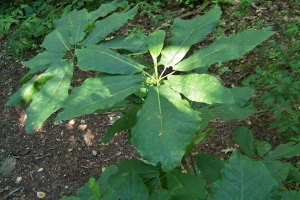
Frazier Magnolia
I set up several videos of me climbing (I just admitted to a selfie! I will not let this become a regular event and certainly not an addiction. I must keep this under control.) You may check them out by clicking on the names below. It will be immediately obvious that I’m no rockstar, but I enjoy the challenge, nonetheless:
Chainsawleft
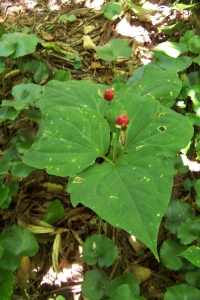
Trillium fruiting
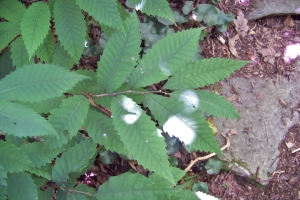
American Chestnut “bush”
After bouldering around until my forearms were quite tired, I walked up to the top of the ridge, sat down, took in the view, ate lunch, and read my Bible. Actually, when I first arrived up top I lay down on the bouldering pad a prayed for awhile. There was such a rest in telling my Father all my burdens about work, family, and internal stress. I have been enjoying, not just tolerating reading Leviticus and Numbers. Numbers 2 and 3 seem like lists of camp arrangement and numbers of fighting men, and numbering religious servants, but they reveal several things about God’s character. He is orderly and efficient and given to detail. The arrangement of Levites reveals His concern for His holiness among the people and grace to not destroy them with His fierce justice. The taking of the Levites in place of the firstborn and the redemption of 273 additional Israelites by a gift of five shekels each reminds us of the depth of our sin problem and the gloriousness of God’s solution in salvation. The more I read the Pentateuch (Genesis to Deuteronomy) the more I feel like Jesus is repeating Himself when He points to God’s holiness and the Law. As a man did He have “aha!” moments of learning the Word from His parents or the synagogue teachers, moments when He said, “I remember saying that.”? All of His Word speaks of His character and what is important to Him. Are we bored with it because we have little passion for knowing Him and what He cares about? Knowledge of Him is our ultimate goal here. Beautiful days in the mountains and hard days of difficulty or frustration are profitable and meaningful if we allow them to direct us to knowing Him more. Yeah, I prefer one over the other but I am slowly learning to muse, “Hmm, I wander how this situation may draw me closer to Him?”

House Fly

Shining Clubmoss (or Shining Firmoss) Huperizia lucidula (Thanks for the ID help Sister L)
The view up top increased my enjoyment of my time concentrating on God. He created all of the beauty around us to remind us of His beauty and the enjoyment we may have from these gifts from His good hand.

Left to Right: Table Rock, Hawksbill, Gingercake

Exceptionally Beautiful August Day
Posted in Beauty, Climbing, General, God Thoughts, God's Word, Outdoors, Photo | Tagged attributes of god, Beauty, Climbing, God Thoughts, God's Word, Outdoors, Photos, purpose in life, Relationship | Leave a Comment »
August 15, 2015 by creatorworship
Culture is an odd and interesting phenomenon. Though the word has now been co-opted to refer to interaction in a business office, the more traditional definition looks more like the http://www.merriam-webster.com first entry: “the beliefs, customs, arts, etc., of a particular society, group, place, or time”. Therein is the oddity and interest. That is a very broad definition trying to capture all that goes into a culture. You can mix and match the first three terms (and the “etc’s” for that matter) with any combination of the “particular” last four terms. Try for instances this combination that helps to explore a situation our tour explored in Peru: ‘art of a particular society in transition through time‘.

Pressing out the air bubbles

Glazed and painted and drying in the sun in readiness for the second firing
We toured the Seminario Ceramicas in Urubamba of the Sacred Valley of the Incas. The head potter, Pablo Seminario, along with his wife the head painter, Merilu Behar, developed a style of glazed and decorated pottery that has elements of ancient Peruvian cultures and modern stylistic exploration. The style was further developed by the isolation necessary for survival during the Shining Path insurgence of the 1980’s. One motif that the potter declared to me that he finds ever new is the shape of the arrowhead. As he said, “It was a tool for gathering food…is similar to the water drop or a leaf”. So Pablo continues to explore splashes of modern creativity mixed with hints of ancient continuity.

Moderno-paleo creations
I was temporarily separated from my tour group because I was taking some pictures in this gallery of creations of the artist. When I exited the room outdoors I didn’t see anyone. I assumed a whole group could not have gone far in a minute so I went to the nearest doorway. When I entered, there was Pablo wielding a small carving tool on a large arrowhead. Realizing I had entered his private studio, I began to back out but he waved me forward, not even slowing the pace of his work.
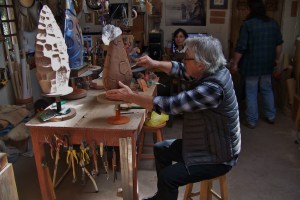
Pablo manifesting a new vision of the arrowhead
For the next 10-12 minutes we amicably discussed the creative process. He seemed to be quite interested in talking with me because I had brought students to tour Peru and because I talked intelligently about art and science. I asked several questions about how he begins a concept and carries it out. One question involved the arrowhead, “You obviously like to make arrowheads. Why did you start with it and why do you continue with it now?” He related the request from an art exhibit many years ago that he combine modern and ancient elements of design. This request caused him to reflect on the usefulness and ubiquitousness of the arrowhead shape he noticed in nature as quoted above. He continues to see new things in the shape and strives to continue to grow and so pursues more content in the arrowhead. This discussion led to me commenting on how one should be thankful to the Creator for instilling the gift of creativity. He retorted that it was far more work than creativity. I countered that the work is necessary but without merit if the person lacks the creative ability; each of us should work to develop the gift we have. The waste of potential that he sees as an artist and I see as a science teacher consumed some of our interaction. We also interacted over the similarities in science and art, how each involves elements of the other, and how both center around the abilities to think and work hard. It was one of those moments when we both knew that we had connected in a meaningful way even though before that moment we had been total strangers from different cultures pursuing different vocations and avocations, separated by different worldviews. Our connection was musing on life, its processes, and its meaning.
His life had been one sufficiently isolated from the insanity of the violent culture around him in order to survive and thrive, and yet not isolated from creative interaction, as his collaboration with his wife and 50 potters and painters in training attests.

Decorating the forms with Inca symbols

Main Gallery
I think that in this discussion and on this trip I discovered a more complete reason for why I like to travel. It extends my musing on life through observation of diversity in nature, culture, thinking, history, distance, science, people, God’s work in the world, and a host of other providential allowances given by a good Creator. We want to see beauty and substance and understand its meaning and purpose. But many are not willing to wade through the meaning of ugliness and triviality to reach the beauty and substance that does not lend to their preconceived ideas of what it should mean. I agree with Socrates, “The unexamined life is not worth living”. Don’t be afraid to examine yours and others and risk having to change what you hold dear for what is true and good and beautiful and full of substance.
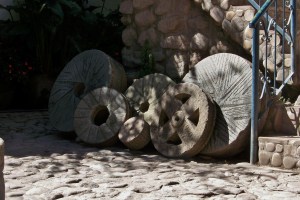
Contrasts of Hues and Properties

Courtyard Beauty of Seminario
Posted in Beauty, Cultural commentary, General, Photo, Travel | Tagged Beauty, Cultural commentary, Photos, purpose in life, Travel | Leave a Comment »
July 26, 2015 by creatorworship
From Ollantaytamba the train winds down the ever narrowing and deepening gorge toward Machu Picchu. The trip takes 1:45 including a few short pauses on siding for passing trains. The gorge only has room for the river and the cut for the train in many places where an extended arm would literally touch the jagged rocks of the cut. Some of the rapids are intense looking and the vegetation slowly increases in density, height, and variety from semi-desert to cloudland rainforest. Students in their uniforms and farmers in their work clothes were headed to school and field. Terraces still hold corn and grazing animals.

I spent most of my time looking out of the windows.

The Whole Tour Group at the first good view of the city

The Narrowing Urubamba River Gorge

Terraces still used
The village of Machu Picchu is not more than 100 m wide and is cut in two by the Urubamba River and the railroad. Densely vegetated cliffs rise easily 1500 feet on either side. I find the topography the most amazing characteristic of the village and the ancient site. Machu Picchu is a UNESCO World Heritage Site visited by over one million people each year. Many details about the construction, location, and history of the site are amazing. Being in a rainforest, the Inca engineers provided it with a subterranean drainage system without which it would have long since eroded away. The temple and Inca rulers’ structures are built of the smooth, fitted stones that are earthquake resistant and yet the Temple of the Sun is slowly splitting apart due to a minor fault line that extends across the concave city green. A wire stretched across the green from one side to the other and made taut by a weight and measured by an instrument indicates that the green is expanding by a few millimeters per year. A quarry on the brow of the ridge was the source of the building stone.

Inca Trail (25 miles to the Capitol Cusco)

Main Gate to the City

Temple of the Sun has a fault

Living and Working Spaces
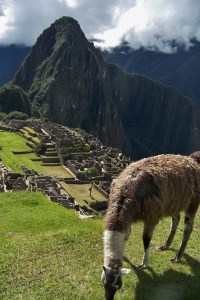
Llamas wander throughout the site

Steep Real Estate (note the archaeologists in blue)

Chinchilla Chillin’

Huayna Picchu overlooks the ridgetop city
Hiram Bingham, the Yale historian who revealed Machu Picchu to the world in 1911, was not the first person of European descent to explore the terraces and temples. It was not the Spanish who saw it though, for they never found it. Why? It had been abandoned before they came and conquered the Inca. The actual reason for its abandonment is unknown but the well worn theories about religious, political, or military causes are not very convincing. Our trained Peruvian guide seemed to think that the evidence of syphilis in the bones of some buried at the Temple of the Condor suggests that an epidemic caused the inhabitants and would be inhabitants to forsake the city. It seems most plausible to me since the Spanish never seemed to have even heard about it. Their writings make no mention of its existence. Also, syphilis was a new world endemic disease before Europeans arrived. Epidemic levels of syphilis result from a sexually debased society. A mere 10 years of abandonment would have been sufficient for the jungle to cover all evidence of its existence. Hiram Bingham would not have found it if farmers had not shown him exactly where it was and had several terraces cleared for farming. The Europeans who discovered it before the American were treasure hunters who did not want Peruvians or anyone else to know they had come and gone.

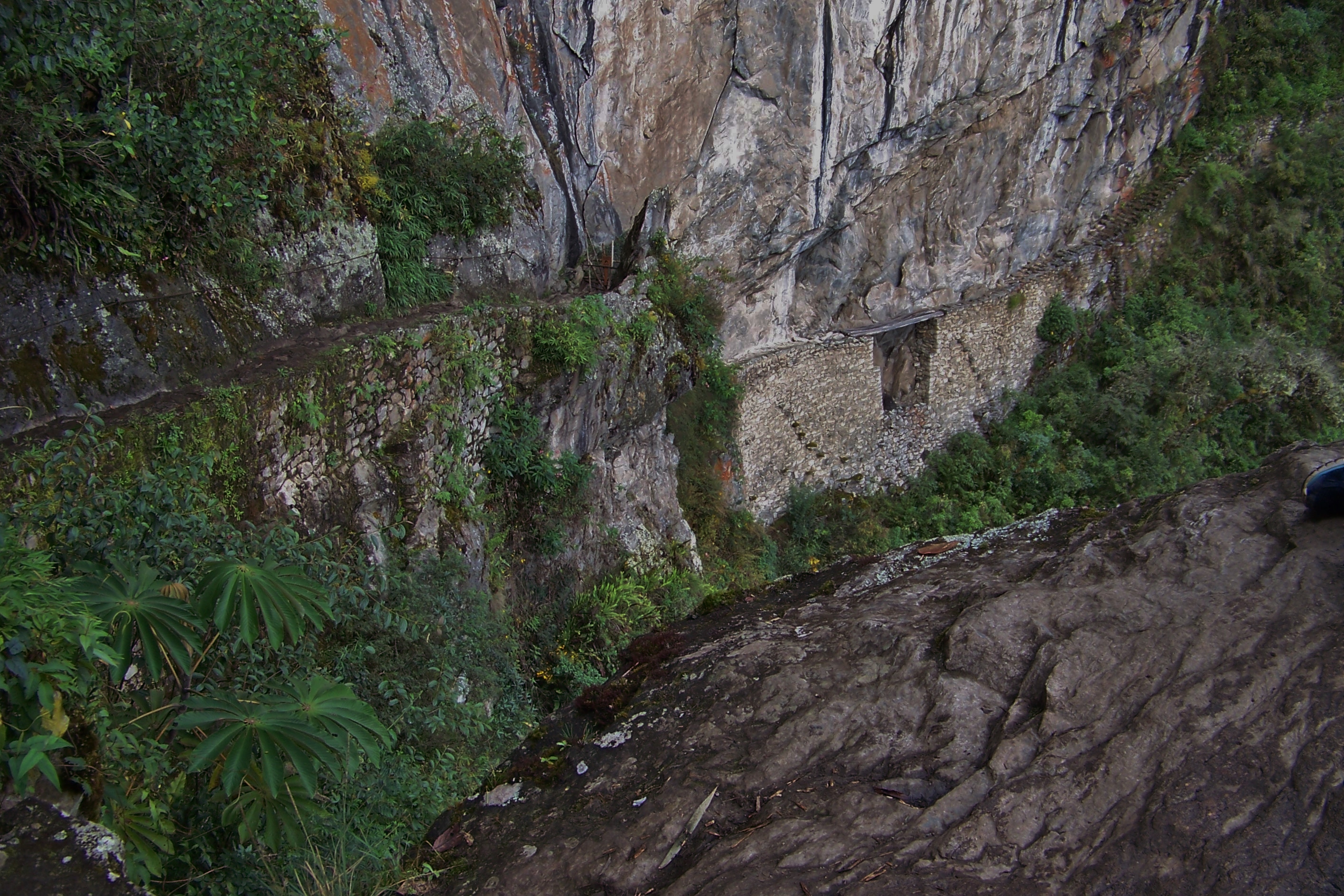
Inca Bridge-a secure gate against an enemy who never came.

Farmers were in good shape
Built in about 1450 and abandoned before 1520, the 140 stone buildings of a construction project in progress testify to both the semi-permanence and futility of all that we do apart from God. Syphilis, war, superstition, drought, or whatever caused the peoples of Machu Picchu to leave give testimony to the ultimate powerlessness of an empire to perpetuate control and forego God’s judgment on evil practices. If we assume that empires and culture are simply short-lived because that is the way it must be, then we fail to remember that this world is fallen and it did not have to be that way. God did not create life for death; man chose death. The enemy is not outside the gate but inside the heart.
Posted in General, Outdoors, Photo, Travel | Tagged Outdoors, Photos, Travel | 1 Comment »
July 12, 2015 by creatorworship
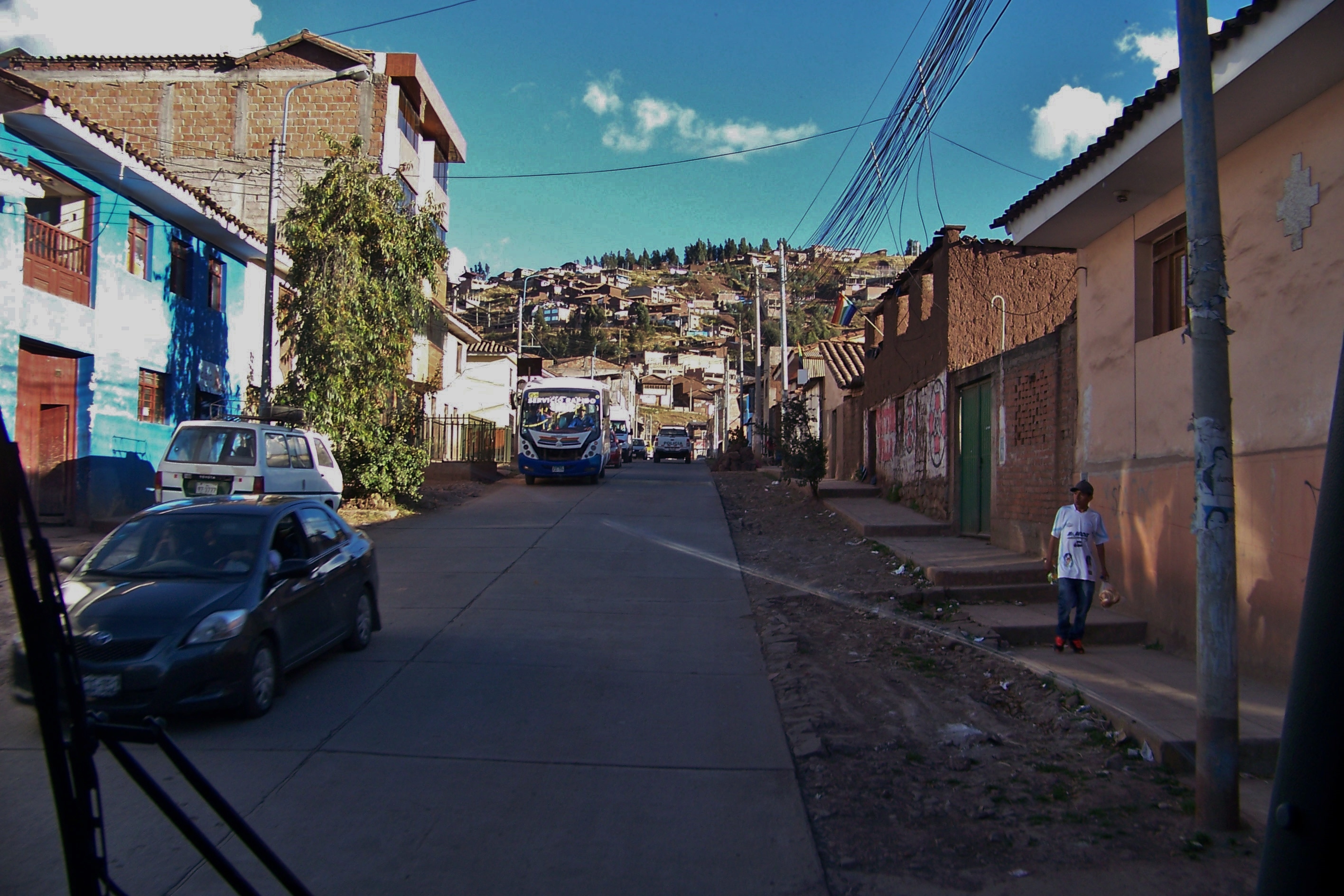
In the late afternoon the bus labored up the steep, windy streets out of Cusco onto a highway and through a gap into a increasingly rural setting. The highway wound from there ever down through a steep-sided valley with occasional leveler spots where villages cling to the side of hills. Chencheros is one such village with walled adobe courtyards along both sides of its streets and no appearance of significant prosperity or poverty. The bus stopped at an open gate in one of the 7 to 8 feet walls. Here is a tourist market for the woven goods of the village, a village where the real things are made. A short distance beyond the gate are pens for llama and Guinea Pigs, the latter having come over from Africa many centuries ago are now a food delicacy and a source for fine wool. Further in young and old Quechua women were weaving various textiles and a pavilion was setup for the demonstration of cutting, washing, carding, spinning, dying, and drying yarn. Leaves and roots provide for many colors but the most fascinating is the Cochineal insect that inhabits cacti of Latin America that provides deep, crimson red colors. The woman demonstrating crushed the white remains of one she had dug out of a prickly pear cactus fruit between her thumb and forefinger. Swirling the contents into her palm revealed the deepest, purplish red. Boiled in water with the yarn these produce a very permanent dye.

Leaving Cusco
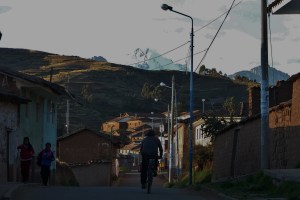
Moving Upward

Wool on Hoof

Cutting, washing, carding, spinning, dying, drying

Weaving Alpaca Wool
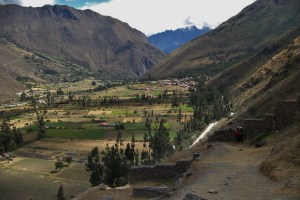
Sacred Valley Downstream of Temple Site above Ollantaytamba
Dusk was upon us as we left Chencheros.
It was time to head down to Urubamba.
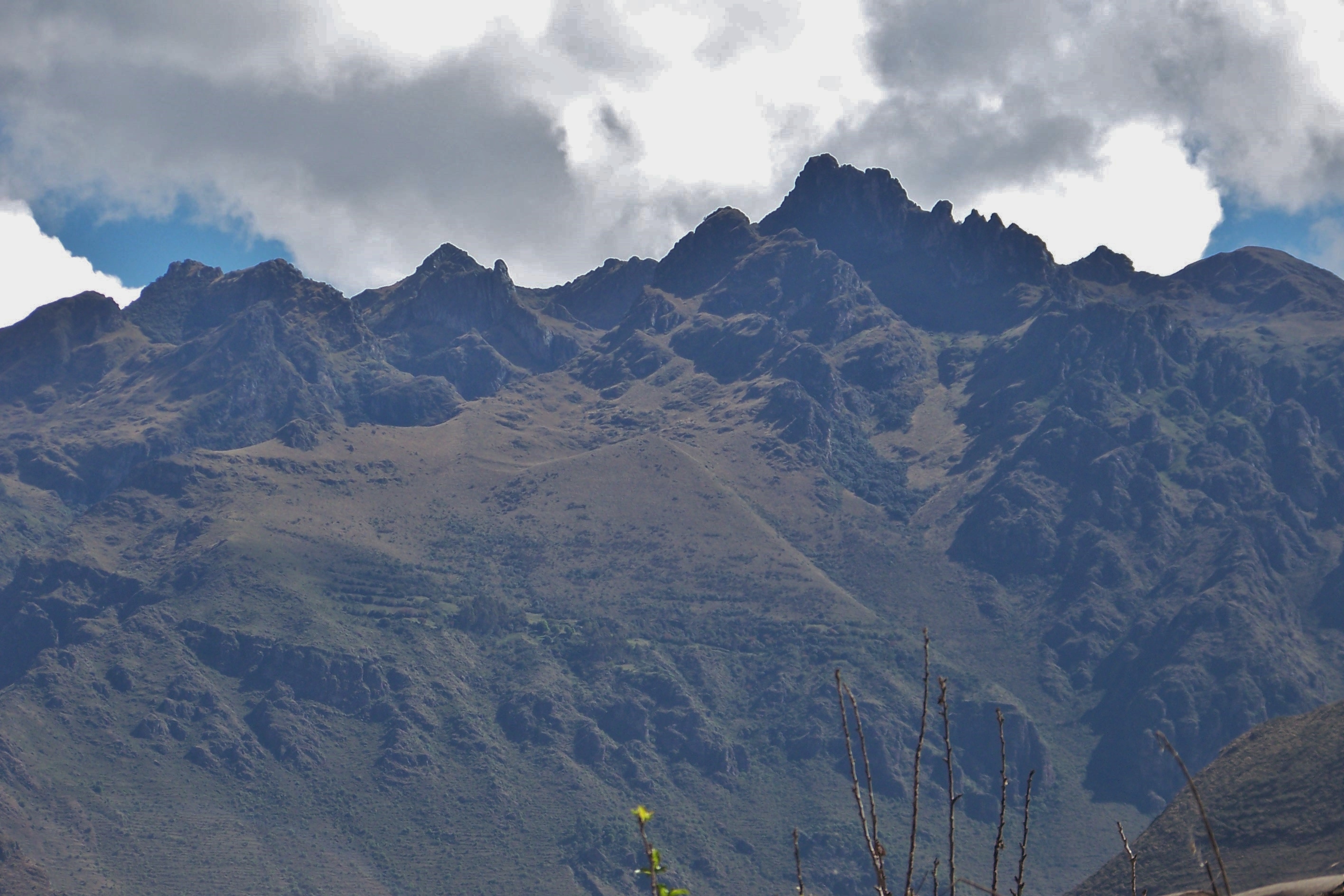
I saw a most beautiful sight as the bus cruised across the upper reaches of the Sacred Valley of the Incas. A high, rugged peak to the west combed the rays of the setting Sun into golden strands while a sliver of the Moon looked on from the deeply violet background. A picture would have trouble doing the scene justice even if I could have stopped and attempted a time exposure, much less my words, for it was profoundly beautiful. By upper reaches of the valley I mean that it is much higher than the part down by the Urubamba River. As the twilight dimmed we came to a set of switchbacks 1000 feet above the provincial capital of Urubamba, shining by electric lights in the dark valley below, while the snow capped peaks loomed darkly above pressing down on the small village below.
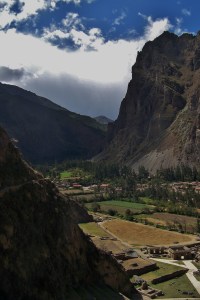
Peaks ‘feel heavy’ on the small valley below
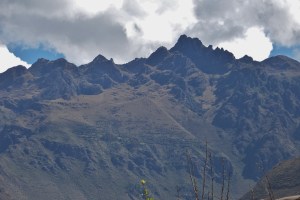
Peaks to Comb the Sun’s Rays
The next morning we headed further downstream to the village and temple site at Ollantaytamba. The temple site has pottery and stonework evidence of pre-Inca terraces and temples. The Incas never finished their temple site here because the Spanish interrupted their 100 year empire and building spree. This fact actually left abundant evidence for how it was being built. Boulders of the acceptable type to the builders (gray basalt) were quarried several thousand feet upslope on the other side of the valley and rolled down. The Urubamba River was divided into two channels by a central levee and half at a time blocked off so the blocks could be pulled across half the river at a time. A ramp on the near side of the valley provided the route up to the temple site. It was perhaps a 9% (~5 degree) slope. We were told that experiments with a 1 ton block required 180 men to drag across smooth, rounded stones lubricated with wet clay up such an incline. The estimate was that 2000 men would have been needed to pull some of the blocks resident to the site!

Ollantaytamba Temple site, terraces, and village

Temple of the Sun at Ollantaytamba with quarry site in the background
While we were at the temple site the local tour guide was telling us about the various foci of Inca worship: sun, moon, stars, earth, water, the underworld, fertility of land, animals, and wives, and more. Solstices, equinoxes, planetary conjunctions, and the like were times for worship. In their pantheon of gods and means of worship they recognized the invisible god who created all things. At this temple site they believed that this god had left them a representation of himself in the rock formations across the valley. They built a small, four parapet structure on top of this formation as a crown. Why with all of their worship of created things did they recognize an invisible god, utterly different from all of their other objects of worship? But remember what Paul said to the men at Lystra who tried to worship Barnabas and him: “We…preach the gospel to you that you should turn from these vain things to a living God, who made the heaven and the earth and the sea and all that is in them. In the generations gone by He permitted all the nations to go their own ways; and yet He did not leave Himself without witness, in that He did good and gave you rains from heaven and fruitful seasons, satisfying your hearts with food and gladness.” (Acts 14:15-17) What was this witness that He left? What the text lists is the very things that the Inca culture worshipped, physical sources of life. And God left further witness: “The heavens are telling of the glory of God; and their expanse is declaring the work of His hands. Day to day pours forth speech, and night to night reveals knowledge. There is no speech, nor are there words; Their voice is not heard. Their line has gone out through all the earth, and their utterances to the end of the world. In them He has placed a tent for the sun, Which is as a bridegroom coming out of his chamber; It rejoices as a strong man to run his course. Its rising is from one end of the heavens, and its circuit to the other end of them; and there is nothing hidden from its heat.” (Psalm 19:1-6) All that those priests were worshipping in the ridge top temples were witnesses to the very God they acknowledged exists but did not worship. How could they have known of His existence? Was it a long forgotten tradition? Perhaps it was but it need not be. They may have figured out the evidence: “…that which is known about God is evident within them; for God made it evident to them. For since the creation of the world His invisible attributes, His eternal power and divine nature, have been clearly seen, being understood through what has been made, so that they are without excuse. For even though they knew God, they did not honor Him as God or give thanks, but they became futile in their speculations, and their foolish heart was darkened. Professing to be wise, they became fools, and exchanged the glory of the incorruptible God for an image in the form of corruptible man and of birds and four-footed animals and crawling creatures.” (Romans 1:19-23) Wow! The object of their worship became the snare that prevented them from worshipping the true God that all of those things clearly pointed to. This perspective on their knowledge and lack of worshipful acknowledgement of God helped to inform my understanding of all that I saw of Inca culture in Peru.

Unfinished Entryway
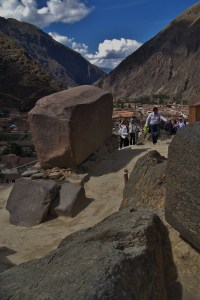
A Block left just short of its destination

The ancient way still practiced
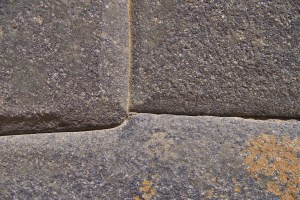
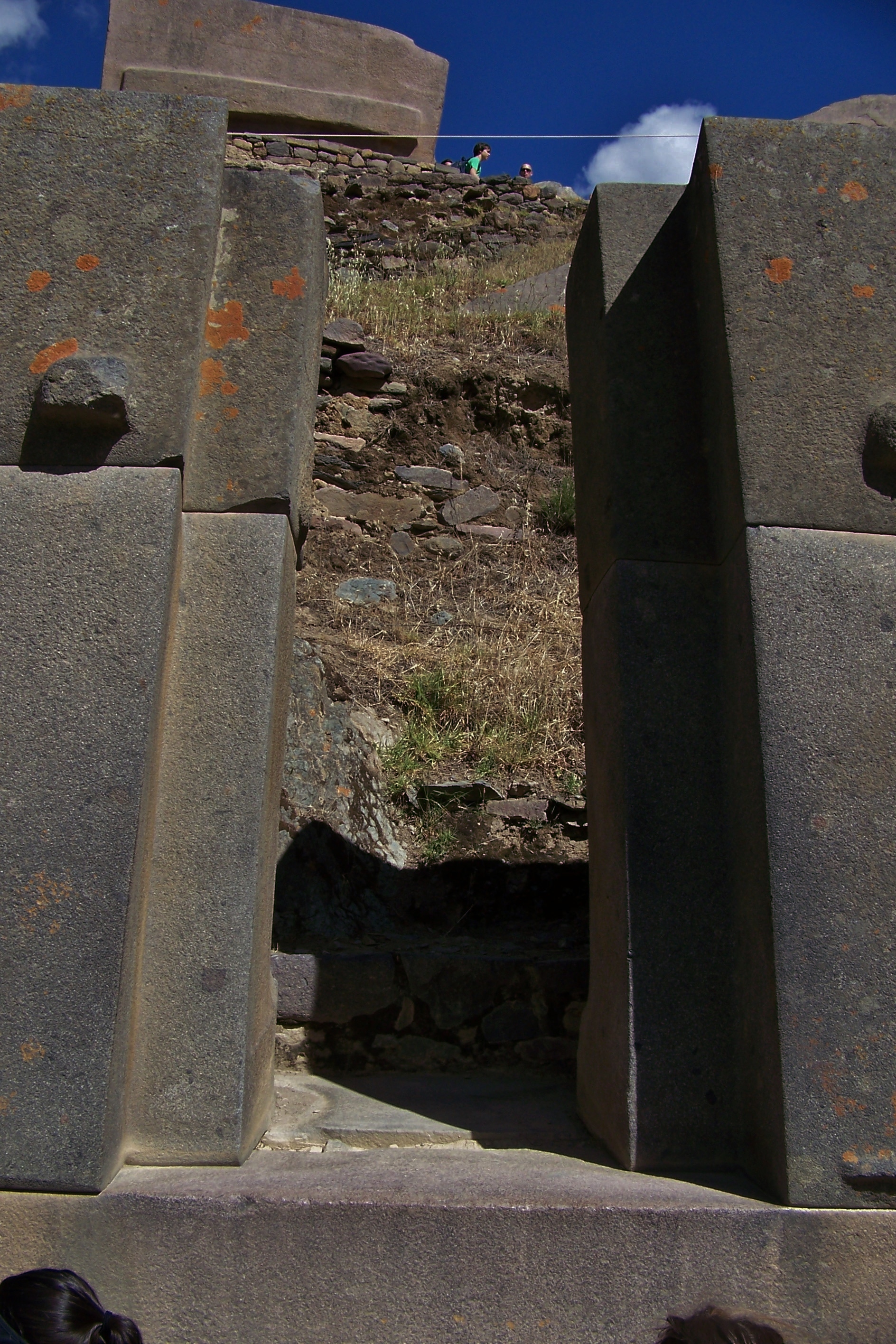
No cement, no gaps, highly earthquake resistant, not eternal
If you care to come along I will explore another strand of this thought in the next Peru entry on Machu Picchu. Until then, blessed truth hunting.
Posted in General, God Thoughts, Photo, Travel | Tagged attributes of god, God Thoughts, Photos, Travel | Leave a Comment »
July 7, 2015 by creatorworship
An American educated Peruvian named Rafael Larco Hoyle opened a museum of Pre-Columbian pottery in 1925 after his father gifted him 600 ancient pieces of pottery and his uncle suggested a museum should be set up. For the rest of his life Larco added to his collection which is now the Museo Larco tesoros del antiguo Peru. [tesoros- “treasure”] There is evidence of 43 Pre-Incan cultures who were sophisticated metalworkers and weavers and farmed and hunted arid and semi-arid landscapes successfully.

Earrings

Weaving

Royal Decorations

Amazingly Lifelike

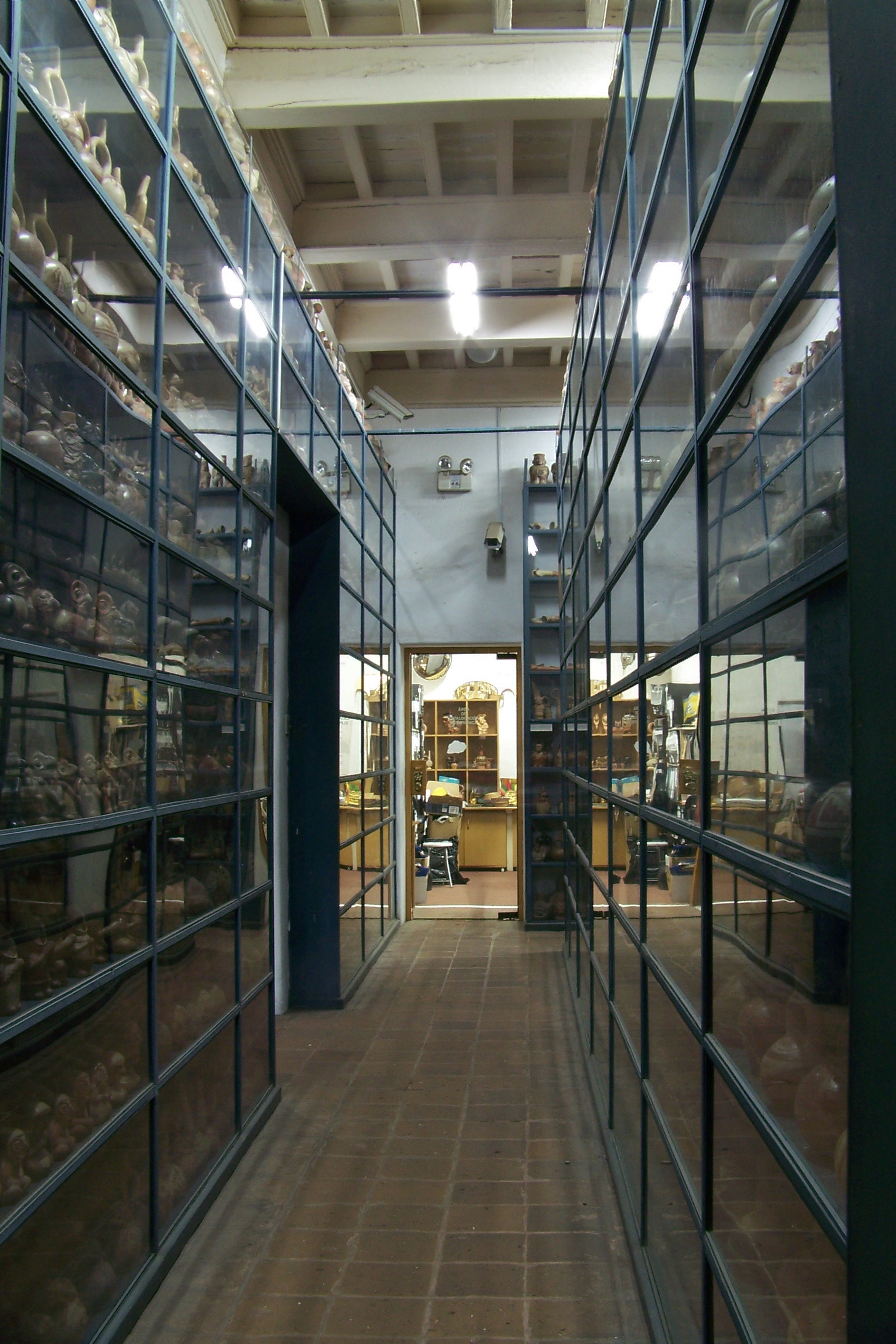
A Small Part of the ‘tesoros’

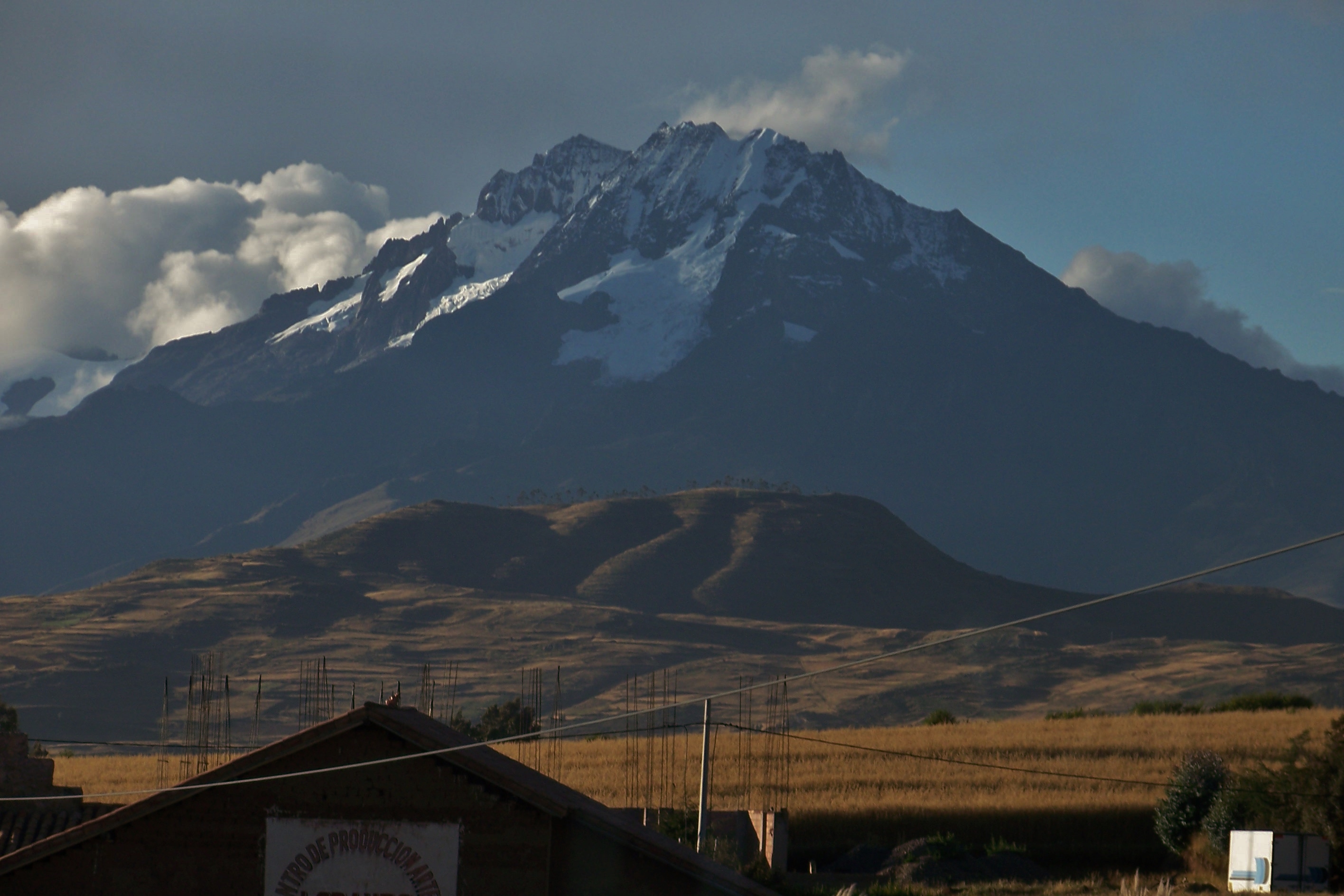
Possibly Cerro de Salantay west of Cusco
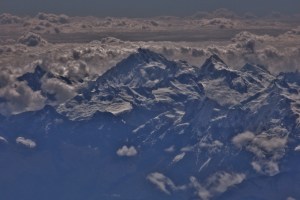
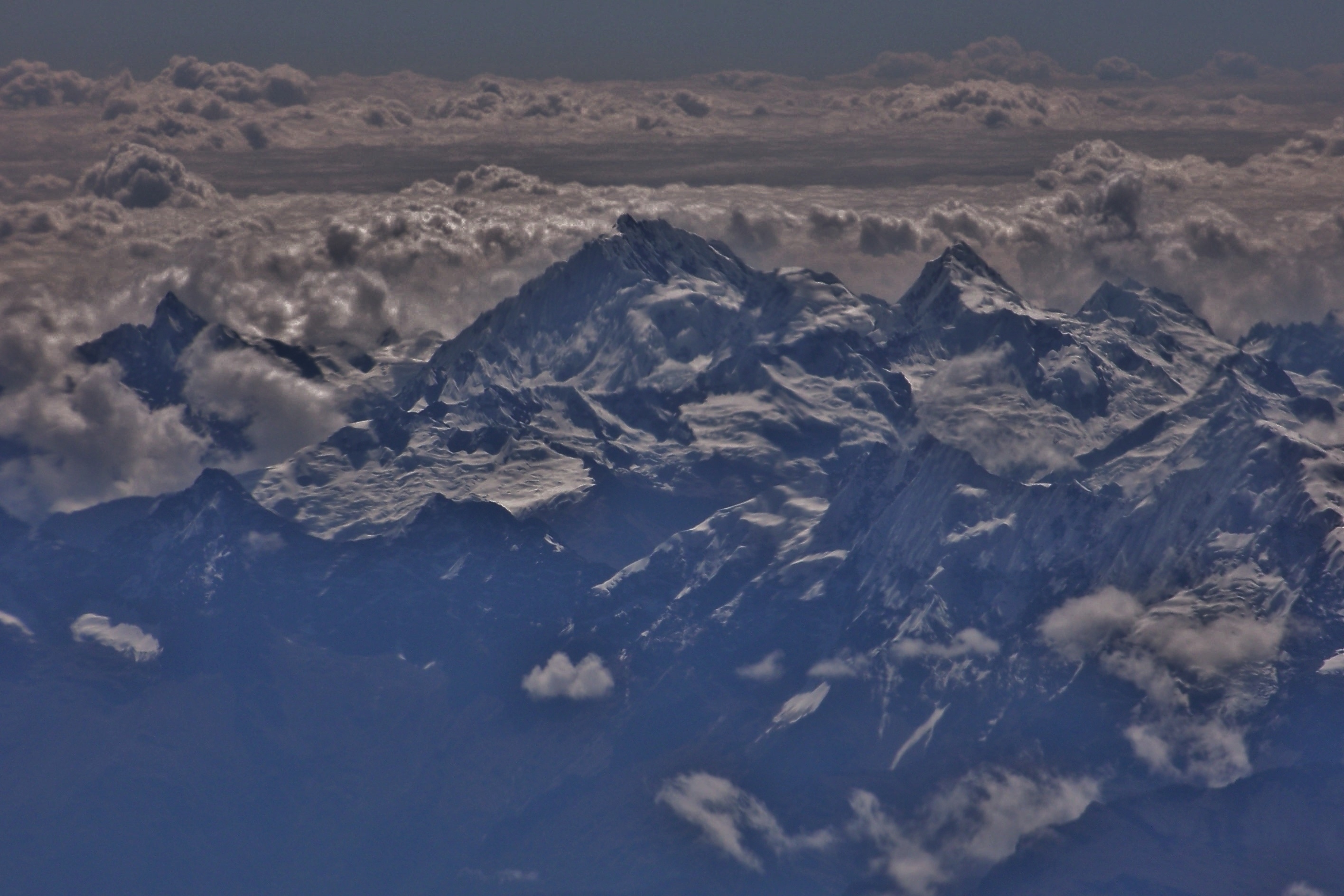
Flight from Cusco to Lima
The Andes Mountains beyond Patagonia are little considered as significant mountains by most North Americans and yet Peru features 9 peaks over 20,000 feet.
Salantay, which is west of Cusco standing 6271 m (20,574 ft.), waters much of the area of the Sacred Valley of the Incas by its melting glaciers. Without these glaciers a large part of Peru would be barren. Flying into Cusco, the one time capital of the Incas (kings of the Quechua), is impressive. The airplane has to snake its way in between high mountain peaks all around and drop fast to land at 11,000 feet. The air is crisp and dry. A certain smell persisted the first half an hour until I was used to it. I finally figured out it must be the smell of ozone that forms at higher elevations. You quickly learn that the sunny side of the street is just barely uncomfortably warm while the shady side of the street requires a sweater if you are not active. Sunscreen or a covering hat is advisable.

A Higher Plain (~11,000 ft)
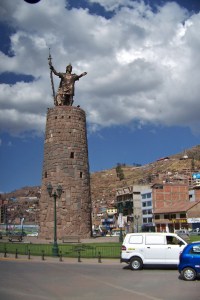
Welcome to Cusco, Royal City of the Incas
Watch next time for forays into the Sacred Valley of the Incas.

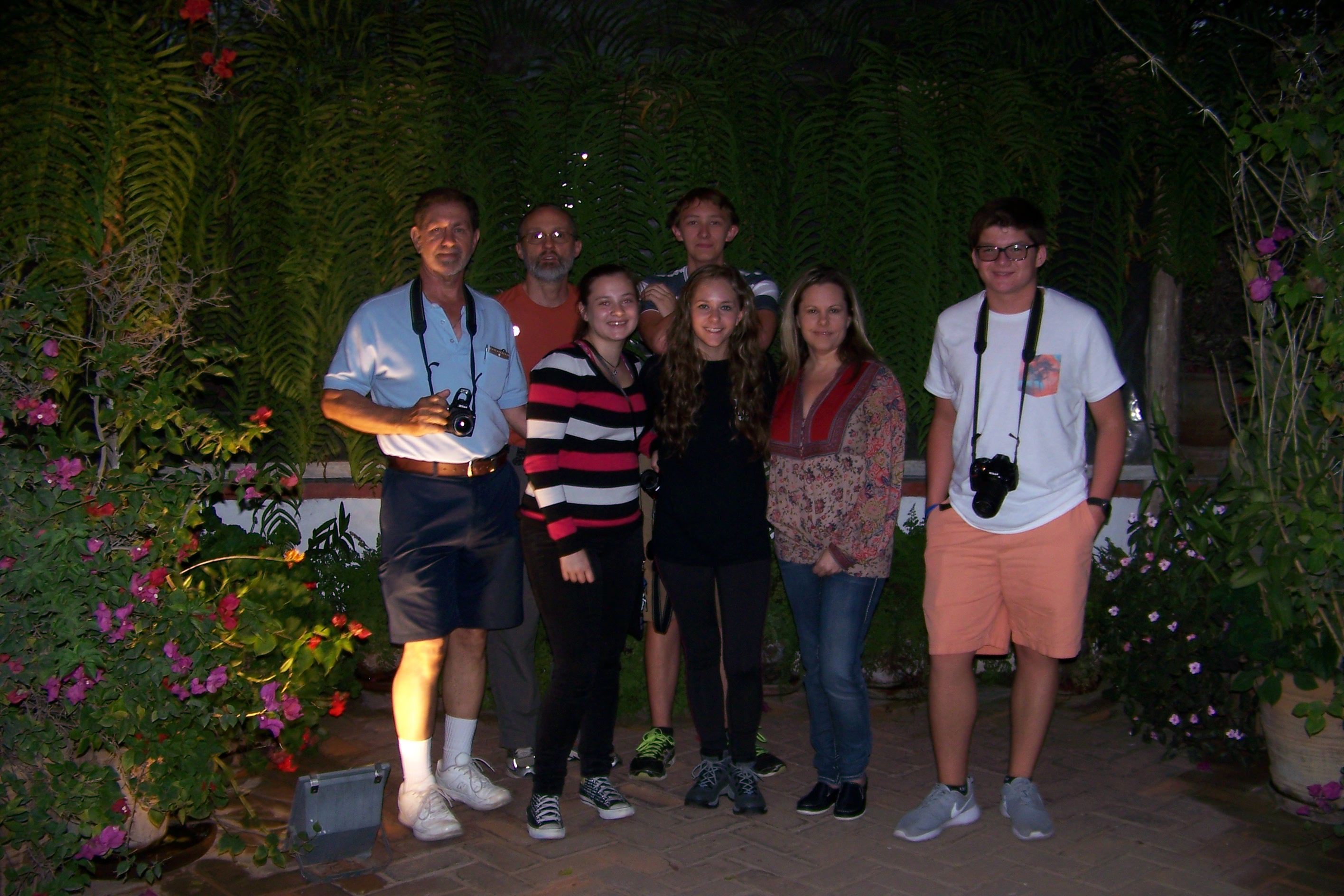
Traveling Buddies
Posted in General, Photo, Travel | Tagged Photos, Travel | Leave a Comment »
July 2, 2015 by creatorworship
A blog titled this way could take many paths through Scripture and personal experience. This entry will only be an abbreviated sequence of thinking that occurred to me while reading about anointing oil and incense for the tent of meeting in Exodus 30 expanded with Scripture references.
God has appeared in the cloud and spoken to the sons of Israel from Mt. Sinai, scaring them sufficiently for them to plead with Moses, “Speak to us yourself and we will listen; but let not God speak to us, or we will die.” Exodus 20:19 But it did not scare them enough to serve the purpose for which Moses said that God spoke for: “Do not be afraid; for God has come in order to test you, and in order that the fear of Him may remain with you, so that you may not sin.” Exodus 20:20 The evidence of course is Exodus 32 when Moses is up on the mountain: “He [Aaron] took this [gold] from their hand, and fashioned it with a graving tool and made it into a molten calf; and they said, “This is your god, O Israel, who brought you up from the land of Egypt.” (v.4) The rapidity with which the Israelites turned away from God is both amazing and frightening, but it pales in comparison to what Aaron, the recently consecrated and anointed High Priest, did by way of directing and encouraging their sinful passions. There is much warning to be taken from this scene. Rather than a rabbit trail about our sinfulness, I see this as the fuller context for the comments I want to make about God.
God knew their tendencies and even warned them to watch out for them by giving them a scare at Mt. Sinai.
So what is God saying to us about worship of Him?
Is He ‘pleading’ with us to worship Him as though He will be lacking and sad without it. No, God is not in need of anything we possess or can give, as Psalm 50 says,“Hear, O My people, and I will speak; O Israel, I will testify against you; I am God, your God. I do not reprove you for your sacrifices, and your burnt offerings are continually before Me. I shall take no young bull out of your house nor male goats out of your folds.
For every beast of the forest is Mine, the cattle on a thousand hills. I know every bird of the mountains, and everything that moves in the field is Mine. If I were hungry I would not tell you, for the world is Mine, and all it contains. Shall I eat the flesh of bulls or drink the blood of male goats? Offer to God a sacrifice of thanksgiving and pay your vows to the Most High; call upon Me in the day of trouble; I shall rescue you, and you will honor Me.” (v.7-15)
Is He ‘expecting’ us to worship Him? In the sense of an expectation placed upon us I would say yes, but in the sense of surprised if we don’t, I think not.“You men who are stiff-necked and uncircumcised in heart and ears are always resisting the Holy Spirit; you are doing just as your fathers did.” Acts 7:51 “Nothing really changes; everything remains the same. We are what we are ’til the day that we die,” sang Larry Norman. God knows the true nature of our hearts. “But Jesus, on His part, was not entrusting Himself to them, for He knew all men, and because He did not need anyone to testify concerning man, for He Himself knew what was in man.” John 2:24-25
Is God “demanding” that we worship Him? No, He has left us with free will to the extent that we do what we always want to do, namely turn away from Him, for “All of us like sheep have gone astray, each of us has turned to his own way; but the Lord has caused the iniquity of us all to fall on Him.: Isaiah 53:6
Instead, I think the Scripture is saying that God is ‘commanding’ us to worship Him. He is worthy of worship, as Psalm 29:2 says, “ascribe to the Lord the glory due to His name”. Worship of God is also beneficial to the worshipper: “Sing for joy in the Lord, O you righteous ones; praise is becoming to the upright.” Psalm 33:1 “‘I will lead him and restore comfort to him and to his mourners, creating the praise of the lips.
Peace, peace to him who is far and to him who is near,’
Says the Lord, ‘and I will heal him.’” Isaiah 57:18-19 Worship trains the next generation for worship of God: “We will not conceal them from their children, but tell to the generation to come the praises of the Lord, and His strngth and His wondrous wondrous works that He has done.” Psalm 78:4
Give praise to God for Who He is; praise Him for the glory and efficacy of His name; praise God for His wonderful works in creation and beneficial works in salvation through His Son Jesus Christ.
Posted in General, God Thoughts | Tagged attributes of god, God Thoughts, Worship | Leave a Comment »
June 27, 2015 by creatorworship
For 8 days four of my students, a mother, a grandfather, and I learned about culture and history, and observed wonderful beauty of the unique and diverse country of Peru.
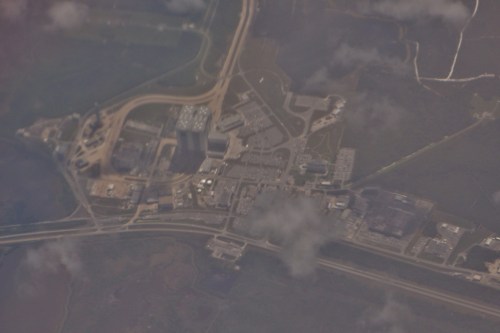
Launch Complex 39 Assembly Building
But first we had to get there. The flight from Charlotte to Miami flew right over Kennedy Space Center at Cape Canaveral. Looking out the window for a glimpse of the coast now and then, I looked at just the right time to see Launch Pads 39A and B. At 36,000 feet the 10 story Assembly Building and trackway to the launch pads look like diminutive LEGO constructions. I was surprised by the airport code for Miami-Dade International – MIA. That means something else to me, but I must confess that layovers in airports can feel just like what I thought that codes means.

Stain Glass in Lima
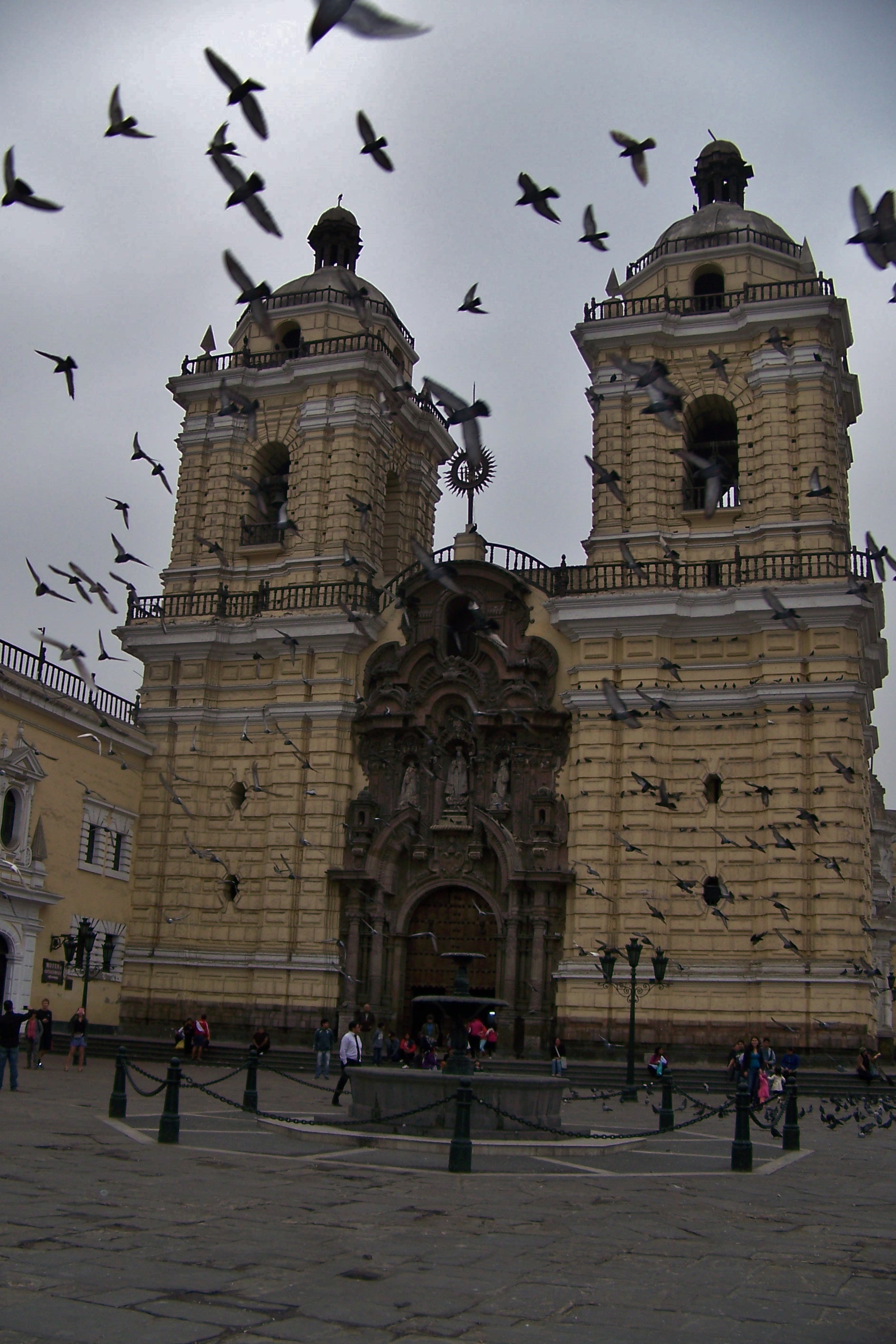
Because of clouds I did not see land again until we turned to make our approach on Lima. I must confess that big cities are a bit intimidating, stressful, and dirty to me. I like people but not so many at once. Lima has its own differences. At 10 million people, it constitutes a full 1/3 of the population of Peru. One native told me that this proportion was largely a result of people escaping the Shining Path during the 1980’s and 90’s. Because of cold ocean currents offshore Fall and Winter are almost entirely cloudy and rainless. This combination results in a dreary, humid, polluted, pleasantly cool climate with very little variation at night. How so many people have enough water from rivers flowing from the mountains is amazing to me. Downtown Lima has numerous churches. Most of the ones I went into on this trip disallow pictures, but I did get some in a basilica near our hotel.

Statue and Hotel of Bolivar on the Main Square
The two heroes of independence in Peru, Jose de San Martin and Simon Bolivar, figure in numerous statues and place names in Lima. San Martin proffered partial independence in 1821 and Bolivar completed the task in 1824. Two other tumultuous periods figure largely in the abbreviated Peruvian history that I received: The War of the Pacific (1879-1883) and The Shining Path Insurgence (1980-~2000). During the former, Chile seized territory from both Peru and Bolivia over a mining treaty dispute via naval and desert battles. Peru lost three ports and Bolivia lost access to the ocean. A tour guide explained that the most northerly port city was returned after 10 years by referendum. The Communist Party militant arm, The Shining Path, committed many atrocities in an attempt to gain control of the government. Desperate times require desperate measures, so that President Fujimori from 1990 to 2000 committed atrocities of equal if not greater intensity to rid the country of this scourge. He succeeded and failed; he is now in jail in Peru.

Kennedy Park (“Park of the Cats”)
After hostilities calmed down I am told that Peru experienced a period of phenomenal economic growth, the best in South America until a few years ago. One reason may be the large number of government employees. Every park and sidewalk has workers who sweep, wash, plant, water, weed, in a word, beautify, and the same spaces have provincial and national police.

Peruvian National Police

Beautification Committee

Construction and Prosperity

Shine and Decline
The view from our hotel window told a variable story of economic stability. Even in the downtown area many building are in decline while others shine.

Franciscan Monastery
A Franciscan Monastery that we toured was more interesting to us for what was under it than what was in it. When the archeologists were allowed to survey the catacombs in the 1990’s they carefully estimated that 25,000 people had been buried there. Bones and skulls in every compartment and such superior structure as has survived several major earthquakes. The tour guide pointed out a “well” said to be 10 meters deep in bones. Everyone wanted to be buried under the church. Believing in the invisible church as the actual body of Christ, many of these bones will not arise at the resurrection, but the magnitude of this scene gave new meaning to the excitement on resurrection day- bring it quickly, Lord Jesus.
Next time I want to discuss the Larco Museum of Archeology in Lima and the flight and first impressions of Cusco. (Note: I find it nearly impossible to orient the text and pictures just as I want them. Oh well, hope you enjoyed my discoveries anyway.)
Posted in Cultural commentary, General, Photo, Travel | Tagged Cultural commentary, Photos, Travel | 2 Comments »
June 11, 2015 by creatorworship
Humility should always be donned by a Christian. We were sinners; we are sinners saved by grace; we will one day not be sinners by the grace of God. Oh, that I could communicate by words and deeds a life of repentance and trust, repentance and trust.
Ups and downs and all arounds
The days go rolling by
No matter all the times we fail
We must again retry

Thank your God or take the rod
A smile or else a cry
Repent, forgiveness will prevail
Joy replaces a sigh

Trust Him now and so learn how
To overcome the lie
That Spirit's power has no avail
To cause the flesh to die

When upside down makes you frown
Recall God is on high
No matter what may you assail
He is all your supply

Jesus died to sin applied
Believe, do not deny
His power over death and hell
One day to heaven fly
Posted in General, Poem, Sustaining, Work of the Holy Spirit | Tagged Poems, Sustaining, Work of the Holy Spirit | Leave a Comment »
June 8, 2015 by creatorworship
We must have a reason to learn
To foster judgment and discern
For thinking is very hard work
With little immediate perk
Many think good jobs are enough
Or just persist when things get tough
Make it more relevant they say
Or guided self-learning and play
No doubt these have some benefit
But why do many tend to quit
Lose interest and totally bored
Wild speculation, truth ignored
Learning is a moral issue
It must be based on what is true
All for God’s glory to pursue
Seeking righteousness to renew
Then can learners not get enough
Persisting long and hanging tough
Pursuing what is right and good
And helping others as they should
Even short of this lofty goal
All people need food for their soul
Orient learning as you should
Teach what is true and right and good
Posted in Cultural commentary, General, Poem | Tagged Cultural commentary, Poems | Leave a Comment »
May 24, 2015 by creatorworship
About this time of year I hear well worn comments like these: “High school is the best time of your life; better make the most of it.” I’m glad that for many of us that is not true or we’d just end it right now. “Now you have to go out into the real world.” High school is real enough with its own set of challenges. “Now you can spread your wings and feel your freedom.” Yes and no. Some have far more license in high school than they should and little will change when they get out. All will continue to have constraints even if only by the law and many will have more responsibility and constraints than they ever have. So where is some wisdom that applies to all. That, of course, comes from the Scripture. For example, as I considered one relative’s graduation recently the following came to mind: “So do not worry about tomorrow; for tomorrow will care for itself. Each day has enough trouble of its own.” (Matthew 6:34) The combination of the ideas of today and trouble set me to thinking on how to give wisdom to this graduate. Following is my mean attempt:
Don't wish your life away
Looking for a better way

Don't fear difficulty
Vexing ambiguity

Don't shun caring embrace
To keep up with the rat race

Don't give up or give in
On false hopes your future pin

Hope instead in God's way
And through today's troubles pray

In His serenity
Find all your security

Care for others with grace
Taking time, slowing your pace

Fight temptation and sin
By God's power you will win
Posted in General, God Thoughts, Poem, Sustaining | Tagged God Thoughts, Poems, Sustaining | Leave a Comment »
April 19, 2015 by creatorworship
The student asked a simple enough question:
Are you overwhelmed by life or overwhelmed by God?
You won’t be overwhelmed by life if you are overwhelmed by God. His mercy, grace, peace, and joy will reduce any care this world produces to a mere challenge to find more security, faith, provision, direction, peace and joy in Christ. His work on our behalf past and present and future is all sufficient. When I am underwhelmed by Him, having given in to the distractions of the world, then I am soon overwhelmed by life. The answer is not more effort but more trust, more focus on Him, more calling out, more resting in His work completed. Inhale more of Christ through His Word; exhale more of trouble in this world by prayer to Him. Make it as constant and automatic as breathing. Sure, you’ll get the wind knocked out of you now and then but that only causes you know more acutely the source of life. (source examples of rest: Romans 6:11, I Corinthians 10:13, Romans 8:1, Hebrews 4:11-16, Colossians 3:15-16)
Posted in General, God Thoughts, Work of Jesus | Tagged God Thoughts, Sustaining, work of christ | Leave a Comment »
March 19, 2015 by creatorworship
In one sense we are a society full of skeptics and well we might be since we have many and conflicting sound bites and philosophies foisted upon us with very little solid truth. Some think that the solution to this dilemma is to operate fully on the relational side and not hassle with truth claims and others think the solution is to come up with your own truth. Neither of these approaches leads to truth, however, because one avoids it and the other is self-contradictory. So where is a person to go to ask hard questions? Civil public discussion is one good source. Not intended to be truth by majority rule but rather a gentle airing of views and questions, it is a good way to open up conversation about truth. Recently at our nearby community college such an open discussion was begun. Prem Isaac of Southern Evangelical Seminary presented a clear, engaging rendition of the Cosmological and Teleological Arguments for the existence of God. Several audience members challenged details of the arguments presented to Mr. Isaac and three of his colleagues on a Q&A panel. One person asked, “Why does the Law of Causality not apply to God?” The answer was given that “Who made God?” is a category mistake, that is to say, saying God is created means He is not God. If we retreat to infinite regression, namely that god was created and then who created god and who created that god and so on, then we have not really answered the question. But the cosmological argument logically presents an answer in that everything that has a beginning has a cause. Science and religion both posit that the Universe had a beginning, therefore, it has a first cause, and since that cause is not part of the effect, namely the Universe, that first cause must be wholly different from the effect. That First Cause is God. What if the Universe had no beginning? The question was couched in more complicated terms, “How about the quantum correction and the suggestion that the universe had no beginning?” The answer was proposed that many math problems produce imaginary numbers. Mere pure math solutions to problems have no real world antecedent. I think that it is reasonable to add that General Relativity and Quantum Theory have existed in tandem for 90+ years now. Both have significant experimental evidence for their validity and yet both contradict each other. Mostly this contradiction seems to be because they evaluate similar situations in different ways, but when they evaluate the same thing in the same way they still contradict each other. Obviously, one or both theories need to be revised to come into line with reality. So how do you use mutually contradictory theories to judge God’s existence, theories that are by their empirical nature limited in what they can evaluate? And this brings me to the last question asked at that meeting, “How scientifically do we account for six days?” My answer is we do not account for six literal days scientifically just as the Big Bang theorists do not actually account for the singularity scientifically. God has revealed that He created all that physically is in six days; we accept that. Then we show by scientific evidence that there is nothing in the world that contradicts that idea. The Big Bang theorist posits a singularity, described as a point, wherein space and time do not exist and all the laws of Physics cannot apply. Then he inserts an “inflationary period” after the Big Bang to get the universe up to speed, so to speak, which cannot be evaluated with physical rules because it obeys none we know, all so the universe can look something like what we now observe. The background radiation was supposed to have been the confirmation of the inflationary period, and even though the observers recently denied the validity of the results, it could never prove that period apart from the presuppositions of the theory. The theorist further injects continuous acceleration of the expansion of the universe without cause, that is, net force to accelerate it. In other words, Big Bang theorists rely on “blind faith” of which they accuse the Creationists. Creationists, however, rely on the Word of an All Powerful, Intelligent Designer, who has given much evidence of being reliable. Civil, public conversation must be polite but it can pull no punches if it is to be constructive and pursue what is true. If you see the truth of this statement, I invite you to enter into just such conversation with a Creationist.
Posted in Creation Articles, General, Science, Why?! | Tagged Creation Articles, Science, Why?! | Leave a Comment »
February 22, 2015 by creatorworship
A pastor friend of mine put this quote on Facebook that he had read from Tim Keller: “For most of us, God hasn’t become our happiness. We, therefore, pray to procure things for our happiness, and not to know him better.” Sometimes quotes are black and white, absolute, and I want to say, no, only sometimes and partially. So I started to respond to this entry but as I tried to think how to respond the depth of my own culpability increased in my eyes. Things procured may not always be material objects, and most frequently are not things I most desire or pursue. They may be accomplishments, comforts, accolades, encouragements, skills, health, entertainments, work, love, a sense of purpose, and so on. They are not knowledge of God. Neither are the bad in themselves, used as tools for knowing Him and making Him known, but I don’t frequently acquire them for that reason. So I retreated from responding to the entry, but the impact of the statement would not fade. I have resolved by the Spirit to confront such idols in the past.
As these thoughts mulled over in my mind I was reminded of the verse in the hymn that goes, “Here I raise my Ebenezer, hither by Thy help I’m come, and I hope, by Thy good pleasure, safely to arrive at home.” The Ebenezer comes from a text in I Samuel 7:8-13: “Then the sons of Israel said to Samuel, “Do not cease to cry to the Lord our God for us, that He may save us from the hand of the Philistines.” Samuel took a suckling lamb and offered it for a whole burnt offering to the Lord; and Samuel cried to the Lord for Israel and the Lord answered him. Now Samuel was offering up the burnt offering, and the Philistines drew near to battle against Israel. But the Lord thundered with a great thunder on that day against the Philistines and confused them, so that they were routed before Israel. The men of Israel went out of Mizpah and pursued the Philistines, and struck them down as far as below Beth-car. Then Samuel took a stone and set it between Mizpah and Shen, and named it Ebenezer, saying, “Thus far the Lord has helped us.” So the Philistines were subdued and they did not come anymore within the border of Israel.” The translation of Ebenezer is a “stone of help”. It is a monument raised by someone to remind them of help that God has given them. It is very easy to emphasize the act of raising the stone or the resolve that went into the help afforded but that is a totally man-centered dead end. God thundered and confused the enemy and routed and weakened to be struck down. Israel was active: pursuing, striking; Samuel set up the stone, but God did all of the heavy lifting and enabled all of the victory. So too in our victories over the temptation “we are destroying speculations and every lofty thing raised up against the knowledge of God, and we are taking every thought captive to the obedience of Christ,” (II Corinthians 10:5) by the enabling power of the Spirit.
At my age and stage of life I have set up more than a few Ebenezers in field of battle. “God is our refuge and strength, A very present help in trouble.” Psalm 46:1 I know His help, and I know how to call on Him, but in many smaller skirmishes and encampment quarrels and disease I am in great need of revisiting an Ebenezer set up where God enabled victory over evil thoughts, or the other one where victory was won over sluggish spiritual discipline, or yet another one where pride of accomplishment and tendency to show off was overcome. And on it goes. I need to take every thought captive by the power He provides, set up monuments to remind me of His victory and what was won, know Him more, and revisit those “stones of help” before or during great or prolonged battles.
Posted in General, God Thoughts, Remembering, Sustaining, Work of the Holy Spirit | Tagged God Thoughts, Remembering, Sustaining, Work of the Holy Spirit | Leave a Comment »
February 2, 2015 by creatorworship
The Pharisees and scribes were at it again, hackling and questioning Jesus. In their minds they were the gatekeepers to the understanding and practice of righteousness. And Jesus once again showed them otherwise:
“Then some Pharisees and scribes came to Jesus from Jerusalem and said, “Why do Your disciples break the tradition of the elders? For they do not wash their hands when they eat bread.” And He answered and said to them, “Why do you yourselves transgress the commandment of God for the sake of your tradition? For God said, ‘Honor your father and mother,’ and, ‘He who speaks evil of father or mother is to be put to death.’ But you say, ‘Whoever says to his father or mother, “Whatever I have that would help you has been given to God,” he is not to honor his father or his mother.’ And by this you invalidated the word of God for the sake of your tradition. You hypocrites, rightly did Isaiah prophesy of you:
‘This people honors Me with their lips, But their heart is far away from Me. ‘But in vain do they worship Me, Teaching as doctrines the precepts of men.’”” Matthew 15:1-9
By trying to create their own laws that in their minds super-fulfilled the requirements of the law they missed the simple truth of God’s requirement and actually transgressed the law. Thus ends all manmade attempts to be righteous by our own schemes and effort. The best we can do apart from the Spirit of God is fail. So I could continue with a survey of all the different ways the Pharisees missed it and perhaps act pharisaically in the process by condemning them to justify myself. But our pastor, Sunday School lessons, and the sharing at church of late has seemed to center around repentance. One day this past week after having read the above passage and while watching my students quietly work on an assignment a thought bore down on me with noticeable weight: Do I honor God only with my lips? Is my heart captured by other things apart from Him and His glory? Before I could get myself off of the hook I began musing on what I am most passionate and excited about. What do I spend the most time on, particularly during leisure time? What do my thoughts go to when there are no responsibilities to fulfill, for the Word says, “one who looks intently at the perfect law, the law of liberty, and abides by it, not having become a forgetful hearer but an effectual doer, this man will be blessed in what he does.” (James 1:25)? How do I help people without using them since “pure and undefiled religion in the sight of our God and Father is this: to visit orphans and widows in their distress, and to keep oneself unstained by the world.” (James 1:27)? How much of the truth that I know do I practice since “to one who knows the right thing to do and does not do it, to him it is sin.” (James 4:17)? A brother in Sunday School this past Sunday prayed, “To defect from carrying out of the mundane is to defect from the grand scheme of God’s plan. It is a denial of Him.” Do I scheme grandiose plans while neglecting the daily tasks before me? The Bible says, “make it your ambition to lead a quiet life and attend to your own business and work with your hands, just as we commanded you, so that you will behave properly toward outsiders and not be in any need.” (I Thessalonians 4:17)? Do I say I am faithful to my wife but not carry it out, for the Word says, “abstain from sexual immorality; that each of you know how to possess his own vessel in sanctification and honor, not in lustful passion, like the Gentiles who do not know God.” (I Thessalonians 4:3-5)? Do I covet, wanting all manner of things and recognition and abilities more than I want God when it says, ““You shall not covet,” so that “sin, taking opportunity through the commandment, produced in me coveting of every kind” (Romans 7:7-8)? Do I “wrangle about words, which is useless and leads to the ruin of the hearers.” (II Timothy 2:14) or dabble in “filthiness and silly talk, or coarse jesting, which are not fitting,” and fail at “giving of thanks. (Ephesians 5:4)? Have my intentions been good but my carry-through poor, “being a double-minded man, unstable in all his ways.” (James 1:8), so that I do not “Make vows to the Lord your God and fulfill them” (Psalm 76:11) as I ought?
My intention is not to wallow in guilt and self-pity because of struggles and failures in these and other areas. That would just produce more tendency to neglect the good and pursue the bad, like a defeated dieter who gives in to all manner of poor food choices over the guilt of one slip-up. Instead, I desire to repent of foolish indulgences, thank God for His enabling progress to overcome these temptations more than in the past, and resolve by the power over sin He provides to “love the Lord your God with all your heart and with all your soul and with all your might.” (Deuteronomy 6:5). I want to honor God with my lips, my heart, my actions, worshipping Him in a God-honoring, eternally valuable way, “accurately handling the word of truth.” (II Timothy 2:15), rather than be classed with lip serving, pharisaical hypocrites.
“Therefore I urge you, brethren, by the mercies of God, to present your bodies a living and holy sacrifice, acceptable to God, which is your spiritual service of worship. And do not be conformed to this world, but be transformed by the renewing of your mind, so that you may prove what the will of God is, that which is good and acceptable and perfect.” Romans 12:1-2
Posted in General, God Thoughts, Strength | Tagged faithfulness, God Thoughts, Strength | Leave a Comment »
January 17, 2015 by creatorworship
God’s Word is true, beginning to end. How do I know? It says so. History and nature point to its truth. Changed lives communicate it. We don’t get to pick and choose which parts are true. It is all true or it is none true. It outlasts every attempt to do away with it or explain it away or ignore it or water it down. Look around the evidence is everywhere:
Beautiful features around the world
Remnants of origin and change unfurled
Point to Creator and Judge of all
First it was good and then came Adam’s Fall
Exists by the Word of His Power
Sky, land, and sea, every bee and flower
Sculpted by the Flood, rearranged now
Destroyed, yet beautified, amazing how
Every force balanced perfectly well
In the life zone with tides and more we dwell
Self-adjusting ecosystems work
Provide food and recycle as a perk
Fine layered strata formed in a day
Coal seams the same age formed in the same way
Mountains folded, canyons scoured away
Forces of judgment, Flood remnants that stay
Does it matter how it came to be?
How it changed long past to what we now see?
Indeed it does, acknowledge God true
As Creator and Judge and Savior, too
Posted in General, God's Word, Poem | Tagged God's Word, Poems | Leave a Comment »
January 16, 2015 by creatorworship
It is poem writing season again. I had trouble starting. When I tried the only thing that came was the first line. The more I thought about it the more I realized that I was vaguely sad. As that settled on my soul I began to think why that would be so given the blessing and lack of obvious stress in my life just now. Rather than try to figure it out I set to pursuing the solution which is found in Scripture. I Peter 5:3-4 says, “humble yourselves under the mighty hand of God, that He may exalt you at the proper time, casting all your anxiety on Him, because He cares for you.” Colossians 3:2-4 says, “Set your mind on the things above, not on the things that are on earth. For you have died and your life is hidden with Christ in God. When Christ, who is our life, is revealed, then you also will be revealed with Him in glory.” Romans 6:11 says, “consider yourselves to be dead to sin, but alive to God in Christ Jesus.” Nehemiah 8:10, “this day is holy to our Lord. Do not be grieved, for the joy of the Lord is your strength.” Given the context, the last verse is not saying that we should never be grieved, but that there is a time not to be. A perpetual state of sadness means a consistent looking away from God toward the circumstances. May God rescue us from that.
Dear Lord help me when I’m sad
To learn Your joy by faith known
Dwell on Your grace and be glad
More my Savior’s beauty shown
In trials and temptations be
Focused on heaven’s riches
That in hardships we may see
Purpose and service niches
Find passion for mundane chores
In praise it brings to our Lord
Through crises open the doors
To know God and Him adored
When loved ones die or withdraw
Find solace in Father’s eyes
From His Word and prayer we draw
Comfort to resist lonely lies
As stress births desperation
Then retreat to His strong side
Flee your worry creation
Rest when in Him you confide
When overwhelmed totally
Seek out saints to hold you up
Build vulnerability
God will through them fill your cup
Not as though struggle will stop
Short of heaven it will not
World, flesh, devil will not drop
The constant barrage of rot
But Christ has overcome them
For those who trust God can know
Victory and joy in Him
And witness to others flow
Posted in General, God Thoughts, God's Word, Poem, Strength, Sustaining | Tagged God's Word, internal strife, Poems, Strength, Sustaining | Leave a Comment »
« Newer Posts - Older Posts »





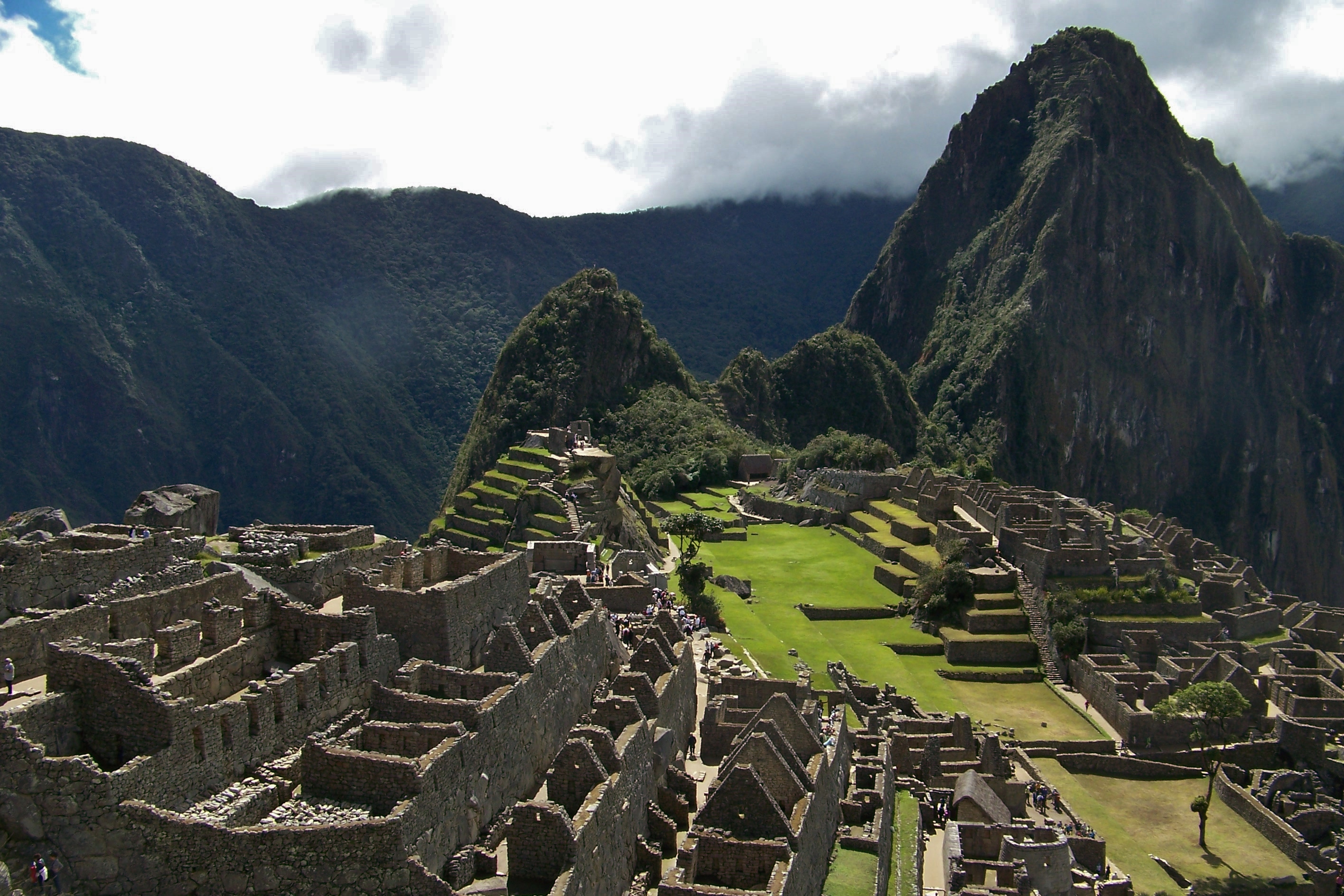





















 CreatorWorship
Peru 5
August 15, 2015 by creatorworship
Culture is an odd and interesting phenomenon. Though the word has now been co-opted to refer to interaction in a business office, the more traditional definition looks more like the http://www.merriam-webster.com first entry: “the beliefs, customs, arts, etc., of a particular society, group, place, or time”. Therein is the oddity and interest. That is a very broad definition trying to capture all that goes into a culture. You can mix and match the first three terms (and the “etc’s” for that matter) with any combination of the “particular” last four terms. Try for instances this combination that helps to explore a situation our tour explored in Peru: ‘art of a particular society in transition through time‘.
Pressing out the air bubbles
Glazed and painted and drying in the sun in readiness for the second firing
We toured the Seminario Ceramicas in Urubamba of the Sacred Valley of the Incas. The head potter, Pablo Seminario, along with his wife the head painter, Merilu Behar, developed a style of glazed and decorated pottery that has elements of ancient Peruvian cultures and modern stylistic exploration. The style was further developed by the isolation necessary for survival during the Shining Path insurgence of the 1980’s. One motif that the potter declared to me that he finds ever new is the shape of the arrowhead. As he said, “It was a tool for gathering food…is similar to the water drop or a leaf”. So Pablo continues to explore splashes of modern creativity mixed with hints of ancient continuity.
Moderno-paleo creations
I was temporarily separated from my tour group because I was taking some pictures in this gallery of creations of the artist. When I exited the room outdoors I didn’t see anyone. I assumed a whole group could not have gone far in a minute so I went to the nearest doorway. When I entered, there was Pablo wielding a small carving tool on a large arrowhead. Realizing I had entered his private studio, I began to back out but he waved me forward, not even slowing the pace of his work.
Pablo manifesting a new vision of the arrowhead
For the next 10-12 minutes we amicably discussed the creative process. He seemed to be quite interested in talking with me because I had brought students to tour Peru and because I talked intelligently about art and science. I asked several questions about how he begins a concept and carries it out. One question involved the arrowhead, “You obviously like to make arrowheads. Why did you start with it and why do you continue with it now?” He related the request from an art exhibit many years ago that he combine modern and ancient elements of design. This request caused him to reflect on the usefulness and ubiquitousness of the arrowhead shape he noticed in nature as quoted above. He continues to see new things in the shape and strives to continue to grow and so pursues more content in the arrowhead. This discussion led to me commenting on how one should be thankful to the Creator for instilling the gift of creativity. He retorted that it was far more work than creativity. I countered that the work is necessary but without merit if the person lacks the creative ability; each of us should work to develop the gift we have. The waste of potential that he sees as an artist and I see as a science teacher consumed some of our interaction. We also interacted over the similarities in science and art, how each involves elements of the other, and how both center around the abilities to think and work hard. It was one of those moments when we both knew that we had connected in a meaningful way even though before that moment we had been total strangers from different cultures pursuing different vocations and avocations, separated by different worldviews. Our connection was musing on life, its processes, and its meaning.
His life had been one sufficiently isolated from the insanity of the violent culture around him in order to survive and thrive, and yet not isolated from creative interaction, as his collaboration with his wife and 50 potters and painters in training attests.
Decorating the forms with Inca symbols
Main Gallery
I think that in this discussion and on this trip I discovered a more complete reason for why I like to travel. It extends my musing on life through observation of diversity in nature, culture, thinking, history, distance, science, people, God’s work in the world, and a host of other providential allowances given by a good Creator. We want to see beauty and substance and understand its meaning and purpose. But many are not willing to wade through the meaning of ugliness and triviality to reach the beauty and substance that does not lend to their preconceived ideas of what it should mean. I agree with Socrates, “The unexamined life is not worth living”. Don’t be afraid to examine yours and others and risk having to change what you hold dear for what is true and good and beautiful and full of substance.
Contrasts of Hues and Properties
Courtyard Beauty of Seminario
Posted in Beauty, Cultural commentary, General, Photo, Travel | Tagged Beauty, Cultural commentary, Photos, purpose in life, Travel | Leave a Comment »