Feeds:
Posts
Comments

America Getting

Americans are getting both what they want and what they deserve. Unless there is a widespread and deep repentance whereby we acknowledge God and obey His commands the United States will continue to slide toward immorality, infamy, impotence, and instability. The immorality is obvious in all that we vote to support and ignore and participate in that is clearly contrary to the Word of God. Infamy comes in the form of hatred from more and more countries of the world, self-hatred over increased oppression of rights and helpless people, and a growing history of blasphemy toward God. We think we are surely not impotent since we still have a strong military, but small troops of bandits are frustrating our every move worldwide, we can’t solve economic problems, natural catastrophe problems are on the increase threatening our personal security and economic viability, and the world will soon ditch our currency since we are so far in debt we can most likely never pay it off. Our instability shows in the aforementioned problems but really manifests itself in our increased suicide rates and divorce rates, debt, disregard of human life inside and outside the womb, educational lethargy, and lawlessness. It occurs to me that slide may not be the correct term for what is happening. Sliding assumes some small degree of frictional force opposing the direction of motion. We seem instead to be free-falling toward a morally corrupt, hating, powerless, unsustainable existence and loving the trip. There are brakes that can be applied but they are not in “how to”, Herculean efforts or renewed resolve. The only opposing force that could overcome this fall and the sudden stop at the bottom is found in God’s grace gained by agreeing with God we are rebelling against Him and receiving the payment Jesus made for those sins when He died on the cross.

Image Bearers

Our “Gospel Project” lesson today was about God’s nature revealed in the Creation story and in the results. I produced a table that summarizes the differences in how God’s nature is revealed in the two different (but not contradictory) stories of Creation in chapters 1 and 2 of Genesis.

  God’s Nature Clarification God’s Name Exhibitied in Creation Response in us

toward God


Above


Transcendent


Separate


Elohim

“Stong One”

“In the beginning God” Have to

must have

-allegiance

-worship

-accountability

Powerful


Able to effect He spoke into existence

ex nihilio

(“out of nothing”)

Authoritative Rules


Beside

Personal Identity, relational Yahweh

“Pre-existent One”

Speaking Want to,

gladly

-desire

-seek

-trust

The lesson speaks of four ways that man is made in the image of God based on Genesis 1 and 2. I think there is clearly from the text a fifth way:

    “27 God created man in His own image, in the image of God He created him; male and female He created them. 28 God blessed them; and God said to them, “Be fruitful and multiply, and fill the earth, and subdue it; and rule over the fish of the sea and over the birds of the [a]sky and over every living thing that [b]moves on the earth.””

We relate- God gave us as male and female to have relationship and commanded multiplication so there would be many people to interact. In fact, all God ordained institutions (family, church, government) reflect the interaction within the Triune Godhead.

We rule- Both the words rule and subdue occur. This is a stewardship that should neither result in abuse of the creation nor worship of it, but care for our benefit. All authority we have is delegated from God and should be carefully dispatched as such.

We work- 1″5 Then the Lord God took the man and put him into the garden of Eden to cultivate it and keep it.”  Work that is purposeful, creative, orders chaos, and work with God’s plan was ordained before the Fall and is a good gift. The type of work we dislike is the punishment on man because of sin and is toil (literally “pain” 3:17) that causes sweat (3:18).

We reproduce- It says “multiply and fill the earth”. When we procreate God provides the spirit so He is still active in creating and allows us to be involved in the process.  God is always involved in the process of giving life. 

We rest- “3 Then God blessed the seventh day and sanctified it, because in it He rested from all His work which God had created and made.”  God was not tired but He was satisfied with the result of His completed work. Christ has completed the work of salvation in us so that we need to rest in Him, faith rest:  “10 For the one who has entered His rest has himself also rested from his works, as God did from His. 11 Therefore let us be diligent to enter that rest, so that no one will fall, through following the same example of disobedience.”

I hope that you will consider how to bear the image of God in you in such a way as to point to Him rather than to yourself. It glorifies Him and satisfies you because you are at peace with Him.


The serious student of the Bible must take seriously the principles of interpretting the biblical text (hermeneutic). Many scholars who have a less than high view of Scripture want to dismiss it as a merely human authored book. Men were involved in the process but lead by the Holy Spirit. The Spirit did not, however, negate the personalities, languages, grammar, styles of writing, or contexts by which the texts were produced. It is the Word of God, infallible in the original manuscripts. We need to understand those human elements that were used to give God’s thoughts meaning. As a part of teaching a lesson in the “Gospel Project” and few weeks ago on interpretation of various genre of the Bible I produced the following page as a beginning to understanding Bible interpretation. I give credit where credit is due. The organization is wholly mine. Click on Hermeneutics for the Bible Believer to view the document.

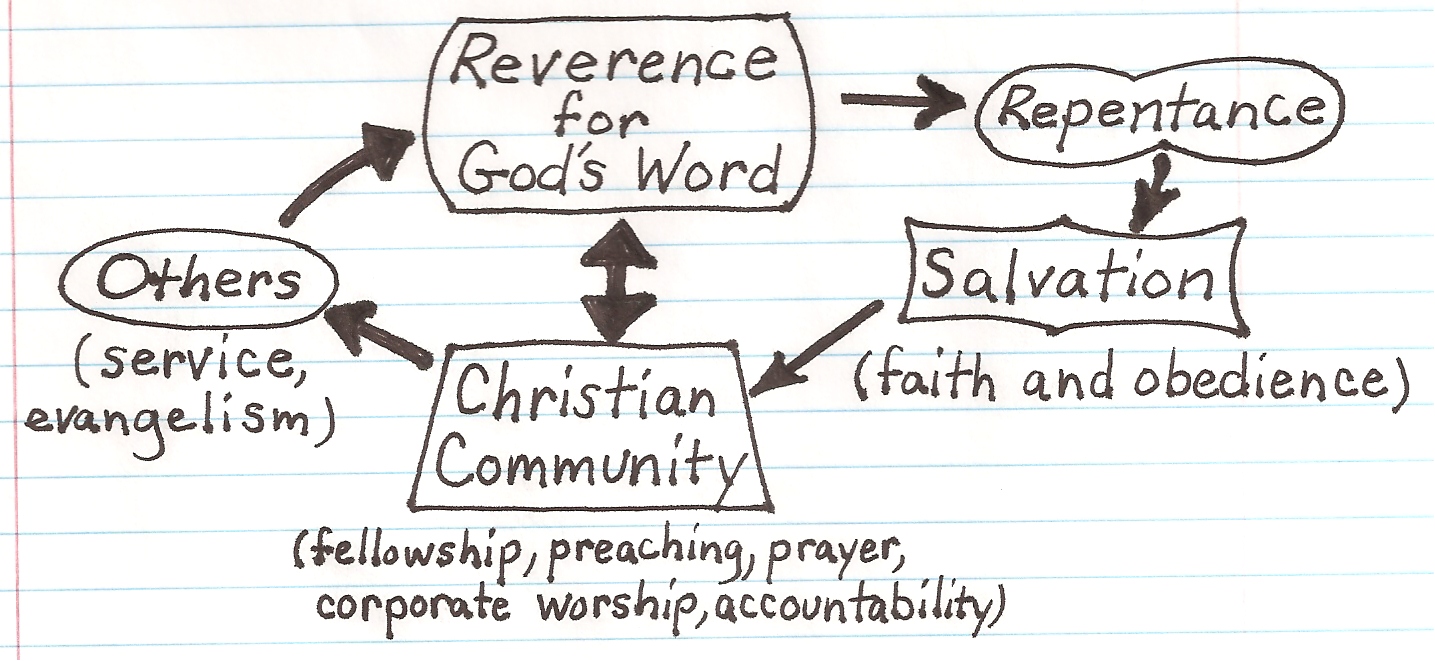
On page 126 of the “Gospel Project” lesson 13 for Fall 2012 Christian George discusses the connection between the centrality of God’s Word and Christian Community, that is, “Scripture is the basis of true community”. Words are good but for my mind understanding and memory are better had by diagrams. So here is this week’s unravelling of interrelationships: (the arrows should be read as “leads to”)

God’s Word and Christian Community

Christian George (“Gospel Project”, Fall 2012, p.109) says, “Theology must lead to worship. And worship is not an end in itself either. Worship must lead to mission. Let’s dig deeper into this concept. What if Christians leave out theology? Then we have worship without an objective and mission without a message. What if Christians leave out mission? Then we have theology without obedience and worship without growth. And what if Christians leave out worship? Then we have theology without devotion and mission without ammunition.”

In lines 1-4 I have mapped out my understanding of what he says in this quote. Line one is the simple outline. Lines 2-4 are the negative results of leaving out one of the disciplines: theology, then mission, then worship. Line 5 is my attempt at putting all of these ideas back into the original outline (line 1). The arrows in line 5 should read “provide ________ to”.

What negative images and ideas of God have you had or heard from the Old Testament? God is harsh; God is unloving.  It’s confusing and archaic so that God is not relevant to where I live. God is changeable and unfair. Has God changed from the Old Testament to the New? If He has why and how can I depend on Him? If He hasn’t why are the two different? Are they revealing different aspects of the same God or is one illustrative and the other explanatory? And because of these fears, dislikes, and misunderstandings do we act like the Old Testament is passe? Do we ignore it?

In Matthew 5:17-19 Jesus says, “Do not think that I came to abolish the Law or the Prophets; I did not come to abolish but to fulfill.” (v.17) Abolish denotes doing away with its authority, usefulness, and relevence. Instead Jesus says He will fulfill it; He will complete and finish what is lacking in it. And in verse 18, “not the smallest letter or stroke shall pass from the Law until all is accomplished.”  Again completion is in mind but I see more of Jesus meeting its challenge and living up to the requirements.

The Old and New Testament are different. What did he set aside? Juan Sanchez in the “Gospel Project” lists food laws (Mark 7:18-19), remember Peter and the sheet coming down from heaven, the temple (Matthew 24:1-2), remember the woman at the well and Jesus telling her how worhsippers would soon worship (John 4:21-24), and the sacrificial system (Hebrews 10:8-10), Jesus is the once for all sacrifice.

Jesus shows that the purpose of the Law is found in Him, by His fulfillment of it. But how is the law about Jesus, that is, how did He fulfill it? There at least 4 ways: 1) He is the fulfillment of prophecy. Christmas and Easter are particularly good times to remember this fact when we consider His birthplace, lineage, suffering, and resurrection. 2) He was, and is, perfect. Jesus has met the Law’s demands. He has accomplished every mark of righteousness and goodness stated and implied in the Law. 3) He has paid the price for our sins. Had He merely lived a perfect life He would have fulfilled the Law for Himself, but He has fulfilled it for everyone who has believed in Him as well. The price for a soul is high as we see in Psalm 49:7-9. Numbers 16:36-38 gives us a very tangible reminder of how costly it is for the sinner. Isaiah 55:1-8 nonetheless shows us it is freely given. So herein is another difference in the Old Testament and New. The Old seems to be asking, “There is a price; who can pay it?”, while the New says, “The price has been paid.” 4) He is the antitype of all types and the reality of the all symbols in the Old Testament. Following are but a few by way of example: a) the new temple- Emmanuel, “God with us”, b) Melchizedek, a priest forever without beginning of days or end of years and without a geneology, c) the bread (manna) from heaven, d) the Rock from which water flowed, e) the root of Jesse and seed of David, and f) the Lamb of God who takes away the sins of the world.

Sanchez goes on to say that “the intention of the law was not about checking off a list of moral requirements but total obedience that flowed from a pure heart.” (p.77) Jesus ups the stakes in Matthew 5:20-22,27-28 if you feel you have kept the Law: “For I say to you that unless your righteousness surpasses thatof the scribes and Pharisees, you will not enter the kingdom of heaven. You have heard that the ancients were told, ‘You shall not commit murder’ and ‘Whoever commits murder shall be liable to the court.’ But I say to you that everyone who is angry with his brother shall be guilty before the court; and whoever says to his brother, ‘You good-for-nothing,’ shall be guilty before the supreme court; and whoever says, ‘You fool,’ shall be guilty enough to go into the fiery hell….You have heard that it was said, ‘You shall not commit adultery’; but I say to you that everyone who looks at a woman with lust for her has already committed adultery with her in his heart.” Outwardly the Pharisees seemed quite righteous to the people of Jesus’ day, so that this would have been a surprise to them. But that is only the beginning. In terms of guiltiness before the law Jesus taught that intentions equal actions. Who among us has not been angry and thought similar things to what Jesus said. And how about the second example? That gets half of the population. But how about the women? How many of them have been guilty of enticing men with immodest dress?

The summary to all of this is that there are two ways to get to heaven. After another example about loving your enemies in Matthew 5:43-47, Jesus concludes by telling the first way to get to heaven, “Therefore you are to be perfect, as your heavenly Father is perfect.” (v.48) But only one person has reached heaven by that means and He was already there before He came to provide the second way, Jesus. If you are going to attempt heaven by works realize the height of the bar is perfection. Throw down all of your claims of ‘I’ve been a good person’ and ‘I don’t hurt anyone’. They are worthless and an affront to God. Realize that your only hope is trusting in what Jesus did on the cross in fulfilling the Law for you, if you will believe. As Spurgeon said, “The commands of Christ are not upon the legal tenor of ‘do this and live,’ but upon the gospel system of ‘live and do this.’ We are not to be attentive to the precepts in order to be saved, but because we are saved. Our master motive is to be gratitude to him who has saved us with a great salvation.” Jesus has fulfilled the Law for us; receive it by faith. Jesus will enable us to fulfill the Law as we trust in Him; work it out by faith. We aren’t teaching people to be good or lift themselves up by their bootstraps, but to trust the perfect example, Jesus, and trust His enabling power to do right.

What is Death?

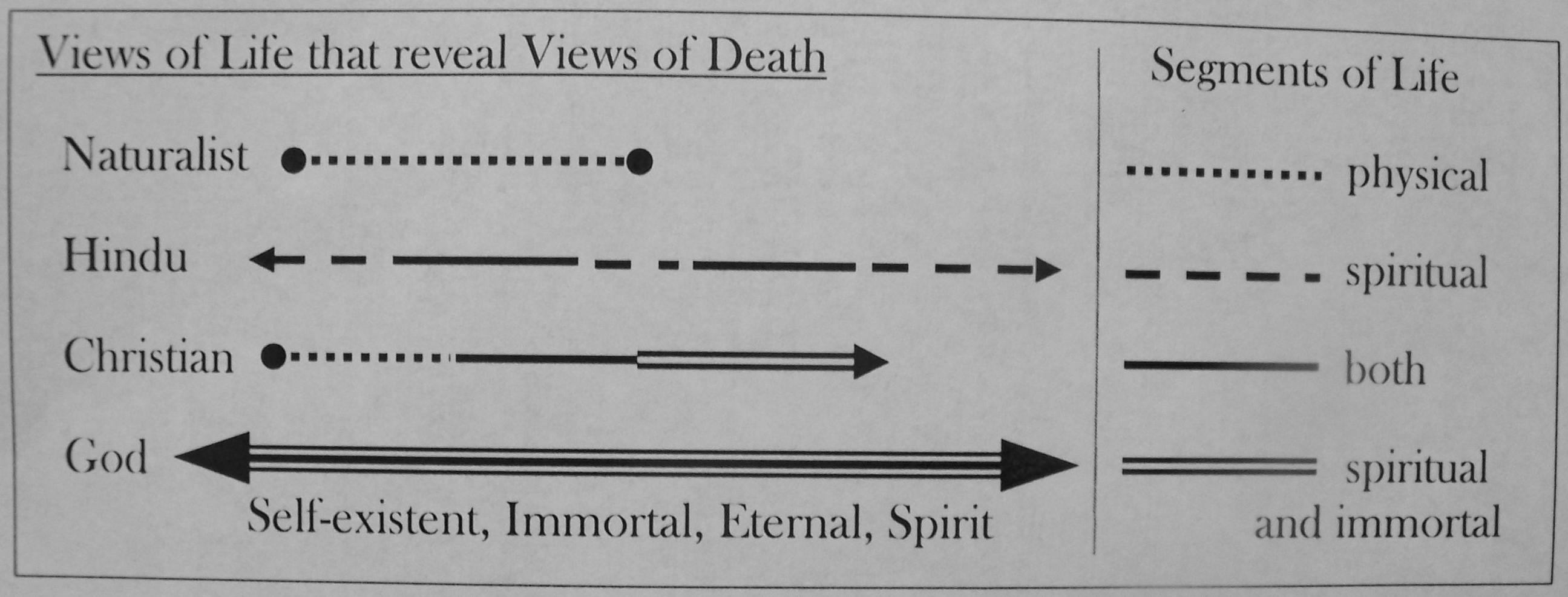
While considering this morbid study it occurred to me that one’s view of life overshadows one’s view of death. Our society has three major views of life I think. I have diagrammed them in the following figure. I add to the view of a Christian’s life that of the God of the Bible.

II Corinthians 5:1-8   

“1 For we know that if the earthly tent which is our house is torn down, we have a building from God, a house not made with hands, eternal in the heavens. For indeed in this house we groan, longing to be clothed with our dwelling from heaven,inasmuch as we, having put it on, will not be found naked.For indeed while we are in this tent, we groan, being burdened, because we do not want to be unclothed but to be clothed, so that what is mortal will be swallowed up by life.Now He who prepared us for this very purpose is God, who gave to us the Spirit as a pledge.

Therefore, being always of good courage, and knowing that while we are at home in the body we are absent from the Lord— for we walk by faith, not by sight— we are of good courage, I say, and prefer rather to be absent from the body and to be at home with the Lord.”

We are neither annihlated nor absorbed into the universal conscientiousness. Instead our spirit is clothed in an immortal body at death. At death we are separated from our body to be united with that imperishable body and with our Lord, worshiping in His presence.

Isaiah 59:2

“But your iniquities have made a separation between you and your God,
And your sins have hidden His face from you so that He does not hear.”

Being dead in spirit toward God in our unsaved condition does not mean our spirit does not exist but that it is separate from God and cannot respond to Him. Because of His holiness He will not respond to us.

Death is separation from body or God, not an end to existence. Eternal death is forever being separated from God and His benefits in the lake of fire. Eternal life is forever thriving in His presence with all the glorious benefits His excellencies bring. The diagram of the Christian’s progress is one of increasing life on into eternity. I look so forward to life after death, eternal bliss after momentary separation from one body into an immortal one.

Two Trajectories

They meet at the cross where Jesus became sin so that we might be the righteousness of God (2 Corinthians 5:21). God’s grace is the only way to change from the fatal nose dive to an eternity in heaven. The diagram is meant to be a logical progression rather than a strictly chronological one since elements of God’s salvation happened in eternity past and in past, present, or future space-time. A friend pointed out to me that the first three items on the upper curve are attributed to the Father, the next 5 items to the Son, and the last 4 items to the Spirit. Of course all three persons of the Godhead were involved in all parts but there is the lead person.

20120820-114000.jpg

The Way Forward


Moving forward is such a hard thing
When the battle within is so strong
Steal your purpose, rob the song you sing
Tedious moments, days that are long
 
Being consistent is harder still
Failing once makes a lie of it all
Cannot be done by an act of will
Unavoidable that you will fall
 
God is faithful and He is your song
He is your reason for living well
The One Who supplies and makes you strong
That you may of His faithfulness tell

Pray So Little

“It is not amazing that God answers prayer; it is amazing we pray so little.”

‘How can you say it’s not amazing that God answers prayer?’ Don’t misunderstand the statement because I do believe it is amazing how He answers prayer. For in pulling off an answer to prayer God must at least redirect the course of God ordained natural forces or the intentions of wills predisposed to wrong. At most He must suspend the rules He has laid down for nature so that they begin running immediately in a new course or give tangible manifestation to spiritual reality. In any circumstance you can name where prayer is answered the supernatural impinges on the natural to bring about God’s purpose with full consideration and at least partial affirmation and completion of the request. All together how prayer is answered demonstrates God’s great power and unending knowledge. How that happens is amazing and wonderful. But that He would answer prayer is not. Answered prayer matches well His character of kindness, mercy, grace, personal involvement in His creation, and goodness. 

But why do we pray so little? Our skeptical, mocking society has largely silenced our praise to God for answered prayer. For one thing they nay say any testimony that challenges their naturalistic presuppositions. ‘That can’t happen; you can’t prove the supernatural.’ Of course you can’t if the only evidence you allow is natural or has a natural explanation. So we Christians back off from saying the truth under the pressure of skeptical mockery. Merely natural explanations, however,  fall short on too many accounts at explaining all that we observe. But our praise to God for answered prayer is silenced for a far more serious reason. Despite the abundant Scriptural evidence to God’s willingness, ability, and examples of answered prayer; the abundant historical evidence (George Mueller very notably); God’s good sustaining grace in our own lives, we pray far too little. We must not believe He will answer. He has many times for me in witnessing opportunities,  financial needs, serious health issues, relational difficulties, bewilderment and discouragement, weather, direction, help for missionaries and witnessing friends. Why do I pray so little? “You do not have because you do not ask. You ask and do not receive because you ask with wrong motives so that you may spend it on your pleasures…” (James 4:2-3) Perhaps a better question is… What is preventing me now? A big and glorious God answers big and God-glorifying prayers! Lord, work in my life so that I pray more and more intensely!

Psalm 1 compares the righteous one to a tree firmly planted, well watered, fruitful, in no danger of withering. I see it as one whose branches reach upward in praise and roots downward into truth. Click on Tree Firmly Planted to see how I visualized it.

Tree Firmly Planted

May God’s blessing be on this child, my first grandchild.

May He save her and sustain her throughout her days.

Miss ERB

 
E R, please come and stay
Be strong and healthy, ready for the fray
That life brings in this world each day
 
Oh, dear E, time sequester
Fasting and praying, let nothing fester
Sanctified as alabaster
 
May your heart be bold and be strong
Ready for battle no matter how long
Looking up, a heart filled with song
 
Miss B, show beauty from above
All tender and nurturing those you love
Pure, chaste, and faithful as a dove
 
Precious one, God be your tower
Guide your thoughts and words in the trying hour
Help God’s people by His power
 
E dear, may your life be clean
Trust Jesus to save, in your life faith be seen
Heaven expecting though unseen

Our Demise

We don’t know how, when, or why
The timing of our demise
Whether slow and painful, cry
Sudden horrible surprise
 
Or to loved ones good-bye say
See a vision from above
Then in peace just drift away
To glory fly as a dove
 
 But, oh, our pain is so slight
Compared to burning below
That will give the hardened fright
Pray for souls that they not go
 
 To avoid death’s awful sting
Look to Jesus’ sacrifice
Daily to His promise cling
Thankful for the purchase price
 
By His sacrifice we win
Heaven for which praise we give
Away from trials and pain and sin
In His presence there to live

Faith or Fear

Faith or fear, which will it be?
Fixed on Jesus, wait and see
What provision or rescue He will bring
Or falter by small degree
And fret and fail to stand free
By looking to yourself where sin will sting
 
Trust  or retreat on the way
Trivial pursuits that may
Distract from weightier tasks to be done
Or track with His plan today
With the Spirit always stay
Until the path laid out for you is run
 
Practice evil no one should
Pass judgment that you could
Wrath and indignation eternal night
Persevere in doing good
Pursue glory all you would
By grace enabled to do what is right
 
Make His resurrection known
Share your faith eternity sown
Not afraid to live and speak out for Him
Or just keep silent or moan
Seeds of discontentment grown
Timid, no purpose and your joy is dim

Following is a slightly expanded version of what I said at B and K’s wedding, mostly because I read only Matthew 22 since Ephesians 5 had been read before I got up to speak:

A Wedding is a day of celebration that has greater and deeper meaning than the happy couple, as significant as they are. God has designed and ordained the various types of human interaction to reflect His character and government within the Godhead and His interaction with His people: government, family, church, and marriage.  In the Old Testament God refers to Himself as the One who rescued and loved a wife, Israel. But she was unfaithful and preferred harlotry (a picture of idolatry rather than worship of God). Many passages present this scenario. Among them, Psalm 45 is a positive one that seems to speak of a king and his queen and the King of kings and His wife. We learn that the wife is the people of God who are frequently unfaithful, as in Hosea and Ezekiel 16. Hosea 3:1 clearly communicates God’s persistence at loving His wife despite her waywardness.

In the New Testament God shows us another ordained allegory which is not a plan B or afterthought in the light of Israel’s unfaithfulness but a long pre-determined picture of what He is about in this time, that of Christ and His Church. The clearest pronouncement of this picture is given in Ephesians 5:22-33. “Wives, be subject to your own husbands, as to the Lord. For the husband is the head of the wife, as Christ also is the head of the church, He Himself being the Savior of the body. But as the church is subject to Christ, so also the wives ought to be to their husbands in everything. Husbands, love your wives, just as Christ also loved the church and gave Himself up for her,  so that He might sanctify her, having cleansed her by the washing of water with the word,  that He might present to Himself the church in all her glory, having no spot or wrinkle or any such thing; but that she would be holy and blameless.  So husbands ought also to love their own wives as their own bodies. He who loves his own wife loves himself;  for no one ever hated his own flesh, but nourishes and cherishes it, just as Christ also does the church,  because we are members of His body.  FOR THIS REASON A MAN SHALL LEAVE HIS FATHER AND MOTHER AND SHALL BE JOINED TO HIS WIFE, AND THE TWO SHALL BECOME ONE FLESH.  This mystery is great; but I am speaking with reference to Christ and the church.  Nevertheless, each individual among you also is to love his own wife even as himself, and the wife must see to it that she respects her husband.”

 To summarize the allegory, marriage between one man and one woman producing offspring and interacting through roles of leadership and submission by mutual commitment and sacrifice concretely demonstrates the relationship of Christ and His Church. This picture brings much glory to God.

Therefore, we should expect that the enemy, Satan, would like nothing better than to destroy this picture. By so doing he destroys people and a reflection of God’s glory. I think his tactic can be seen by an analogy: Even as the glare of the city lights obscure the beauty of Moon and stars, so the glitzy show of sexual perversion and marital unfaithfulness attempts to block the God glorifying purity of a man and wife faithfully and lovingly representing Christ and His Church through their marriage. How does this apply to you and me? Young men and old, I’m speaking to you. Have you made the covenant that Job did? “I have made a covenant with my eyes; How then could I gaze at a virgin?” (Job31:1) You must avert your eyes and work hard a being pure of eyes and heart. Young women and old, I’m speaking to you. Have you heeded the directions in I Timothy 2:9-11, “I want women to adorn themselves with proper clothing, modestly and discreetly, not with braided hair and gold or pearls or costly garments, but rather by means of good works, as is proper for women making a claim to godliness. A woman must quietly receive instruction with entire submissiveness.”? Do you cover yourself? The passage does not just speak of modest dress, though. It also speaks of modesty in conduct. Do you flirt with your eyes? Do you manipulate with your speech? Men and women, give glory to God in how you act and speak.

So how does this picture of Christ and His Church work? The wife’s role is a responsive role. Why should she do this? “As the Church” (v.24), so the the wife is representative. I Peter 3:1-6 shows that her witness is foremost for her husband to win him over to doing what is right even when he is disobeying the word. And the epitome of this submission is seen in Sarah “calling him lord” (v.6). Because this relationship points to the relationship of God and His people, this degree of submission makes sense. Certainly the Church calls Christ Lord. Just now the world is speaking frequently of the leftovers of a “patriachal society”, referring to any degree of gender role, but the Bible clearly teaches it for the purpose of marital unity and glory to God. Consider the English word husband. It literally means manager. We accept managers in business because they bring order and profitability, so why do we reject them in God’s economy? The wife is responding to the husband’s headship role, representing how “Christ also is the head of the church” (v.23).  How did Christ carry out His role as Head? First of all as Savior (v.23).  “He gave Himself up for her” (v.25). I believe this refers to much more than committing His body to die on the cross. He took on the wrath of God which was our due, a much greater torture than physical pain and death. Why would He put Himself through this torture? That He set the Church apart for Himself, both cleansing and presenting her to Himself (v.26). He valued His people so much as to take God’s wrath. Having cleansed her from sin, He now continues setting her apart by His Word. Practically this is accomplished through Bible preaching, God-centered fellowship, Spirit-led praying, and Christ-centered evangelism. Then in the future at His wedding feast it shall be declared, “‘Let us rejoice and be glad and give the glory to Him, for the marriage of the Lamb has come and His bride has made herself ready’. It was given to her to clothe herself in fine linen, bright and clean; for the fine linen is the righteous acts of the saints.” (Revelation 19:7-9) The bride arrives dressed beautifully in white representing purity, the light of her husband’s eyes. She is glorious, spotless, without wrinkle, or blemish. Jesus has far more than just reversed death. The Church that the bride is representing is not rescued from hell and death to an ugly, scarred existence. The Church is called upon and must work with this pruifying work of Her Lord Jesus. He will present us to Himself cleansed, beautiful as this bride appears before you today.

The man is further to be a servant of his wife pursuant of the end of cleansing her. He accomplishes this role by loving her as himself (v.28-30). This is a difficult and daily role, who is sufficient for these things? And the relationship is intimate and permanent (v.31). To be sure that no one misunderstands that Paul is talking about the marriage relationship as representative of the Christ/Church relationship he interjects verse 32. Then he summarizes with verse 33. Why is there a different command for man and woman? Humanly speaking it is because each has different needs. The man’s greatest need is to be respected; the woman’s greatest need is to be loved. But again the picture of Christ and His Church is in full view. Christ did and is loving His Church. How can our response be anything other than respecting and reverencing and obeying our Lord?

One other passage that I would like to consider related to this picture is the Parable of the Wedding Feast found in Matthew 22:1-14:  Jesus spoke to them again in parables, saying, “The kingdom of heaven may be compared to a king who gave a wedding feast for his son.  And he sent out his slaves to call those who had been invited to the wedding feast, and they were unwilling to come.  Again he sent out other slaves saying, ‘Tell those who have been invited, “Behold, I have prepared my dinner; my oxen and my fattened livestock are all butchered and everything is ready; come to the wedding feast.”’  But they paid no attention and went their way, one to his own farm, another to his business,  and the rest seized his slaves and mistreated them and killed them.  But the king was enraged, and he sent his armies and destroyed those murderers and set their city on fire.  Then he said to his slaves, ‘The wedding is ready, but those who were invited were not worthy.  Go therefore to the main highways, and as many as you find there, invite to the wedding feast.’  Those slaves went out into the streets and gathered together all they found, both evil and good; and the wedding hall was filled with dinner guests.    But when the king came in to look over the dinner guests, he saw a man there who was not dressed in wedding clothes,  and he said to him, ‘Friend, how did you come in here without wedding clothes?’ And the man was speechless. Then the king said to the servants, ‘Bind him hand and foot, and throw him into the outer darkness; in that place there will be weeping and gnashing of teeth.’  For many are called, but few are chosen.” In this passage, Jesus assumes the picture we have been speaking of even before Paul had written about it. He goes further to deepen the meaning and change it slightly from what we have spoken of. The feast is initiated by the king who has a son getting married. But where is the bride? She is here, represented by the individuals. This idea is consistent with what we read in Revelation 19:9, “the fine linen [of the bride’s dress] is the righteous acts of the saints.”  And verse 14 says these individuals are both chosen and called.  

Not all of those called heed however. Some of those invited actively reject the invitation, refusing to come, scoffing, and beating and killing the king’s servants. Others more passively refuse, having other things to attend to which they evidently consider more important.  The King, obviously God, is angry at all of this God-hating and destroys them.  But there is another kind of person at the feast who is self-deceived. This person, representing many in the church today, has a more subtle problem. Unlike those who refused to come, he desires to be at the wedding feast. As revealed by the king’s question, he has a problem. He is not dressed in wedding clothes which those who attend must receive. Instead he is dressed in self-righteousness. If this represents you, you might be one who says, “I’m a church-goer. I’m a good family man. I’m a submissive wife. I’m a decent, upstanding citizen. I acknowledge God.” But God says of your good works, “All our righteous deeds are a filthy garment…” (Isaiah 64:6). The problem may be subtle but that does not make any less serious considering the results to the man. Hell is a real place.

The problem needs a bold solution. “For by grace have you been saved through faith and that not of yourselves; it is a gift from God, not as a result of works that no one should boast.” (Ephesians 2:8-9) The wedding clothes are a gift. You must repent of your dead works. This means that you must turn away from your own righteousness and declare with God that it is sin and turn to what Jesus has done on the cross to rescue you from sin. This is God’s grace: ‘God’s Riches At Christ’s Expense.’ He gives those who trust in Him eternal life. Repent and receive the gift; you cannot buy it. I know that B and K would like nothing better than to know that someone came to receive the gift of eternal life from Jesus because of their wedding ceremony. May God bless B and K’s marriage and may He bless the Church’s purity and may He open your eyes to your need for the Savior so that you may be clothed and ready to come to the wedding feast that will be held one day. 
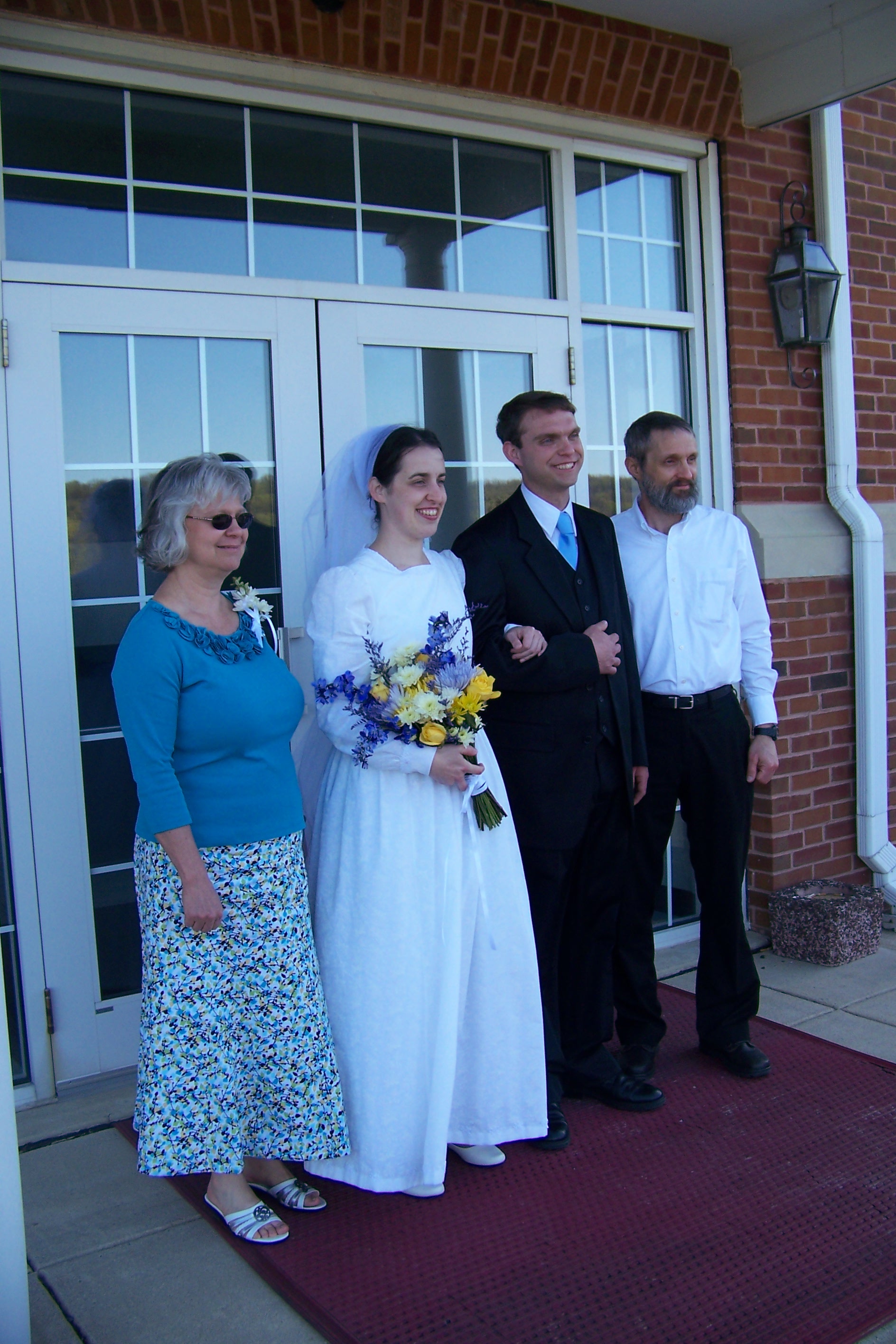
B & K Union

A beautiful and complete wedding ceremony (1:45) with hymns, a covenant reading and signing, vows, sermonettes by both fathers, prayers of dedication, and reception, the happy couple is off to the honeymoon:

“He who finds a wife [helpmate] finds a good thing and obtains favor with the Lord.” Proverbs 18:22

K and neice


“Husbands, love your wives, just as Christ also loved the church and gave Himself up of her, so that He might snactify her, having cleansed her by the washing of water with the word, that He might present to Himself the church in all her glory, having no spot or wrinkle or any such thing’ but that she would be holy and blameless.” Ephesians 5:25-27


The groom has four siblings and the bride nine. The father of the bride is the pastor so add most of the church. The groom works for an electrical company that is very family oriented. There were easily 300 people packed into the old firehall where the church meets.

The Happy Couple with the Groom's Parents


On many fronts it was a joyous occasion as families were brought together to get to know each other, families were strengthened by reminder of their calling and privileges, and one new family was formed.


Oh, then there is my daughter; there is a first granddaughter

                       on the way in June!

(The family is growing.)

Analogy

As a Bible reader and a high school science teacher I cherish good analogies because they clarify otherwise obscure concepts. I thought of two short analogies in the past few days as I mused upon ideas concerning marriage and motivation.

Concerning marriage, I believe Satan would like nothing better than to destroy the picture of Christ and His Bride, the Church. As I thought of this attempt to hide this picture designed by God I thought of light pollution:

Even as the glare of city lights obscures the beauty of stars and moon, so the glitzy show of sexual perversion and marital unfaithfulness attempts to block the God glorifying purity of a man and a wife faithfully and lovingly representing Christ and His Church by their marriage.

As my pastor taught in Romans 1 last evening he marveled over the obligation of Paul in verse 14 becoming the eagerness to share the gospel in verse 15. He showed how we too should be eager in our obligations, not counting them as burdens. He went on to say, “Duty by itself without delight will not sustain us.” Then what is the use of duty, I thought, and what is its relationship to delight? Following is my conclusion by way of analogy:

The flywheel of duty will not continue to spin for long unless powered by the engine of delight. However, when the engine of delight misses the flywheel of duty keeps the engine of delight spinning for several revolutions until it is restarted, its spark and fuel being sought from its source, the empowering work of the Holy Spirit.

There are so many good hymns. As with most things we have a tendency to rush over them as if to extract the sweetness without savoring the deeper substance. So as time allows on occasion I try to assimilate a little more of the spiritual nutrients from these poems that we sing. In poetry I like completeness of thought with conciseness of language. Of course that is a challenge. The hymn “One Day” seems to be just such a hymn, surveying the incarnation, crucifixion, burial, resurrection, and second coming of Christ. Emphasizing this idea of these events happening on a certain ‘one day’ each produces a unity of the verses and points to the historicity of the works of Christ. In each of the verses Christ and His work are exalted and personalized to the person singing the song. These are all wonderful elements, but I’m rarely quite satisfied, so I thought that it covers from Christ’s incarnation at Bethlehem to the beginning of eternity, shouldn’t it include eternity past forward to Bethlehem?  I sat down and wrote two more verse to “complete” the thought of salvation history conveyed in the song. I was unable to bring in the element of personalizing the work of Christ to the singer and I’m confident that my poetry is not so good as the author, J. Wilbur Chapman,  but I enjoyed the effort and contemplation anyway, and so may you.

One day the Godhead took counsel in heaven
One day the Christ was appointed to die
Jesus submitted in full to His Father
While He still sat on His throne up on high
 
One day Christ Jesus created first Adam
One day He walked in the garden with him
Then Adam sinned and all mankind was fallen
As second Adam He would rescue them

One day when Heaven was filled with His praises,
One day when sin was as black as could be,
Jesus came forth to be born of a virgin,
Dwelt among men, my example is He!

Refrain

Living, He loved me; dying, He saved me;
Buried, He carried my sins far away;
Rising, He justified freely forever;
One day He’s coming—O glorious day!

One day they led Him up Calvary’s mountain,
One day they nailed Him to die on the tree;
Suffering anguish, despised and rejected:
Bearing our sins, my Redeemer is He!

Refrain

One day they left Him alone in the garden,
One day He rested, from suffering free;
Angels came down o’er His tomb to keep vigil;
Hope of the hopeless, my Savior is He!

Refrain

One day the grave could conceal Him no longer,
One day the stone rolled away from the door;
Then He arose, over death He had conquered;
Now is ascended, my Lord evermore!

Refrain

One day the trumpet will sound for His coming,
One day the skies with His glories will shine;
Wonderful day, my belovèd ones bringing;
Glorious Savior, this Jesus is mine!

Refrain

I noticed something after I wrote the first two verses. The refrain repeats and reviews the five themes of incarnation, crucifixion, burial, resurrection, and the second coming of Christ presented one at a time in each of the five verses. I guess the hymn was wonderfully complete and filled out after all. Oh well, I reviewed all the more God’s wonderful grace in the process.

True Science

Logic is good and should be sound when used but no matter how sound the logic if the beginning point is wrong (wrong presuppositions) the end result (understanding of God, man, sin, eternity, reality, the world around us, fundamental forces and particles) must also be wrong at some level. For that reason I endeavor to pursue a study of science that begins with a true beginning and is most supported by evidence. Galileo was restricted because he believed truth both in terms of the Creator and in terms of the revealed evidence the Creator gave (most notably four moons orbiting Jupiter rather than Earth). Eventually the truth of his observations was accepted by all. Sometimes the opposite happens and ideas are accepted that start from the wrong place, making assumptions that are not true and do not hold up under scrutiny, and yet still persist. Evolution is just such a false idea but because of the metaphysical commitments (read, ” secularized ‘beliefs'”) it yet stands under the onslaught of truth. So then true science involves a correct starting place, opened-minded and careful observation, and sound logic. In the last generation it seemed that people gave an unerring allegiance to science and technology for all of the problems of humankind that it solved. But recently there is a growing skepticism toward “scientific theories” because they have led us to dead ends so that the heart is not satisfied, the real problems of society are not solved, there are major gaps in the explanation of the observed, health is treated for symptoms rather than promoting long-term health, and technology deceives by reducing the quality of life when fully embraced (Note that our country spends more on healthcare than any other and yet ranks 37th on the World Health Organization’s list of health systems. Many health enhancing practices are ignored or disdained by much of the world.). The summary of what I am saying is as follows. I applaud the efforts of many practitioners of science for their attempts to explain their various disciplines from the evidence they have based on logic that they work hard at making consistent. But turning a blind eye to influences outside of the natural system that effect all that we see both as to its origin and its progress is stubborn and wrong. God impinges daily on this terrarium we call the universe all the way from holding the forces and particles in check to controlling where it is headed. 

I’m so enamored with the short-term benefits and successes while God sees
eternity along with my utter good and His ultimate glory. Help me, Lord, to
seek what is lasting, to make real breakthroughs through the muck and mire
of life.
 
Lord, I long for something new
Something with a tremendous view
Perhaps a perch overlooking the heights
So my soul might take its fanciful flights
Life is not lived on that plane
We must first teach the heart and train
That you fully see the view above
Fully know all My holiness and love
I don’t want hardship and pain
I want victory without rain
Love, security, adventure, too
Fun, satisfaction, oh, and something true
You have those more than you know
Through rain and storm there’s more to show
Know Me, you must cease to worship you
Submit to Me and know all that is true
Then you will fly in My strength
Know joy and completeness at length
Thankful for trials and what they have done
Building you up, bringing praise to the Son
Myrela

Art, health, civilizations, photography, nature, books, recipes, etc.

Overflows from the Heart

"But the things that proceed out of the mouth come from the heart…" Matthew 15:18

CreatorWorship

Pointing to the One who made, saved, and sustains