Feeds:
Posts
Comments

Posts Tagged ‘God Thoughts’

I am very thankful for a weekend at home. I have been out of town six times in the last six weeks. I am also thankful that I am not a long distance truck driver or regional salesman. My back and mind would die a quick death in a vehicle seat. Last weekend I drove 32 hours in 4 1/2 days to see my fourth-born graduate from LeTourneau University in Longview, Texas. Not only was the graduation worth the trip but the Christian fellowship I experienced while there seemed like a spiritual retreat.

The couple whose house my son has lived at the last two semester was where my fourth son and I also stayed. They opened their home and their hearts. The man is an emergency transport helicopter pilot who once flew in Papua New Guinea for Wycliffe Bible Translators. He uses his technical expertise as a witness to how believers in Jesus serve people. His wife homeschooled their eight children. She explained how inadequate and fretful about teaching she felt at first until she remembered her Christian college president’s saying,”Walk with the King, and be a blessing.” That is what she wanted to teach her children and that was all that was required of her. She could relax and live the life of grace before them.

I met my son’s Senior Design Project Professor. He has an encouraging testimony of how God saved a wild red-neck and put him into service to teacher young men and women to make good use of God’s gifts while giving God the glory. 

The commencement speaker was Edmund C. Moy, one time Director of the US Mint in Washington, D.C. With stories from his own experience he urged graduates to be competent and caring Christians. Following are my quick notes on the seven pieces of advice he gave: 

  1. Seek a Mentor.

  2. Find or form a like-minded group with whom to pray and fellowship and witness.

  3. Be trustworthy with the small things; integrity matters.

  4. Do good work; it praises God.

  5. Make a “to be list” to become spiritually mature.

  6. Consider public service.

  7.  Many resumes have a zig-zag path. That’s OK: God is behind it.

Both at the dinner on Saturday night and Sunday afternoon the hosts, other parents, and graduates talked freely of spiritual matters. Several of the graduates led singing of spiritual songs. Another father and I were grateful for the friendship forged between our sons and the hosts’ son-in-law over the last four years, encouraging each other to live godly lives and be good students imparted life-long lessons and habits in all three of these young men. On this Mother’s Day, several mothers told stories of God’s work in their children’s lives and the graduates responded with other stories and thanks for godly mothers and fun times with Christian brothers.

In the Sunday School my son has attended the last 3 1/2 years the teacher reminded us by a survey of examples that the stories of the Bible they had been learning are examples of God’s grace and sovereign plan worked without fail in believers’ lives. The sermon following was given as a series of five sermonettes by the five elders on aspects of God’s love:

1. God is love because He is a Father in a triune relationship.

2. God’s love is expressed in the Old Testament as ‘hesed’, steadfast love.

3. God’s love is best expressed in the gift of Jesus.

4. God’s love never fails.

5. It is difficult for us to comprehend how much God loves us.

I had abundant time to think about all of these lessons as I drove 5 hours on Sunday and 10 1/2 hours on Monday by myself back to North Carolina. My back ached by the time I arrived home and my mind was dull and exhausted but my spirit was refreshed, ready to begin again at the mundane and stressful job of teaching high school science with excellence and care.

Paraphrase of the Great and Secondary Commandments

Paraphrase of the Great and Secondary Commandments

One Time "Richest Acre in the World", Kilgore, TX

One Time “Richest Acre in the World”, Kilgore, TX


Senior Design Project and Senior Designer

Senior Design Project and Senior Designer

An Inventor, Entrepreneur, Industrialist, Philanthropist, Evangelist Christian

An Inventor, Entrepreneur, Industrialist, Philanthropist,
Evangelist Christian


!---!---!---!

!—!—!—!

Dad, Grad, and Sib

Dad, Grad, and Sib


Good Aim Matters

Good Aim Matters on The Big Muddy

Waiting in Line for the upstream passage

Waiting in Line for the upstream passage

Read Full Post »

How could I not be thinking about testing with the situation I was in. But my thoughts went to a different, more significant and substantial type of test- the test of faith. Some days I am trusting fairly well but others I am failing miserably. The thoroughly up side of this type of test though is the guaranteed perfect grade at the end of the term for those enrolled in the class.

Mark it well, this is only a test
Heaven comes after, eternal rest
Now prove the metal of who you are
It's faith in God will carry you far

It's not by works you enter the rest
Nor by your goodness you pass the test
Your goodness comes by God's work in you
Obtained by faith in the Savior true

Not one temptation can overwhelm
When you cling to God who's at the helm
Storms, wind, and hail will batter your boat
The trusted Master keeps you afloat

Saved by grace through faith in Christ alone
Scripture instructs, by this you are grown
God receives praise as only He should          (Solae Quinque)
For God passed your test, He only could

Read Full Post »

I listened to a youtube video as I often do, and this one was titled “Self-Efficacy”. The intent of the video was kind but the result was mistaken and really sad. It explained that “self-esteem is this idea about how you see yourself, how capable you think you are, how happy you are with yourself, but self-efficacy is something kind of different, and its rather important. It’s how you perceive your ability to accomplish something.” The video went on to explain how one must develop self-efficacy to accomplish anything and that no one else can really show you how but only inspire you to try. It went on to say that there are people that use self-efficacy for evil to gain confidence to hurt people. A sad part to me was the realization that all self actualization is bad because it emphasizes and exalts self and ignores or even rejects God. We should have Christ-esteem which then provides us with value because He created us and died for us and enables us. And we should bless His efficacy that enables each one of us to “do all things through Him who strengthens me.” (Philippians 4:13) The most sad part of the video, however, was the inadvertent admission later in the video that the speaker did not know how to bring about world peace even though he thought that it must be emphasized. I can’t bring about world peace either but I know from whence peace comes and whence world peace shall come. We may have peace with God and within ourselves now by trusting in what Jesus did on the cross. That enables us to pursue growing peace with those around us and will one day result in world peace when Jesus returns and sets the world right.

As I mulled over some difficulties within my family recently I concluded that even though life may be difficult at times, it is right and good and beneficial for us to trust God. The following poem came to me as I thought on these things:

Each new day God provides our need
He our bodies and spirits feed
Sometimes it feels like we are starved
It is then we are apt to plead

To call on Him for our supply
Is His command, He will reply
Of delay that seems not answered
Glorifies Him when we rely

Emotions raw so often we cry
Relationships have gone awry
All hope of healing seems removed
Then must we trust Him though we sigh

Good health eludes us though pursued
Accidents happen though we cared
For these struggles so unprepared
Faith does not mean we will be spared

It is then we trust God so wise
Know Him more as each moment flies
Submit, expectations altered
Temporal and eternal prize

Read Full Post »

In the fourth generation and 60 years after King David died there arose a king over Judah whose name was Asa. His father and grandfather had no heart for God, worshipping idols and allowing the people to run wild in their pursuit of idolatry. And his great-grandfather, Solomon, turned away from God in His old age because of the enticement and idolatry of his many wives. So it is a surprise the high praise Asa is given in I Kings 15: “Asa did what was right in the sight of the Lord, like David his father. He also put away the male cult prostitutes from the land and removed all the idols which his father had made. He also removed Maacah his mother from being queen mother, because she had made a horrid image as an Asherah; and Asa cut down her horrid image and burned it at the brook Kidron… the heart of Asa was wholly devoted to the Lord all his days.” (v.11-13, 14b) Much of Asa’s story is repeated in II Chronicles 14-16, but as is frequently the case the story includes more spiritually commentary on details given in Kings. Besides removing idols and their worshippers, II Chronicles 14 also says that he “commanded Judah to seek the Lord God of their fathers and to observe the law and the commandment” (v. 4) and God rewarded him in that “the land was undisturbed, and there was no one at war with him during those years, because the Lord had given him rest.” (v. 6) Asa took advantage of these benefits of time and security by fortifying cities and strengthening the number and equipment of his army. And yet he did not put his trust in these but called on God to defeat a million man Ethiopian army that came against him. In response God indeed defeated the army and sent Azariah the prophet to strengthen and encourage Asa and Judah to continue seeking God because there is reward in it (II Chronicles 15:1-7). Asa indeed took courage and increased his reforms in Israel by more idol worship removal, restoring the altar of the temple and sacrificing on it, and promoting a covenant among the people to serve God only. There was peace for 20 more years.

     In all of this glowing report about Asa there are two blindspots of his that arise in the story. One is obvious and the other is not. “In the thirty-sixth year of Asa’s reign Baasha king of Israel came up against Judah and fortified Ramah in order to prevent anyone from going out or coming in to Asa king of Judah. Then Asa brought out silver and gold from the treasuries of the house of the Lord and the king’s house, and sent them to Ben-hadad king of Aram, who lived in Damascus, saying, ‘Let there be a treaty between you and me, as between my father and your father. Behold, I have sent you silver and gold; go, break your treaty with Baasha king of Israel so that he will withdraw from me.’” (II Chronicles 16:1-3) Baasha does withdraw and Asa has all of his people carry away the materials of fortification to build other fortifications. Well played, right? No, poorly played because as the prophet Hanani points out, “you have relied on the king of Aram and have not relied on the Lord your God.” (v. 7) Asa’s blindspot, indeed his sin, is pride in the form of self-reliance. This had not been a problem 20 years before when he had called on God to defeat the enemy. Three indicators that it is indeed pride and not a simple oversight follow. Asa throws the prophet into prison and oppresses some of the people, maybe because they agreed with Hanani. The third indicator of his old age pride appears three years later when God further tests him with disease in his feet. “Yet even in his disease he did not seek the Lord, but the physicians.” (v. 12) The word “yet” indicates that this activity was a continuation of the self-reliance with the scheming that trusted a king rather than God. Such self-reliance is a danger for us all. For youth it may generally fall more in the realm of strength and supposed invincibility, but for the wizened king it may have been more the bane of years of experience without continued growth in reliance upon God due to comfort. We cannot let our guard down, “For the eyes of the Lord move to and fro throughout the earth that He may strongly support those whose heart is completely His.” (v. 9) The biter was the prophet’s next words: “You have acted foolishly in this.” If Asa had repented right then and there God may not have strapped him with so much war thereafter, or not tested him with foot disease. God is more concerned with purifying us than making us comfortable.

     The less obvious blindspot of Asa appears in one short phrase basically repeated in the other passage. “But the high places were not taken away,” and “…not removed from Israel.” (I Kings 15:14a; II Chronicles 15:17a) These detractors from Asa’s reputation are almost dismissed by their follow-up phrases: “nevertheless the heart of Asa was wholly devoted to the Lord all his days,” (I Kings 15:14) and “nevertheless Asa’s heart was blameless all his days.” (II Chronicles 15:17) It seems that even though the high places were an oversight in Asa’s reforms and worship, his intentions toward God in worship were always pure. But this is not quite the end of the discussion because the Chronicles passage adds some facts that seem to confuse this whole problem. One of the first things that II Chronicles 14 indicates that Asa did was “he removed the foreign altars and high places, tore down the sacred pillars, cut down the Asherim…” (v. 3). Did he remove the high places or did he not? I think that the answer is both yes and no. This latter mention of high places is surrounded by mention of “foreign altars” with specific examples. The other high places may have been of the type mentioned when God spoke to Solomon in I Kings 3: “The people were still sacrificing on the high places, because there was no house built for the name of the Lord until those days. Now Solomon loved the Lord, walking in the statutes of his father David, except he sacrificed and burned incense on the high places. The king went to Gibeon to sacrifice there, for that was the great high place; Solomon offered a thousand burnt offerings on that altar. In Gibeon the Lord appeared to Solomon in a dream at night; and God said, “Ask what you wish Me to give you.” (v. 2-5) Solomon along with the people and subsequent kings all had this blindspot. They were worshipping God but not how and where He told them to worship. In fact it was not until Hezekiah, 9 generations and over 210 years later, that “he removed the high places…” (II Kings 18:4) The Assyrian general scoffing at Judah’s confidence confirms that these are the high places of worship to God when he says, “is it not He whose high places and whose altars Hezekiah has taken away, and has said to Judah and to Jerusalem, ‘You shall worship before this altar in Jerusalem’?” (II Kings 18:22) What then is my point by all of this “high places” discussion? What may I learn? As I grow older I certainly want to avoid the glaring sin of self-reliance, and repent where it rears its ugly head. But I also want to ferret out the more subtle blindspots, sins of my culture that are dragging us down and we don’t even see it. God is gracious with us overlooking so much. When our heart is right before Him, He extends more grace, guiding us through many difficulties with help and rest on all sides. But our blindspots are not overlooked; He knows them every one. O Lord, reveal them to us so that we may go deeper with You, gain Your blessing on ourselves and our culture, and glorify Your name in every crack and cranny of life, so that “we are destroying speculations and every lofty thing raised up against the knowledge of God, and we are taking every thought captive to the obedience of Christ” (II Corinthians 10:5).

Read Full Post »

I kept wanting to go to the mountains but people, responsibility, and other priorities kept preventing it. Seeing my repeatedly frustrated efforts my wife said that I should go tomorrow. I wasn’t going to second guess the cessation of chores and her encouragement to go. Besides, after taking a walk with her early on this August 1st I knew that it was an exceptionally clear, low humidity, and cool day. (65 degrees was enough for several people to say it felt like the first Fall day- wishful thinking with August and September ahead.) So a hasty breakfast and quicker packing job and I was gone. I like solitude but I like company, too, but the whole reason I was going alone was because I couldn’t find anyone and one had even backed out. 

I even enjoy the drive up on a very curvy rode in a small, good cornering car with a clutch and adequate power. The air was crisp, the sky totally blue, and my heart was light. Bouldering by yourself is considered to be quite risky by some, but I have observed others doing it with care. You only attempt climbs that are straight up over the pad with no barn door potential. The weather meant exceptional friction, almost unheard of in the humid South in the summer. I was climbing well, but I can’t say if I was climbing exceptionally well because I couldn’t try anything really hard because of the ground rules for climbing alone I’d set down. During rest breaks I took pictures of fern and tree leaves.

Rockcap Fern (Polypodium virginianum) I believe

Rockcap Fern (Polypodium virginianum) I believe

Frazier Magnolia

Frazier Magnolia

I set up several videos of me climbing (I just admitted to a selfie! I will not let this become a regular event and certainly not an addiction. I must keep this under control.) You may check them out by clicking on the names below. It will be immediately obvious that I’m no rockstar, but I enjoy the challenge, nonetheless:

Disc and Throw

Chainsawleft

Trillium fruiting

Trillium fruiting

American Chestnut "bush"

American Chestnut “bush”


After bouldering around until my forearms were quite tired, I walked up to the top of the ridge, sat down, took in the view, ate lunch, and read my Bible. Actually, when I first arrived up top I lay down on the bouldering pad a prayed for awhile. There was such a rest in telling my Father all my burdens about work, family, and internal stress. I have been enjoying, not just tolerating reading Leviticus and Numbers. Numbers 2 and 3 seem like lists of camp arrangement and numbers of fighting men, and numbering religious servants, but they reveal several things about God’s character. He is orderly and efficient and given to detail.  The arrangement of Levites reveals His concern for His holiness among the people and grace to not destroy them with His fierce justice. The taking of the Levites in place of the firstborn and the redemption of 273 additional Israelites by a gift of five shekels each reminds us of the depth of our sin problem and the gloriousness of God’s solution in salvation. The more I read the Pentateuch (Genesis to Deuteronomy) the more I feel like Jesus is repeating Himself when He points to God’s holiness and the Law. As a man did He have “aha!” moments of learning the Word from His parents or the synagogue teachers, moments when He said, “I remember saying that.”? All of His Word speaks of His character and what is important to Him. Are we bored with it because we have little passion for knowing Him and what He cares about? Knowledge of Him is our ultimate goal here. Beautiful days in the mountains and hard days of difficulty or frustration are profitable and meaningful if we allow them to direct us to knowing Him more. Yeah, I prefer one over the other but I am slowly learning to muse, “Hmm, I wander how this situation may draw me closer to Him?”

House Fly

House Fly


Evergreen groundcover

Shining Clubmoss (or Shining Firmoss) Huperizia lucidula (Thanks for the ID help Sister L)


The view up top increased my enjoyment of my time concentrating on God. He created all of the beauty around us to remind us of His beauty and the enjoyment we may have from these gifts from His good hand.

Left to Right: Table Rock, Hawksbill, Gingercake

Left to Right: Table Rock, Hawksbill, Gingercake

Exceptionally Beautiful August Day

Exceptionally Beautiful August Day


Read Full Post »

In the late afternoon the bus labored up the steep, windy streets out of Cusco onto a highway and through a gap into a increasingly rural setting. The highway wound from there ever down through a steep-sided valley with occasional leveler spots where villages cling to the side of hills. Chencheros is one such village with walled adobe courtyards along both sides of its streets and no appearance of significant prosperity or poverty. The bus stopped at an open gate in one of the 7 to 8 feet walls. Here is a tourist market for the woven goods of the village, a village where the real things are made. A short distance beyond the gate are pens for llama and Guinea Pigs, the latter having come over from Africa many centuries ago are now a food delicacy and a source for fine wool. Further in young and old Quechua women were weaving various textiles and a pavilion was setup for the demonstration of cutting, washing, carding, spinning, dying, and drying yarn. Leaves and roots provide for many colors but the most fascinating is the Cochineal insect that inhabits cacti of Latin America that provides deep, crimson red colors. The woman demonstrating crushed the white remains of one she had dug out of a prickly pear cactus fruit between her thumb and forefinger. Swirling the contents into her palm revealed the deepest, purplish red. Boiled in water with the yarn these produce a very permanent dye.

Leaving Cusco

Leaving Cusco

Moving Upward

Moving Upward

Wool on Hoof

Wool on Hoof

Cutting, washing, carding, spinning, dying, drying

Cutting, washing, carding, spinning, dying, drying

Weaving Alpaca Wool

Weaving Alpaca Wool

Sacred Valley Downstream of Temple Site above Ollantaytamba

Sacred Valley Downstream of Temple Site above Ollantaytamba

  Dusk was upon us as we left Chencheros.

   It was time to head down to Urubamba.

I saw a most beautiful sight as the bus cruised across the upper reaches of the Sacred Valley of the Incas. A high, rugged peak to the west combed the rays of the setting Sun into golden strands while a sliver of the Moon looked on from the deeply violet background. A picture would have trouble doing the scene justice even if I could have stopped and attempted a time exposure, much less my words, for it was profoundly beautiful. By upper reaches of the valley I mean that it is much higher than the part down by the Urubamba River. As the twilight dimmed we came to a set of switchbacks 1000 feet above the provincial capital of Urubamba, shining by electric lights in the dark valley below, while the snow capped peaks loomed darkly above pressing down on the small village below.

Peaks 'feel heavy' on the small valley below

Peaks ‘feel heavy’ on the small valley below

Peaks to Comb the Sun's Rays

Peaks to Comb the Sun’s Rays


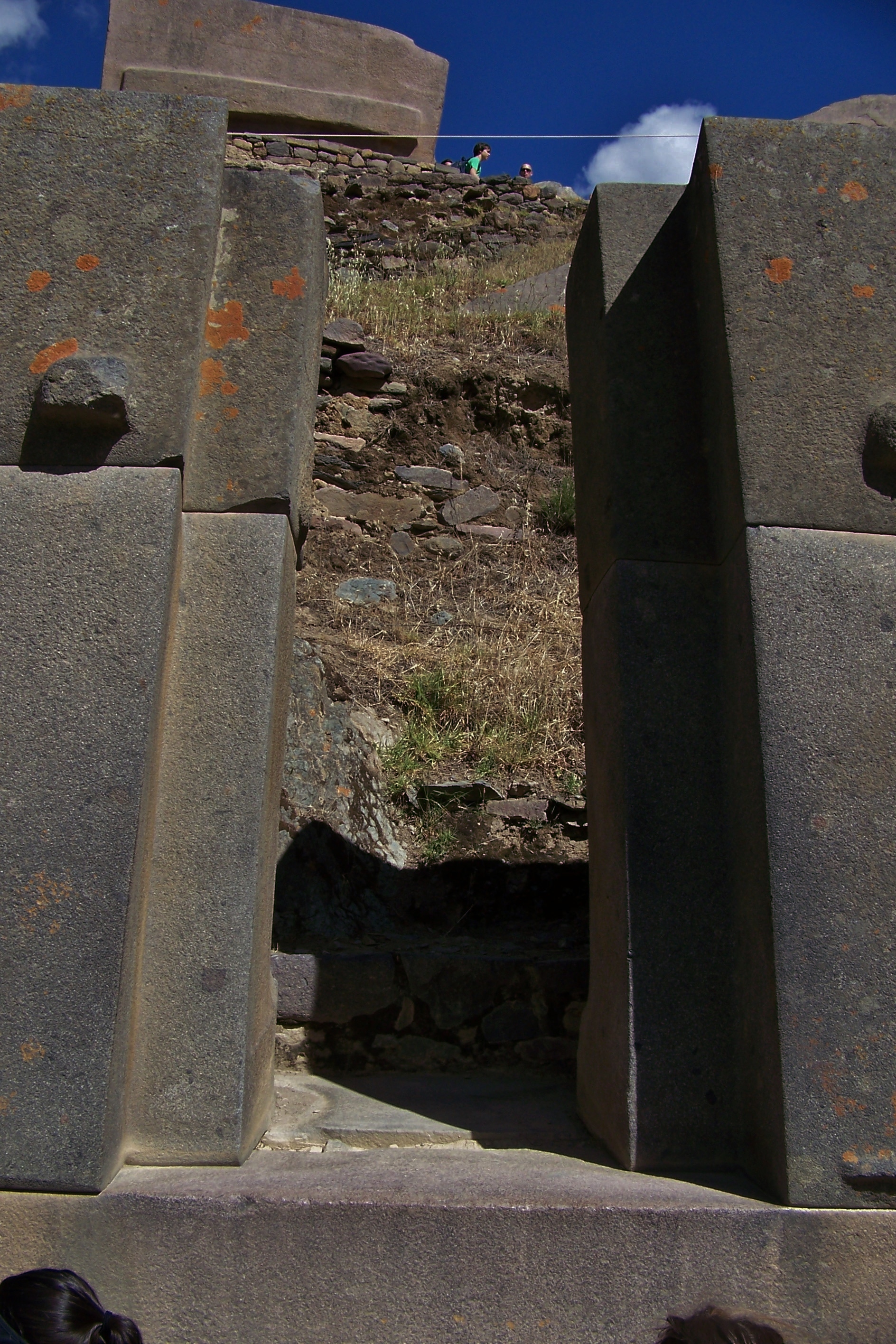
The next morning we headed further downstream to the village and temple site at Ollantaytamba. The temple site has pottery and stonework evidence of pre-Inca terraces and temples. The Incas never finished their temple site here because the Spanish interrupted their 100 year empire and building spree. This fact actually left abundant evidence for how it was being built. Boulders of the acceptable type to the builders (gray basalt) were quarried several thousand feet upslope on the other side of the valley and rolled down. The Urubamba River was divided into two channels by a central levee and half at a time blocked off so the blocks could be pulled across half the river at a time. A ramp on the near side of the valley provided the route up to the temple site. It was perhaps a 9% (~5 degree) slope. We were told that experiments with a 1 ton block required 180 men to drag across smooth, rounded stones lubricated with wet clay up such an incline. The estimate was that 2000 men would have been needed to pull some of the blocks resident to the site!

Ollantaytamba Temple site, terraces, and village

Ollantaytamba Temple site, terraces, and village

Temple of the Sun at Ollantaytamba with quarry site in the background

Temple of the Sun at Ollantaytamba with quarry site in the background


While we were at the temple site the local tour guide was telling us about the various foci of Inca worship: sun, moon, stars, earth, water, the underworld, fertility of land, animals, and wives, and more. Solstices, equinoxes, planetary conjunctions, and the like were times for worship. In their pantheon of gods and means of worship they recognized the invisible god who created all things. At this temple site they believed that this god had left them a representation of himself in the rock formations across the valley. They built a small, four parapet structure on top of this formation as a crown. Why with all of their worship of created things did they recognize an invisible god, utterly different from all of their other objects of worship? But remember what Paul said to the men at Lystra who tried to worship Barnabas and him: “We…preach the gospel to you that you should turn from these vain things to a living God, who made the heaven and the earth and the sea and all that is in them. In the generations gone by He permitted all the nations to go their own ways; and yet He did not leave Himself without witness, in that He did good and gave you rains from heaven and fruitful seasons, satisfying your hearts with food and gladness.” (Acts 14:15-17) What was this witness that He left? What the text lists is the very things that the Inca culture worshipped, physical sources of life. And God left further witness: “The heavens are telling of the glory of God; and their expanse is declaring the work of His hands. Day to day pours forth speech, and night to night reveals knowledge. There is no speech, nor are there words; Their voice is not heard. Their line has gone out through all the earth, and their utterances to the end of the world. In them He has placed a tent for the sun, Which is as a bridegroom coming out of his chamber; It rejoices as a strong man to run his course. Its rising is from one end of the heavens, and its circuit to the other end of them; and there is nothing hidden from its heat.” (Psalm 19:1-6) All that those priests were worshipping in the ridge top temples were witnesses to the very God they acknowledged exists but did not worship. How could they have known of His existence? Was it a long forgotten tradition? Perhaps it was but it need not be. They may have figured out the evidence: “…that which is known about God is evident within them; for God made it evident to them. For since the creation of the world His invisible attributes, His eternal power and divine nature, have been clearly seen, being understood through what has been made, so that they are without excuse. For even though they knew God, they did not honor Him as God or give thanks, but they became futile in their speculations, and their foolish heart was darkened. Professing to be wise, they became fools, and exchanged the glory of the incorruptible God for an image in the form of corruptible man and of birds and four-footed animals and crawling creatures.” (Romans 1:19-23) Wow! The object of their worship became the snare that prevented them from worshipping the true God that all of those things clearly pointed to. This perspective on their knowledge and lack of worshipful acknowledgement of God helped to inform my understanding of all that I saw of Inca culture in Peru.

Unfinished Entryway

Unfinished Entryway

A Block left just short of its destination

A Block left just short of its destination


The ancient way still practiced

The ancient way still practiced


No cement, no gaps, highly earthquake resistant, not eternal

No cement, no gaps, highly earthquake resistant, not eternal


If you care to come along I will explore another strand of this thought in the next Peru entry on Machu Picchu. Until then, blessed truth hunting.


Read Full Post »

A blog titled this way could take many paths through Scripture and personal experience. This entry will only be an abbreviated sequence of thinking that occurred to me while reading about anointing oil and incense for the tent of meeting in Exodus 30 expanded with Scripture references.

God has appeared in the cloud and spoken to the sons of Israel from Mt. Sinai, scaring them sufficiently for them to plead with Moses, “Speak to us yourself and we will listen; but let not God speak to us, or we will die.” Exodus 20:19  But it did not scare them enough to serve the purpose for which Moses said that God spoke for: “Do not be afraid; for God has come in order to test you, and in order that the fear of Him may remain with you, so that you may not sin.” Exodus 20:20 The evidence of course is Exodus 32 when Moses is up on the mountain: He [Aaron] took this [gold] from their hand, and fashioned it with a graving tool and made it into a molten calf; and they said, “This is your god, O Israel, who brought you up from the land of Egypt.” (v.4) The rapidity with which the Israelites turned away from God is both amazing and frightening, but it pales in comparison to what Aaron, the recently consecrated and anointed High Priest, did by way of directing and encouraging their sinful passions. There is much warning to be taken from this scene. Rather than a rabbit trail about our sinfulness, I see this as the fuller context for the comments I want to make about God.

God knew their tendencies and even warned them to watch out for them by giving them a scare at Mt. Sinai.

So what is God saying to us about worship of Him?

Is He ‘pleading’ with us to worship Him as though He will be lacking and sad without it. No, God is not in need of anything we possess or can give, as Psalm 50 says,“Hear, O My people, and I will speak; O Israel, I will testify against you; I am God, your God. I do not reprove you for your sacrifices, and your burnt offerings are continually before Me. I shall take no young bull out of your house nor male goats out of your folds.
For every beast of the forest is Mine, the cattle on a thousand hills. I know every bird of the mountains, and everything that moves in the field is Mine. If I were hungry I would not tell you, for the world is Mine, and all it contains. Shall I eat the flesh of bulls or drink the blood of male goats? Offer to God a sacrifice of thanksgiving and pay your vows to the Most High; call upon Me in the day of trouble; I shall rescue you, and you will honor Me.” (v.7-15)

Is He ‘expecting’ us to worship Him? In the sense of an expectation placed upon us I would say yes, but in the sense of surprised if we don’t, I think not.“You men who are stiff-necked and uncircumcised in heart and ears are always resisting the Holy Spirit; you are doing just as your fathers did.” Acts 7:51 “Nothing really changes; everything remains the same. We are what we are ’til the day that we die,” sang Larry Norman. God knows the true nature of our hearts. But Jesus, on His part, was not entrusting Himself to them, for He knew all men, and because He did not need anyone to testify concerning man, for He Himself knew what was in man.” John 2:24-25

Is God “demanding” that we worship Him? No, He has left us with free will to the extent that we do what we always want to do, namely turn away from Him, for “All of us like sheep have gone astray, each of us has turned to his own way; but the Lord has caused the iniquity of us all to fall on Him.: Isaiah 53:6

Instead, I think the Scripture is saying that God is ‘commanding’ us to worship Him. He is worthy of worship, as Psalm 29:2 says, “ascribe to the Lord the glory due to His name”. Worship of God is also beneficial to the worshipper: “Sing for joy in the Lord, O you righteous ones; praise is becoming to the upright.” Psalm 33:1 “‘I will lead him and restore comfort to him and to his mourners, creating the praise of the lips.
Peace, peace to him who is far and to him who is near,’
Says the Lord, ‘and I will heal him.’” Isaiah 57:18-19 Worship trains the next generation for worship of God: “We will not conceal them from their children, but tell to the generation to come the praises of the Lord, and His strngth and His wondrous wondrous works that He has done.” Psalm 78:4

Give praise to God for Who He is; praise Him for the glory and efficacy of His name; praise God for His wonderful works in creation and beneficial works in salvation through His Son Jesus Christ.

Read Full Post »

About this time of year I hear well worn comments like these: “High school is the best time of your life; better make the most of it.” I’m glad that for many of us that is not true or we’d just end it right now. “Now you have to go out into the real world.” High school is real enough with its own set of challenges. “Now you can spread your wings and feel your freedom.” Yes and no. Some have far more license in high school than they should and little will change when they get out. All will continue to have constraints even if only by the law and many will have more responsibility and constraints than they ever have. So where is some wisdom that applies to all. That, of course, comes from the Scripture. For example, as I considered one relative’s graduation recently the following came to mind: “So do not worry about tomorrow; for tomorrow will care for itself. Each day has enough trouble of its own.” (Matthew 6:34) The combination of the ideas of today and trouble set me to thinking on how to give wisdom to this graduate. Following is my mean attempt:

Don't wish your life away
Looking for a better way

Don't fear difficulty
Vexing ambiguity

Don't shun caring embrace
To keep up with the rat race

Don't give up or give in
On false hopes your future pin

Hope instead in God's way
And through today's troubles pray

In His serenity
Find all your security

Care for others with grace
Taking time, slowing your pace

Fight temptation and sin
By God's power you will win

Read Full Post »

The student asked a simple enough question:

Are you overwhelmed by life or overwhelmed by God?

You won’t be overwhelmed by life if you are overwhelmed by God. His mercy, grace, peace, and joy will reduce any care this world produces to a mere challenge to find more security, faith, provision, direction, peace and joy in Christ. His work on our behalf past and present and future is all sufficient. When I am underwhelmed by Him, having given in to the distractions of the world, then I am soon overwhelmed by life. The answer is not more effort but more trust, more focus on Him, more calling out, more resting in His work completed. Inhale more of Christ through His Word; exhale more of trouble in this world by prayer to Him. Make it as constant and automatic as breathing. Sure, you’ll get the wind knocked out of you now and then but that only causes you know more acutely the source of life. (source examples of rest: Romans 6:11, I Corinthians 10:13, Romans 8:1, Hebrews 4:11-16, Colossians 3:15-16)

Read Full Post »

A pastor friend of mine put this quote on Facebook that he had read from Tim Keller: “For most of us, God hasn’t become our happiness. We, therefore, pray to procure things for our happiness, and not to know him better.” Sometimes quotes are black and white, absolute, and I want to say, no, only sometimes and partially. So I started to respond to this entry but as I tried to think how to respond the depth of my own culpability increased in my eyes. Things procured may not always be material objects, and most frequently are not things I most desire or pursue. They may be accomplishments, comforts, accolades, encouragements, skills, health, entertainments, work, love, a sense of purpose, and so on. They are not knowledge of God. Neither are the bad in themselves, used as tools for knowing Him and making Him known, but I don’t frequently acquire them for that reason. So I retreated from responding to the entry, but the impact of the statement would not fade. I have resolved by the Spirit to confront such idols in the past.

As these thoughts mulled over in my mind I was reminded of the verse in the hymn that goes, “Here I raise my Ebenezer, hither by Thy help I’m come, and I hope, by Thy good pleasure, safely to arrive at home.” The Ebenezer comes from a text in I Samuel 7:8-13: “Then the sons of Israel said to Samuel, “Do not cease to cry to the Lord our God for us, that He may save us from the hand of the Philistines.” Samuel took a suckling lamb and offered it for a whole burnt offering to the Lord; and Samuel cried to the Lord for Israel and the Lord answered him. Now Samuel was offering up the burnt offering, and the Philistines drew near to battle against Israel. But the Lord thundered with a great thunder on that day against the Philistines and confused them, so that they were routed before Israel. The men of Israel went out of Mizpah and pursued the Philistines, and struck them down as far as below Beth-car. Then Samuel took a stone and set it between Mizpah and Shen, and named it Ebenezer, saying, “Thus far the Lord has helped us.” So the Philistines were subdued and they did not come anymore within the border of Israel.”  The translation of Ebenezer is a “stone of help”. It is a monument raised by someone to remind them of help that God has given them. It is very easy to emphasize the act of raising the stone or the resolve that went into the help afforded but that is a totally man-centered dead end. God thundered and confused the enemy and routed and weakened to be struck down. Israel was active: pursuing, striking; Samuel set up the stone, but God did all of the heavy lifting and enabled all of the victory. So too in our victories over the temptation “we are destroying speculations and every lofty thing raised up against the knowledge of God, and we are taking every thought captive to the obedience of Christ,” (II Corinthians 10:5) by the enabling power of the Spirit.

At my age and stage of life I have set up more than a few Ebenezers in field of battle. “God is our refuge and strength, A very present help in trouble.” Psalm 46:1 I know His help, and I know how to call on Him, but in many smaller skirmishes and encampment quarrels and disease I am in great need of revisiting an Ebenezer set up where God enabled victory over evil thoughts, or the other one where victory was won over sluggish spiritual discipline, or yet another one where pride of accomplishment and tendency to show off was overcome. And on it goes. I need to take every thought captive by the power He provides, set up monuments to remind me of His victory and what was won, know Him more, and revisit those “stones of help” before or during great or prolonged battles.

Read Full Post »

The Pharisees and scribes were at it again, hackling and questioning Jesus. In their minds they were the gatekeepers to the understanding and practice of righteousness. And Jesus once again showed them otherwise:

“Then some Pharisees and scribes came to Jesus from Jerusalem and said, “Why do Your disciples break the tradition of the elders? For they do not wash their hands when they eat bread.”  And He answered and said to them, “Why do you yourselves transgress the commandment of God for the sake of your tradition?  For God said, ‘Honor your father and mother,’ and, ‘He who speaks evil of father or mother is to be put to death.’  But you say, ‘Whoever says to his father or mother, “Whatever I have that would help you has been given to God,” he is not to honor his father or his mother.’ And by this you invalidated the word of God for the sake of your tradition. You hypocrites, rightly did Isaiah prophesy of you:

This people honors Me with their lips, But their heart is far away from Me. But in vain do they worship Me, Teaching as doctrines the precepts of men.’””          Matthew 15:1-9

By trying to create their own laws that in their minds super-fulfilled the requirements of the law they missed the simple truth of God’s requirement and actually transgressed the law. Thus ends all manmade attempts to be righteous by our own schemes and effort. The best we can do apart from the Spirit of God is fail. So I could continue with a survey of all the different ways the Pharisees missed it and perhaps act pharisaically in the process by condemning them to justify myself. But our pastor, Sunday School lessons, and the sharing at church of late has seemed to center around repentance. One day this past week after having read the above passage and while watching my students quietly work on an assignment a thought bore down on me with noticeable weight: Do I honor God only with my lips? Is my heart captured by other things apart from Him and His glory? Before I could get myself off of the hook I began musing on what I am most passionate and excited about. What do I spend the most time on, particularly during leisure time? What do my thoughts go to when there are no responsibilities to fulfill, for the Word says, “one who looks intently at the perfect law, the law of liberty, and abides by it, not having become a forgetful hearer but an effectual doer, this man will be blessed in what he does.” (James 1:25)? How do I help people without using them since “pure and undefiled religion in the sight of our God and Father is this: to visit orphans and widows in their distress, and to keep oneself unstained by the world.” (James 1:27)? How much of the truth that I know do I practice since “to one who knows the right thing to do and does not do it, to him it is sin.” (James 4:17)? A brother in Sunday School this past Sunday prayed, “To defect from carrying out of the mundane is to defect from the grand scheme of God’s plan. It is a denial of Him.” Do I scheme grandiose plans while neglecting the daily tasks before me? The Bible says, make it your ambition to lead a quiet life and attend to your own business and work with your hands, just as we commanded you,  so that you will behave properly toward outsiders and not be in any need.” (I Thessalonians 4:17)? Do I say I am faithful to my wife but not carry it out, for the Word says, abstain from sexual immorality; that each of you know how to possess his own vessel in sanctification and honor, not in lustful passion, like the Gentiles who do not know God.” (I Thessalonians 4:3-5)? Do I covet, wanting all manner of things and recognition and abilities more than I want God when it says, You shall not covet, so that “sin, taking opportunity through the commandment, produced in me coveting of every kind” (Romans 7:7-8)? Do I wrangle about words, which is useless and leads to the ruin of the hearers.” (II Timothy 2:14) or dabble in “filthiness and silly talk, or coarse jesting, which are not fitting,” and fail at “giving of thanks. (Ephesians 5:4)?  Have my intentions been good but my carry-through poor, “being a double-minded man, unstable in all his ways.” (James 1:8), so that I do not “Make vows to the Lord your God and fulfill them” (Psalm 76:11) as I ought?

My intention is not to wallow in guilt and self-pity because of struggles and failures in these and other areas. That would just produce more tendency to neglect the good and pursue the bad, like a defeated dieter who gives in to all manner of poor food choices over the guilt of one slip-up. Instead, I desire to repent of foolish indulgences, thank God for His enabling progress to overcome these temptations more than in the past, and resolve by the power over sin He provides to “love the Lord your God with all your heart and with all your soul and with all your might.” (Deuteronomy 6:5).  I want to honor God with my lips, my heart, my actions, worshipping Him in a God-honoring, eternally valuable way, “accurately handling the word of truth.” (II Timothy 2:15), rather than be classed with lip serving, pharisaical hypocrites.

“Therefore I urge you, brethren, by the mercies of God, to present your bodies a living and holy sacrifice, acceptable to God, which is your spiritual service of worship. And do not be conformed to this world, but be transformed by the renewing of your mind, so that you may prove what the will of God is, that which is good and acceptable and perfect.” Romans 12:1-2

Read Full Post »

(First Draft, since starting with the completed version might not happen in time)

I am prepared and even enthusiast about living for however much longer God has in mind for me, be that 50 minutes or 50 years. However, the longer I live the less likely I am to live substantially longer. I do participate in some risky behaviors, albeit, thoughtfully, cautiously, and frequently with prayer. And additionally I most fervently hope that me writing this blog just now is not an indication that God is getting ready to take me soon, though I will not object in the least if He does. Rather, I see this blog entry as a bullet on my to do list that has had a few red flags inserted by recent personal events. I want to mention my wishes for my funeral.

The most expensive item first: Bury me wherever is cost effective and convenient for those dealing with my loss. God can resurrect whatever parts and pieces He has ordained to be transformed into my new body from anywhere in this old world from mountain top to ocean depth and a whole lot of less glorious places than that. We respectfully plant bodies (good terminology given what I Corinthians 15 says about perishable seed) because they contained spirits made in the image of God and because those of believers will be resurrected to be in His presence, which is comforting to the mourning loved-ones. An inexpensive casket and what not is sufficient; I’ll assure you it won’t impress me.

I would like to influence several aspects of the service, however.

Primarily, focus on the Savior; I certainly will be. I have too few earthly accomplishments of merit with which to praise the Holy One. I do have this: grace. God has imparted grace to me in salvation, in living, in family, in provision of every talent, possession, happiness, pursuit, safety, knowledge, or any other thing you can think of He provided me with. Speak of His grace, sing of His grace, pray about His grace, urge hearers to partake of His grace.

One area of grace in my life was a love and desire to know and live by God’s Word (you can argue later about how I didn’t do either; the point is God gave this poor sinner so much). So please sing “How Firm A Foundation”. I have sung all 7 verses with a congregation before. They are very appropriate for this situation. Why are you in such a hurry, I’m not going anywhere? At least sing the first two, please.

If you think you are leaving this place (Earth, I mean) without the help of Jesus, you are headed the wrong way; reconsider now. I know where I’m headed and why, and I want you to hear about it at my funeral. Please sing all four verses of “My Hope Is Built On Nothing Less”. If you cry, let it be because you understand just how deep His grace is reaching to secure your eternity. It is not your effort, not your rock solid faith or piety; it is the rock solid faithfulness and power of Jesus on your behalf, enabling you to believe, continue to believe, and improve in your living.

If you will tolerate singing yet a third hymn, let it be “My Hope Is In The Lord”, or a fourth hymn, sing “Praise The Savior”. These complete my list of most favorite hymns, though my children should know that I had many “favorite” hymns.

Read from I Corinthians 15. If someone is available who can or will, preach on it, especially the depth of witness to the event of the resurrection (verses 3-11), the reason it matters (verses 12-18), and Christ’s resurrection (verses 20-28). If time allows speak about the first and second Adam (verses 40-49) where you cannot neglect to bring in Romans 5 about justification by faith. If you see nodding off or rolling eyes, just tell them that I was dying to hear one more time about all that Jesus has done for me and them. No, actually, don’t mention half of what I’ve said in this blog. It may be a solemn occasion even if a celebratory one, owing to my home going.

If you want to read other Scriptures, some suggestions include Genesis 1 since by God’s grace I have always believed that God created the heavens and earth in six literal days, all the more as the scientific evidence pours in. Read from Revelation 21 and/or 22. The last chapter fortifies the weakest of faith. He is coming again; we can persevere by His enabling power and faithful Word through the Spirit we are given. Hold on.

A good call to worship to God, for that is what I hope my funeral will be, one of my favorite passages is Hebrews 1:1-4, though you don’t have to stop at verse 4.

I know this is getting a bit long and will have to be cut down, but I so love Hebrews 4:9-16. Please don’t be afraid to give a bit of commentary on each of the verses I have suggested so that God might powerfully move in the hearts of the faint-hearted and the lost. I am at my rest because Jesus didn’t rest until He had finished His work on my behalf (II Corinthians 5:21). How could you neglect to read a few verses from II Corinthians 5 at a funeral? Maybe I should just write the sermon and put it in a blog entry for you to print off and read. Perhaps, but probably not, because it would be better if the Spirit spoke to that crowd on that day. At some point I may well organize this rambling list of desires for my funeral into a more coherent service. I hope that you (the organizer) will not neglect this list out of hand. Blessings to you in the name of Jesus, my Savior and Lord.

If you want to read something I wrote, perhaps one of my better poems about God and our life in Him would be in order. Pick as you may, but here are some suggestions based on appropriateness or value: “Trust Is Your Rest”, “The Why”, “But a Few of His Benefits”, “Our Demise”, **”Ichthus Rhyme”, “First Cause”, “A Servant’s Ambition”, “Just Sayings”, **”Eyes on Things Above”, **”A Need To Create”, “Advent Colors”, or

God’s grace is my comfort and rest

My strong tower in the midst of test

While I trust Him I shall prevail

Raised from the dead without fail

Man, did that list get carried away. Pick one or none, but read Scripture and sing hymns.

Read Full Post »

In an e-mail Christmas greeting friends of mine sent there was what seemed to me an exceptional Christmas Card picture. The beauty and poem and tenderness were not the exceptionality for me. The profound nature of the picture was the silent commentary of an empty manger. In the same way as we as Protestants insist on an empty cross, it is appropriate for us to reflect on an empty manger. He is not a helpless baby any longer; He is not any longer tempted as we are (though without sin); He is no longer on the cross or in the tomb; He is still fully human and fully God, glorified, reigning from His throne on high. In time and history He came to the manger, the villages, the cross, the tomb. He is there no longer! But He is still in my heart and yours through the Holy Spirit so that we are positionally in Him on the throne at the right hand of the Majesty on High.

I enjoy a well done creche that makes an attempt at accurately picturing the scene of His arrival. But because we are given so little information and the shepherds’ and magi’s visits were probably separated by at least months and we don’t know if it was a cave, barn, lean-to, or adobe house extension, we spend inordinate amounts of time imagining things that are not of great benefit. But that He came to the most humble of circumstances and is now exalted on high is the most outrageously glorious rags to riches story of all time. And that was not the low point or high point of His humility. On the cross He was robbed of every decency and deserved honor willingly to take on your and my indecency and deserved dishonor so that we might be glorified with Him. That is worth celebrating all the time; crosses and mangers and tombs are mere symbols for remembering what we celebrate.

Merry Christmas

Read Full Post »

I have not blogged since August, the longest time off since I started blogging in 2007. The pace of life always seems on the uptick and where are the moments for musing? God is at work and life is still a challenge. I want to relate His goodness, provision, direction, and discipline in my life, but it is more important to live out what He has set before me than always write it down.

I had a dream the middle of this last week. I probably dream frequently as do most people but I infrequently remember that I have dreamed at all and even when I do the dream is vague and fades quickly when I awake. When I have a vivid dream I pay attention.

In the dream I was sitting in a chair at a white, plastic round table surrounded by chairs perhaps large enough to seat 6. The table sat near the inside to an entrance to a business, perhaps a department store or the entrance to a mall, but I could not tell which one because I was faced toward the multiple sets of double doors through which many people were passing. It was a hectic scene but I was focused on a piece of paper on the table before me. With a pencil I kept trying to organize how to pay the doctor bills, complete all of the tasks required of me by home and work, and fulfill all of the commitments I had made to people. As I struggled over the list occasionally I would glance up to see one or three or two people sitting at the table across from me. Every one of the people that would come and sit for a moment was someone I know and can name. Some would be saying encouraging words to me and others would just smile. These were all people who have and are helping my wife and me since her stroke. I could not understand their actual words but I understood the content of their words and smiles to mean that God was working it out and that they were there to see us through. I continued to fret and pour over the list. One couple who has helped us in various ways came separately to the table, first the woman and then the man. She smiled at me with an ever growing smile as if to say, “God has this under control, trust Him.” After she left the man came and lounged, legs crossed, telling a story as he is apt to do, interjecting my name with “It will work out.” Others came who have blessed us with their presence and concern and prayers and help and financial assistance and encouraging words.

When I awoke I had several immediate conclusions that seemed abundantly evident from the dream:

   1) God was saying to me that He had sent all of these people to help us.

   2) My fretting was useless, distracting me from blessing, lacking in faith, and sin, and I need to repent of it. (I didn’t even think that I was fretting or scheming but it is so easy to to fall prey to that lie. I knew God was in control and providing but I still was adding my “two cents worth” of figuring it out.)

   3) I need to thank some people who I have not really thanked for all of the help they have given us.

We need the church. You can’t fellowship by yourself. You can’t glorify God to the full extent and in the way He has ordained without believers’ input. The people of God help us in so many ways through prayer, encouragement, admonition, teaching, and material help. We miss out by not growing relationships with fellow believers in a local body of believers, worshipping, praying, working, witnessing, crying, and laughing together.

Read Full Post »

It is a common response among some Christians these days to say that their faith is not a religion as the other belief systems have it but a relationship with the Creator and Savior. I heartily agree with this distinction  because God has initiated relationship with us through the saving blood of His Son, Jesus. Other faith systems are religions whereby the adherent attempts to acquire some semblance of relationship with a deity by acts of ritual. Therefore, religion is marked by ritual, most notably rituals of appeasement. Any casual observer as well as the skeptic will be quick to point out that Christianity also has ritual. A little reflection will quickly reveal that most of that ritual is human generated. But even apart from that there is the prescribed ritual of the Lord’s Supper and  Baptism. So how is it that I am claiming that  Christianity is different? 

In many respects related to the topic at hand I must confess that it is no different though it is supposed to be. What I ambitiously desire to do in a few words is describe how it should be different, how it is not, and how it may regularly be transformed into different when it falters into same ‘ole, same ‘ole. My thesis is that unbelievers among the skeptic, disinterested, and nominal Christian, as well as the carnal Christian and devoted believer are constantly in danger of practicing religion through ritual because they are deceived (some as a persistent condition and others as a periodic pitfall) into believing that we must appease the gods or God in order to gain their or His favor.

True relationship must have forms and norms, which may be seen as ritual, but the point is not the ritual or any attempt at controlling or appeasing the one with whom you are interacting (for if it is the relationship has problems which will appear now or later). For instance, we say hello and good-bye, shake hands or hug, address our elders as Mister or Missis, and any number of things to be polite and show respect as demonstrations of love in order to build up the relationship.  Formalities keep relationships appropriate and prevent misunderstanding and hurt.

As regards relationship with God, we must approach Him in reverence and in appropriate ways both because He is worthy and because He is not to be trifled with at peril to ourselves. But He has initiated the relationship and provides all that is needed to maintain and grow it. We can do neither and should cease trying both because we never can and because it is an affront to His provision of grace, an act of unbelief.

So as it should look, the Lord’s Supper or Baptism are relationship building activities that draw us and onlookers closer to God, not through appeasement but by focus on Him, listening to what He communicates to us through prayer, and His word and what we communicate to Him through worship and obedience. Other forms of worship like listening to the Word preached, singing or hearing singing, musing on His Word or His beauty as revealed in Creation, confessing sin, interacting with others about the things of God in fellowship are forms for getting to know God better, telling others about Jesus, and serving others.

Here is where the ritual may creep in or always be present. At any point we believe the lie that we must appease or control God or get lazy (complacency!), we counterfeit relationship by doing ritual. The activities we are involved in may be the very ones God commands and may be the very ones that brought blessing by growing our relationship with God last week or yesterday, but we have fallen back on the way that is easier for the flesh, that old sinful nature within, going through the motions- ritual! The unbeliever knows no other way; the carnal believer knows too little of the blessing of relationship with God; the devoted follower is blind-sided by inattention to the things he knows to do and avoid that build or destroy intimacy with God, respectively.

The solution for all comers is the same. Repent! Your sin is unbelief. No amount of ritual will ever draw you closer to God. If you do not know Him, then meet Him through the introduction of faith in what Jesus did on the cross to forgive you for your sin. Getting to know Him is wonderful. If you know Him already quit trying to manipulate the relationship by performing ritual; repent and again seek to know Him. It will bring peace to your beleaguered soul.

Then be alert for the Lie that you can make a go of it on your own, a lie nearly as old as the Garden of Eden where Satan proposed it. Better to pause from spiritual activity rather than continue in ritualistic persistence. Don’t use this as an excuse to continue in an undisciplined way, not pursuing relationship with God. Pause instead to regain passion for the pursuit through the prayer of repentance. Then seek the ancient paths that Jeremiah speaks of  to follow after your God.

Read Full Post »

“Christianity preaches the infinite worth of that which is seemingly worthless and the infinite worthlessness of that which is seemingly so valued,” quoted my pastor of Dietrich Bonhoeffer. Paul declared,But whatever things were gain to me, those things I have counted as loss for the sake of Christ. More than that, I count all things to be loss in view of the surpassing value of knowing Christ Jesus my Lord, for whom I have suffered the loss of all things, and count them but rubbish so that I may gain Christ, and may be found in Him, not having a righteousness of my own derived from the Law, but that which is through faith in Christ, the righteousness which comes from God on the basis of faith, that I may know Him and the power of His resurrection and the fellowship of His sufferings, being conformed to His death; in order that I may attain to the resurrection from the dead.” Philippians 3:7-11

As we get nearer to Christ through years of devotion and repetition of trials, we discover more His value and less the worth of all that we held so dearly without cause. The pastor’s quote drove me immediately to a quote of another Christian who had drawn close to the Savior just before his death: “He is no fool who gives what he cannot keep to gain that which he cannot lose.” Jim Elliot (This may actually be a quote he had memorized after reading the English nonconformist preacher, Philip Henry, though it is not possible to know.) Elliott was willing to put all of his fears and desires on hold to reach for eternal gain.

Is there a pattern here? Do we value more that which is valuable as we gain a greater glimpse of Him who is valuable? Does that relate closely to the time of our home-going (heavenward, I mean)?

“If your heart takes more pleasure in reading novels, or watching TV, or going to the movies, or talking to friends, rather than just sitting alone with God and embracing Him, sharing His cares and His burdens, weeping and rejoicing with Him, then how are you going to handle forever and ever in His presence? You’d be bored to tears in heaven, if you’re not ecstatic about God now!” Keith Green

Bonhoeffer’s and Elliot’s lives were cut short directly as a result of pursuing Gospel-centered lives and Green’s while focusing on spreading the Gospel. It seems that this pursuit of God is dangerous. But perhaps that perspective of saying that it is dangerous is still that of one afraid to totally let go and serve God. Maybe that pursuit of God is really exciting and the seemingly early demise of these believers is the reward of hot pursuit of their goal. If your appointed, that is God ordained, assignment is complete your demise is neither untimely nor problematic, though I am not ignoring the hurt and discomfort it causes loved ones.

We could also quote other saints who outlived most everyone around them while seeking God with all their heart: “If I had a thousand pounds China should have it—if I had a thousand lives, China should have them. No! Not China, but Christ. Can we do too much for Him? Can we do enough for such a precious Saviour?” Hudson Taylor (1832-1905)

Still, there is some truth to the difficulty of living for Christ which Taylor, Judson, Carey, and many others would quickly attest. But so did Paul: “Indeed, all who desire to live godly in Christ Jesus will be persecuted.” II Timothy 3:12 And G.K. Chesterton confers: “Christianity has not been tried and found wanting; it has been found difficult and not tried.”

Watchman Nee was one of those exceptions of the type I am quoting here, “And it is through conflict that God induces the believer to seek and to grasp total triumph in Christ.” (1903-1972; died in prison for his faith)

What are we “normal folk”, Christians not called to foreign lands or extreme conditions, to do? There is much instruction about “ordinary living” but here are verses that show that it too is ordained by God for His glory: But we urge you, brethren, to excel still more, and to make it your ambition to lead a quiet life and attend to your own business and work with your hands, just as we commanded you, so that you will behave properly toward outsiders and not be in any need.” I Thessalonians 4:10-12 The quiet life is not the undisturbed life. If you witness to your neighbors and live in purity before God, someone will notice and be irritated enough to bother you. Recall the II Timothy 3:12 verse above. And no one is a stranger to difficulty in this fallen world. Not for the sake of “some action” in the persecution arena or difficulty district but for the purpose of knowing your Savior and enjoying Him far more than now, don’t be afraid to count what is eternally rubbish as loss to gain what is eternally priceless, knowledge and intimacy with Christ. May God enable you and me to so do, rejoicing in the process and the outcome.


Read Full Post »

“I urge you, rejoice in the same way and share your joy with me.” (Phillipians 2:18) and Finally, my brethren, rejoice in the Lord. To write the same things again is no trouble to me, and it is a safeguard for you.” (Phillipians 3:1) Okay, Paul, I hear you but what is the big deal here? You said it twice, pleading, commanding, and “safeguard”, really?

When I looked at the context of the two verses I realized why he is so adamant. So then, my beloved, just as you have always obeyed, not as in my presence only, but now much more in my absence, work out your salvation with fear and trembling; for it is God who is at work in you, both to will and to work for His good pleasure.Do all things without grumbling or disputing;  so that you will prove yourselves to be blameless and innocent, children of God above reproach in the midst of a crooked and perverse generation, among whom you appear as lights in the world,  holding fast the word of life, so that in the day of Christ I will have reason to glory because I did not run in vain nor toil in vain. But even if I am being poured out as a drink offering upon the sacrifice and service of your faith, I rejoice and share my joy with you.” (2:12-17) and Beware of the dogs, beware of the evil workers, beware of the false circumcision;  for we are the true circumcision, who worship in the Spirit of God and glory in Christ Jesus and put no confidence in the flesh” (3:2-3). Paul is alerting the believers to get serious and rejoice. You take part in God’s work to sanctify you and here are some major hindrances to progress: voicing a bad attitude, contrary generation, trials, false teachers, legalists, and the flesh. Rejoicing is a safeguard because the listed hindrances to sanctification are beaten back by the rejoicing in the things of God based on an act of faith. Bad attitudes and the flesh, and every person contrary to the truth cannot defeat the act of worship of rejoicing. Begin to rejoice even if you don’t feel like it; even if you are struggling to see it; even if the circumstances say otherwise. Your faith will expand, others will be drawn in, and God will be glorified.

“Feasting on the riches of His grace, resting ‘neath His shelt’ring wing; always looking on His smiling face- that is why I shout and sing!” goes the old hymn. Dwell on Him; trust in Him; cling to Him; rejoice in Him.

Read Full Post »

The ability to remember and associate smells is one of the most powerful forms of memory, enhancing a sense of time and place and visual cues. The Olfactory Glands are located in the sinuses very close to a part of the brain that processes and retrieves memories and emotions, the amygdala. Scientists have isolated a thousand different enzymes that bond to odiferous chemicals in the  identification of smells in humans.

 I’m originally from East Tennessee where the clay is nearly as orange as this print and hard enough so that you are not be able to stick a mattock into it more than 2 to 3 inches no matter how hard you hit it. There is abundant clay where I live now but it is most usually infused with muscovite mica (the silvery sheet mineral that you can see through) which makes it much easier to dig in.  My number three son and I are building a deck for a colleague of mine. Where the deck is located there is no mica in the clay (odd) so it digs like East Tennessee clay.  On the way home the other day I inadvertently put my hand on to my face and smelled the clay/dry grass mixture on my fingers. Memories began to flood in from so many times and places that I couldn’t ruminate before the next set of life experiences were upon me. Being dirty is repulsive to many but when it reminds me of things I have enjoyed doing it becomes a perfume. I immediately thought of helping friends and strangers put up hay on a hot or balmy June  or September day. I thought of setting fence posts for a horse training ring and the one hole where the Sassafras root filled our noses. Or the many fences I have built or repaired over lawn and woods when the scent of clay on the posthole diggers is matched with leather warming up on the wooden handles.  I thought of collecting spiders for research and digging in the back yard where I grew up to make a hide-out with my brother. I remember tilling in the garden in The Horseshoe and caving in a number of East Tennessee sinkholes or repairing pipes or foundations for many evenings and nights until a dropped into bed. All of these thoughts flooded my mind in less than a minute. Odors can be very subtle and yet bring back some of the most vivid memories. I was surprised by the sudden onset and pleased by the thoughts of life lived to the fullest.

When I was a youth, I once prayed that the Lord would let me experience life to the fullest. They say you should be careful what you pray for but I believe you should be bold in what you pray for when your heart is right. God is wise and kind enough to sort out how He should answer. God has abundantly answered that prayer, but of course, not in ways I would have ever expected or wanted. With the many good and significantly pleasant memories are the hard and mundane and heartbreaking ones. You can’t really experience all of life without difficulty. I’ve never been afraid to work hard, so many of my good memories are high energy, even difficult experiences, that only later mellow into good memories. I am thankful to God for allowing me to experience so many varied activities and interactions with people over the years. He is good to me far beyond the necessities of physical and spiritual life. I have truly enjoyed life and want to share my love of the outdoors and science and beauty and solid thinking with others. Though read by few, that is the reason I write this blog, to point to the One who creates, saves and sustains so abundantly.

Read Full Post »

During the sermon this morning the pastor referenced two metaphors used by John MacArthur concerning unity in the church. Never quite willing to let a good analogy go unanalyzed and extended I began musing.

According to his reporting of MacArthur, we frequently see unity as a bag of marbles. Marbles (people in the church) are held in (unity) by a bag (programs). If the bag wears thin or tears the church loses all its marbles via the loss of the external binding force of the bag.   It occurred to me that the congregants scatter because they have potential energy (sin nature) that gives them momentum (movement) away from one another once the constraining force of the bag is reduced. The reason this occurred to me is that I have seen dead churches that still have a semblance of unity even when there are no programs to hold them together simply because there is also no life or movement in the church. Dead objects don’t move (or stop their present straight line motion (tradition)) unless acted upon.

MacArthur thought that a better analogy for unity was that of a magnet (God) acting as a central attractive force upon iron filings (the people). But the science teacher in me rebuffed that there are no mono-poles. For every north pole there is a south pole, always. So what we are being attracted to as our north pole-God- causes us to be oriented away from what is then our south pole-the world, the flesh, and the devil. Iron filings alone will be attracted to either pole but once magnetized by an attraction to one pole will orient with their “backs” to the other pole since they become mini-magnets with north and south poles. We still have sin natures which pull us the wrong way, but we now have a new pole oriented toward God and others in our church, unless we pull away.

What attracts you? What are you being oriented toward? What have you turned your back on or is this outside force deciding for you? Orient yourself toward God by His grace along with a body of believers (iron filings) and you will turn your back on evil. Try to stay neutral and you will be pulled in by the next passing attraction.

Read Full Post »

Worked, played, napped, read, ran, and just now I sat on this cool, exceptionally clear summer night listening to the distant fireworks of my small town. How could freedom not come to mind, but I’m concerned. As the rockets burst 10 blocks away my thoughts went to how freedom is abused and misused:

Always free to do what is right

In dungeon dark or Main Street bright

Don’t take license and act the fool

For righteousness use God’s gracious tool

Or else He’ll take it from us all

And great will be this nation’s fall

Which once so brightly shone for good

Frequently for justice it once stood

Not without fault or blemish there

But most citizens gave a care

Whereas now we say right is wrong

Parade evil in our law and song

Oh, once free land turn back to God

Give freedom more than a yearly nod

Read Full Post »

« Newer Posts - Older Posts »

Myrela

Art, health, civilizations, photography, nature, books, recipes, etc.

Overflows from the Heart

"But the things that proceed out of the mouth come from the heart…" Matthew 15:18

CreatorWorship

Pointing to the One who made, saved, and sustains