Feeds:
Posts
Comments

Posts Tagged ‘theology’

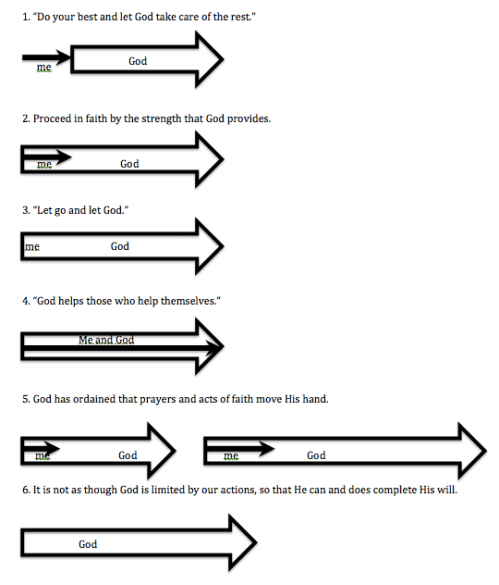
He said, “Do your best and let God take care of the rest.” I had heard this and similar phrases many times, but I went off on a mental tangent of evaluating it in the light of Scripture. I think that I understand the intent of the saying, namely that we have an active part to play in growing righteousness in our life and God completes what is lacking in us. Thus far I have no problem, but I think we may do better in our understanding and representation of the interplay of our effort and God’s empowerment. Toward a theology of effort and empowerment consider the following diagrams with their perspectives on the topic:

effort-empowerment-arrows

The arrows are somewhat self-explanatory, but I want to clarify them for my own benefit and yours. Though, as I said, the #1 was stated with right intentions, I believe that at face value it is really saying that I exert effort to the extent of my ability and then God kicks in for the rest. But the Scripture says,“for in Him we live and move and exist” (Acts 17:28), and “I am the vine, you are the branches; he who abides in Me and I in him, he bears much fruit, for apart from Me you can do nothing.” (John 15:5) We cannot even breathe apart from the grace He provides, but the “nothing” here seems to me to be ‘nothing of eternal significance’. As Paul teaches in I Corinthians 3:11-15, For no man can lay a foundation other than the one which is laid, which is Jesus Christ.  Now if any man builds on the foundation with gold, silver, precious stones, wood, hay, straw, each man’s work will become evident; for the day will show it because it is to be revealed with fire, and the fire itself will test the quality of each man’s work. If any man’s work which he has built on it remains, he will receive a reward. If any man’s work is burned up, he will suffer loss; but he himself will be saved, yet so as through fire.” 

I think that #2 is closer to the right perspective. God wants us to be involved and tells us through Paul to work out your salvation with fear and trembling; for it is God who is at work in you, both to will and to work for His good pleasure.” (Philippians 2:12b-13) Our part is working with God by faith that He provides all we need to obey Him. He is actually the one willing and working and He receives all the glory as only He should. We receive no glory for effort, seeing that His divine power has granted to us everything pertaining to life and godliness, through the true knowledge of Him who called us by His own glory and excellence. For by these He has granted to us His precious and magnificent promises, so that by them you may become partakers of the divine nature, having escaped the corruption that is in the world by lust.” (II Peter 1:3-4) The “magnificent promises” and “divine nature” afforded believers far exceed our efforts. For this reason I have the ‘me’ arrow inside the ‘God’ arrow. God is in, through, and around all that we do and amplifies it to a magnificent and divine level, “abundantly beyond all that we ask or think, according to the power that works within us” (Ephesians 3:20).The result is that “Christ is all, and in all” (Colossians 3:11) and “to Him be the glory in the church and in Christ Jesus to all generations forever and ever. Amen.” (Ephesians 3:21)

#3 is not only lazy but detracts from the glory of God by not proving His purpose and plan as revealed in such passages as Ephesians 2:10: For we are His workmanship, created in Christ Jesus for good works, which God prepared beforehand so that we would walk in them.” We are not to be idle. Our flesh will consume us the moment we stop clinging to God and moving forward in the strength He provides, for “the heart is more deceitful than all else And is desperately sick; Who can understand it?” (Jeremiah 17:9) Conversely, “I can do all things through Him who strengthens me.” (Philippians 4:13)

#4 may seem like a statement of working with God, but I have seen consistently that the people who use this phrase are just trying to be good in their own right and have little concern for godliness or God’s glory. He intends and expects of those whom He is saving and the whole world as well that they acknowledge Him in all things: ““Fear God, and give Him glory, because the hour of His judgment has come; worship Him who made the heaven and the earth and sea and springs of waters.” (Revelation 14:7) 

Our hearts tend to be lazy when it comes to spiritual disciplines, but I believe that God has ordained that His will is frequently accomplished and His kingdom built by enabling the efforts He orchestrates within us (#5), as we said above from Philippians 2:12-13. So we work hard and bring God glory as you see Paul and the Thessalonians did: For you recall, brethren, our labor and hardship, how working night and day so as not to be a burden to any of you, we proclaimed to you the gospel of God. You are witnesses, and so is God, how devoutly and uprightly and blamelessly we behaved toward you believers; just as you know how we were exhorting and encouraging and imploring each one of you as a father would his own children, so that you would walk in a manner worthy of the God who calls you into His own kingdom and glory.” (I Thessalonians 2:9-12) It is right and proper that we should work hard at spiritual progress in the strength God provides in order that others might be drawn to God and God be glorified.

And with all of this effort, remember that God needs nothing from us and can accomplish His will without us whenever and however He pleases (#6). “Behold, I am the Lord, the God of all flesh; is anything too difficult for Me?” (Jeremiah 32:27) But He has made us involved in so much of what He is doing, “for this reason I bow my knees before the Father, from whom every family in heaven and on earth derives its name, that He would grant you, according to the riches of His glory, to be strengthened with power through His Spirit in the inner man, so that Christ may dwell in your hearts through faith; and that you, being rooted and grounded in love, may be able to comprehend with all the saints what is the breadth and length and height and depth, and to know the love of Christ which surpasses knowledge, that you may be filled up to all the fullness of God.” (Ephesians 3:14-19) For  “I have been crucified with Christ; and it is no longer I who live, but Christ lives in me; and the life which I now live in the flesh I live by faith in the Son of God, who loved me and gave Himself up for me.” (Galatians 2:20)

Read Full Post »

Yeah, man, my life motto, “Life is Good”, “livin’ the dream!” Good vibes, positive outlook, need plenty of that, right? Not so fast. What about when you are sick and you just lost your job and the dog got run over and taxes went up and there is another war and…you get the idea. So, does that mean life is bad then? Is that what I’m saying? Let’s take a closer look. If the phrase, “Life is Good” was the end of the thought, it has limited utility to help us along in life perhaps, but as used in our society at this time it has modifying thought that follows. This implied extension of the thought is also explicitly stated in places like the “Life is Good” Facebook page. It goes something like this: Life is good because I’m doing what I like and liking what I do. The implication is a totally self focused or humanist view of life and it doesn’t work on several levels. First of all, you can’t always do what you want to. Secondly, in a more narrow sense, if doing what you want to do refers to your vocation, it is an economic impossibility for everyone to have the job of their dreams. And as just pointed out, many times life is hard. The idea may well turn into life is good for some subset of the population for whom everything is falling into place, but that must surely imply that I don’t care what happens to the other half or I think they just need to get their life together, think positive, and make it happen. Or maybe we are being urged to follow blind optimism: Let’s pretend life is good and that will somehow make it better. All of these possibilities seem a bit depressing unless you happen to be riding the wave, and even then it probably won’t last.

Rather than just burst your bubble and leave you hanging, I would like to suggest a more meaningful and purposeful phrase and explain why it is not just wishful thinking: “Life is good because God is good.” Stated this way the fact that life is also at times hard is not ignored or denied. God is working blessings deeper and more lasting. In the midst of hardship God is training us to trust Him (Proverbs 3:5-6,12) and look for what is honorable, pure, and good (Philippians 4:8). He is building, reserving, and guaranteeing future blessings (1 Corinthians 2:9) that outweigh these present difficulties (Romans 8:18). Through His gifts of goodness to us and as we praise Him we are given value, comfort, and provision (Psalm 34). Our lives are filled with meaning (Romans 8:28) and purpose (Psalm 67:7); He is given glory (John 15:8). These reasons that life is good will seem foolish to those who do not know Him (1 Corinthians 1:18), but I invite you to find the peace, joy, and purpose in serving God through the knowledge of His Son, Jesus (Psalm 34:8; Colossians 1:9-13), for He is the way to God (John 14:6). “Life is good because God is good”, which means that all of life is life gained from God and lived unto God (2 Peter 1:2-4), to His glory and for our benefit.

Read Full Post »

Hebrews 1:3 is a deeply insightful verse about our God: “And He is the radiance of His glory and the exact representation of His nature, and upholds all things by the word of His power. When He had made purification of sins, He sat down at the right hand of the Majesty on high.” I have long been fascinated by the phrase “radiance of His glory” and have written about it once upon a time here (Radiance Check out the poem, too.). “Radiance” is translated “brightness” in several versions but seems to fall short of conveying what Jesus accomplishes by revelation to us of His Father. He shines forth His glory, that is, we could not know of God without seeing His glory in Jesus’ representation of Him. You only see the sun because of the light radiating from it. Analogies can be taken too far, in this case to make Jesus out to be something or someone separate from the Father. That is heresy and not at all my intention in explaining radiance. Rather, hear what Jesus said, “Don’t you know me, Philip, even after I have been among you such a long time? Anyone who has seen me has seen the Father. How can you say, ‘Show us the Father’?” (John 14:9) That verse, of course, bears on the phrase “exact representation” also. In the ESV it reads, “exact imprint”. As an illustration I pressed my truck key into Play-Doh. I pointed out that plastic could be poured into the imprint, harden and used to open my truck door. Again, you could get into positive/negative imprint or representation being a facsimile rather than the original but that is not what the Scripture is saying. These analogies fall short because of the mystery of the Trinity, meaning our inability to understand the essential nature of God, but He gives us insight to extend our understanding even though we fall short of full understanding.

The next phrase is the one that has caught my attention most recently. I am now going to indulge in some manifest musing (or “thinking out loud” as we usually say if I were talking to you). Heupholds all things by the word of His power.” “Word of His power” is an odd construction in English. NASB, KJV, NKJV, and ESV use this phrase. NIV, HCSB, and NRSV say, “His powerful word”, and the RSV says, “his word of power”, both phrases which seem to me to have a different meaning from “word of His power”.  I suspect the three newer translations (NIV, HCSB, and NRSV) made interpretative decisions for the purpose of clarity. Is this change justified? The Greek Interlinear Bible (http://www.scripture4all.org/OnlineInterlinear/NTpdf/heb1.pdf) has the literal English word order as “declaration [word] of the ability (power) of Him” (“[]” being my addition and “()” being theirs). Not claiming to know more than the slightest inkling of Greek grammar, I can at least say that the majority translations are going with the more literal wording. The interlinear translation and Strong’s help us with what the particular words mean. “Word” here is not logos, the expression of God, but rhema, a declaration. And “power” is dynamis, which means ability or potential for power or action.

The “of” is important. It denotes possession. If I say, “son of mine” I mean the same thing as “my son”. The shade of difference is the emphasis on son in the first phrase. So the reason I don’t think “word of His power” and “His powerful word” mean the same thing is that “powerful” is not possessive, but a descriptive modifier. It says His word is powerful. “Word of His power” says His power’s word. The power is expressed in a declaration (word). Rather than saying His word has power, it seems to be saying that His power has word. His power proceeds forth as that which communicates what will be (be that static (“upholds”) or dynamic (“created” Isaiah 40:26)). Word modifies power rather than power modifying word. If we had the word it could read, ‘His wordful power’. The emphasis is on declaration (word) that upholds all things but the source of that word is His power. From His power proceeds forth a word which upholds. The way his power is being exhibited is through efficacious declaration.

Read Full Post »

My pastor taught on Jesus’s warning in the Sermon on the Mount concerning false prophets found in Matthew 7:15-20. He asked, given the teaching of 7:1, “Do not judge so that you will not be judged“, and theme of how to live in the Sermon, why is this passage about false prophets (and teachers) here? He concluded that there is a balance to not being condemningly judgmental in 7:1 that emphasized being discerning and discriminating. False Prophets destroy the church from within frequently before their presence is detected. They must be recognized and ousted. The pastor showed from the passage that they have three characteristics: 1) Inwardly Corrupt (outward appearance with no inward experience), 2) Bad Fruit (coming from deeds of the flesh), and 3) Destined for Destruction (true belief includes growth in righteousness). On the second point the pastor describe a bad tree with bad fruit. As happens on occasions my mind drifted off into a parallel illustration.

Eastern Black Walnut (Juglans nigra (I actually remembered that without looking it up, but I can’t remember people’s names. I have poor skills at people name association.)) is an easy tree to identify in the woods. As you approach it you know what it is before you can discern leaves or bark. Very little grows under a walnut tree. The fruit (really the hull of the fruit surrounding the nut) has a poison that prevents other trees and many herbaceous varieties from growing under it. A tree given wide berth by other trees in the eastern forest is rare. More frequently trunks are quite close and roots intertwine each other if sunlight is sufficient for both. When I arrived home I found that the leaves and twigs, but especially the roots, also have the poison,“juglone” (5 hydroxy-1,4­ napthoquinone) (https://hort.purdue.edu/ext/HO-193.pdf). The information I read says that many trees and plants are tolerant to juglone, but my observation in the woods tells me that though tolerant in the sense that their leaves don’t turn yellow or the plant die, the plants do not evidently sprout well under walnut trees since the ground most usually looks almost as if it is mowed.

 The spiritual metaphor here is the same as that of a fruit tree but more caustic perhaps? Green, developing walnuts look nice enough and are certainly abundant. The False Teacher may have the appearances of fruitfulness in quality and quantity, but they inhibit life and growth. And the source is the roots which one source said can poison the ground for several years after the tree is removed. Wow! This happens in churches so that they are still reeling years after the false teachers has been run off. “You have seen their abominations and their idols… so that there will not be among you a man or woman, or family or tribe, whose heart turns away today from the Lord our God, to go and serve the gods of those nations; that there will not be among you a root bearing poisonous fruit and wormwood. (Deuteronomy 29:17-18) And Jesus said, Either make the tree good and its fruit good, or make the tree bad and its fruit bad; for the tree is known by its fruit. You brood of vipers, how can you, being evil, speak what is good? For the mouth speaks out of that which fills the heart.” (Matthew 12:33-34) May God multiply to His Church the grace of discernment to recognize and biblically deal with false teachers in their midst so that the sheep are not led astray and poisoned. May He strengthen and refresh those churches who have fallen prey to the poison root and fruit of false prophets that have inhibited growth among its members. May God purify us and build us up in the knowledge of Him so that we may worship Him in spirit and truth and share His glory accurately in the world.

Read Full Post »

The nature versus nurture debate is a longstanding argument over whether physical and behavioral characteristics we observe in an organism have resulted from genetic gifting (nature) or environmental influence (nurture). Most informed science observers realize that outcomes in an organism are the result of both. Still the argument persists because we want to know which of the two influences has the most effect on a particular characteristic of an organism. Genes affect the outcome of the organism; environment affects the outcome of the organism; environments pressure genes to turn on or off, producing outcomes in an organism (epigenetics). But does the force of genes and environment decide how a person must act? If you or I say that we cannot help act in a certain way because this is the way we are made or you and I act this way because that is how our parents or culture taught us to be, are we excused to act in that way? No, neither nature nor nurture is an excuse for how a person acts. To see why I say so let us assume for the sake of argument that our actions are influenced by genetic and environmental factors.1 Are we excused for our actions? I have a tendency to lie, which I believe all people have (Jeremiah 17:9; I John 1:6,8,10). Does that excuse me to lie? No, it does not anymore than being pressed into a gang and having a genetically predisposed tendency toward anger gives me an excuse for murdering someone.

Most people will admit to the truth of these statements but what if the subject is more controversial? Chelsea Kensington writes, “Sexual orientation probably is not determined by any one factor but by a combination of genetic, hormonal, and environmental influences. In recent decades, biologically based theories have been favored by experts… Although there continues to be controversy and uncertainty as to the genesis of the variety of human sexual orientations, there is no scientific evidence that abnormal parenting, sexual abuse, or other adverse life events influence sexual orientation. Current knowledge suggests that sexual orientation is usually established during early childhood.” Many similar quotes may be obtained off of the internet with ease. Again let us assume that this statement is true1, namely that there is a strong genetic predisposition toward homosexuality coupled with certain undetermined environmental factors. Does that make it acceptable in God’s sight? Does that make it right? Does that give us an excuse or reason? No, it does not. Leviticus 18:22 says, “You shall not lie with a male as one lies with a female; it is an abomination.” An abomination is “a thing that causes disgust or hatred,” but to whom? God hates it. If you are still reading this article you are probably either agreeing with me or very angry, but you must realize that if you vehemently disagree that you are not arguing with me, but God. When God hates something, then it is not right and “all unrighteousness is sin” (I John 5:17). The result is sure: “Do not be deceived; neither fornicators, nor idolaters, nor adulterers, nor effeminate, nor homosexuals, nor thieves, nor the covetous, nor drunkards, nor revilers, nor swindlers, will inherit the kingdom of God.” (I Corinthians 6:9-10). The solution for all these sinners listed, murderers and liars, too, is the same. Do not blame genetic nature or poor nurturing. Instead, admit that you have the spiritual nature of your father, Adam, a tendency to rebel against God, and that you have acted in self-willed reliance upon that nature in your rebellion against God. Plead with God to rescue you from your sinfulness based on what Jesus did on the cross to take away sins and what He accomplished when He rose from the dead to defeat death. (Acts 2:21; 4:12; John 3:14-20; I Corinthians 15:12-26; Ephesian 2:8-9) Nature and nurture have no ability to restrain you from the outcome of joy and peace you will experience.

1I do not agree with the statements but assume them true to show it makes no difference in responsibility.

Read Full Post »
Partakers of grace by God’s decree
Participators in grace freely
Profoundly touched by His sovereign grace
Provides, motivates to run the race
 
Manifold grace for every challenge
Manifest grace on Spirit’s works hinge
Modeling character of God’s grace
Molded by His image we embrace
 
God’s grace worked out through His providence
Good gifts and guidance in evidence
Gone is condemnation and sin’s rule
Goal Christ’s likeness as with flesh we duel
 
On God’ grace through each day we will rest
Onslaught in the battle of each test
Ongoing refinement of this jewel
One day glory when Christ comes to rule
 
Philippians 1:3-14 seems to me to be saying that partakers of grace are participators in grace.
The God who decrees and predestines us to receive grace also enables and guides us in the living out of grace.
 

Read Full Post »

By clicking on Trinity Day 2 Answers you can see the answers I promised to the Bible Study on manifestation of God’s character in His trinity in God ordained social institutions. We could avoid much of the heart-ache and problems we sustain if we would follow God’s plan for how the social interactions are supposed to work. Government, for instance, is involved far beyond its God ordain sphere of influence so that it mettles in the church and family spheres. Avenging evil and defense of the citizenry is all it is supposed to do. As a result of the many other things it forces on us, we lose freedom by each one.

Read Full Post »

Having reviewed the biblical doctrine of the Trinity I now turn to its application by God to all God-ordained social institutions. Because we have refused to understand how God’s character is expressed in what He has created and ordained we try to re-invent social institutions apart from God, effectively destroying them.  I will allow several days for study before I fill in the blanks. (Lest I be called for plagiarism, I must acknowledge the ideas of Del Tackett in “The Truth Project”. I have digested and added my own study and organization to his framework.)  Click on Outworking of the Trinity to start the study.

Read Full Post »

About a month ago I was leading our Sunday School class in a quick discussion of what the the Bible says about the Trinity and what it doesn’t. Confusion about God’s triune nature is not merely a theological blunder. It effects how you live because theology has consequences. Misunderstandings and refusals to believe the basics of God’s character and intra-relationship of His persons result in more than difference of conviction. It results in heresy. We cannot fully understand the Trinity because it our logical ability to resolve the interplay of the three Scriptural declarations about who the triune God is. Read my attempt at clarifying the issues involved by clicking on Trinity

Read Full Post »

We are drawn to strength and power. Whether it incites fear because of its wildness and antagonism or security because of its protection and deterrent, we are curious and awestruck and enamored by the sight and use of power and strength. Strength is the shear magnitude of force that may be brought to bear on an object whereas power is how fast that strength may be utilized to move or deflect an object. But how do we account for all powerful, omnipotent. Is it just a hypothetical construct? Or perhaps it is a “my dad is bigger than your dad” scenario invented by Christians trying to justify their puny conception of reality. Is it necessary to God’s character and is it true? Does the Bible teach that God is omnipotent?

Having previously discussed God’s infinite character in “Omniscience”, Omnipresence”, and “To Infinity and Beyond”, I submit that omnipotence is indeed a necessary part of God’s nature in order for Him to be infinite any respect and infinite in knowledge and presence in particular. How can He know all things if He is not everywhere at once? And how can He be all places at once if He is not all powerful? Or else on the latter question He is but a background noise in the universe that influences nothing and no one. But He is active. We know that He is because we observe it in nature; we observe it in changed lives; we observe it in answers to prayer. His influence reaches throughout all of Creation and into all spheres (physical and spiritual). So if God is omnipotent, what is possible for Him to do?

God can save to the uttermost. “And Jesus said to His disciples, “Truly I say to you, it is hard for a rich man to enter the kingdom of heaven. “Again I say to you, it is easier for a camel to go through the eye of a needle, than for a rich man to enter the kingdom of God.” When the disciples heard this, they were very astonished and said, “Then who can be saved?”  And looking at them Jesus said to them, “With people this is impossible, but with God all things are possible.”” (Matthew 19:23-26)  In fact, Isaiah 63:1 says that He is “mighty to save”. ‘

This power of His makes Him the only Sovereign: “Why should the nations say,“Where, now, is their God?” But our God is in the heavens; He does whatever He pleases.” Psalm 115:2-3  

He is so powerful that nothing He does may be changed, for it says, “Forever, O Lord, Your word is settled in heaven.” (Psalm 119:89)  Having seen His power to bring down and rise up, to produce wind and lightning and storm Job declared, “I know that You can do all things, and that no purpose of Yours can be thwarted.” (Job 42:1-2)  

He spoke the Creation into existence out of nothing, for II Peter 3:5 says, “it escapes their notice that by the word of God the heavens existed long ago”. His judgments have been and will be with great and unassailable power. He will form the new heavens and new earth to stand fast forever.

But there are things that God cannot do, or more accurately, will not do. Anything contrary to His nature He will not do. Titus 1:2 gives to us who are trusting His promises great encouragement when Paul reports on our salvation, “the hope of eternal life, which God, who cannot lie, promised long ages ago”. And James 1:13 proclaims, “Let no one say when he is tempted, “I am being tempted by God”; for God cannot be tempted by evil, and He Himself does not tempt anyone.” Since there is no evil in God, none proceeds from Him nor influences Him. Another discussion seems outside what the Bible proclaims about God. There is a hypothetical argument in Physics that pits an immovable object against an unstoppable force. But if the adjectives both hold true, then these two items have infinite inertia and strength, respectively, making them strictly speaking gods. But the Bible is clear on this point when it teaches that there is but one God (Deuteronomy 6:4). There are several ways out of this problem, but saying there is no God is not acceptable on either logical (look around you man) or biblical grounds (Romans 1:19-20). Perhaps neither of the objects exist (it is hypothetical afterall), or perhaps only one of them exists, or perhaps they describe the same object, namely God. The argument reminds me of another one that the skeptic likes to bring up to throw the believer off kilter and off subject (You need Jesus!). Can God make a boulder so big that He cannot lift it? If the boulder were that big it would be infinite. If it were infinite then it would be god. Then there would be two gods and not one as the Bible declares. And in reality there would be no gods because neither is fully sovereign, so no, God will not make a boulder too big that He cannot lift it.

For the Christian there are a number of daily applications to this concept of God’s omnipotence. We may feel secure. This security is a great gift from God, but this is not the reason we are here. How does God’s power enable us to fulfill His mission, which is our mission? His mission is glory to Himself through our spreading of the Gospel. His omnipotence enables us to defeat spiritual forces through prayer when witnessing and during spiritual opposition. His power enables us through the Holy Spirit’s work to overcome the sin and temptation in our own lives. Witnessing is the hardest thing to be involved in because of resistance from the world, the flesh, and the devil. “For our struggle is not against flesh and blood, but against the rulers, against the powers, against the world forces of this darkness, against the spiritual forces of wickedness in the heavenly places.” (Ephesians 6:12)  And we are speaking life to dead people who don’t even know that they are spiritually dead, separated from God. Their non-response, or conversely their antagonism, proceeds from this separation from God. We are in every sense in spiritual battle and need God’s power to overcome darkness in the form of hatred, apathy, skepticism, and our own faltering tendencies.

May God’s omnipotence be pleased to include us in His mission for His purposes and glory and our growth and joy. Amen.

Read Full Post »

He is everywhere all the time- ubiquitous location! He doesn’t have to rush to get somewhere because He’s already there. If you can observe all situations in all locations you can know everything. We are so tied down by location. We say, “I can’t be two places at once,” but what about an infinite number of places all of the time? 

“Where can I go from Your Spirit?
 Or where can I flee from Your presence?
 If I ascend to heaven, You are there;
 If I make my bed in Sheol, behold, You are there.
 If I take the wings of the dawn,
 If I dwell in the remotest part of the sea,
 Even there Your hand will lead me,
 And Your right hand will lay hold of me.”  Psalm 139:7-10

David grapples with this transcendent attribute of God in a very personal way. There is no escape from God’s presence resulting in God’s complete control of David’s path. Many find such an arrangement very confining, but David finds His presence and thoughts of him comforting, for “when I awake, I am still with You.” Psalm 139:18b  

So why do we pretend to hide actions from God?

“…she took from its fruit and ate; and she gave also to her husband with her, and he ate.  Then the eyes of both of them were opened, and they knew that they were naked; and they sewed fig leaves together and made themselves loin coverings. They heard the sound of the Lord God walking in the garden in the cool of the day, and the man and his wife hid themselves from the presence of the Lord God among the trees of the garden.  Then the Lord God called to the man, and said to him, “Where are you?”  He said, “I heard the sound of You in the garden, and I was afraid because I was naked; so I hid myself.”  And He said, “Who told you that you were naked? Have you eaten from the tree of which I commanded you not to eat?” The man said, “The woman whom You gave to be with me, she gave me from the tree, and I ate.”  Then the Lord God said to the woman, “What is this you have done?” And the woman said, “The serpent deceived me, and I ate.”” Genesis 3:6-13

Adam and Eve hid in at least 3 ways. They sewed figs leaves as coverings. They hid in the garden. Adam hid by standing by passively and receiving the fruit from Eve without comment.Then they hid by casting blame on others: the woman you gave me, the serpent. But God had no difficulty finding their location or their orientation toward Him. God was gracious to give them opportunity to admit what they had done, but they just kept hiding when they began the blame game. God was present during the whole scenario, but gave them free choice to obey or disobey. 

“Each man said to his mate, “Come, let us cast lots so we may learn on whose account this calamity has struck us.” So they cast lots and the lot fell on Jonah.  Then they said to him, “Tell us, now! On whose account has this calamity struck us? What is your occupation? And where do you come from? What is your country? From what people are you?”  He said to them, “I am a Hebrew, and I fear the Lord God of heaven who made the sea and the dry land.”  Then the men became extremely frightened and they said to him, “How could you do this?” For the men knew that he was fleeing from the presence of the Lord, because he had told them.” Jonah 1:7-10

As if he could flee from God’s presence, Jonah tries and the men think he is, or at least is trying. Our lack of understanding of God’s omnipresence is baffling. If Jonah is fleeing but the storm results from God’s pursuit then Jonah is not really getting away and they know it and fear. Our thoughts and attempts are logically inconsistent. We should cease trying to get away, but if we are tempted to attempt it, we should fear. Like the mouse between the cat’s legs, we may run but we are always firmly within His grasp. God addresses the preposterous nature of such attempts: 

““Am I a God who is near,” declares the Lord,
“And not a God far off? Can a man hide himself in hiding places
So I do not see him?” declares the Lord.
“Do I not fill the heavens and the earth?” declares the Lord.” Jeremiah 23:23-24

Though God is everywhere He is not just anywhere. We who believe in the God of the Bible are not because of this doctrine become pantheists. God is Creator, not created. He is over, around, within, and beside all created things but He is separate: 

“In the beginning God created the heavens and the earth. The earth was formless and void, and darkness was over the surface of the deep, and the Spirit of God was moving over the surface of the waters.” Genesis 1:1-2

He sees the wicked and knows their ways but He dwells with others:

“You felt secure in your wickedness and said, ‘No one sees me,’
Your wisdom and your knowledge, they have deluded you;
For you have said in your heart, ‘I am, and there is no one besides me.’” Isaiah 47:10

“The Lord is far from the wicked,
But He hears the prayer of the righteous.” Proverbs 15:29

Besides communicating the immediacy of God’s presence the following passage points out that God is both transcendent in His presence and personal in His presence.

“”For thus says the high and exalted One
Who lives forever, whose name is Holy,
“I dwell on a high and holy place,
And also with the contrite and lowly of spirit
In order to revive the spirit of the lowly
And to revive the heart of the contrite.”” Isaiah 57:15

Since God is always present with us whether we sense it or not, we may take comfort in His powerful presence. We who have trusted Jesus and belong to God are secure. In some of His last words Jesus promised: 

“Lo,I am with you always, even to the end of the age.” Matthew 28:20 

And because of His presence we should be desirous and careful to act in a way that is pleasing to Him. It is our motivation to be pleasing to Him and because He is near He sees all. He is also near in that He is coming again to take us to be with Him for eternity. 

“Rejoice in the Lord always; again I will say, rejoice!  Let your gentle spirit be known to all men. The Lord is near.” Philippians 4:4

His nearness is comfort to us and dreadful to the wicked.  We should be careful to live for Him out of thanks for all He has done. The wicked should repent of their wickedness and not pretend to be able to hide from Him or avoid His judgment. He is here. He sees. He knows. Take heed.

Read Full Post »

He knows everything- the position and momentum of every particle (Heisenberg Principle doesn’t apply), where they have been and where they are going? He knows all thoughts and possibilities? If the idea doesn’t blow your little mind it’s just because you haven’t understood it yet.

That’s OK; David didn’t either:

“O Lord, You have searched me and known me.
 You know when I sit down and when I rise up;
 You understand my thought from afar.
 You scrutinize my path and my lying down,
 And are intimately acquainted with all my ways.
 Even before there is a word on my tongue,
 Behold, O Lord, You know it all.
 You have enclosed me behind and before,
 And laid Your hand upon me.
 Such knowledge is too wonderful for me;
 It is too high, I cannot attain to it.”      Psalm 103:1-6

David points out that God knows his location, position, thoughts, intentions; direction before, during, and after moving; the words coming to his tongue. The result is entrapment, control, of which David realizes he has no comprehension beyond the fact that God does know, which was also revealed to David as a prophet in this Psalm. To state the case simply, God has intimate knowledge of us.

Do you find God’s thoughts of you, as expressed here, threatening or comforting? David was awed, acknowledging that he could not understand, but how did that make him feel? Jesus tells us the proper response to such a knowledge and power:

 “A disciple is not above his teacher, nor a slave above his master. It is enough for the disciple that he become like his teacher, and the slave like his master. If they have called the head of the house Beelzebul, how much more will they malign the members of his household! Therefore do not fear them, for there is nothing concealed that will not be revealed, or hidden that will not be known. What I tell you in the darkness, speak in the light; and what you hear whispered in your ear, proclaim upon the housetops. Do not fear those who kill the body but are unable to kill the soul; but rather fear Him who is able to destroy both soul and body in hell. Are not two sparrows sold for a cent? And yet not one of them will fall to the ground apart from your Father.  But the very hairs of your head are all numbered. So do not fear; you are more valuable than many sparrows.” Matthew 10:25b-31

Do not fear; fear; do not fear. Which is it, Lord? Well, it depends on who you should fear and in what way. People can harm and even kill the body, but do not fear that because the worst it can result in is pain and the best is ushering you into the presence of God (not an excuse for humanly speaking “untimely” death by one’s own hand or someone else’s). Do fear, reverence, hold in awe God who can eternally separate you from His presence into an eternal world of hurt. But for those who know Him (not merely about Him), do not fear for His knowledge of you is intimate down to the counting of each hair and He values you.

Not only does He know us intimately, but He also knows us and all things completely:

1) in the present

“Listen to this, O Job,
 Stand and consider the wonders of God.
 “Do you know how God establishes them,
 And makes the lightning of His cloud to shine?
 Do you know about the layers of the thick clouds,
 The wonders of one perfect in knowledge…?”  Job 37:14-16 

“Little children, let us not love with word or with tongue, but in deed and truth.  We will know by this that we are of the truth, and will assure our heart before Him in whatever our heart condemns us; for God is greater than our heart and knows all things.  I John 3:18-20

His knowledge is our security!

2) in the past and the future 

“Remember the former things long past,
For I am God, and there is no other;
I am God, and there is no one like Me,
Declaring the end from the beginning,
And from ancient times things which have not been done,
Saying, ‘My purpose will be established,
And I will accomplish all My good pleasure’”  Isaiah 46:9-10

One outside of time can see “the end from the beginning”, but I can’t fathom lack of time, existing in the eternal present, or foreknowledge. I can praise Him as the one of a kind God He is and be secure in His plan, established and accomplished as it is by a His good pleasure which is good (James 1:17). Not only does He know everything actual- past, present, future- but He also knows all potential as seen by the call to repentance of Jesus:

“Woe to you, Chorazin! Woe to you, Bethsaida! For if the miracles had occurred in Tyre and Sidon which occurred in you, they would have repented long ago in sackcloth and ashes.” Matthew 11:21

The application for our lives is powerful. Since God knows my good, bad, and ugly sides and still loves me and chose me apart from any good or bad, then my relationship with Him is totally secure. But did He really choose me apart from foreknowledge of me?  

“…there was Rebekah also, when she had conceived twins by one man, our father Isaac; for though the twins were not yet born and had not done anything good or bad, so that God’s purpose according to His choice would stand, not because of works but because of Him who calls, it was said to her, “The older will serve the younger.”  Just as it is written, “Jacob I loved, but Esau I hated.””  Romans 9:10-13

What are we to say about those who do not know Jesus? Are they simply doomed to hell because they have not been chosen? We can’t know who is and who isn’t, because we are limited in knowledge. But we do have the opportunity to plead for our salvation and we know that He hears, for “it shall be that everyone who calls on the name of the Lord will be saved.” Acts 2:21

Additionally, our security in Him is greatly increased because His plan is based on perfect knowledge so that nothing takes Him by surprise. His plan will be accomplished, period: “…You have worked wonders, plans formed long ago, with perfect faithfulness.” Isaiah 25:1

The result of these assurances of security should be to help us interpret situations that come up in our lives in a more patient, confident, purposeful, thankful, and eternal manner. Circumstances may be hard but they are not without purpose. We can add to the glory given to God by working with His plan instead of against it. He is worthy and there is great reward. 

The thoughts expressed herein are a mixture of mine and those of Kendell Easley in the Summer 2013 Gospel Project lesson “The Omni God”.

Read Full Post »

Over the next several blog entries I want to consider the three omni-attributes of God: omniscience, omnipresence, and omnipotence. By their very quality I can not hope to touch their grandeur, that is the grandeur of their owner, but it is always appropriate to explore and praise the glories of our God. 

As I begin to consider these facets of the most perfect jewel it seems to me that these facets are three perspectives on one characteristic of God. Afterall, He cannot do all things if He does not know all things. And He cannot know all things if He is not everywhere at once. And He cannot be everywhere at once if His power is limited. To what one characteristic do I refer? God is infinite. He is without limit or boundary. “…Who is like the Lord our God…?”   Psalm 113:5a

But is it true? Do we exaggerate who God is for our own comfort or to ward off the claims of opposing viewpoints or other gods? We Christians are a people of the Book. Does the Bible reveal God as infinite in these three ways: all knowing, all present, all powerful?

Read Full Post »

Regeneration, renewal, sealing, sanctification, leading, filling, gifting the Holy Spirit is mighty in the believer’s life, always glorifying the work of Christ on the cross on our behalf. We finish our study tonight with emphasis on leading, filling, and gifting. Scripture certainly says more about these issues and the working out of them in our lives certainly require more consideration, but here is an overview:

V. Leading of the Spirit

      A. How

            1. Direct leading

                a. Sent Acts 13:4

                b. Forbad Acts16:6

                c. Said…go Acts 8:29-31

               d. Re-location Acts 8:39

          2. As involves truth

               a.Word of God only Deuteronomy 18:20-22

               b. Guides John 16:13

               c. Witness  Romans 8:16; Revelation 3:14

     B. Filling 

          1. Acts 6:5

          2. Acts 2:4, 4:8, 13:9

          3. Ephesians 5:18

          4. Luke 1:15

          5. Luke 1:41,67

          6. Acts 13:52

      C. Gifts

          1. I Corinthians 12:3-11,18

          2. Order    I Corinthians 14:26-33

      D. Result

          1. Romans 8:13-15  sons of God

          2. Galatians 5:18 not under the Law

Study Guide

V. Leading of the Spirit
The following verses each tell something about how
the Spirit leads us. For each verse write down how He leads.
1. Direct leading
     a. Acts 13:4

     b. Acts16:6

     c. Acts 8:29-31

     d. Acts 8:39

2. As involves truth
     a. Deuteronomy 18:20-22

     b. John 16:13

3. The following verses speak of the filling of the Holy Spirit. When does it seem to be happening or should happen: all the time, special occasions, when we ask for it?
     a. Acts 6:5

     b. Acts 2:4, 4:8, 13:9

     c. Ephesians 5:18

     d. Luke 1:15

     e. Luke 1:41,67

     f. Acts 13:52

4. Is there a difference in being led by the Spirit and being
filled with the Spirit? If so, what is it, and if not, are they
just two phrases for the same thing?


5. The following verses speak about the gifts of the Spirit
and how they operate.
     a. What is God’s purpose for the church in putting various
         gifts in the church according to I Corinthians 12:3-11,18?

     b. What are some of the gifts listed?


     c. Based on I Corinthians 14:26-33, what do you think
          edification means?

     d. What is the reason given by Paul for why prophets and
          those speaking in tongues should speak one at a time?

6. What are some results of being led by and filled with the
     Spirit in the following verses?
     a. Romans 8:13-15

     b. Galatians 5:18


Read Full Post »

Let’s focus more detail on the sanctifying work of the Holy Spirit, what He does for us and in us, and how we are involved in His work.

IV. Sanctifying Work of the Spirit

      A. Necessity

          1. Galatians 3:1-18

          2. Galatians 5:17

          3. Romans 7:14-8:4

      B. Transformative work of the Spirit

          1. Galatians 5:22-23      2. Romans 8:13

      C. How we are involved

          1. Romans 6:11    2. I Corinthians 10:13   

          3. Philippians 4:8  4. Galatians 4:24,26

          5. I Corinthians 6:18    6. II Corinthians 5:7

          7. II Corinthians 5:14-15

Study Guide

IV. Sanctifying Work of the Spirit

1. In what ways do the following verses point out that

    the work of the Spirit is necessary?

    a. Galatians 3:1-18


    b. Galatians 5:17


    c. Romans 7:14-8:4


2a. Based on Galatians 5:22-23, who produces the fruits?


b. List the fruits and then indicate on which one(s) of the

    following each one focuses:   inward, outward, upward

    1)

    2)

    3)

    4)  

    5)  

    6)

    7)

    8)

    9)


3a. According to Romans 8:13 do we have a part in the

       Spirit working in us? If so, what is it?


b. The following verses shed further light on the answer to

#3a. How do each of these verses say we may be involved?

     1) Romans 6:11


     2) I Corinthians 10:13       


     3) Philippians 4:8 


     4) Galatians 5:24,26


     5) I Corinthians 6:18


     6) II Corinthians 5:7


     7) II Corinthians 5:14-15


Read Full Post »

The Divine Person of the Holy Spirit, as we have seen is evidenced by many characteristics of both divinity and personhood. Now we want to emphasize the aspect of this divine person’s work in the world and believers.

III. Work of the Holy Spirit

      A. In the World

          1. Creation  Job 33:4

          2. Inspiration of Scriptures  II Peter 1:21

          3. Miracles  Matthew 12:28

          4. Providence  Psalm 104:30

          5. Conviction  John 16:7-9

      B. In Believers

          1. Regeneration  Titus 3:5

                   a. Revealing and convicting of

                             1) sins         2) original sin (intentions)

                             3) failing of own works

                   b. Revealing of God

                             1) holiness  2) mercy

                   c. Revealing of Christ’s saving work

          2. Sanctification

               Salvation is a great gift

              Thought by the Father above

              Received by faith in the work

              Bought by the Son here in love

              In our hearts promoting change

             Wrought by the Spirit, the Dove

          3. Resurrection  Romans 8:11

          4. Teaches  Luke 12:12

          5. Commands  Acts 13:2

          6. Assurance  Ephesians 1:13-14

          7. Leading and filling

      C. Our Response

                1. Ephesians 4:3      2. II Timothy 2:15

                3. Romans 8:16       4. Revelation 3:14,22

Study Guide

III. Work of the Holy Spirit

A. The H.S. has worked and is working in the world.

     How is He at work in the following verses?

1. Job 33:4 


2. II Peter 1:21


3. Matthew 12:28


4. Psalm 104:30


5. John 16:7-9


B. How is He working in believers ? Titus 3:5


6. Regeneration 

a. What is the term in the verse for revealing problems in a

     person’s heart in John 16:7-11?

1) sins  2) original sin (intentions)   3) failing of own works

b. What is being shown the sinner when he/she is convicted

     of righteousness? What and/or who is being revealed?


    1) holiness        2) mercy


c. God is just and sin must be judged. How is the saved

    sinner’s sin judged?


7. Renewing (Sanctification) II Thessalonians 2:13-14

Salvation is a great gift

Thought by the Father above

Received by faith in the work

Bought by the Son here in love

In our hearts promoting change

Wrought by the Spirit, the Dove

8. What other important works of the Spirit are spoken of

     in the following verses?     

a. Romans 8:11

b. Luke 12:12

c. Acts 13:2

d. Ephesians 1:13-14

More on the following in the next days

e. Leading

f. Filling

Application.

9. Is God active in the world today? How?


10. Does the believer have a part in the work of Spirit or

      should we get out of the way so He can work?

      a. Ephesians 4:3

      b. II Timothy 2:15

      c. Romans 8:16

      d. Revelation 3:14,22

Read Full Post »

The Spirit is both divine and a person. Let us survey the evidence from Scripture that He is indeed both, not subordinate and not a mere force.

II. Divine Person of the Holy Spirit

    A. Divine…not subordinate

         1.  Names

              a. Named separate from Almighty God

                   1) Exodus 31:1-5             2) Psalm 51:1

               b. Called God Acts 5:1-5

          2. Divine Attributes

                a. Omnipresence Psalm 139:7-8

                b. Omniscience I Corinthians 2:10-11

                c. Omnipotence Luke 1:35

                d. Sovereignty I Corinthians 12:11

                e. Eternity Hebrews 9:14

           3. Works

           4. Honors

                a. Unpardonable Sin Matthew 12:31

                b. In Trinity in position and action- I John 5:7

    B. Person…not force

          1. Name John 14:26

               a. Comforter- KJV, ESV

               b. Helper-  NASB c. Advocate- NIV

          2. Personal characteristics

               a. Intelligence- teach  John 14:26

               b. Will- Acts 16:7

               c. Affections- Isaiah 63:10

          3. Actions of a Person

          4. Stands as a separate Person

               a. I Peter 1:1-2          b. II Corinthians 13:14

          5. Separate from His power- I Corinthians 2:4

Study Guide

II. Divine Person of the Holy Spirit

1. What does the word divine mean?


2. Is He subordinate to anyone else?


The following are evidences that the Holy Spirit is divine. 

He is named separate from Almighty God, distinct from Him.

3a. How is the Holy Spirit separated from God Almighty in 

       these verses? 

      1) Exodus 31:1-5

      2) Psalm 51:10-11

 b. How is the Holy Spirit declared divine in Acts 5:1-5?


4. The divine attributes mentioned in these verses point to 

    the Holy Spirit’s divinity. What do each of the following 

    say about Him and His divinity?

a. Psalm 139:7-8

b. I Corinthians 2:10-11

c. Luke 1:35

d. I Corinthians 12:11

e. Hebrews 9:14

5. If the Holy Spirit could do things only God could do, 

   would that give evidence that He is God?


6. Honors

a. Why is speaking against the Holy Spirit an unpardonable 

    sin? Matthew 12:24,28-31


b. In what ways is the Holy Spirit honored as part of the 

    Trinity in I John 5:7?


7. Various names are used for the Holy Spirit in John 

    14:26:

     1) Comforter- KJV, ESV,       2)  Helper-  NASB,

     3) Advocate- NIV. How do these point to the Holy Spirit

          being a person instead of a force?


8. If the Holy Spirit has characteristics of a person that is 

     good evidence that He is a person. What personal

     characteristic does each of the following verses point out?

a. John 14:26

b. Acts 16:7

c. Isaiah 63:10

9. Actions of a person would also give evidence that He is a person.

10. In what two ways does the H.S. stand as a separate 

       person in each of the following verses?

       a. I Peter 1:1-2

       b. II Corinthians 13:14


11. Why does the Spirit’s power in I Corinthians 2:4

     indicate He is a person distinct from the God Almighty?


Read Full Post »

Is the Holy Spirit a person or a force, coequal or subordinate, active or passive, divine or not, real or imagined, Old Testament or New, available or aloof?

These are but a few of the questions I hope to answer in a Scripture based study of the Holy Spirit. I hope you will read along and look up the references for your own benefit. The five studies will be divided up in to two parts, an outline and a study guide. The topics are not exhaustive on Scripture about the Spirit but I do believe they are thorough.

Is the Holy Spirit a New Testament invention?

I. Trinity- One God, three Persons      Deuteronomy 6:4

    A. Does the Spirit show up in the Old Testament?

         1.  Use of plural

               a. Genesis 1:26            b. Genesis 3:22

               c. Genesis 11:7

        2. God conversing within the Trinity

              a. Psalm 45:6-7             b. Psalm 110:1

         3. All three mentioned

              a. Isaiah 48:16        b. Isaiah 42:1-4  Who is “My Servant”?

B. Spirit spoken of more clearly after Pentecost

          1. Sent

              a. John 15:26               b. John 3:34

          2. Prophesied in the OT: Ezekiel 36:22-28

Study Guide

I. Trinity

*Is the Holy Spirit a New Testament invention?

1. What does Deuteronomy 6:4 say about God?

2. Does the Spirit show up in the Old Testament?

a. What about the following verses suggest the Holy Spirit?

    1) Genesis 1:26   2) Genesis 3:22   3) Genesis 11:4

b. What is happening within God in the following verses

    and what does it suggest about Him?

    1) Psalm 45:6-7 2) Psalm 110:1

c. Who are the three persons referred to in these verses?

   1) Isaiah 48:16    2) Isaiah 42:1-4  Who is “My Servant”?

3. Why is the Spirit spoken of more clearly after

    Pentecost?

a. Because He is _______     a. John 15:26   b. John 3:34

b. In the OT this was ____________    Ezekiel 36:22-28

Application.

4. Since the Holy Spirit is God, how should you interact

    with Him?

5. What are some ways you find out more about Him?

Read Full Post »

« Newer Posts

Myrela

Art, health, civilizations, photography, nature, books, recipes, etc.

Overflows from the Heart

"But the things that proceed out of the mouth come from the heart…" Matthew 15:18

CreatorWorship

Pointing to the One who made, saved, and sustains