Archive for the ‘General’ Category
Weathered, Beaten, and Submerged
Posted in General, Poem, Science, tagged Poems, Science on February 11, 2018| Leave a Comment »
Wave upon wave upon the coast breaks
Longshore currents carry sediments
In deltas and mangrove swamps land grows
Estuaries were once rivers
Island arcs form in convergent zones
From hot spots and boundaries they grow
Some seamounts are flat on top
Mid-ocean ridges build ocean crust
So much building up and tearing down
His Inimitable Person
Posted in General, God Thoughts, Poem, Random thoughts, Work of Jesus, tagged Person of Christ, Poems, Random thoughts, theology, Worship on January 29, 2018| 2 Comments »
When my pastor was leading the Lord’s Supper yesterday, he spoke of the Savior’s perfections, making mention of His impeccable life. For those who have read my blog for some time, you know that words and thoughts can set me off. Words beginning in “im” and “in” began to pour into my mind concerning all the ways that Jesus is perfect. The only one that didn’t come to me was inimitable, but I was looking for an “i” word that means perfect to use in the title. I came home in the afternoon and wrote the following poem. I have provided definitions below to help you.
His impeccable life
On display to see
His impervious character
The reason it could be
His invincible power
Makes His enemies flee
His indescribable wisdom
Totally beyond me
His indefatigable grace
Has set believers free
His incomparable mercy
I praise on bended knee
His interposed blood
Rescued His church, we
His inconceivable love
In salvation the key
His infinite existence
The great I AM is He
Inimitable-so good or unusual as to be impossible to copy; unique
Impeccable-in accordance with the highest standards of propriety; faultless
Impervious-unable to be affected by
Invincible-too powerful to be defeated or overcome
Indescribable-too unusual, extreme, or indefinite to be adequately described
Indefatigable-persisting tirelessly
Incomparable-without an equal in quality or extent; matchless
Interposed-place or insert between one thing and another
Inconceivable-not capable of being imagined or grasped mentally; unbelievable
Infinite-limitless or endless in space, extent, or size; impossible to measure
6, Yea 7, Abhorrences
Posted in General, God Thoughts, God's Word, Poem, Truth, Work of the Holy Spirit, tagged Change, Poems, Proverbs, Sin, theology, Truth on January 28, 2018| Leave a Comment »
Last Sunday my pastor preached from Proverbs 6:16-19. He began by assuring us that the purpose of the passage, as well as his sermon, was not to condemn but to help. God points out our sin for the purpose of warning us so that we might come to Him for help. His second point was how far short we fall, yet how gracious God is. My heart was stirred by the sermon and I reflected on it later in the week, I put many of the pastor’s thoughts into the following poem. I hope that you find it admonishing, instructive, and encouraging.
His grace is spread abroad in us
By manifold and diverse ways
That cleanses us from deadly sins
To live for Him all of our days
To end six sins which God so hates
His character pure they offend
Even seven sins He abhors
By fierce judgment He shall attend
No more haughty eyes glaring pride
Now like the humble Savior be
Eyes that show compassion and love
That all might His grace and truth see
Enough of tongues that concoct lies
Denying and obscuring truth
God’s truth will set you free, He said
Renewing your years as in youth
Hands that shed innocent blood, stop
The Savior’s blood was shed for you
Now like the Master’s healing hands
Helping the poor and infirm, too
Hearts devise wicked plans to scheme
Transgress the righteousness of God
A heart of compassion put on
Equity more than just a nod
Feet run rapidly to evil
While rebellion rules in the heart
Submit to the Savior and live
In healing conflict do your part
False witnesses uttering lies
Gossip and slander destroy lives
Put away filthy, silly talk
Be instead one who for truth strives
One spreading strife among brothers
Strikes a note of profound discord
Seek unity with the brethren
Dwelling in peace with one accord
By God’s help we pursue these things
Bringing all glory to our Lord
Blessings come to ourselves and kin
Others encouragement afford
Arrival Pictures
Posted in General, Photo, tagged Grandchildren, Photos on January 28, 2018| Leave a Comment »
We are happy for our son and his wife as they welcomed their 4th child and 3rd son into their home on Thursday morning. Thankfully the other three children slept through the home birth activities, awakening to a new baby brother. I was asked for pictures and here they are:


May God bless this little one with knowledge of Him and clear purpose revealed.
The LORD Has Remembered His Love and Truth
Posted in General, Grandchildren, Poem, tagged Love, Poems, Truth on January 26, 2018| 1 Comment »
We are so blessed to welcome a 5th grandchild, the 4th child of our oldest son, into the world this Thursday, 1/25/18
Zachary, The LORD has remembered
To His promises true
May God’s salvation soon be proffered
Pour His grace upon you
Master Tyndale, you enter a world
That is no friend to truth
Against whom all its powers unfurled
To stop with claw and tooth
Be on your guard with God’s armor on
Find rest from all trouble
In His promises relied upon
With faith strength redouble
“Do not let kindness and truth leave you;
Bind them around your neck”
That God’s twofold grace may be in view
All your actions bedeck
(Scripture quote from Proverbs 3:3)
Resolution Time
Posted in General, Sustaining, Work of the Holy Spirit, tagged Resolutions, Sustaining, Work of the Holy Spirit on January 1, 2018| Leave a Comment »
Resolutions are like water off a ducks back. They bead up on the oily resistance of our habits and roll off of the feather weight of our existence. We really don’t have the ability to make change that counts for eternity. We may do that which is good, by common grace, for our neighbor or environment, but still wrongly intentioned.
So why even talk about resolutions or trying at all? The reason is The Enabler, the Holy Spirit, Who lives inside of those who have and habitually submit to Him.
Is this enabling just for the perfect and privileged? No, it is for all who feel a deep desire, ultimately given by the same Enabler, to make change.
And how is this enabling obtained and practiced? It starts with submission to the Son in salvation of the soul and continues in a renewing of that submission as life goes along. Jesus came to save sinners from rebellions and omissions past, present, and future, but He also came in order for those sinners to do what is right in God’s sight. As is says in Romans 8:3-4: “For what the Law could not do, weak as it was through the flesh, God did: sending His own Son in the likeness of sinful flesh and as an offering for sin, He condemned sin in the flesh, so that the requirement of the Law might be fulfilled in us, who do not walk according to the flesh but according to the Spirit.”
My resolve then for this coming year is not by my own puny strength which will fade or become puffed up with some level of success, but “divinely powerful for the destruction of fortresses” (2 Corinthians 10:4; check out verses 3-6).
How do I access that kind of power? Yesterday morning in church after hearing a sermon on how Christ is better than all other ways to God and enables us to live victoriously, I wanted to conclude the service with the following hymn by James Fillmore:
- I am resolved no longer to linger,
Charmed by the world’s delight,
Things that are higher, things that are nobler,
These have allured my sight.- Refrain:
I will hasten to Him,
Hasten so glad and free;
Jesus, greatest, highest,
I will come to Thee.
- Refrain:
- I am resolved to go to the Savior,
Leaving my sin and strife;
He is the true One, He is the just One,
He hath the words of life. - I am resolved to follow the Savior,
Faithful and true each day;
Heed what He sayeth, do what He willeth,
He is the living Way. - I am resolved to enter the kingdom,
Leaving the paths of sin;
Friends may oppose me, foes may beset me,
Still will I enter in. - I am resolved, and who will go with me?
Come, friends, without delay;
Taught by the Bible, led by the Spirit,
We’ll walk the heav’nly way.
I settled for singing one verse and refrain with two sisters from the choir. I hope it will set a tone for my life and theirs and yours in the coming year, that God’s power might wet our most stubborn, bad habits until they are washed away and fire our weak resolve into weighty ballast of the soul for God and His kingdom.
Work and Play
Posted in Climbing, General, Outdoors, Photo, Random thoughts, tagged Climbing, Outdoors, Random thoughts on December 30, 2017| Leave a Comment »
I know people that don’t know how to play and others who don’t how to work. I like the addition to the old saying by Maria Edge recorded in Wikipedia, “All work and no play makes Jack a dull boy; all play and no work makes Jack a mere toy.” Keep me far from both kinds of people, because for the one you will constantly have to pull their weight and the other will perpetually be a weight to your spirit. Upon reflection, however, I think that knowing how to work and knowing how to play are both learned. So perhaps I should feel sadness for someone who doesn’t know how to do either or both. And for my part, I have erred on too much of one or the other in times past. Not that I have the perfect balance now, but I find that when work is over done either by compulsion or by obsession, play is frequently the tonic. When the indulgence is too much play it loses its savor, because change of pace and relief from work are largely the reasons and pleasure in play.
Yesterday and today were examples of when I went after each one in its appointed time.
Yesterday I went bouldering. I had not been climbing in a month and wanted to go ever so much, but life gets in the way sometimes. I didn’t climb particularly well, which is to be expected when I don’t do it often. My climbing partner had not been for a longer time, but we both tried and celebrated our little successes. During a break we were sitting in the sunshine listening to water trickling over pebbles beneath the nearby boulder and admiring the large trees around us. It was probably below 40 degrees, but we were heavily clothed and the thin overcast did little to obscure the warmth of the sun. There was no breeze and we sat mostly in silence much of the time. Later I observed that I think that I needed the excuse of going climbing today to be allowed to sit in the woods and be quiet. I did enjoy climbing and succeeded at several problems; I enjoyed the conversation; most of all I enjoyed the winter woods in hibernation and the rest it gave to my soul.
Today I set aside for attacking the huge job of cleaning the leaves off of my three quarter acre lot, knowing full well that it was only a start that I was going to make and not a completion. Usually there is little reason to start this chore before the New Year because willow oaks are reluctant to shed their leaves. This year they came down several weeks earlier because a heavy, wet snow pulled them down as it sloughed off in the wind and warmth. I had previously blown some leaves away from the back of the house, so today I began by hauling 10 loads on my painter’s drop cloth. Next I climbed up on the roof and blew the gutters out with the leaf blower and did the same on my neighbor’s roof. Our growing season is long and grass frequently grows even through parts of winter. Leaves in high grass are very hard to get up. I mowed back and forth pushing the leaves in one direction. Periodically I stopped the mower and raked up leaves onto the drop cloth. I trimmed branches and cut down dead flowers and hauled downed branches. I surprised myself and finished the whole front yard and 30 feet away from the back of the house.
Why am I recording all of this work and play? Who cares and why would I care to remember? Well, my blog is more about me reflecting on life than having a following, though I hope that you may benefit from my musings and ramblings. I am reminding myself that I value working hard and playing hard and sleeping well, because I think these are right and good and I am thankful to have the strength to be able to. And when I pause to think about it, I hear the encouragement or admonition, depending on my frame of mind: “Whether, then, you eat or drink or whatever you do, do all to the glory of God.” (I Corinthians 10:31) I hope that I have and hope that you and I will in the New Year.

Bright day, Boulder, and a Buckeye tree

Reaching for the topout hold
Advent Celebration 2017
Posted in Advent, General, God Thoughts, Work of Jesus, tagged Advent, Relationship, work of christ on December 26, 2017| 1 Comment »
We had such a blessing around the table and advent wreath last evening with three of our sons and future daughter-in-law. My personality hardly even knows how to do unhurried time, but it was so good, good conversation, good food, good consideration of both advents, good singing, and good gifts.

Let us remember that among the other blessings that Christ brought was His rescue of us from under the Law as slaves to sin so that we might become sons of God. He accomplished all of this through His incarnation, sacrificial death, and resurrection. The penalty of sin is gone because He eliminated the legal problem by satisfying it. Now His Spirit indwells us so that the power of sin is retreating from our lives. And we have hope of His second advent that will bring judgement so that we might live in His holy presence apart from the presence of sin. May your New Year be prosperous in health, relationships, finances, and most of all, your knowledge and service of our Savior.
Wet?
Posted in General, Random thoughts, Science, Why?!, tagged Random thoughts, Science, Why?! on December 24, 2017| 4 Comments »
I most dislike annoying little problems when I have previously tried to solve them to no avail. Or even worse when my ‘solution’ works for a while and then doesn’t. I bought a non-stick, copper infused, ceramic skillet (“Red Copper’ brand) about 6 months ago so that my wife and I could cook our breakfast without it sticking. For about 4 months it worked wonderfully. Undercook, overcook, oil, no oil, it didn’t seem to matter, it didn’t stick.
My wife makes homemade sausage and almond meal pancakes. So my daily procedure is to put a little oil in the pan, add crumbled sausage, break two eggs over it, scramble the yokes, and move away to put a pancake in the toaster and pack my lunch. Just before the egg is totally solid I turn the eye off and flip the egg-sausage fritter over, reaching over to push down the toaster button.
Why did it begin sticking when I try to flip it over? It didn’t for several months and now it has for several months. I set out to try to figure out this mystery. I must be doing something differently. That the change resided in me and not in the pan was clear to me from two additional pieces of information. My wife cooks her breakfast after I have left for work. She commented one day, “Why are you having trouble with the food sticking in the pan? Aren’t you using oil? Mine doesn’t stick.”
Secondly, I re-oiled the pan like I had when I first got it. You fill the bottom with oil, place it in the oven for 15 minutes at low heat, and pull it out to cool. I could see why this works, because it reminds me of oilite bushings. Wikipedia says, “Oilite is a porous bronze or iron alloy commonly impregnated with an oil lubricant and used in bearings.” When the bearing warms up during use, it will release a little oil that lubricates the bearing surface preventing overheating. It works wonderfully well and the bearing can be re-oiled by submerging it in hot oil. But that didn’t prevent the egg from sticking.
I tried more oil. The liquid egg only pushed it aside and stuck to the bottom.
I tried different kinds of oil: butter, olive oil, coconut oil. The smells were great but the sticking persisted.
I tried different temperatures which either left me twiddling my thumbs or the egg slightly burnt on one side.
Finally, I pretty much gave up, but the egg pushing the oil aside confused me a bit. Why didn’t the egg just roll over the top of the oil as it cooked? I realized that the real question that I was asking was, “Why does the oil not wet the surface of the pan but the egg does?”
For many of you the word “wet” seems totally out of place in this scenario. Afterall, waters wets, right? But what does it mean to wet a surface? I will give a formal definition in a moment, but the best one is illustrative. Water wets an unwaxed car but beads up on a well waxed car. Water is sticky. It adheres to things different than itself, that is wets surfaces, and it coheres to other water molecules, that is beads up. So how does it decide which one to do? If the adhering forces are stronger, then it wets the surface; if the cohering forces are stronger, then it beads up. Once again Wikipedia (Hey, I’m not into this, you can’t trust Wikipedia thing. Be a bit skeptical of it on religion or politics and realize it will probably be incomplete on many subjects, but as an overview it is a good, quick reference.): “Wetting is the ability of a liquid to maintain contact with a solid surface, resulting from intermolecular interactions when the two are brought together. The degree of wetting (wettability) is determined by a force balance between adhesive and cohesive forces.” All liquids can wet surfaces: water, oil, egg, lava, alcohol, gasoline, and so forth.
The various oils (butter, olive and coconut oils) were beading up on the pan. So, this very morning I tried a new strategy. I let the coconut oil heat until it began to bubble, then I threw in the sausage and egg. It didn’t stick, what a pleasant, small blessing! Perhaps I had become too efficient at making my breakfast in the morning, being so fast at putting in the oil, sausage, and egg, until I had reached the ‘sticking’ point of the procedure. One little, almost imperceptible change I made was putting in those three things instead of punctuating the oil heating with putting in the pancake and opening the almond butter jar.
It will be interesting to see if I have found the real solution. As researchers like to say, “further research is needed.” But I think that upon reflection this must be the solution. My wife always puts in some combination of peppers, onions, and mushrooms to momentarily saute before adding her beaten egg, and her breakfast never sticks.
Marvelous Mondays
Posted in Beauty, Experience, General, Outdoors, Photo, Random thoughts, Science, tagged Beauty, Experience, Outdoors, Photos, Random thoughts, Science on December 20, 2017| Leave a Comment »
I have the privilege (really!) to patrol Monday morning parking lot duty from 7:15 until 7:50. On most Monday mornings there are no more than 2 or 3 cars in the parking lot when I arrive. That makes for some quiet moments to consider the day, pray about concerns, and look around. Quiet allows you to observe better. One morning I saw various seeds under the trees: Bald Cypress cones, acorns, and Sweet Gum balls. Another morning I saw oak leaves of various sizes and broadness on the ground. Looking up into the tree I could see that smaller ones generally came from the top of the tree and larger ones from the bottom. These larger ones are called shade leaves. They are competing for the sparse sunlight in the shade cast by the rest of the tree. Yet a third morning I spied leaves popping up a few at a time in the direction from one bush to another. I kept watching and every 5 to 10 seconds the leaves would pop up an inch or so. After every few minutes the movement of the leaves would retrace the path back toward the first bush. I concluded that I was seeing a mouse or other vermin forging a tunnel just under the leaves and mulch on this frosty morning.
Speaking of frost, the very next week the morning was even colder, around 27 degrees (-2.8 degrees Celsius). As I approached my usual vantage point for watching cars, students, and nature, I saw that the golden brown Bald Cypress needles had fallen to the ground in the last week and this morning were fringed in frost. I went to investigate and caught a hold of an early arriving former student, requesting that he snap a picture and e-mail it to me (gonna have to get one of them new fangled smart phones one of these days).

The most Exquisite Lace
I retreated back to my self-appointed post. Still there were but few cars in the lot and none nor no one stirring. I glanced over toward the frosted needles once or twice. Then between two bushes I spied a curious sight about which I was at first incredulous. In fact, a few minutes later a student came to pass my way and I requested the use of her young eyes to see if she would see what I think I was yet seeing. She confirmed that there were indeed the appearance of heat waves between the bushes. Imagine, heat waves on a frosty morning! She went on and I was left standing to contemplate how this could be. Moments later a small breeze kicked up and the waves were gone. That only served to confirm my belief that they had been heat waves.
Heat waves are caused by varying densities of fluid (air in this case) refracting light passing through them. Usually the warmer fluid is rising, forming a convective cell. As it randomly snakes upward the background images are gently contorted by the light passing through the foreground fluid.
But what was forming the heat waves? As my eyes scanned the parking lot and Cypress needles, it seemed to me that the frost was heavier during the short period I had been standing there. That may have only been to my sight because of the increasing light as the sun rose, but it brought a possibility to mind. When frost forms, water vapor in the air turns directly into solid ice crystals on the grass or windshield. This process is called deposition, which is the opposite of sublimation, and skips the liquid state going either way. The heat given off by changing from gas to liquid and liquid to solid is about 8 times more than the heat given off by the same amount of liquid water cooling from 100 to 0 degrees Celsius. Needless to say, a significant amount of energy is given off by the deposition of frost. Frosty heat waves, that is shimmering amazing.*
*If my conclusion is correct
A Face Full of Experience
Posted in Experience, General, Random thoughts, tagged Experience, Random thoughts, Why?! on December 17, 2017| Leave a Comment »
As I said in a recent post, I have taught whole science lessons by using the illustration of the woodstove. See if you can name the concept being taught by the following story before I name it at the end.
Heating with wood can be interesting and exciting (chimney fire!) but also mundane. When something interesting happens it gets your attention. One bright morning in early Spring in the Horseshoe I got up and ate breakfast. I had not started a fire the night before because it wasn’t that cool and we like to sleep cool. My wife said, “Don’t you think it’s cool enough for a fire?” Of course, there is only one right answer, so I gathered wood and kindling and sat down to build a small fire to “knock the chill off.” I had only just lit the paper and cardboard when the smoke started billowing out of the top of the open door into the living room. My immediate response was to slam the stove door followed by jumping up to check to see if the stove pipe damper was open. The smoke started oozing out around the door dampers, so I hastened to screw those shut, only to continue more slowly coming out around several small gaps around the doors. All there was left to do was to open the front door and start fanning. After a few minutes the smoke was cleared and the living room really needed a fire in the stove. I got my flashlight, cautiously opened the stove door and peered into the exiting stove pipe at the back of the stove. There seemed to be no obstruction. I even used a mirror but couldn’t see around the curve for the smoke. There must surely be an obstruction in the chimney, be it birds or squirrels or bats or nest thereof. I was determined to get to the bottom of the problem. I put on a coat and hat and went outside to get the ladder and lean it up against the house. As soon as I got out from under the back door porch, I realized that the morning was warming up quickly in the bright sunshine. It was warmer outside than inside. Maybe I should just open the doors and wait. But instead I continued on the mission of solving the mystery stoppage in my chimney. I climbed up onto the red metal porch roof with the flashlight and then scampered up the steeper main roof and grabbed ahold of the chimney. Straddled across the peak of the roof, I removed the chimney cap and pulled the flashlight out of my back pocket. When I shown it down into the opening, I had to wait for my eyes to adjust and move my face closer. I could see clearly down most of the length of the chimney. There was very little creosote build-up. But toward what I judged to be the bottom where I should have seen the pipe coming into the chimney from the stove, the view went fuzzy. I could not tell what I was looking at. I tried to adjust the flashlight and my head to see better, but to no avail. Frustrated, I thought, “I’ll fix that,” shut off the light, slid down the roof to the porch, bounded down the ladder, and stepped over to the old smokehouse, now a storage shed. I strung up my 100′ extension cord with a plug-in socket and light bulb on the end and retraced my course back up to chimney side. Next, I lowered the lit bulb down into the chimney, which was very well lit now. When I lowered the bulb down to the vague area, I could see that there was smoke hovering low in the chimney. I lowered the light into the smoke and it totally disappeared after several inches more of lowering. It would appear and disappear as I raised and lowered it out of this dense smoke layer. I turned my head aside for a moment to consider, since fresh creosote is not the most pleasant smell. Just as I turned back to look again I got a face full of smoke that just kept coming. I choked on the lung full I received and must have called out in alarm because my wife yelled up to ask if I was OK. I hastily pulled the light out and made my way down to the porch with the smoke settling down the roof behind me. What in the world was happening? The smoke cleared quickly, because there really wasn’t all that much. I climbed back up on the peak of the roof and again lowered the light. The chimney was clear.
It took me awhile to figure out what had happened. Have you figured it out, yet? There are several hints in the story having to do with temperature. Before you read below you may want to go back and reread with the hint.
The temperature was warmer outside than inside. Cold air is denser than warm air. Since there was not a fire the night before, the air in the chimney was cooler than the quickly warming exterior air. When I started the fire, smoke was not able to move through the pipe because the air there was heavier than that higher in the chimney where the sun beamed down. There was a thermal inversion in the chimney restricting the air from rising. When I left the light bulb in the smoke layer for a few moments of slow reflection, it warmed the smokey layer so that it was lighter than the air above it and began to rise. I got a face full of lesson about thermal inversion. This situation happened again years later in the home we presently live in. I didn’t even hesitate. I climbed up on the roof and lowered a light bulb down into the chimney. The smoke rose. I climbed down and started a fire and had a warm feeling inside knowing that knowledge and experience go a long way toward clearing away smoke that obscures your path.
A Sincere Fire
Posted in General, Random thoughts, Remembering, Sustaining, tagged Photos, Random thoughts, Remembering on December 10, 2017| Leave a Comment »
Sometimes I’m not sure if I have already written a post or just thought about it. So, sometimes I go back into my own blog and search for a post. The post I actually wrote was about 29 years of heating with wood (Click on the following title to read “A Warm Habit“.). I am now heating in my 35th year. I have some unfinished writing I said I would write another day in “A Warm Habit”.
The first year I heated with wood was the second winter of our marriage. I used a wood stove borrowed from a friend. The next year my father bought me a small, cast iron, bolt together wood stove with a nice picture on both sides. It was sufficient for the small 3 room house we were renting. As hindsight now allows me to regret, I sold that stove the next year. I thought that I would not heat with wood again when my wife and I went for a year of Bible School in Chicago and lived in a 4 room house with central oil heat. The next year we moved to Elizabethton, TN, and lived in the front half of a split house. Ironically, though we had just lived in Chicago, the first winter in Elizabethton was the coldest we ever had in a house. The landlord had a wood stove in the the crawl space with ductwork to supposedly heat both halves. It didn’t heat our half. Our first child was constantly wrapped up like he was outdoors. The next winter we lived in a house on Camp Ta-Pa-Win-Go. I paid a small rent and worked as maintenance man. We heated with the very nice installed wood stove. The next year we moved to the Horseshoe, a small gorge and bend in the Watauga River in that shape. The first year in that little house in the woods with the curtains that blew in the winter breeze, we heated with my friend’s wood stove again while he was building a house.
If you having been following this story, then you will realize that we had now been married 7 winters and heated with wood for five. It was again time to find a wood stove. I started checking the want ads of the local newspaper, because this was in the days before Ebay and Craigslist. I looked at several that were a combination of too small for heating a whole house and too expensive for my budget since I was was in the state of affairs referred to as under-employed at the time, doing odd jobs. I saw another stove advertised for $250 in Bristol, TN, about an hour and a half drive by the roads then available. The price seemed at the edge of my range and it was called a Fisher “Grandfather”, which I understood vaguely to mean it was a larger model stove. I grabbed a friend and we went that way. It was well after dark when we pulled up to the most curious house in the neighborhood. The house was obviously much older than any other in the neighborhood. It was a one story white clapboard house that had a large porch all across the front with disproportionately large white columns one might expect to see on a big house on the plantation. The address matched. The windows were unlit even as the neighborhood was poorly lit. A young couple came to the door. The stove was in the front living room which was almost empty except for the large, two door wood stove in front of the chimney. I sized it up while my friend made small talk. I began to engage with the man in order to try to haggle the price. He referred me to his wife, who he said was the owner of the stove before they were married. One of us made a comment about the interesting house. They began to explain that they had hoped to remodel this post-Civil War house and raise their family there. Instead, they were now going to be missionaries and had already cleared most of their furniture. I told the young woman that my budget was really tight and I intended to heat with wood as I had already been doing to save money. With what I thought to be almost tears in her eyes she explained how the stove was meaningful to her because of family connections and that she hated to part with it. She had already turned down several other people who had wanted the stove and finished her story by saying, “I just want to find a home for this stove with someone who will burn a sincere fire.” I assured her that based on the fact that I was already regularly heating with wood, cut and split all of my own wood, and had a growing family and a limited income, that I could most certainly “burn a sincere fire.” I felt as though I was swearing to always burn fires in this way. Based on my sincere testimony, the woman was convinced and allowed me to give her just $190 for a stove that probably cost $900 to $1000 new. But I was not scamming or playing; things were really that tight. The stove was very hard for us three young men to move, given its size and weight. We laid down boards and mostly scooted the stove across these boards to avoid scratching the hardwood floor and porch. We wrestled it onto the back of my 1970 F-100 with the rusted bed. For the next 30 winters thus far I have burnt the most sincere fires possible, keeping warm a wife and 5 children in three different houses in two states. I think that what most makes the fires in this stove sincere is the enjoyment I obtain from heating with wood and the reflection I have while starting fires. My wife encouraging me to get up and start a fire because it’s cold in the house probably doesn’t hurt any.
As He has so many times, God provided what I needed when I needed it. During those times when it seemed as though He didn’t, really He did, just not in the way or at the time that I expected or requested. He is good.

Starting a sincere fire during the first snow of the season with wet wood drying by the wood box in the background.

The sideboard of an old woodbox that my wife stenciled when we lived in the Horseshoe.
Juxtaposition within the God-Man
Posted in Advent, General, God Thoughts, Work of Jesus, tagged Advent, Person of Christ, theology, work of christ, Worship on December 3, 2017| Leave a Comment »
When two different objects or ideas are placed near to one another, so that their nearness emphasizes their differences, this is called juxtaposition. [Raise up an off white, slightly stained rag and ask, “Is it clean?” When there is doubt, say, “Let me help you.” Raise up a very white, clean rag and point to the first rag, saying, “Is it clean?”] The hymn writer highlights the juxtaposition well, a contrast of seemingly incompatible facts, when he writes: “’Tis myst’ry all: th’ Immortal dies: Who can explore His strange design?” (Charles Wesley) Indeed, how can this be, that the infinite, immortal, all powerful, all knowing, everywhere present, eternal God sovereignly limits Himself to finite, mortal, frail, limited in knowledge and location and time, human flesh?
We do not merely speak of incarnation. You and I are incarnate, that is, housed in flesh. No, we speak of Divine Incarnation, God in flesh. As the Scripture says, “Christ Jesus, who, although He existed in the form of God, did not regard equality with God a thing to be grasped, but emptied Himself, taking the form of a bond-servant, and being made in the likeness of men. Being found in appearance as a man, He humbled Himself” (Philippians 2:6-8) But another Scripture says, “He is the radiance of His glory and the exact representation of His nature, and upholds all things by the word of His power.” (Hebrews 1:3)
We have stated the fact of God the Son taking on human flesh. But what was the means? How did it happen? The Scripture says, “an angel of the Lord appeared to him in a dream, saying, “Joseph, son of David, do not be afraid to take Mary as your wife; for the Child who has been conceived in her is of the Holy Spirit. She will bear a Son; and you shall call His name Jesus, for He will save His people from their sins.” Now all this took place to fulfill what was spoken by the Lord through the prophet: “Behold, the virgin shall be with child and shall bear a Son, and they shall call His name Immanuel,” which translated means, “God with us.” And Joseph awoke from his sleep and did as the angel of the Lord commanded him, and took Mary as his wife, but kept her a virgin until she gave birth to a Son; and he called His name Jesus.” (Matthew 1:20-24)
Through the conception by the Holy Spirit within the Virgin Mary, Jesus retained His sinless, divine nature enabling Him to live a perfect life and overcome death, which had the power to save. By being developed in Mary’s womb, Jesus gained a body of flesh and human nature and capacities by which He could be a substitutionary sacrifice for “without shedding of blood there is no forgiveness of sin.” (Hebrews 9:22)
Therefore, we should celebrate the Incarnation of Christ, because by it we are both saved and taught about God. We should also resolve to serve the Incarnate Christ, because we owe Him our life now and for eternity. As the songwriter says:
“From heaven you came helpless babe
Entered our world, your glory veiled
Not to be served but to serve
And give Your life that we might live
This is our God, The Servant King
He calls us now to follow Him
To bring our lives as a daily offering
Of worship to The Servant King” (by Graham Kendrick)
Ebb and Flow of a Tradition
Posted in Climbing, General, Outdoors, Photo, Travel, tagged Climbing, Outdoors, Photos, Travel on November 28, 2017| 1 Comment »
Many of the Thanksgiving traditions of my family are over 30 years old: the meal with the brothers at the oldest’s house, the flag football game, the day after hike, guests from near and far. Many of the children who are now parents don’t really remember Thanksgiving any other way. But as spouses have been added, which means extended families, the traditions have had to flex and bend to traditions and schedules of other families. The day after hike used to be on “Black Friday”, sort of a rejection of the shopping madness for a stroll in the mountains and conversation with family. But this year and last the big meal was on Friday, and this year the hike was on Thursday. Rather than brothers and spouses and children and cousins, it was trimmed down to my oldest brother and me.
We explored a few ruins and cemetery in the Sugarlands of the Great Smoky Mountains National Park. There was once a thriving community on this gentle slope below Bulls Head of the Mt. LeConte. The sugar maples upslope were a source of sugar and the name of the community. There was Pi Beta Phi settlement school begun there in 1920 with a stone house for the teachers and later a CCC Camp for workers in the young National Park.
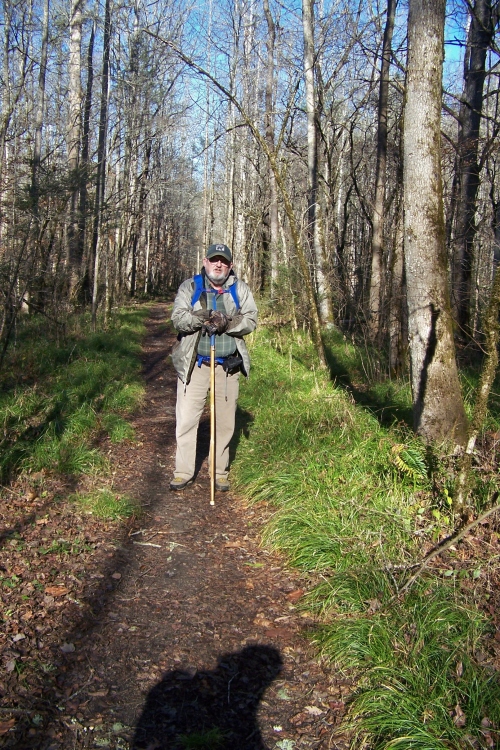
Catching rays in the leafless Autumn before the dim winter days
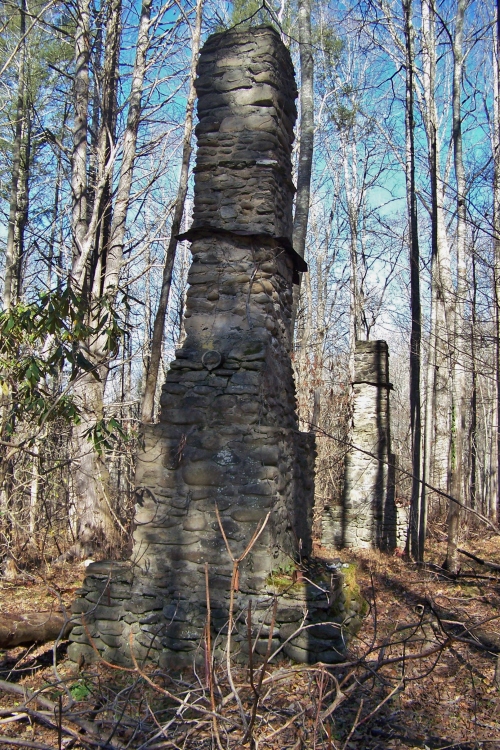
The main school house? The boarding quarters or dining room?

Rest under the plush carpet
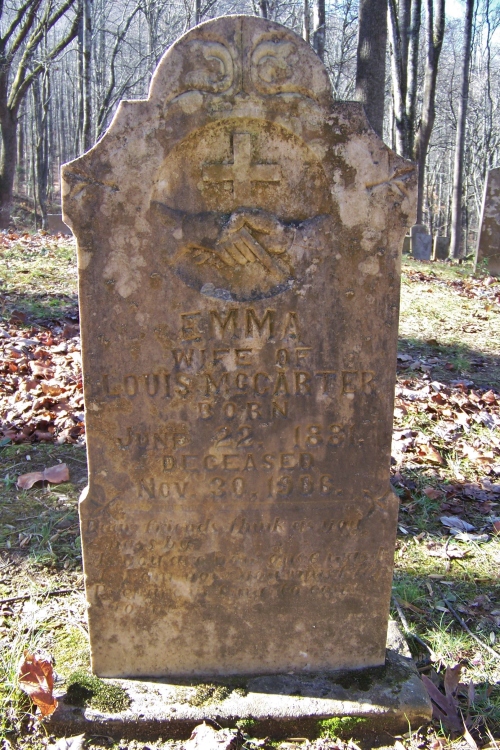
Emma

Creek crossing
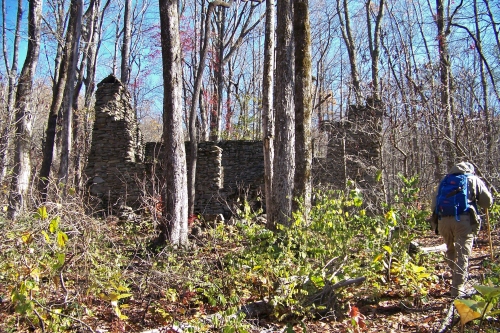
Teacher’s House
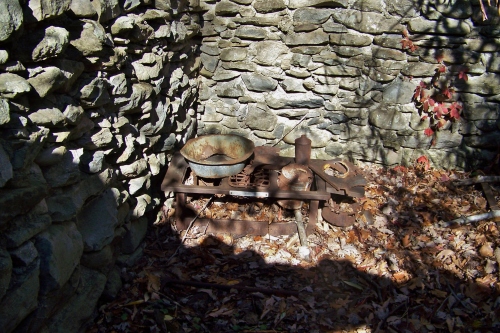
Kitchen
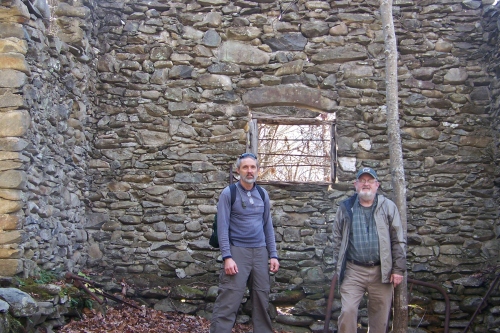
Living Room

Beech and Sourwood juxtaposed

Bedload scouring

Both lively and peaceful

Double Duty- cleared land and separated
After the hike I went to visit my 3rd born. Arriving just before dark, we went down to Kingston to see the sunset. Having already set, we walked the concrete “boardwalk” enjoying the fading colors and good conversation.

Too late and just in time

On Saturday I went bouldering at Lilly Boulders at the Obed Scenic River climbing area. I was by myself at first but met up with another climber with whom I enjoyed the day. I was climbing exceptionally well, and truth be told, the grading of climbs seems easy here than at home. The day was perfect for climbing: crisp, dry, sunny.
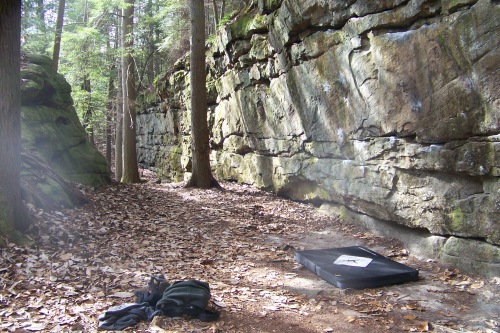
One wall at Lilly Boulders
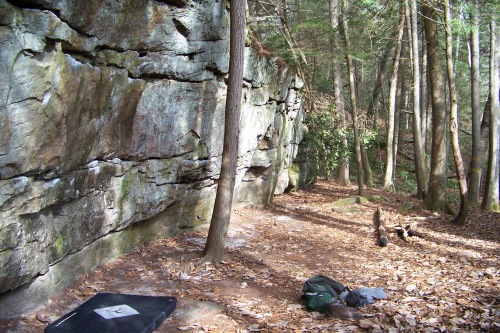
Lots of good climbing
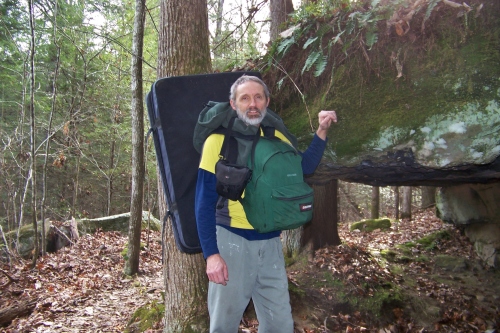
Approach Pose
A Race Equation
Posted in General, Random thoughts, Strength, tagged Random thoughts, Science on November 14, 2017| Leave a Comment »
Equations are abbreviated definitions that simplify and clarify complex concepts and data. They may be used to calculate, which may either reveal past events or predict future outcomes. Qualitatively, they enable the understanding of interrelationships between variables, which may not be obvious otherwise. On the other hand, not all relationships within an equation are the mere product of their juxtapositions within an equation. Rather, some variables owe their interaction to feedback loops within their physical situations. For instance, according to the equation below, in order to have the best period (race time), both power and endurance must be at their maximum. But in physical reality, for a runner, when power is maximum, endurance must be low. Sprinters are not endurance runners. Conversely, when endurance is high, then power must be low. Long distance runners are not sprinters. Actually the equation does reveal this relationship, because if you move the power variable to the other side of the equation you get po = 1/e, or more accurately, power is inversely proportional to endurance. That is, as endurance increases, power decreases.
From the equation you may also see that pace and distance should be inversely proportional. But the opposite is true. A longer distance requires requires a slower pace, that is, larger number.
And when distance is increased, endurance must increase and power must decrease.
The Runner efficiency variable may not be able to be determined, though I think that athletic physiologists are trying desperately to do so with VO2 max, respiratory exchange ratio, fast twitch/slow twitch muscle, body mass, % body fat, and running mechanics. Strength training and anaerobic sprints seem to be two popular methods for increasing runner efficiency. Diet must not be discounted as a way to build better runners.
The constant, K, is a factor that converts the other five variables into a race time, T. At this level of development of the equation, it is nothing more than a fudge factor to make five variables equal to the one.
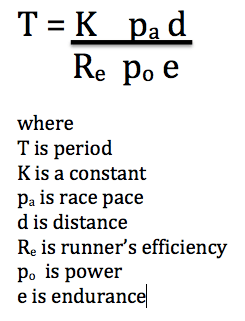
The best race time (T) is what every runner, coach, and spectator is after. Thinking through this equation might help the runner and coach better design training that will secure that result. Are you training for power, the sprint, or endurance, the long distance run? What training regimens do you need to perform to meet these goals? How much is it reasonable to increase both power and endurance? What are the limits of one, given the other?
I feel certain that good runners and their coaches have all of the relationships dialed in, so that an equation seems silly, but I benefit in my thought about running by the simple definition called an equation.
Soli Deo Gloria
Posted in Faith, General, Glory, God Thoughts, Grace, Reformation 500, Truth, tagged Faith, God Thoughts, Grace, Salvation, theology, Truth, Worship on October 31, 2017| 1 Comment »
On October 31, 1517, the Protestant Reformation began when Martin Luther nailed his 95 theses on to the Wittenburg Castle Church door. The Protestant Reformation was a movement in the 16th and 17th centuries in Europe, which tried to reform the Roman Catholic Church, because of perceived doctrinal and moral corruption that undermined the Christian gospel. The result was excommunication and the Protestant movement. These Latin phrases; sola scriptura (Scripture Alone), sola gratia (Grace Alone), sola fide (Faith Alone), sola Christus (Christ Alone), Soli Deo Gloria (for the glory of God Alone), were the fundamental principles of the protestant reformers. They were developed over time, to summarize the theological conviction of the reformers and are central to the doctrine of salvation. -John Piper
In April of 1518, the head of the Augustinian Order called for a formal disputation of the ideas that Martin Luther had put forth. This gave Luther an opportunity to expand upon his concerns. At the meeting, Luther put forward a “theology of the cross” as opposed to a “theology of glory.” -Editors Introduction to the Book of Concord
A theology of glory expects total success, finding all the answers, winning all the battles, and living happily ever after. The theology of glory is all about my strength, my power, and my works. A theologian of glory expects his church to be perfect and always to grow. If a theologian of glory gets sick, he expects God to heal him. And if he experiences failure and weakness, if his church has problems and if he is not healed, then he is often utterly confused, questioning the sufficiency of his faith and sometimes questioning the very existence of God. -Gene Edward Veith
To better understand the theology of glory, one need only look at the adjective included in the five Latin phrases. Alone. The use of this simple term suggests that the theology of glory, understood God’s work of Scripture, Grace, Faith and Christ were insufficient.
The Catholic Church adhered to what Martin Luther called the “theology of glory” (in opposition to the “theology of the cross”), in which the glory for a sinner’s salvation could be attributed partly to Christ, partly to Mary and the saints, and partly to the sinner himself. The reformers responded, “No, the only true gospel is that which gives all glory to God alone, as is taught in the scriptures.” -Monergism.com
This true and Biblical gospel, proclaimed by the reformers, was about how man can be justified before a holy God. Not by any merited favor, but by grace alone. Not any works a man can do such as the confession, penance or indulgences, but by faith alone. Not by any other sacrifice, such as mass, but only in Christ alone. Not found in the church, papacy or tradition, but in Scripture alone. And not for the veneration, worship or glory of Mary, Saints or Angels, but to the Glory of God Alone.
For Luther, the bottom line was the bondage of the will, or the deadness of the human soul. The Bible tells us that we are totally helpless. Ephesians 2:1-3, “And you were dead in your trespasses and sins, in which you formerly walked according to the course of this world, according to the prince of the power of the air, of the spirit that is now working in the sons of disobedience. Among them we too all formerly lived in the lusts of our flesh, indulging the desires of the flesh and of the mind, and were by nature children of wrath, even as the rest.” We were dead in our trespasses and sin and by nature children of wrath. Only grace can raise us from the dead and only Christ could be our punishment. Those two miracles, life from death and wrath removed, can only be received as a gift. Thus, it is to the glory of God alone. -John Piper
When reflecting on today’s subject of God receiving all glory, you may have thought, “I am a Baptist. I know that we do not glorify Mary, Saints or Angels.” This, I’m sure, is true for many of us here. However, these two verses may shed some light on our weakness and who we do glorify instead of God alone.
Proverbs 14:12, “There is a way which seems right to a man, But its end is the way of death.” 2 Timothy 3:2, “For men will be lovers of self, lovers of money, boastful, arrogant, revilers, disobedient to parents, ungrateful, unholy…”
The Bible tells us:
- Scripture is from God. 2 Timothy 3:16, “All Scripture is inspired by God…”
- Grace is from God. Ephesians 2:8, “For by grace you have been saved through faith; and that not of yourselves…”
- Faith comes from God. Hebrews 12:2, “looking to Jesus, the founder and perfecter of our faith”
- Christ was sent by God. John 3:17, “For God did not send the Son into the world to judge the world, but that the world might be saved through Him.”
- Genesis 1:1, “In the beginning God created the heavens and the earth.”
- Proverbs 16:9, “The mind of man plans his way, but the Lord directs his steps”
- Psalm 103: 19, “The Lord has established His throne in the heavens, And His sovereignty rules over all.”
- Psalm 19:1, “The heavens are telling of the glory of God; And their expanse is declaring the work of His hands.”
- Romans 13:1, “Every person is to be in subjection to the governing authorities. For there is no authority except from God, and those which exist are established by God.”
- Ephesians 1:11-12, “also we have obtained an inheritance, having been predestined according to His purpose who works all things after the counsel of His will, to the end that we who were the first to hope in Christ would be to the praise of His glory.”
- Colossians 1:16-17, “For by Him all things were created, both in the heavens and on earth, visible and invisible, whether thrones or dominions or rulers or authorities—all things have been created through Him and for Him. He is before all things, and in Him all things hold together.”
- Hebrews 1:3, “And He is the radiance of His glory and the exact representation of His nature, and upholds all things by the word of His power. When He had made purification of sins, He sat down at the right hand of the Majesty on high…”
- Hebrews 11:10, “for he was looking for the city which has foundations, whose architect and builder is God.”
- John 3:16, “For God so loved the world, that He sent His one and only son, that everyone believing in Him should not perish but have everlasting life.”
- 1 John 1:9, “If we confess our sins, He is faithful and righteous to forgive us our sins and to cleanse us from all unrighteousness.”
- Philippians 1:6, “For I am confident of this very thing, that He who began a good work in you will perfect it until the day of Christ Jesus.”
- Revelation 4:11, “Worthy are You, our Lord and our God, to receive glory and honor and power; for You created all things, and because of Your will they existed, and were created.”
Soli Deo Gloria
Sola Fide
Posted in Faith, General, Glory, God Thoughts, Grace, Reformation 500, Truth, tagged Faith, God Thoughts, Grace, theology, Truth on October 31, 2017| 1 Comment »
Our pastor has encouraged us to look at the 5 solas of the Protestant Reformation. The first Sunday was Scripture alone. The second Sunday was Grace alone. Today we look at faith alone.
When Paul explains the gospel in Romans, he says that in that gospel “is the righteousness of God revealed…as it is written, The just shall live by faith.” (Romans 1:17)
I want to begin by looking at how the Catholic church obscured the gospel, then move to how the Reformation recovered the gospel, and finally give an implication of this gospel for us today.
The Catholic church obscured the gospel of faith alone by tangling up regeneration with justification like a really bad game of twister. Biblically, Regeneration is being born again—having eternal life infused into our souls. Justification is God the judge declaring us to be legally righteous in his sight (instead of guilty). The mixing up of regeneration and justification resulted in the Catholic church teaching that in baptism a man receives an infusion of righteousness into his soul. And this infusion of righteousness is what makes a man inherently righteous before God. Consequently, the Catholic church went on to teach that the fruit of righteousness flows from divine life experienced in baptism so that a man may merit by his gracious works justification. So, the foundation of a right standing before God is what a man becomes at his baptism and what a man does after his baptism. That baptism often being an infant baptism.
This was the thinking that Martin Luther was plagued by. If there was ever a monk who could have been saved by his monkery, it would have been Martin Luther. Vigils, prayers, reading, spending much time confessing, and fasting were performed by Luther. But all of this work failed to give him the peace with God that he was desperate for. And that’s because Galatians 2:16 says “a man is not justified by the works of the law.” So, the Catholic church obscured the gospel of faith alone by tangling up regeneration and justification and in this way tortured Martin Luther.
But what the Reformation did was untangle regeneration and justification. And this resulted in clarifying what justification means: Justification is not progressive, but the instantaneous declaration of God that a sinner is righteous instead of guilty. And the instrument by which a man is justified is not man’s work, but faith alone in Christ and his work at Calvary.
Romans 4:5 says “ But to him that worketh not, but believeth on him that justifieth the ungodly, his faith is counted for righteousness.” Worketh “not”. Justifieth the “ungodly”.
But how can God declare an ungodly man righteous? He does not do this by infusing righteousness into a man’s soul (as the Catholic church taught), but by imputing the righteousness of Christ to a believing sinner. In other words, when a man believes on Christ, God considers the righteousness of Christ as belonging to the sinner.
Think of it this way—when a poor woman marries a rich man, that woman enters into a union with him so that she shares in his wealth. The poor woman becomes rich. Similarly, when a sinful man believes in Christ, that man enters into a union with Him so that he shares in His righteousness. And in this manner God considers Christ’s righteousness as belonging to the sinner and thus declares the sinner to be righteous. This is the only way that a sinful man may have peace with God.
We have seen how the Catholic church obscured the gospel of faith alone and how the Reformation recovered that gospel. Now, an implication for the church today is this: we had better get justification by faith alone right before we do any work. Another way to say it would be to say, the church had better get the gospel right before she gets to work.
When Paul reveals what the gospel means in Romans, he talks about justification by faith alone.
When the Catholic church obscured that gospel, it gave rise to an unhealthy religiosity. Germany was not being taken over by secularism—it was very religious, but it was an unhealthy religiosity that arose from the burial of justification by faith alone. Contrastingly, we here in America do see secularism taking over. And what a temptation it would be for us in our day to say “We need to get back to being religious!” But if that religiosity does not arise from justification by faith alone, then we are not standing on the gospel.
What revolutionized Europe was not increasing religious activity. It was the recovery of justification by faith alone. May it be so in our day.
Sola Gratia
Posted in Faith, General, God Thoughts, Grace, Reformation 500, Work of Jesus, tagged Faith, God Thoughts, Grace, Salvation, theology, Truth, Worship on October 30, 2017| Leave a Comment »
In this third installation of the 5 solae, we come to what another brother had to say about grace alone:
I want to begin with a personal testimony from January of this year…
After a brief explanation from the Lutheran pastor, I followed the funeral procession into the church—deeply moved. Why? For sure I was going to miss my wife’s aunt, who had been a dear family member to us.
But more importantly, what impacted me was the symbol on her casket that illustrated a truth most dear to me. You see, the casket was covered in a white cloth, symbolizing righteousness, which would be the only thing God would accept from her as she would be presented to Him for judgment. But…whose righteousness?
The symbolism goes further—on the cover was the shape of a cross, and the Greek symbols for Christ. Whose righteous works is God accepting? Would He see ANY of my aunt’s works?
No, for He would not accept them!
She was being presented to God, covered by the righteousness of our blessed Christ! And THIS was our family’s comfort in our loss.
Eph 2:8-10: “For by grace are you have been saved through faith, and that not of yourselves; it is the gift of God; not of works, lest anyone may boast. For we are His workmanship, created in Christ Jesus for good works, which God prepared beforehand, that we should walk in them.”
In this short statement is the sum of the Biblical teaching of the work of grace. It begins with God-working in us faith which justifies us (giving us Christ’s righteousness), which results in good works which please Him—according to His working in us.
Over time, as the Church of the Middle Ages abandoned the supreme authority of Scripture—“Sola Scriptura” in favor of traditions, other doctrines began to emerge—not only those absent from the Bible, but also changes to the understanding of grace itself.
The Medieval Church’s teaching gradually drifted to the assertion that God’s grace would help us produce the works that He would accept for justification, rather than the grace of Christ’s finished work of cross and resurrection for us.
It is in this world that Martin Luther sought to be right with a Holy God.
In keeping with church traditions, he followed the rules of the monastery, and did penance–all to a radical extreme (and even the annoyance of his fellow clergy)—all the time being under condemnation in his heart because of the majesty of God’s holiness and perfection overwhelming him.
At this point, as he studied the Bible, he discovered that it is not his righteousness that God will accept, but Christ’s, and that he should by faith abide in Him! Luther received God’s gracious gift of eternal life.
Luther and the other reformers returned to the Biblical, apostolic understanding that good works and a changed life flow from Christ’s righteousness given to us, instead of leading to it. God will not have his glorious gospel assisted by human works.
Our Christ, as God in human flesh, takes on Himself ALL of our sin and sinfulness on the cross, and gives us ALL of the righteous obedience of His perfect life. We call this teaching Sola Gratia, or “grace alone.”
In short, God’s grace justifies us completely in Christ’s work, and gives us a heart of repentance, rather than demanding we “do penance.”
Church Historian Stephen Nichols tells us that Ulrich Zwingli, the Swiss reformer, is portrayed in a portrait with an open Bible.
In an illustration of this grace to us, the Bible was opened to Matt 11:27-30:
“All things have been handed over to Me by My Father; and no one knows the Son except the Father; nor does anyone know the Father except the Son, and anyone to whom the Son wills to reveal Him.
Come to Me, all who are weary and heavy-laden, and I will give you rest. Take My yoke upon you and learn from Me, for I am gentle and humble in heart, and you will find rest for your souls. For My yoke is easy and My burden is light.”
This is Christ’s gracious invitation to us—then, and now.
On this 500th anniversary of the Reformation, we celebrate our salvation in Christ, Sola Gratia, by grace alone—in the words of the Apostle Paul: “…to the praise of the glory of His grace, which He freely bestowed on us in the Beloved…”
Sola Scriptura
Posted in Faith, General, Glory, God Thoughts, God's Word, Grace, Reformation 500, Truth, tagged Faith, God Thoughts, Grace, Salvation, theology, Truth, Worship on October 29, 2017| Leave a Comment »
Several weeks ago my brother in Christ shared this about the sufficiency of Scripture:
“Sola Scriptura is a reminder that God has always worked and will always work on this side of eternity through His word the Bible. Sola Scriptura deals primarily with the issue of authority. It is not a base claim that says that nothing except Scripture is helpful. It is not a claim to Scripture only in all cases. That would not be Biblical. Recognizing this is to distinguish between Sola Scriptura and Scriptura Nuda. Sola Scriptura does not argue that there is no value in anything except for Scripture standing on its own. It is an argument that Scripture is the only basis of authority.
I think a couple of verses would help us frame this discussion. Psalm 138:2 captures the sentiment of Sola Scriptura in a poetic way, but it also stresses a note of praise and worship which seems very appropriate when we are remembering God’s faithfulness over the 500 years since the Reformation. The psalmist here says:
“I bow down toward your holy temple and give thanks to your name for your steadfast love and your faithfulness, for you have exalted above all things your name and your word.”
Several translations say this slightly differently, but the idea is clear: God exalts his Word. And God exalts those who exalted his word, and God will be exalted when his word is exalted.
The Reformation, which was a great turning from the time when doctrinal error was pervasive in the church, to a time when the church was based much more on the truth of Scripture follows clearly a line or trajectory of a return to Scripture. Every individual who had a hand in the Reformation of the church was a person who had first learned to see the Scriptures as their sole authority. You can back up to 200 years earlier and look at the life of John Wycliffe in England, who was persecuted for his position on the authority and importance of Scripture. You can look in the 1400s at John Huss, who was also persecuted for a similar stand. He was martyred for his belief in Scripture. But he is the one who famously said, “you may cook this goose.” His name Huss meaning goose, “but in its stead God will raise the Swan who will sing his praises.” That Swan came 100 years later, just a few miles away, in the person of Martin Luther. Martin Luther, was ironically induced into the priesthood in the same church that the bishop who condemned Huss was buried in. And so we see consistently through history, God superintending to bring about his own glory and the reform of his church through the honoring of Scripture. Each of those men engaged in the great task of putting the Scriptures into the language of the common man of their day. Each one of them understood that one of the great tasks of their life was to put Scripture into the language of the common man, so that the English plough boy could read Scripture in English, and the German peasant could read Scripture in German.
Simply put, Sola Scriptura is the cause of the Reformation. The other principles, or rally cries of the Reformation; the other solas, whether it is Sola Gratia, Solus Christus, Sola Fide, or Soli Deo Gloria. We could not and would not have any of these were it not for return to Scripture only. Scripture is the foundation; it is the foundation upon which God’s work will always be built.
Peter reminds us in II Peter 1:16. In this passage Peter reminds us of a pivotal time during the life of Christ. A time where Peter and two other disciples are alone with Christ on a mountaintop, and there in that Transfiguration moment they see the Lord in His glory. But Peter tells us in verse 19:
“And we have the prophetic word more fully confirmed, to which you will do well to pay attention as to a lamp shining in a dark place, until the day dawns and the morning star rises in your hearts.”
The King James translation express this as “we have a more sure word of prophecy”. One of the things Peter is reminding us of here, is the fact that even if God were to reveal himself physically to us, as Christ was revealed to the disciples on that mountain Transfiguration, that appearance would not and should not be as authoritative or as significant to us as the physical pages of the word of God that we have in our hands. Peter says that what we have is a more sure word; it is a word more fully confirmed, which we do well to pay attention to. Sola Scriptura thus speaks to the authority and sufficiency of the word of God.
The threat to Scripture in the time leading up to the Reformation, came from an approach to Scripture which claimed that we could not know for sure what Scripture was saying. The scholars and some church authorities the time said that we could look to tradition and Scripture, we could look to reason and Scripture, we could look to the great leading voices of the church and Scripture, and we can look to experience and use that to temper our understanding of Scripture. And out of that mixture of endless qualifications and piles of meaningless footnotes maybe we can come up with something that in some way we could call true. Martin Luther said that that approach to truth, and approach to truth that is merely tentative, an approach to truth that denies the absolute authority of God’s word, an approach that says truth is only possible, is an approach to truth that paves the road to hell. Martin Luther said we do not need possible truth. We need therefore truths; truths that are absolute and unequivocal. We need truths that come to us with the thunderous certainty of Romans 5, “therefore there is now no condemnation for those that are in Christ Jesus.” We need truths that are absolute! And our only hope, our only source for that kind of truth comes in the revealed Word of God, Sola Scriptura.
Sola Scriptura is thus the basis of our confident joy. Every commemoration, every anniversary, every celebration, should ultimately be characterized by gratitude. A gratitude that shows that we are thankful to God. God is the only reason why good things live long. On the 500th anniversary of the Reformation our heart should be hearts that are filled with gratitude that God has kept his word. We can say with the hymn writer:
“How firm a foundation the Saints of the Lord
Is laid for your faith in His excellent Word
What more can He say than to you He has said
To you who to Jesus for refuge have fled.”
Let us be thankful for Sola Scriptura.”
A 500 Project
Posted in General, God Thoughts, God's Word, Grace, Reformation 500, Work of Jesus, Work of the Holy Spirit, tagged Faith, God Thoughts, Grace, Salvation, theology, Truth, Worship on October 28, 2017| Leave a Comment »
My son and his wife hosted a Reformation 500th Anniversary Conference back in April. The website for the conference has history of the various states in Europe that were effected by the Reformation. They wrote and edited summaries of these histories. The website also has links to all of the conference speakers’ talks. Soon the site will have legible pictures of the 40 story boards (trifold boards) he and his wife made for the conference. All of these resources may be accessed at www.reformation500pa.com
Happy 500th and happy researching!

