Archive for the ‘God’s Word’ Category
The Purpose for Trials
Posted in Faith, General, God Thoughts, God's Word, Grace, Sustaining, Trials, tagged Blessing, Faith, God's glory, Joy, Purpose, Trials on May 27, 2018| 1 Comment »
Iron Sharpening Iron
Posted in Experience, General, God Thoughts, God's Word, Grace, Proverb, Random thoughts, Strength, Work of the Holy Spirit, tagged Experience, Fellowship, Proverb, Random thoughts, Relationship on February 18, 2018| Leave a Comment »
Pastor preached on Proverbs 27:17 this morning: “Iron sharpens iron,
so one man sharpens another.” He spoke about the need, purpose, and process of believers helping each other grow spiritually. I enjoy extending metaphors, which requires care not to come up with analogies not there or elsewhere delineated in Scripture or life. The usefulness of such an enterprise may be to help those who hear to further understand the importance of the concept portrayed by the metaphor.
Why does the Scripture say iron sharpens iron? That has long bothered me, because anyone who has sharpened a knife or tool knows that you use a whetstone, grinding stone, or ceramic sharpening tool which are harder than the tool. And such tools existed. I Samuel 13:20 records the desperation for Israel when “all Israel went down to the Philistines, each to sharpen his plowshare, his mattock, his axe, and his hoe.” These events were more than 300 years before Solomon wrote the proverb. For that matter, why shouldn’t I use modern technology, the diamond sharpening stone?
The proverb is a metaphor for fellowship and discipleship within the congregation of believers. God doesn’t give us any other choice. We must sharpen each other. And we are not back at the castle. We are in the battle, so the grinding wheel is not an option. We go to our brother, cross swords in a mutually beneficial way and come away sharpened for more battle. Fellowship is the non-optional, God-ordained means for being honed to battle readiness.
Those who want to exclude themselves because of “hypocrites in the church” or “I can worship in nature” just fine or “all I need is Jesus” are dull or more likely twisted and unbalanced weapons. The problem is everybody wants to be sharp but nobody wants to be sharpened. When you are sharpening a blade, one swipe of the finger near the edge will reveal why so few want to be sharpened. Your finger will come up with a dark gray dust from the sharpening process. Sharpening removes material. Bad material and excess material must be removed from your life. It can be painful and humbling.
For some it’s rust from lack of use or exposure to corroding influences that needs to be removed and is hindering the cutting edge. For others, it is good material, all be it not according to faith or God’s direction, that needs to be removed to reduce the fat edge of dullness.
When two materials of equal hardness are used to do the sharpening, material is removed from both edges. Discipling and being discipled means involvement in another person’s life with all of the mutual messiness and need for honing away spiritual dullness.
And some of us are more of a mess than others. I own a double bladed axe. The way that I came into ownership of this axe goes back to the beginning of my wood heating days. I borrowed this axe (first mistake) to split some of the first wood I cut. While attempting to split some very twisted forks, I got several wedges stuck in a piece. I used the axe to attempt to get the wedges out (second mistake). I bought the axe, that is, I replaced the friend’s axe and kept the broken one. The strike took out a half-moon divot in the blade about the size of your thumbnail. In years since I have used the good blade to split and the broken blade when risking to remove wedges or cut roots near metal or concrete. No other sizable divots have been removed but the the edge has been bludgeoned a few times. I have tried for years to sharpen that divot out of the blade. For the longest time my efforts were to no avail, but now, years later, that blade is reasonably sharp while still having somewhat of a dent in the edge. It took years and that blade is possibly an inch shorter than the other one. That blade is me. The difference is that I have multiple divots. God has had to work for years to grind away the dullness of my spirit due to sinful habits and difficulties of life. I still show the scars and I’m not the sharpest tool in the box, but neither am I who I was. And much of that has been because God has used brothers and sisters in my life to remove rust here and dullness there. I doubt seriously that I will be admired as a shining blade of perfection, but I do pursue a cutting edge pursuit of God in the battle of life. And for that I give Him all of the praise.
6, Yea 7, Abhorrences
Posted in General, God Thoughts, God's Word, Poem, Truth, Work of the Holy Spirit, tagged Change, Poems, Proverbs, Sin, theology, Truth on January 28, 2018| Leave a Comment »
Last Sunday my pastor preached from Proverbs 6:16-19. He began by assuring us that the purpose of the passage, as well as his sermon, was not to condemn but to help. God points out our sin for the purpose of warning us so that we might come to Him for help. His second point was how far short we fall, yet how gracious God is. My heart was stirred by the sermon and I reflected on it later in the week, I put many of the pastor’s thoughts into the following poem. I hope that you find it admonishing, instructive, and encouraging.
His grace is spread abroad in us
By manifold and diverse ways
That cleanses us from deadly sins
To live for Him all of our days
To end six sins which God so hates
His character pure they offend
Even seven sins He abhors
By fierce judgment He shall attend
No more haughty eyes glaring pride
Now like the humble Savior be
Eyes that show compassion and love
That all might His grace and truth see
Enough of tongues that concoct lies
Denying and obscuring truth
God’s truth will set you free, He said
Renewing your years as in youth
Hands that shed innocent blood, stop
The Savior’s blood was shed for you
Now like the Master’s healing hands
Helping the poor and infirm, too
Hearts devise wicked plans to scheme
Transgress the righteousness of God
A heart of compassion put on
Equity more than just a nod
Feet run rapidly to evil
While rebellion rules in the heart
Submit to the Savior and live
In healing conflict do your part
False witnesses uttering lies
Gossip and slander destroy lives
Put away filthy, silly talk
Be instead one who for truth strives
One spreading strife among brothers
Strikes a note of profound discord
Seek unity with the brethren
Dwelling in peace with one accord
By God’s help we pursue these things
Bringing all glory to our Lord
Blessings come to ourselves and kin
Others encouragement afford
Sola Scriptura
Posted in Faith, General, Glory, God Thoughts, God's Word, Grace, Reformation 500, Truth, tagged Faith, God Thoughts, Grace, Salvation, theology, Truth, Worship on October 29, 2017| Leave a Comment »
Several weeks ago my brother in Christ shared this about the sufficiency of Scripture:
“Sola Scriptura is a reminder that God has always worked and will always work on this side of eternity through His word the Bible. Sola Scriptura deals primarily with the issue of authority. It is not a base claim that says that nothing except Scripture is helpful. It is not a claim to Scripture only in all cases. That would not be Biblical. Recognizing this is to distinguish between Sola Scriptura and Scriptura Nuda. Sola Scriptura does not argue that there is no value in anything except for Scripture standing on its own. It is an argument that Scripture is the only basis of authority.
I think a couple of verses would help us frame this discussion. Psalm 138:2 captures the sentiment of Sola Scriptura in a poetic way, but it also stresses a note of praise and worship which seems very appropriate when we are remembering God’s faithfulness over the 500 years since the Reformation. The psalmist here says:
“I bow down toward your holy temple and give thanks to your name for your steadfast love and your faithfulness, for you have exalted above all things your name and your word.”
Several translations say this slightly differently, but the idea is clear: God exalts his Word. And God exalts those who exalted his word, and God will be exalted when his word is exalted.
The Reformation, which was a great turning from the time when doctrinal error was pervasive in the church, to a time when the church was based much more on the truth of Scripture follows clearly a line or trajectory of a return to Scripture. Every individual who had a hand in the Reformation of the church was a person who had first learned to see the Scriptures as their sole authority. You can back up to 200 years earlier and look at the life of John Wycliffe in England, who was persecuted for his position on the authority and importance of Scripture. You can look in the 1400s at John Huss, who was also persecuted for a similar stand. He was martyred for his belief in Scripture. But he is the one who famously said, “you may cook this goose.” His name Huss meaning goose, “but in its stead God will raise the Swan who will sing his praises.” That Swan came 100 years later, just a few miles away, in the person of Martin Luther. Martin Luther, was ironically induced into the priesthood in the same church that the bishop who condemned Huss was buried in. And so we see consistently through history, God superintending to bring about his own glory and the reform of his church through the honoring of Scripture. Each of those men engaged in the great task of putting the Scriptures into the language of the common man of their day. Each one of them understood that one of the great tasks of their life was to put Scripture into the language of the common man, so that the English plough boy could read Scripture in English, and the German peasant could read Scripture in German.
Simply put, Sola Scriptura is the cause of the Reformation. The other principles, or rally cries of the Reformation; the other solas, whether it is Sola Gratia, Solus Christus, Sola Fide, or Soli Deo Gloria. We could not and would not have any of these were it not for return to Scripture only. Scripture is the foundation; it is the foundation upon which God’s work will always be built.
Peter reminds us in II Peter 1:16. In this passage Peter reminds us of a pivotal time during the life of Christ. A time where Peter and two other disciples are alone with Christ on a mountaintop, and there in that Transfiguration moment they see the Lord in His glory. But Peter tells us in verse 19:
“And we have the prophetic word more fully confirmed, to which you will do well to pay attention as to a lamp shining in a dark place, until the day dawns and the morning star rises in your hearts.”
The King James translation express this as “we have a more sure word of prophecy”. One of the things Peter is reminding us of here, is the fact that even if God were to reveal himself physically to us, as Christ was revealed to the disciples on that mountain Transfiguration, that appearance would not and should not be as authoritative or as significant to us as the physical pages of the word of God that we have in our hands. Peter says that what we have is a more sure word; it is a word more fully confirmed, which we do well to pay attention to. Sola Scriptura thus speaks to the authority and sufficiency of the word of God.
The threat to Scripture in the time leading up to the Reformation, came from an approach to Scripture which claimed that we could not know for sure what Scripture was saying. The scholars and some church authorities the time said that we could look to tradition and Scripture, we could look to reason and Scripture, we could look to the great leading voices of the church and Scripture, and we can look to experience and use that to temper our understanding of Scripture. And out of that mixture of endless qualifications and piles of meaningless footnotes maybe we can come up with something that in some way we could call true. Martin Luther said that that approach to truth, and approach to truth that is merely tentative, an approach to truth that denies the absolute authority of God’s word, an approach that says truth is only possible, is an approach to truth that paves the road to hell. Martin Luther said we do not need possible truth. We need therefore truths; truths that are absolute and unequivocal. We need truths that come to us with the thunderous certainty of Romans 5, “therefore there is now no condemnation for those that are in Christ Jesus.” We need truths that are absolute! And our only hope, our only source for that kind of truth comes in the revealed Word of God, Sola Scriptura.
Sola Scriptura is thus the basis of our confident joy. Every commemoration, every anniversary, every celebration, should ultimately be characterized by gratitude. A gratitude that shows that we are thankful to God. God is the only reason why good things live long. On the 500th anniversary of the Reformation our heart should be hearts that are filled with gratitude that God has kept his word. We can say with the hymn writer:
“How firm a foundation the Saints of the Lord
Is laid for your faith in His excellent Word
What more can He say than to you He has said
To you who to Jesus for refuge have fled.”
Let us be thankful for Sola Scriptura.”
A 500 Project
Posted in General, God Thoughts, God's Word, Grace, Reformation 500, Work of Jesus, Work of the Holy Spirit, tagged Faith, God Thoughts, Grace, Salvation, theology, Truth, Worship on October 28, 2017| Leave a Comment »
My son and his wife hosted a Reformation 500th Anniversary Conference back in April. The website for the conference has history of the various states in Europe that were effected by the Reformation. They wrote and edited summaries of these histories. The website also has links to all of the conference speakers’ talks. Soon the site will have legible pictures of the 40 story boards (trifold boards) he and his wife made for the conference. All of these resources may be accessed at www.reformation500pa.com
Happy 500th and happy researching!
Inspired and Profitable
Posted in General, God's Word, Truth, tagged God's Word, theology, Truth on September 17, 2017| 1 Comment »
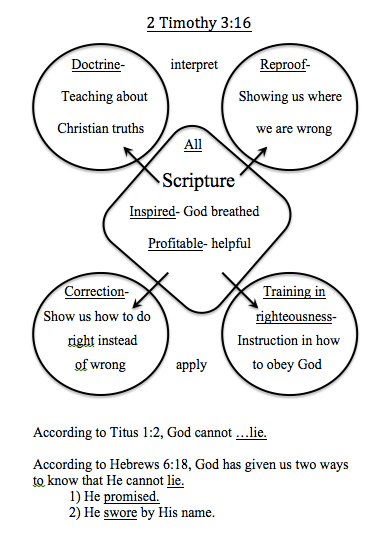
It is such a joy to teach young people about the Word of God. God’s Word is our foundation for truth and life. Trying to increase the students’ understanding and memory of what was being taught, I came up with a diagram. Perhaps it will help you, too.
Humble Absolutism
Posted in General, God's Word, Truth, tagged Truth on July 20, 2017| 2 Comments »
I read an article posted on Facebook (Someone reading this article is saying, “There was your first mistake.”) recently that was titled, “Want to be Smarter? Learn to Say “I Don’t Know” by Zat Rana. I think that the sense of the article is humility, which is a valuable virtue for all of life and particularly discussions of significant topics. Humility should rule all of our discussions and particularly those on profound and sublime subjects. He says early on, “Somehow, we have decided that it’s okay to hold beliefs based on blind affiliation rather than rigorous critical thought.” Far too much of that goes on, probably because assenting to ideas by affiliation is easier than researching a topic and coming to your own conclusions. Also, he says, “more often than not, the issue lies in our inability to humbly accept that we don’t and can’t know everything; that, often, we are wrong.”
So far I am tracking with him. But immediately he charges into his defense of his position with his first point: “The Irrationality of Certainty”. His most supporting thought is that “Certainty is an illusion, and there is no shame in being wrong because, by nature, our entire perception of the world is wrong.” Now life truly is a balancing act, and we must hold many of our ideas lightly, but saying that there is nothing about which you can be certain, because it is an illusion, reduces all of life to relativism, which is illogical according the law of non-contradiction. Just because you don’t know something doesn’t mean it isn’t certain or that you can’t know it. There are things of substance that I can know for sure, not because I have all of the data, but because I know the One who does. There are absolutes and they can be known. There are many things I must hold lightly and be ready to be corrected and informed, but there are others I stake my life on.
His next sub-title is “The Disease of Blind Affiliation”. His contention is that “we form a connection to something that we fundamentally haven’t questioned.” In many scenarios of politics and tradition and even religious thinking, what he says is so very true, but don’t use this as an excuse not to make commitments about what is true. The agnostic view of the world and God is an excuse not to make a commitment that will require change and conviction. It reminds me of what the writer of Acts says about the Athenians concerning their questioning of Paul: “Now all the Athenians and the strangers visiting there used to spend their time in nothing other than telling or hearing something new.” Act 17:21 This is how many avoid commitment to the truth: “…always learning and never able to come to the knowledge of the truth.” II Timothy 3:7
“What is truth?” (John 18:38), Pilate asked Jesus. Was Pilate opened-minded? Was he seeking for truth? The evidence of the passage (John 18:29-19:18) is that he wanted to feel important, secure, popular, and in control, but he was not interested ultimately in what was true or right. His attempts to rescue Jesus were to avoid repercussions either from the crowd or some vague sense of a wrathful deity. Is it any different now? “If you continue in My word, then you are truly disciples of Mine; and you will know the truth, and the truth will make you free.” (John 8:32-33), said Jesus. If you don’t start with God’s Word you certainly can’t continue in it. I urge you, dear reader, to dig into the Word of God and plead with God to reveal to you truth. It exists; it is unchanging; it is life changing; you can know with certainty; it will keep you humble.
Integrity
Posted in Faith, General, God's Word, Strength, Sustaining, tagged Faith, Strength, Worship on December 17, 2016| Leave a Comment »
I have always struggled to get a handle on the essential essence of integrity. It is far more than honesty and deeper than mere examples. While studying Daniel 6 I was struck with new force by Daniel’s faithfulness, trustworthiness, moral uprightness, whole and undivided spirit that resulted in him being the same in public as he was in private. That is to say, Daniel exhibited godly integrity. What is the source of integrity and what does it produce? As I searched for answers in the passage and on the internet I came across an interesting statement by Larry Sternberg that says,
“In common conversation the word “integrity” is most often associated with honesty. But that’s a very narrow understanding of the concept. In addition to honesty, integrity is about being whole and unimpaired. We can speak about the integrity of a roof or a ship’s hull. When a structure can remain unimpaired in the face of pressure, assaults or stressors, that structure has strong integrity.
When it comes to a person, integrity involves the ability to remain true to one’s values in the face of pressure, assaults or stressors. We know little about the strength of a person’s integrity when life is easy. What if it will cost you your job? What if you’ll lose some friends? What if you’ll go to jail? What if you’ll get beat up — or worse? We only learn about the strength of a person’s integrity when things get tough, when adhering to those values involves a high cost.” (reference)
Though not stated directly, the take away I gained from this short article was ‘Integrity produces courage and courage reveals integrity.’
And even though the wicked can be ‘true to himself’ (a phrase I’ve heard a number of times), it is godly integrity that is admirable. It is unselfish and gives glory to God, its source. It frustrates the wicked as with the satraps (provincial governors) and counselors who envied Daniel, but impresses those who see its purity and simplicity as with Darius the king. Daniel is not called upon to state his refusal to obey the edict as his friends Shadrach, Meshach, and Abednego were in chapter 3: “King Nebuchadnezzar, we do not need to defend ourselves before you in this matter. If we are thrown into the blazing furnace, the God we serve is able to deliver us from it, and he will deliver us from Your Majesty’s hand. But even if he does not, we want you to know, Your Majesty, that we will not serve your gods or worship the image of gold you have set up.” (Daniel 3:16-18) He does state his innocence after the fact: “My God sent his angel, and he shut the mouths of the lions. They have not hurt me, because I was found innocent in his sight. Nor have I ever done any wrong before you, Your Majesty.” (Daniel 6:22) Daniel’s unstated trust in God points to God’s trustworthiness. So Darius gives glory to God because he recognizes the miracle that God did for Daniel:
“I issue a decree that in every part of my kingdom people must fear and reverence the God of Daniel.
“For he is the living God
and he endures forever;
his kingdom will not be destroyed,
his dominion will never end.
27 He rescues and he saves;
he performs signs and wonders
in the heavens and on the earth.
He has rescued Daniel
from the power of the lions.” (Daniel 6:26-27)
Darius also recognizes that Daniel’s integrity points to God: “Daniel, servant of the living God, has your God, whom you serve continually, been able to rescue you from the lions?…The king was overjoyed.” (Daniel 6:20,23)
And this has long been my desire, that I would have the integrity of Daniel and that my life would point to God. I have not been so faithful as Daniel but God has been faithful to work wondrously in my life so that I pursue the goal of integrity each day so that I might give glory to Him and hear one day, “Well done thou good and faithful servant.” (Matthew 25:21)
Wordful Power
Posted in General, God Thoughts, God's Word, Strength, Sustaining, Work of Jesus, tagged God Thoughts, God's Word, Strength, Sustaining, theology, work of christ on October 9, 2016| Leave a Comment »
Hebrews 1:3 is a deeply insightful verse about our God: “And He is the radiance of His glory and the exact representation of His nature, and upholds all things by the word of His power. When He had made purification of sins, He sat down at the right hand of the Majesty on high.” I have long been fascinated by the phrase “radiance of His glory” and have written about it once upon a time here (Radiance Check out the poem, too.). “Radiance” is translated “brightness” in several versions but seems to fall short of conveying what Jesus accomplishes by revelation to us of His Father. He shines forth His glory, that is, we could not know of God without seeing His glory in Jesus’ representation of Him. You only see the sun because of the light radiating from it. Analogies can be taken too far, in this case to make Jesus out to be something or someone separate from the Father. That is heresy and not at all my intention in explaining radiance. Rather, hear what Jesus said, “Don’t you know me, Philip, even after I have been among you such a long time? Anyone who has seen me has seen the Father. How can you say, ‘Show us the Father’?” (John 14:9) That verse, of course, bears on the phrase “exact representation” also. In the ESV it reads, “exact imprint”. As an illustration I pressed my truck key into Play-Doh. I pointed out that plastic could be poured into the imprint, harden and used to open my truck door. Again, you could get into positive/negative imprint or representation being a facsimile rather than the original but that is not what the Scripture is saying. These analogies fall short because of the mystery of the Trinity, meaning our inability to understand the essential nature of God, but He gives us insight to extend our understanding even though we fall short of full understanding.
The next phrase is the one that has caught my attention most recently. I am now going to indulge in some manifest musing (or “thinking out loud” as we usually say if I were talking to you). He “upholds all things by the word of His power.” “Word of His power” is an odd construction in English. NASB, KJV, NKJV, and ESV use this phrase. NIV, HCSB, and NRSV say, “His powerful word”, and the RSV says, “his word of power”, both phrases which seem to me to have a different meaning from “word of His power”. I suspect the three newer translations (NIV, HCSB, and NRSV) made interpretative decisions for the purpose of clarity. Is this change justified? The Greek Interlinear Bible (http://www.scripture4all.org/OnlineInterlinear/NTpdf/heb1.pdf) has the literal English word order as “declaration [word] of the ability (power) of Him” (“[]” being my addition and “()” being theirs). Not claiming to know more than the slightest inkling of Greek grammar, I can at least say that the majority translations are going with the more literal wording. The interlinear translation and Strong’s help us with what the particular words mean. “Word” here is not logos, the expression of God, but rhema, a declaration. And “power” is dynamis, which means ability or potential for power or action.
The “of” is important. It denotes possession. If I say, “son of mine” I mean the same thing as “my son”. The shade of difference is the emphasis on son in the first phrase. So the reason I don’t think “word of His power” and “His powerful word” mean the same thing is that “powerful” is not possessive, but a descriptive modifier. It says His word is powerful. “Word of His power” says His power’s word. The power is expressed in a declaration (word). Rather than saying His word has power, it seems to be saying that His power has word. His power proceeds forth as that which communicates what will be (be that static (“upholds”) or dynamic (“created” Isaiah 40:26)). Word modifies power rather than power modifying word. If we had the word it could read, ‘His wordful power’. The emphasis is on declaration (word) that upholds all things but the source of that word is His power. From His power proceeds forth a word which upholds. The way his power is being exhibited is through efficacious declaration.
Poison Fruit and Root
Posted in General, God Thoughts, God's Word, Grace, Sustaining, tagged God Thoughts, God's Word, theology, Worship on October 2, 2016| 3 Comments »
My pastor taught on Jesus’s warning in the Sermon on the Mount concerning false prophets found in Matthew 7:15-20. He asked, given the teaching of 7:1, “Do not judge so that you will not be judged“, and theme of how to live in the Sermon, why is this passage about false prophets (and teachers) here? He concluded that there is a balance to not being condemningly judgmental in 7:1 that emphasized being discerning and discriminating. False Prophets destroy the church from within frequently before their presence is detected. They must be recognized and ousted. The pastor showed from the passage that they have three characteristics: 1) Inwardly Corrupt (outward appearance with no inward experience), 2) Bad Fruit (coming from deeds of the flesh), and 3) Destined for Destruction (true belief includes growth in righteousness). On the second point the pastor describe a bad tree with bad fruit. As happens on occasions my mind drifted off into a parallel illustration.
Eastern Black Walnut (Juglans nigra (I actually remembered that without looking it up, but I can’t remember people’s names. I have poor skills at people name association.)) is an easy tree to identify in the woods. As you approach it you know what it is before you can discern leaves or bark. Very little grows under a walnut tree. The fruit (really the hull of the fruit surrounding the nut) has a poison that prevents other trees and many herbaceous varieties from growing under it. A tree given wide berth by other trees in the eastern forest is rare. More frequently trunks are quite close and roots intertwine each other if sunlight is sufficient for both. When I arrived home I found that the leaves and twigs, but especially the roots, also have the poison,“juglone” (5 hydroxy-1,4 napthoquinone) (https://hort.purdue.edu/ext/HO-193.pdf). The information I read says that many trees and plants are tolerant to juglone, but my observation in the woods tells me that though tolerant in the sense that their leaves don’t turn yellow or the plant die, the plants do not evidently sprout well under walnut trees since the ground most usually looks almost as if it is mowed.
The spiritual metaphor here is the same as that of a fruit tree but more caustic perhaps? Green, developing walnuts look nice enough and are certainly abundant. The False Teacher may have the appearances of fruitfulness in quality and quantity, but they inhibit life and growth. And the source is the roots which one source said can poison the ground for several years after the tree is removed. Wow! This happens in churches so that they are still reeling years after the false teachers has been run off. “You have seen their abominations and their idols… so that there will not be among you a man or woman, or family or tribe, whose heart turns away today from the Lord our God, to go and serve the gods of those nations; that there will not be among you a root bearing poisonous fruit and wormwood. (Deuteronomy 29:17-18) And Jesus said, “Either make the tree good and its fruit good, or make the tree bad and its fruit bad; for the tree is known by its fruit. You brood of vipers, how can you, being evil, speak what is good? For the mouth speaks out of that which fills the heart.” (Matthew 12:33-34) May God multiply to His Church the grace of discernment to recognize and biblically deal with false teachers in their midst so that the sheep are not led astray and poisoned. May He strengthen and refresh those churches who have fallen prey to the poison root and fruit of false prophets that have inhibited growth among its members. May God purify us and build us up in the knowledge of Him so that we may worship Him in spirit and truth and share His glory accurately in the world.
Love of God’s Word
Posted in General, God's Word, tagged God's Word on July 3, 2016| Leave a Comment »
In the book “10 Questions to Diagnose Your Spiritual Health” by Donald
Whitney, the second question he asks is, "Are you governed increasingly
by God’s Word?" Following is an outline Bible study that I put together
based on that chapter. In parentheses are my thoughts and partial answers
to questions.
1. What is the most valuable object in the world?
   Rare, beautiful, large, or necessities of life perhaps
   Bible- likened to the basic of life
       Amos 8:11, Jeremiah 15:16, Matthew 4:4
(Without the Bible we would have no purpose, direction, or explanation
of salvation and godly living.)
2. Psalm 119:72 Do you value it that highly?
   (My evidence of valuing the Bible comes with reading, studying and
    heeding what it says.)
3.Does the ready availability of God’s Word cause you to de-emphasize
  its importance in your thinking and priorities?
  Prov. 29:18, Hebrews 4:12, I Peter 2:2
  (I would value it more if it were about to be taken away or even if
   I had to hide it and read it in secret.)
4. What practical ways do you value the Word of God on a daily or
   regular basis?
   (I value God’s Word by reading, studying, memorizing,hearing it
    preached, sharing it with others, seeking to live by it, and
    changing my views based on its words.)
5. Do you consciously inquire as to what the Bible says about specific
   areas of life? If so, what are some areas?
   (I do inquire about what the Bible says about His will for me, what
    is right and wrong, how I should interact with my family, neighbors,
    church members, fellow citizens,the lost, and people I am offended by,
    and seek to live by it.
6.Do you ask spiritual leaders to help you apply Scripture in particular
  situations? Do you literally open the Bible to search for God’s will?
  (A quote by Octavious Winslow on p.31-32 may be summarized as "nothing
   perhaps more stongly indicates the tone of a believer's spirituality,
   than the light in which the Scriptures are regarded by him.")
7. What is your response to spending time in God’s Word?
   Psalm 119:47, 48, 97, 113,119, 127, 163
   “Indifference to truth is a mark of death.” John Piper
   (David says numerous times that he loves God’s Word.
    Indifference to God’s Word is little different than hatred.)
8. Jesus, the Living Word, quotes and obeys the written Word of God
   because it…
   a. contains truth   John 17:17
   b. contains the Father’s will and words   John 14:23-24
   c. is sufficient for all life and godliness   2 Timothy 3:16
   d. is an example for us Luke 10:26; 1 Corinthians 10:11
9.The human Jesus lived by and memorized the written Word of God
  Matthew 4:4
  (Can you imagine Jesus as a boy memorizing Scripture? OK, I'm not
   too into "sanctified imagination when it comes to Scripture, but
   seriously, when He was running over a verse, did He ever muse,
   "Did I say that before (a long time ago)?"
Isaiah 8:20: "To the Law and to the Testimony"
             (is like saying “What does the Bible say?”)
10. How important is Scripture? Deut. 32:47
    (“no dawn”, “no light”- spiritually dead Is 8:20
     “it is your life” Dt 32:47)
11. What does the Bible say?
    Example: “God helps those who help themselves.”
              No, Romans 5:6-8 and Galatians 3:2-5
    (Rom 5:“helpless”; sanctification the same Gal 3;
     An argument could be made that helping yourself is like being
     careful “walk and please God” and lead a “quiet life” (I Thess 4:1-12)
     and God blesses your obedience and diligence, but helping yourself
     instead of clinging to God to even do good works is humanism.)
12.  Other examples to explore: How should my child be educated?
     How would God have me vote in the next election?
     Should I make a purchase (What is its purpose?)?
     What should I be doing and not doing in my church?
     Do we have qualified biblical leaders?
     How should our church reach people with the gospel and what is my part?
     What should I do with my life when I retire?
     (In other words, “all of life-events and choices great and small-
      should be governed by the Word of God.” p.35)
13. Psalm 119:105, Acts 18:26 Have you within the last several years
    revised your beliefs and actions based on what you learned in
    God’s Word?
    (I believe I have gained a balance in my understanding between the
     importance of covenants and times in God’s economy for the end.
     I value relationships more now than formerly.
     I crave and take more opportunity for witness as I become more
     convinced of the judgment to come.
     I have a different view of divorce and remarriage.)
14. How might you deepen your desire for God’s Word?
    (Deepen your desire for God’s Word by
     reading it, listening to sermons, meditating, praying Scripture,
     seeking out promises, searching Scriptures for life’s answers,
     training yourself to ask,“How does the Bible speak to this?”)
15. Examine your spiritual health by asking yourself,
    “Am I governed increasingly by God’s Word?"
Asa’s Blindspots
Posted in General, God Thoughts, God's Word, Sustaining, tagged God Thoughts, God's Word, Sustaining, Worship on December 28, 2015| 2 Comments »
In the fourth generation and 60 years after King David died there arose a king over Judah whose name was Asa. His father and grandfather had no heart for God, worshipping idols and allowing the people to run wild in their pursuit of idolatry. And his great-grandfather, Solomon, turned away from God in His old age because of the enticement and idolatry of his many wives. So it is a surprise the high praise Asa is given in I Kings 15: “Asa did what was right in the sight of the Lord, like David his father. He also put away the male cult prostitutes from the land and removed all the idols which his father had made. He also removed Maacah his mother from being queen mother, because she had made a horrid image as an Asherah; and Asa cut down her horrid image and burned it at the brook Kidron… the heart of Asa was wholly devoted to the Lord all his days.” (v.11-13, 14b) Much of Asa’s story is repeated in II Chronicles 14-16, but as is frequently the case the story includes more spiritually commentary on details given in Kings. Besides removing idols and their worshippers, II Chronicles 14 also says that he “commanded Judah to seek the Lord God of their fathers and to observe the law and the commandment” (v. 4) and God rewarded him in that “the land was undisturbed, and there was no one at war with him during those years, because the Lord had given him rest.” (v. 6) Asa took advantage of these benefits of time and security by fortifying cities and strengthening the number and equipment of his army. And yet he did not put his trust in these but called on God to defeat a million man Ethiopian army that came against him. In response God indeed defeated the army and sent Azariah the prophet to strengthen and encourage Asa and Judah to continue seeking God because there is reward in it (II Chronicles 15:1-7). Asa indeed took courage and increased his reforms in Israel by more idol worship removal, restoring the altar of the temple and sacrificing on it, and promoting a covenant among the people to serve God only. There was peace for 20 more years.
In all of this glowing report about Asa there are two blindspots of his that arise in the story. One is obvious and the other is not. “In the thirty-sixth year of Asa’s reign Baasha king of Israel came up against Judah and fortified Ramah in order to prevent anyone from going out or coming in to Asa king of Judah. Then Asa brought out silver and gold from the treasuries of the house of the Lord and the king’s house, and sent them to Ben-hadad king of Aram, who lived in Damascus, saying, ‘Let there be a treaty between you and me, as between my father and your father. Behold, I have sent you silver and gold; go, break your treaty with Baasha king of Israel so that he will withdraw from me.’” (II Chronicles 16:1-3) Baasha does withdraw and Asa has all of his people carry away the materials of fortification to build other fortifications. Well played, right? No, poorly played because as the prophet Hanani points out, “you have relied on the king of Aram and have not relied on the Lord your God.” (v. 7) Asa’s blindspot, indeed his sin, is pride in the form of self-reliance. This had not been a problem 20 years before when he had called on God to defeat the enemy. Three indicators that it is indeed pride and not a simple oversight follow. Asa throws the prophet into prison and oppresses some of the people, maybe because they agreed with Hanani. The third indicator of his old age pride appears three years later when God further tests him with disease in his feet. “Yet even in his disease he did not seek the Lord, but the physicians.” (v. 12) The word “yet” indicates that this activity was a continuation of the self-reliance with the scheming that trusted a king rather than God. Such self-reliance is a danger for us all. For youth it may generally fall more in the realm of strength and supposed invincibility, but for the wizened king it may have been more the bane of years of experience without continued growth in reliance upon God due to comfort. We cannot let our guard down, “For the eyes of the Lord move to and fro throughout the earth that He may strongly support those whose heart is completely His.” (v. 9) The biter was the prophet’s next words: “You have acted foolishly in this.” If Asa had repented right then and there God may not have strapped him with so much war thereafter, or not tested him with foot disease. God is more concerned with purifying us than making us comfortable.
The less obvious blindspot of Asa appears in one short phrase basically repeated in the other passage. “But the high places were not taken away,” and “…not removed from Israel.” (I Kings 15:14a; II Chronicles 15:17a) These detractors from Asa’s reputation are almost dismissed by their follow-up phrases: “nevertheless the heart of Asa was wholly devoted to the Lord all his days,” (I Kings 15:14) and “nevertheless Asa’s heart was blameless all his days.” (II Chronicles 15:17) It seems that even though the high places were an oversight in Asa’s reforms and worship, his intentions toward God in worship were always pure. But this is not quite the end of the discussion because the Chronicles passage adds some facts that seem to confuse this whole problem. One of the first things that II Chronicles 14 indicates that Asa did was “he removed the foreign altars and high places, tore down the sacred pillars, cut down the Asherim…” (v. 3). Did he remove the high places or did he not? I think that the answer is both yes and no. This latter mention of high places is surrounded by mention of “foreign altars” with specific examples. The other high places may have been of the type mentioned when God spoke to Solomon in I Kings 3: “The people were still sacrificing on the high places, because there was no house built for the name of the Lord until those days. Now Solomon loved the Lord, walking in the statutes of his father David, except he sacrificed and burned incense on the high places. The king went to Gibeon to sacrifice there, for that was the great high place; Solomon offered a thousand burnt offerings on that altar. In Gibeon the Lord appeared to Solomon in a dream at night; and God said, “Ask what you wish Me to give you.” (v. 2-5) Solomon along with the people and subsequent kings all had this blindspot. They were worshipping God but not how and where He told them to worship. In fact it was not until Hezekiah, 9 generations and over 210 years later, that “he removed the high places…” (II Kings 18:4) The Assyrian general scoffing at Judah’s confidence confirms that these are the high places of worship to God when he says, “is it not He whose high places and whose altars Hezekiah has taken away, and has said to Judah and to Jerusalem, ‘You shall worship before this altar in Jerusalem’?” (II Kings 18:22) What then is my point by all of this “high places” discussion? What may I learn? As I grow older I certainly want to avoid the glaring sin of self-reliance, and repent where it rears its ugly head. But I also want to ferret out the more subtle blindspots, sins of my culture that are dragging us down and we don’t even see it. God is gracious with us overlooking so much. When our heart is right before Him, He extends more grace, guiding us through many difficulties with help and rest on all sides. But our blindspots are not overlooked; He knows them every one. O Lord, reveal them to us so that we may go deeper with You, gain Your blessing on ourselves and our culture, and glorify Your name in every crack and cranny of life, so that “we are destroying speculations and every lofty thing raised up against the knowledge of God, and we are taking every thought captive to the obedience of Christ” (II Corinthians 10:5).
Time to Unwind and Reflect
Posted in Beauty, Climbing, General, God Thoughts, God's Word, Outdoors, Photo, tagged attributes of god, Beauty, Climbing, God Thoughts, God's Word, Outdoors, Photos, purpose in life, Relationship on August 17, 2015| Leave a Comment »
I kept wanting to go to the mountains but people, responsibility, and other priorities kept preventing it. Seeing my repeatedly frustrated efforts my wife said that I should go tomorrow. I wasn’t going to second guess the cessation of chores and her encouragement to go. Besides, after taking a walk with her early on this August 1st I knew that it was an exceptionally clear, low humidity, and cool day. (65 degrees was enough for several people to say it felt like the first Fall day- wishful thinking with August and September ahead.) So a hasty breakfast and quicker packing job and I was gone. I like solitude but I like company, too, but the whole reason I was going alone was because I couldn’t find anyone and one had even backed out.
I even enjoy the drive up on a very curvy rode in a small, good cornering car with a clutch and adequate power. The air was crisp, the sky totally blue, and my heart was light. Bouldering by yourself is considered to be quite risky by some, but I have observed others doing it with care. You only attempt climbs that are straight up over the pad with no barn door potential. The weather meant exceptional friction, almost unheard of in the humid South in the summer. I was climbing well, but I can’t say if I was climbing exceptionally well because I couldn’t try anything really hard because of the ground rules for climbing alone I’d set down. During rest breaks I took pictures of fern and tree leaves.

Rockcap Fern (Polypodium virginianum) I believe

Frazier Magnolia
I set up several videos of me climbing (I just admitted to a selfie! I will not let this become a regular event and certainly not an addiction. I must keep this under control.) You may check them out by clicking on the names below. It will be immediately obvious that I’m no rockstar, but I enjoy the challenge, nonetheless:
Disc and Throw
Chainsawleft

Trillium fruiting

American Chestnut “bush”
After bouldering around until my forearms were quite tired, I walked up to the top of the ridge, sat down, took in the view, ate lunch, and read my Bible. Actually, when I first arrived up top I lay down on the bouldering pad a prayed for awhile. There was such a rest in telling my Father all my burdens about work, family, and internal stress. I have been enjoying, not just tolerating reading Leviticus and Numbers. Numbers 2 and 3 seem like lists of camp arrangement and numbers of fighting men, and numbering religious servants, but they reveal several things about God’s character. He is orderly and efficient and given to detail. The arrangement of Levites reveals His concern for His holiness among the people and grace to not destroy them with His fierce justice. The taking of the Levites in place of the firstborn and the redemption of 273 additional Israelites by a gift of five shekels each reminds us of the depth of our sin problem and the gloriousness of God’s solution in salvation. The more I read the Pentateuch (Genesis to Deuteronomy) the more I feel like Jesus is repeating Himself when He points to God’s holiness and the Law. As a man did He have “aha!” moments of learning the Word from His parents or the synagogue teachers, moments when He said, “I remember saying that.”? All of His Word speaks of His character and what is important to Him. Are we bored with it because we have little passion for knowing Him and what He cares about? Knowledge of Him is our ultimate goal here. Beautiful days in the mountains and hard days of difficulty or frustration are profitable and meaningful if we allow them to direct us to knowing Him more. Yeah, I prefer one over the other but I am slowly learning to muse, “Hmm, I wander how this situation may draw me closer to Him?”

House Fly

Shining Clubmoss (or Shining Firmoss) Huperizia lucidula (Thanks for the ID help Sister L)
The view up top increased my enjoyment of my time concentrating on God. He created all of the beauty around us to remind us of His beauty and the enjoyment we may have from these gifts from His good hand.

Left to Right: Table Rock, Hawksbill, Gingercake

Exceptionally Beautiful August Day
Creator and Judge
Posted in General, God's Word, Poem, tagged God's Word, Poems on January 17, 2015| Leave a Comment »
God’s Word is true, beginning to end. How do I know? It says so. History and nature point to its truth. Changed lives communicate it. We don’t get to pick and choose which parts are true. It is all true or it is none true. It outlasts every attempt to do away with it or explain it away or ignore it or water it down. Look around the evidence is everywhere:
Beautiful features around the world
Remnants of origin and change unfurled
Point to Creator and Judge of all
First it was good and then came Adam’s Fall
Exists by the Word of His Power
Sky, land, and sea, every bee and flower
Sculpted by the Flood, rearranged now
Destroyed, yet beautified, amazing how
Every force balanced perfectly well
In the life zone with tides and more we dwell
Self-adjusting ecosystems work
Provide food and recycle as a perk
Fine layered strata formed in a day
Coal seams the same age formed in the same way
Mountains folded, canyons scoured away
Forces of judgment, Flood remnants that stay
Does it matter how it came to be?
How it changed long past to what we now see?
Indeed it does, acknowledge God true
As Creator and Judge and Savior, too
Victory Through Struggle
Posted in General, God Thoughts, God's Word, Poem, Strength, Sustaining, tagged God's Word, internal strife, Poems, Strength, Sustaining on January 16, 2015| Leave a Comment »
It is poem writing season again. I had trouble starting. When I tried the only thing that came was the first line. The more I thought about it the more I realized that I was vaguely sad. As that settled on my soul I began to think why that would be so given the blessing and lack of obvious stress in my life just now. Rather than try to figure it out I set to pursuing the solution which is found in Scripture. I Peter 5:3-4 says, “humble yourselves under the mighty hand of God, that He may exalt you at the proper time, casting all your anxiety on Him, because He cares for you.” Colossians 3:2-4 says, “Set your mind on the things above, not on the things that are on earth. For you have died and your life is hidden with Christ in God. When Christ, who is our life, is revealed, then you also will be revealed with Him in glory.” Romans 6:11 says, “consider yourselves to be dead to sin, but alive to God in Christ Jesus.” Nehemiah 8:10, “this day is holy to our Lord. Do not be grieved, for the joy of the Lord is your strength.” Given the context, the last verse is not saying that we should never be grieved, but that there is a time not to be. A perpetual state of sadness means a consistent looking away from God toward the circumstances. May God rescue us from that.
Dear Lord help me when I’m sad
To learn Your joy by faith known
Dwell on Your grace and be glad
More my Savior’s beauty shown
In trials and temptations be
Focused on heaven’s riches
That in hardships we may see
Purpose and service niches
Find passion for mundane chores
In praise it brings to our Lord
Through crises open the doors
To know God and Him adored
When loved ones die or withdraw
Find solace in Father’s eyes
From His Word and prayer we draw
Comfort to resist lonely lies
As stress births desperation
Then retreat to His strong side
Flee your worry creation
Rest when in Him you confide
When overwhelmed totally
Seek out saints to hold you up
Build vulnerability
God will through them fill your cup
Not as though struggle will stop
Short of heaven it will not
World, flesh, devil will not drop
The constant barrage of rot
But Christ has overcome them
For those who trust God can know
Victory and joy in Him
And witness to others flow
Real Value
Posted in General, God Thoughts, God's Word, tagged Christ Jesus, Dietrich Bonhoeffer, God Thoughts, God's Word, Jim Elliot, purpose in life, Random thoughts, ultimate issues on August 3, 2014| 1 Comment »
“Christianity preaches the infinite worth of that which is seemingly worthless and the infinite worthlessness of that which is seemingly so valued,” quoted my pastor of Dietrich Bonhoeffer. Paul declared, “But whatever things were gain to me, those things I have counted as loss for the sake of Christ. More than that, I count all things to be loss in view of the surpassing value of knowing Christ Jesus my Lord, for whom I have suffered the loss of all things, and count them but rubbish so that I may gain Christ, and may be found in Him, not having a righteousness of my own derived from the Law, but that which is through faith in Christ, the righteousness which comes from God on the basis of faith, that I may know Him and the power of His resurrection and the fellowship of His sufferings, being conformed to His death; in order that I may attain to the resurrection from the dead.” Philippians 3:7-11
As we get nearer to Christ through years of devotion and repetition of trials, we discover more His value and less the worth of all that we held so dearly without cause. The pastor’s quote drove me immediately to a quote of another Christian who had drawn close to the Savior just before his death: “He is no fool who gives what he cannot keep to gain that which he cannot lose.” Jim Elliot (This may actually be a quote he had memorized after reading the English nonconformist preacher, Philip Henry, though it is not possible to know.) Elliott was willing to put all of his fears and desires on hold to reach for eternal gain.
Is there a pattern here? Do we value more that which is valuable as we gain a greater glimpse of Him who is valuable? Does that relate closely to the time of our home-going (heavenward, I mean)?
“If your heart takes more pleasure in reading novels, or watching TV, or going to the movies, or talking to friends, rather than just sitting alone with God and embracing Him, sharing His cares and His burdens, weeping and rejoicing with Him, then how are you going to handle forever and ever in His presence? You’d be bored to tears in heaven, if you’re not ecstatic about God now!” Keith Green
Bonhoeffer’s and Elliot’s lives were cut short directly as a result of pursuing Gospel-centered lives and Green’s while focusing on spreading the Gospel. It seems that this pursuit of God is dangerous. But perhaps that perspective of saying that it is dangerous is still that of one afraid to totally let go and serve God. Maybe that pursuit of God is really exciting and the seemingly early demise of these believers is the reward of hot pursuit of their goal. If your appointed, that is God ordained, assignment is complete your demise is neither untimely nor problematic, though I am not ignoring the hurt and discomfort it causes loved ones.
We could also quote other saints who outlived most everyone around them while seeking God with all their heart: “If I had a thousand pounds China should have it—if I had a thousand lives, China should have them. No! Not China, but Christ. Can we do too much for Him? Can we do enough for such a precious Saviour?” Hudson Taylor (1832-1905)
Still, there is some truth to the difficulty of living for Christ which Taylor, Judson, Carey, and many others would quickly attest. But so did Paul: “Indeed, all who desire to live godly in Christ Jesus will be persecuted.” II Timothy 3:12 And G.K. Chesterton confers: “Christianity has not been tried and found wanting; it has been found difficult and not tried.”
Watchman Nee was one of those exceptions of the type I am quoting here, “And it is through conflict that God induces the believer to seek and to grasp total triumph in Christ.” (1903-1972; died in prison for his faith)
What are we “normal folk”, Christians not called to foreign lands or extreme conditions, to do? There is much instruction about “ordinary living” but here are verses that show that it too is ordained by God for His glory: “But we urge you, brethren, to excel still more, and to make it your ambition to lead a quiet life and attend to your own business and work with your hands, just as we commanded you, so that you will behave properly toward outsiders and not be in any need.” I Thessalonians 4:10-12 The quiet life is not the undisturbed life. If you witness to your neighbors and live in purity before God, someone will notice and be irritated enough to bother you. Recall the II Timothy 3:12 verse above. And no one is a stranger to difficulty in this fallen world. Not for the sake of “some action” in the persecution arena or difficulty district but for the purpose of knowing your Savior and enjoying Him far more than now, don’t be afraid to count what is eternally rubbish as loss to gain what is eternally priceless, knowledge and intimacy with Christ. May God enable you and me to so do, rejoicing in the process and the outcome.
Cut or Prune?
Posted in Beauty, General, God Thoughts, God's Word, Outdoors, Photo, Strength, Sustaining, tagged Beauty, God Thoughts, God's Word, Outdoors, Photos, purpose in life, Strength, Sustaining on April 7, 2014| Leave a Comment »
Spring has significantly sprung in our neck of the woods. We may yet have another wintery storm but the bluster is mostly out of that season. Flowers seem particularly profuse this season: carpets of red trillium, bluets, grape hyacinth, and violets. The hardier varieties of Daffodils have already shown their glory. Leaves are sprouting rapidly on the trees.

Neighbor’s Redbud

Violets and Grape Hyacinth

Violets and Ground Ivy

Variety of Heal All?
As the transformation has occurred, when not out in the yard or woods, I have been watching from the dining room window as I eat. One sight in the last two weeks has arrested my attention, however, and it is of my own doing. I’ve long wanted fruit trees that produce. I lived for six years across a dirt road from a pear tree that no one cared for or seemed aware of. It would produce a few pears each year that were the old style: hard and sweet- moon glow pears I think. One year just before we moved the spring and summer conspired together with a perfect combination for this old pear tree. It produced so many large pears that it bent over with some of the pears touching the ground. Even more fascinating was the almost total lack of worms or other insects. I ate pears for lunch every day and most usually with yogurt after super. I ate them with my cereal for breakfast. We froze some and I ate them relentlessly. My wife ate her share as well. The tree produced for 3 1/2 months until heavy frost. It was simply amazing. The next year the pear tree produced a few worm eaten pears just like it had in all of my previous notice of it. Soon afterward we moved to our present house. One of the things that drew us to the house we bought was the trees: oak, redbud, catalpa, pitch pine, white ash, chinese chestnut, and two apple trees. I was too busy with house repair and job to prune them the first several years, but I read up on pruning and pruned them later on. I believe that it was the season a year and a half after that they produced some decent sized and number of apples. A fair number were without worm. They are probably what is referred to as cooking apples because they lack much firmness, and much sweetness or tartness desirable in an eating apple. Since then frost has gotten the flowers and worms have rotted the fruit. I sprayed them one year with soap just after the blooms fell off, to no avail. I’m not a pesticide kind of guy and I haven’t figured out the natural ways of preventing apple worms. I have pruned them somewhat since then but finally let them go. My son pruned them heavily last year but they are so tall that you can’t reach half of the apples and those that fall are severely damaged. There is a point to all of this story. I went out to try again this spring and found that the larger tree had several rotten places in the trunk. If there was any possibility of producing apples, it seemed to me, this problem must be dealt with. I cut most of the rot out. Now I sit and look at the sad results of my decisive action.
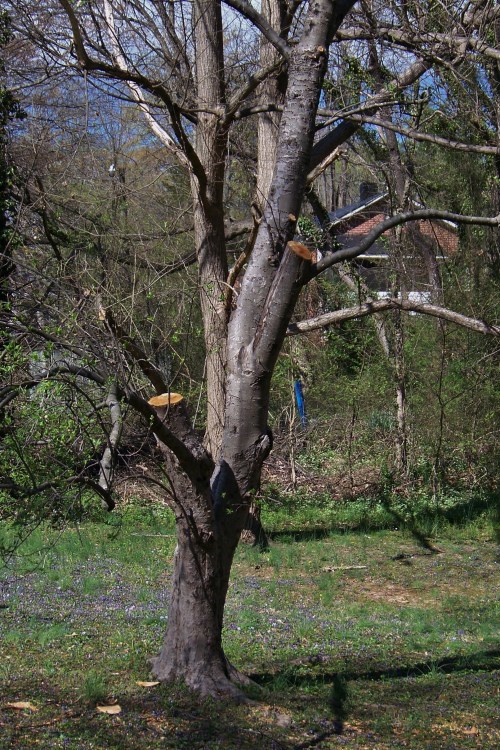
- Ouch!

I was immediately reminded of two Scripture passages: John 15:1-11 and Luke 13:1-9 Hear a little of each passage:
“I am the true vine, and My Father is the vinedresser. Every branch in Me that does not bear fruit, He takes away; and every branch that bears fruit, He prunes it so that it may bear more fruit… he who abides in Me and I in him, he bears much fruit, for apart from Me you can do nothing. If anyone does not abide in Me, he is thrown away as a branch and dries up; and they gather them, and cast them into the fire and they are burned.” John 15:1-2, 5-6 “And He began telling this parable: ‘A man had a fig tree which had been planted in his vineyard; and he came looking for fruit on it and did not find any. And he said to the vineyard-keeper, ‘Behold, for three years I have come looking for fruit on this fig tree without finding any. Cut it down! Why does it even use up the ground?’ And he answered and said to him, ‘Let it alone, sir, for this year too, until I dig around it and put in fertilizer; and if it bears fruit next year, fine, but if not, cut it down.’” Luke 13:6-9
Perhaps it is a parable for my life just now. No, by God’s grace, I do not believe I will be burned up because I belong to Him, but does cut down mean eternally separated or ‘fallen asleep’ as those who were disobedient (I Corinthians 11:30)? I have been severely pruned or cut; difficulties with career, health, loved ones. Has my life been unfruitful and full of rot so that it needed a major pruning? Am I too apt to be content, complacent when I have orders to fulfill? There are other ways to look at the reasons for these trials but I don’t want to be oblivious to the obvious. I certainly feel like this tree looks. And I don’t see it or mean it as complaining. I just want to learn the lessons that are here and serve my Lord better rather than have to recycle remediation. The flowers bloom all around; the sun shines brightly; the soil is warming and wet; the grass is greening. Am I connected and abiding in the vine (trunk and root) so that I may bloom, leaf, and bear fruit. I want to be a fruit tree that produces. I want to be pruned, not cut down.
A New Way Led
Posted in General, God Thoughts, God's Word, Sustaining, tagged attributes of god, God Thoughts, God's Word, Poems, purpose in life, Sustaining, ultimate issues on January 19, 2014| Leave a Comment »
I break the present silence with trepidation because as always I feel compelled to be honest and that is hard when you have also been foolish in the eyes of others. So, I will start off slowly and get around to several points in a circuitous way.
At 4 AM on New Years Day, my precious wife awoke with what I now know to be “having a stroke”. She rubbed her head both front and back, complaining of it hurting and could not recognize me speaking to her. There is so much I am not saying because it is too hard to say, and there have been many doubts and tears. We finally arrived at the hospital for a 3 night stay. Thankfully the stroke did not effect her motor skills other than a general, temporary weakness. She walked into the ER, spoke in a limited way without slurred speech, grasp numerous nurses and doctors hands and pushed against their resistance. Instead, her language center was arrested. She could not say names, mine, her own, and to her, most notably, her children. She could not understand many instructions which led one doctor to conclude she had motor skill deficiencies because she could not follow his instructions to apply pressure against his push.
I am going to post several poems that came 2 weeks after the events described above that reveal some of my reactions to all that I saw and experienced during this time as a result of seeing my wife’s debilitation and having family push me this way and that. The reflections are obviously focused around my thoughts and struggles concerning the stroke my wife had and are therefore skewed away from the events to my feelings about the events. No one is truly objective afterall though that does not mean untruthful. My first poem is a short one that deals with the immediate “why” question, to which there is no answer other than “He is good”:
I know in my heart that God is goodHis Word declares it so From His works to show How His providence and care The abundance He does share Reveal that He is kind And powerful and involved and good
If you have not yet concluded by faith that He is good you will probably ask endlessly “Why”, or perhaps, accuse Him, when it is sin in the world that is the cause of so much pain and suffering. Oh, so its sin and not Him. Why didn’t you say so? It is because all good and ill is filtered through His providential hands, otherwise He is not truly God: “I am God, and there is no one like Me, declaring the end from the beginning, and from ancient times things which have not been done, saying, ‘My purpose will be established, and I will accomplish all My good pleasure’; calling a bird of prey from the east, the man of My purpose from a far country. Truly I have spoken; truly I will bring it to pass. I have planned it, surely I will do it.” (Isaiah 46:9-11) Here it is, pay careful attention, those of you who want to soften God down, “who are stagnant in spirit, who say in their hearts, ‘The Lord will not do good or evil'” (Zephaniah 1:12): “I am the Lord, and there is no other, The One forming light and creating darkness, causing well-being and creating calamity; I am the Lord who does all these.” (Isaiah45:6-7) Wow what a tangent! But it is not a false one because His goodness is based on His sovereignty- He is not fickle; He has purpose, much of which He has made known and yet is inscrutable by man. He is good and there is purpose in difficulty and harm we experience.
Outworking of the Trinity
Posted in General, God's Word, Remembering, Work of Jesus, Work of the Holy Spirit, tagged attributes of god, God's Word, gospel project, theology, ultimate issues, work of christ, Work of the Holy Spirit on October 15, 2013| Leave a Comment »
Having reviewed the biblical doctrine of the Trinity I now turn to its application by God to all God-ordained social institutions. Because we have refused to understand how God’s character is expressed in what He has created and ordained we try to re-invent social institutions apart from God, effectively destroying them. I will allow several days for study before I fill in the blanks. (Lest I be called for plagiarism, I must acknowledge the ideas of Del Tackett in “The Truth Project”. I have digested and added my own study and organization to his framework.) Click on Outworking of the Trinity to start the study.
Trinity Overview
Posted in General, God's Word, tagged attributes of god, God's Word, gospel project, theology, ultimate issues on October 9, 2013| Leave a Comment »
 CreatorWorship