Feeds:
Posts
Comments

Archive for the ‘Random thoughts’ Category

The sky was so blue you would have thought we were out West. The day was just barely long sleeves cool in the shade and balmy in the sun. With the low humidity rock friction was good. The wall pictured has very obvious ripple marks which were probably laid down during the Flood in loose sand, lithified then tipped. It is the type of climb that is challenging because of the small holds rather than the need for significant strength. It is not really that hard since it is on a positive slope, but you never quite feel like you are secure because the holds are small. I would not attempt to lead it for that reason. For me this has been a year of recovering from injury, so climbing at all is amazing and climbing decently is even better. I picked my way up this climb and completed it in one try. By contrast, on a later climb I struggled with strength moves up half way and then the holds became so small I didn’t even know what to reach for next. I was totally shut down. I find climbing to be both exhilarating and humbling. I always enjoy the conversation with my climbing partner, who is a growing, young believer in Christ, an avid outdoor enthusiast, and an intelligent engineer.

Noel Rap BF

Rappelling after a climb. Deep blue skies!

sunny mushroom2

In the moss of my backyard

The trees in my backyard usually sustain moss green until the heat and shade of June, but this year it has remained green even until late October. As I write it is raining hard yet again. The miniature scene above shows a recent mushroom popping up through the moss into a spot of sunlight even as leaves begin to fall off of the willow oak. I don’t remember seeing this type of mushroom before with the yellow rim. It was bright yellow when the fruiting body first began to open. I readily understand the attraction of bonsai scenes. The small detail of lush greenery is fascinating and beautiful. 

I am so thankful for eyes to see dark blue skies, ripple marks on rock, moss and mushrooms and all. The Creation is only a dim shadow of the beauty of our God and one day we who belong to Him will see Him.

Frederick Faber says it well in his hymn “My God How Wonderful Thou Art”:

“How beautiful, how beautiful,
The sight of Thee must be,
Thine endless wisdom, boundless power,
And awful purity!…

Only to sit and think of God—
Oh, what a joy it is!
To think the thought, to breathe the name—
Earth has no higher bliss!.

Father of Jesus, love’s reward!
What rapture it will be
Prostrate before Thy throne to lie,
And gaze and gaze on Thee!”

Read Full Post »

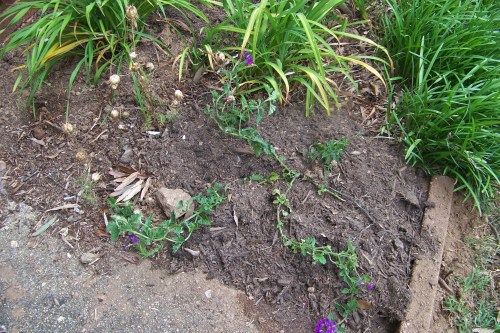
Let me begin with a few excuses: 1) not much time, 2) more than normal rainfall, 3) injury, and for good measure 4) wasn’t sure it was worth it. My wife had asked me to weed the flower beds in front of the house several times. I must confess that the only thing that got me motivated to actually start was the avoidance of another chore I detest more, scrapping paint. Now that I’ve blown my cover about a few of my procrastinating personality flaws, here is the point I considered while yanking crabgrass leaders out of the soil.

Weeds run deep. They grow fast. Ignoring them makes their removal harder. Weeds can choke the life out of things. Apart from poison that contaminates everything, the only way to prevent weeds is to replace them with desirable plants that leave no room for weeds.

I have another flower patch that has very little weeds in the middle of it. Weeds have no room for roots and very little sunlight. The various kinds of lilies simply grow too close, having produced more bulbs with each passing year. I will not be thinning them because I don’t have to weed that area. English gardens make more sense, with their crowded beds of profusely blooming flowers. Undesirable weeds just can’t take root in this environment.

It is the same way in our lives. It is not enough to root out something unprofitable or wrong in our life. We must replace it with something better, more desirable, healthier, God-pleasing. Otherwise the weeds will return all the faster in the cleared, well-tilled ground we just cleared.

It reminds me of what Jesus said, “When the unclean spirit goes out of a man, it passes through waterless places seeking rest, and not finding any, it says, ‘I will return to my house from which I came.’ And when it comes, it finds it swept and put in order. Then it goes and takes along seven other spirits more evil than itself, and they go in and live there; and the last state of that man becomes worse than the first.” (Luke 11:24-26) What Jesus states is in the more extreme, related to demon possession and salvation. But even for those of us who are already saved by His grace, we need God in every area of our lives filling up the void spaces, working righteousness in us, teaching us prudence, kindness, and discipline. Our lives filled with the good things of the Lord are far less likely to be encroached upon by the seedier tendrils of sin and unbelief.

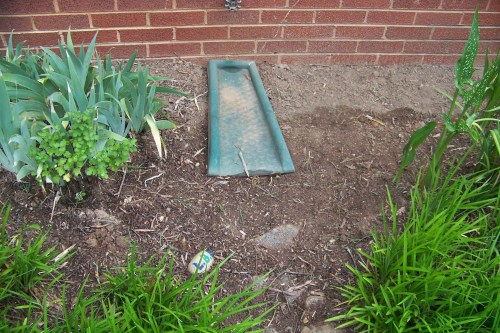
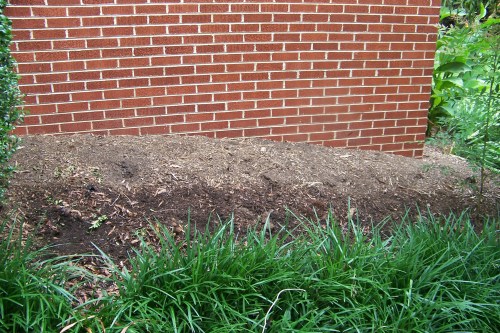
101_1159

Weeds all gone

101_1160

Totally gone

101_1161

Dead azalea, too

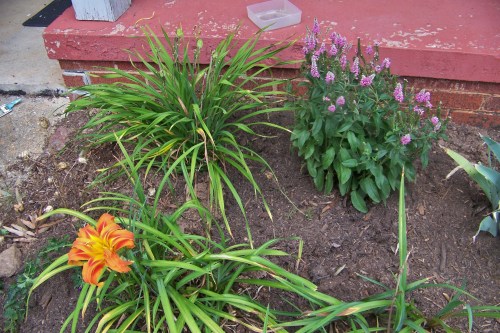
101_1163

A transplanted daylily (not the one in bloom) and a Purple Speedwell

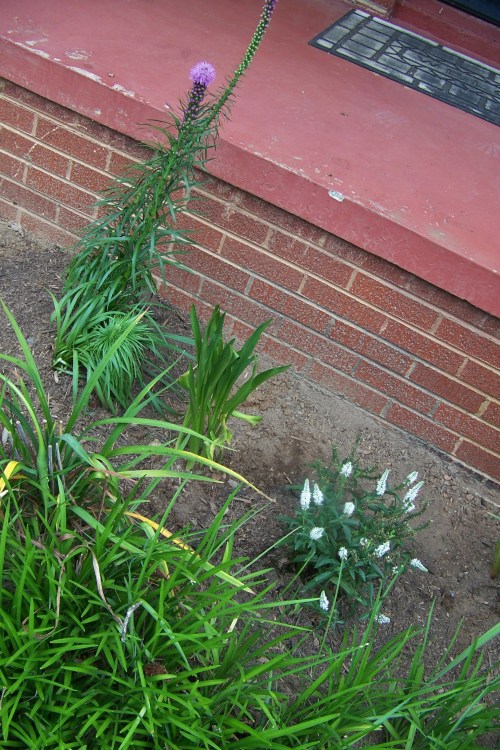
101_1164

A Gayfeather and White Speedwell with volunteer Cala Lily in between

101_1162

spreading Purple Verbena

Now that I’ve begun to clean the inside of the cup, I guess it’s time to spruce up the outside as well. Oh, I hate scrapping paint.

Read Full Post »

Over the weekend my neighbor came over to share a photo album of his recent vacation. Several relatives took him to the beach, a pier to fish, a battleship, and out to eat several times. He was very excited explaining in his broken, repetitive speech about the beach and waves, a fish he caught, the large shells and big guns of the ship, and pancakes he had. You see, my neighbor has an IQ of around 80. His experience of life is very simple and concrete. (He is also the best neighbor that I have ever had.) The thought occurred to me as he talked that his excitement sounded very similar to that of a young child. Subsequently, I considered that me or some very intelligent person is little different compared to God’s infinite intelligence, perception, and power. We are all enjoying the beach like young children in our level of perception compared to God. But are we all enjoying it with the simple excitement and thankfulness of this neighbor of mine? As I considered it further this morning, I thought about the 4 things our society values: riches, intelligence, beauty, and athletic ability. Those are gifts to be thankful for, but frequently they bring their own problems because we think these gifts somehow come from us. We would be best off without these gifts if we are going to misuse them. And we would be best off not alive if we don’t know God through His Son.

I’d rather be a bear of little brain
Thankful, content, and partially sane
Than one of high intellect and profane
Ungrateful, unbelieving and inane

I would rather be an ugly duckling
Humble and kind, always listening
Than one gorgeous, proud peacock strutting
Self-absorbed and manipulating

I’d rather be a spastic water boy
Team player, play maker, full of joy
Than the stud and star that’s all a ploy
To be in the lights, a lonely alloy

I would rather be poor and struggle hard
Thankful and content though often jarred
Than be filthy rich and on my guard
And by greed and retribution marred

I’d rather be a believer in God
A servant, humble though roughly shod
Than a skeptic agnostic, oh so mod
Separated eternally from God

Read Full Post »

101_0983

…there’s a Gecko in your bathtub!

101_0988

…Spanish Moss is in every Live Oak tree.

101_0989

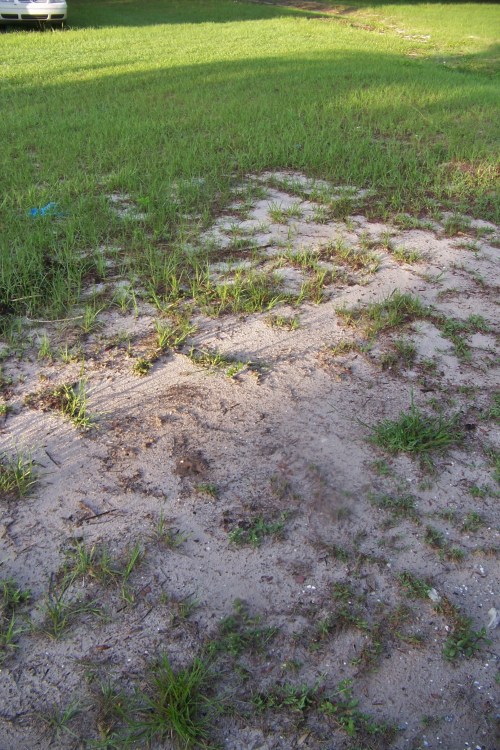
…there is sand and only sand, and it’s everywhere, in your clothes, in your car, in your house, in the breeze.

101_0990

…the rocks were once alive- coral or shells.

101_0993

…everything grows on everything else. (Pop Quiz: What is the difference in an epiphyte and a parasite?)

101_1013

…there are a numerous variety of birds, many of which have long legs and long beaks.

101_1020

…you can see thunderstorms coming hours and multiple dozens of miles in advance.

101_1021

…the power company provides places for raptors to nest.

101_1022

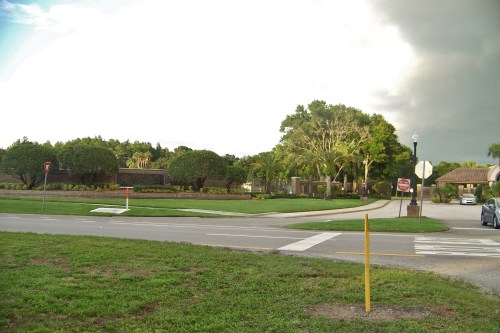
…most of the housing developments have walls and many gates and more than a few screened in swimming pools behind every house (a car in every garage?).

I like different for a change, but it is good to be home where   

   1) the tub don’t have no critters hangin’ out in it. (hope ya ain’t offended by my grammar).
2) the only thing hangin’ in a tree is branches and squirrels.
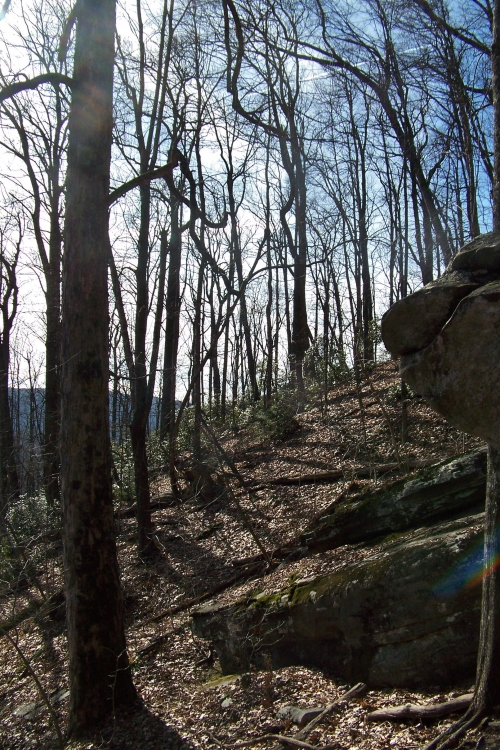
3) the dirt is orange clay and the rocks are hard with crystals.

   4) the birds are small and sing songs in the morning.
   5) thunderstorms pop up of a sudden.
   6) you have 1/2 million dollar homes and trailers on the same street.
I like traveling and exploring and I like coming home, too. God has created a big, varied world with so much to fill the senses and point us to Him.

Read Full Post »

It was time for Monday morning parking lot duty again (for more see “Marvelous Mondays“). “We shouldn’t even be here, it’s snowing.” I had my full rain suit on with a little less than comfortable amount of clothing underneath. That slight discomfort added a bit to the melancholy of the streetlights and angled snowfall that resulted in light splatter sounds on my hood. Water droplets flashed like Advent lights on tree branches and pavement as their moving form refracted the artificial light source. I always station myself at the center of the parking lot under six trees planted there a mere eleven years ago. They have produced their own microcosm. The birds love to come early and sing from their branches and feed on insects under the shrubs below them. I am constantly amazed at how lively the little space is. I have long observed the disparity of growth among these six trees, but the stark and beautiful scene of this morning caused me to contemplate their survival and interaction in a rather curious way.


A small island in the parking lot
A heavily mulched and shrubbed plot
Reprieve from the barren blacktop
Place of rest and food where birds stop

Six Pin Oak trees were planted there
Shade and shelter where birds repair
One grew fast, rules over the rest
Two compete, the larger one test
Two struggle, healthy but not strong
One not thriving, everything wrong
Disease, breakage, the bark looks old
Misshapen, stunted, soon may fold

All are needed, the plot complete
The strong, the weak, those that compete
The weak need so much extra care
How will we help them to repair?

Read Full Post »

Pastor preached on Proverbs 27:17 this morning: “Iron sharpens iron,
so one man sharpens another.” He spoke about the need, purpose, and process of believers helping each other grow spiritually. I enjoy extending metaphors, which requires care not to come up with analogies not there or elsewhere delineated in Scripture or life. The usefulness of such an enterprise may be to help those who hear to further understand the importance of the concept portrayed by the metaphor.

Why does the Scripture say iron sharpens iron? That has long bothered me, because anyone who has sharpened a knife or tool knows that you use a whetstone, grinding stone, or ceramic sharpening tool which are harder than the tool.  And such tools existed. I Samuel 13:20 records the desperation for Israel when “all Israel went down to the Philistines, each to sharpen his plowshare, his mattock, his axe, and his hoe.” These events were more than 300 years before Solomon wrote the proverb. For that matter, why shouldn’t I use modern technology, the diamond sharpening stone?

The proverb is a metaphor for fellowship and discipleship within the congregation of believers. God doesn’t give us any other choice. We must sharpen each other. And we are not back at the castle. We are in the battle, so the grinding wheel is not an option. We go to our brother, cross swords in a mutually beneficial way and come away sharpened for more battle. Fellowship is the non-optional, God-ordained means for being honed to battle readiness.

Those who want to exclude themselves because of “hypocrites in the church” or “I can worship in nature” just fine or “all I need is Jesus” are dull or more likely twisted and unbalanced weapons. The problem is everybody wants to be sharp but nobody wants to be sharpened. When you are sharpening a blade, one swipe of the finger near the edge will reveal why so few want to be sharpened. Your finger will come up with a dark gray dust from the sharpening process. Sharpening removes material. Bad material and excess material must be removed from your life. It can be painful and humbling.

For some it’s rust from lack of use or exposure to corroding influences that needs to be removed and is hindering the cutting edge. For others, it is good material, all be it not according to faith or God’s direction, that needs to be removed to reduce the fat edge of dullness.

When two materials of equal hardness are used to do the sharpening, material is removed from both edges. Discipling and being discipled means involvement in another person’s life with all of the mutual messiness and need for honing away spiritual dullness.

And some of us are more of a mess than others. I own a double bladed axe. The way that I came into ownership of this axe goes back to the beginning of my wood heating days. I borrowed this axe (first mistake) to split some of the first wood I cut. While attempting to split some very twisted forks, I got several wedges stuck in a piece. I used the axe to attempt to get the wedges out (second mistake). I bought the axe, that is, I replaced the friend’s axe and kept the broken one. The strike took out a half-moon divot in the blade about the size of your thumbnail. In years since I have used the good blade to split and the broken blade when risking to remove wedges or cut roots near metal or concrete. No other sizable divots have been removed but the the edge has been bludgeoned a few times. I have tried for years to sharpen that divot out of the blade. For the longest time my efforts were to no avail, but now, years later, that blade is reasonably sharp while still having somewhat of a dent in the edge. It took years and that blade is possibly an inch shorter than the other one. That blade is me. The difference is that I have multiple divots. God has had to work for years to grind away the dullness of my spirit due to sinful habits and difficulties of life. I still show the scars and I’m not the sharpest tool in the box, but neither am I who I was. And much of that has been because God has used brothers and sisters in my life to remove rust here and dullness there. I doubt seriously that I will be admired as a shining blade of perfection, but I do pursue a cutting edge pursuit of God in the battle of life. And for that I give Him all of the praise.

Read Full Post »

When my pastor was leading the Lord’s Supper yesterday, he spoke of the Savior’s perfections, making mention of His impeccable life. For those who have read my blog for some time, you know that words and thoughts can set me off. Words beginning in “im” and “in” began to pour into my mind concerning all the ways that Jesus is perfect. The only one that didn’t come to me was inimitable, but I was looking for an “i” word that means perfect to use in the title. I came home in the afternoon and wrote the following poem. I have provided definitions below to help you.

His impeccable life
On display to see
His impervious character
The reason it could be
His invincible power
Makes His enemies flee
His indescribable wisdom
Totally beyond me
His indefatigable grace
Has set believers free
His incomparable mercy
I praise on bended knee
His interposed blood
Rescued His church, we
His inconceivable love
In salvation the key
His infinite existence
The great I AM is He

Inimitable-so good or unusual as to be impossible to copy; unique
Impeccable-in accordance with the highest standards of propriety; faultless
Impervious-unable to be affected by
Invincible-too powerful to be defeated or overcome
Indescribable-too unusual, extreme, or indefinite to be adequately described
Indefatigable-persisting tirelessly
Incomparable-without an equal in quality or extent; matchless
Interposed-place or insert between one thing and another
Inconceivable-not capable of being imagined or grasped mentally; unbelievable
Infinite-limitless or endless in space, extent, or size; impossible to measure


Read Full Post »

I know people that don’t know how to play and others who don’t how to work. I like the addition to the old saying by Maria Edge recorded in Wikipedia, “All work and no play makes Jack a dull boy; all play and no work makes Jack a mere toy.” Keep me far from both kinds of people, because for the one you will constantly have to pull their weight and the other will perpetually be a weight to your spirit. Upon reflection, however, I think that knowing how to work and knowing how to play are both learned. So perhaps I should feel sadness for someone who doesn’t know how to do either or both. And for my part, I have erred on too much of one or the other in times past. Not that I have the perfect balance now, but I find that when work is over done either by compulsion or by obsession, play is frequently the tonic. When the indulgence is too much play it loses its savor, because change of pace and relief from work are largely the reasons and pleasure in play.

Yesterday and today were examples of when I went after each one in its appointed time.

Yesterday I went bouldering. I had not been climbing in a month and wanted to go ever so much, but life gets in the way sometimes. I didn’t climb particularly well, which is to be expected when I don’t do it often. My climbing partner had not been for a longer time, but we both tried and celebrated our little successes. During a break we were sitting in the sunshine listening to water trickling over pebbles beneath the nearby boulder and admiring the large trees around us. It was probably below 40 degrees, but we were heavily clothed and the thin overcast did little to obscure the warmth of the sun. There was no breeze and we sat mostly in silence much of the time. Later I observed that I think that I needed the excuse of going climbing today to be allowed to sit in the woods and be quiet. I did enjoy climbing and succeeded at several problems; I enjoyed the conversation; most of all I enjoyed the winter woods in hibernation and the rest it gave to my soul.

Today I set aside for attacking the huge job of cleaning the leaves off of my three quarter acre lot, knowing full well that it was only a start that I was going to make and not a completion. Usually there is little reason to start this chore before the New Year because willow oaks are reluctant to shed their leaves. This year they came down several weeks earlier because a heavy, wet snow pulled them down as it sloughed off in the wind and warmth. I had previously blown some leaves away from the back of the house, so today I began by hauling 10 loads on my painter’s drop cloth. Next I climbed up on the roof and blew the gutters out with the leaf blower and did the same on my neighbor’s roof. Our growing season is long and grass frequently grows even through parts of winter. Leaves in high grass are very hard to get up. I mowed back and forth pushing the leaves in one direction. Periodically I stopped the mower and raked up leaves onto the drop cloth. I trimmed branches and cut down dead flowers and hauled downed branches. I surprised myself and finished the whole front yard and 30 feet away from the back of the house.

Why am I recording all of this work and play? Who cares and why would I care to remember? Well, my blog is more about me reflecting on life than having a following, though I hope that you may benefit from my musings and ramblings. I am reminding myself that I value working hard and playing hard and sleeping well, because I think these are right and good and I am thankful to have the strength to be able to. And when I pause to think about it, I hear the encouragement or admonition, depending on my frame of mind: “Whether, then, you eat or drink or whatever you do, do all to the glory of God.” (I Corinthians 10:31) I hope that I have and hope that you and I will in the New Year.

101_0758

Bright day, Boulder, and a Buckeye tree

101_0764

Reaching for the topout hold

Read Full Post »

Wet?

I most dislike annoying little problems when I have previously tried to solve them to no avail. Or even worse when my ‘solution’ works for a while and then doesn’t. I bought a non-stick, copper infused, ceramic skillet (“Red Copper’ brand) about 6 months ago so that my wife and I could cook our breakfast without it sticking. For about 4 months it worked wonderfully. Undercook, overcook, oil, no oil, it didn’t seem to matter, it didn’t stick.

My wife makes homemade sausage and almond meal pancakes. So my daily procedure is to put a little oil in the pan, add crumbled sausage, break two eggs over it, scramble the yokes, and move away to put a pancake in the toaster and pack my lunch. Just before the egg is totally solid I turn the eye off and flip the egg-sausage fritter over, reaching over to push down the toaster button.

Why did it begin sticking when I try to flip it over? It didn’t for several months and now it has for several months. I set out to try to figure out this mystery. I must be doing something differently. That the change resided in me and not in the pan was clear to me from two additional pieces of information. My wife cooks her breakfast after I have left for work. She commented one day, “Why are you having trouble with the food sticking in the pan? Aren’t you using oil? Mine doesn’t stick.”

Secondly, I re-oiled the pan like I had when I first got it. You fill the bottom with oil, place it in the oven for 15 minutes at low heat, and pull it out to cool. I could see why this works, because it reminds me of oilite bushings. Wikipedia says, “Oilite is a porous bronze or iron alloy commonly impregnated with an oil lubricant and used in bearings.” When the bearing warms up during use, it will release a little oil that lubricates the bearing surface preventing overheating. It works wonderfully well and the bearing can be re-oiled by submerging it in hot oil. But that didn’t prevent the egg from sticking.

I tried more oil. The liquid egg only pushed it aside and stuck to the bottom.

I tried different kinds of oil: butter, olive oil, coconut oil. The smells were great but the sticking persisted.

I tried different temperatures which either left me twiddling my thumbs or the egg slightly burnt on one side.

Finally, I pretty much gave up, but the egg pushing the oil aside confused me a bit. Why didn’t the egg just roll over the top of the oil as it cooked? I realized that the real question that I was asking was, “Why does the oil not wet the surface of the pan but the egg does?”

For many of you the word “wet” seems totally out of place in this scenario. Afterall, waters wets, right? But what does it mean to wet a surface? I will give a formal definition in a moment, but the best one is illustrative. Water wets an unwaxed car but beads up on a well waxed car. Water is sticky. It adheres to things different than itself, that is wets surfaces, and it coheres to other water molecules, that is beads up. So how does it decide which one to do? If the adhering forces are stronger, then it wets the surface; if the cohering forces are stronger, then it beads up. Once again Wikipedia (Hey, I’m not into this, you can’t trust Wikipedia thing. Be a bit skeptical of it on religion or politics and realize it will probably be incomplete on many subjects, but as an overview it is a good, quick reference.): “Wetting is the ability of a liquid to maintain contact with a solid surface, resulting from intermolecular interactions when the two are brought together. The degree of wetting (wettability) is determined by a force balance between adhesive and cohesive forces.” All liquids can wet surfaces: water, oil, egg, lava, alcohol, gasoline, and so forth.

The various oils (butter, olive and coconut oils) were beading up on the pan. So, this very morning I tried a new strategy. I let the coconut oil heat until it began to bubble, then I threw in the sausage and egg. It didn’t stick, what a pleasant, small blessing! Perhaps I had become too efficient at making my breakfast in the morning, being so fast at putting in the oil, sausage, and egg, until I had reached the ‘sticking’ point of the procedure. One little, almost imperceptible change I made was putting in those three things instead of punctuating the oil heating with putting in the pancake and opening the almond butter jar.

It will be interesting to see if I have found the real solution. As researchers like to say, “further research is needed.” But I think that upon reflection this must be the solution. My wife always puts in some combination of peppers, onions, and mushrooms to momentarily saute before adding her beaten egg, and her breakfast never sticks. 

Read Full Post »

I have the privilege (really!) to patrol Monday morning parking lot duty from 7:15 until 7:50. On most Monday mornings there are no more than 2 or 3 cars in the parking lot when I arrive. That makes for some quiet moments to consider the day, pray about concerns, and look around. Quiet allows you to observe better. One morning I saw various seeds under the trees: Bald Cypress cones, acorns, and Sweet Gum balls. Another morning I saw oak leaves of various sizes and broadness on the ground. Looking up into the tree I could see that smaller ones generally came from the top of the tree and larger ones from the bottom. These larger ones are called shade leaves. They are competing for the sparse sunlight in the shade cast by the rest of the tree. Yet a third morning I spied leaves popping up a few at a time in the direction from one bush to another. I kept watching and every 5 to 10 seconds the leaves would pop up an inch or so. After every few minutes the movement of the leaves would retrace the path back toward the first bush. I concluded that I was seeing a mouse or other vermin forging a tunnel just under the leaves and mulch on this frosty morning.

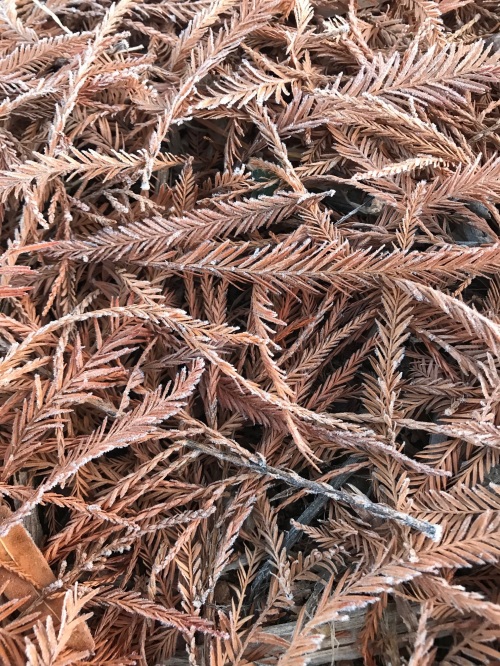
Speaking of frost, the very next week the morning was even colder, around 27 degrees (-2.8 degrees Celsius). As I approached my usual vantage point for watching cars, students, and nature, I saw that the golden brown Bald Cypress needles had fallen to the ground in the last week and this morning were fringed in frost. I went to investigate and caught a hold of an early arriving former student, requesting that he snap a picture and e-mail it to me (gonna have to get one of them new fangled smart phones one of these days).

Bald Cypress needles

The most Exquisite Lace

I retreated back to my self-appointed post. Still there were but few cars in the lot and none nor no one stirring. I glanced over toward the frosted needles once or twice. Then between two bushes I spied a curious sight about which I was at first incredulous. In fact, a few minutes later a student came to pass my way and I requested the use of her young eyes to see if she would see what I think I was yet seeing. She confirmed that there were indeed the appearance of heat waves between the bushes. Imagine, heat waves on a frosty morning! She went on and I was left standing to contemplate how this could be. Moments later a small breeze kicked up and the waves were gone. That only served to confirm my belief that they had been heat waves.

Heat waves are caused by varying densities of fluid (air in this case) refracting light passing through them. Usually the warmer fluid is rising, forming a convective cell. As it randomly snakes upward the background images are gently contorted by the light passing through the foreground fluid.

But what was forming the heat waves? As my eyes scanned the parking lot and Cypress needles, it seemed to me that the frost was heavier during the short period I had been standing there. That may have only been to my sight because of the increasing light as the sun rose, but it brought a possibility to mind. When frost forms, water vapor in the air turns directly into solid ice crystals on the grass or windshield. This process is called deposition, which is the opposite of sublimation, and skips the liquid state going either way. The heat given off by changing from gas to liquid and liquid to solid is about 8 times more than the heat given off by the same amount of liquid water cooling from 100 to 0 degrees Celsius. Needless to say, a significant amount of energy is given off by the deposition of frost. Frosty heat waves, that is shimmering amazing.*

*If my conclusion is correct


Read Full Post »

As I said in a recent post, I have taught whole science lessons by using the illustration of the woodstove. See if you can name the concept being taught by the following story before I name it at the end.

Heating with wood can be interesting and exciting (chimney fire!) but also mundane. When something interesting happens it gets your attention. One bright morning in early Spring in the Horseshoe I got up and ate breakfast. I had not started a fire the night before because it wasn’t that cool and we like to sleep cool. My wife said, “Don’t you think it’s cool enough for a fire?” Of course, there is only one right answer, so I gathered wood and kindling and sat down to build a small fire to “knock the chill off.” I had only just lit the paper and cardboard when the smoke started billowing out of the top of the open door into the living room. My immediate response was to slam the stove door followed by jumping up to check to see if the stove pipe damper was open. The smoke started oozing out around the door dampers, so I hastened to screw those shut, only to continue more slowly coming out around several small gaps around the doors. All there was left to do was to open the front door and start fanning. After a few minutes the smoke was cleared and the living room really needed a fire in the stove. I got my flashlight, cautiously opened the stove door and peered into the exiting stove pipe at the back of the stove. There seemed to be no obstruction. I even used a mirror but couldn’t see around the curve for the smoke. There must surely be an obstruction in the chimney, be it birds or squirrels or bats or nest thereof. I was determined to get to the bottom of the problem. I put on a coat and hat and went outside to get the ladder and lean it up against the house. As soon as I got out from under the back door porch, I realized that the morning was warming up quickly in the bright sunshine. It was warmer outside than inside. Maybe I should just open the doors and wait. But instead I continued on the mission of solving the mystery stoppage in my chimney. I climbed up onto the red metal porch roof with the flashlight and then scampered up the steeper main roof and grabbed ahold of the chimney. Straddled across the peak of the roof, I removed the chimney cap and pulled the flashlight out of my back pocket. When I shown it down into the opening, I had to wait for my eyes to adjust and move my face closer. I could see clearly down most of the length of the chimney. There was very little creosote build-up. But toward what I judged to be the bottom where I should have seen the pipe coming into the chimney from the stove, the view went fuzzy. I could not tell what I was looking at. I tried to adjust the flashlight and my head to see better, but to no avail. Frustrated, I thought, “I’ll fix that,” shut off the light, slid down the roof to the porch, bounded down the ladder, and stepped over to the old smokehouse, now a storage shed. I strung up my 100′ extension cord with a plug-in socket and light bulb on the end and retraced my course back up to chimney side. Next, I lowered the lit bulb down into the chimney, which was very well lit now. When I lowered the bulb down to the vague area, I could see that there was smoke hovering low in the chimney. I lowered the light into the smoke and it totally disappeared after several inches more of lowering. It would appear and disappear as I raised and lowered it out of this dense smoke layer. I turned my head aside for a moment to consider, since fresh creosote is not the most pleasant smell. Just as I turned back to look again I got a face full of smoke that just kept coming. I choked on the lung full I received and must have called out in alarm because my wife yelled up to ask if I was OK. I hastily pulled the light out and made my way down to the porch with the smoke settling down the roof behind me. What in the world was happening? The smoke cleared quickly, because there really wasn’t all that much. I climbed back up on the peak of the roof and again lowered the light. The chimney was clear.

It took me awhile to figure out what had happened. Have you figured it out, yet? There are several hints in the story having to do with temperature. Before you read below you may want to go back and reread with the hint.

The temperature was warmer outside than inside. Cold air is denser than warm air. Since there was not a fire the night before, the air in the chimney was cooler than the quickly warming exterior air. When I started the fire, smoke was not able to move through the pipe because the air there was heavier than that higher in the chimney where the sun beamed down. There was a thermal inversion in the chimney restricting the air from rising. When I left the light bulb in the smoke layer for a few moments of slow reflection, it warmed the smokey layer so that it was lighter than the air above it and began to rise. I got a face full of lesson about thermal inversion. This situation happened again years later in the home we presently live in. I didn’t even hesitate. I climbed up on the roof and lowered a light bulb down into the chimney. The smoke rose. I climbed down and started a fire and had a warm feeling inside knowing that knowledge and experience go a long way toward clearing away smoke that obscures your path.

Read Full Post »

Sometimes I’m not sure if I have already written a post or just thought about it. So, sometimes I go back into my own blog and search for a post. The post I actually wrote was about 29 years of heating with wood (Click on the following title to read “A Warm Habit“.). I am now heating in my 35th year. I have some unfinished writing I said I would write another day in “A Warm Habit”.

The first year I heated with wood was the second winter of our marriage. I used a wood stove borrowed from a friend. The next year my father bought me a small, cast iron, bolt together wood stove with a nice picture on both sides. It was sufficient for the small 3 room house we were renting. As hindsight now allows me to regret, I sold that stove the next year. I thought that I would not heat with wood again when my wife and I went for a year of Bible School in Chicago and lived in a 4 room house with central oil heat. The next  year we moved to Elizabethton, TN, and lived in the front half of a split house. Ironically, though we had just lived in Chicago, the first winter in Elizabethton was the coldest we ever had in a house. The landlord had a wood stove in the the crawl space with ductwork to supposedly heat both halves. It didn’t heat our half. Our first child was constantly wrapped up like he was outdoors. The next winter we lived in a house on Camp Ta-Pa-Win-Go. I paid a small rent and worked as maintenance man. We heated with the very nice installed wood stove. The next year we moved to the Horseshoe, a small gorge and bend in the Watauga River in that shape. The first year in that little house in the woods with the curtains that blew in the winter breeze, we heated with my friend’s wood stove again while he was building a house.

If you having been following this story, then you will realize that we had now been married 7 winters and heated with wood for five. It was again time to find a wood stove. I started checking the want ads of the local newspaper, because this was in the days before Ebay and Craigslist. I looked at several that were a combination of too small for heating a whole house and too expensive for my budget since I was was in the state of affairs referred to as under-employed at the time, doing odd jobs. I saw another stove advertised for $250 in Bristol, TN, about an hour and a half drive by the roads then available. The price seemed at the edge of my range and it was called a Fisher “Grandfather”, which I understood vaguely to mean it was a larger model stove. I grabbed a friend and we went that way. It was well after dark when we pulled up to the most curious house in the neighborhood. The house was obviously much older than any other in the neighborhood. It was a one story white clapboard house that had a large porch all across the front with disproportionately large white columns one might expect to see on a big house on the plantation. The address matched. The windows were unlit even as the neighborhood was poorly lit. A young couple came to the door. The stove was in the front living room which was almost empty except for the large, two door wood stove in front of the chimney. I sized it up while my friend made small talk. I began to engage with the man in order to try to haggle the price. He referred me to his wife, who he said was the owner of the stove before they were married. One of us made a comment about the interesting house. They began to explain that they had hoped to remodel this post-Civil War house and raise their family there. Instead, they were now going to be missionaries and had already cleared most of their furniture. I told the young woman that my budget was really tight and I intended to heat with wood as I had already been doing to save money. With what I thought to be almost tears in her eyes she explained how the stove was meaningful to her because of family connections and that she hated to part with it. She had already turned down several other people who had wanted the stove and finished her story by saying, “I just want to find a home for this stove with someone who will burn a sincere fire.” I assured her that based on the fact that I was already regularly heating with wood, cut and split all of my own wood, and had a growing family and a limited income, that I could most certainly “burn a sincere fire.” I felt as though I was swearing to always burn fires in this way. Based on my sincere testimony, the woman was convinced and allowed me to give her just $190 for a stove that probably cost $900 to $1000 new. But I was not scamming or playing; things were really that tight. The stove was very hard for us three young men to move, given its size and weight. We laid down boards and mostly scooted the stove across these boards to avoid scratching the hardwood floor and porch. We wrestled it onto the back of my 1970 F-100 with the rusted bed. For the next 30 winters thus far I have burnt the most sincere fires possible, keeping warm a wife and 5 children in three different houses in two states. I think that what most makes the fires in this stove sincere is the enjoyment I obtain from heating with wood and the reflection I have while starting fires. My wife encouraging me to get up and start a fire because it’s cold in the house probably doesn’t hurt any.

As He has so many times, God provided what I needed when I needed it. During those times when it seemed as though He didn’t, really He did, just not in the way or at the time that I expected or requested. He is good.

101_0744

Starting a sincere fire during the first snow of the season with wet wood drying by the wood box in the background.

101_0742

The sideboard of an old woodbox that my wife stenciled when we lived in the Horseshoe.

Read Full Post »

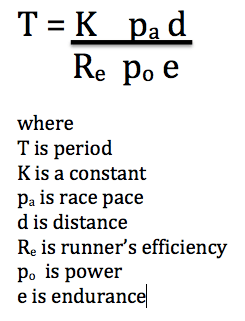
Equations are abbreviated definitions that simplify and  clarify complex concepts and data. They may be used to calculate, which may either reveal past events or predict future outcomes. Qualitatively, they enable the understanding of interrelationships between variables, which may not be obvious otherwise. On the other hand, not all relationships within an equation are the mere product of their juxtapositions within an equation. Rather, some variables owe their interaction to feedback loops within their physical situations. For instance, according to the equation below, in order to have the best period (race time), both power and endurance must be at their maximum. But in physical reality, for a runner, when power is maximum, endurance must be low. Sprinters are not endurance runners. Conversely, when endurance is high, then power must be low. Long distance runners are not sprinters. Actually the equation does reveal this relationship, because if you move the power variable to the other side of the equation you get po = 1/e, or more accurately, power is inversely proportional to endurance. That is, as endurance increases, power decreases.

From the equation you may also see that pace and distance should be inversely proportional. But the opposite is true. A longer distance requires requires a slower pace, that is, larger number.

And when distance is increased, endurance must increase and power must decrease.

The Runner efficiency variable may not be able to be determined, though I think that athletic physiologists are trying desperately to do so with VO2 max, respiratory exchange ratio, fast twitch/slow twitch muscle, body mass, % body fat, and running mechanics. Strength training and anaerobic sprints seem to be two popular methods for increasing runner efficiency. Diet must not be discounted as a way to build better runners.

The constant, K, is a factor that converts the other five variables into a race time, T. At this level of development of the equation, it is nothing more than a fudge factor to make five variables equal to the one.


Screen Shot 2017-11-14 at 9.14.14 PM

The best race time (T) is what every runner, coach, and spectator is after. Thinking through this equation might help the runner and coach better design training that will secure that result. Are you training for power, the sprint, or endurance, the long distance run? What training regimens do you need to perform to meet these goals? How much is it reasonable to increase both power and endurance? What are the limits of one, given the other?

I feel certain that good runners and their coaches have all of the relationships dialed in, so that an equation seems silly, but I benefit in my thought about running by the simple definition called an equation.

Read Full Post »

Being observant makes life interesting. Being intentionally observant is more interesting, and being in a group of people who enjoy discussing intentional observation is much more interesting. One evening I was walking out of the tower door of the church, which faces west, with two brothers. The sun was low and directly in our faces, making it hard to see. We were discussing what we intended to do when I pulled up short and said, “What in the world?” They both seemed surprised and said, “What’s wrong?” “How can this be?” I replied more to myself than to them, “The sun is shining in our faces but there are shadows in front of us.” I turned around to see if there were shadows behind us where they should be and discovered the truth of the bright shadows in front. The sun was equally blinding reflecting off of the glass door we had just exited. “I thought the laws of Physics were overthrown for a moment.” One of those two men still gives me a hard time about my observation and utter amazement.

I only hope that I may one day be such a good reflection of my Savior’s glory as to caste bright shadows over the lives of those who are blinded in His presence. And will there even be shadows in heaven where the light of His glory penetrates and purifies all its surroundings, where sin cannot abide, and praise arises uninterrupted before His throne? Even in the shadows of my continued sin nature, the world’s wicked system, and the devil’s devious temptations, I look forward to brighter days of knowing and serving Him through the grace He daily provides. Though shadows fall all around us, His presence brightens even these.

Read Full Post »

Many the comment that comes from students the last few days for school. Many are gracious, wanting to end on a friendly note. It shows a measure of decency on the part of the majority of students. Others are harshly truthful and others contrived, far from truthful, out of some need to right a never done wrong. “I can’t wait until this class is over. Friends told me that I wouldn’t be able to wait to get out of here, but that I would miss you afterward. I don’t see that happening.” It seemed like a complement to me, if not from the student in front of me, then certainly from the ‘friends’. Dealing constantly with people is not easy business. It wears on the emotions, particularly if you care even a little bit. It doesn’t help that you always know that you have failed in some small way with every person you interact with, even though you know you did your best overall and intended the best for your students. It is for all of this difficulty in the midst of trying that the occasional word of genuine encouragement lifts the weary soul. At the end of the last assignment to be graded for one class there was the following statement: “Mr. __, I’m so glad you were my teacher! I learned alot from you! Science and life choices.” That is the way that I want to be remembered as a teacher- passionate about teaching Science and life. Many of my years of teaching have been stressful for reasons inside the class and out. This past year was not the worst for stress, but it did rank. At the same time it was a year of spiritual benefit in my own life and in opportunity to talk to students about eternal things. It sometimes amazes me how often students will bring up the subject of where we came from, or do I believe in God, or how do you solve life’s difficult problems, or what is the meaning of life. Some of the questions relate directly to the subject at hand and others seem random, though I am sure that the underlying thought process that brought them forward was not. I hope that I taught many students science and life this past year and that God will take what I offered for His glory and their good.

Read Full Post »

Grammar is fascinating and frustrating. A wordsmith must surely play with it sometimes to see what change in perspective it gives a sentence or idea or story. All people who try to thoughtfully put ideas down on paper or screen must surely have faltered in how to follow the rules while conveying the thought and feeling. As a teacher and sometime writer, I deal in a fair amount of grammar though I am by no means a wordsmith.

So it was today that I warmed to the prayer of my pastor as he requested of God that He make our indicatives into our imperatives. I believe I knew what he meant, that we should take those statements of fact that God declares about who we are and what we have in Him and make them bold statements of faith by acting on them as though commanded by the very statement of them. I lost most of the rest of his prayer as I requested that God would indeed do that in my life in areas that I knew were not fully under His Lordship.

It was only later in the day that I again reflected on the thought, this time to consider if I had really understood it. Then my mind went all bonkers on details. For instance, what is the term for different types of statements? Oh yeah, mood? When he made that request, being a man who frequently studies the Scriptures, was he thinking English or Greek verb moods? What are the English and Greek verb moods, what do they mean, and how are they expressed? How might I use conscious awareness of them to benefit my writing and deepen the content of what I convey?

It feels good after so many months of tight schedule and stressful deadlines to be sufficiently unencumbered of the mind to have random thoughts and have a few minutes to put them down. Here is an attempt at sharing a good mood:

I desire while still living who I am in Christ shall command me to obey.

That is a mood worth having!

Read Full Post »

Evidently, last night a spider had laid three lines of silk down the windshield of my truck squarely in the line of my vision for driving. The Sun shining in from just south of my predominantly easterly direction on the way to church down the interstate produced little repeating rainbows in the silk. From bottom to top they gleamed: red, orange, yellow, green, blue, and the last two just looked like black gaps before the next red. The colors were brilliant and made the silk appear much wider than it did when the Sun was obscured once or twice by tree branches. I noticed that when I moved my head left or right the colors changed. When I moved to the right the color transitioned to longer red beads up and down the silk. When I moved my head left the color transitioned toward blue. Just before I exited the interstate the roadbed trends slightly more North and I finally began seeing violet when I leaned left.** I was thankful for light traffic on the interstate since I was focusing on 5 lines, one solid white, one dashed, and three multicolored. I thought of lunar eclipses, when the Moon is blood red or orange. Light from the Sun is refracted by the atmosphere onto the surface of the Moon which is moving through the shadow of the Earth. The shorter wavelength colors bend more evidently, careening off into space between Moon and Earth. I also reflected on the refraction that occurs in a droplet of water on a leaf producing and fisheye view of flowers or landscapes behind. The Sun was also pleasantly warm on me. I praised God for beauty He instilled into Creation which points to His superior beauty and His goodness that allows me to be aware of and see it and experience warm Sun and have a truck to travel in, and so on. I went to a corporate worship service later, which I would always recommend, but I got started early with three lines of evidence for God’s beauty and love of beauty.

**I don’t think that I ever see indigo, or is it violet I don’t see? That is, I don’t discern two colors, indigo and violet. I had the thought for the first time today that perhaps I don’t see violet. When I get in discussions with my family about a transition color between green and blue, they always say it looks blue and I most usually say it looks green. Does that mean that I see colors differently than most people, seeing what normal (whatever that means in this situation) eyes discern as blue as green or that I just name them differently? If it is the former, then perhaps I also see indigo as blue and violet as indigo and don’t see a separate violet color. If this is true it in no way changes reality, but only casts a shadow of doubt on my perception of reality. Afterall, certain people certainly hear more or most frequently less than 20 to 20,000 Hz frequency of sound.

Read Full Post »

     In my Earth Science class we are learning about Meteorology. Today I was discussing cumulonimbus clouds, how they form, and the results of their violent action. Maybe you can guess where this is going. Given my particular Southern accent, there is not a dime’s worth of difference between the pronunciation of hail and hell. (And yes, I can pronounce them differently and correctly, and yes, there is a difference in Southern accents. (That was for my Northern brothers and more British speaking acquaintances.)) So, a student immediately seizes upon the opportunity to ask which one I meant. I replied, as the snickers increased, that we could talk about either one. I then proceeded to compare and contrast the two by way of modeling proper separation of homonyms (as they appeared), prefacing my comments by saying that I take both seriously, since I believe both are real. Encouraged on by several students, I re-pronounced the words, “hale” (long a) and “hel” (short e) and said one is cold and one is hot. One is a thing and the other is a place. 

     Had I had more time to think, I believe that after re-pronouncing them that I would have said something more along the lines of, “One is a thing; one is a place. Both are real and dangerous. One is hot and one is cold. One can ruin your day and one can ruin your eternity. One can injure your head and one can injure your soul. Both are avoidable if you retreat to an ‘umbrella’ of protection from the wrath they entail.” Hopefully the little I did actually say communicated much of what I would intend to say if it were not a spur of the moment reaction.

Read Full Post »

If you hold to objects close together with a small gap between them and peer through toward a bright light you can see the bending of the light around the two edges as an interference pattern. The result makes the two object appear to grow together if they are at the correct distance apart. You may find an example at the following link: https://www.meteoros.de/blog/pics/blackdrop2.jpg The parallel lines of dark and light are called a diffraction pattern even though the sight of them results from light interference. Seeing Venetian blinds lit up by sunshine today with blurry edges reminded me of this pattern. If you ever see the old movie “Sergeant York” you may remember him moistening the front sights of his rifle. This disturbs the diffraction pattern making for clearer sights. As I stood taking in this familiar sight on the blinds the thought of a metaphor for moral ambiguity came into focus.

At the edge of light and shadow
Is where the challenge of life is
Ambiguous scenario
Time to have a real life pop quiz

Diffraction pattern blurs the line
Blinds by alternate light and dark
Fuzzy scheme in the contrast cline
Right and wrong seem no longer stark

Are there exceptions to the rule?
Dismiss the law and moral code?
Sparse view, the way of the fool
To quit the way for your own road

There is good and bad in the gray
Right and wrong all mixed together
God has not left us with no way
To discern, know, and do better

When life does not seem black and white
Then pray to God and search His Word
Don't give up on doing the right
Don't give in or follow the herd


Read Full Post »

I was so regular about blogging until this Autumn when it all fell apart. Taking a class at the local community college after about 24 years away from the classroom has been a fun challenge. I believe time studying how students study has caused me to be a wiser student, but an old brain is simply slower, or at least this one is. With the immense amount of time pressure and brain strain I just cannot feel justified in blogging, but I just could not pass up the following short interaction in class yesterday:

My students and I were discussing one of my warm-up questions at the beginning of class. The question asked why Earth was considered to be in the life zone of our solar system. In order to contrast our privileged position I contrasted it with Mars. One student mused that “they” were talking about sending people there.
Another one said, “I wouldn’t want to go”.
“Why not,” I replied.
“There’s no wifi up there.”
I reasoned, “If you went to Mars, NASA would send you, therefore, you would have wifi,
the best wifi in the solar system. They have wifi on the International Space station. They e-mail home.”
The student replied, “You really could live on Mars, then.”
“So you think that you have to have wifi to live?” I queried.
“Yes, I would.”
“I went many years without wifi and had no problem.”
Several students chimed in together, “But you didn’t need wifi back then.”
Another student added, “Yeah, you need food, air, water, and wifi.”
One would like to assume that there was some tongue in cheek here, but the first response, “You really could live on Mars,” was intoned as one of those aha moments when the student understood that spaceflight was not just science fiction, all because NASA provides wifi there. This one should go in that book that all teachers say they will write one day about student reactions.

Read Full Post »

« Newer Posts - Older Posts »

Myrela

Art, health, civilizations, photography, nature, books, recipes, etc.

Overflows from the Heart

"But the things that proceed out of the mouth come from the heart…" Matthew 15:18

CreatorWorship

Pointing to the One who made, saved, and sustains