Feeds:
Posts
Comments

Posts Tagged ‘Grace’

Several weeks ago my brother in Christ shared this about the sufficiency of Scripture:

“Sola Scriptura is a reminder that God has always worked and will always work on this side of eternity through His word the Bible. Sola Scriptura deals primarily with the issue of authority. It is not a base claim that says that nothing except Scripture is helpful. It is not a claim to Scripture only in all cases. That would not be Biblical. Recognizing this is to distinguish between Sola Scriptura and Scriptura Nuda. Sola Scriptura does not argue that there is no value in anything except for Scripture standing on its own. It is an argument that Scripture is the only basis of authority.

I think a couple of verses would help us frame this discussion. Psalm 138:2 captures the sentiment of Sola Scriptura in a poetic way, but it also stresses a note of praise and worship which seems very appropriate when we are remembering God’s faithfulness over the 500 years since the Reformation. The psalmist here says:

“I bow down toward your holy temple and give thanks to your name for your                       steadfast love and your faithfulness, for you have exalted above all things your                   name and your word.”

Several translations say this slightly differently, but the idea is clear: God exalts his Word. And God exalts those who exalted his word, and God will be exalted when his word is exalted.

The Reformation, which was a great turning from the time when doctrinal error was pervasive in the church, to a time when the church was based much more on the truth of Scripture follows clearly a line or trajectory of a return to Scripture. Every individual who had a hand in the Reformation of the church was a person who had first learned to see the Scriptures as their sole authority. You can back up to 200 years earlier and look at the life of John Wycliffe in England, who was persecuted for his position on the authority and importance of Scripture. You can look in the 1400s at John Huss, who was also persecuted for a similar stand. He was martyred for his belief in Scripture. But he is the one who famously said, “you may cook this goose.” His name Huss meaning goose, “but in its stead God will raise the Swan who will sing his praises.” That Swan came 100 years later, just a few miles away, in the person of Martin Luther. Martin Luther, was ironically induced into the priesthood in the same church that the bishop who condemned Huss was buried in. And so we see consistently through history, God superintending to bring about his own glory and the reform of his church through the honoring of Scripture. Each of those men engaged in the great task of putting the Scriptures into the language of the common man of their day. Each one of them understood that one of the great tasks of their life was to put Scripture into the language of the common man, so that the English plough boy could read Scripture in English, and the German peasant could read Scripture in German.

Simply put, Sola Scriptura is the cause of the Reformation. The other principles, or rally cries of the Reformation; the other solas, whether it is Sola Gratia, Solus Christus, Sola Fide, or Soli Deo Gloria. We could not and would not have any of these were it not for return to Scripture only. Scripture is the foundation; it is the foundation upon which God’s work will always be built.

Peter reminds us in II Peter 1:16. In this passage Peter reminds us of a pivotal time during the life of Christ. A time where Peter and two other disciples are alone with Christ on a mountaintop, and there in that Transfiguration moment they see the Lord in His glory. But Peter tells us in verse 19:

“And we have the prophetic word more fully confirmed, to which you will do well to          pay attention as to a lamp shining in a dark place, until the day dawns and the                    morning star rises in your hearts.”

The King James translation express this as “we have a more sure word of prophecy”. One of the things Peter is reminding us of here, is the fact that even if God were to reveal himself physically to us, as Christ was revealed to the disciples on that mountain Transfiguration, that appearance would not and should not be as authoritative or as significant to us as the physical pages of the word of God that we have in our hands. Peter says that what we have is a more sure word; it is a word more fully confirmed, which we do well to pay attention to. Sola Scriptura thus speaks to the authority and sufficiency of the word of God.

The threat to Scripture in the time leading up to the Reformation, came from an approach to Scripture which claimed that we could not know for sure what Scripture was saying. The scholars and some church authorities the time said that we could look to tradition and Scripture, we could look to reason and Scripture, we could look to the great leading voices of the church and Scripture, and we can look to experience and use that to temper our understanding of Scripture. And out of that mixture of endless qualifications and piles of meaningless footnotes maybe we can come up with something that in some way we could call true. Martin Luther said that that approach to truth, and approach to truth that is merely tentative, an approach to truth that denies the absolute authority of God’s word, an approach that says truth is only possible, is an approach to truth that paves the road to hell. Martin Luther said we do not need possible truth. We need therefore truths; truths that are absolute and unequivocal. We need truths that come to us with the thunderous certainty of Romans 5, “therefore there is now no condemnation for those that are in Christ Jesus.” We need truths that are absolute! And our only hope, our only source for that kind of truth comes in the revealed Word of God, Sola Scriptura.

Sola Scriptura is thus the basis of our confident joy. Every commemoration, every anniversary, every celebration, should ultimately be characterized by gratitude. A gratitude that shows that we are thankful to God. God is the only reason why good things live long. On the 500th anniversary of the Reformation our heart should be hearts that are filled with gratitude that God has kept his word. We can say with the hymn writer:

         “How firm a foundation the Saints of the Lord

          Is laid for your faith in His excellent Word

         What more can He say than to you He has said

         To you who to Jesus for refuge have fled.”

Let us be thankful for Sola Scriptura.”
Read Full Post »

My son and his wife hosted a Reformation 500th Anniversary Conference back in April. The website for the conference has history of the various states in Europe that were effected by the Reformation. They wrote and edited summaries of these histories. The website also has links to all of the conference speakers’ talks. Soon the site will have legible pictures of the 40 story boards (trifold boards) he and his wife made for the conference. All of these resources may be accessed at www.reformation500pa.com

Happy 500th and happy researching!

Read Full Post »

Some anniversaries are celebrated with much pomp. Perhaps in limited or hidden circles or isolated from one another, the 500th anniversary of the Reformation is being celebrated. But from my limited view, I am not seeing it. Perhaps this history changing event is obscured by the willful ignoring of the main purveyors of information. It is my hope that the quiet remembrance and thanksgiving of the saints for this God directed change in direction of the church and at that time will result in godly resolution to renew repentance and reformation in our time.

My church is committing some small focus to this great event and how it effects the church today. For 5 weeks leading up to the 500th anniversary, we are presenting a 5-10 minute “Reformation Moment” on the 5 solae of the Reformation. Then this coming Sunday night we have a speaker who will give us an overview of Reformation history. One of the solae for which I have a transcript is “Solus Christus”:

In these 5 weeks we are giving consideration to the 5 solae that summarize the Reformation ideas about God bringing salvation to man. As has been said, the Latin word sola means “alone” or “only”: only Scripture, only grace, only faith, only Christ, only God’s glory. There is, however, one sense in which they are not alone. The solae must be taken together to give a full picture of what God has done and evermore will do to secure our salvation. All of these solae grew out of the reformers’ realizations that the Roman Catholic Church had strayed from the true Gospel message by adding requirements and layers to what God had done, much as the Pharisees had done by the time Jesus was on Earth.

Today we focus on Solus Christus, Christ alone. That this idea is Scriptural is abundantly clear from numerous references. Jesus, Himself, proclaimed His exclusive role in salvation when He said in John 14, “I am the way, and the truth, and the life; no one comes to the Father but through Me.” (v. 6) Peter amplifies the idea when he and John are brought before the rulers and elders of the people in Acts 4:  And there is salvation in no one else; for there is no other name under heaven that has been given among men by which we must be saved”. (v. 12) No priest, no deacon, no pastor, no pope, no mentor or prophet or holy man or saint or angel can in any way help us in salvation other than to point us to Christ because, as I Timothy 2:5-6 says, “there is one God, and one mediator also between God and men, the man Christ Jesus, who gave Himself as a ransom for all, the testimony given at the proper time.”

Furthermore, Christ is only and once sacrificed. For the celebration of the mass is said to be the true body and blood of Christ sacrificed for sins. Scripture says: “And inasmuch as it is appointed for men to die once and after this comes judgment, so Christ also, having been offered once to bear the sins of many, will appear a second time for salvation without reference to sin, to those who eagerly await Him.” (Hebrews 9:27-28)” Salvation comes through trusting in Christ alone for his once and final sacrifice on the cross. We do not need the priest as mediator or the mass as a means of applying saving grace.

Luther understood our tendencies all too well when he said, “we humans are weak and stubbornly perverse and are more likely to become attached to saints than to Christ…that it is easier for us humans to believe and trust in everything else than in the name of Christ, who alone is all in all, and more difficult for us to rely on him in whom and through whom we possess all things.”

As Huldrych [Ulrich] Zwingli proclaimed, “Christ is the only way of salvation of all who were, are now, or shall be.” In Article 54 of his Sixty-Seven Articles (1523), Zwingli explicitly contrasts the Roman sacramentalist view with solus Christus: “Christ has borne all our pain and travail. Hence, whoever attributes to works of penance what is Christ’s alone, errs and blasphemes God.”1

Joel Beeke in writing about the Solus Christus says, “The centrality of Christ is the foundation of the Protestant faith. Martin Luther said that Jesus Christ is the “center and circumference of the Bible”—meaning that who He is and what He did in His death and resurrection is the fundamental content of Scripture. Salvation is only in Jesus Christ because there are two conditions that, no matter how hard we try, we can never meet. Yet, they must be done if we are to be saved. The first is to satisfy the justice of God through obedience to the law. The second is to pay the price of our sins. We cannot do either, but Christ did both perfectly”2

In his “Institutes of the Christian Religion”, John Calvin wrote, “Christ stepped in, took the punishment upon himself and bore the judgment due to sinners. With his own blood he expiated the sins which made them enemies of God and thereby satisfied him…we look to Christ alone for divine favour and fatherly love!…Hence Christ is called “King of peace” (Is. 9:6) and “our peace” (Eph 2:14) because he quiets all agitations of conscience. If we ask the means, we must come to the sacrifice by which God has been appeased. For anyone unconvinced that God is appeased by that one atonement, in which Christ endured his wrath, will never cease to tremble. In short, we must seek peace for ourselves solely in the anguish of Christ our Redeemer.”3

Solus Christus, Christ alone. As one blogger said, “Since Rome has not changed, and since our own hearts constantly look elsewhere for salvation, the issue is still before us today.  So it is still the duty of the church to clear away all helpers and assistants in salvation and preach Christ and him alone. He is all we have for salvation, but he is all that we’ll ever need.”4 Martin Luther gives us a simple summary, quote, “I must listen to the gospel. It tells me not what I must do, but what Jesus Christ the Son of God has done for me.”

  1. http://www.ligonier.org/blog/top-five-books-five-solas-solus-christus/
  2. http://www.ligonier.org/learn/articles/christ-alone/
  3. John Calvin, Institutes of the Christian Religion 2.16.2
  4. https://reformedreader.wordpress.com/2012/03/24/martin-luther-on-solus-christus/

Read Full Post »

Sigh and Faith

One sentence from a comment on my last entry keeps coming back to me:

“A man was meant to be doubtful about himself, but undoubting about the truth; this has been exactly reversed.”        (G.K. Chesterton)

When I came across a small poem that I had written about a year ago and considered my daily struggles, it seemed an example of how I must doubt my sinful self and cling evermore so firmly to the saving truth that brings joy and confidence. This salvation is not a past tense thing, it is a continuous present tense thing:

A deep heavy sigh

To realize I’ve failed again

How can I reply

Other than repent of sin

Only live by faith

Letting God’s grace to shine through

Jesus first of all

In all life that I pursue

Read Full Post »

Being observant makes life interesting. Being intentionally observant is more interesting, and being in a group of people who enjoy discussing intentional observation is much more interesting. One evening I was walking out of the tower door of the church, which faces west, with two brothers. The sun was low and directly in our faces, making it hard to see. We were discussing what we intended to do when I pulled up short and said, “What in the world?” They both seemed surprised and said, “What’s wrong?” “How can this be?” I replied more to myself than to them, “The sun is shining in our faces but there are shadows in front of us.” I turned around to see if there were shadows behind us where they should be and discovered the truth of the bright shadows in front. The sun was equally blinding reflecting off of the glass door we had just exited. “I thought the laws of Physics were overthrown for a moment.” One of those two men still gives me a hard time about my observation and utter amazement.

I only hope that I may one day be such a good reflection of my Savior’s glory as to caste bright shadows over the lives of those who are blinded in His presence. And will there even be shadows in heaven where the light of His glory penetrates and purifies all its surroundings, where sin cannot abide, and praise arises uninterrupted before His throne? Even in the shadows of my continued sin nature, the world’s wicked system, and the devil’s devious temptations, I look forward to brighter days of knowing and serving Him through the grace He daily provides. Though shadows fall all around us, His presence brightens even these.

Read Full Post »

Following after Jesus has its many rewards and challenges. The challenges all originate from our sin nature, and “seeing that His divine power has granted to us everything pertaining to life and godliness, through the true knowledge of Him who called us by His own glory and excellence,” (2 Peter 1:3) we really have no excuse. This enabling power given to us through the agency of the Holy Spirit helps us to “enter through the narrow gate; for the gate is wide and the way is broad that leads to destruction, and there are many who enter through it. For the gate is small and the way is narrow that leads to life, and there are few who find it.” (Matthew 7:13-14)

God is at work in us for our sanctification, but He also commands us to be diligently about increasing our sanctification: “Work out your salvation with fear and trembling; for it is God who is at work in you, both to will and to work for His good pleasure.” (Philippians 2:12-13) Because of the lie of Satan that induced the original sin of Adam, “you will be like God, knowing good and evil” (Genesis 3:5), we now have a sin nature. As a result “death reigned from Adam until Moses, even over those who had not sinned in the likeness of the offense of Adam” (Romans 5:14), and there is still “nothing good dwells in me, that is, in my flesh; for the willing is present in me, but the doing of the good is not. For the good that I want, I do not do, but I practice the very evil that I do not want.” (Romans 7:18-19) To put it plainly, the lie of Satan was that you can do it on your own, that is, be good enough, be like God. Every religion is a way to work your way to heaven or attempt to please God. True Christianity is not this way, that is, works oriented, but grace oriented, because God has and is accomplishing all that is needed to please Him and secure for us a place in heaven. But we sinners by nature and by practice are hooked on the Lie and must throughout this lifetime be diligent to believe what God has said and done in and for us.

I love analogies and metaphors and thought of this situation today as I was describing a friend’s need to find a church where grace is preached. We should seek a church where truth is preached, the Gospel is preached, and the whole counsel of God is preached, right? Most definitely we should, but we are like an old pick-up truck that has a badly mis-aligned front end that constantly wants to steer us into the left ditch which we must persistently fight by holding the steering wheel to the right so that we may track straight. The mis-alignment is our works oriented sin nature; steering to the right is a constant placing of God’s grace before our eyes and in our thinking; the straight track is the narrow way that God is guiding us along toward Himself.

Or we are setting a course of the narrow way by turning the tiller of grace that has us tacking into the wind of the world, the flesh, and the devil. We are always empowered by God, but He frequently accomplishes that through the effort of faith we put forth. This “steering” or “tack” is not a new level of works, but a clinging to God, the only source of life and godliness, joy and heaven.

Read Full Post »

Bright new day
Mockingbird has his say
Lush and green
Rain brings Spring's early sheen

Season's start
Foliage and plumage art
All dainty
Nests and blooms aplenty

All things grow
Matter, energy flow
Life's cycle
Replenish, recycle

Young ones sup
Foal, calf, kitten, and pup
Insects buzz
Peach, leaf, and mildew fuzz

Remember 
God's mercies are tender 
He provides 
Creates, sustains, abides

Read Full Post »

Mundane and tedious blights the soul
Clips the wings and dulls life's sheen
Off to the digs, the life of a mole
Outwardly lulled, inwardly lean

Nothing big but challenges galore
Wanting to rise to the top
But daily life pins you to the floor
While pleading that troubles would stop

Why do difficulties continue?
Why do my troubles persist?
Where's a fresh start and a new venue?
Does purpose in problems exist?

If you would be faithful in little
Later entrusted with much
The trials will test your faith and mettle
Spirit's power revealed as such

Hold on and trust in the daily tasks
Find His help in every trial
Cling to Him, doing all that He asks
Don't doubt, turning to denial

Embracing your God ordained story
Bear up under every test
Then to God will go all the glory
And your soul will find joy and rest

Read Full Post »

Lord, You give us all good things
To enjoy and praise Your Name
Thanks for Your benefits rings
Always gracious, always the same

Difficulty You allow
Confusion part of what's planned
Hardship brings sweat to the brow
Some gifts are hard to understand

Trusting Your goodness the plan
Resist confusion and pain
Cling to God, unbelief ban
Let His rule and direction reign

Halt all you're not called to do
Do well what He's given you
Make it first Him to pursue
God will work well to see you through

Then peace will reign in your heart
Problems will not overwhelm
Each new day a brand new start
Your joy when God is at the helm


Read Full Post »

I was asked, as one of the guests requested by the Eagle Scout candidate, if I would like to speak during the ceremony. I asked if I would be allowed to share Scripture. The response was, “That would be good because the pastor had a conflict and can’t come.” Following is an approximation of what I said then:

Eagle Scout Candidate (ESC- I used his name where this appears), congratulations on your accomplishment. I am here to give you a challenge. Your Scout Oath speaks of duty to God, Family, Country, Others, and Self. Life is about relationships. I add family to the list because, even though it is not included directly in your oath, it is the most fundamental unit of society, even above government, and is surely included in “others”. The Scout Promise and Path is about fulfilling these duties within these relationships.

My challenge today, ESC, pertains to the question, What is our duty to God?

Micah 6:8 says, He has told you, O man, what is good; and what does the Lord require of you but to do justice, to love kindness, and to walk humbly with your God?” In the context before and after this verse the prophet points out that this requirement is not being fulfilled. Is it an unreasonable requirement? Paul quotes King David, the prophet (Psalm 36) when he says,There is none righteous, not even one; there is none who understands,there is none who seeks for God; all have turned aside, together they have become useless; there is none who does goodthere is not even one.” (Romans 3:10-12) Paul summarizes the problem just a few verses later: “for all have sinned and fall short of the glory of God.” (v.23) Is God being unreasonable to require what we cannot do? What is the solution? The solution is relationship with God. Hear what Ephesians 2:8-9 says: For by grace you have been saved through faith; and that not of yourselves, it is the gift of God; not as a result of works, so that no one may boast.” The first step in duty to God is to know God through His Son, Jesus.  The next step is to live for God. These two steps cannot be reversed. You cannot simply serve God and be a nice person. You must know God through Jesus first, then He gives power to those who know Him by providing everything they need for life and godliness (2 Peter 1:2-3).

ESC, my challenge to you is this: Know God through Jesus, not know about God. Know God by receiving Jesus as your Savior. Secondly, know God regularly through His Word and through worship. Thirdly, serve family, country, and all people through the power God gives, giving Him the credit. This is your duty to God.

Read Full Post »

Last week I was asked to film some running and interviews and be interviewed about exercising. After challenging students to come out for a set of couch to 5K training sessions to be sponsored by the track team, I gave them my challenge: “I have been exercising for over 40 years and here is what I’ve learned: Start now, start small, and start again.” Start now, because if you don’t you probably won’t. Start small and progress slowly or you will probably be overwhelmed and give up. Life is challenging. You get injured or sick or you have responsibilities that prevent you or old habits overtake you and you just sit. Don’t give up; start again. And the next time it happens start again and again until the habit makes it hard to quit.

When I walked away from being interviewed I realized that what I said could readily be applied to many areas of life. The spiritual application is one of perseverance and diligence in the pursuit of relationship with God. Our life with God begins and continues by grace through faith, but we are also urged to “work out your salvation with fear and trembling; for it is God who is at work in you, both to will and to work for His good pleasure”. (Philippians 2:12-13) God’s work in us results in us working. Our salvation is secure in Him but our sanctification is progressive. If it is reading the Bible regularly or studying it, or praying, or witnessing, or going to church for worship and fellowship: Start now, start small, start again. You’ve given in again to that sinful urge. Your old self wants it and that’s why you did it, but your new life in Christ wants to please Him and wants to break the slavery to sin. It is not just a matter of stop. You need to replace the sinful urge with a godly urge. Practice righteousness. Start now. Start small. Start again. You neglect the best for the alright and easy. Set your priorities in order which includes the best and down time to recuperate from intense activities. Start now. Start small. Start again. Getting in shape spiritually is not so different than getting in shape physically, though really it is because “…discipline yourself for the purpose of godliness;  for bodily discipline is only of little profit, but godliness is profitable for all things, since it holds promise for the present life and also for the life to come.” (I Timothy 4:7-8) And furthermore, though you should “work out your salvation with fear and trembling;” simultaneously “…it is God who is at work in you, both to will and to work for His good pleasure.” (Philippians 2:13-14) And “our struggle is not against flesh and blood, but against the rulers, against the powers, against the world forces of this darkness, against the spiritual forces of wickedness in the heavenly places.” (Ephesians 6:12) Other than that (haha!) they are the same, so start now, start small, and start again. Coupled with the many promises that we “can do all things through Him who strengthens me” (Philippians 4:13) and “No temptation has overtaken you but such as is common to man; and God is faithful, who will not allow you to be tempted beyond what you are able, but with the temptation will provide the way of escape also, so that you will be able to endure it.” (I Corinthians 10:13) and “if anyone sins, we have an Advocate with the Father, Jesus Christ the righteous” (I John 2:1) and “His divine power has granted to us everything pertaining to life and godliness, through the true knowledge of Him who called us by His own glory and excellence,” (2 Peter 1:3), and more, then the least we can do is start now, start small, and start again.

Read Full Post »

Oh Father, my heart is heavy
My past failures and troubles, too
Exact from me a stiff levy
Brokenness, regrets not a few

There is now no condemnation
Help me believe that it is true
Act so without reservation
Participate in life anew

Communicate life to loved one 
Keep what is best for him in view
Remembering victories won
Repent, reconcile, and renew

May my life show to all others
That forgiveness makes all things new
Humble in success and failures
Belief in Christ is what is due

Make my heart light with joy and peace
Paint my life with a brighter hue
Christ's life in me a brand new lease
May be seen by all to be true

Read Full Post »

The hymn by this name has become one of my favorites over the years because it conveys the holiness and glory of God by transporting the mind to the mercy seat both in the tabernacle and in heaven. The version I have has 5 verses. The original, written by Frederick Faber, has 8 verses: (for a choir rendition, albeit too slow for my liking, click here: https://www.youtube.com/watch?v=t4VtpEu3CDQ)

My God, how wonderful Thou art,
Thy majesty, how bright;
How beautiful Thy mercy seat
In depths of burning light!

How dread are Thy eternal years,
O everlasting Lord,
By prostrate spirits day and night
Incessantly adored!

How wonderful, how beautiful,
The sight of Thee must be;
Thy endless wisdom, boundless power,
And glorious purity!

O how I fear Thee, living God,
With deep and tender fear;
And worship Thee with trembling hope,
And penitential tears!

Yet, I may love Thee, too, O Lord,
Almighty as Thou art;
For Thou hast stooped to ask of me
The love of my poor heart!

No earthly father loves like Thee,
No mother, e’er so mild,
Bears and forbears as Thou hast done,
With me, Thy sinful child.

Only to sit and think of God,
Oh, what a joy it is!
To think the thought, to breathe the Name,
Earth has no higher bliss.

Father of Jesus, love’s Reward!
What rapture it will be
Prostrate before Thy throne to lie,
And gaze, and gaze on Thee!

As I sang this wonderful hymn, and others, and mused on Psalm 103, more verses came to me. They are not of a quality of the original but I do intend them as worship to God:

He righteous deeds each day performs
Judgments for the oppressed
Compassionate and gracious He 
With love for the distressed

As high as heaven above earth
So great His steadfast love
Is toward all those who fear their God
The God who dwells above

As far as east is from the west
Transgressions He removes
A Father who compassion on
A child who his God fears

For all is peace, my soul at rest
Submitted to His will
Our God is good and great and kind
To know Him is a thrill

One day in heaven we will be
Adoring face to face
But now we see His glory great
Through His redeeming grace

Read Full Post »

“But In these last days He has spoken to us by His Son.” (Hebrews 1:2) When one spoke for God in times past He was considered a prophet. Jesus taught about God. Jesus revealed hidden things about God. Jesus spoke miracles into existence. For the people who observed these things “Fear gripped them all, and they began glorifying God, saying, ‘A great prophet has arisen among us!’ and, ‘God has visited His people!’” (Luke 7:16) By late in His ministry they were convinced: “And the crowds were saying, ‘This is the prophet Jesus, from Nazareth in Galilee.’” (Matthew 21:11) It was certainly true that they were anticipating a prophet. Messianic fever had been rife for many years. When a Roman commander and his cohort seized Paul the Apostle he wanted to know the cause of the riot forming. Knowing the tendency of Jewish people to look for prophets and messiahs he responds to Paul’s request to speak in Greek: “Then you are not the Egyptian who some time ago stirred up a revolt and led the four thousand men of the Assassins out into the wilderness?” (Acts 21:38) This question also suggests that the people were perhaps looking for a revolutionary, political savior rather than a spiritual one. The spiritual leaders participated in this anticipation and probably incited it, even if not intentionally. When they asked John the Baptizer about who he was, “They asked him, ‘What then? Are you Elijah?’ And he said, ‘I am not.’ ‘Are you the Prophet?’ And he answered, No.’” (John 1:21) (underline mine) This phrase, ‘the’ Prophet, arises again: “Therefore when the people saw the sign which He had performed, they said, ‘This is truly the Prophet who is to come into the world.’” (John 6:14) They were most definitely looking for one certain prophet who would come for a specific purpose. The crowds were evidently weighing the evidence for this being the one: “Some of the people therefore, when they heard these words, were saying, ‘This certainly is the Prophet.’” (John 7:40)

But what specific prophet were they anticipating and for what reason would he be special? Moses was a one of kind prophet, as the Scripture says: Since that time no prophet has risen in Israel like Moses, whom the Lord knew face to face, for all the signs and wonders which the Lord sent him to perform in the land of Egypt against Pharaoh, all his servants, and all his land, and for all the mighty power and for all the great terror which Moses performed in the sight of all Israel.” (Deuteronomy 34:10-12) But Moses looked forward to an even greater prophet than himself when he said: “The Lord your God will raise up for you a prophet like me from among you, from your countrymen, you shall listen to him. This is according to all that you asked of the Lord your God in Horeb on the day of the assembly, saying, ‘Let me not hear again the voice of the Lord my God, let me not see this great fire anymore, or I will die.’ The Lord said to me, ‘They have spoken well. I will raise up a prophet from among their countrymen like you, and I will put My words in his mouth, and he shall speak to them all that I command him. It shall come about that whoever will not listen to My words which he shall speak in My name, I Myself will require it of him.” (Deuteronomy 18:15-19) The Prophet would be similar to Moses but superior in that refusal on the part of anyone to listen to him would be fatal. The people of Jesus’ time were anticipating The Prophet, the great Prophet, who Moses said would come.

Jesus fit the description. He claimed to be the one: The woman said to Him, ‘I know that Messiah is coming (He who is called Christ); when that One comes, He will declare all things to us. Jesus said to her, ‘I who speak to you am He.’” (John 4:25-26) Jesus did miracles of provision and healing and raising from the dead. He revealed the mystery that He was in fact God and had authority to explain who God is. He had the authority to condemn though He says that He was not the one who would do it: And Jesus cried out and said, ‘He who believes in Me, does not believe in Me but in Him who sent Me. He who sees Me sees the One who sent Me. I have come as Light into the world, so that everyone who believes in Me will not remain in darkness. If anyone hears My sayings and does not keep them, I do not judge him; for I did not come to judge the world, but to save the world. He who rejects Me and does not receive My sayings, has one who judges him; the word I spoke is what will judge him at the last day. For I did not speak on My own initiative, but the Father Himself who sent Me has given Me a commandment as to what to say and what to speak. I know that His commandment is eternal life; therefore the things I speak, I speak just as the Father has told Me.’” (John 12:44-50) God said that the one who refused this prophet He would require it of him. Jesus says that the result will be judgment at the last day for not receiving words He pronounced from God the Father. The Prophet has come about 2020 years ago. A mere 30+ years later He died so that we may live and rose so we might rise. This Christmas season receive His words from the Father so that God may require your disobedience in the sacrifice of Jesus on the cross rather require it of you for eternity.

Read Full Post »

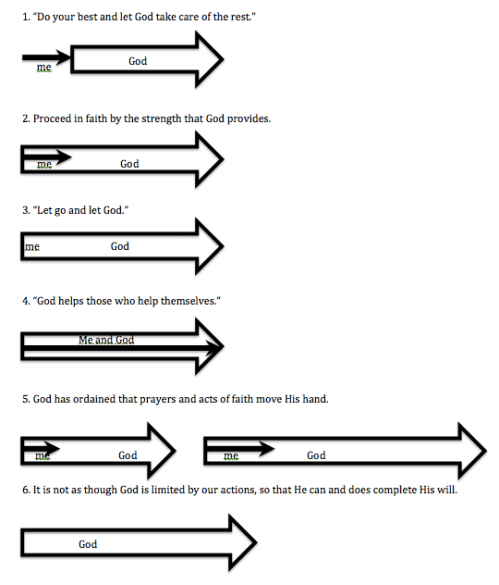
He said, “Do your best and let God take care of the rest.” I had heard this and similar phrases many times, but I went off on a mental tangent of evaluating it in the light of Scripture. I think that I understand the intent of the saying, namely that we have an active part to play in growing righteousness in our life and God completes what is lacking in us. Thus far I have no problem, but I think we may do better in our understanding and representation of the interplay of our effort and God’s empowerment. Toward a theology of effort and empowerment consider the following diagrams with their perspectives on the topic:

effort-empowerment-arrows

The arrows are somewhat self-explanatory, but I want to clarify them for my own benefit and yours. Though, as I said, the #1 was stated with right intentions, I believe that at face value it is really saying that I exert effort to the extent of my ability and then God kicks in for the rest. But the Scripture says,“for in Him we live and move and exist” (Acts 17:28), and “I am the vine, you are the branches; he who abides in Me and I in him, he bears much fruit, for apart from Me you can do nothing.” (John 15:5) We cannot even breathe apart from the grace He provides, but the “nothing” here seems to me to be ‘nothing of eternal significance’. As Paul teaches in I Corinthians 3:11-15, For no man can lay a foundation other than the one which is laid, which is Jesus Christ.  Now if any man builds on the foundation with gold, silver, precious stones, wood, hay, straw, each man’s work will become evident; for the day will show it because it is to be revealed with fire, and the fire itself will test the quality of each man’s work. If any man’s work which he has built on it remains, he will receive a reward. If any man’s work is burned up, he will suffer loss; but he himself will be saved, yet so as through fire.” 

I think that #2 is closer to the right perspective. God wants us to be involved and tells us through Paul to work out your salvation with fear and trembling; for it is God who is at work in you, both to will and to work for His good pleasure.” (Philippians 2:12b-13) Our part is working with God by faith that He provides all we need to obey Him. He is actually the one willing and working and He receives all the glory as only He should. We receive no glory for effort, seeing that His divine power has granted to us everything pertaining to life and godliness, through the true knowledge of Him who called us by His own glory and excellence. For by these He has granted to us His precious and magnificent promises, so that by them you may become partakers of the divine nature, having escaped the corruption that is in the world by lust.” (II Peter 1:3-4) The “magnificent promises” and “divine nature” afforded believers far exceed our efforts. For this reason I have the ‘me’ arrow inside the ‘God’ arrow. God is in, through, and around all that we do and amplifies it to a magnificent and divine level, “abundantly beyond all that we ask or think, according to the power that works within us” (Ephesians 3:20).The result is that “Christ is all, and in all” (Colossians 3:11) and “to Him be the glory in the church and in Christ Jesus to all generations forever and ever. Amen.” (Ephesians 3:21)

#3 is not only lazy but detracts from the glory of God by not proving His purpose and plan as revealed in such passages as Ephesians 2:10: For we are His workmanship, created in Christ Jesus for good works, which God prepared beforehand so that we would walk in them.” We are not to be idle. Our flesh will consume us the moment we stop clinging to God and moving forward in the strength He provides, for “the heart is more deceitful than all else And is desperately sick; Who can understand it?” (Jeremiah 17:9) Conversely, “I can do all things through Him who strengthens me.” (Philippians 4:13)

#4 may seem like a statement of working with God, but I have seen consistently that the people who use this phrase are just trying to be good in their own right and have little concern for godliness or God’s glory. He intends and expects of those whom He is saving and the whole world as well that they acknowledge Him in all things: ““Fear God, and give Him glory, because the hour of His judgment has come; worship Him who made the heaven and the earth and sea and springs of waters.” (Revelation 14:7) 

Our hearts tend to be lazy when it comes to spiritual disciplines, but I believe that God has ordained that His will is frequently accomplished and His kingdom built by enabling the efforts He orchestrates within us (#5), as we said above from Philippians 2:12-13. So we work hard and bring God glory as you see Paul and the Thessalonians did: For you recall, brethren, our labor and hardship, how working night and day so as not to be a burden to any of you, we proclaimed to you the gospel of God. You are witnesses, and so is God, how devoutly and uprightly and blamelessly we behaved toward you believers; just as you know how we were exhorting and encouraging and imploring each one of you as a father would his own children, so that you would walk in a manner worthy of the God who calls you into His own kingdom and glory.” (I Thessalonians 2:9-12) It is right and proper that we should work hard at spiritual progress in the strength God provides in order that others might be drawn to God and God be glorified.

And with all of this effort, remember that God needs nothing from us and can accomplish His will without us whenever and however He pleases (#6). “Behold, I am the Lord, the God of all flesh; is anything too difficult for Me?” (Jeremiah 32:27) But He has made us involved in so much of what He is doing, “for this reason I bow my knees before the Father, from whom every family in heaven and on earth derives its name, that He would grant you, according to the riches of His glory, to be strengthened with power through His Spirit in the inner man, so that Christ may dwell in your hearts through faith; and that you, being rooted and grounded in love, may be able to comprehend with all the saints what is the breadth and length and height and depth, and to know the love of Christ which surpasses knowledge, that you may be filled up to all the fullness of God.” (Ephesians 3:14-19) For  “I have been crucified with Christ; and it is no longer I who live, but Christ lives in me; and the life which I now live in the flesh I live by faith in the Son of God, who loved me and gave Himself up for me.” (Galatians 2:20)

Read Full Post »

Yeah, man, my life motto, “Life is Good”, “livin’ the dream!” Good vibes, positive outlook, need plenty of that, right? Not so fast. What about when you are sick and you just lost your job and the dog got run over and taxes went up and there is another war and…you get the idea. So, does that mean life is bad then? Is that what I’m saying? Let’s take a closer look. If the phrase, “Life is Good” was the end of the thought, it has limited utility to help us along in life perhaps, but as used in our society at this time it has modifying thought that follows. This implied extension of the thought is also explicitly stated in places like the “Life is Good” Facebook page. It goes something like this: Life is good because I’m doing what I like and liking what I do. The implication is a totally self focused or humanist view of life and it doesn’t work on several levels. First of all, you can’t always do what you want to. Secondly, in a more narrow sense, if doing what you want to do refers to your vocation, it is an economic impossibility for everyone to have the job of their dreams. And as just pointed out, many times life is hard. The idea may well turn into life is good for some subset of the population for whom everything is falling into place, but that must surely imply that I don’t care what happens to the other half or I think they just need to get their life together, think positive, and make it happen. Or maybe we are being urged to follow blind optimism: Let’s pretend life is good and that will somehow make it better. All of these possibilities seem a bit depressing unless you happen to be riding the wave, and even then it probably won’t last.

Rather than just burst your bubble and leave you hanging, I would like to suggest a more meaningful and purposeful phrase and explain why it is not just wishful thinking: “Life is good because God is good.” Stated this way the fact that life is also at times hard is not ignored or denied. God is working blessings deeper and more lasting. In the midst of hardship God is training us to trust Him (Proverbs 3:5-6,12) and look for what is honorable, pure, and good (Philippians 4:8). He is building, reserving, and guaranteeing future blessings (1 Corinthians 2:9) that outweigh these present difficulties (Romans 8:18). Through His gifts of goodness to us and as we praise Him we are given value, comfort, and provision (Psalm 34). Our lives are filled with meaning (Romans 8:28) and purpose (Psalm 67:7); He is given glory (John 15:8). These reasons that life is good will seem foolish to those who do not know Him (1 Corinthians 1:18), but I invite you to find the peace, joy, and purpose in serving God through the knowledge of His Son, Jesus (Psalm 34:8; Colossians 1:9-13), for He is the way to God (John 14:6). “Life is good because God is good”, which means that all of life is life gained from God and lived unto God (2 Peter 1:2-4), to His glory and for our benefit.

Read Full Post »

How could I not be thinking about testing with the situation I was in. But my thoughts went to a different, more significant and substantial type of test- the test of faith. Some days I am trusting fairly well but others I am failing miserably. The thoroughly up side of this type of test though is the guaranteed perfect grade at the end of the term for those enrolled in the class.

Mark it well, this is only a test
Heaven comes after, eternal rest
Now prove the metal of who you are
It's faith in God will carry you far

It's not by works you enter the rest
Nor by your goodness you pass the test
Your goodness comes by God's work in you
Obtained by faith in the Savior true

Not one temptation can overwhelm
When you cling to God who's at the helm
Storms, wind, and hail will batter your boat
The trusted Master keeps you afloat

Saved by grace through faith in Christ alone
Scripture instructs, by this you are grown
God receives praise as only He should          (Solae Quinque)
For God passed your test, He only could

Read Full Post »

I listened to a youtube video as I often do, and this one was titled “Self-Efficacy”. The intent of the video was kind but the result was mistaken and really sad. It explained that “self-esteem is this idea about how you see yourself, how capable you think you are, how happy you are with yourself, but self-efficacy is something kind of different, and its rather important. It’s how you perceive your ability to accomplish something.” The video went on to explain how one must develop self-efficacy to accomplish anything and that no one else can really show you how but only inspire you to try. It went on to say that there are people that use self-efficacy for evil to gain confidence to hurt people. A sad part to me was the realization that all self actualization is bad because it emphasizes and exalts self and ignores or even rejects God. We should have Christ-esteem which then provides us with value because He created us and died for us and enables us. And we should bless His efficacy that enables each one of us to “do all things through Him who strengthens me.” (Philippians 4:13) The most sad part of the video, however, was the inadvertent admission later in the video that the speaker did not know how to bring about world peace even though he thought that it must be emphasized. I can’t bring about world peace either but I know from whence peace comes and whence world peace shall come. We may have peace with God and within ourselves now by trusting in what Jesus did on the cross. That enables us to pursue growing peace with those around us and will one day result in world peace when Jesus returns and sets the world right.

As I mulled over some difficulties within my family recently I concluded that even though life may be difficult at times, it is right and good and beneficial for us to trust God. The following poem came to me as I thought on these things:

Each new day God provides our need
He our bodies and spirits feed
Sometimes it feels like we are starved
It is then we are apt to plead

To call on Him for our supply
Is His command, He will reply
Of delay that seems not answered
Glorifies Him when we rely

Emotions raw so often we cry
Relationships have gone awry
All hope of healing seems removed
Then must we trust Him though we sigh

Good health eludes us though pursued
Accidents happen though we cared
For these struggles so unprepared
Faith does not mean we will be spared

It is then we trust God so wise
Know Him more as each moment flies
Submit, expectations altered
Temporal and eternal prize

Read Full Post »

(First Draft, since starting with the completed version might not happen in time)

I am prepared and even enthusiast about living for however much longer God has in mind for me, be that 50 minutes or 50 years. However, the longer I live the less likely I am to live substantially longer. I do participate in some risky behaviors, albeit, thoughtfully, cautiously, and frequently with prayer. And additionally I most fervently hope that me writing this blog just now is not an indication that God is getting ready to take me soon, though I will not object in the least if He does. Rather, I see this blog entry as a bullet on my to do list that has had a few red flags inserted by recent personal events. I want to mention my wishes for my funeral.

The most expensive item first: Bury me wherever is cost effective and convenient for those dealing with my loss. God can resurrect whatever parts and pieces He has ordained to be transformed into my new body from anywhere in this old world from mountain top to ocean depth and a whole lot of less glorious places than that. We respectfully plant bodies (good terminology given what I Corinthians 15 says about perishable seed) because they contained spirits made in the image of God and because those of believers will be resurrected to be in His presence, which is comforting to the mourning loved-ones. An inexpensive casket and what not is sufficient; I’ll assure you it won’t impress me.

I would like to influence several aspects of the service, however.

Primarily, focus on the Savior; I certainly will be. I have too few earthly accomplishments of merit with which to praise the Holy One. I do have this: grace. God has imparted grace to me in salvation, in living, in family, in provision of every talent, possession, happiness, pursuit, safety, knowledge, or any other thing you can think of He provided me with. Speak of His grace, sing of His grace, pray about His grace, urge hearers to partake of His grace.

One area of grace in my life was a love and desire to know and live by God’s Word (you can argue later about how I didn’t do either; the point is God gave this poor sinner so much). So please sing “How Firm A Foundation”. I have sung all 7 verses with a congregation before. They are very appropriate for this situation. Why are you in such a hurry, I’m not going anywhere? At least sing the first two, please.

If you think you are leaving this place (Earth, I mean) without the help of Jesus, you are headed the wrong way; reconsider now. I know where I’m headed and why, and I want you to hear about it at my funeral. Please sing all four verses of “My Hope Is Built On Nothing Less”. If you cry, let it be because you understand just how deep His grace is reaching to secure your eternity. It is not your effort, not your rock solid faith or piety; it is the rock solid faithfulness and power of Jesus on your behalf, enabling you to believe, continue to believe, and improve in your living.

If you will tolerate singing yet a third hymn, let it be “My Hope Is In The Lord”, or a fourth hymn, sing “Praise The Savior”. These complete my list of most favorite hymns, though my children should know that I had many “favorite” hymns.

Read from I Corinthians 15. If someone is available who can or will, preach on it, especially the depth of witness to the event of the resurrection (verses 3-11), the reason it matters (verses 12-18), and Christ’s resurrection (verses 20-28). If time allows speak about the first and second Adam (verses 40-49) where you cannot neglect to bring in Romans 5 about justification by faith. If you see nodding off or rolling eyes, just tell them that I was dying to hear one more time about all that Jesus has done for me and them. No, actually, don’t mention half of what I’ve said in this blog. It may be a solemn occasion even if a celebratory one, owing to my home going.

If you want to read other Scriptures, some suggestions include Genesis 1 since by God’s grace I have always believed that God created the heavens and earth in six literal days, all the more as the scientific evidence pours in. Read from Revelation 21 and/or 22. The last chapter fortifies the weakest of faith. He is coming again; we can persevere by His enabling power and faithful Word through the Spirit we are given. Hold on.

A good call to worship to God, for that is what I hope my funeral will be, one of my favorite passages is Hebrews 1:1-4, though you don’t have to stop at verse 4.

I know this is getting a bit long and will have to be cut down, but I so love Hebrews 4:9-16. Please don’t be afraid to give a bit of commentary on each of the verses I have suggested so that God might powerfully move in the hearts of the faint-hearted and the lost. I am at my rest because Jesus didn’t rest until He had finished His work on my behalf (II Corinthians 5:21). How could you neglect to read a few verses from II Corinthians 5 at a funeral? Maybe I should just write the sermon and put it in a blog entry for you to print off and read. Perhaps, but probably not, because it would be better if the Spirit spoke to that crowd on that day. At some point I may well organize this rambling list of desires for my funeral into a more coherent service. I hope that you (the organizer) will not neglect this list out of hand. Blessings to you in the name of Jesus, my Savior and Lord.

If you want to read something I wrote, perhaps one of my better poems about God and our life in Him would be in order. Pick as you may, but here are some suggestions based on appropriateness or value: “Trust Is Your Rest”, “The Why”, “But a Few of His Benefits”, “Our Demise”, **”Ichthus Rhyme”, “First Cause”, “A Servant’s Ambition”, “Just Sayings”, **”Eyes on Things Above”, **”A Need To Create”, “Advent Colors”, or

God’s grace is my comfort and rest

My strong tower in the midst of test

While I trust Him I shall prevail

Raised from the dead without fail

Man, did that list get carried away. Pick one or none, but read Scripture and sing hymns.

Read Full Post »

Work With God

A third grandchild has arrived. It is time to praise God and plead mercy for the child. I pray that God might graciously answer my prayer:

Matthias gift of a gracious Lord

Come early to know your Savior God

That He may mercy to you afford

In the life ordained you run and trod

Knowing the path He gives to you


Spurgeon a flower of healing be

As the Prince of Preachers know God’s Word

Live it and speak it so others see

The Gospel and God’s glory be heard

That others taste His goodness through you


Francis a freeman by Providence

A slave to righteousness may you be

Soldier in step with Master’s cadence

To challenge fly, from temptation flee

The Lord’s will and work be done in you

Read Full Post »

« Newer Posts

Myrela

Art, health, civilizations, photography, nature, books, recipes, etc.

Overflows from the Heart

"But the things that proceed out of the mouth come from the heart…" Matthew 15:18

CreatorWorship

Pointing to the One who made, saved, and sustains