Feeds:
Posts
Comments

Archive for the ‘Outdoors’ Category

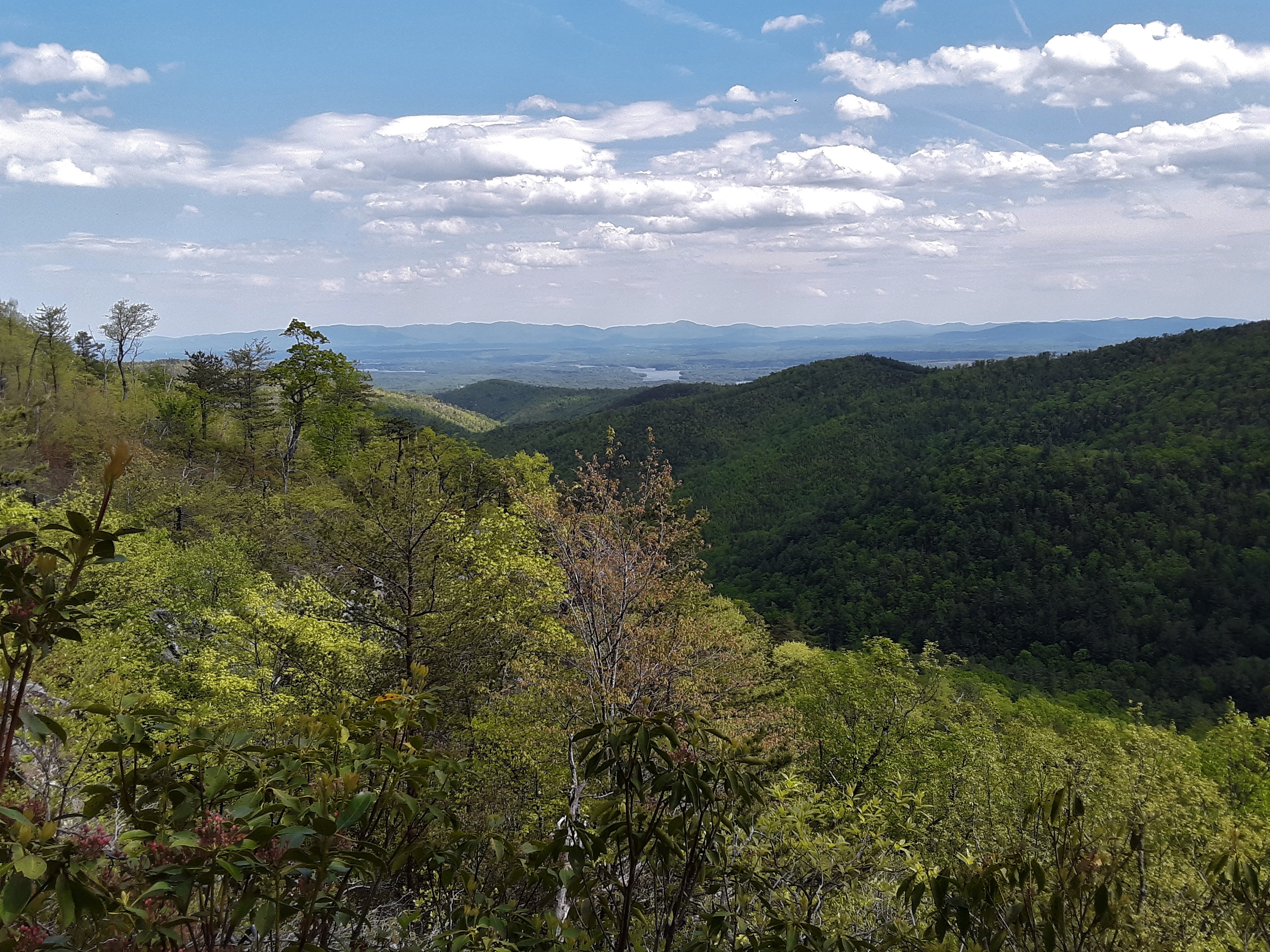
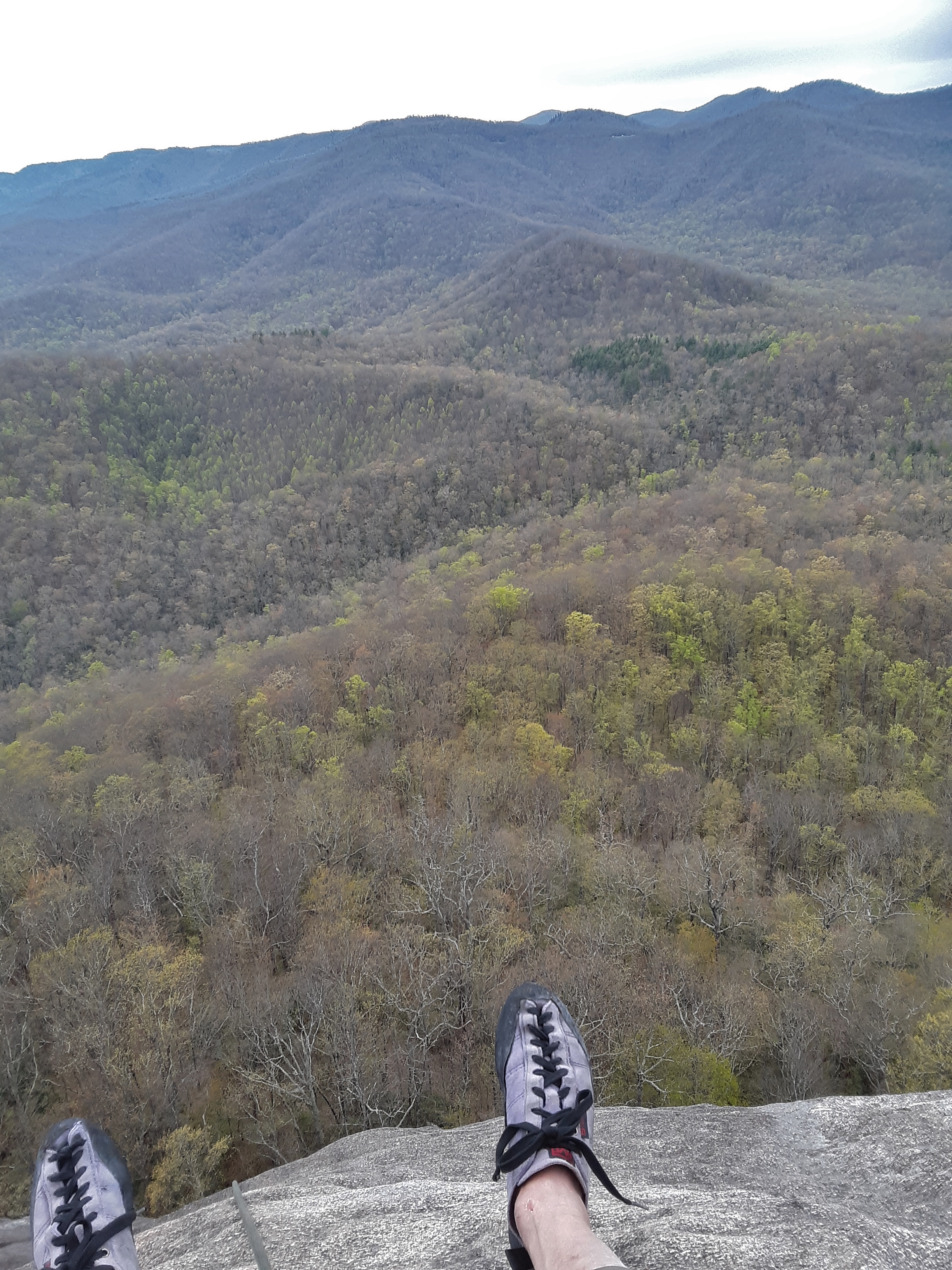
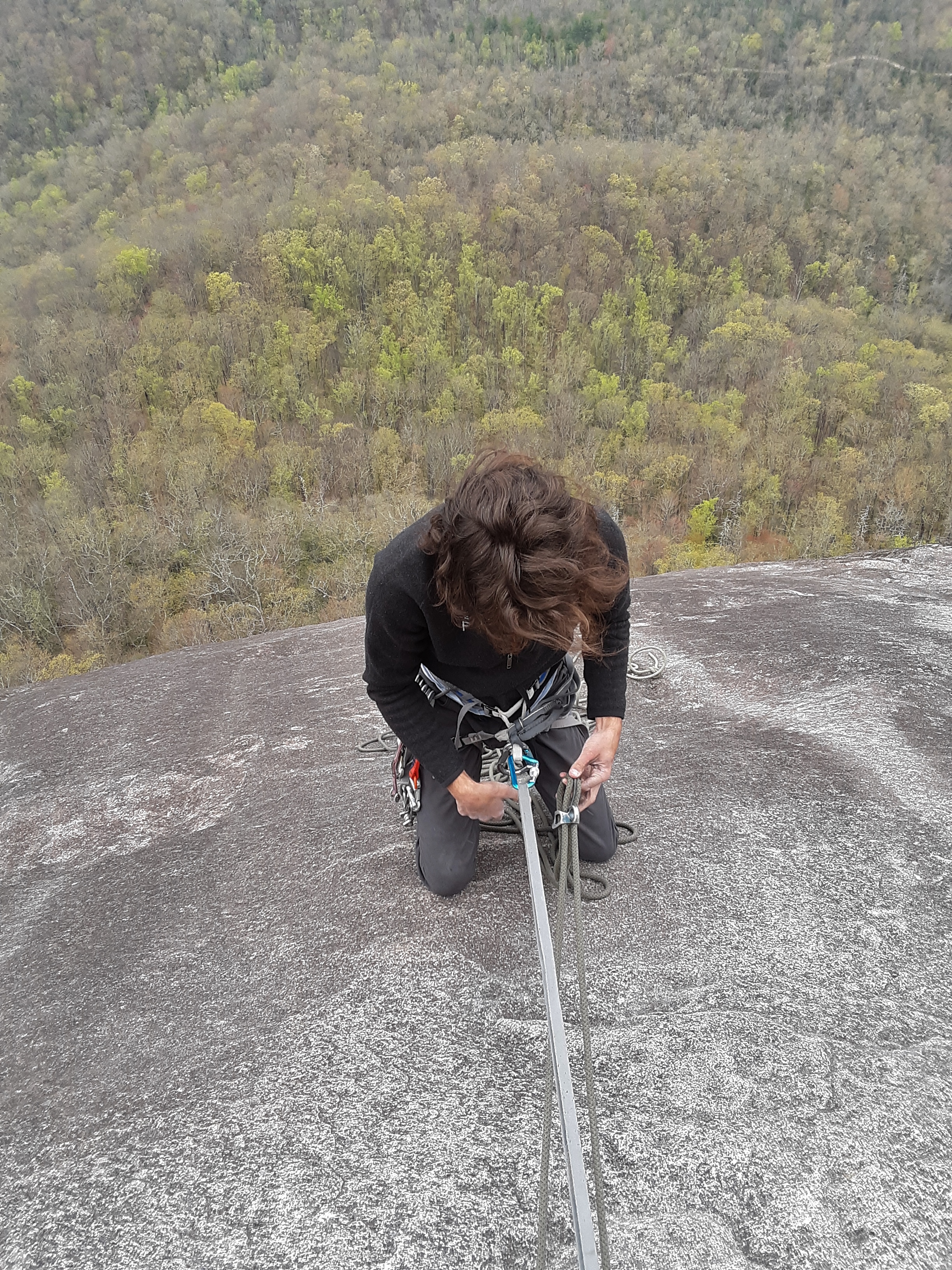
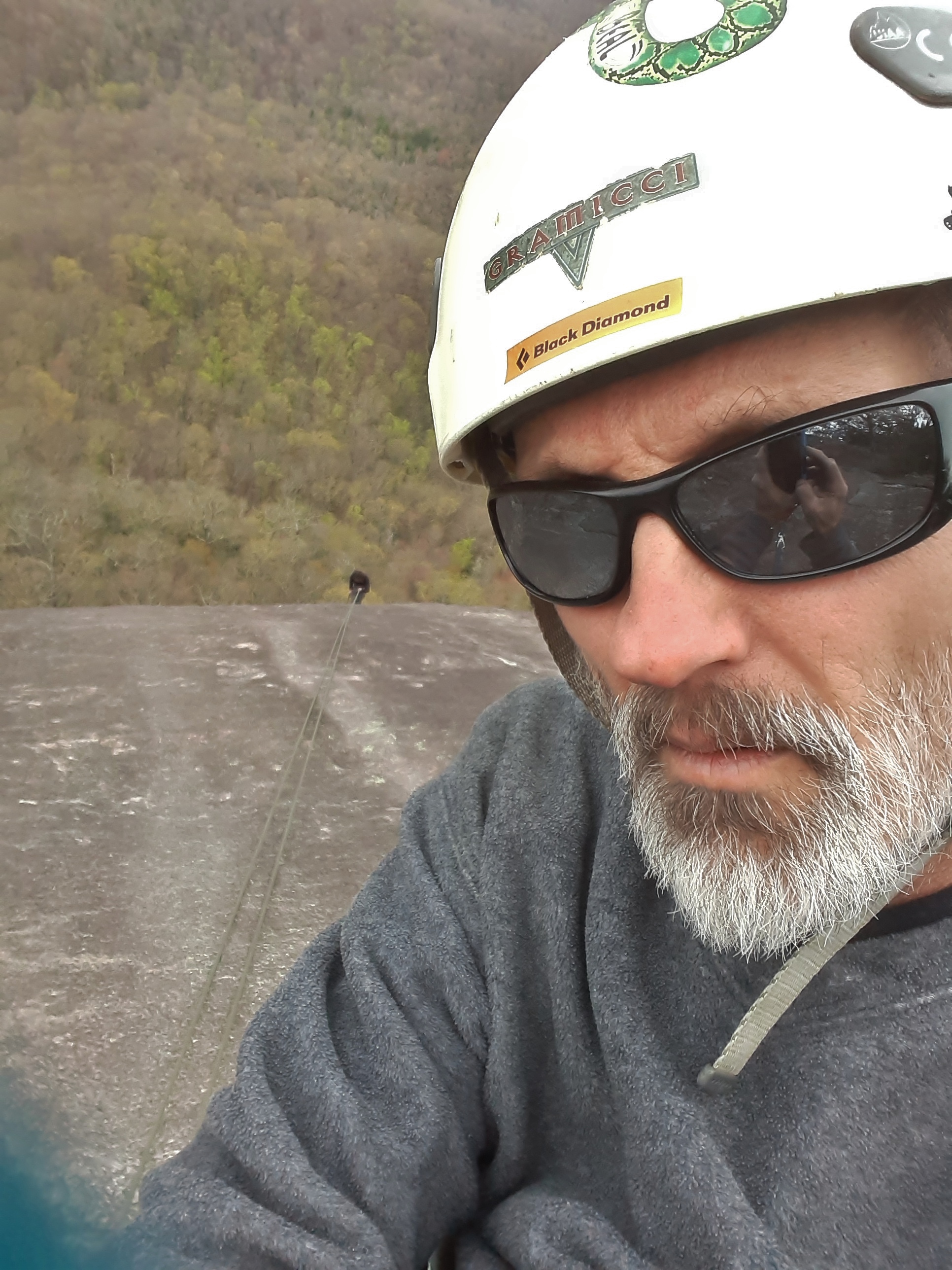
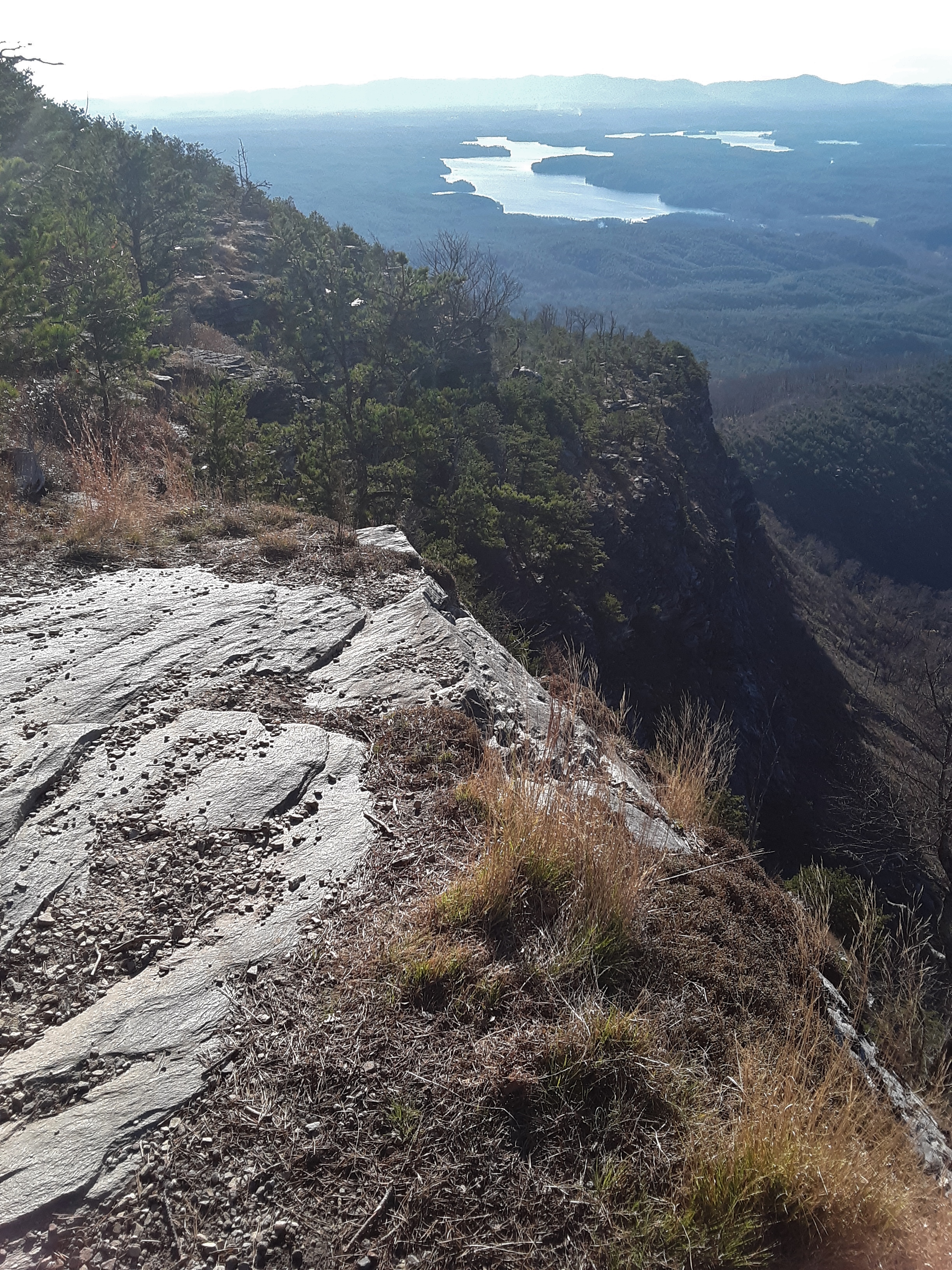
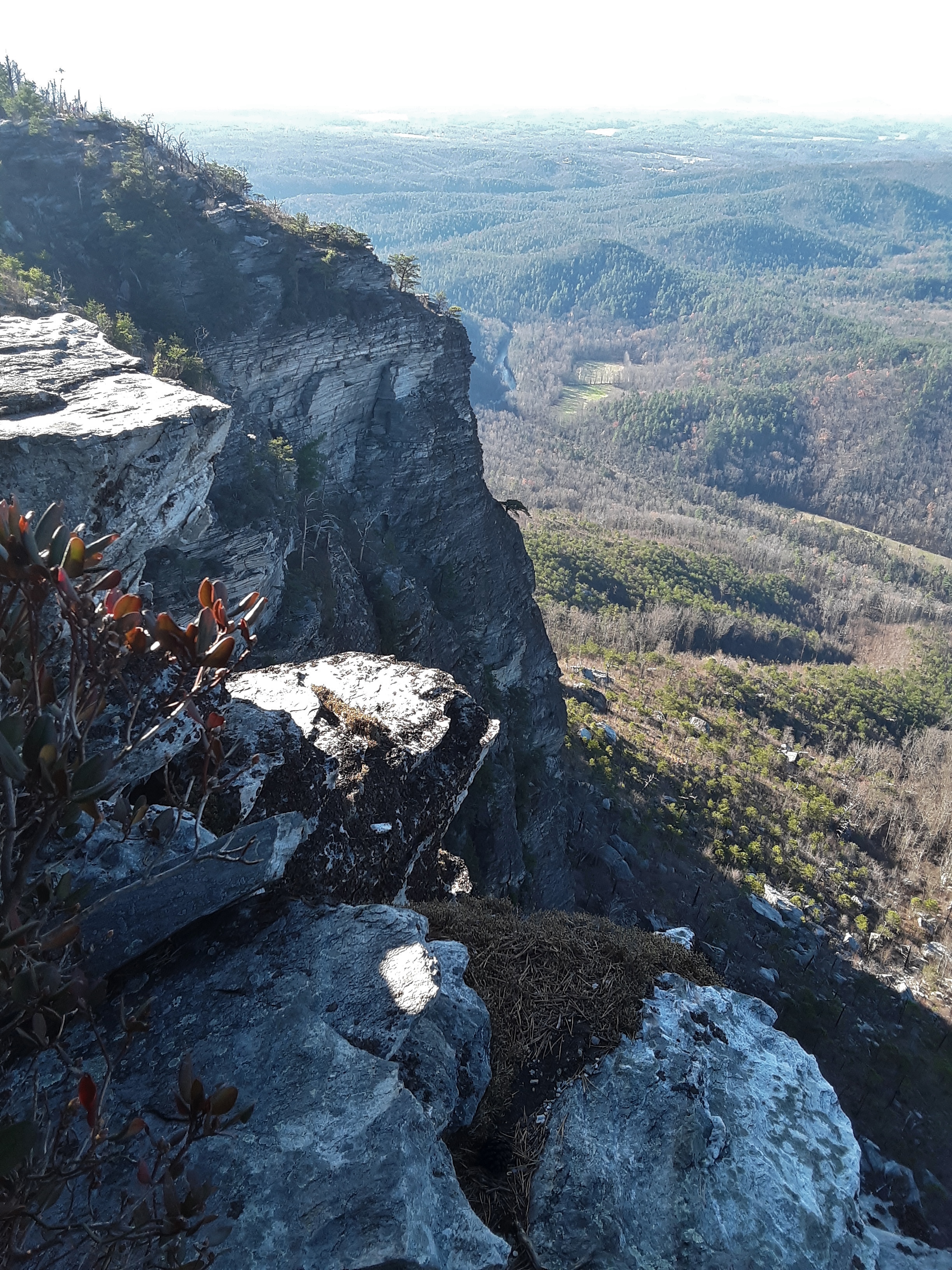
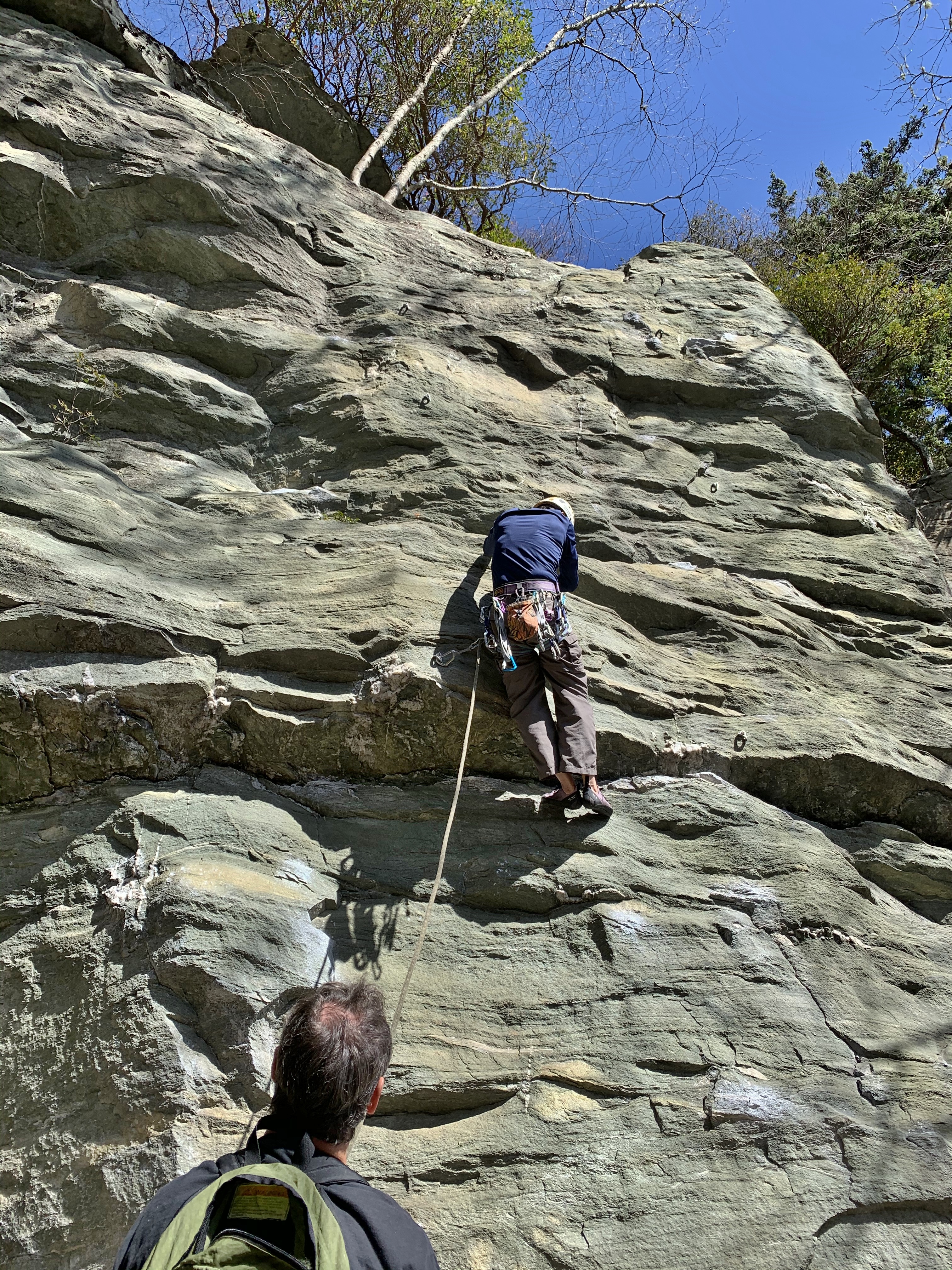
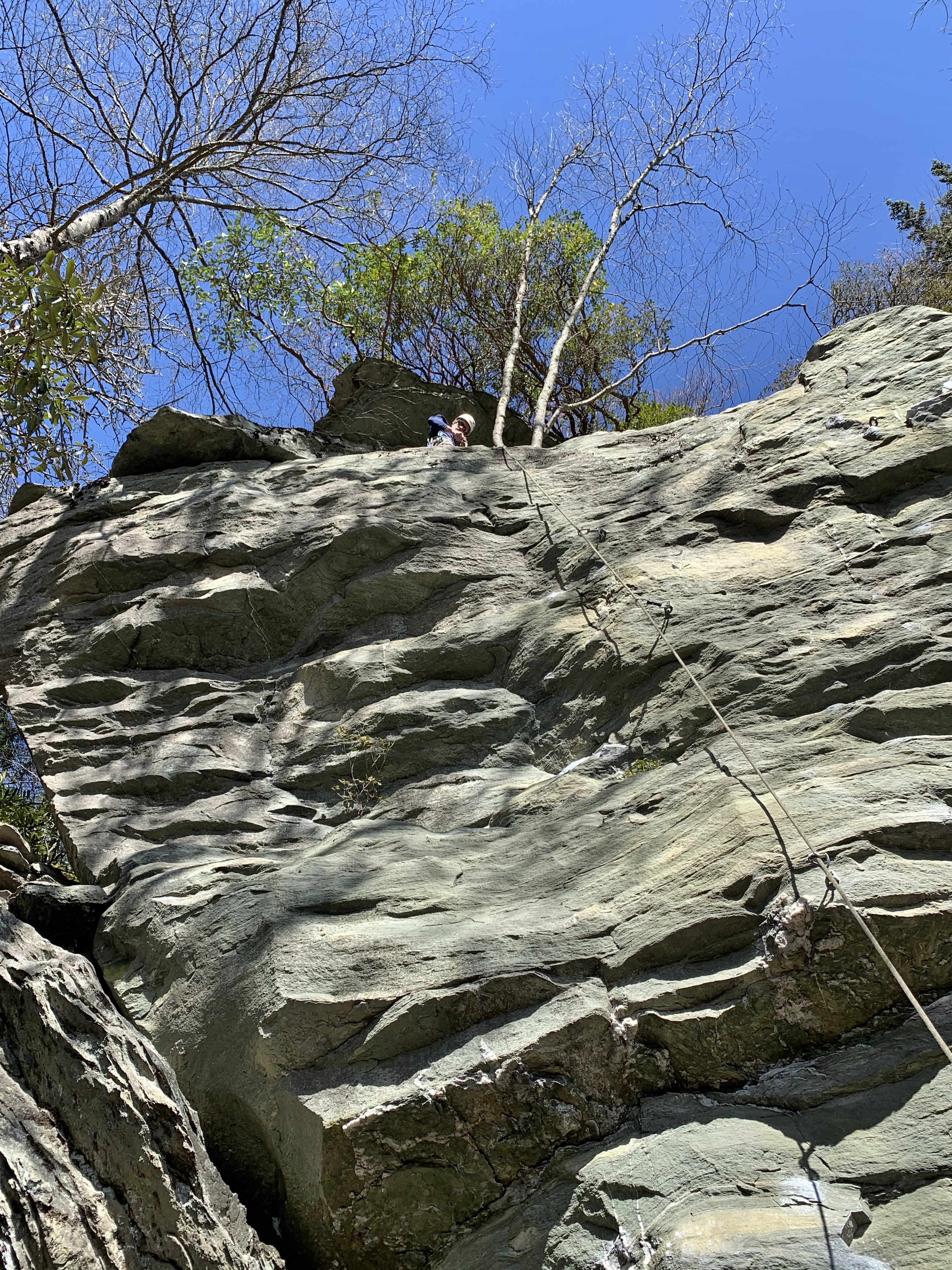
The sun was out, the breeze was cool, the sky was clear, then variably and partly cloudy, and the climbing was good. Showing someone climbs on a crag is fun, and I even climbed one I had not climbed. We got in ten pitches in seven hours. It wasn’t a record pace, but we weren’t in a hurry. I never get tired of this view from the top of Black Fork Cliffs. It is in my county and yet it seems worlds apart, so secluded and isolated.

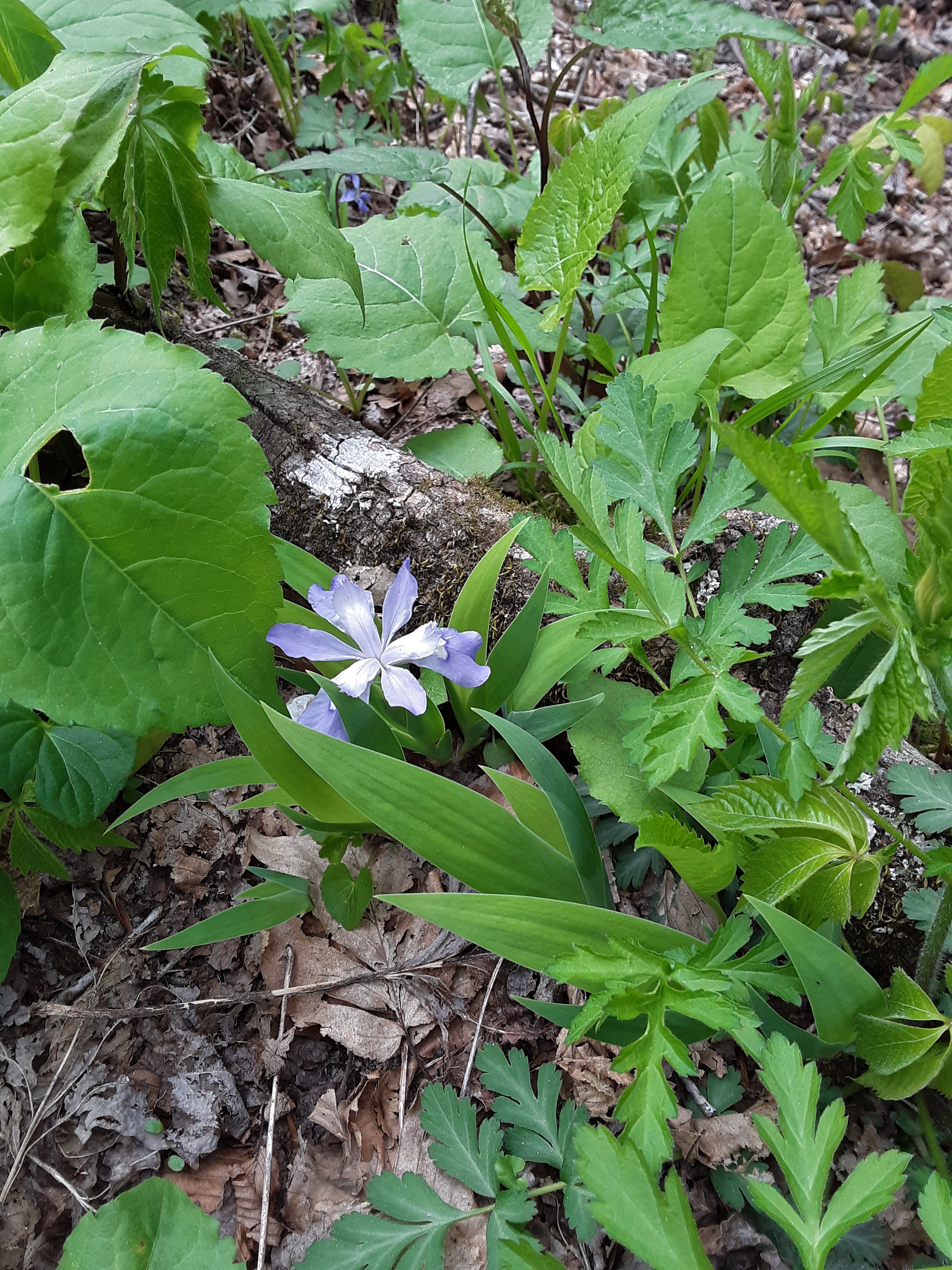
Two fires in the last dozen or so years have robbed the cliff base of its shade, but that in turn is generating a fast renewal. It seems early for Frazier Magnolia to be blooming, but there it was.

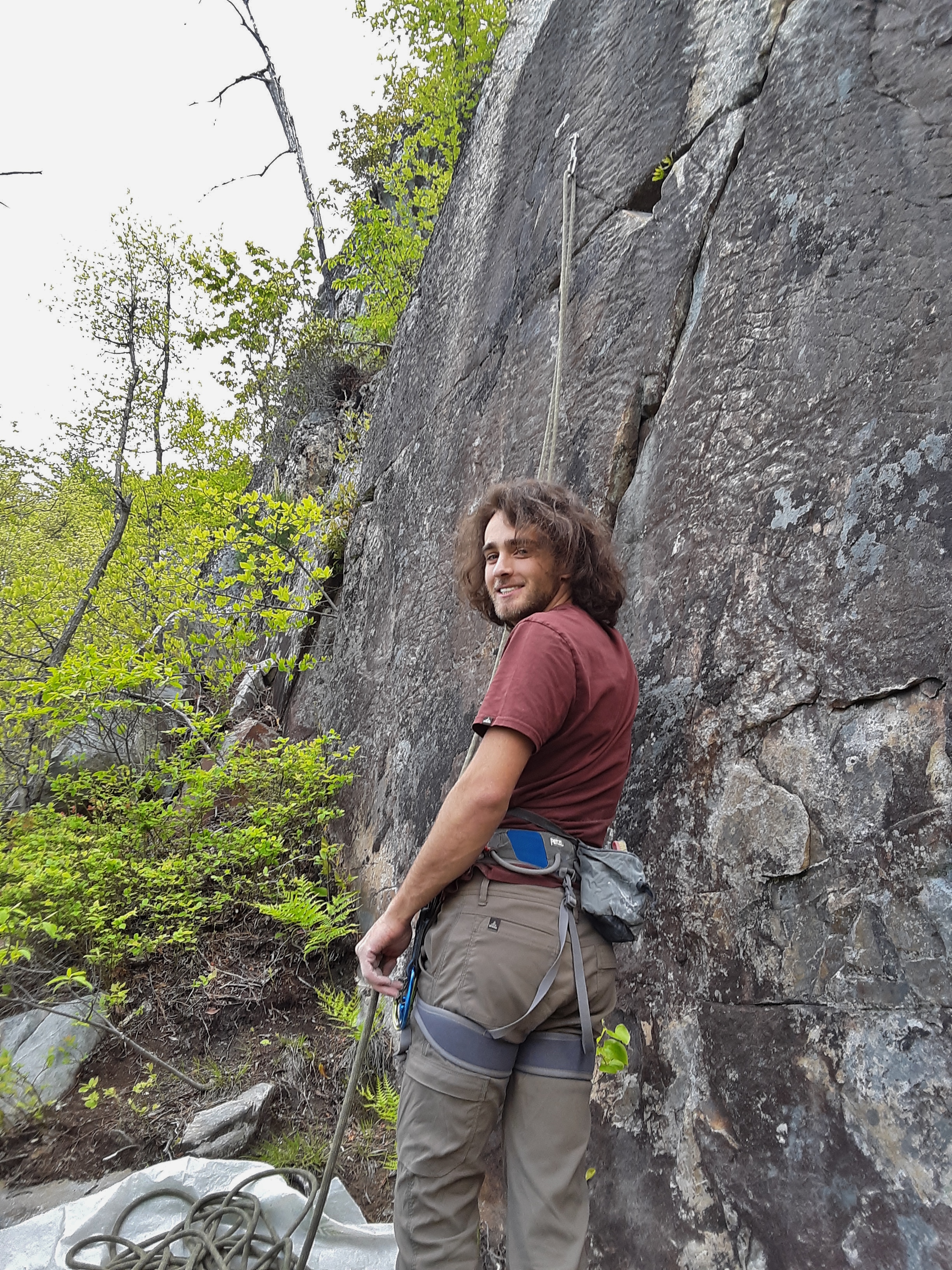
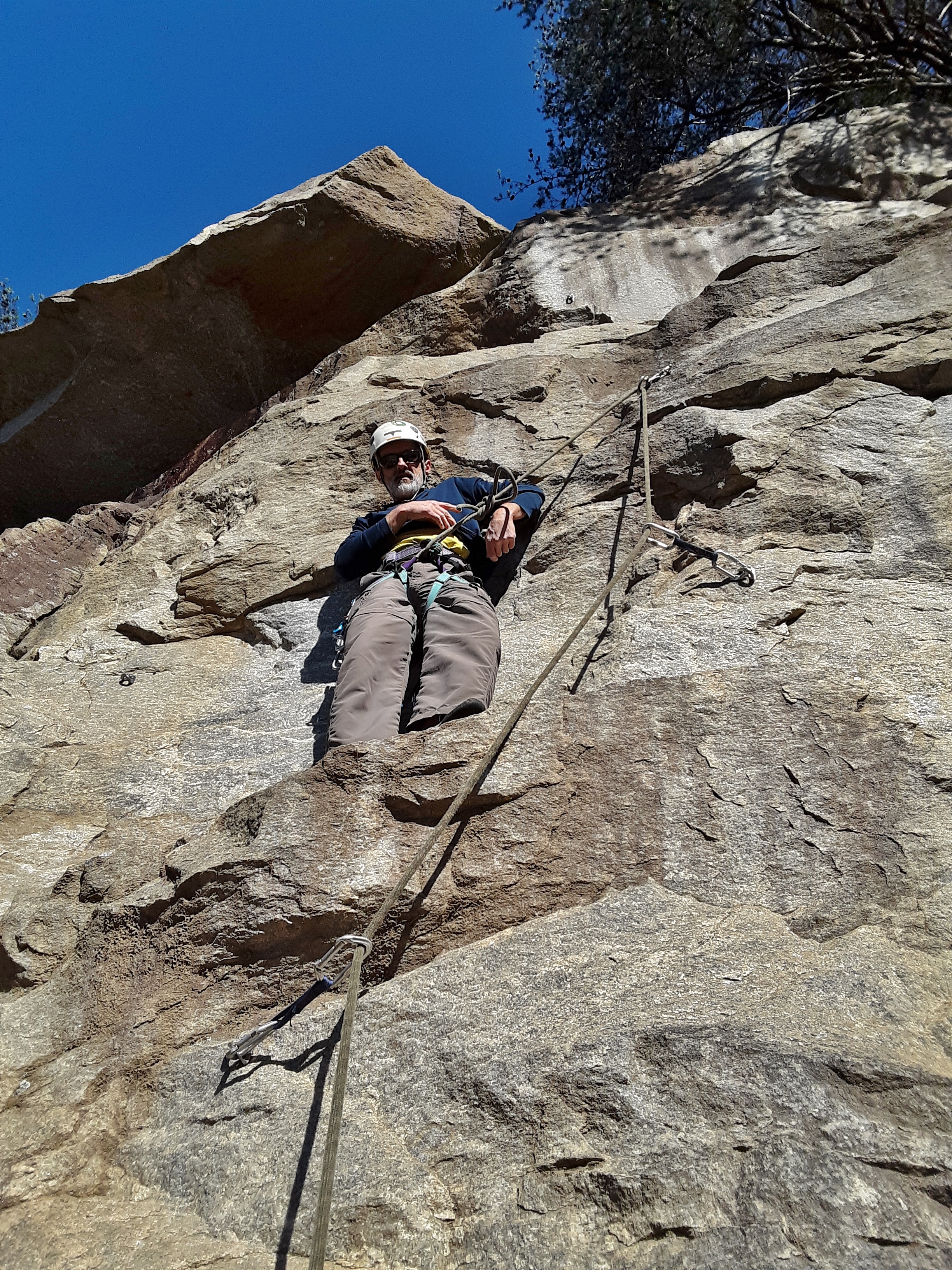
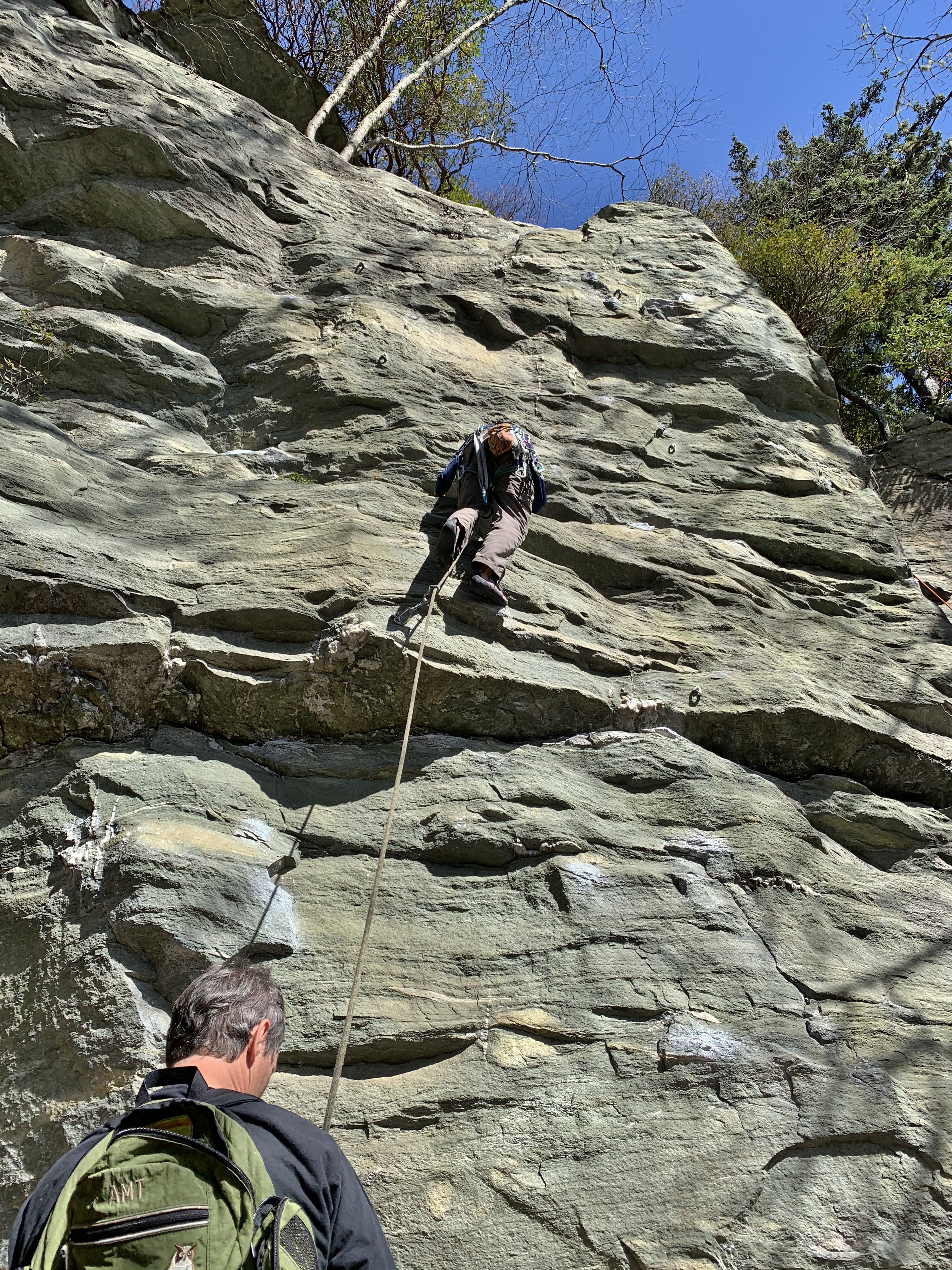
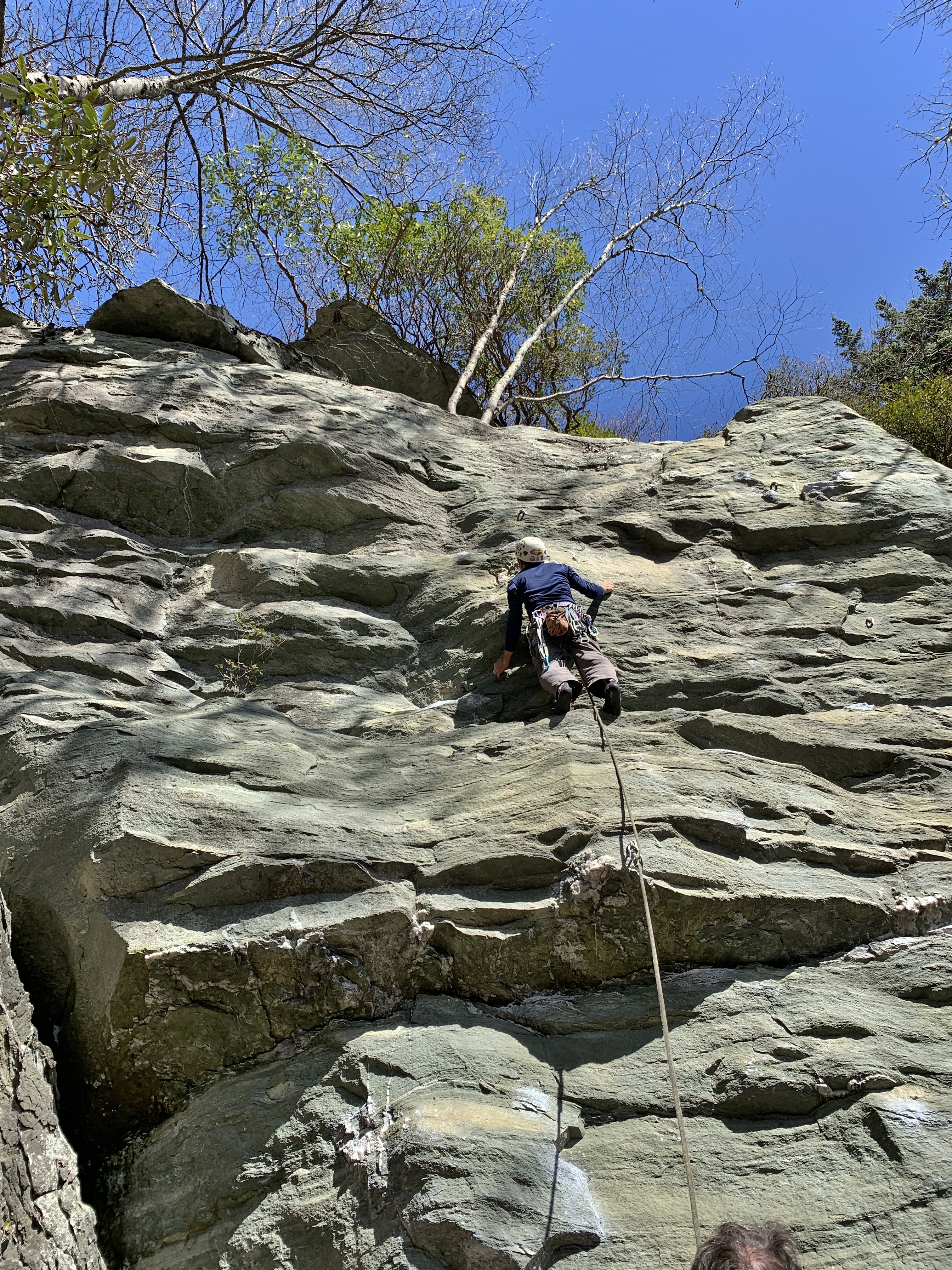
Psyched again and doing new pitches he’d never been on. Notice that the rope is already on the wall. How did that happen? It’s called stick clipping. In my case, I used an extendable painter’s pole with a device on the end that holds the quickdraw (shown on the bolt in the picture). This makes the climbing safe from ground up.

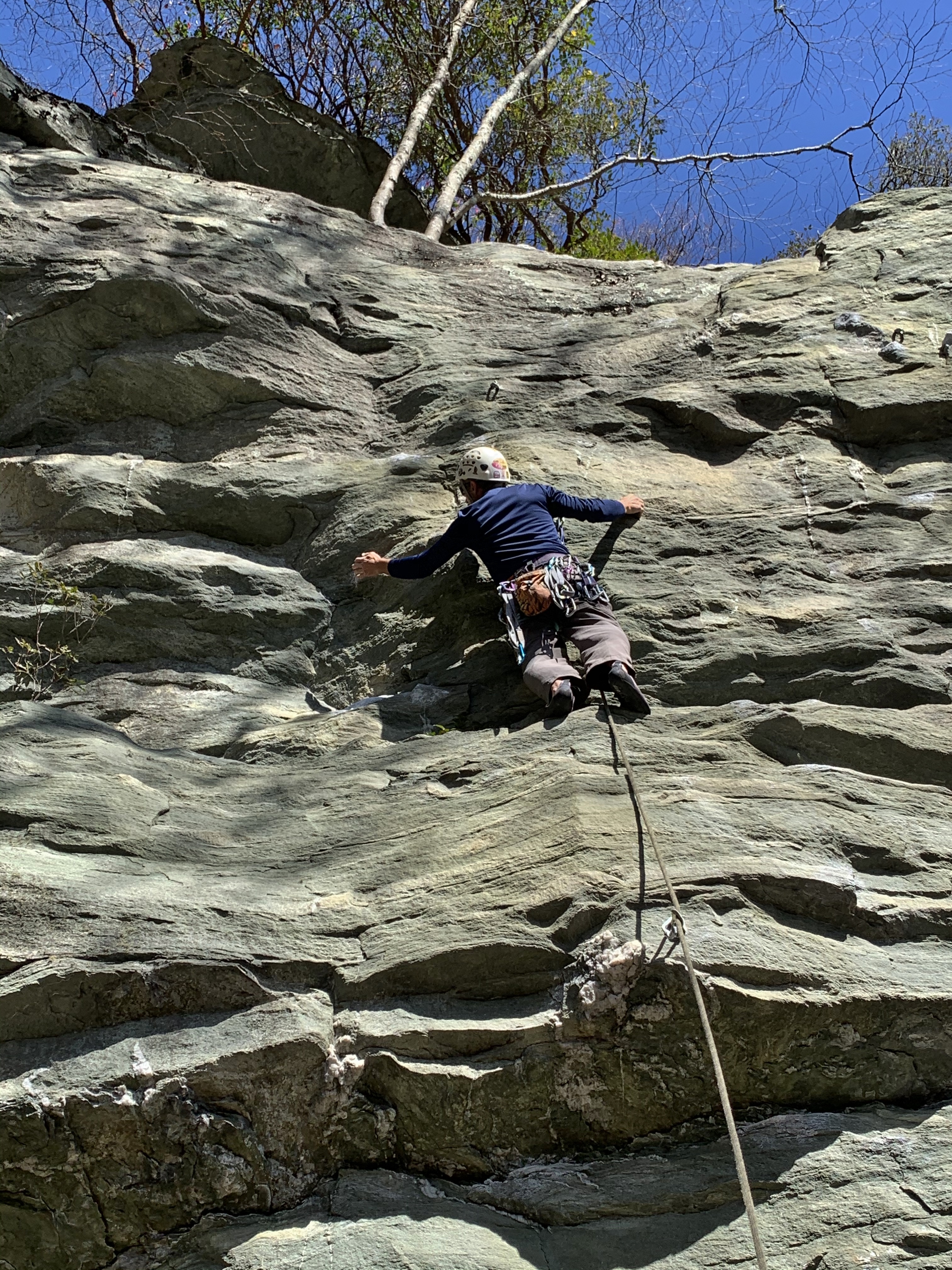
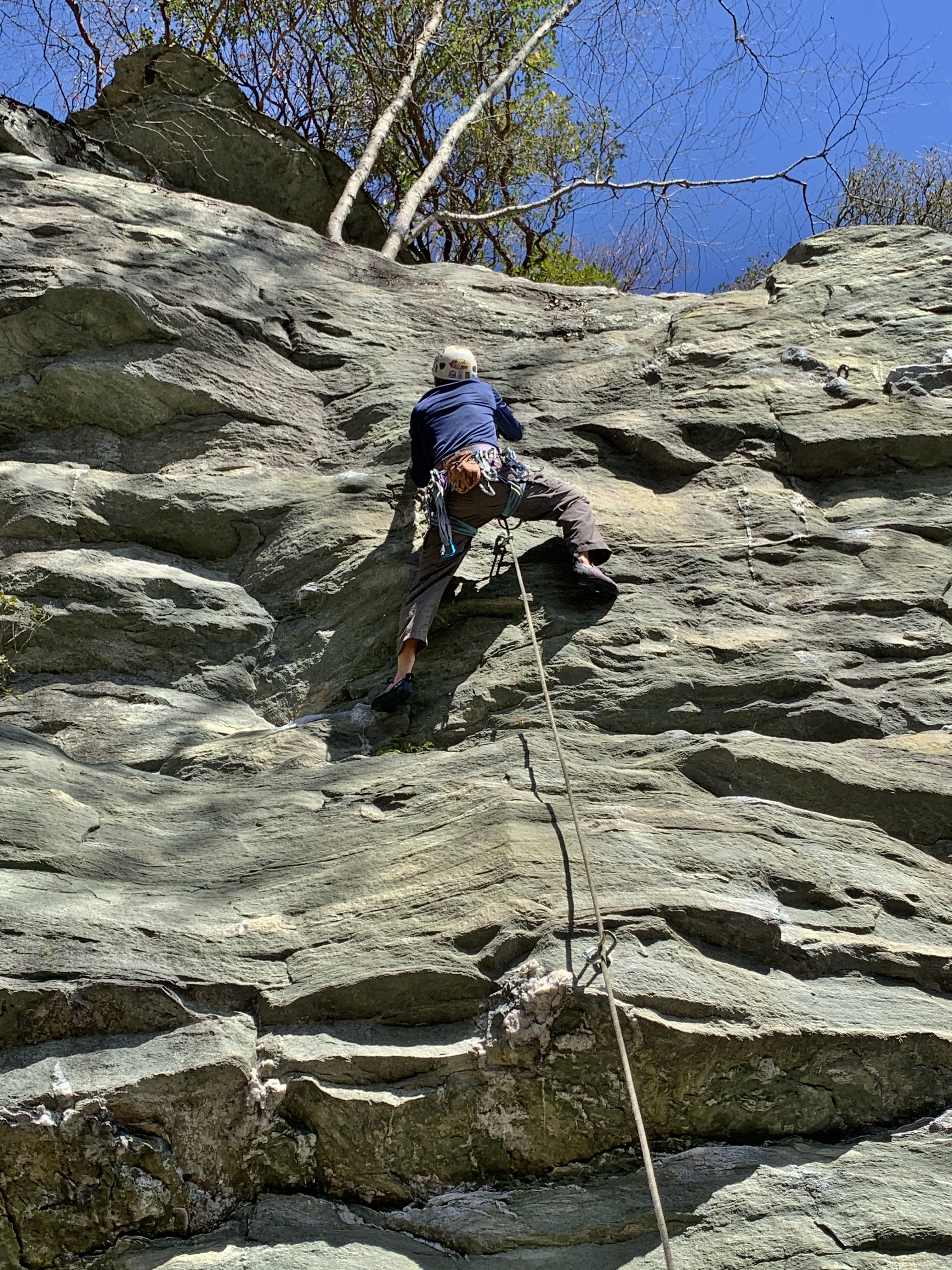
We refer to such climbs as next pictured as “one move wonders” because most of the climb is very easy except for the one move he is trying to make over what looks like a “warped wall” from Ninja Warriors.

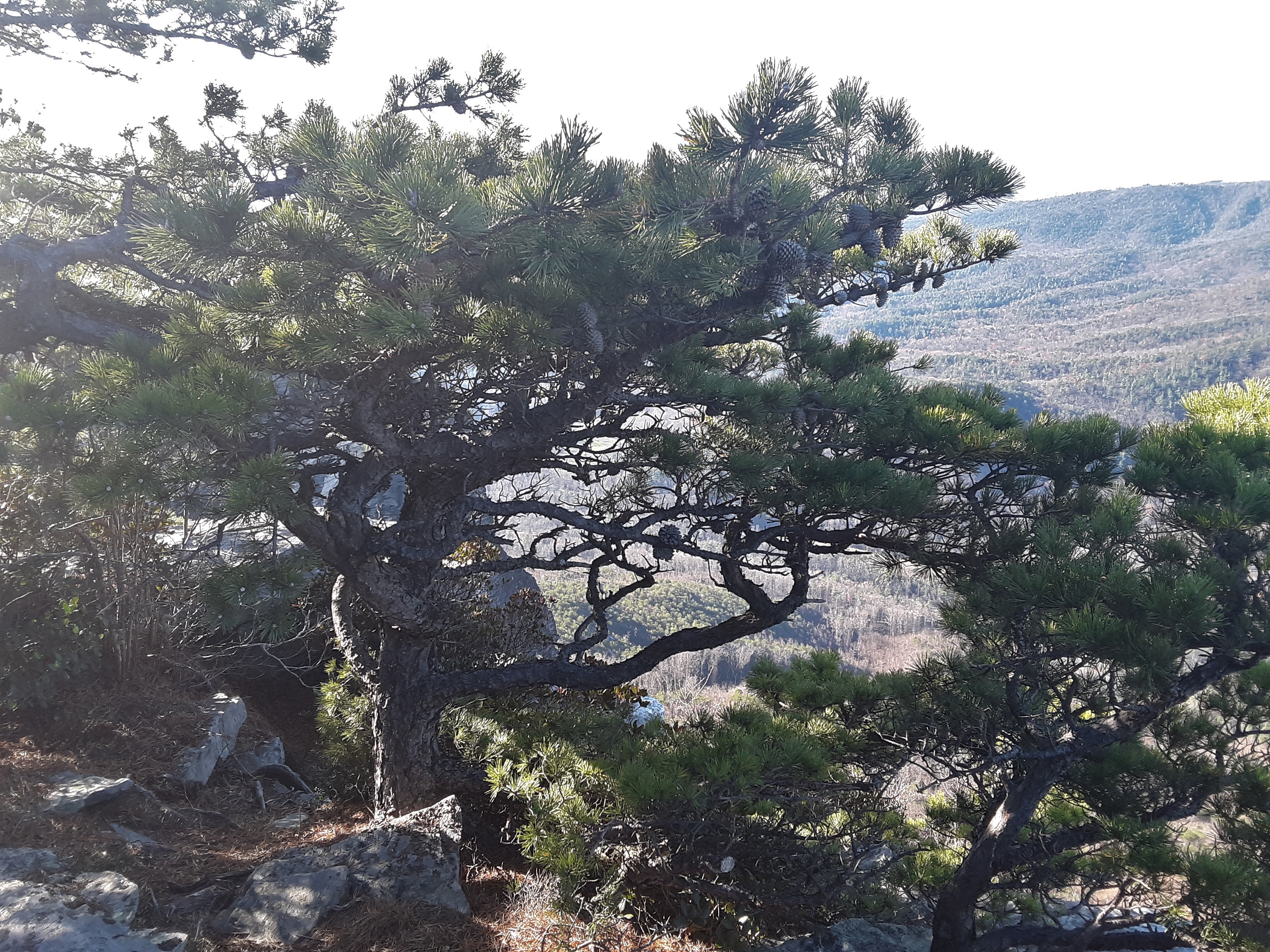
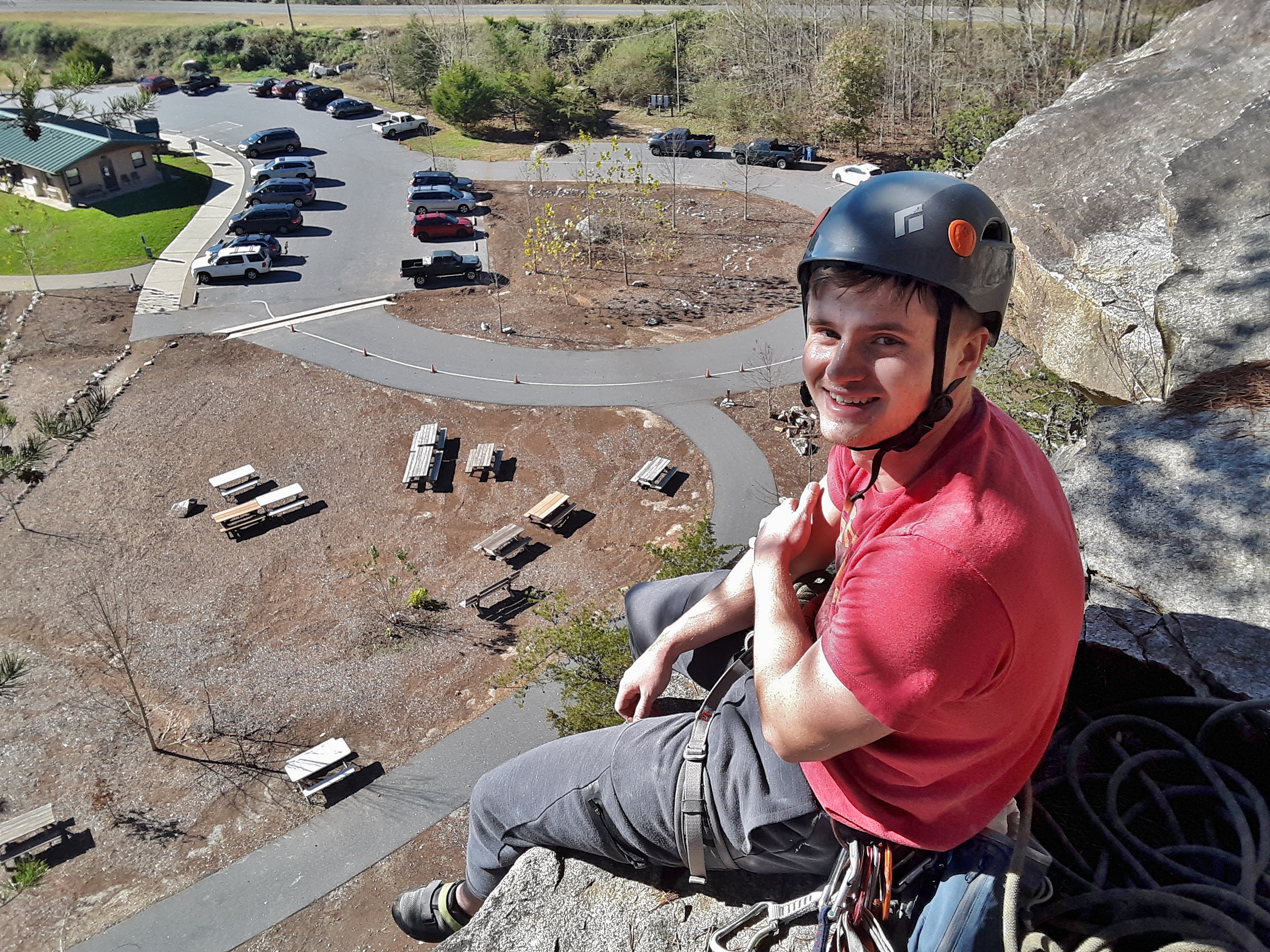
The stainless steel rings at the top of a sport climb are secure, giving a comfortable stance for looking around. The black lichen looks like pits in the rock, but aren’t. I cannot figure out the dead pine tree. Am I seeing another tree behind it cause the bizarre shape appearance of the trunk, or is it really that odd looking?

Contemplating.

Lunch snack and belayer rest. Maybe that’s what he was contemplating. When is he going to get up? The Komodo’s (a defunct brand similar to Crocks) keep my climbing shoes clean between climbs.

This rock formation looks like a spire or tower, but on the back side it really only sticks up about 10 feet above its attachment to the wall.

It looks cool even if it is an easy climb.

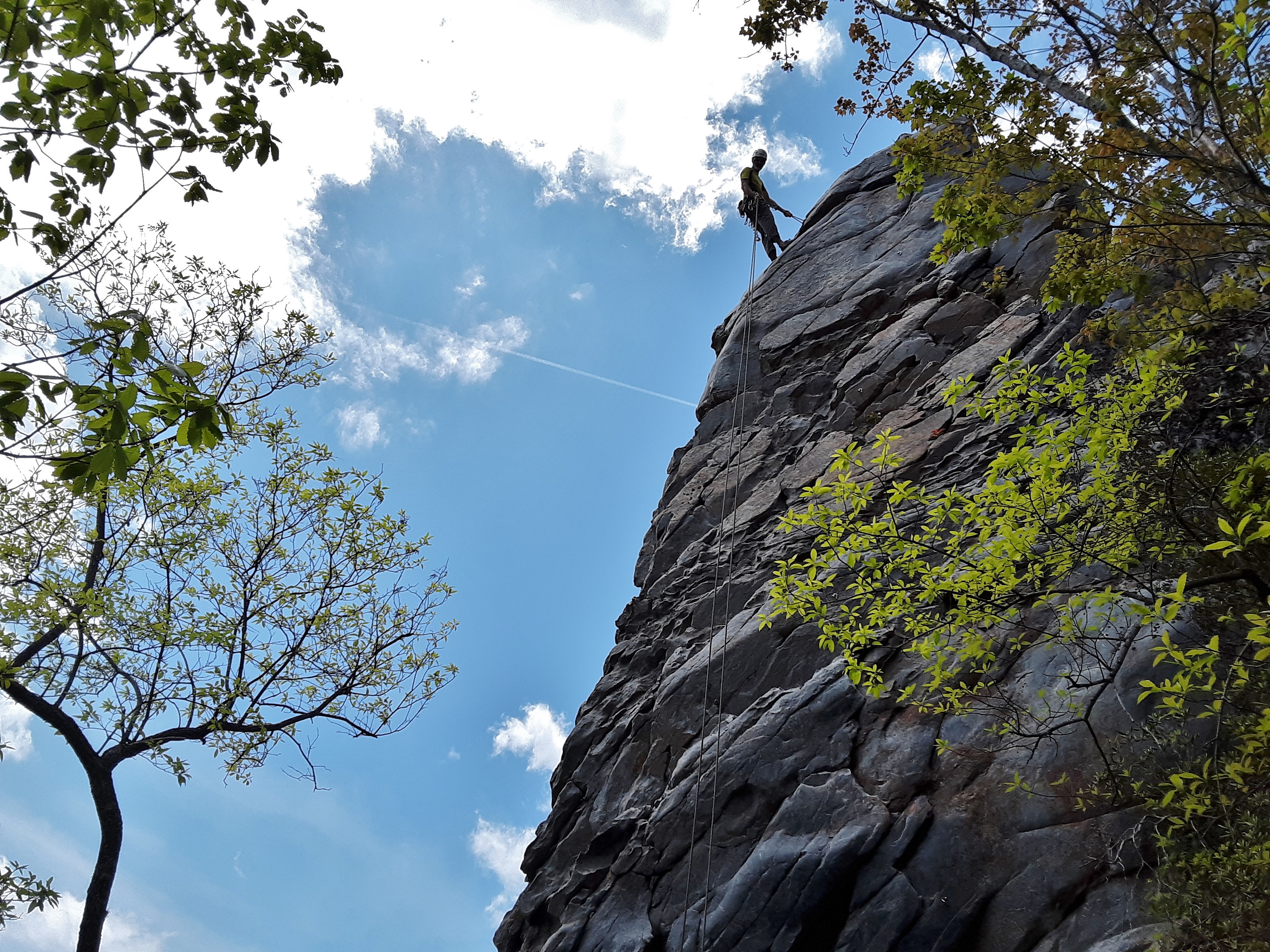
Notice in the next two shots my right hand, brake hand, position, as I rappel. Brake.

Feed rappel.

Broadhead Skink (Eumeces [Plestiodon] laticeps) (1): Such creatures make our attempts and pride about climbing seem rather pointless.

This is the second, and I might say, successful attempt. I couldn’t touch the move over the vertical section just after the second bolt. I saw him do it and still didn’t know what to do.

Another day out in the woods and fresh air, on the rock, thankful for the “One Who made, saved, and sustains” this world, and more specifically, me. May you see His care for you and choose to follow Him, too.

  1. Species Profile: Broadhead Skink (Eumeces [Plestiodon] laticeps) | SREL Herpetology (uga.edu)

Read Full Post »

On my bucket list of climbs I’ve wanted to do was The Nose at Looking Glass Rock. Today I led all four pitches. This brave fellow was psyched to do it with me.

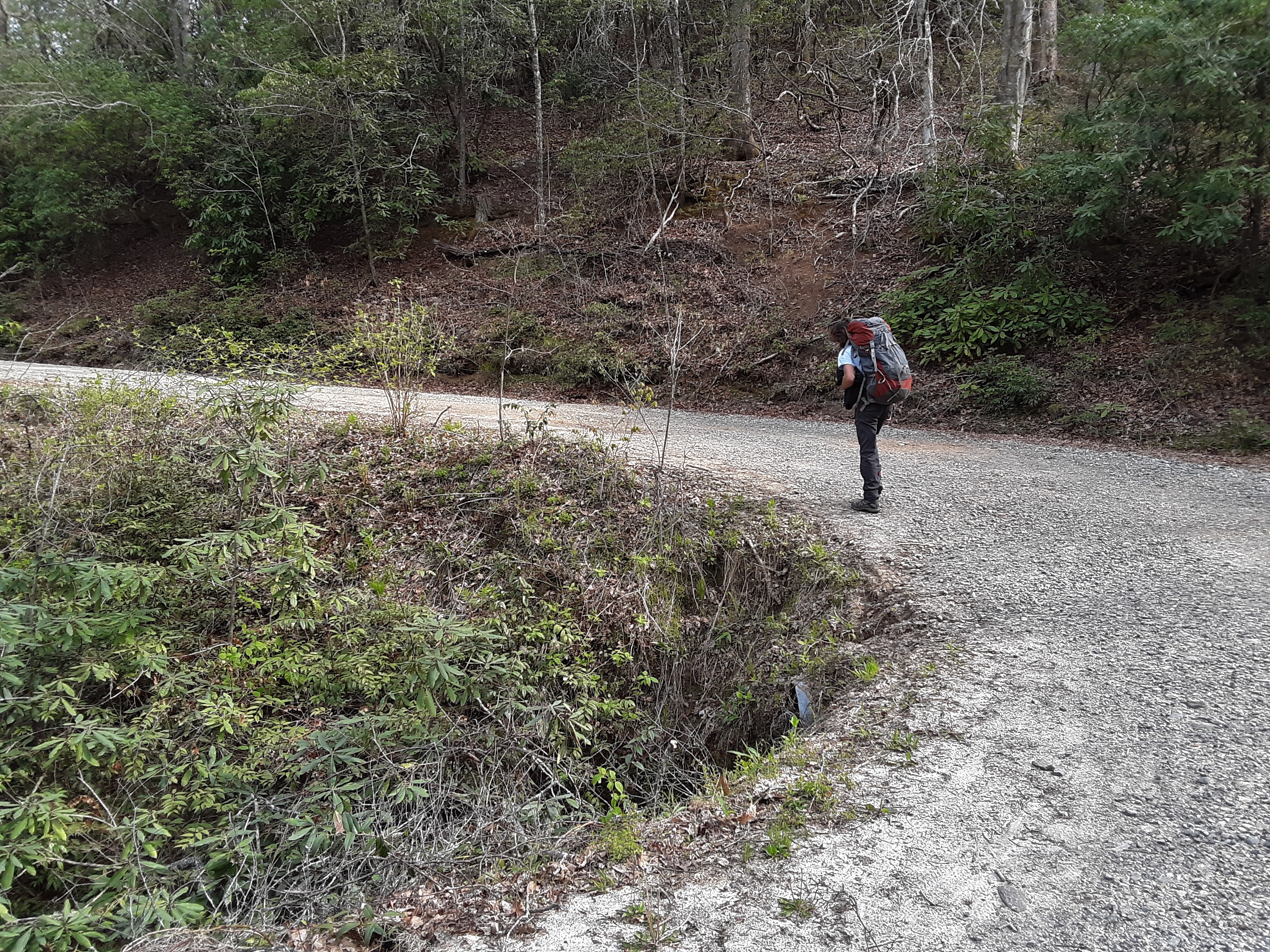
The gravel road approach was gated and we didn’t know that there was another way closer, so we walked in three miles from the Education Center.

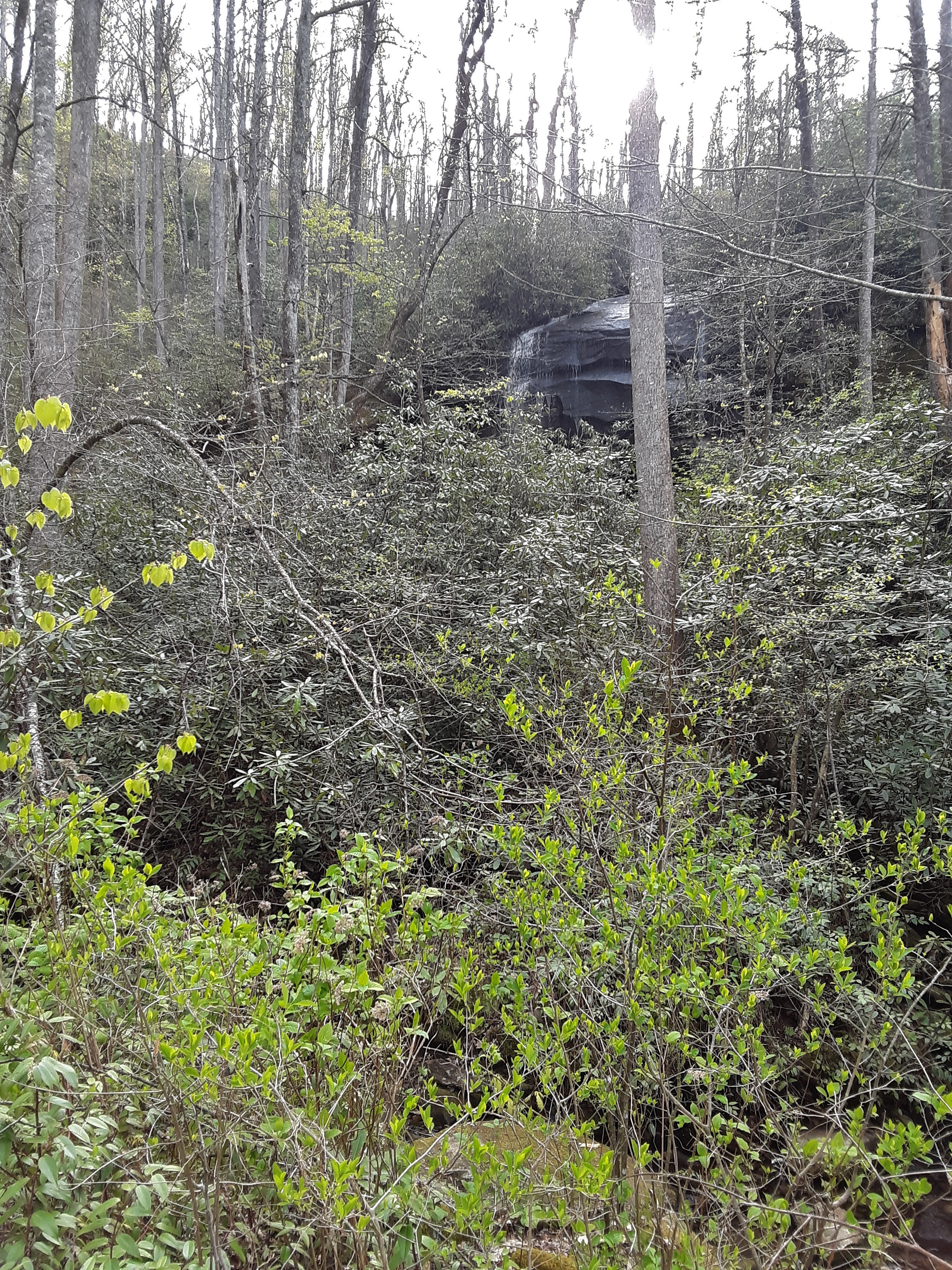
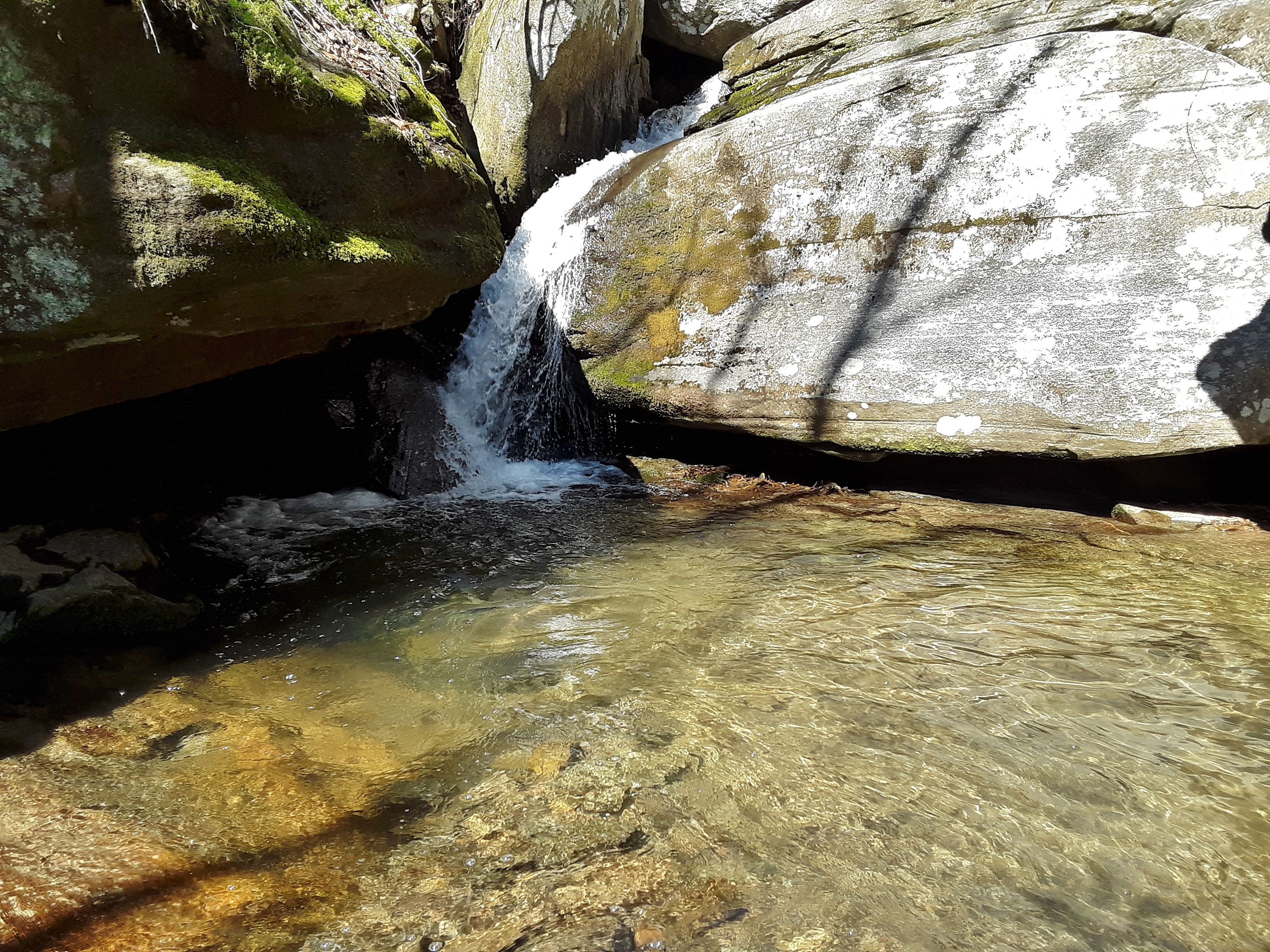
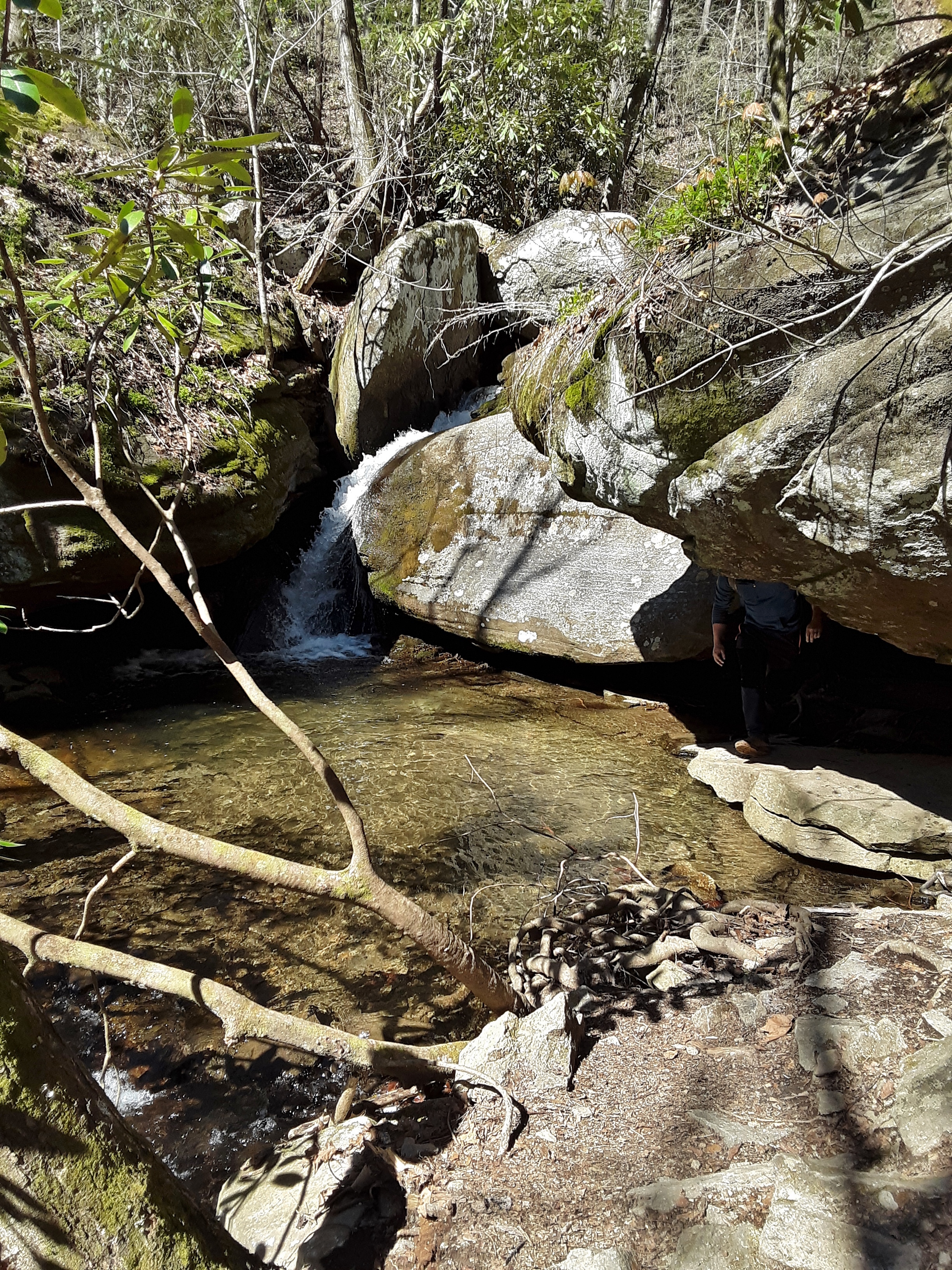
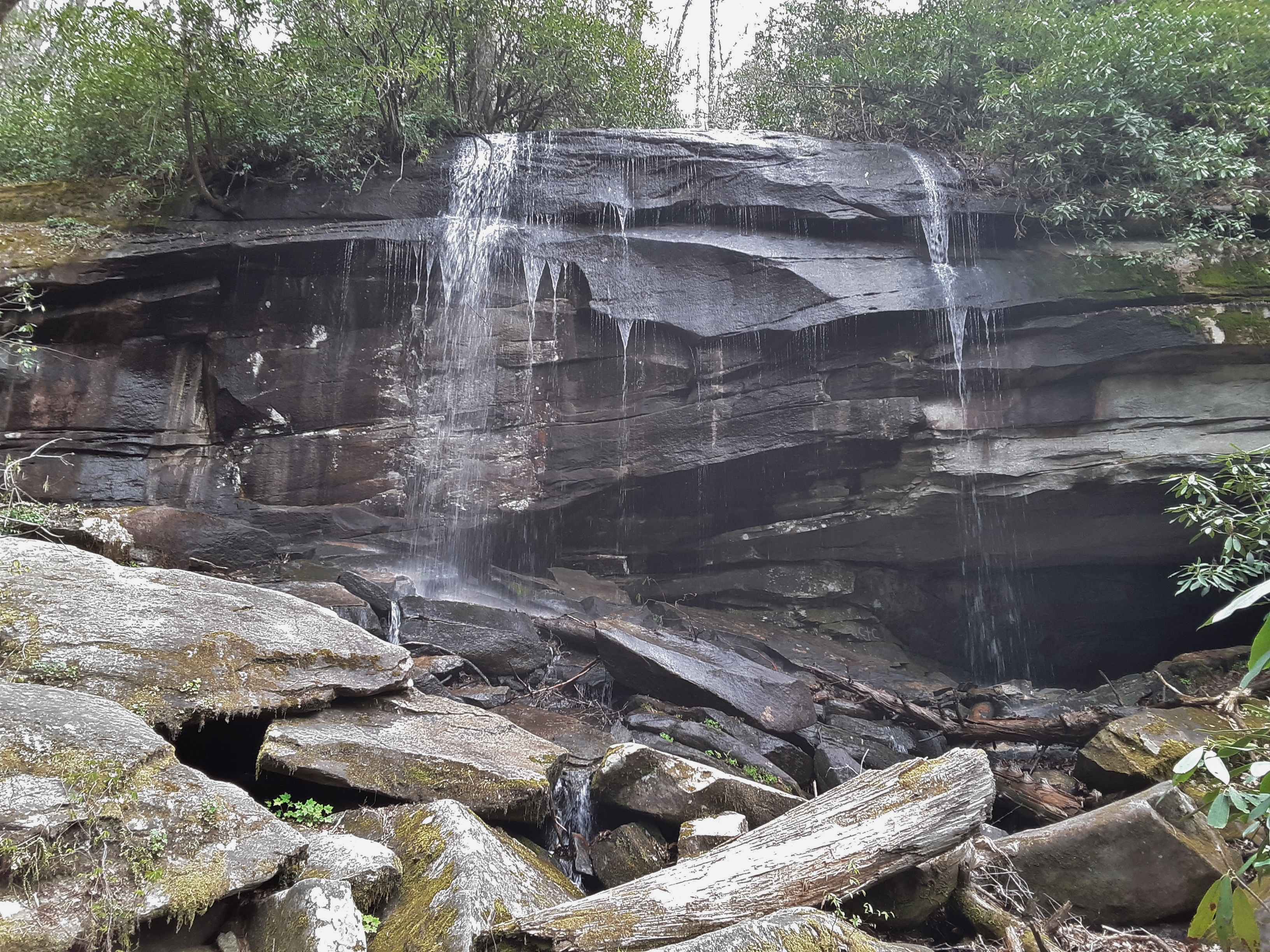
Along the way was a nice waterfall, but checking it out would have to wait until later.

The parking at the approach trail is about 0.3 mile from the base of the rock, though quite steeply up, especially with a pack of climbing gear.

To my eye this rock face is odd both in overall shape and features called “eyebrows” throughout the rock.

I wanted to lead the climb, which is a 5.8 and well within my wheelhouse. It is a different style of climbing, however, because one must use the ‘eyebrows’ as underclings (1). The weather was pleasant for hiking and climbing, but unexpectedly cloudy, cool, and breezy at times.

It is always good to see that your belayer is alert and paying attention. You can clearly see that this climb is the most popular by the impact of foot traffic at its base. Certain climbs are called “classic”, which I have never quite understood. Does that mean people like it, it has been around a long time, that it is interesting or otherwise aesthetically pleasing, or some vague combination of all of these? After some difficult climbs we could not complete later, mostly because of lack of good protection (2), I commented that perhaps the reason you only ever hear about half a dozen climbs out of several hundred is that most are crazy hard or too run-out (3) for most people to want to climb them.

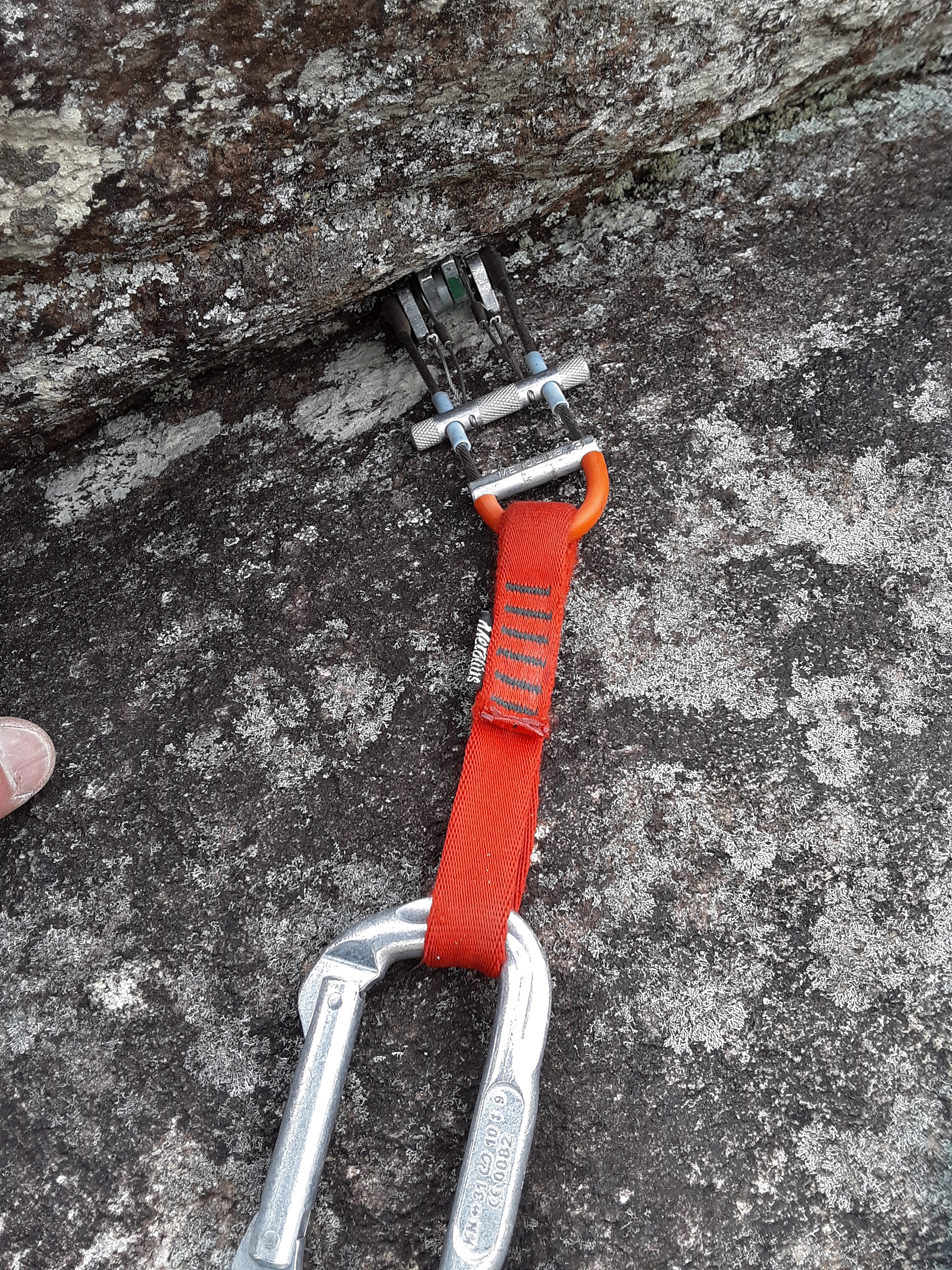
When you trad (4) climb you place protection devices like stoppers, hexs, tri-cams, slings, or cams like the one pictured here. Then you clip your rope into a carabiner attached to the end that catches your fall. This was a solid or ‘bomber’ placement. There are sections on this wall and this climb where there are handholds but no placement for protection. This results in a run-out situation. By the way, do you see how I mark my equipment?

Following is the view at the first set of belay anchors about 90′ up. Spring has just begun at this level but not much higher. My partner commented on how he likes the contrast of fresh green and gray limbs, because the gray accentuates the bright green of new leaves.

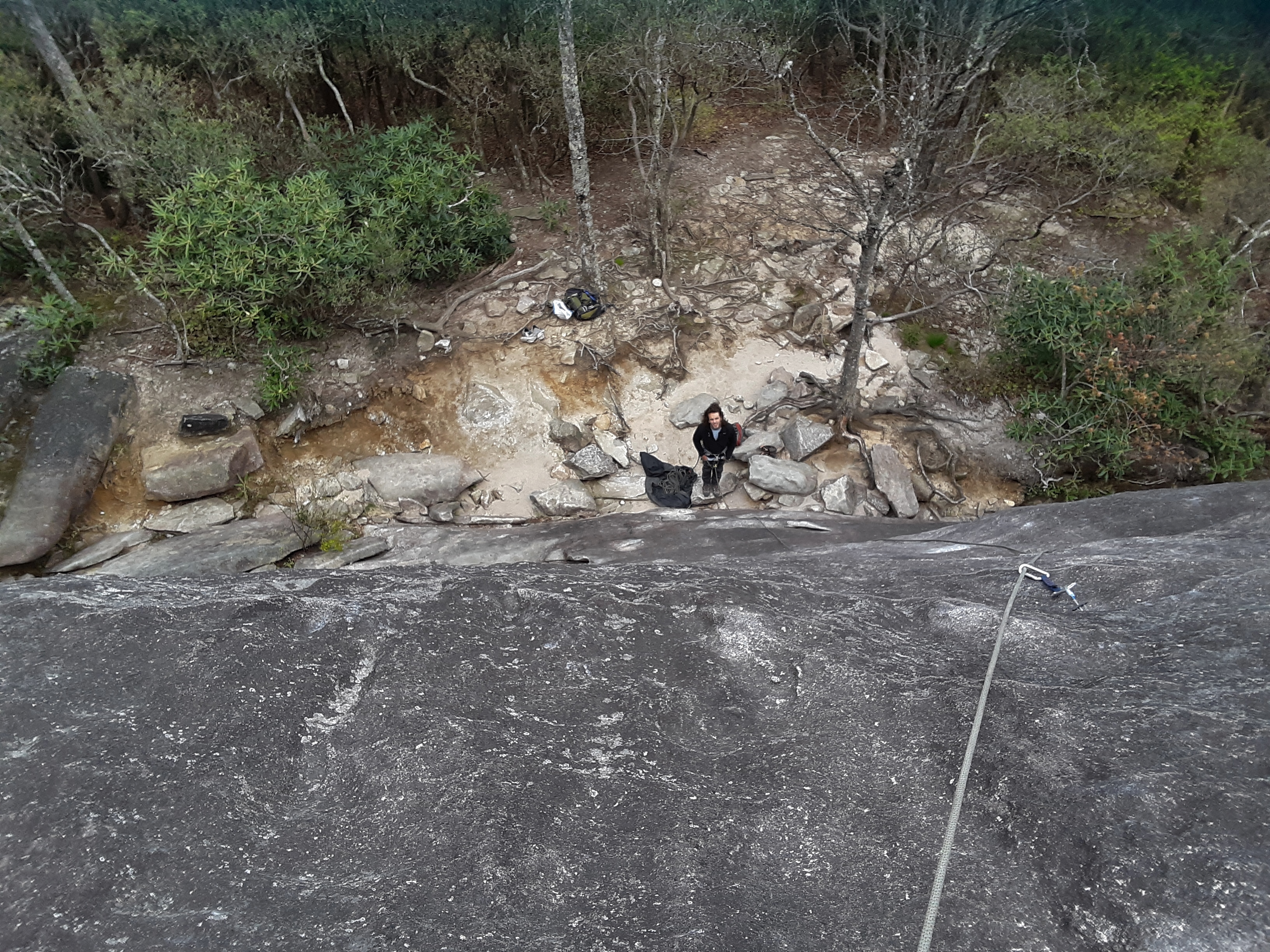
I was the lead climber on this climb. My partner was the follower. He is seen here cleaning the route, that is, collecting the protection that I had set. Notice in some of these pictures the visual illusion that the surface is not very steep, as in the foreground here. None of this climb is truly vertical, but except for a few ledges, it is a 60 to 85 degree wall.

And here we are on one of the ledges transitioning for me to begin leading the next pitch (4).

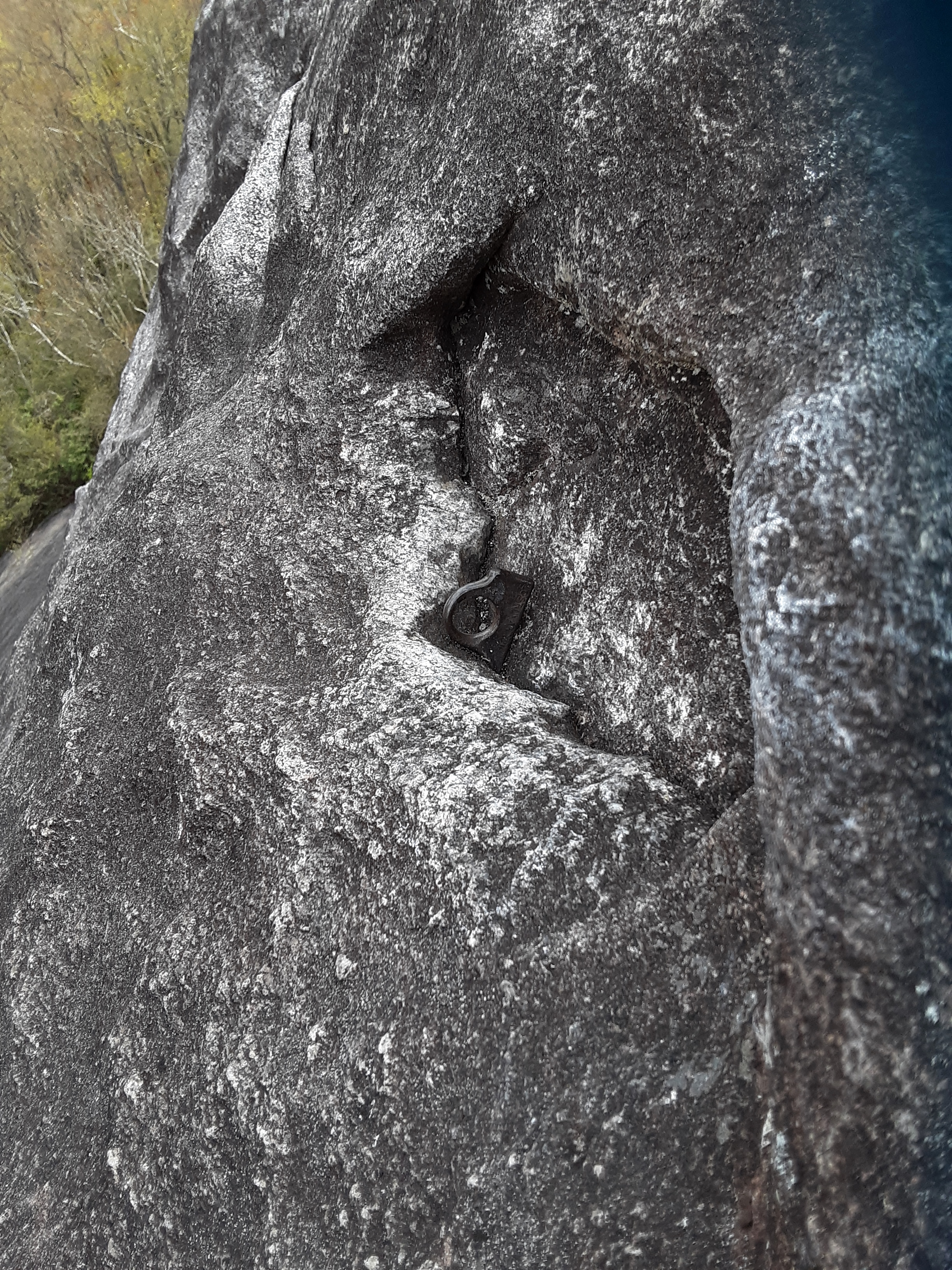
Being such a popular and old climb, I saw several old and broken pieces of pro along the route. The piton pictured is really old school.

The views were great. Note the occasional evergreen amongst the bare deciduous expanse.

It is always nice to have a comfortable place to sit when you are belaying, though it is not frequent. Notice the parked cars at the Looking Glass Mountain Overlook on the Blue Ridge Parkway. I had stopped there many times in the past, had a picnic with the family there once, and several times thought that I’d like to climb this rock. I wonder if any tourists with binoculars were spying our progress this day? I think that the peak behind the peak behind the overlook is Richland Balsam.

I gave my partner a hard time, saying this picture looked like he was a model for outdoor clothing. You can see some older, though quite sturdy, bolts he is tied into. This location is the lunch ledge which is still not level but reasonable to walk around on untethered away from the edge.

The following four images from the top combine to make a 180 degree panorama from south through west to north. We didn’t stay here long because it started sleeting. Yes, it was sleeting in late April. Well, it does happen rarely on the high peaks in mid-summer.

Time to rappel back down. Once again it looks nearly flat in the foreground but isn’t. The blue device through which there are two bites of rope in his left hand is called an ATC (5).

In the following selfie you can see the reflection of not only the phone with which I am taking the picture but also one of the bolts to which I am attach and my partner is rappelling and the tree line at the top of the peak.

On the hike out we saw some wildflowers like this blue flag and May Apple.

I got closer to the waterfall, which had a 20′ overhang to its right.

This day was the first time I have climbed at Looking Glass Rock and the first 4 pitch climb I have completed. It was a pleasant day with lively conversation. I see endless views of God’s beauty in the rocks and trees and sky and flowing water. It gives rest to my mind and challenge to my body to be out in His Creation and sharing it with someone. Perhaps that is part of the reason that I share it with you. I want to you to enjoy it with me, acknowledge the beauty of God’s work with me, and resolve to get out more and enjoy it yourself. Come along with me if you like.

  1. undercling- fingers and palms facing up and pushing up to counteract downward foot pressure for stepping up.
  2. good protection- strong enough to catch you and frequent enough to prevent long falls
  3. run-out- excessive distance between climbing protection that may result in a long and dangerous fall.
  4. pitch- the distance of climb between two belay stations equal to less than the length of the rope
  5. ATC- Air Traffic Controller was named by Black Diamond and now colloquially referred to for all similar devices, sorta like Kleenex is for all facial tissue.

Read Full Post »

I was in need of going over the mountain a couple of days ago. I have done the trip so, so many times. I decided that I needed to stop on the way back to take a little hike and break up the trip. I appreciate scenes I have already seen and return to many frequently. I especially enjoy showing others little wonders of nature that I have seen. But I was alone and I longed to see something new, and it did not have to be big or impressive. I found what I suspect to be an underappreciated little jewel off the far end of the Linville Falls Access Parking Lot. Old growth forests are few in the Eastern United States. I content myself with enjoying the occasional lone larger tree. This Eastern White Pine is a healthy example.

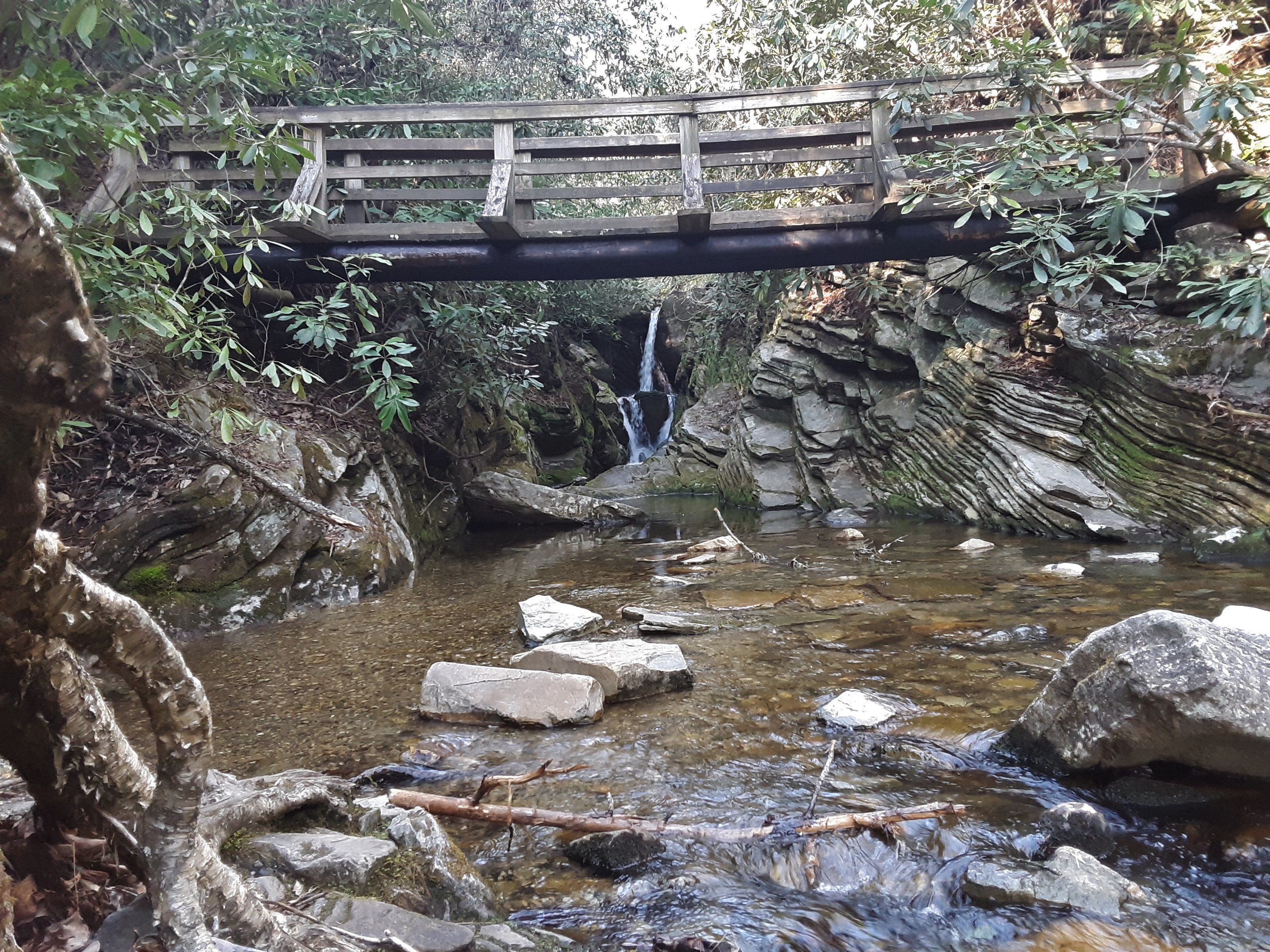
The trail is very short. By the time you walk to the far end of the parking lot, you are half way there. The trail goes up over a little hump past several large trees and then down into a narrow notch where the park service has a bridge just right for viewing and walking up between the boulders.

In the middle of the bridge, voila’, Dugger’s Creek Falls.

On the far side of the bridge the steps go up between the boulders in such an inviting way.

Always desirous of a little adventure and a better picture, I got off trail just at the base of these stairs. Inviting though they be, they were a bit too civilized for my present frame of mind. Instead, I battled a bit of rhododendron and some small drop offs. The falls, in the 12 to 15 feet wide notch and cloaked in rhodo’s was not having it.

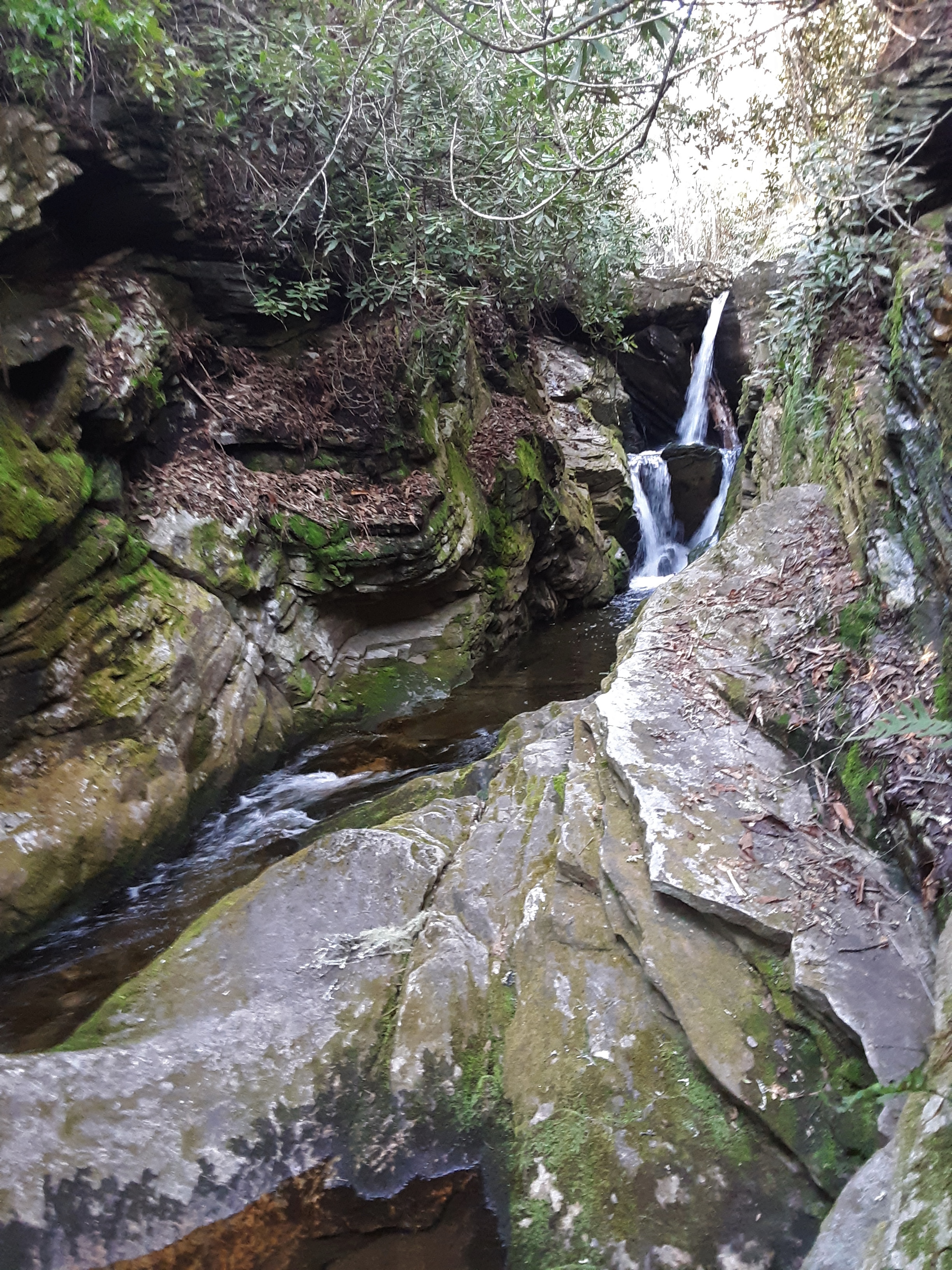
So, I went to the top of the falls in order to check out how and where the water squirms between the cracks and voids of the notch. If you look closely, you can see the bridge. If it were summer, I would probably wade up the stream to the base of the falls, but I don’t have a waterproof camera, so that would not be recorded.

Above the falls the creek comes rushing down into the notch, still a steep pitch with more broken boulders along the sides.

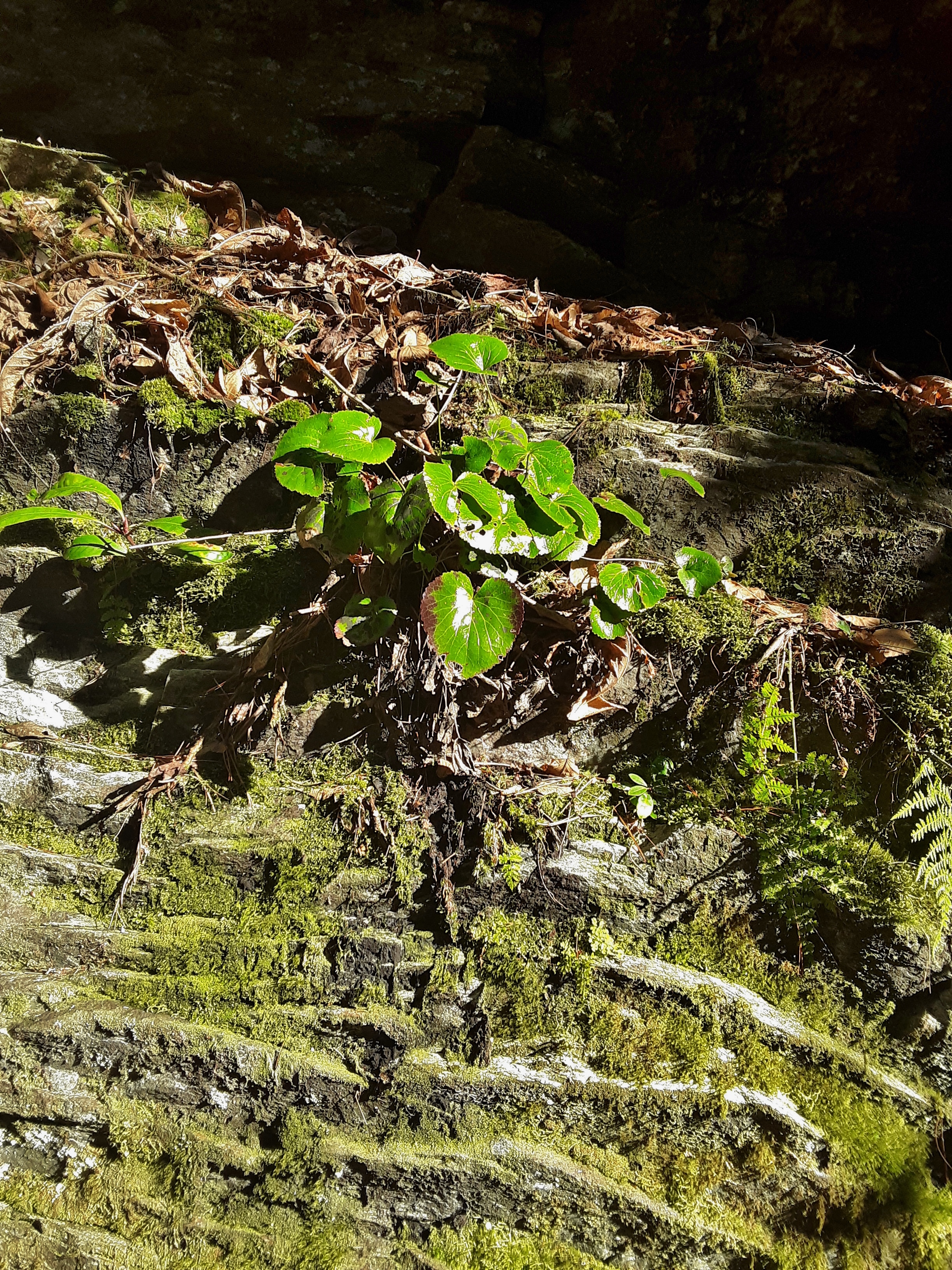
The scene is green with Galax and fern and moss.

The rock form is definitely foliated metamorphic, the layers curiously formed in waves.

The trail exits the woods onto the road just out of sight of the bridge or falls, but just before it does you get one more good view.

Not quite satisfied until I have explored every little turn and divot, I crossed the creek and worked my way under the bridge and edged up along the small cliffs. It was no use. The likelihood of wet feet or more (e.g. wet cellphone) stopped me short of completing every inch. I was satisfied with one more picture and a rock scramble back up to the trail.

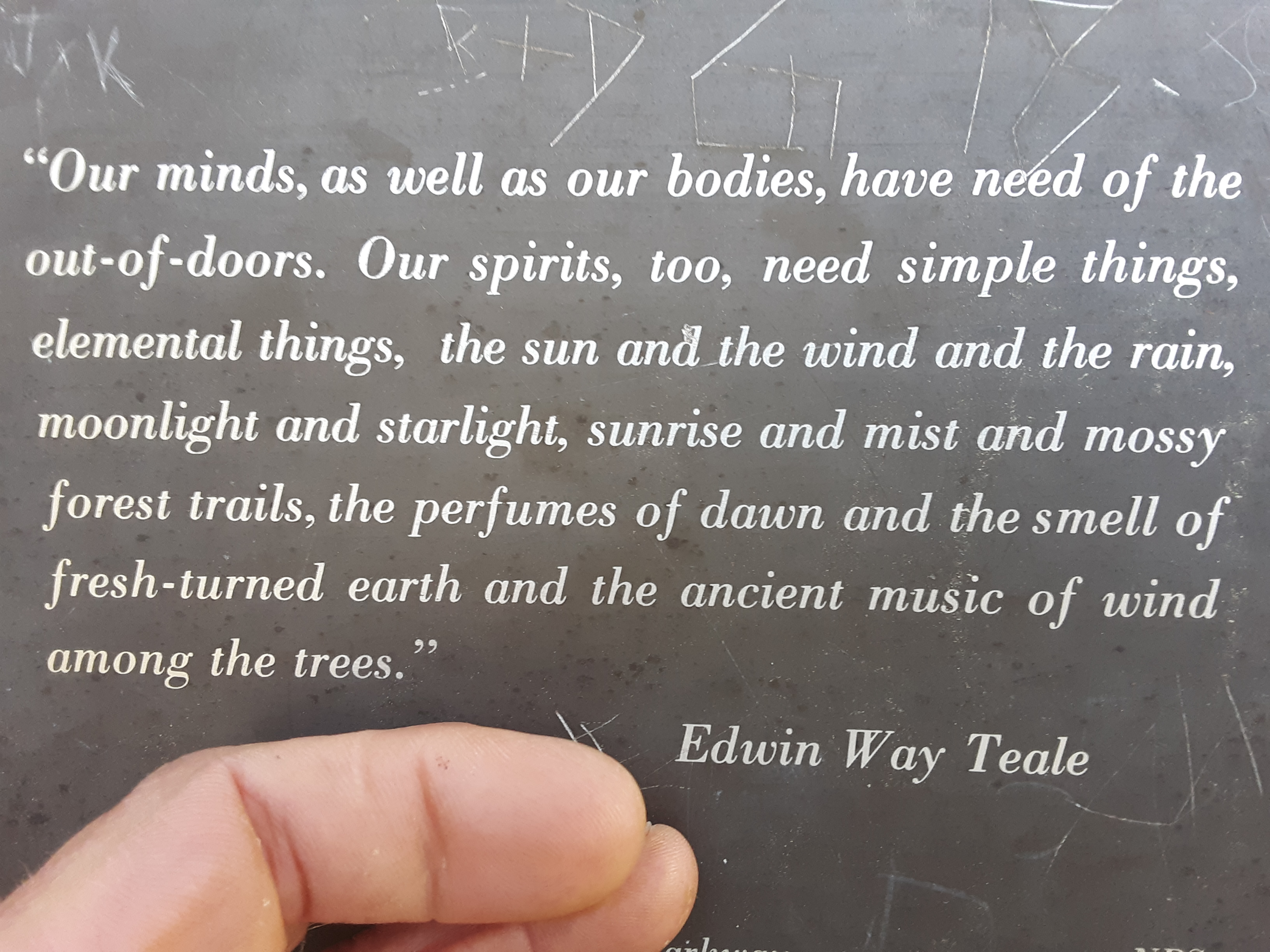
On the beyond the bridge side of the trail are several plagues with quotes. The following was apt to my present situation.

The author does not say why we are in need of these things, and it is certainly true that many never consider that they are. But when I muse upon why this quote is true, it seems to me to point to the beauty of God as the why we seek the beauty in nature. We cannot now see Him, though Jesus said, “Blessed are the pure in heart, for they shall see God.” (Matthew 5:8) We want to see His beauty and seek it in nature. But “How can a young man keep his way pure? By keeping it according to Your word.” (Psalm 119:9) But no one is able apart from the righteousness that Christ imparts, “for all have sinned and fall short of the glory of God. (Romans 3:230 As He told those questioning Him about the work of God, “This is the work of God, that you believe in Him whom He has sent.” (John 6:29) Therefore, I look forward, not based on my merit, but His in which I trust, to seeing His beautiful, awesome visage one day, just as I seeks its tarnished and veiled reflection in His Creation I so enjoy experiencing.

Read Full Post »

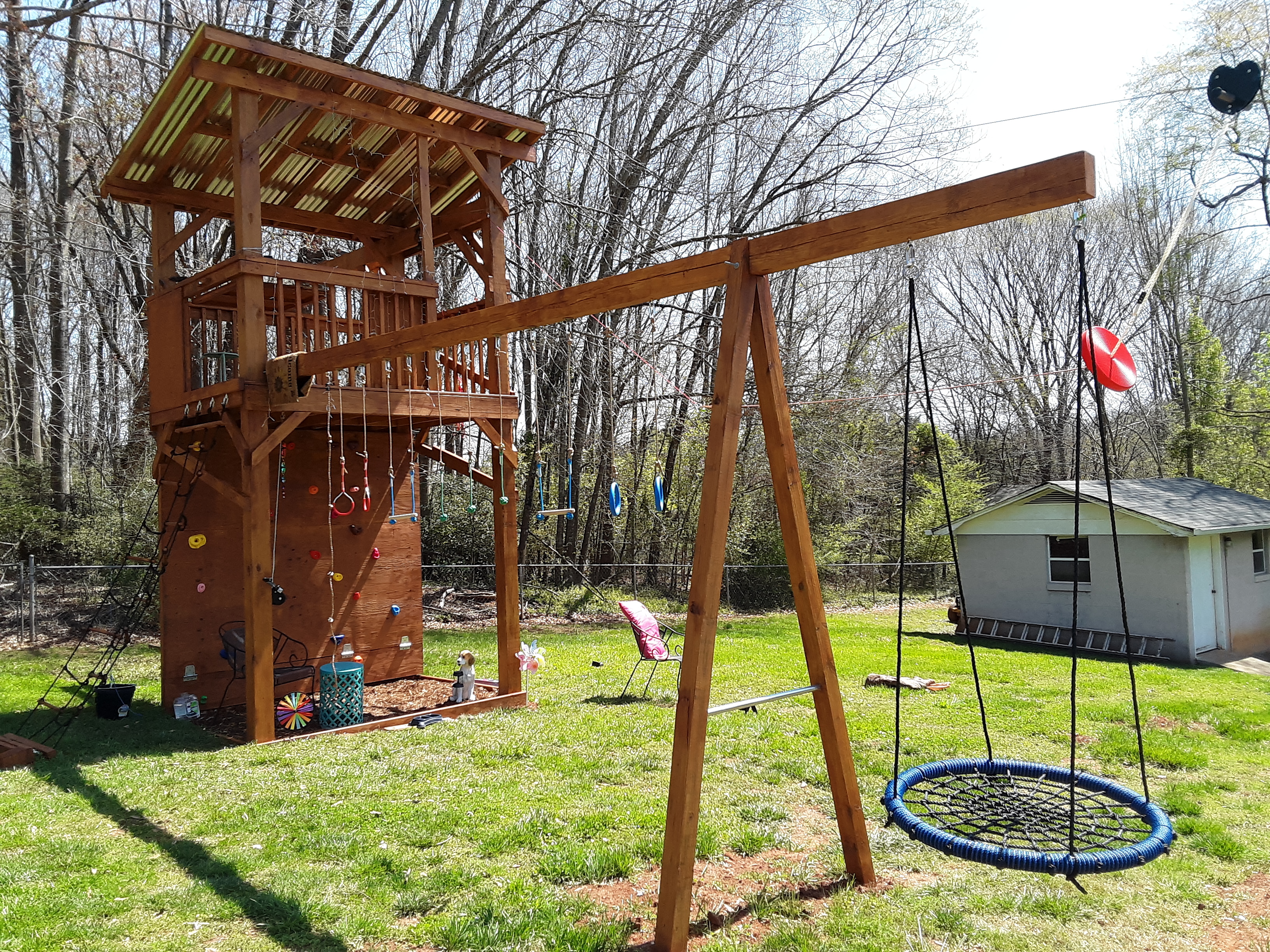
Here it is!

The owner installed the chain to hang the net swing temporarily, then asked me to move the swing. An outdoor aerial silk is supposed to reside here one day.

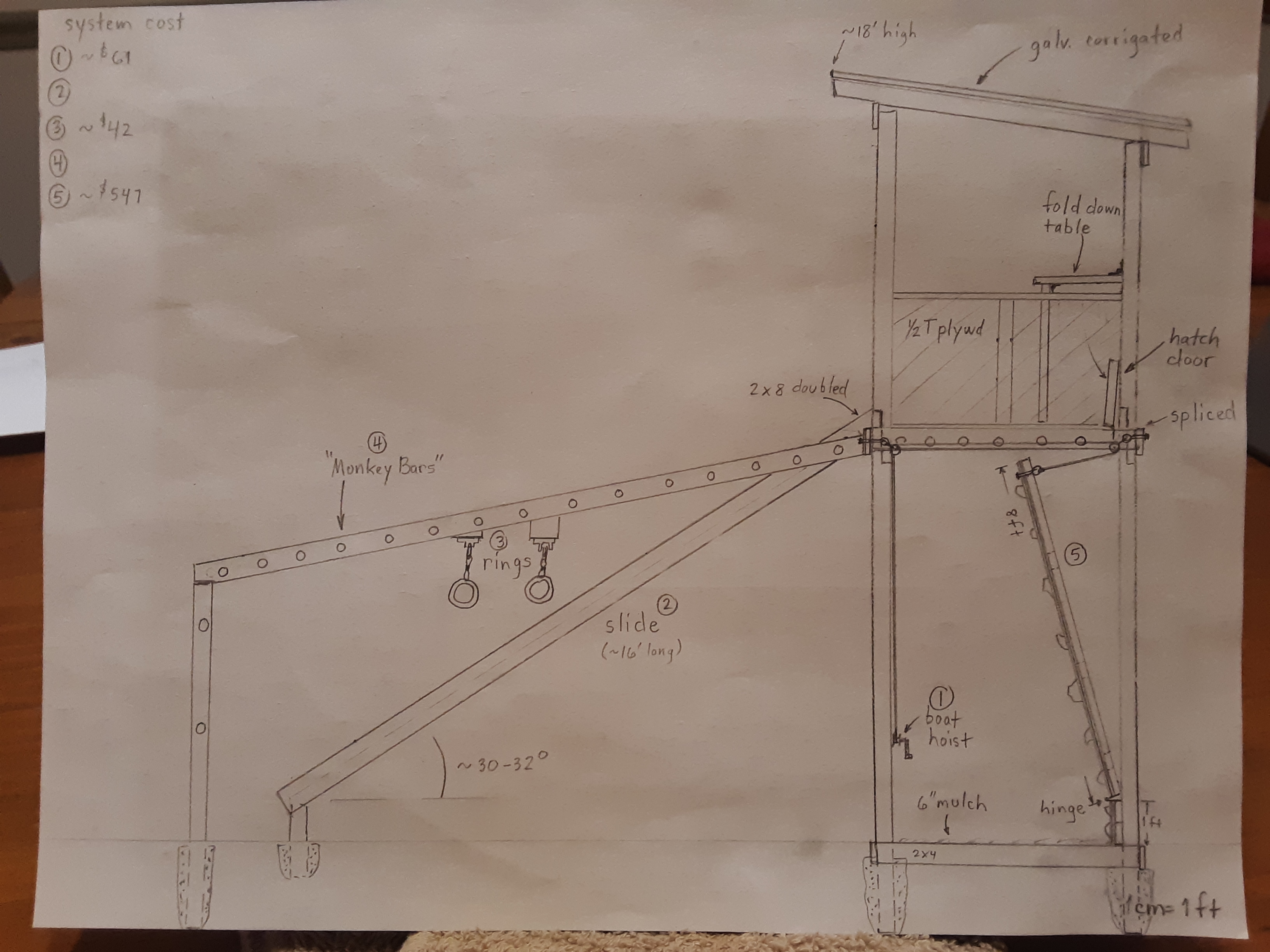
Check out the plans. The basic concept is there, but the homeowner wanted the addition of a climbing net, a zipline, a beam for the aerial silk, and a good place to mount the net swing. For cost reasons that eliminated the slide and monkey bars. The fold down table became a doorway for the climbing net. The climbing wall got lowered from 9′ to 8′ and 7′ wide to 8′ wide. The zipline resulted in changing from 4 x 4 posts to 6 x 6 posts and adding all of those diagonals.

The zipline, due to height of the playhouse and surrounding topography is steeper than suggested. So we began to look for a way to slow the ending. I added a spring and a friend added a magnetic break. They work on the same principle as dropping a magnet down a copper pipe. Copper does not magnetize but it does conduct electric current well. Therefore, when the magnet is moving down the pipe a current is induced which has a magnet field which just happens to be counter to the magnet’s field. The magnet is slowed by this counter-EMF. So is the magnet surrounding the zipline cable. The black bungee brings the magnet back to the point for the next braking action. So, the zipline is fast but has a controlled stop.

Read Full Post »

The opportunities to do things with my children have been spread out more as time has gone along. People get busy, new responsibilities and challenges come along, and time is stretched. So it was good to take two short hikes with my youngest two sons and a daughter-in-law. Coming from two hours away and a half hour away, they met at my house at just after 10 AM. We drove to Catawba Falls, seeing four waterfalls in a mile and a half stretch. Along the way there is an old powerhouse built in 1923 by Daniel Adams. (1,2) My son inspects the foundation and well where the generator once resided.

His wife awaits our return to the trail and bridge on this bright, crisp day.

Right next to the powerhouse is a recent pedestrian bridge from which my son is considering the course and flow of the creek. These new alloys of steel that corrode protectively are a boon for non-maintenance. The trees in this area have been left alone for probably 70-80 years and are beginning to grow decently large.

A tributary crosses the trail a little further up. Just below the trail is a large pile of boulders and little waterfall tumbling between the boulders.

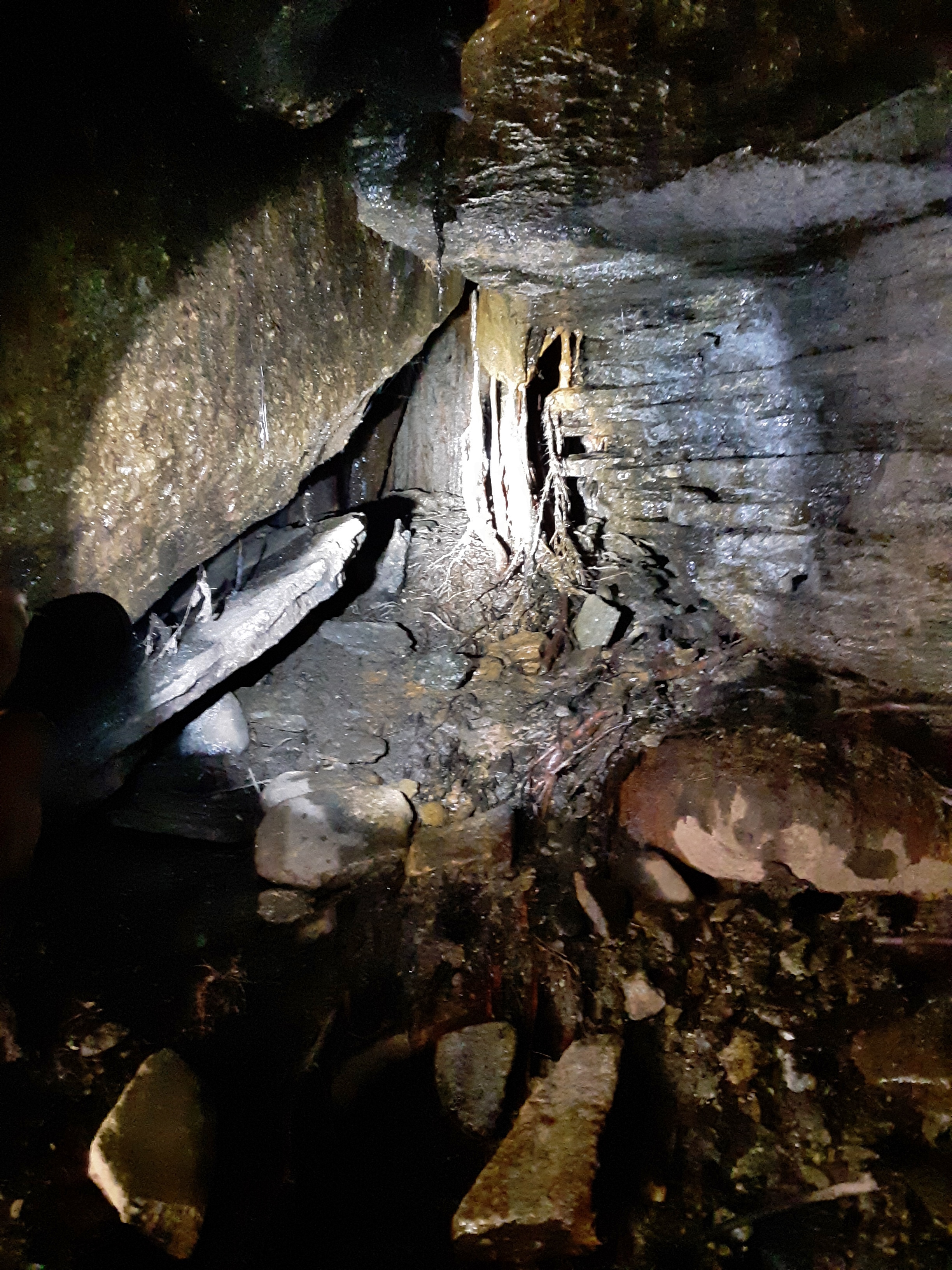
To the right of the falls and pool is a curious little cave that would be a good home for a water side creature. Tree roots provide a eerie entrance curtain.

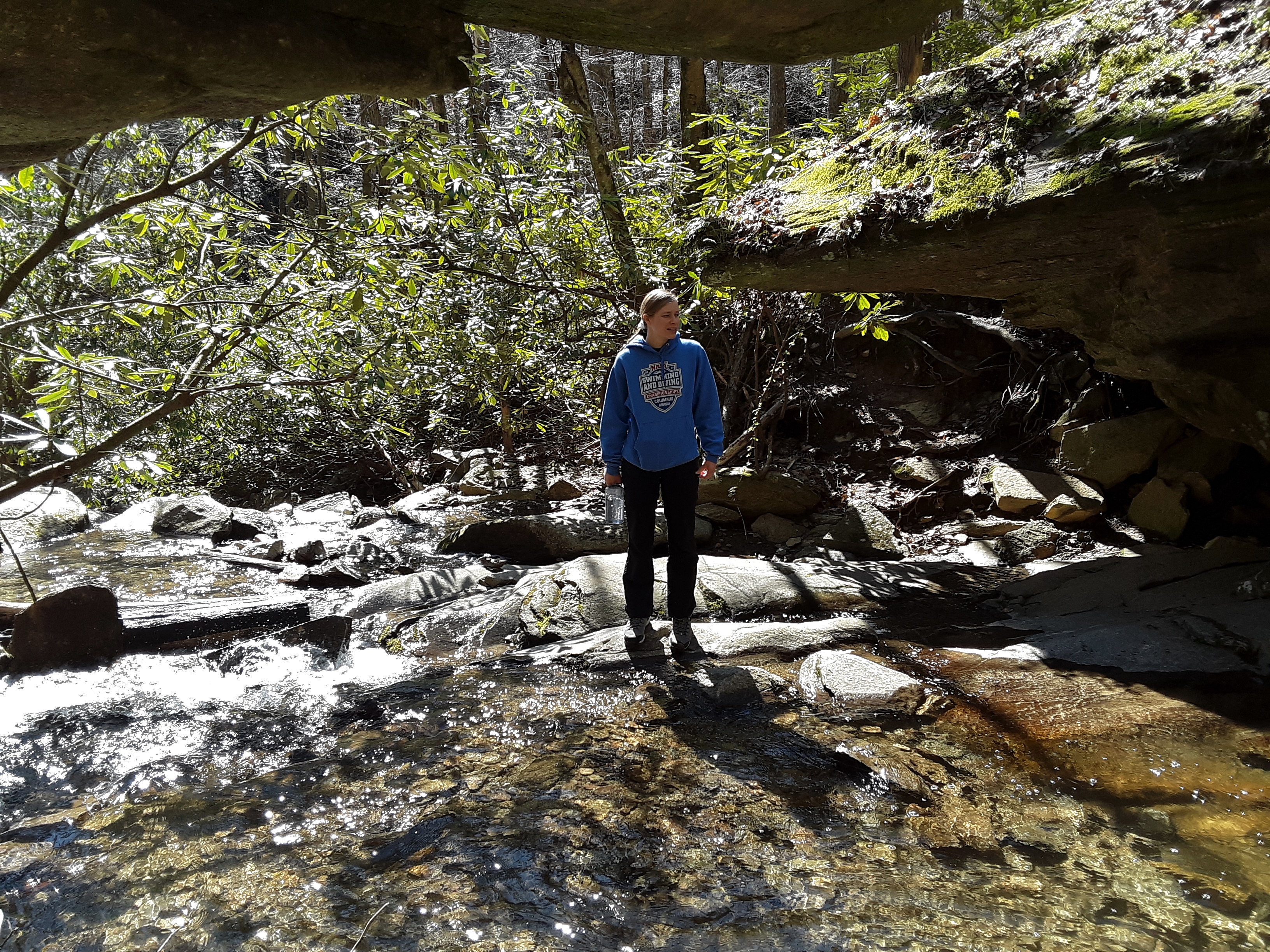
She patiently awaits our silly exploring again. The boulders are fascinating with their significant overhangs.

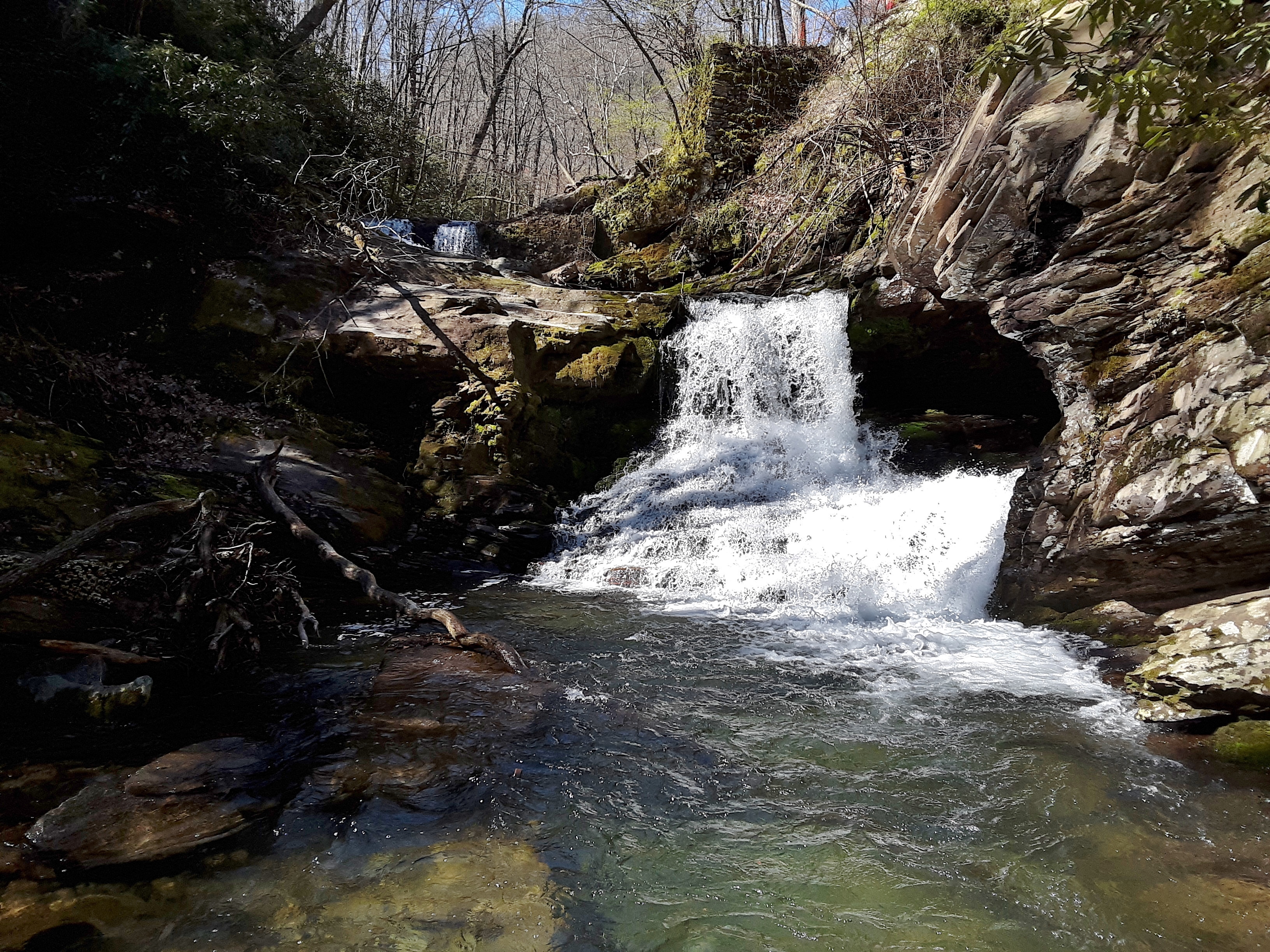
The Lower Catawba Falls is a double falls, the upper part caused by the remains of the powerhouse dam. The dam is perhaps a 1/4 mile upstream from the powerhouse. I feel sure that this distance along the creek is to gain sufficient head (3), and therefore pressure, to run the generator. The water looks inviting, but icicles lined the edges of the falling water from the 20 degree morning.

The biggest show is the Middle Catawba Falls. It is said to be a 105 feet cascade. I don’t know where that is being marked from, but I’d say more. I have some better pictures of it when I went with my church group in September. (see “Cascade, Not Falls“) Today I was capturing our enjoyment of the scene.

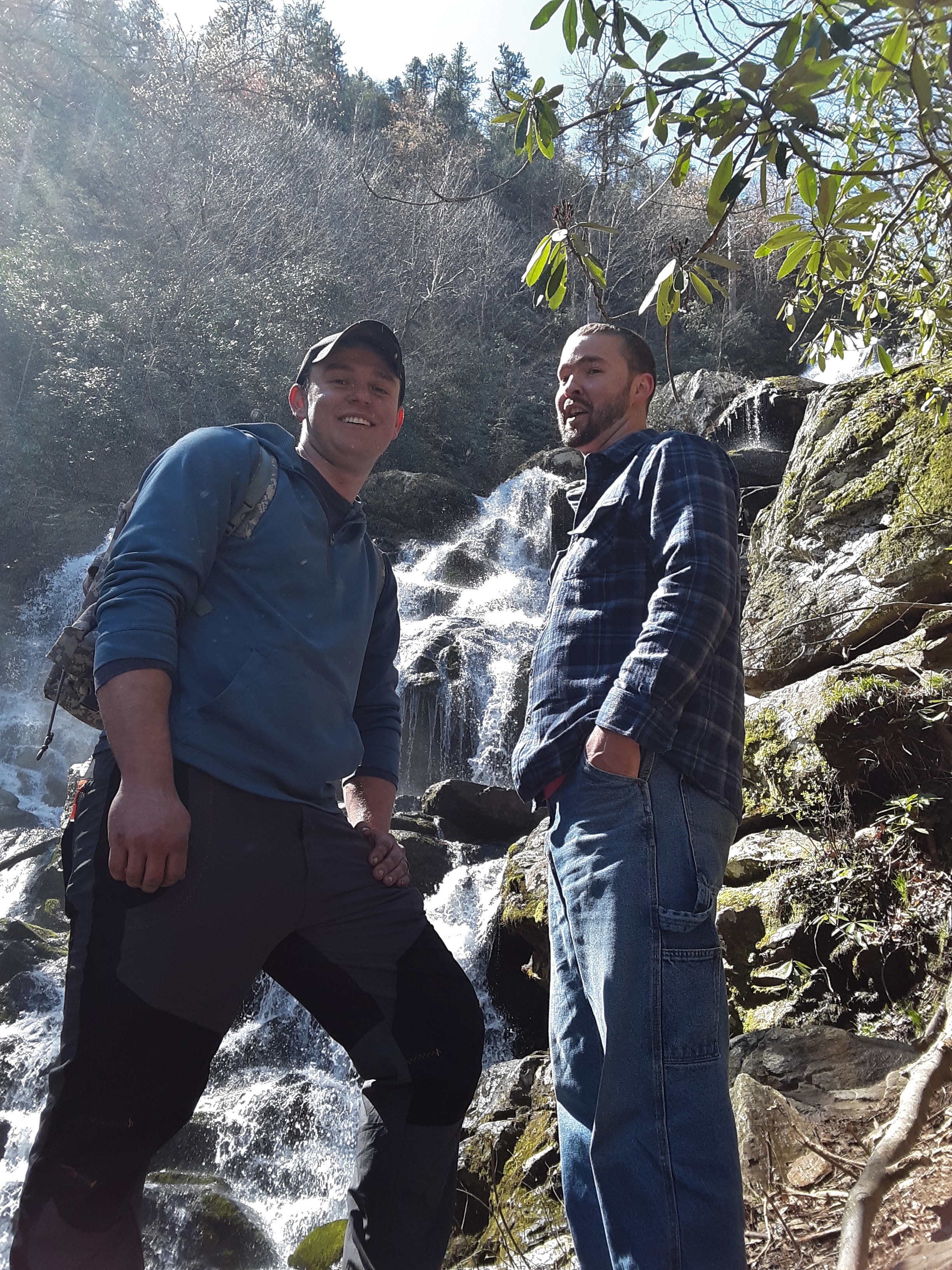
It’s good to see the guys together and happy and enjoying the outdoors.

In this picture of me you can see icicles just up and left of my head. Pictures of falls in full sunlight are hard. In person the ever changing crystals of reflective light are enlivening to the eyes and mind, but my cellphone doesn’t know what to do with all of that light.

I wanted to see the Upper Catawba Falls. So my sons and I figured out a way to get safely above the middle falls. Recorded as 55 feet high, it is the most beautiful and symmetrical of the three.

I learned a little fun activity when I was at Machu Picchu, Peru. (“Peru 4“) I would go around and ask couples if I they would like for me to take picture of them with their camera. Being a cameraman, I know you can’t take the picture and be in the picture effectively (4). Several people offered to take my picture in return. Being by myself and wanting to record my presence there, it was a welcome offer. So this time I offered an exchange. I took their picture with their phone and they took our picture with my phone. Try it sometime. People are appreciative.

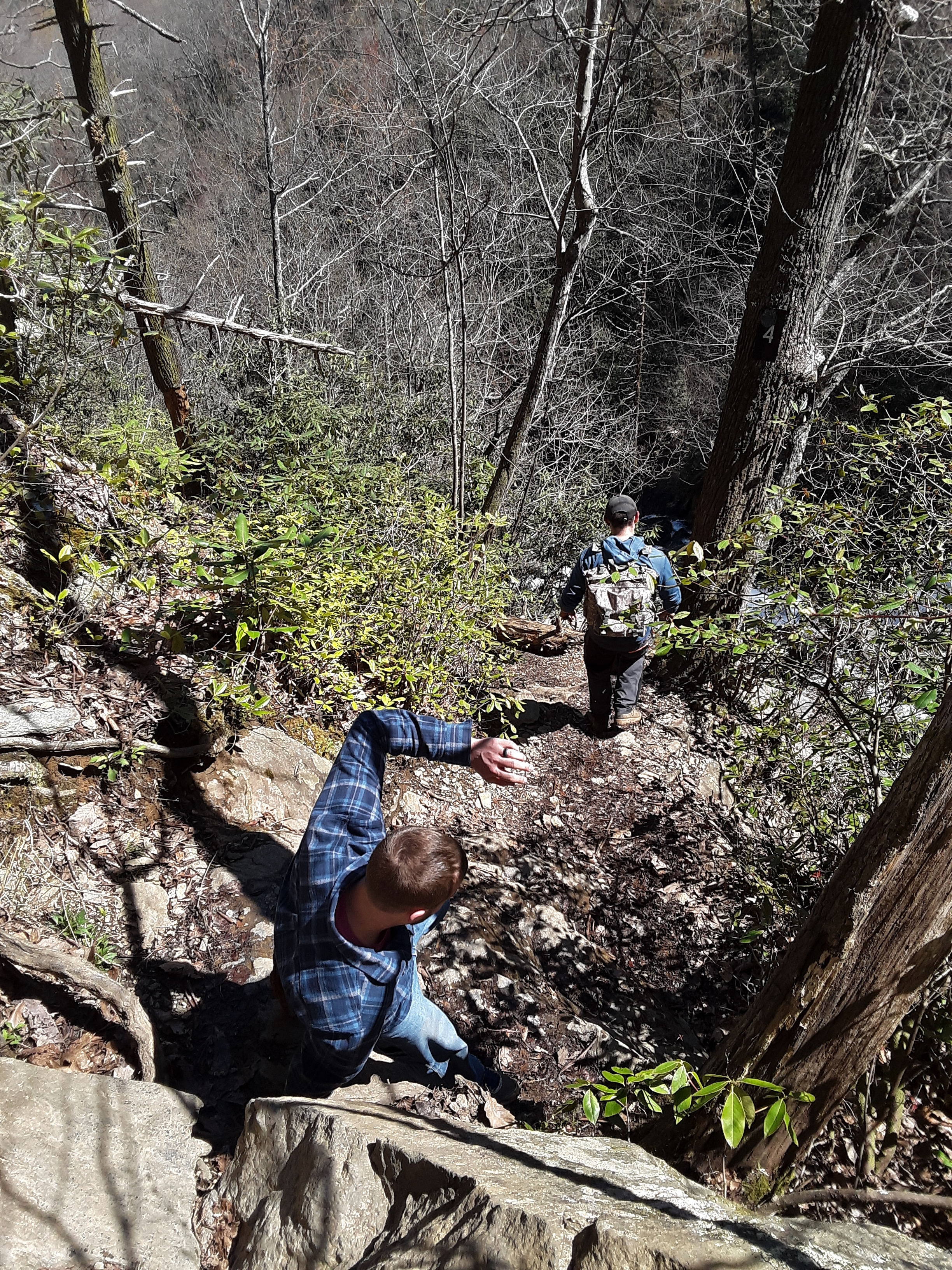
On the way back down there are good views and it is steep.

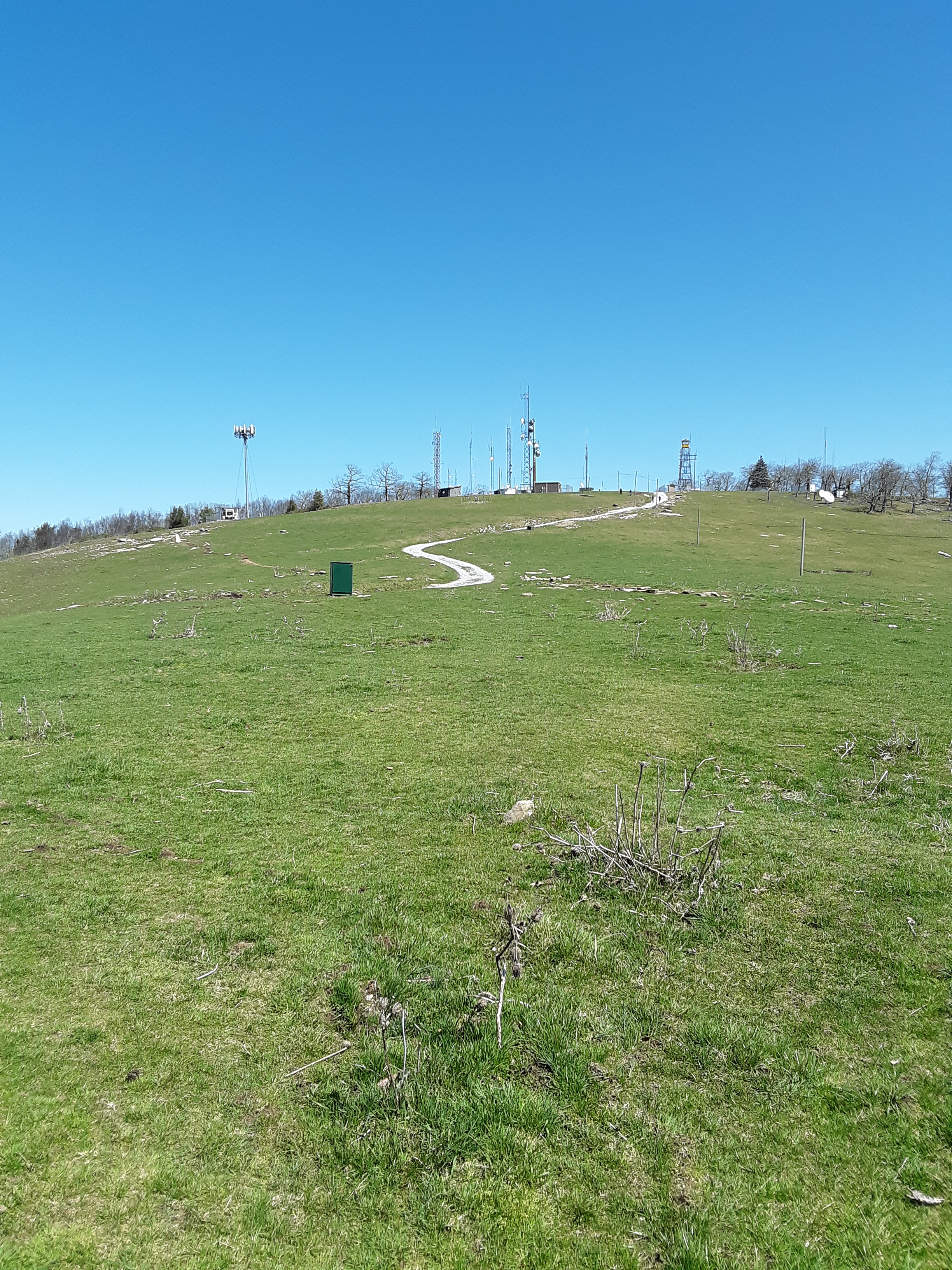
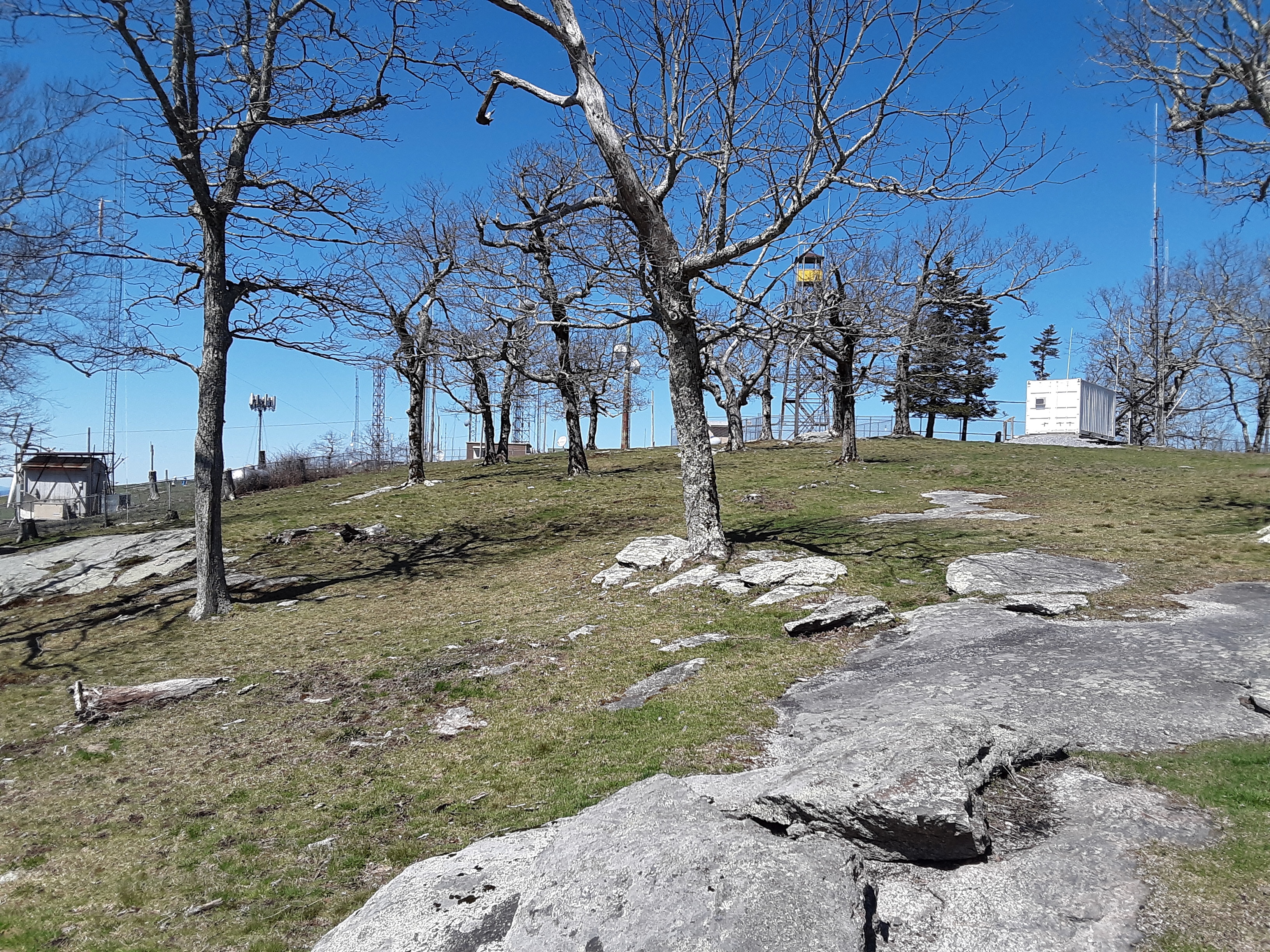
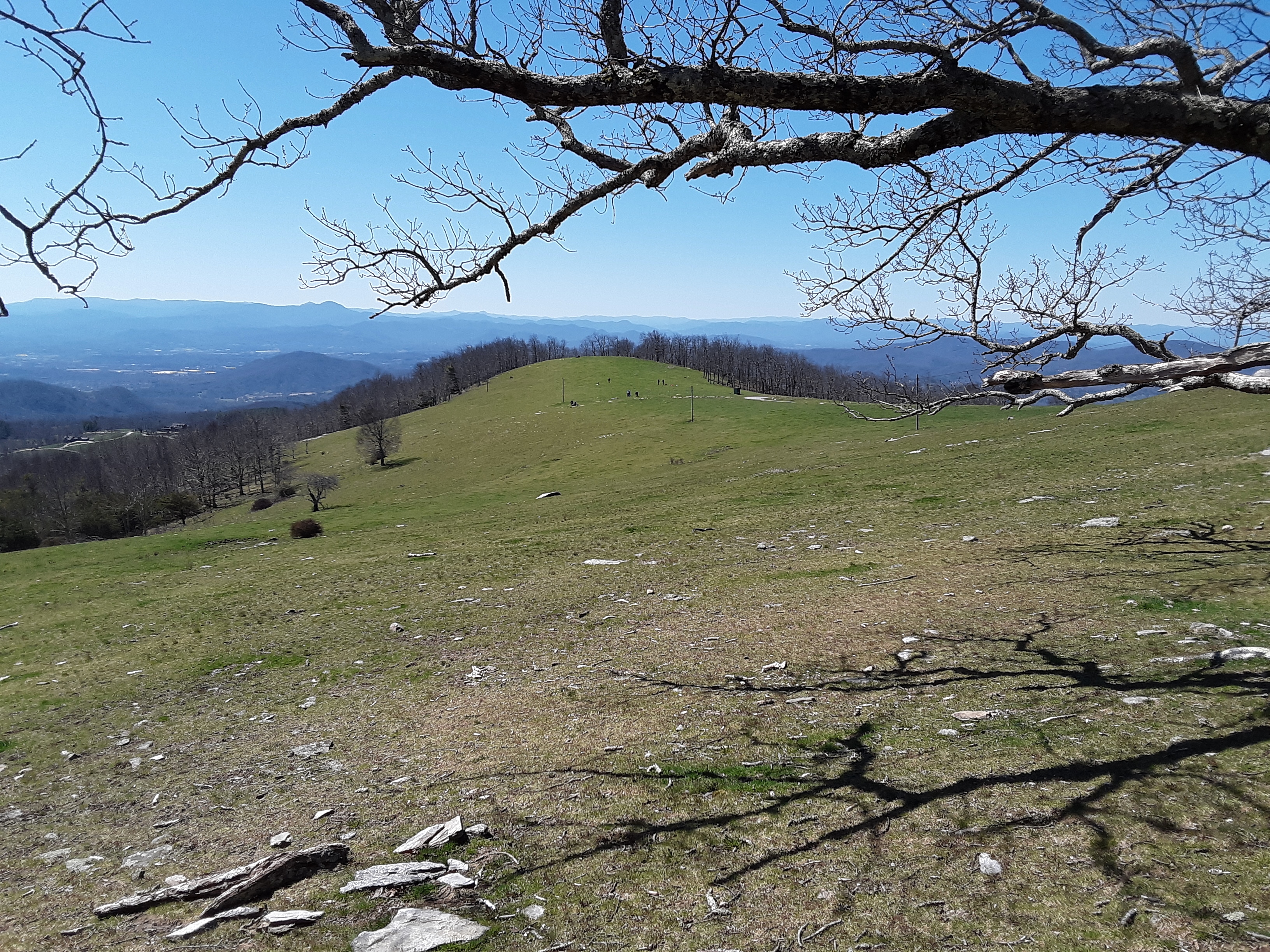
Next we took a 50 minute drive to the Bearwallow Mountain Trail. I should have taken a few pictures of the very open (no underbrush) woods on the way up (5). The large field at the top with the closely cropped grass and numerous variety of towers, both old and new, was a surprise to me. The short grass turns out to be the result of regular pasturing of cattle.

We lounged and ate in the grass and calm air. There had been a cold wind on the north and west slope on the hike up, but it was calm here.

My cellphone telephoto is not good but it does reveal mountains in the county where I reside some 45 miles away ‘as the crow flies’. The little pointy one is Table Rock and the asymmetrical one two peaks to the left is Hawk’s Bill.

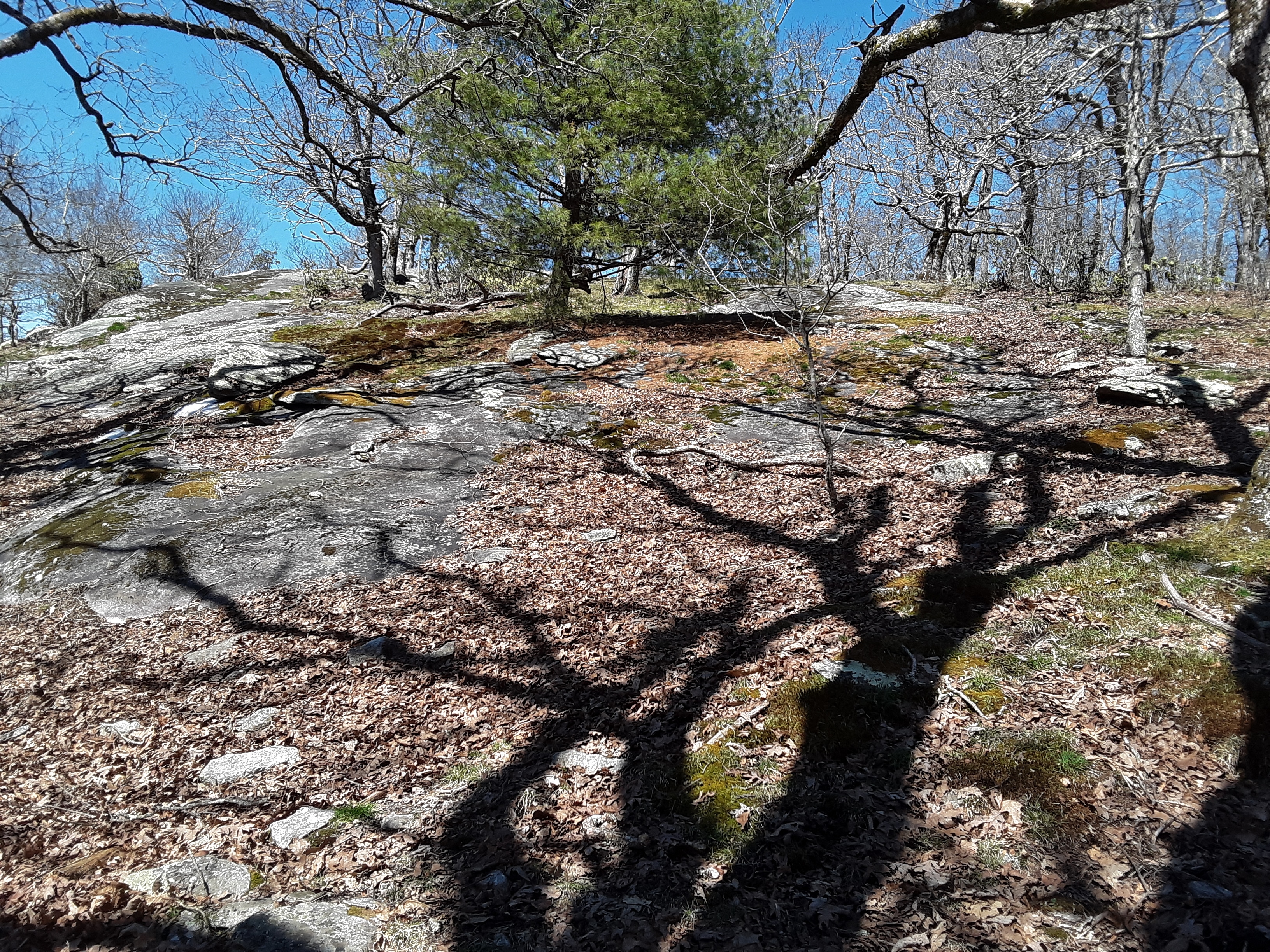
The soil is very shallow at the top of this peak and the metamorphised granite pops out here and there.

Sadly, the old firetower is fenced off. It must provide a truly unobstructed 360 degree view.

The largest domed shaped peak on the horizon is Mt. Pisgah. Even my old eyes could discern the huge tower that resides thereupon.

I present this similar picture for the purpose of showing how large the field is. My three hiking companions stand halfway between the two power poles awaiting my return from picture taking.

The wind was still cutting on the north aspect when we descended, but the conversation was warm and lively, like the greening grass and bright sunshine in the pre-Spring higher elevation we enjoyed this day. I am thankful to God for time outdoors with family and hope that more will come with more of my family many times in the future.

  1. catawbafallspowerhousesidephotobuck.jpg (800×498) (wordpress.com)
  2. Catawba Falls Trail Map (hikingupward.com)
  3. Hydraulic head – Energy Education
  4. I don’t consider most selfies to be effective, that is, good picture taking, and certainly not to be compared to a good portrait.
  5. I commented to my sons that the “woods is sure clear.” My youngest pointed out that it should be “woods are clear.” He was right, but it caused me to be amazed once again at the crazy language we speak. I think that the reason I didn’t have subject verb agreement was our use of the word woods. Based on reading, I am confident that past usage was “wood” rather than “woods”. Therefore, the “wood is”, referring to the forest.

Read Full Post »

Why haven’t I written a blog entry in awhile? Work has been intense. After a long week of work and an 11 hour Saturday repairing a deck, I took a Sunday rest. The week before an urgent situation caused me to have to pack and travel on Sunday. I was much in need of a break. I walked about 100 yards into the woods at the house where I was staying and leaned up against a tree. Lying down soon followed. I observed the surroundings for a short while and then took a solid nap. Only the first few lines of the poem came to me then. The remainder followed a few days later after two more 12 hour days to finish up the deck repair. I was away from home and appointments forced my hand to work such long hours.

My body is tired, spirit too
Quiet rest, think things through
The treetops sway, dry leaves rattle
Pond frogs peep, crows far off prattle

Sunshine is warm, the breeze is cool
Pushing so hard, oh, what a fool
Working so hard, no time to play
What’s the purpose, what is the way?

I sense just now the air is hush
The leafy bed is soft and plush
God helps His own in the their sleep
Provides strength when the road is steep

Busy the ant upon my knee
Still dormant branches above me
What’s the balance of work and rest?
Wait in trust or rise to the test?

Too tired to figure it all out
And can’t know all God is about
But on this quiet, pleasant day
I will sleep right here where I lay

I made a few switches in word order after talking to a friend about our minds so often working from the concrete to the abstract. We see something and respond, “Oh, that reminds me of what I feel or need or how I relate to someone.” God has been good to me to provide health and work and skill to make money for the ever rising bills. I am trying to steward (manage) my blessings, not complain about them.

Read Full Post »

It has been a busy month since I last went for a hike with my youngest son. The conditions were totally different (See “Winter Hike” for comparison.). The temperatures eased into the lower 70’s with breezy patches of clouds passing over revealing and obscuring the sunshine. We started off on a crowded trail where most everyone strolls in the South Mountains.

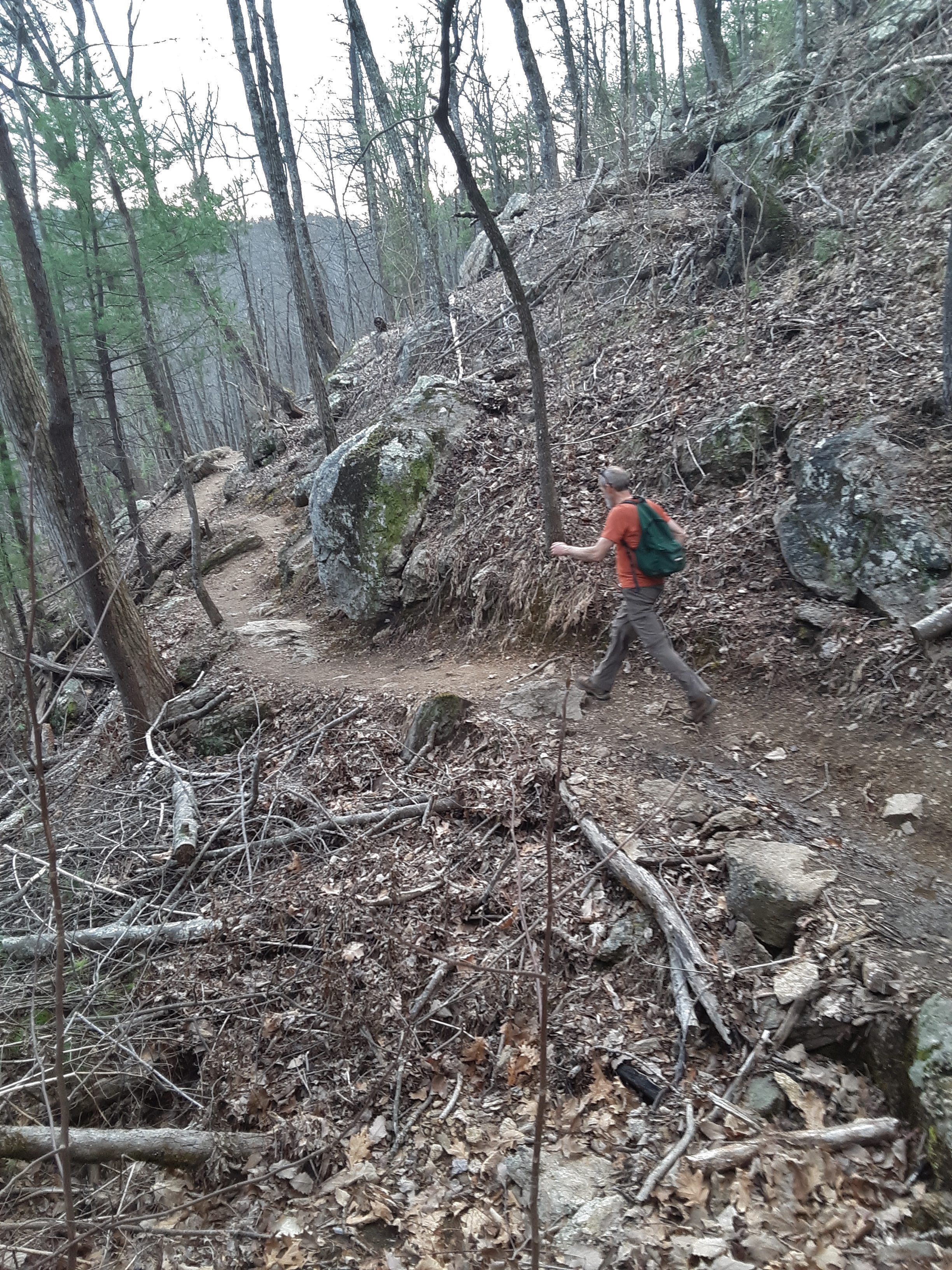
Soon we started off up the ridge onto a trail I observed to my son that I had not been on for perhaps 20 years. He replied that was one way to reveal your age. I did not recognize the trail, however, because it had recently been reworked because of a forest fire that cleared some areas and thinned others.

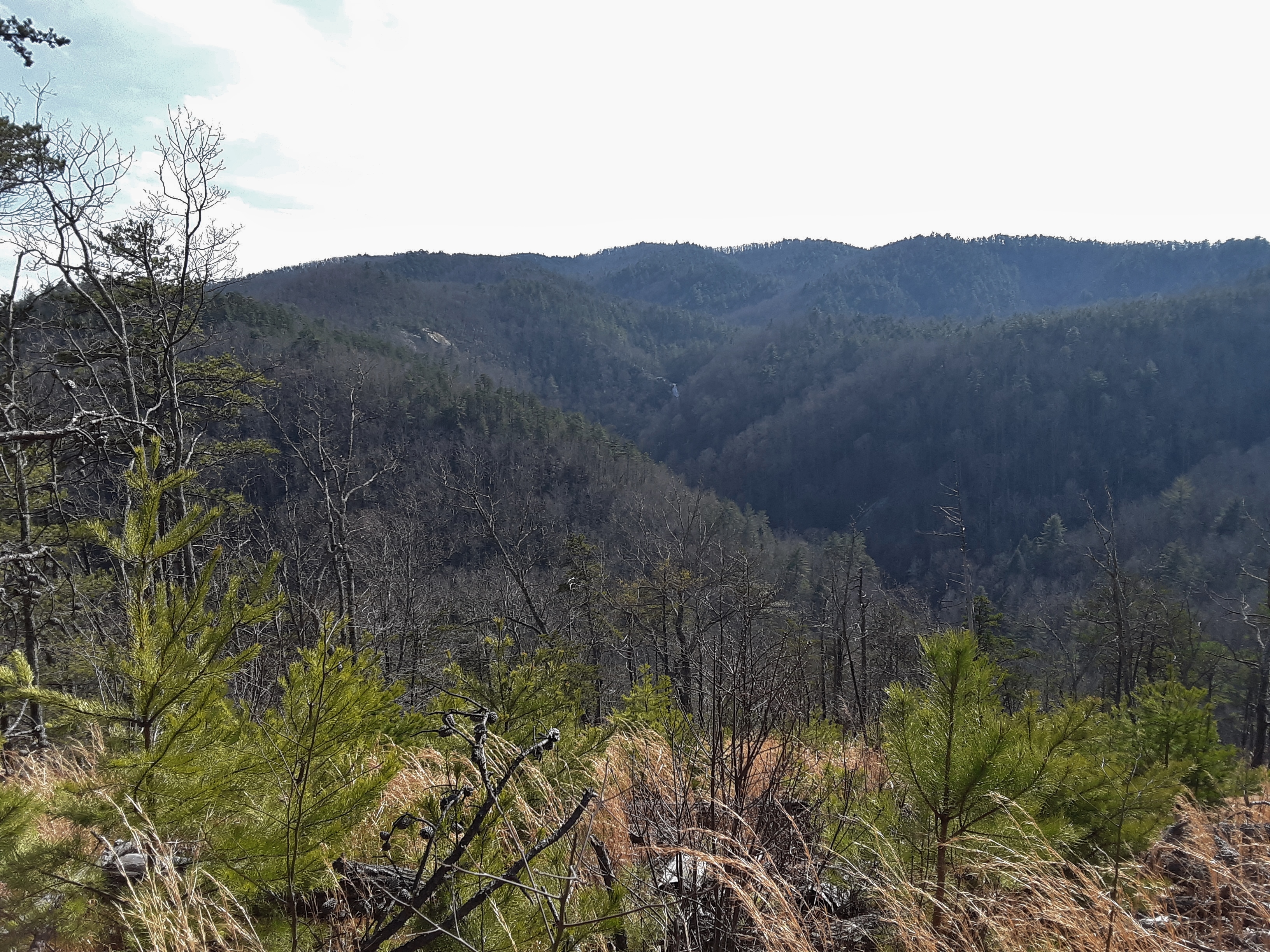
In one clearing where pine saplings were drinking in the full sunlight, we could see High Shoals Falls on the other side of the gorge. Can you pick it out?

A little snack was in order and more water than we would have expected to drink on the last day of February due to the temperature.

The old man enjoyed a little rest in the warm sunshine before continuing on. In reality, the major part of the climb was over at this point.

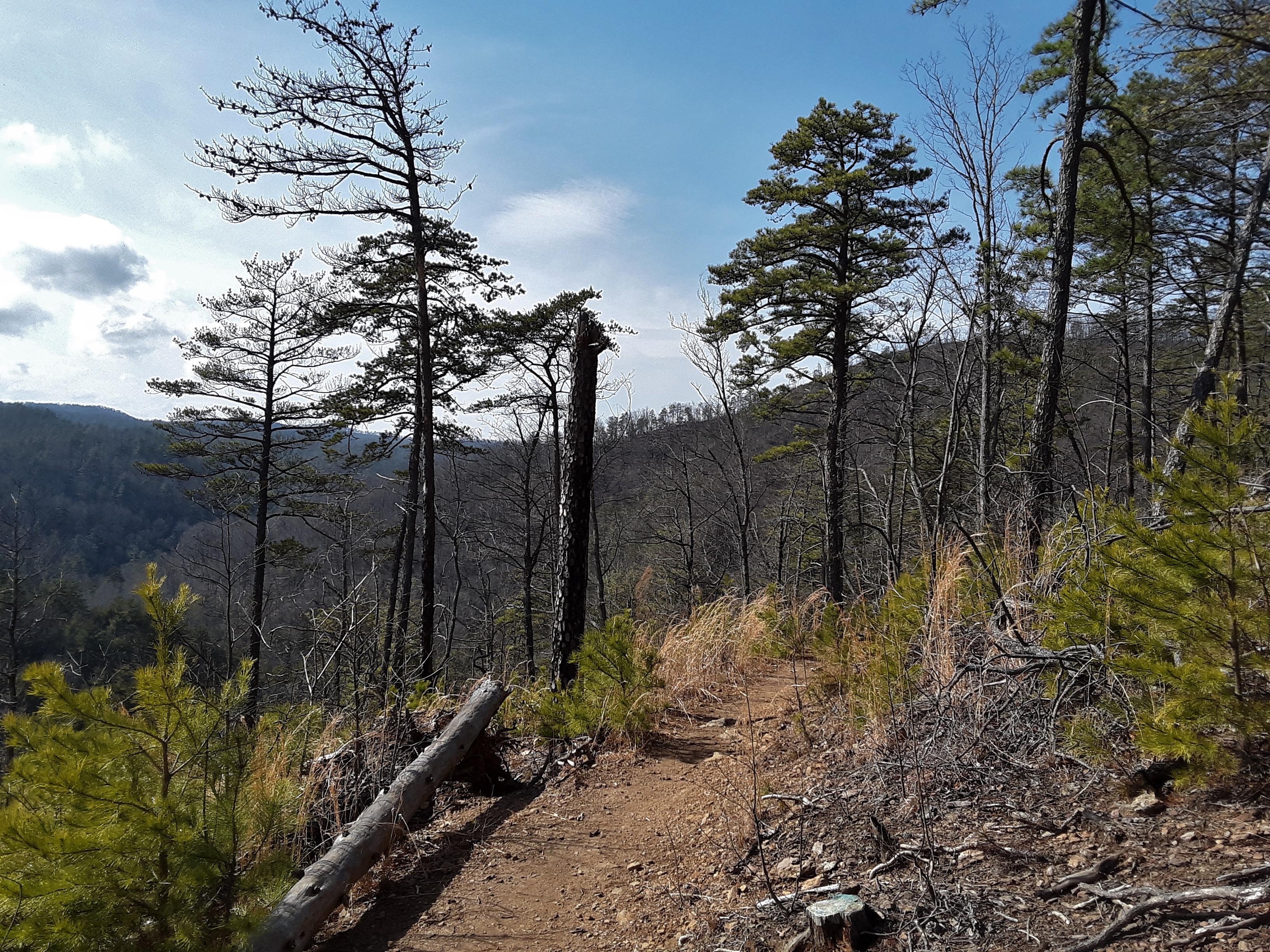
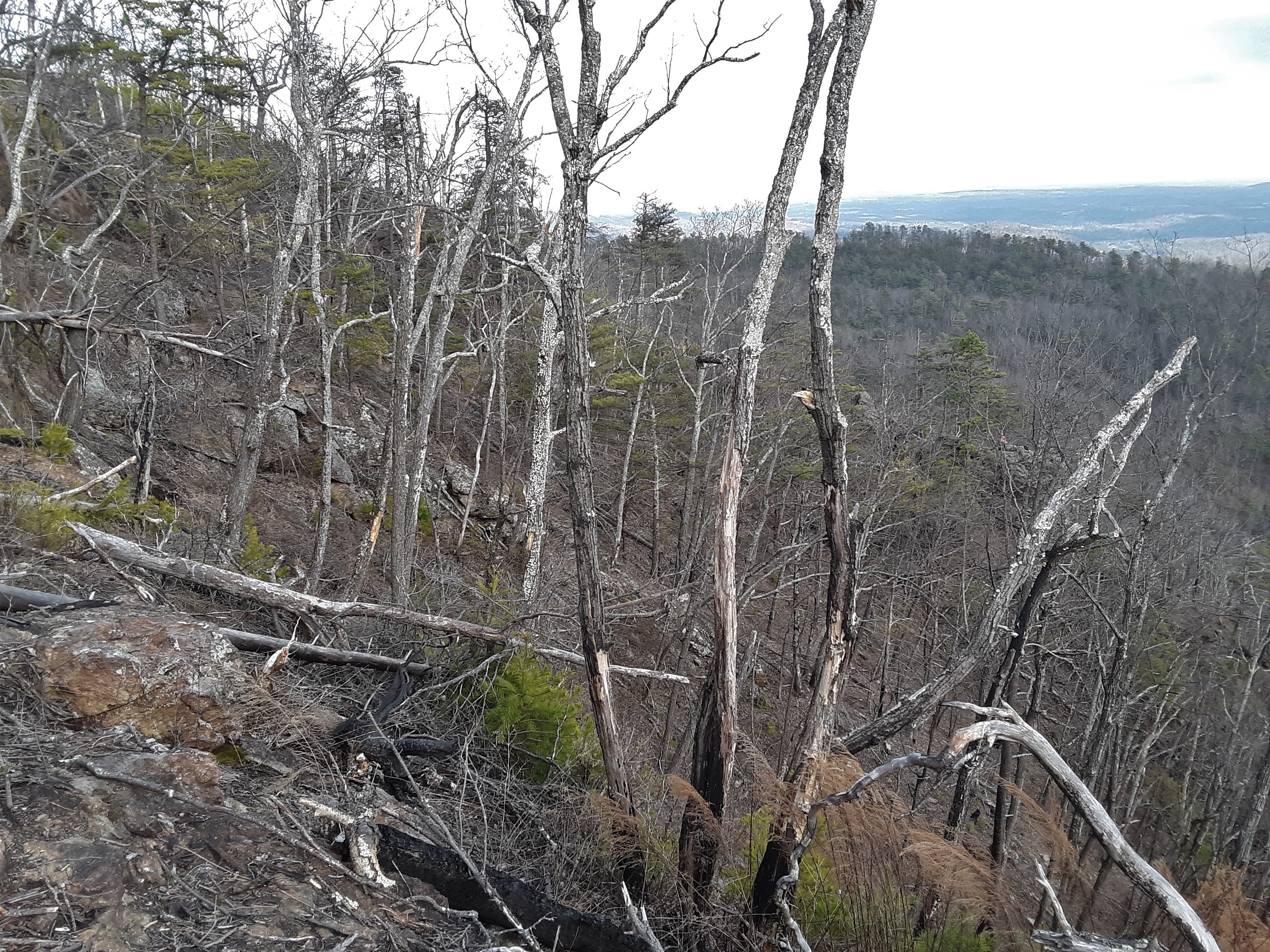
One hates to see so many large trees down, but there are advantages like better views, increased sunlight and the renewal it brings to the forest. On the other hand, fires also allow erosion of topsoil from rainfall, which has been heavy the past two years. Take note that every picture showing the ground has bare mineral soil. Notice also the beautiful blue skies when the camera was not facing south (glare).

When we reached the ridge, the breeze was a stiff but pleasantly cooling wind from the south. My son pointed out the peaks he had been on the day before with his father-in-law. We need to form a party of three for a hike sometime soon.

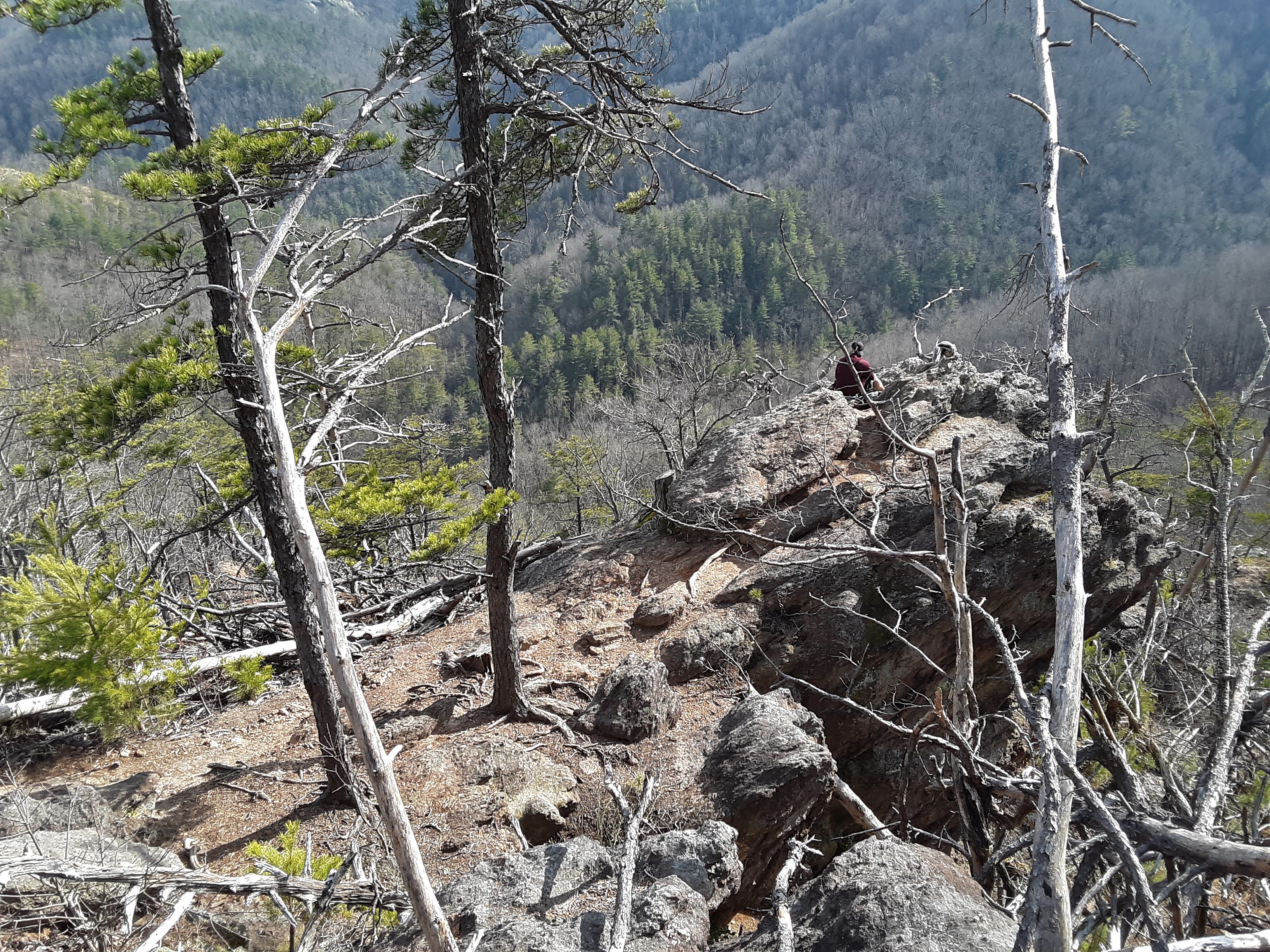
The marked overlook was down to the left of the ridge trail. It had an impressive rock outcropping, but not being near the top of the ridge, it had a limit angle of view. Also, the dude on the rock was listening to loud music and imbibing the combustion products of an aromatic herbaceous species familiar to the olfactory sensors.

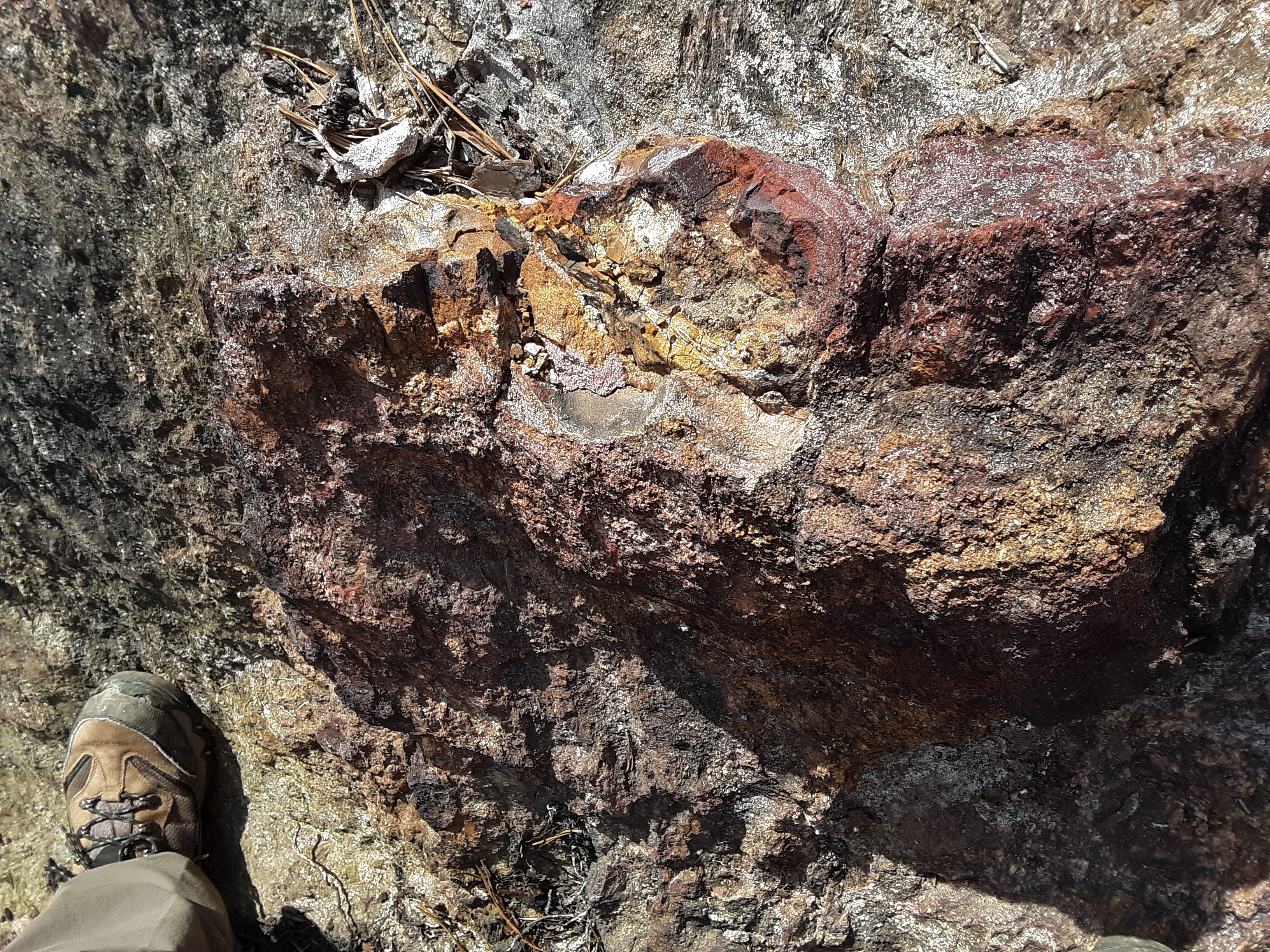
I quickly took a picture of some “overly cooked” metamorphic rock with iron deposits, which was quite brittle and sharp.

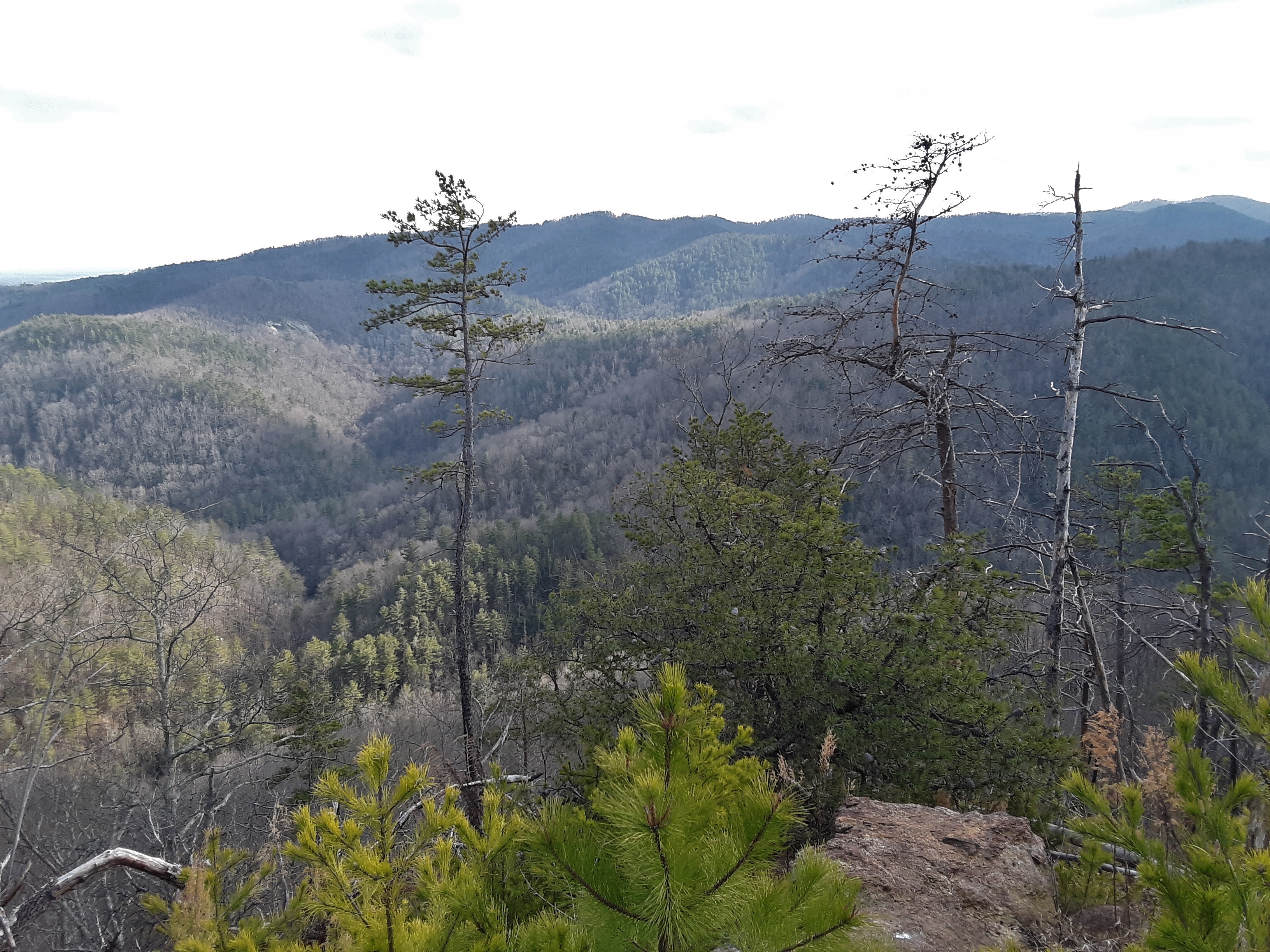
Then we promptly left for a location of more sensory satisfaction on top of the ridge. There we found a less impressive rock outcropping with far more impressive view. It was the site I had remembered from many years ago but with a 270+ degree panorama due to downed trees. We could see deeper into the mountain range, across to the other side of the gorge, and east toward the Piedmont (swinging around from south to east to north in the following pictures). See if you can spot the bright shirt on the lower lookout in the last picture of this sequence.

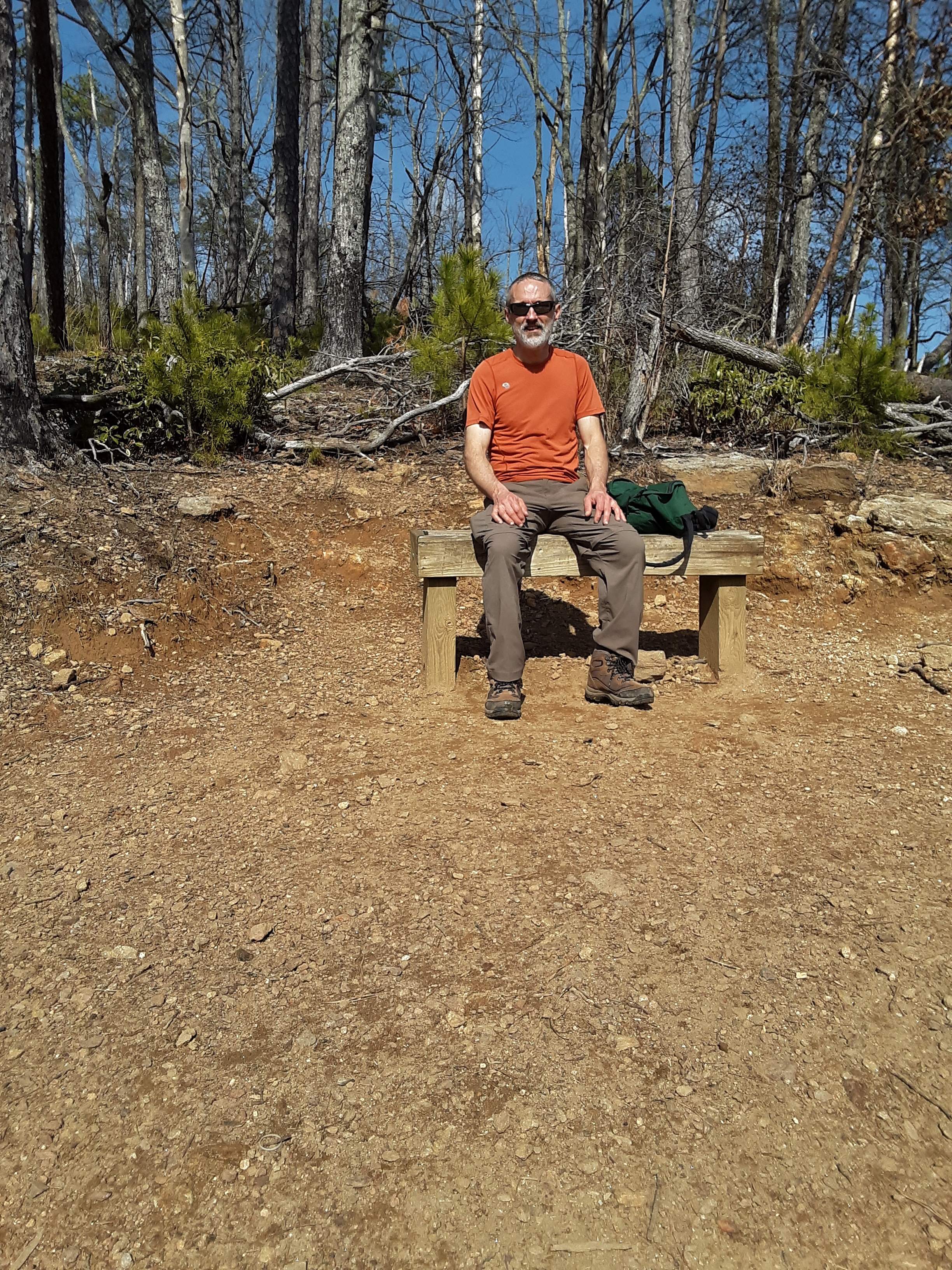
Snack and portrait time

Earlier and further down the slope I had hoped outloud that the fire would result in a quicker transition to hardwoods as it sometimes does. You have probably already discerned how wrong I was. In fact the top of the ridge, where it is quite dry, was spread with Table Mountain Pine saplings, whose seeds only germinate with assistance of fire.

I don’t get many pictures of my son looking at the camera. A certain degree of camera shyness or camera apathy is involved, but also he may be getting back at me for those hikes years ago when I expected him and his brother to keep up. Now the old man mostly sees the his back side as he glides away. The next picture is the very top of Chestnut Knob. I am very skeptical that the top of the knob ever had a Chestnut tree on it. More likely it was named downslope where the abundant producers of food for forest ranging swine were fed.

I asked my son at one interesting turn in the trail on the way down to take my picture when I got to a rock below. That picture actually didn’t turn out so well but several before I got there did.

At the bottom of the gorge my son checked the temperature of the water. It is amazing how much a week of warm weather can warm up a creek after it had been filled with ice just two weeks ago.

The company, conversation, temperature, wind, trail, and views were pleasant. It is always good to get out into God’s Creation for a few hours to reset and recharge.

Read Full Post »

Our daughter came to cook and freeze food for us so that I could get some reprieve from a combination of outdoor and house work. While and because she worked and because the weather and other responsibilities that didn’t allow too much outdoor work, I spent some time with the grandchildren.

Besides cooking, there was also homeschool, because in homeschool, “school is never out”. Of course, the saying alludes to the fact that all situations are opportunities, like the more traditional one pictured and all others, to learn and grow.

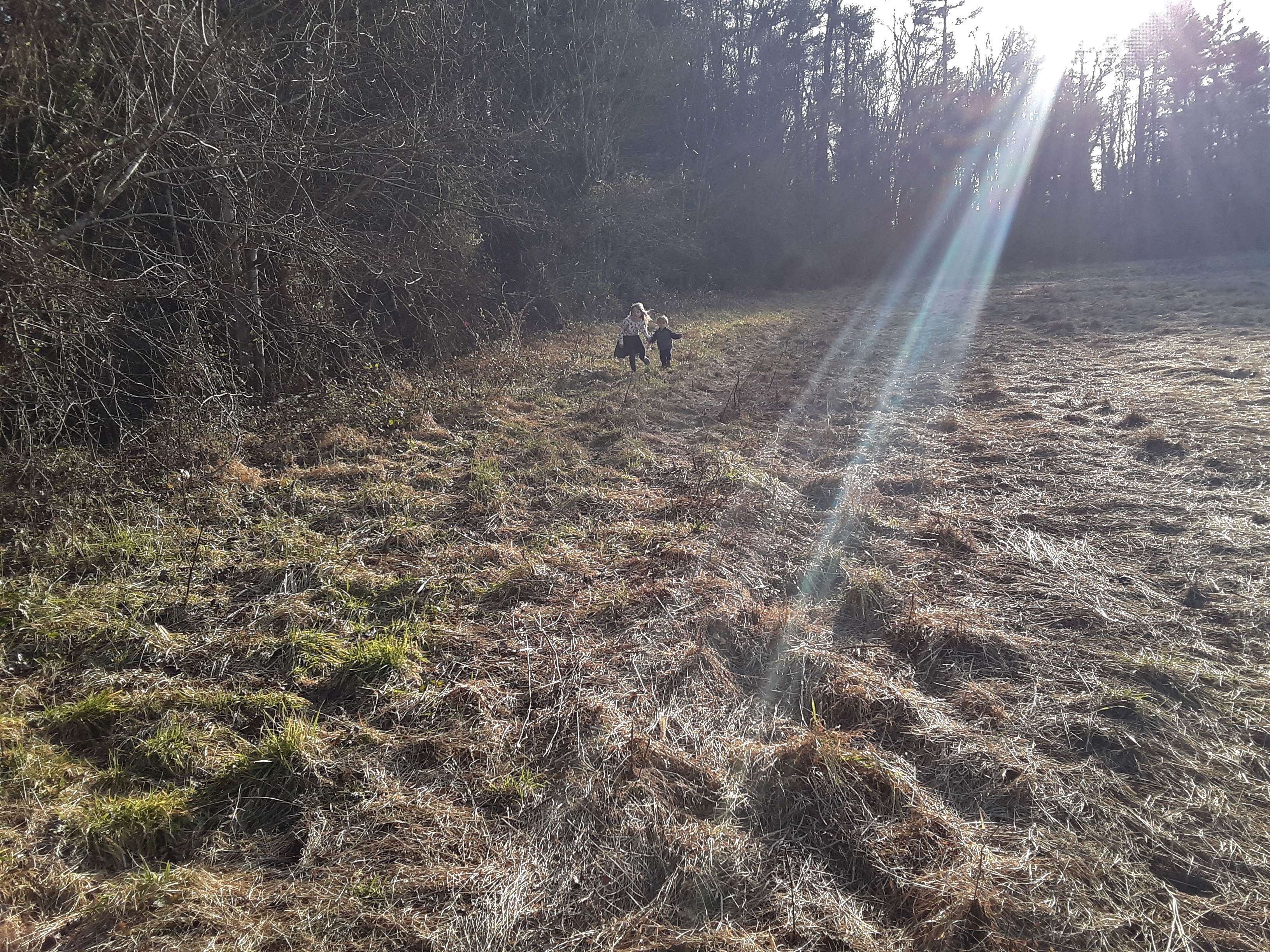
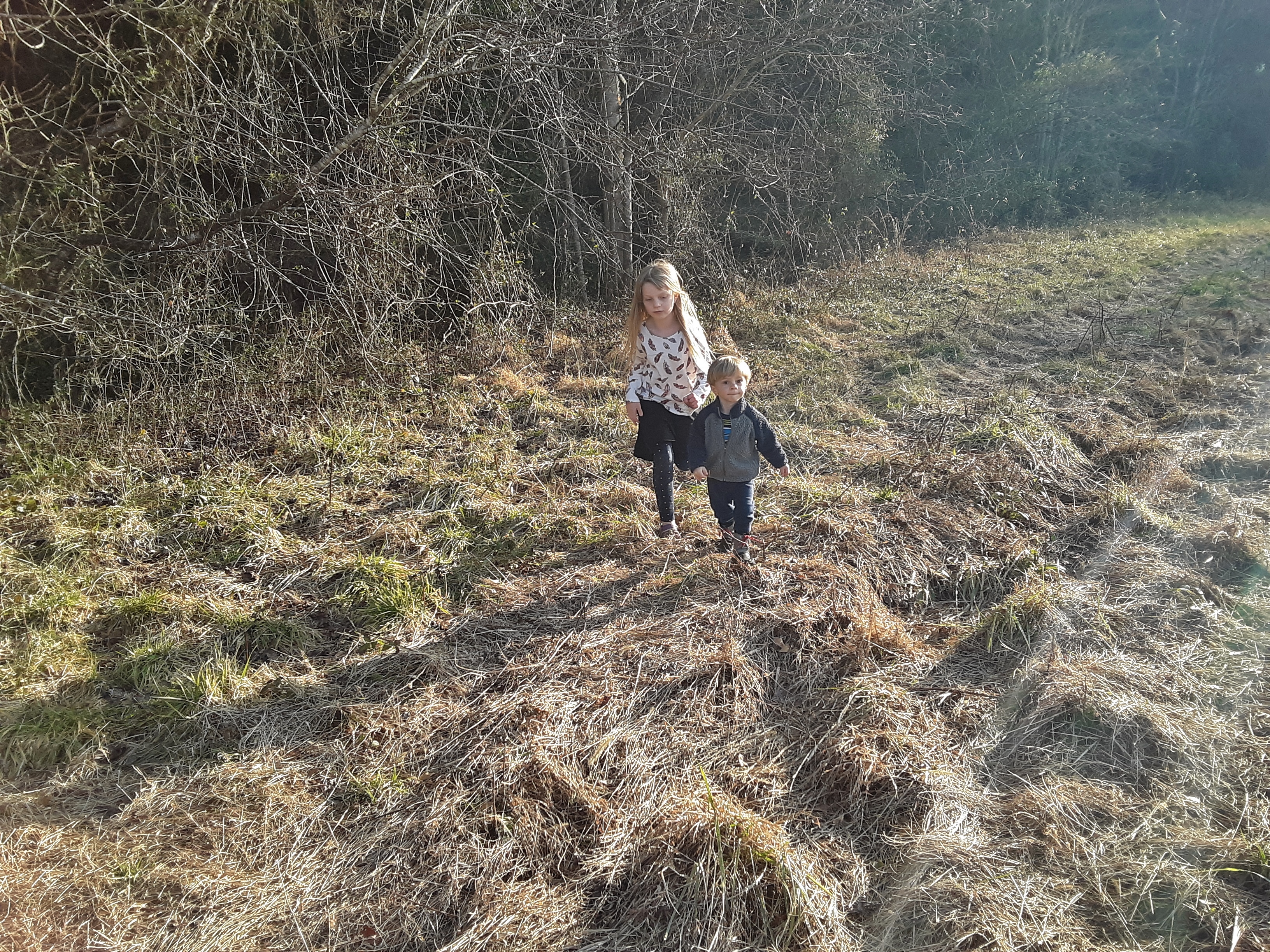
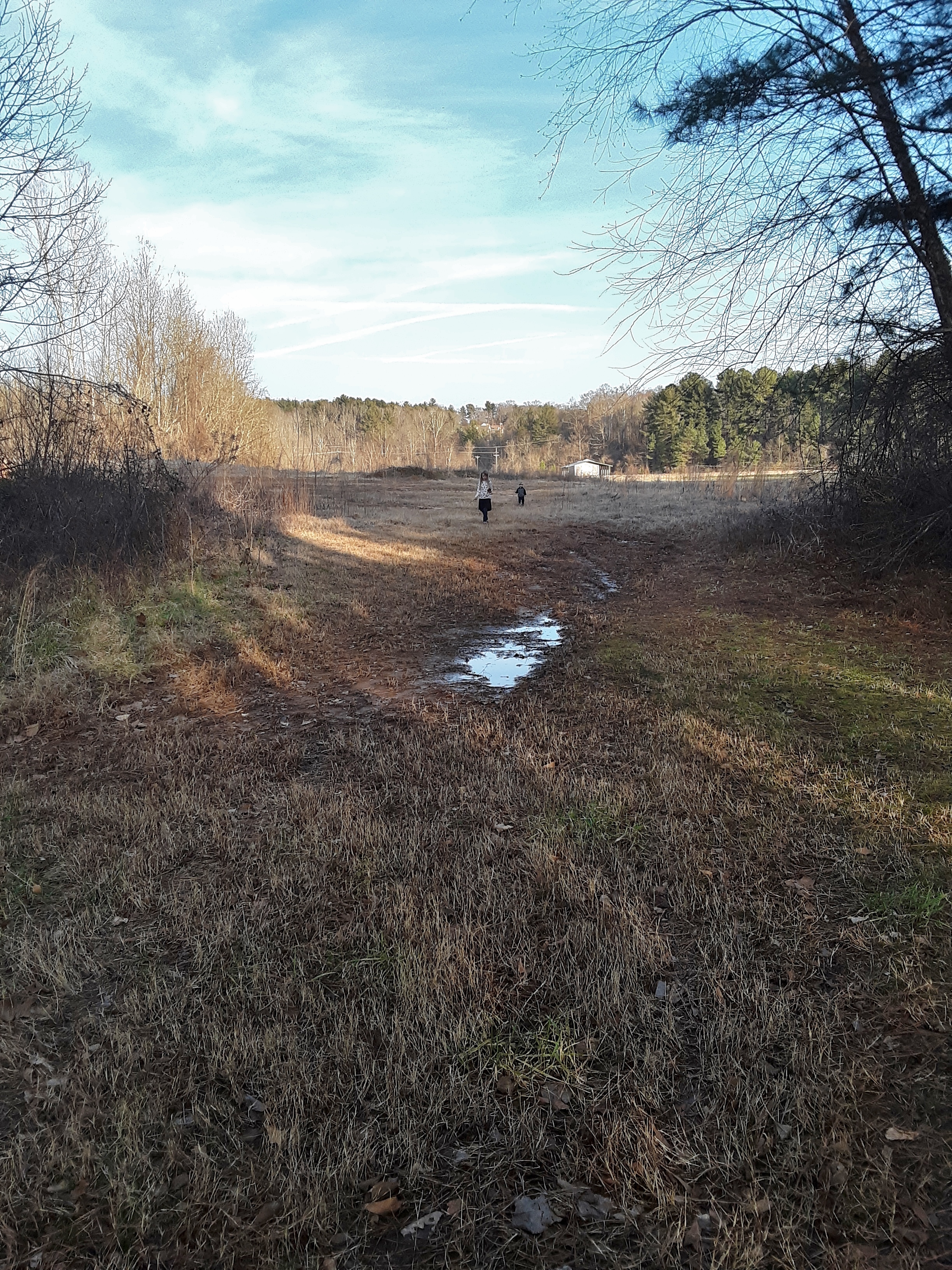
One day we took a walk at the local greenway, except we got off the beaten path to see something different. I guess we will call it a fieldtrip.

We actually walked about 2 miles after an hour or so of playing on the Beanstalk Playfort*.

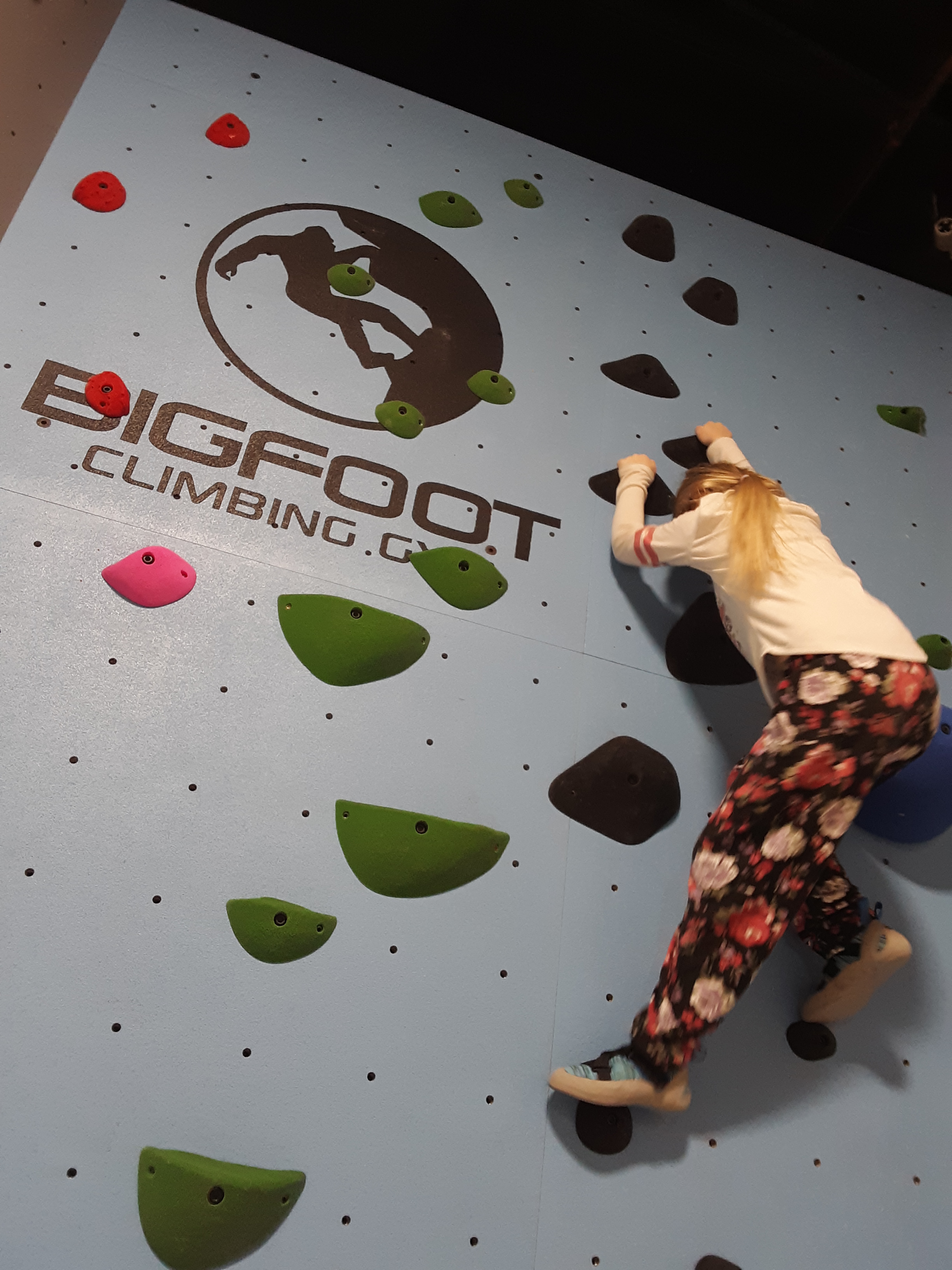
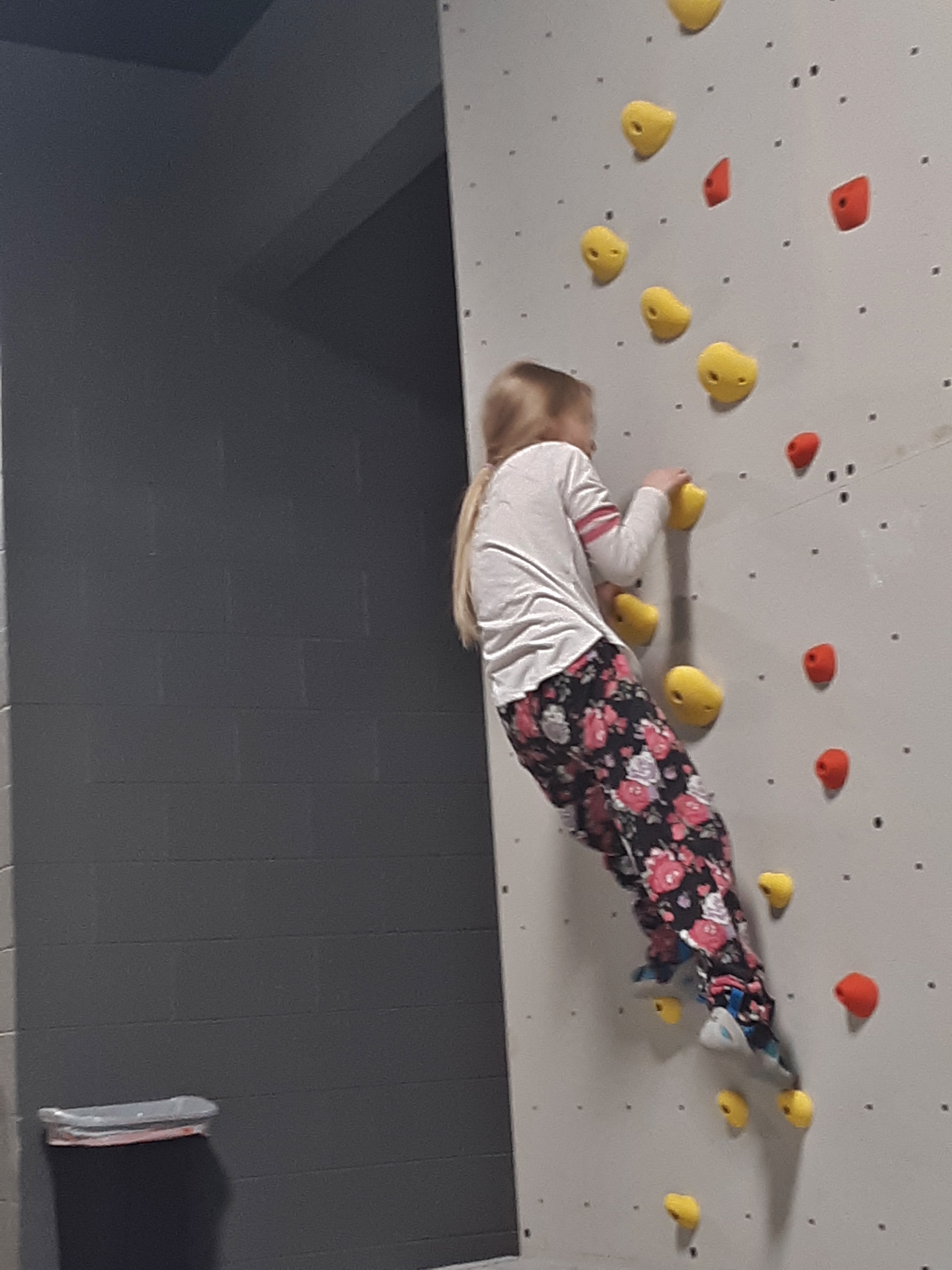
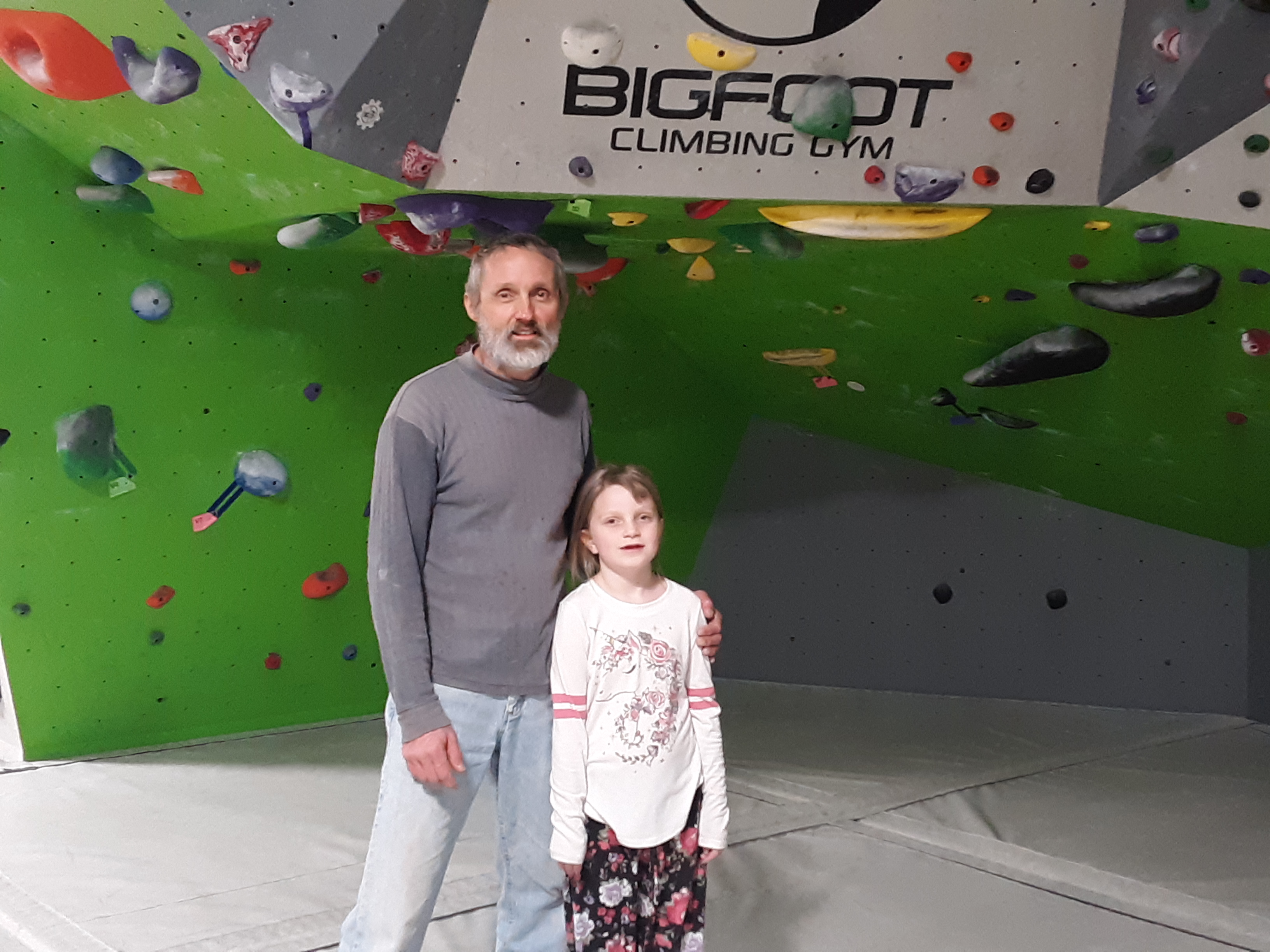
The next day brought continuous rain, so while the my daughter worked and my wife and grandson napped, my granddaughter (E) and I went to the climbing wall.

With a little suggestion and growing confidence with exposure, she began using her toes more and getting to the top more. She met a girl her age with whom she climbed abit.

This was only E’s second time climbing but she enjoyed it thoroughly.

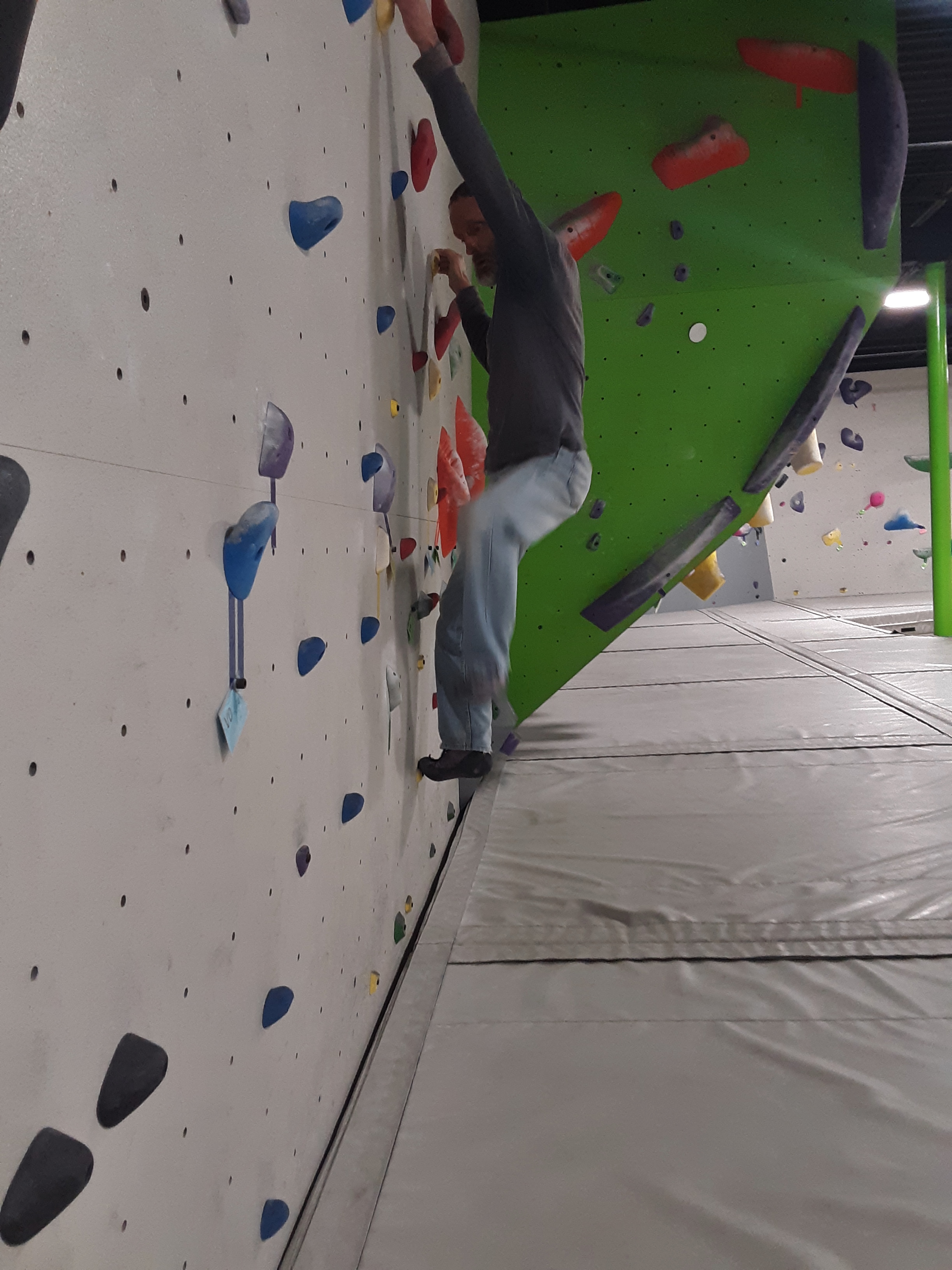
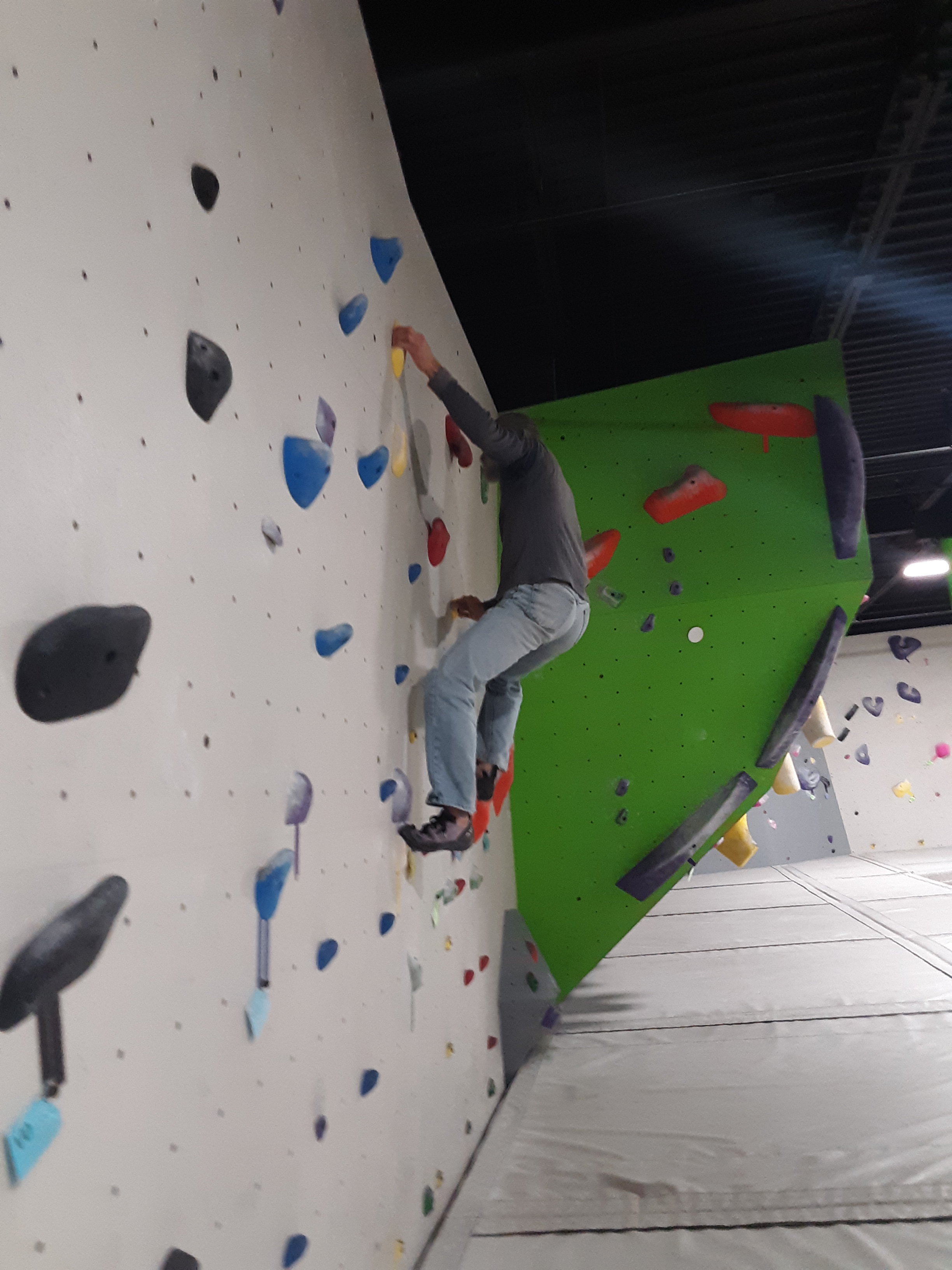
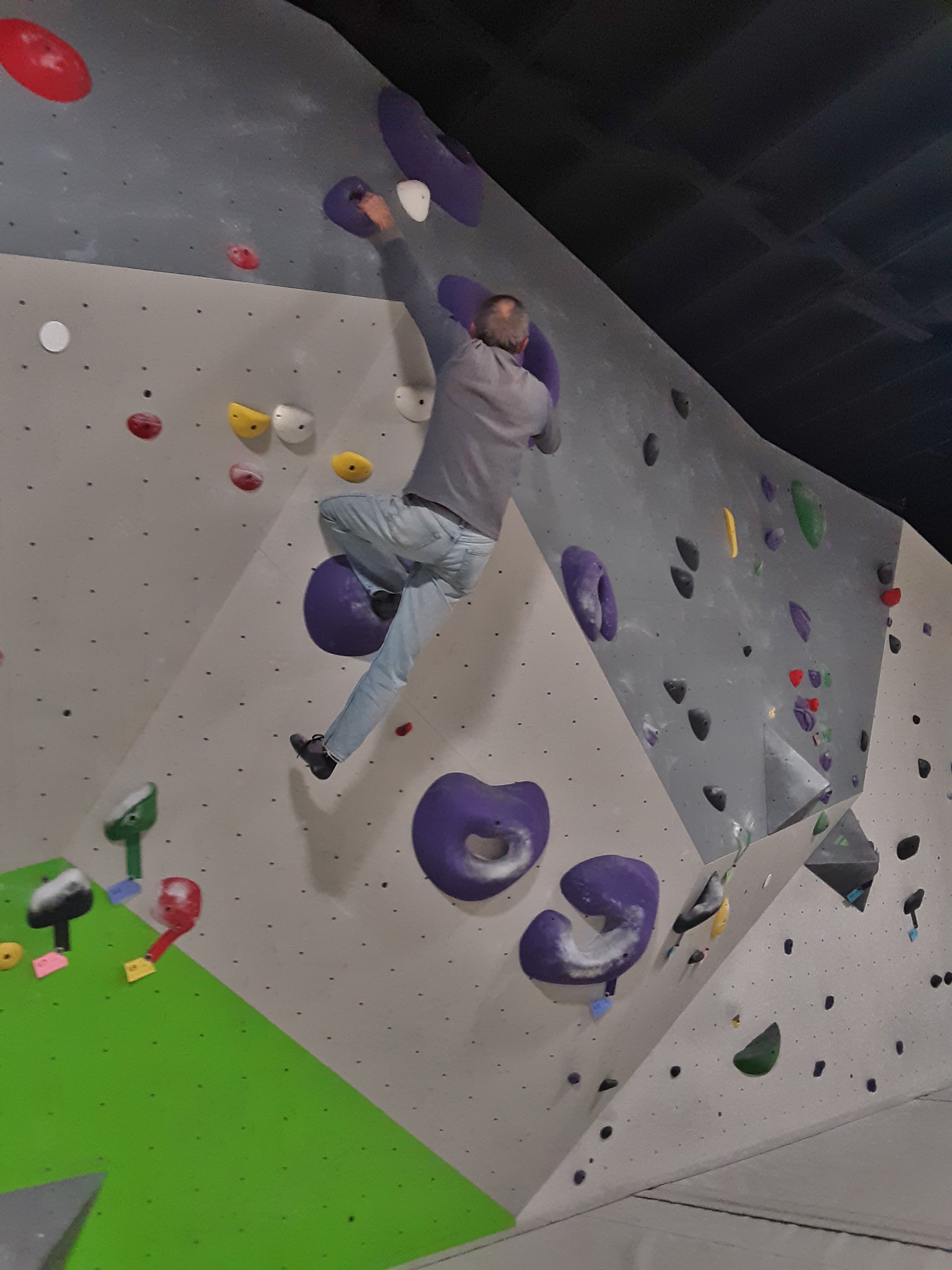
The old man couldn’t stay off of the wall either, even though he’s been declared a bit “off the wall” at times.

The unexpected part was that E had picked up my phone and was taking pictures.

We asked the employee behind the desk and new climbing friend of mine to take a few pictures. I would like to encourage you to check out Bigfoot Climbing Gym**.

I did a traverse around the children’s wall, which was quite challenging, especially these pink and orange holds. Actually, I couldn’t go up them at all and barely traversed across*** them.

We had a fun time and I read to her several chapters of “Tales of the Resistance”, second in a three book series, over the five days they were here. All were encouraged, but I think my daughter was just tired.

*Our local playground pictured here from the website, third picture down on the left.

**https://bigfootclimbinggym.com Check out the 1st anniversary events. It would be a good, inexpensive way to check out the gym.

***Is “tranversed across” a redundant phrase, or does it communicate, as I am trying to, that as I traversed I went across these to climbs?

Read Full Post »

The temperatures have been very variable this winter, frequently ranging from high sixties to low twenties in less than forty-eight hours. We haven’t seen much snow in the valley, but the mountains and west slope have gotten consistent, though not deep accumulations. My youngest son wanted to go for a hike and I wanted to go see a waterfall that I had never seen. We started down the wrong trail, which I pretty much knew as soon as we started, but we saw a waterfall anyway. It was good to get out into the woods in some crisp air. The first picture is of the Hump Mtn heights from Mortimer Road.

Frozen gravel is an odd sight. The air spaces created by the expanding ice make it quite crunchy to step on.

If you have not seen it before, the lacy frost heave of bare soil with excess moisture is even odder to see.

I am a little out of practice, but you can tell the temperature from the position and shape of the rhododendron leaves. They droop more and more as the temperature drops and curl up in the mid-teens degrees F. The following picture shows low twenties. When we first entered the woods in a shady spot, the leaves were hanging straight down, indicating below twenty. I didn’t see any curled on this trip.

Which trail are we on? The color of the blaze tells you. The sunbeam across this Mockernut Hickory bark gives the blaze an extra apparent significance. It makes me sad to see when someone slashes at a tree. the damage to the bark can introduce disease or allow entrance by insects.

Microcosms or micro-environments have long fascinated me from the perspectives of the interactions and completeness of their little ecosystems and the photographic possibilities. If one takes the time to look, there is so much going on in the following picture. And in warmer seasons, insects, spiders, and other arthropods would be combing the surface and subsurface for detrital delicacies and with carnivorous cravings. My son mentioned that spiders can be incredibly small. Having studied spiders, I told him that the Family Microphanidae (1) required a hand lens to even see and more magnification to discern parts. I had identified a few back in the day.

Stone wall, rock outcropping, or tree bark? This one is not so hard to figure out but pictures with a narrow field of view are frequently used for puzzles. The interesting features include moss “leaves” (2) and miniature lichen scales, remnants of snow, insect bore holes, and the platy form of pine bark.

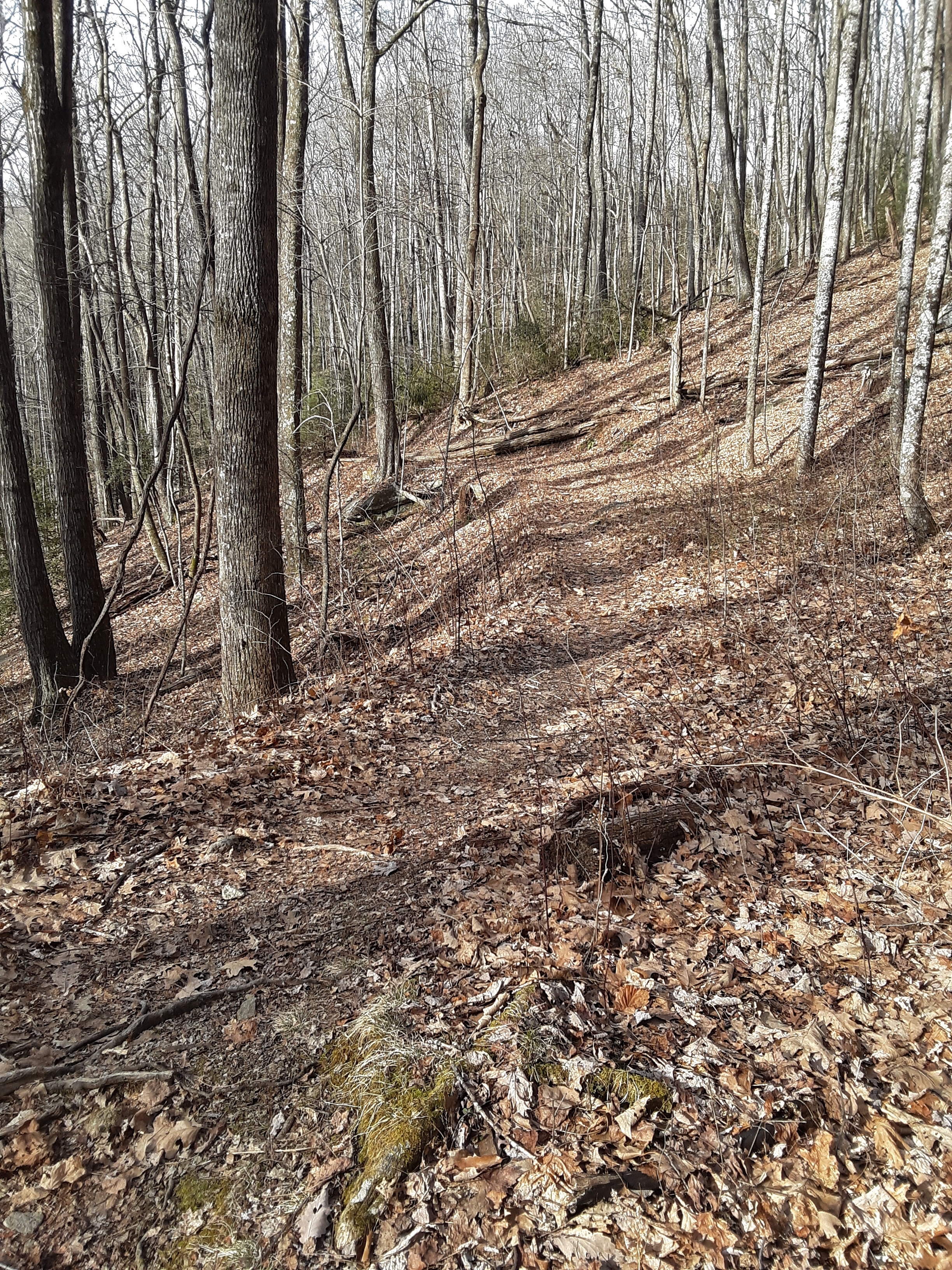
I like the open hardwood forest which has such a stark, leafless beauty in winter.

The quietness of the woods soothes, quiets, and focuses the mind. Work and societal stress are well coped with by the occasional few hours in the woods. Rhododendron thicket ahead! It means increased ground moisture and change in aspect. (3)

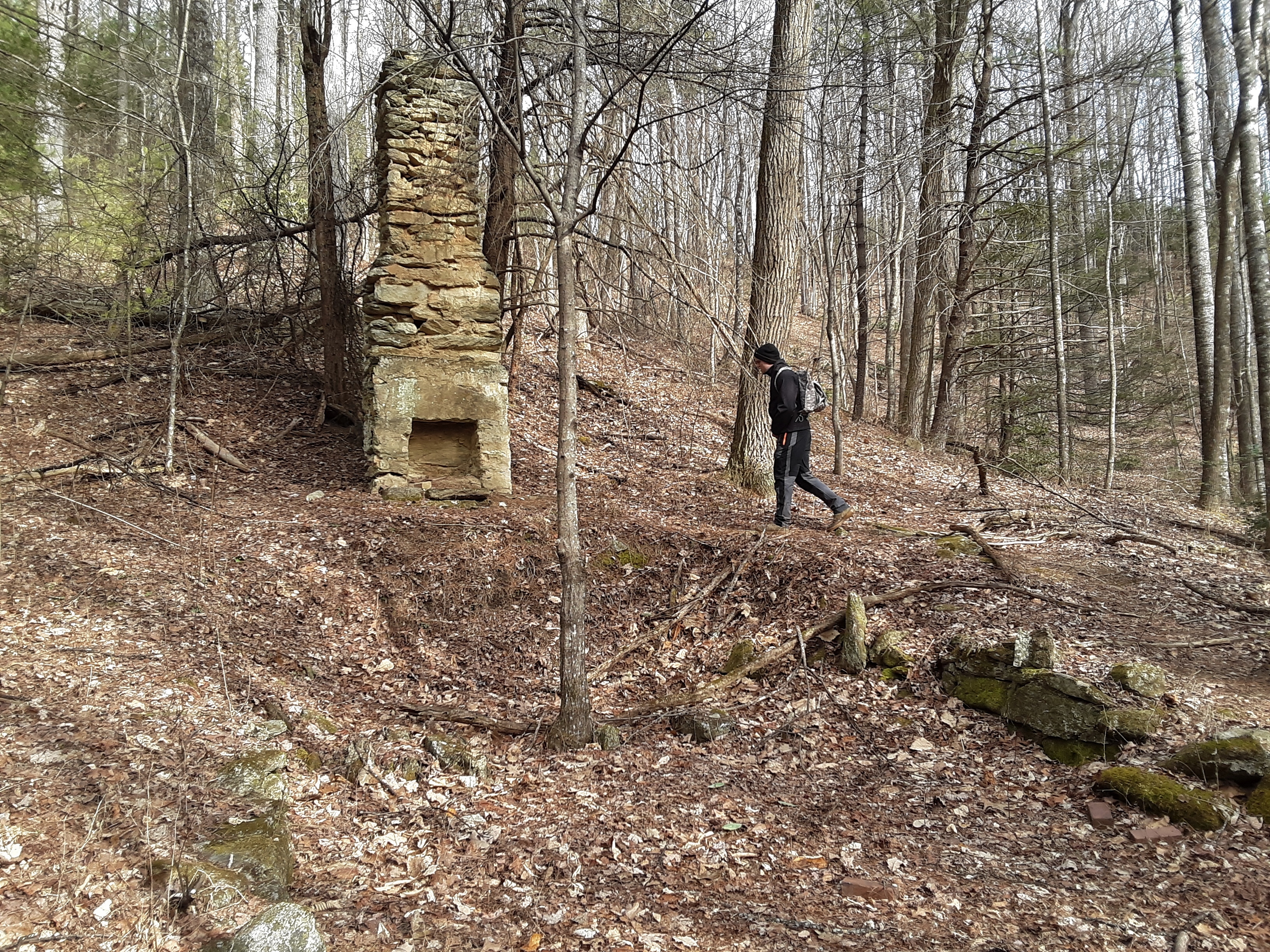
Chimneys in the woods are not uncommon, but this one is in particularly good condition. My son thought it might be an old store next to the logging road.

The old cookstove has seen better days. I had hopes that the nameplate was on the door, but someone had removed it long ago. It would have been cast-iron and not so deteriorated as the plate-steel guts of the stove.

My son wanted to see how thick the ice was. Given the fluctuations in temperatures lately, it surprising that it was about 2 1/2 inches. Composed of three distinct layers, it had vertical striations of air bubbles ending at clearly seen interfaces between the layers.

A full week of consistently cold temperatures would render this cascade flowing under the ice. The edges were icing.

Only a video can show this next curiosity of bubbles: Click on https://youtu.be/HAeuLXcRzyg to see the short video.

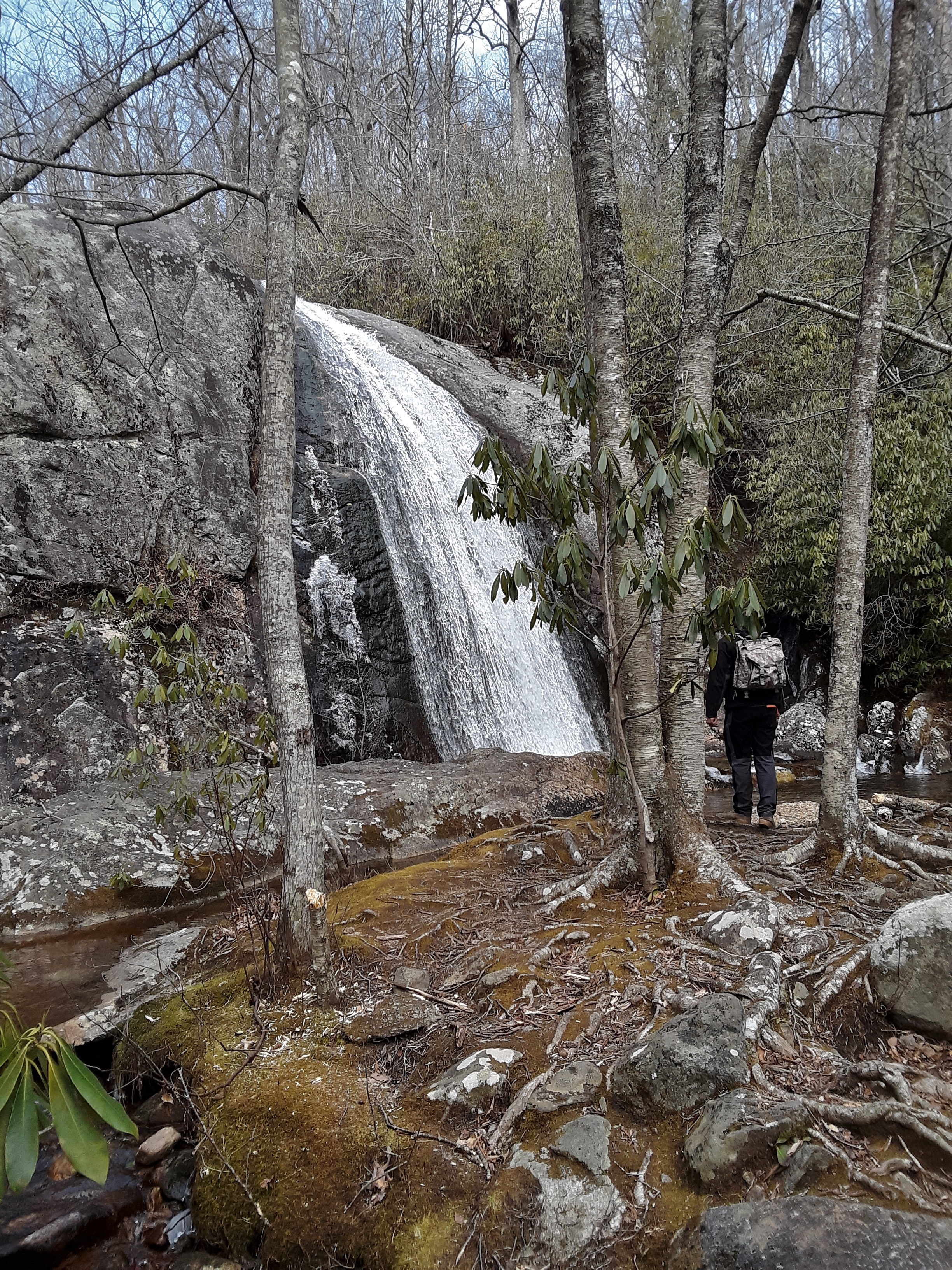
North Harper Creek Falls runs down perhaps 150 yards of 30 degree sloped rock outcropping to then fall over a 25′ cliff at the bottom. It occurred to me that the water slips into the pool and makes far less noise than most falls. The picture shows moderate flow for this falls.

You can tell it is cold when I bring out my Australian surplus army wool paints, Canadian down skiing vest, and purple heavy weight fleece pullover. As I get older it takes less cold to pull out the serious gear. We actually saw two trail runners, one of whom was wearing shorts. I guess they didn’t stand still too long.

This spot has memories. I once did a homeschool ecology lesson from this spot. As you can see from the view, this spot feels totally out in the middle of nowhere. It is about as close as you can get to it in my neck of the woods.

Right at the beginning of the trail it crosses private property. The confirming indicator is the corner marker. The government clearly marks their corners.

In fact, they are hard to miss.

I wonder if it is advisable to report an unwilling or accidental destruction, defacing, change, or removal?

Early in the hike as I was making a creek crossing, my left foot slipped on ice and plunged into the creek over the top of the boot. It could have been worse. No injury and nothing else got wet. I poured out the water and walked without a sock on my left foot for perhaps a mile. My heel began to tell me a blister was in my future, so I told my son that I would take him up on his offer to dry out my sock. We found a wide spot on the trail where there was totally bare, mineral soil. My son gathered small dead umbels (4) of flowers that he said are always dry even when it is raining. We both gathered leaves and twigs up to about thumb diameter. He got quite the hot little fire going and fed it while I rotated my sock near the base causing steam to rise from it. I have one regret concerning this blog entry. I was so intent on drying my sock that I never thought to take a picture of the fire. My son did do a thorough job of spreading the embers and stamping it out before we left. I crossed the creek at a different place on the way back.

I was thankful to be able to get out and enjoy the quiet and talk with my son and see beauty. Before we left, with the assistance of the runners’ map, we found the trailhead where we should have begun. We are determined to return soon. I thank God for the beauty of His Creation and His kindness toward me to allow me to hike for so many years and still yet.

  1. I would not be at all surprised if you cannot find any reference to that spider family name. Classification Scientists love to change things around, especially since they believe, falsely as I believe, they have found the key to classification in DNA comparison phylogenetic trees.
  2. Mosses do not have true leaves because they are non-vascular plants and lack the complexity of leaves.
  3. Aspect is the compass direction of slope, which determines amount of sunlight, drying, and temperatures.
  4. Umbels are arrangements of flowers in an umbrella shape.

Read Full Post »

I share a random day in my little town. Actually, the following pictures are a composite of several days. I like to take walks in my neighborhood. It’s my constitutional, a time to think and decompress, and I always look for something new, be it ever so small.

I went out early to go to a jobsite. The Eastern sky was aflame.

After work I went for a walk. The head welder at a nearby muffler shop finds time for more creative uses of his talents than muffling exhaust. A quick Google search in images informs me that other people are doing this kind of thing, but I see some real creativity in these “Tin Man” models. This lady, out for the day shopping, was the welder’s first attempt.

Sponge Bob and friends came next. The color really adds something to the art.

My favorite part of the boy is his skateboard, which I think is made from a catalytic converter.

The wry grin, copper corded beard, and fretless electric guitar are quite the sight. The alien looks like something straight out of Star Wars. I like his manifold pants.

Brenda the Good Witch or the Wicked Witch of the West?

Rudolph parked in the corner for next season.

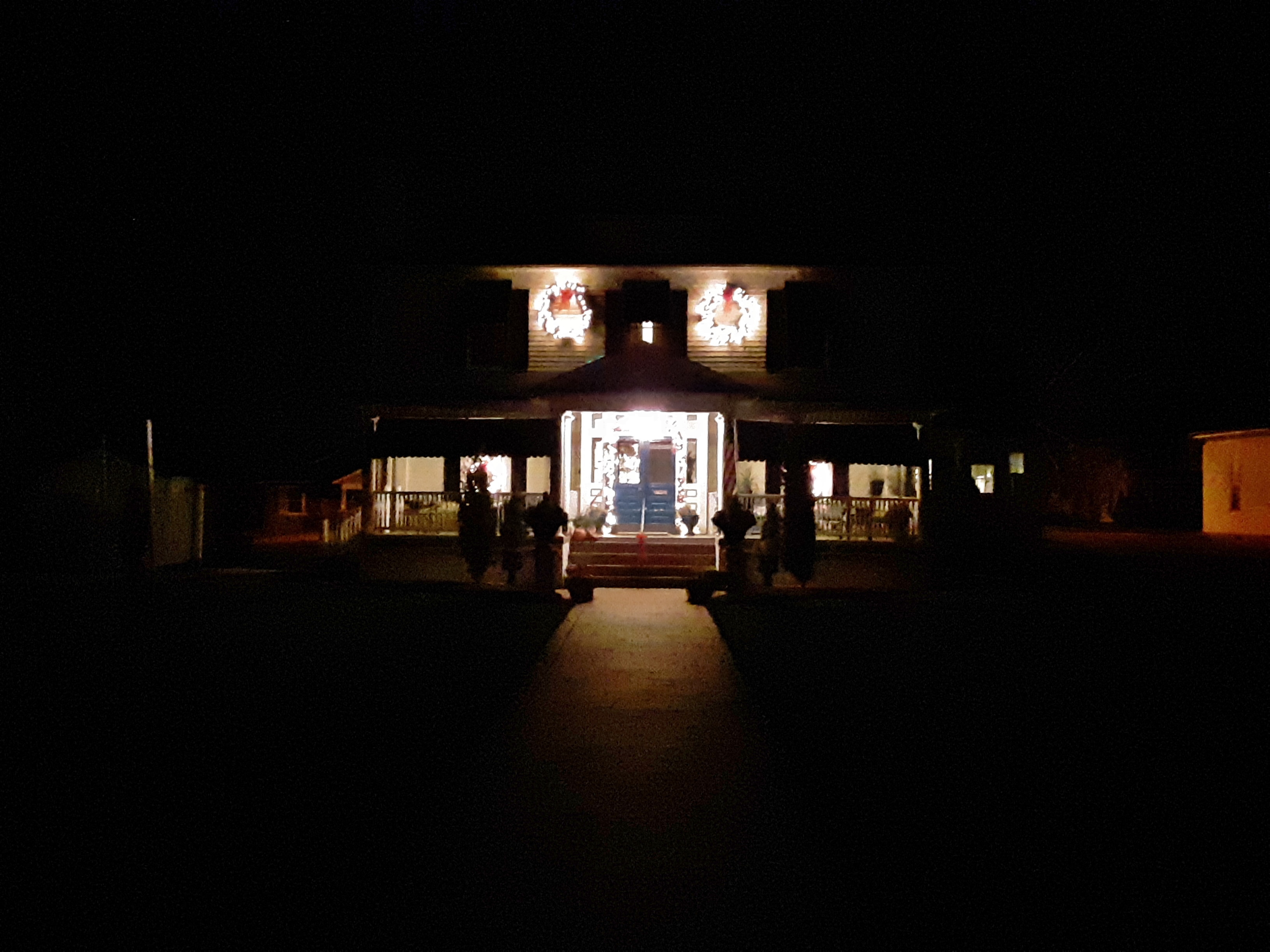
Simple decorations for the Advent Season are the most appealing to me.

Cascade Park is a quiet little piece of woods in the middle of town. Different seasons, temperatures, and flow make it worth coming to see many times over. It is a good urban space to take first time visitors to when you go for a short walk.

Each type of tree has its own form of crown, which if not disturbed by trimming reveals the species. Pitch Pine is a well shaped tree.

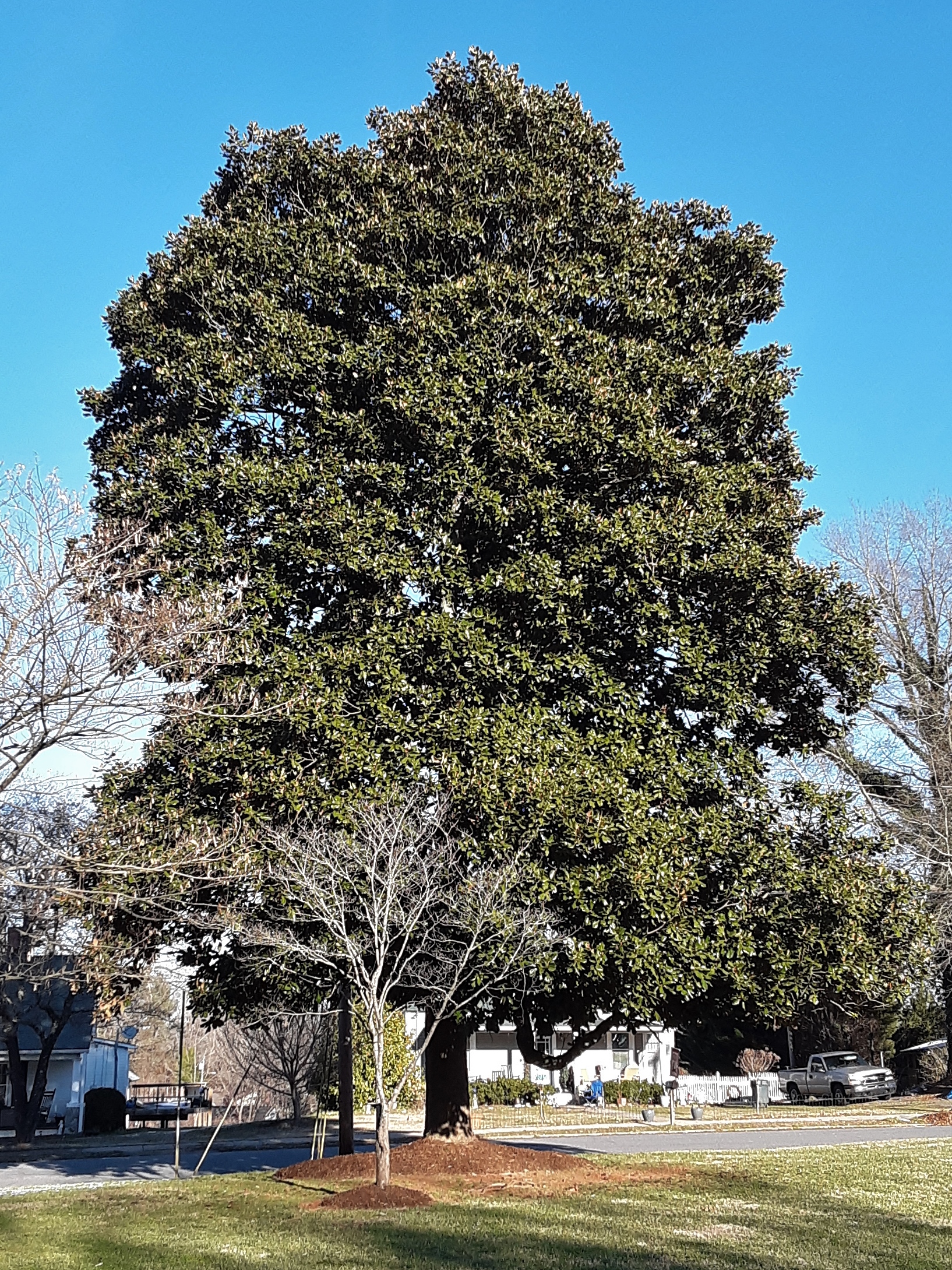
Southern Magnolia was originally only native to the Gulf Coastal Plain. Now it is an ornamental all over the South. Since it can live and compete successfully in all of the growth zones, why didn’t it? I suggest it is evidence that the period since the Flood has not been so long. Starting from some few plants it spread over the deep South but didn’t make it any further in the time allotted. It is easy to see why Dogwood is an understory tree. They don’t get much larger than the one pictured.

Oaks trees are ubiquitous in this part of the country. But which of the 15 likely varieties is this treeform? It certainly is of the redoak rather than whiteoak grouping. It is quite large with a spread crown so it is likely Southern Red Oak, Black Oak, or Northern Red Oak.

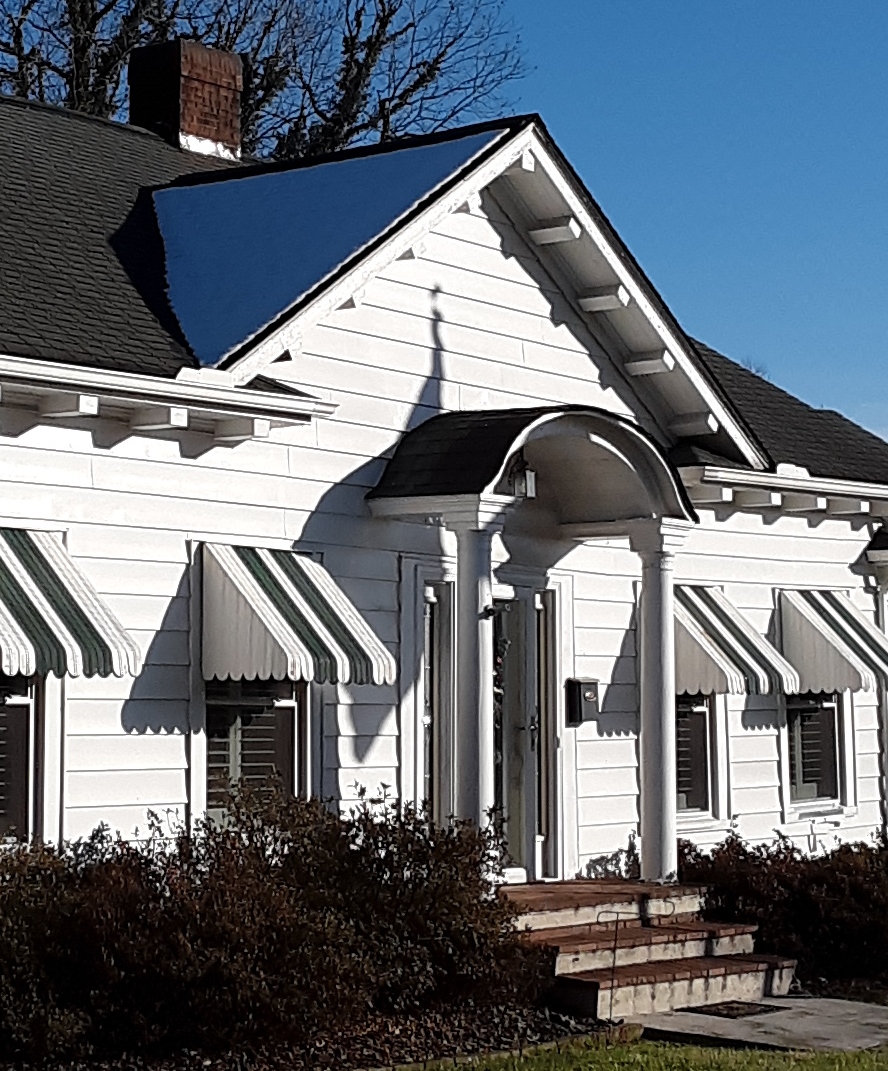
I took this picture for three reasons. Firstly, you can see that the hour is past midday and the low angle winter sun never shown on the heldover snow. Secondly, the front porch canopy is unique and nice. Thirdly, the old fashion window awnings are a Southern touch to keep out the hot summer sun.

Long may it fly and what it symbolizes stand. “I tremble for my country when I reflect that God is just; that his justice cannot sleep forever.” Thomas Jefferson

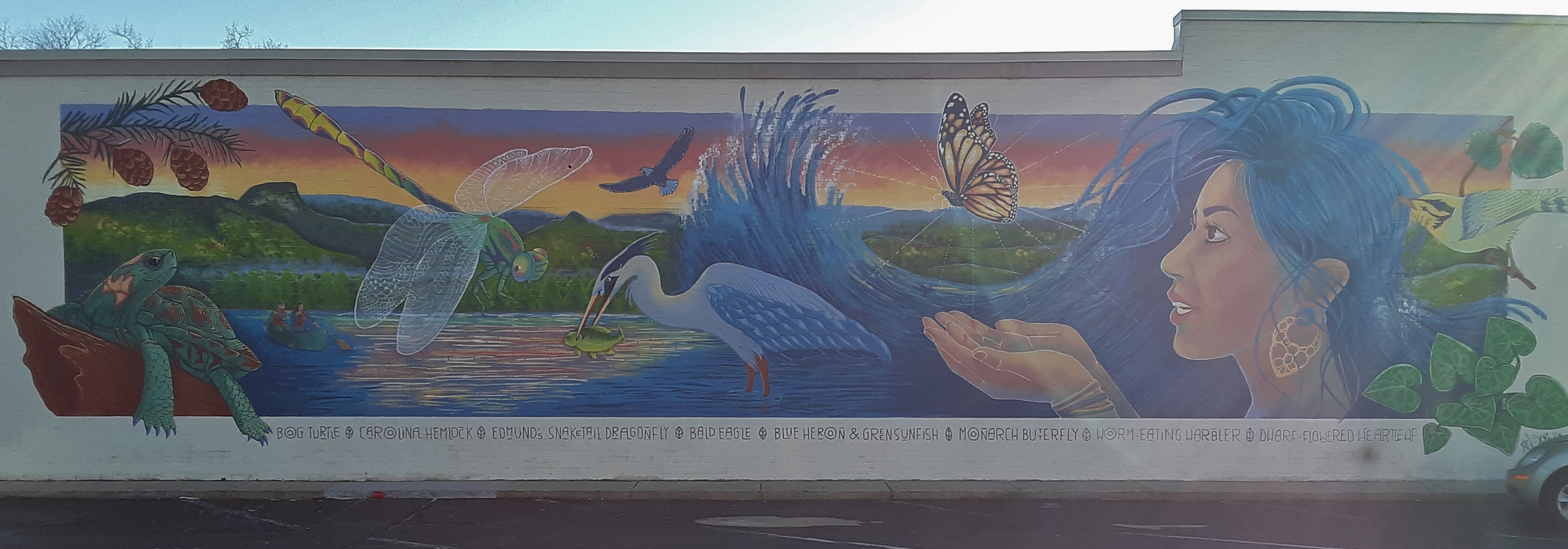
In order to highlight our town’s diversity, the local business commissioned this mural on the side of the local climbing gym. I shows a very Latin American woman in a very Western North Carolina habitat.

I could do a whole blog entry or two on the local architecture. I love big porches. This house also has local fame because a former president sat on the porch during a campaign rally.

Genuine randomness here. Did you know that the color of the hydrant cap reveals the flow rate it can generate so that the firefighters know what they have available?

Red: 500 gallons per minute Orange: 500 to 999 gpm

Green: 1,000 to 1,499 gpm Blue: 1,500 gpm or greater

Also, did you ever consider that hydrants have not changed form substantially for a century?

The sky alight with setting sun and condensation trails is an interesting sight.

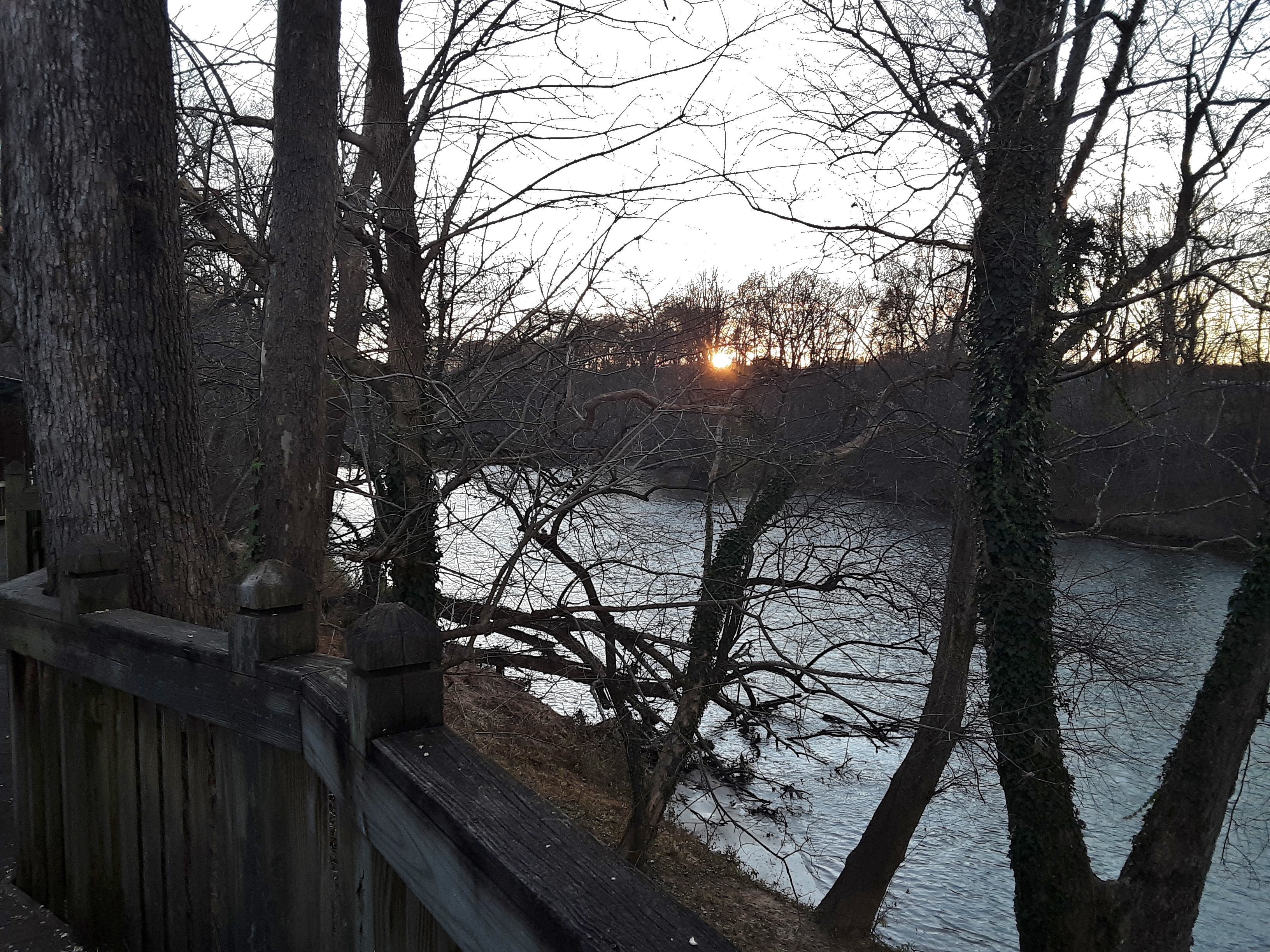
A walk by the river at dusk is always pleasant, even though it can be quite chilly this time of year. Cold drainage and moisture from the river seem to make the cold penetrate more.

This is proof that old dogs can learn new tricks. In fact, I really like the new garlic press that got online. It is soooo much simpler to clean.

I hope you may have as nice of random days as I have. I am so very busy and blessed and challenged.

Read Full Post »

I worked on a deck project for about half of the day before my son and his wife came for lunch. I thought we would be sitting around and talking, but he declared that he, his wife, and his brother had planned a hike for the afternoon. I asked to come along for what was a surprise outing on my birthday.

My youngest son decided that he wanted to enter the woods downstream of the main parking lot. The lower lot was full so we had to walk down the road a bit to get to where we wanted to begin on the trail.

I guess they didn’t want their picture taken.

For a change of pace we did the usual trail to the falls backwards, hiking up the long, steep, old logging road to a point above the falls. On the way up there is one small view of the waterfall, which was further obscured by fog this day. The backlighting of the fog caused outlines around twigs in the following picture- odd.

High Shoals Falls through twig and mist

Fog precludes panoramic views but it quietens and narrows the woods down to a more introspective view.

I think that my earth tones blend well with the trunks and leaves.

Sometimes bridges are provided which helps when the water is up and cold. This has been another year of excessive rain, so clogged and sand lined creeks are common.

There is always something foreboding about the top of a waterfall.

Most rock can hold its own weight up, so what level of forces are needed to crack boulders in this way and what supplied it?

The following picture has a number of curious elements. Check out the lower trunk on the small tree a the right. What happened to cause that? The moss testifies to the fact that this area is always wet, not just during a damp fog. The couple are frame perfectly, observing nature, and yet seem out of place somehow. There has been much slippage for these boulders to lie just so. The noise and action of a waterfall never ceases to grab our attention, but there is so much more going on if we look closer.

The splash zone of this waterfall and rapids below is quite large so there are plenty of Hornworts, Liverworts, Mosses, and Ferns. Check out the Doghobble at the right.

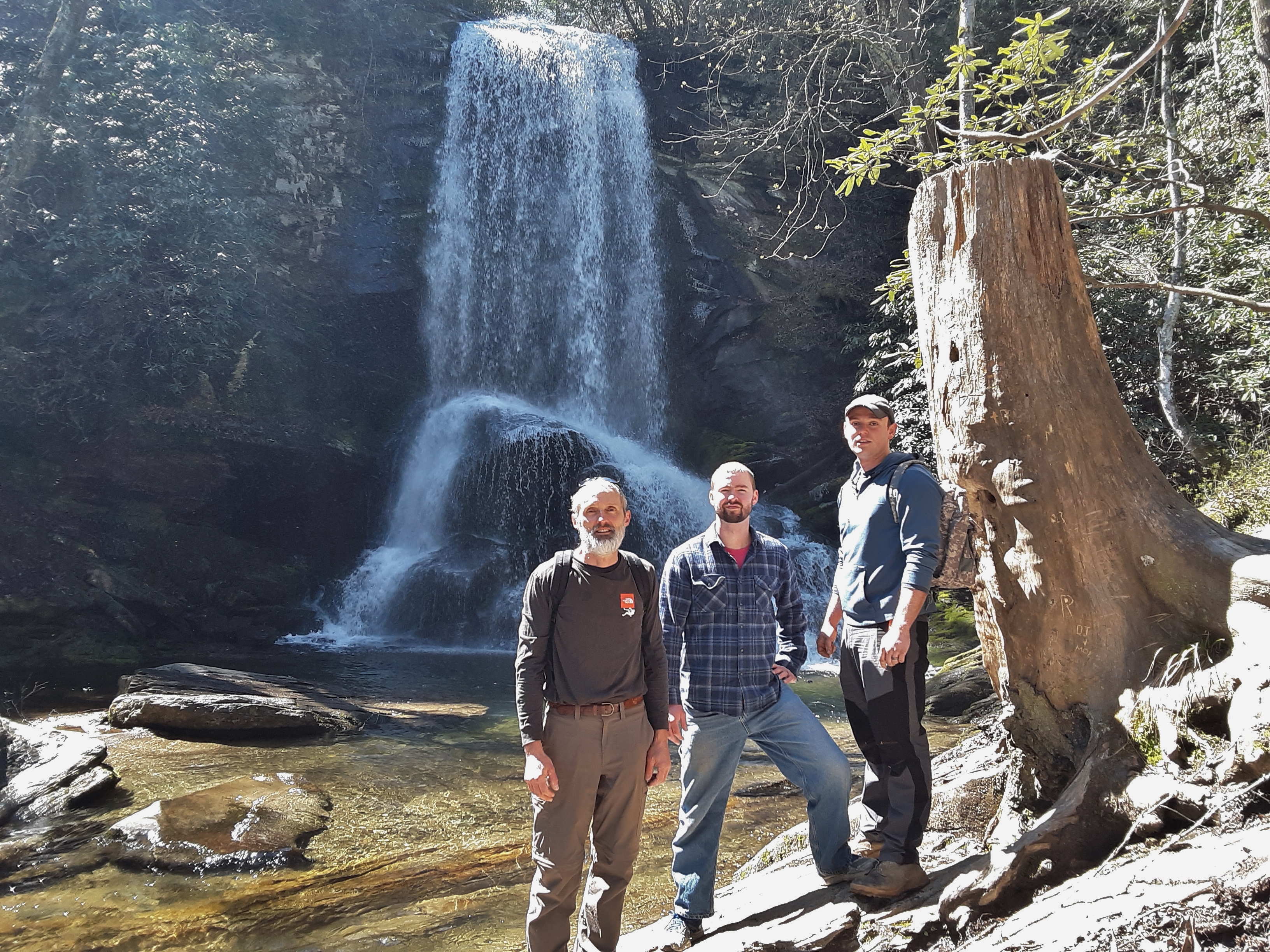
We came across some friends, all girls: a mother, 4 daughters, and 2 cousins.

Watching over the brood

There is plenty of Doghobble and Rhododendron, too.

We took a new side trail to a small waterfall as well.

Above the waterfall

River rocks are so good at revealing the geology above their resting place. Though colorful in variety, they speak loudly of the regional metamorphism that shaped these mountains.

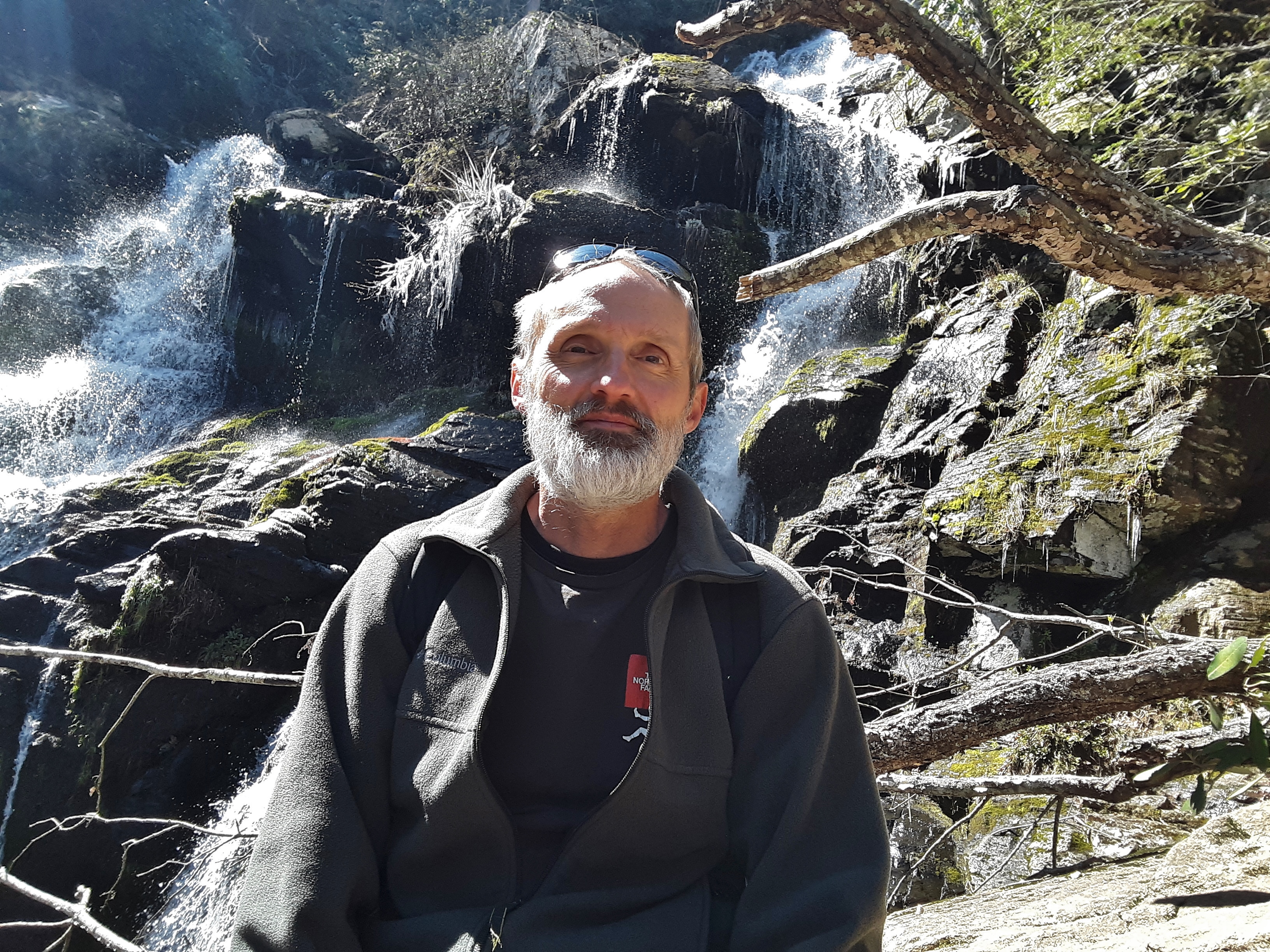
My young friend took the following pictures. She is improving regularly in her framing and composition of her photographs. I wear the sunglasses on my head out of habit even when there is little hope of the fog clearing.

I did not expect a hike on my birthday. I mused later that God is good in the little details as well as the big. I enjoyed the day with a few of my children.

Read Full Post »

The tradition in my family for about 30 years has been to gather at my oldest brother’s house for Thanksgiving. Numerous traditions grew up around this basic idea. One of the most enduring is the day after hike (see “Cascades and Escapades” and “Ebb and Flow of a Tradition” as two recent examples).

Of course, you can guess that this year was different. We didn’t meet at the elder brother’s house. His immediate family did. They also went on their hike. A good portion of my immediate family met at my house on Friday for thanksgiving reflections and a meal. There was plenty of good food prepared by numerous hands. We read psalms of thanksgiving and sang hymns and shared things we are thankful for.

On Saturday, prompted by two of my sons, we took a hike. My youngest and a young friend were beginning a one night backpacking trip, and the rest of us were along for the views and conversation. The slope had been burnt over twice about 15 years earlier and eliminated much of the topsoil. Regrowth has been slow, but the views are good.

The backlighting turned out OK, but since we did not know that at the time we shifted 180 degrees and posed again for the friendly hiker that I asked to record the images.

My son admitted that he was overly packed for a one nighter.

There are patches where it was not completely burned off and the younger trees come back faster here with the presence of more soil.

New growth is heartening.

The previous pictures show the relatively shallow slope the southeast face of the Shortoff Mountain. The next one shows where the trail comes along the edge of the vertical northwest facing precipice.

Table Mountain Pine predominates the stressed conditions of shallow soil, wind blown and otherwise drying conditions.

You wouldn’t be surprised to discover that this young friend is a tri-athlete. He stands upon metamorphized layers that are common to the Gorge.

Lake James actually dams three parallel streams, two of which are visible here. The South Mountains are visible in the background, being the last foothills before subsidence into the Piedmont region.

Wind is a creative and random sculptor of trees, imparting to this specimen a bonsai appearance.

There are many lone trees hanging onto the cliffs but the pine on this vertical section seems somehow “braver” or “more determined” as anthropomorphisms would have it.

Table Mountain Pine is also one of those species that require fire to open the cones and germinate the seeds. The cones appear to be fortresses against their time of opening.

Shortoff Mountain is amazingly flat on top as seen in this view along the Mountain to Sea Trail.

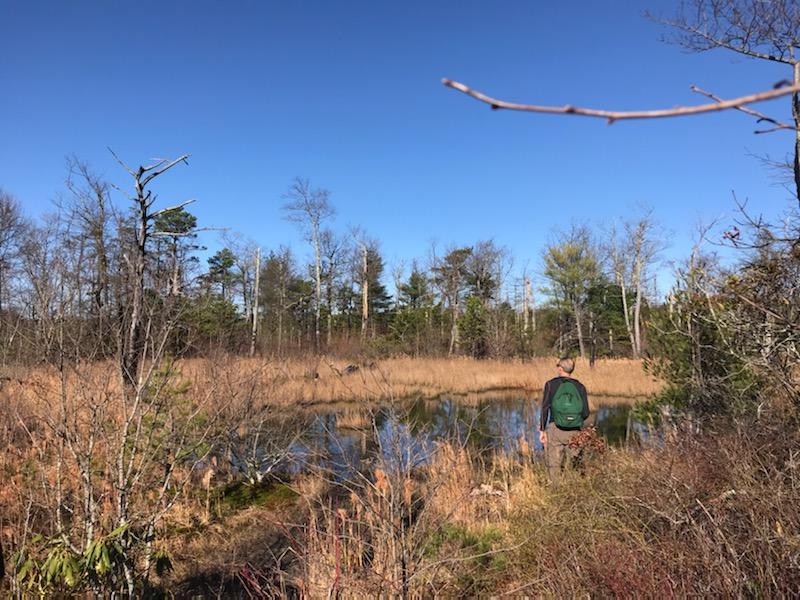
I know that fire is necessary and unavoidable, but I hate what it did to this little pond. First of all, it is amazing that a pond exists at the summit of a flat-topped mountain. It is not a mere wet weather pool. It used to have shade, open water, abundant frogs, small fish with only minimal vegetation in the water. Now the pond has eutrophied to such an extent as to hold no discernible animal life.

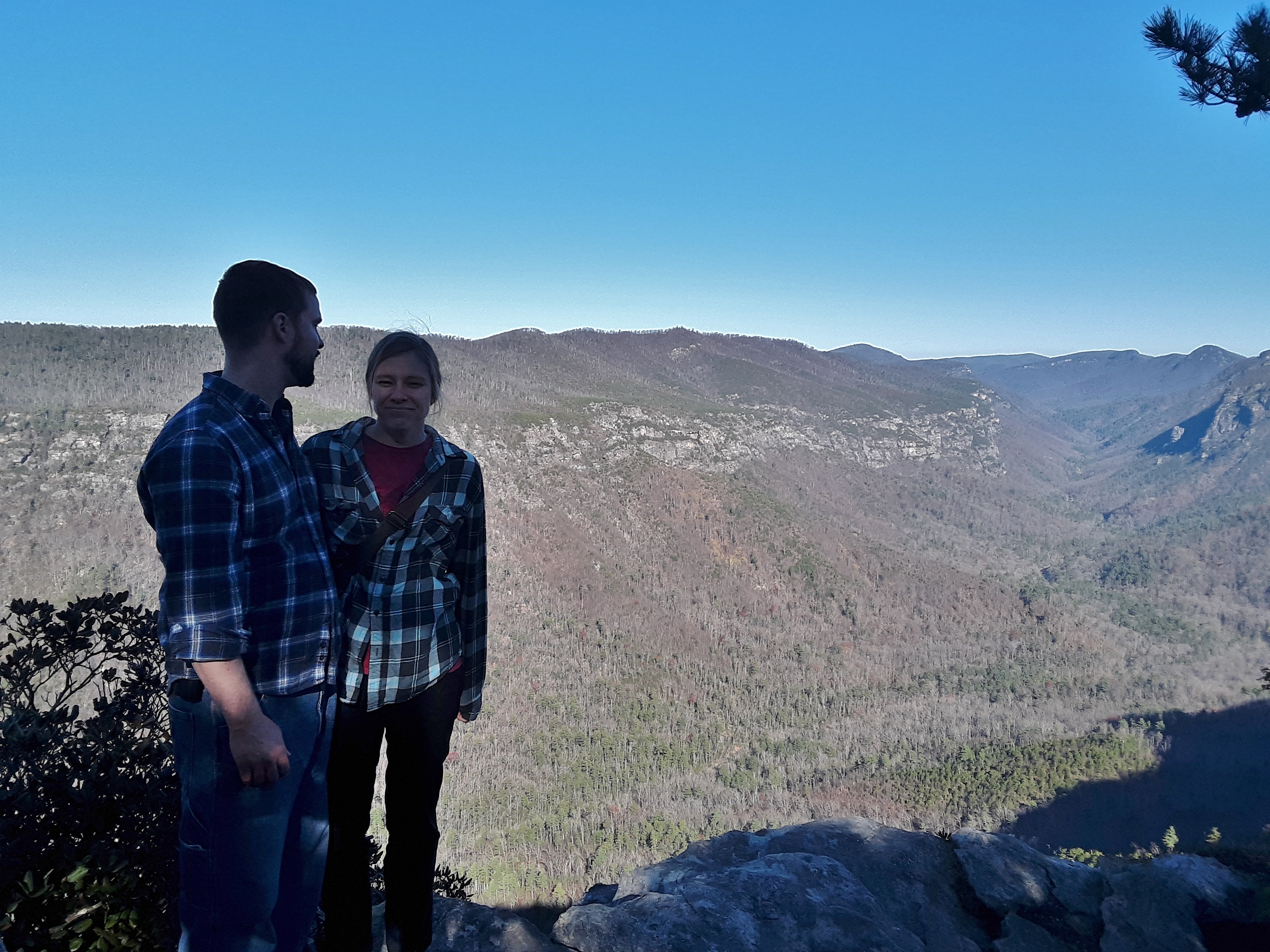
Not knowing that it was there, I had to point out to my young friends that we should stop and look at the best view of Linville Gorge available. Because the Gorge turns slightly at the mouth, you stand here on the rim looking straight up the majority of the length of the Gorge.

You can tell by the quality of the colors that this picture was not taken with my phone. I credit my daughter-in-law for this good picture.

And here she is with her husband.

Near the previous view is another one facing out of the mouth of the Gorge, revealing ridges more than 30 miles away.

I conclude with a picture of me contemplating the change and continuity of God’s nature. We can design our Biosphere 2 in an attempt to copy the real thing*, but our attempts cannot hold a candle to the ability of God’s designed Biosphere to absorb stress in the form of weather and natural disaster and human pollution and still recover and adapt. Man may have caused the fire that so affected this pond, but lightning could have just as well accomplished the same thing during drought. The pond may be changed for the duration of its existence or it may eventually recover its shaded, lively charm. Either way it is and will adapt well.

*If you don’t believe in design in nature, just consider the extent to which scientists go to design experiments like Biosphere 2 and they don’t even work that well.

Read Full Post »

Two trees down, and what do you do with the wood? Neighbors came for some of it. The woodworker snatched away the trunks. The city took the branches. The compost is chewing on the leaves. The friend of a friend ground the stumps. But those pieces in the range of ten inches to two and a half feet in diameter and many with multiple forks were still around. I had suggested to my friend that he borrow a hydraulic log splitter, but he could not find one. Then I remembered that a recent acquaintance, a brother in Christ with whom I hit it off well at first meeting, had recently offered me the use of his wood splitter in an unrelated circumstance. The problem had been that his splitter was at the back of a large workshop that had been converted to temporary storage. It had wood and tools and equipment stacked in front of the wood splitter. So, my homeowner friend with the two big trees on the ground and I offered to help him dig it out. That was an adventure in old wood, old tools, old memories, and dreams for future projects. With a will to get it out, we dug it out in under an hour, inflated the tires and off we went. It appeared that the woodsplitter had been used very few times and it had been stored for several years. Thankfully the gasoline had been drained out of the tank, as that can gum up the carburetor over time. It wouldn’t start anyway. There was definitely fuel in the cylinder. There was no spark on the plug. There was spark from the coil. We took a trip to the Tractor Supply for a new spark plug. It still wouldn’t start. We took the air filter off, found a neighbor with starter fluid, but it still only barked once or twice. I prayed more directly about it starting. The neighbor put his hand over the choked intake. It sputtered. It sputtered a few more times and then started up with very little smoke, running well the rest of the day, and restarting easily after refueling. Those pesky double problems can take time and troubleshooting skills.

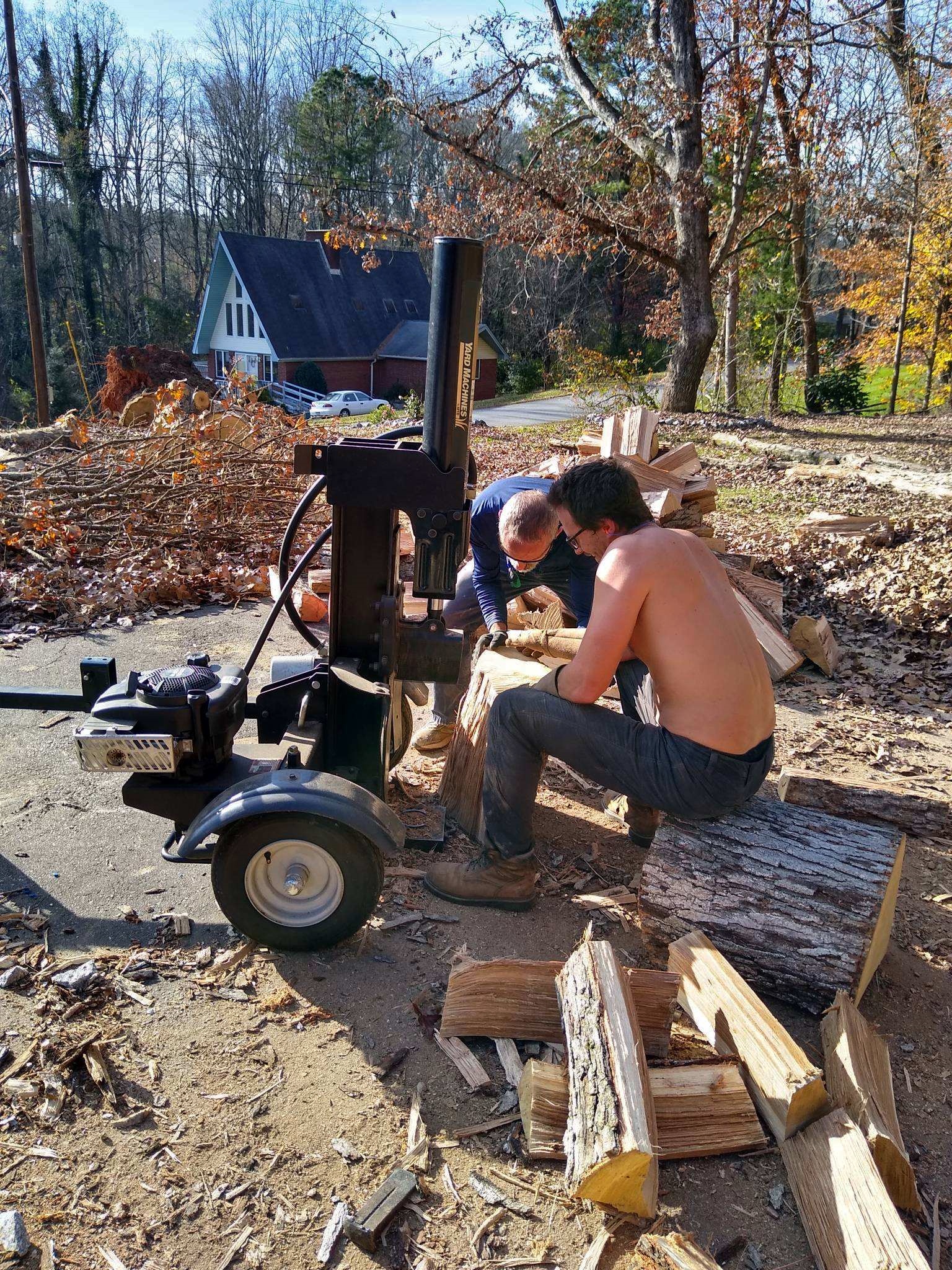
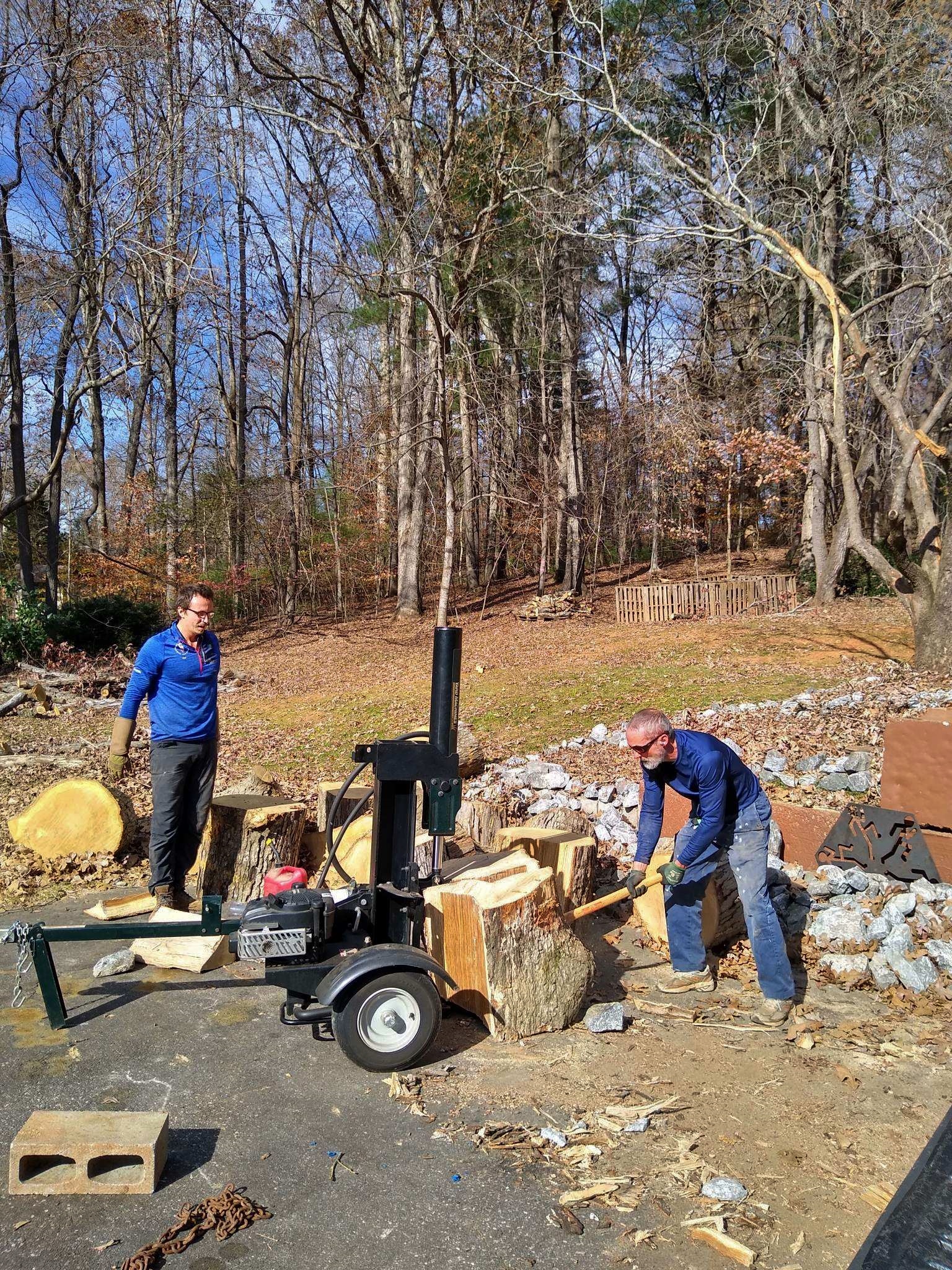
We split wood for more than six hours. The claim and assumption is that a hydraulic wood splitter takes all of the work out of splitting wood. It most definitely makes it easier and splits twisted and forked pieces that are hard to do manually, but it does not remove all work. And, there are pieces that can only be done with sledgehammer and multiple wedges. Following I have two sequences of the splitting process. The observant viewer would figure out that these are not actually sequential pictures, but ordered from various images to show the process. Most of the work of hydraulic wood splitting is getting the log under the wedge.

The fun and easy part is pushing the lever and watching the wedge split, mangle, or destroy almost any piece of wood put beneath it. I found that on the tougher pieces, when the splitter was straining to go through the wood, that I would press harder on the lever as if that would make a difference. Part of the trick on the larger and more twisted grains is “reading the grain” as I call it, or “grainology”, as my friend termed it.

Sometimes the wedge goes through but the wood is not fully separated. Here we are determining what to do next.

Since the piece is heavy you want to avoid having to flip it around or over. Frequently the answer is a well placed blow with an axe or sledgehammer.

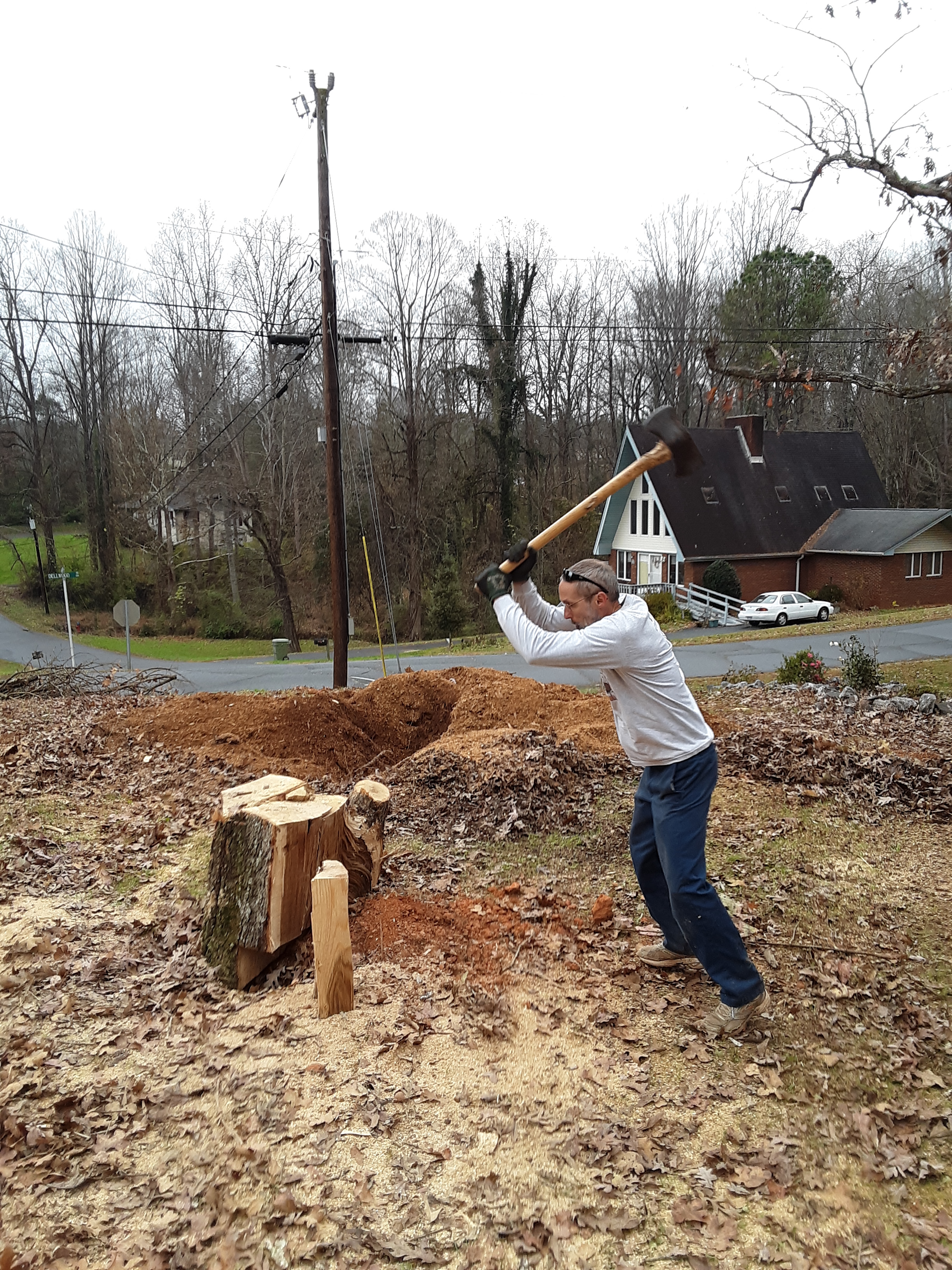
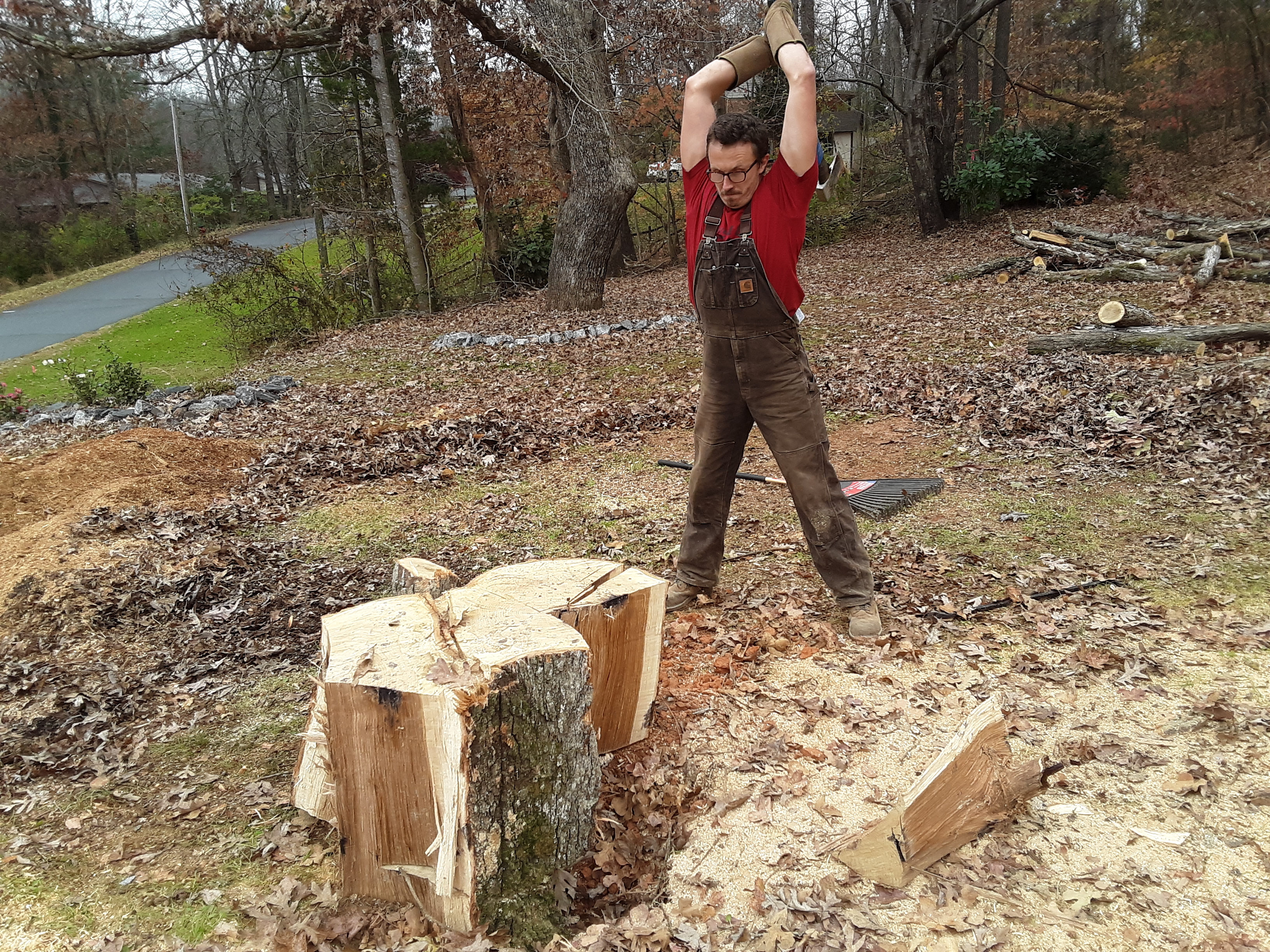
We were very tired after so many hours heaving the pieces into place that we totally overlooked one last big chunk. When I returned several days later to load another truckload of wood, I assured my friend that we could split it with sledgehammer and axe. The next sequence of pictures arose from my friend trying to time the shutter of the camera with the blow upon the block of wood. I’m glad he missed numerous times so that you could see what goes into a swing. Splitting a piece of wood is not a strength move but a power mover. Therefore, the power is produced by the whip you give to the axe handle from about its highest point to just before the impact. There was not need for great power in these straight grained pieces I was splitting for this sequence, so my swing is not quite what makes for the most powerful swing. If I was producing more power, I would slide my top hand (right hand in the pictures) down the handle to increase the whip and thus the power. The reason the whip is so effective is that power is how fast work is done. I have a limited ability to increase strength, but the whip can greatly increase speed, reducing time and increasing power.

The other factor in a good blow is hitting the right spot at the right angle. The next picture captures that moment when I focus on the spot to be hit before commencing to swing. I find that I must focus there all the way through the swing and that distraction or fatigue decrease my likelihood of hitting my intended target. Basically, you are trying to strike parallel to the radial grain toward or away from the growth center.** On smaller or thinner pieces you can strike along a ring to split a piece. It is more tricky with forks, but there are places and directions to hit that make those more likely to split as well. It is all in reading the grain.

Splitting wood is both an athletic move and an endurance move in order to keep repeating it.

I attribute my next stance to both the partial stiffness of age and the positioning of the axe for a powerful blow. My young friend takes a similar stance just before striking but with a little less evidence of stiffness.

Proof of the ease of the pieces being split is the axe going all the way through and into the ground. This does not often happen. After the photo op we split the fork with wedges. It took quite a few blows to go through that.

I love this next picture. It shows my friend’s determination, focus and strength. He was amazed at the first decently large piece that I split cleanly with an axe. I felt like I had done a Hollywood stunt*** and quickly explained that I was able to do that because it was so straight grained. These pieces are the joy and fun of splitting wood before the real work commences.

There’s that stance again.

It is amazing how fast the wood can pop sometimes. The piece has flown off to his right before his axe hit the ground. He learned something else this day. Though plastic handled axes and sledgehammers have the advantage of being hard to break, the handle pounds the daylights out of your arms all the way up. I swung his axe a few times and then went over to get my wooden handled axe for the remainder, as you see above.

White Oak wood has such a pleasant smell. I actually took a cup full of ground stump mulch home as a potpourri for my livingroom. The wood has the property of cooperage, swelling to seal fluids in barrels and buckets. It makes lovely, sturdy furniture and provides much food for woodland animals. Its foliage is beautiful and especially in the Autumn when it turns yellow. It can live to a ripe old age five or six times what any of us will. It makes for good shade and grows in rich or poor soil with less water than most hardwoods. It is, in short, another of God’s good creations with much beauty and utility. I enjoyed observing and extracting some of that goodness for multiple people’s use.

*I hope you don’t think my pun inappropriate, based on 2 Timothy 2:15 (KJV). He does own both after all.

**The growth center is where the rings come together, that is, where it began to grow, and is not the same as the geometric center because trunks and branches frequently grow faster on one side than the other based on tension or compression caused by holding weight.

***Have you ever watched an old Western movie with someone splitting wood? They go through every time. Why? They use straight-grained, dried Western varies of wood like cottonwood or fir that you could split with a hatchet.

Read Full Post »

I enjoy relating to serious, fun-loving young people. How can they simultaneously be both you may ask? A person can know what is serious, consider and muse on it and discuss it and act on it, and still have a good sense of humor and enjoy fun challenges and take reasonable, considered risks.

The climbing partner with whom I have been out the most in the last six months is just such a person. He is a former science student of mine who loves to climb, is getting married soon, just started his first nursing job right out of college, and most importantly shares the same faith as me. Life still challenges me with work and play and relationships and worship. As a result, there is plenty to talk about.

Because of where we now live, we meet approximately halfway in between at Rocky Face Mountain Recreation Park. The old quarry has numerous and wide ranging difficulty of sport climbs. I usually post pictures of one or both of us actively climbing, but the mood of the weather, the climbing, and the conversation had me pointing my camera elsewhere.

Reorganizing equipment at the top of the first pitch.*
Happy, but on edge on the first pitch
Shutdown, resting, and figuring out where to go.

On the point of climbing, I suggested that we climb two pitches to the top of the second tier since I had never been there. I bit off more than I could chew on the upper tier and had to traverse left to an easier climb and then far back right further up. You can see this in the following picture.

Check out the rope at far left and stretching across the middle to the right, and me sitting on top under the tree.
Hanging out on top
No easier approach to a climbing area can be had.**

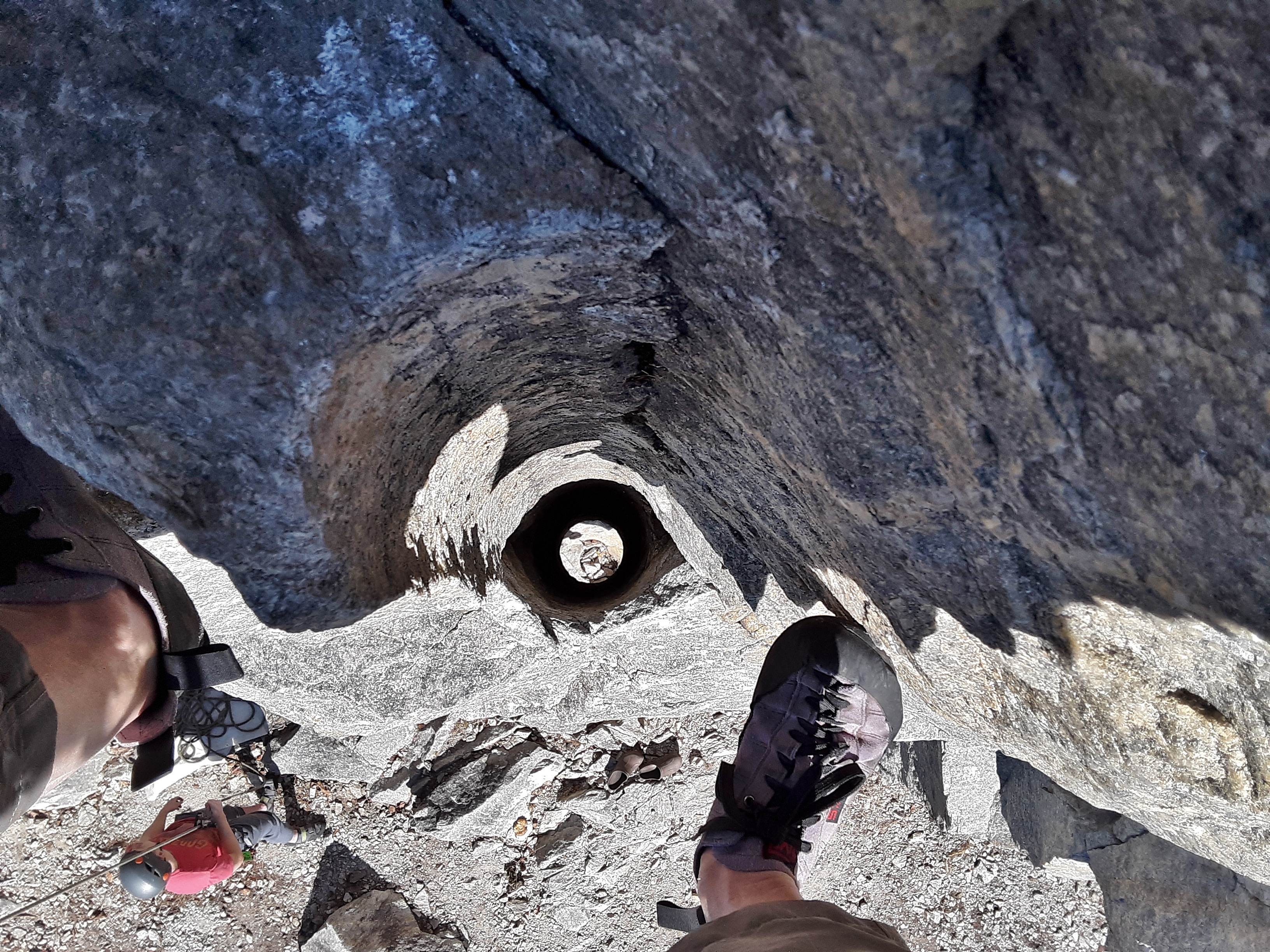
As I said earlier, this climbing area was an old quarry. One of the biggest needs for infrastructure is gravel and stone. The hole pictured below between my feet is the remnants of a bore hole. It is an added boost to perspective to see both my feet and my belayer on the ground.

For the next climber, climbing is no big deal with the right equipment. I think that it is an Eastern Fence Lizard, though arguably out of its habitat if that be so.

*Yes, we are tied in to rope and/or anchors the who time for safety.

**The temperature changed from mid-thirties when we arrived to lower sixties with high solar gain. I am actually getting ready to rappel down, so I have two shirts that I took off stuffed into the shirt I am wearing, giving the appearance of a beer belly.

Read Full Post »

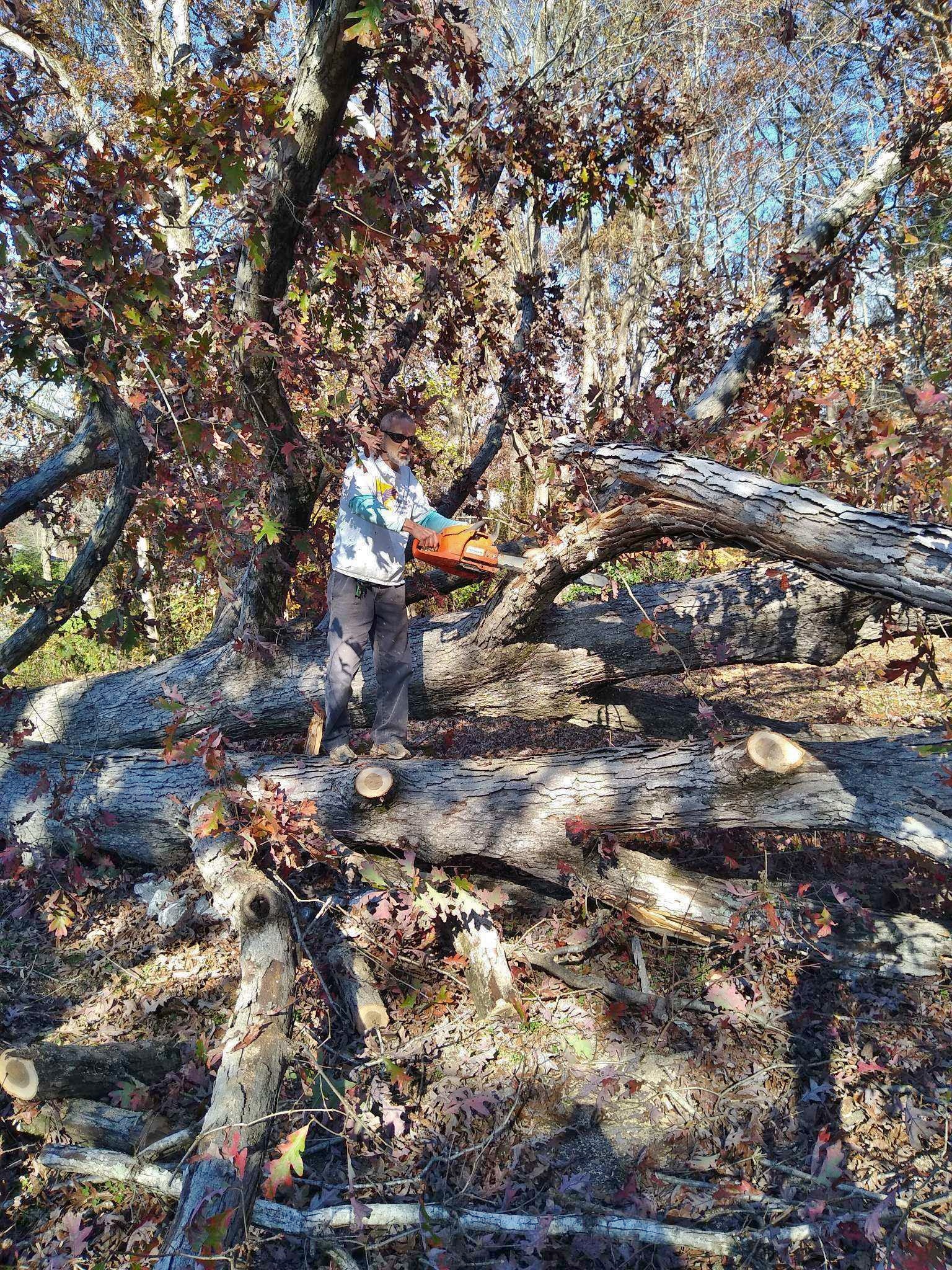
…that is, Kerplunk number 2, not Karakoram Mountain #2, the second highest peak in the world above sea level. After the first tree fell without warning, being a seemingly healthy tree and not on a particularly windy day, my friends began to suspect another White Oak tree in their front yard. Was it similarly diseased and fated for freefall? They had a company drop the tree and then called on me to cut it up. I observed that the outer dozen or more rings were indeed darker as if diseased, which you can see in the first picture. It took me over six hours to cut up the branches and part of the trunk. It would have been longer but the local ironworks/woodworker agreed to get the main trunk. Because the tree felling company did not report grounding until late morning, I did not start cutting until 11:30. My friend, the homeowner, came home from work early to clear away brush and firewood. I was cutting pretty much non-stop for 6 hours. My forearms were very weak and achy the next morning.

My stance indicates to me that I was cutting upward to prevent pinching of my saw by the weight on the branch.

Because I knew the iron/woodwork was coming, I cleared the branches off of the main trunk first. I left outriggers to keep the trunk off of the ground and prevent it from rolling over. Then I began to clear the driveway.

I spend a considerable amount of time working outside for which I am thankful. I have however, began wearing light, long-sleeved SPF-50 shirts and hat to protect me from the Sun. My forearms indicate that I spent far too many years baking in sunlight.

There were many forks up the tree because it had been severely topped some time long ago. Don’t trim more than a little from a tree, especially oak trees. It uglifies them and shortens their life.

The ironworker/woodworker has all of the toys. Below he is clearing the smaller pieces in order to drag the trunk down to the driveway. The front and rear wheels of the forklift steer. It is not quite “zero-turn” but close.

I thought that my Husqvarna Rancher 460 with the 2′ bar was quite a lot of saw, but the Stihl was far more powerful and appears to have a 30″ bar.

He cut two logs, a ten foot one and a twelve foot one and loaded them in 30 minutes. I estimated the larger of the two logs to be 3500-4000 lbs based on size and typical weight of green oak wood.*

While I was editing the next picture, I zoomed in to count rings. This is about 22 feet up the trunk on the smaller of the two trees (2 1/2 feet in diameter instead of 3 1/2 feet in diameter of the larger tree). I counted 70 rings. Even if the base revealed 90 years of growth, this was a mere youngin’ in White Oaks trees that can live for 500-600 years.

*60 to 70 lbs per cubic foot- wow! Especially amazing considering the dried oak is 48 lbs/cu.ft

Read Full Post »

A neighbor said it sounded like a huge car crash when it came down. There was little to no wind when it happened. The roots were rotten. White Oak trees don’t usually fall over from a rotten base. The wood is more rot resistant than the red oaks, but I guess most any tree can rot.* My friend and former colleague’s wife found it lying on the ground when she arrived home. She reported that the tip of the branches were 10-12 feet from the house. She also said that her husband commented on the tree appearing to be leaning before he left for work. The base was about 3 1/2 feet in diameter with a dense crown from having been topped many years ago.

Though you cannot see much progress, I am already hard at work in the following picture. In fact, it took me 7 hours to clear all of the branches to the point seen in last picture. I had abundant help from my friend and his brother and their wives. They kept the area clear for me to cut non-stop.

I delight in the light gray, “alligator skin” bark of a white oak that wraps around.

A good stance, concentration, ear and eye protection, awareness of what can go wrong, and always God’s grace have kept me from major injury chainsawing for 37 years. The closest I ever came** to major cut injury was a six inch gash in my left pant leg below the knee. Near misses are instructive and precipitate thankful exclamations and further caution.

Awkward positions are unavoidable at times, but having an escape plan and hazard avoidance help. Notice, though it works me harder, how I am instinctively holding the saw away from me. This position avoids the potential kickback of the limb and dropping the saw onto myself.

I took home a truck and trailer load of wood. The homeowner set aside wood to split later and 8′ to 15′ pieces to make a barrier for erosion control. A local welder/woodworker came and got the lower ten feet of trunk for boards. Not wasting resources does my heart good.

Here I avoided reaching overhead by cutting further down the trunk. I dropped this section onto waiting logs below so the I could cut it up without striking the ground, which is the worst enemy to a chain.

Hopefully I will remember to take a few pictures of the end result when I am there again. It was a hard, but a good day’s work. I am thankful to God for continued health to be able to work this hard still outdoors.

*Is Cypress an exception?

**How many major injuries has God kept each one of us from that we knew nothing of?

Read Full Post »

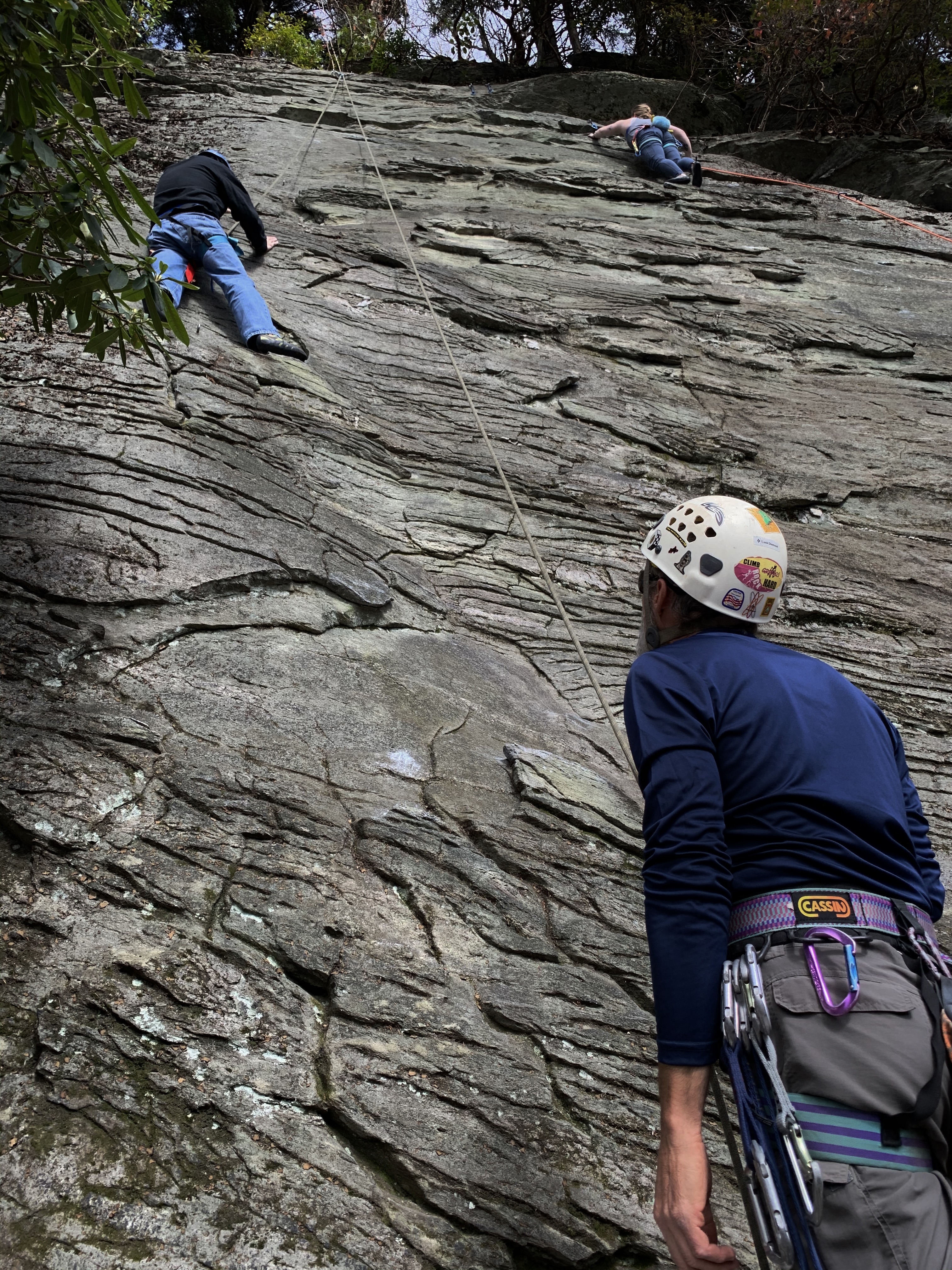
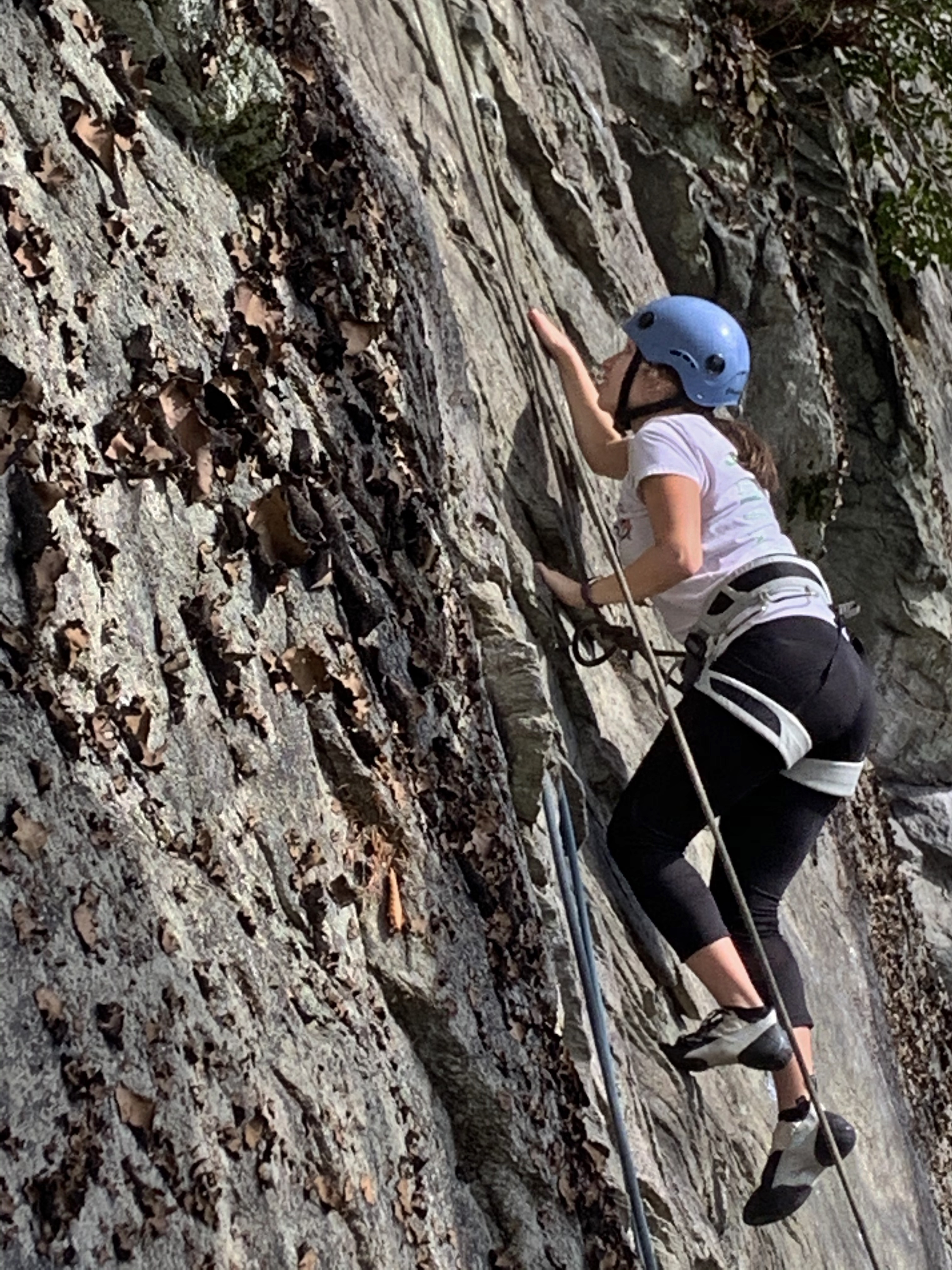
What, you may ask, do those two words have to do with one another? Well, I’m the dinosaur who took two newbies out to go climbing. As they described it, they had climbed two or three times each indoors but never outdoor and I was the “pro”*. There was a little fear of heights, a little curiosity, some determination, and a good amount of enthusiasm. Father and I attend the same church. His daughter came in to town specifically for this outing. It was cloudy and uncertain when we met at the rendezvous point, but as we traveled up the mountain we could see the sun shining on the side of the mountain where I knew we would be climbing. It turned out to be both a beautiful and pleasant day with plenty of challenge and a measure of success.

Flaking the rope; grinning for the camera
Father and Daughter; yeah, definitely related
Enthusiastic Start
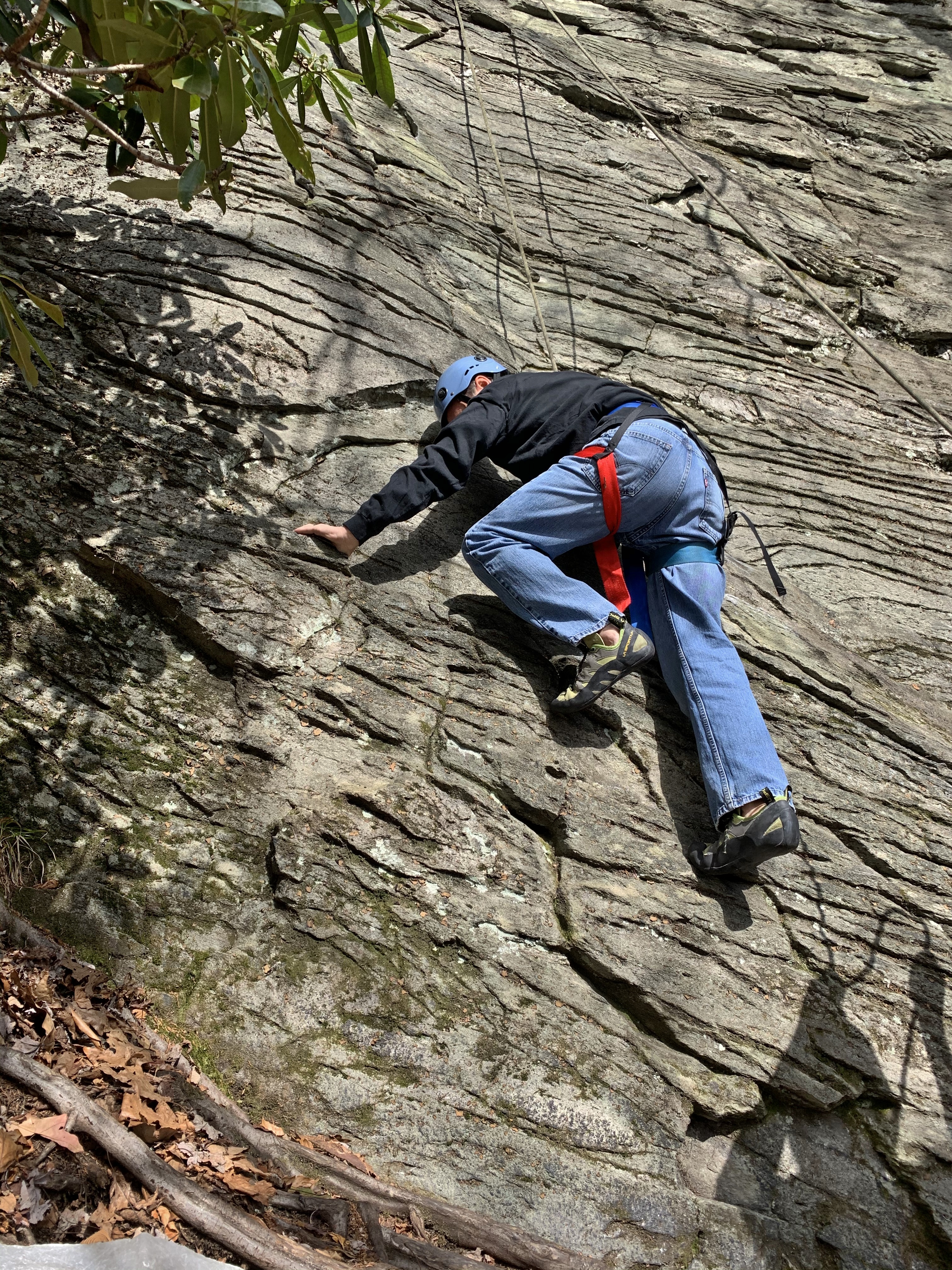
Working it.
Always good to have an attentive belayer

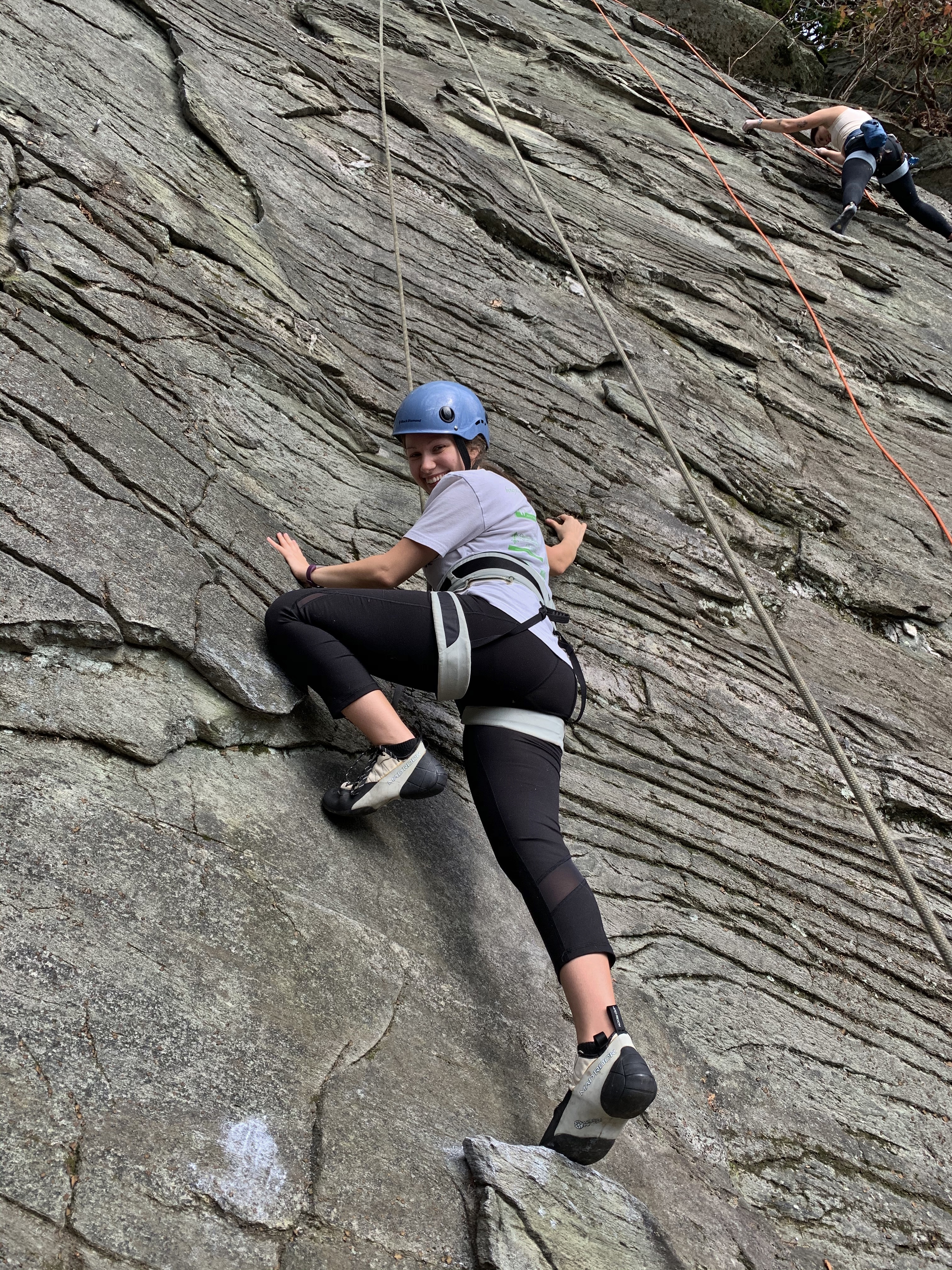
The next picture is very instructive to those who have not climbed before. At any level of climbing, you reach a challenge point. The pose reveals the intensity. The facial expression shows the focus and goal. Sometimes it is fun to just cruise up a climb, but challenge, getting shut down, and overcoming the by problem solving and focus are major draws to climbing. Add to that training for strength and technique in order to up your game, and you have many of the central components of good climbing.

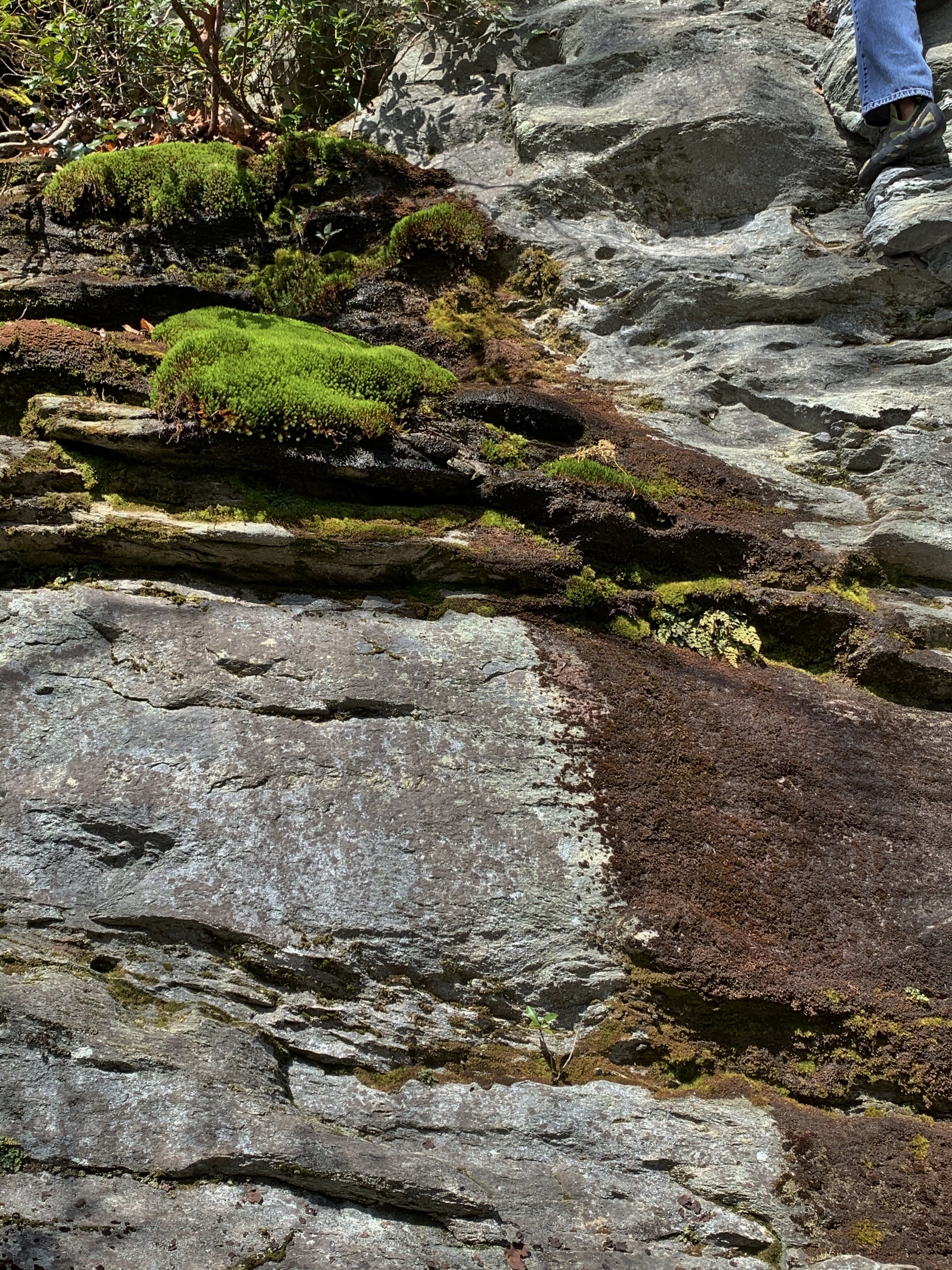
Seeps Keep Green
Challenge can be fun!

I must give credit to the young lady with the iPhone for the great pictures. Indulge me for a moment in a sequence of shots on one climb that I did.

In this next shot, notice the rope going through the carabiner at my left hip. The carabiners and “dogbone” in combination are called a quickdraw. It is attached to a bolt in the wall that protected my move over this small roof. This style of climbing is called sport climbing. You can see other bolts of an adjacent climb at the right.

The next few moves involve crimpers, small fingertip holds for one to four fingers.

The picture below gives a sense of pause which actually happened. Sequence of which hand or foot and in which order the holds are used is important in climbing.

At least the foothold was huge.

The hardest part of the climb, upon which the climb is rated, is called the crux (from crux ansata, literally “cross with a handle”; very appropriate for a difficult move on a difficult hold). This one relates to the smallness of holds as well as the long reach up left to a crimp. Don’t be impressed since it is only a 5.10b climb, far below world class 5.16.

Got it!
Topping out
Building an anchor

Everyone was all smiles and we enjoyed the day. They even said they would like to go again.

Later

*”You are to us”, the protested when I said I was nowhere near that.

Read Full Post »

… and little people are nonetheless significant beyond their size.

My wife and I visited our daughter and her family this past weekend. It set me to notice little things more than I have recently. Flowers blooming at the end of November is novel, but this little guy was showing off his stuff right next to their driveway. I have told the problem with controlling the focus on my phone, but here it reminded me of a little thing. This is what the flower looks like when I don’t have my bifocals on or when not using the right part of them. Doing fine work above my head is a pain since I have difficulty seeing it. I have actually flipped my glasses upside down to see what I am doing. It’s those little things.

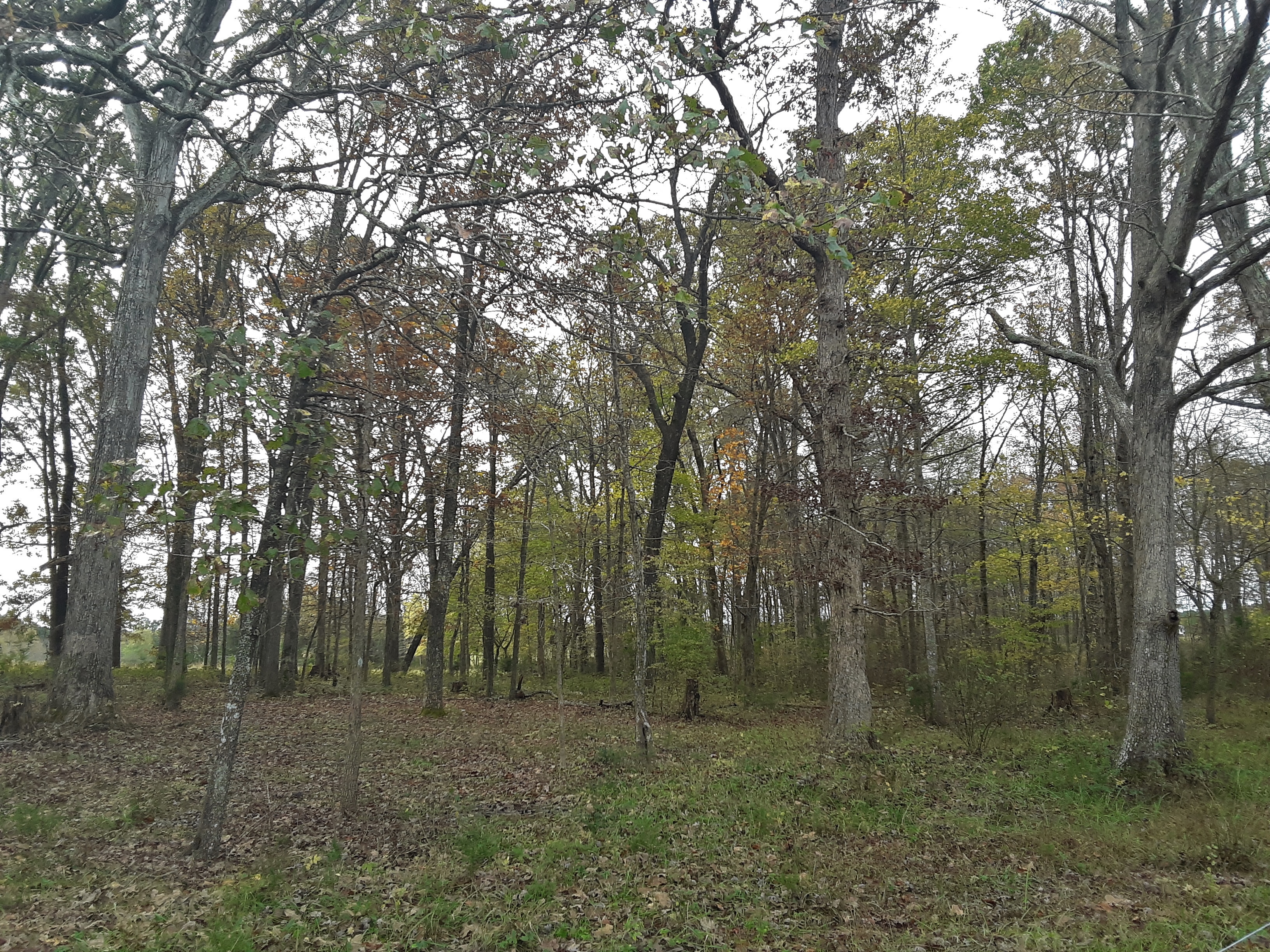
I took an early walk the next morning. The temperature was brisk and there was no one out yet. The woods on either side of the road give this straightaway a pleasantly lonely feeling. White oaks and red oaks and maples and Sourwood and the occasional pine reside in a woods infrequently grazed by cattle. It is a pleasant little scene.

Most of the leaves have turned and dropped off, but this little Red Maple tree by the road was not having it. There was still time to show off the colors.

I’m not a big dog fan, but their dog is an outside dog and likes to explore and circle back around to you. He seems to have come to understand that I’m OK with his occasional inquiries as long as he is not in my face all the time.

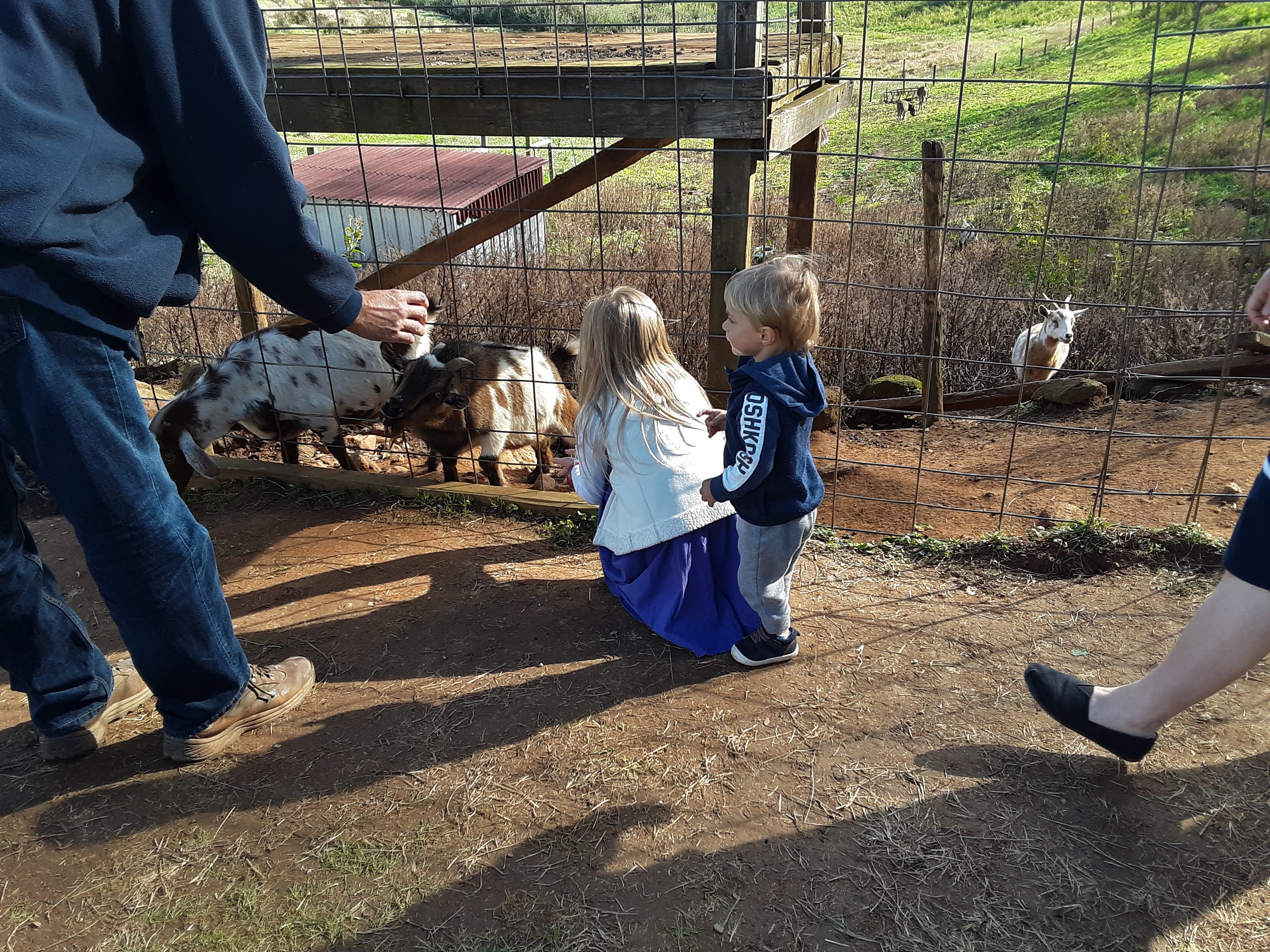
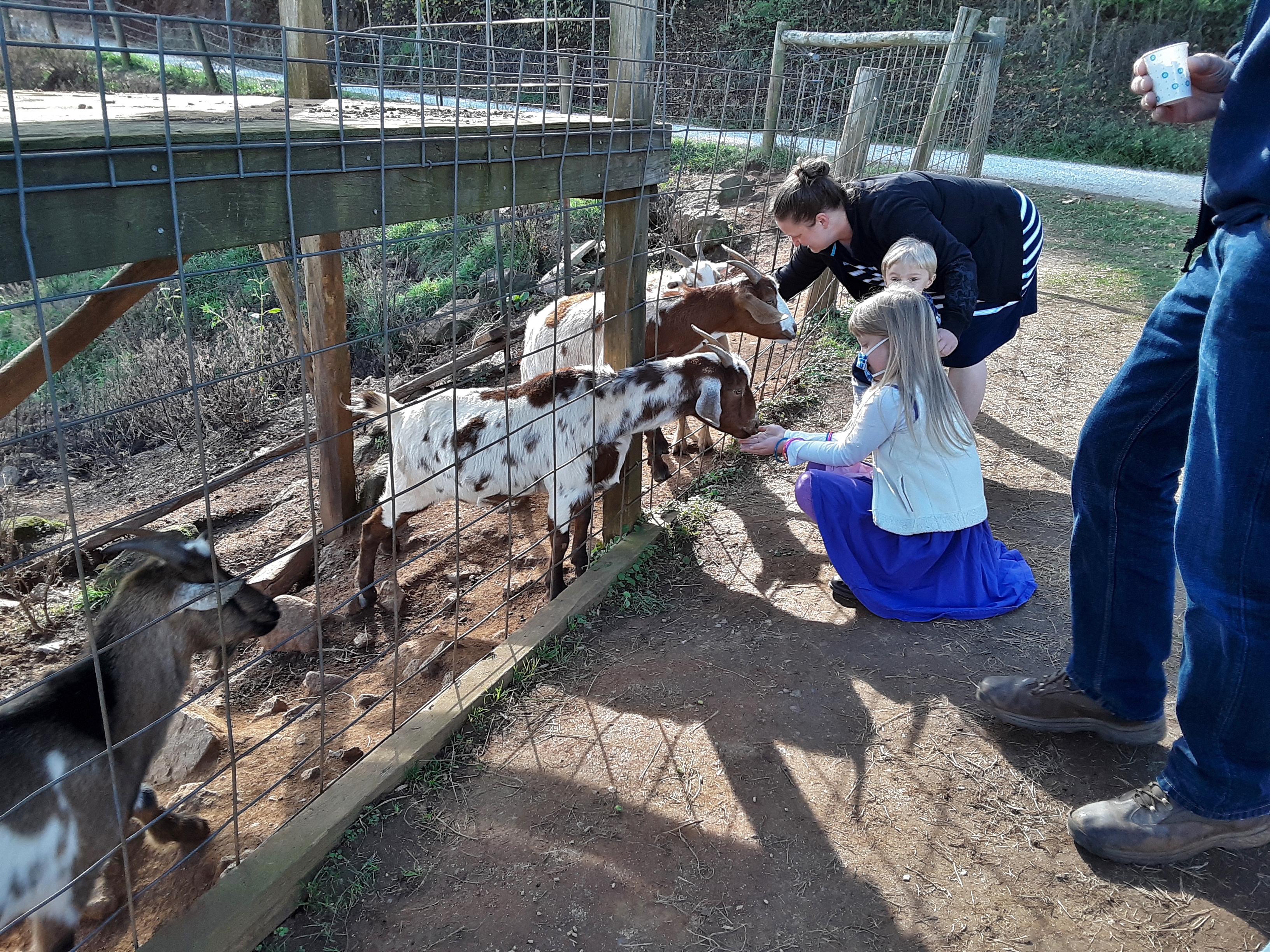
Little grandchildren are a big deal, posterity and all that. It is fun to watch them explore and learn. It was a little kindness, but the man in the picture who is unknown to us, gave the children feed to give to the goats. I hope that he enjoyed watching them interact with them as much as they and we did.

It was also curious to watch how adept the goats had become at retracting their heads and horns out of the fencing without getting hung up.

Little moments of quiet, particularly in nature, are so restful to the soul. I hope that my son-in-law found it so.

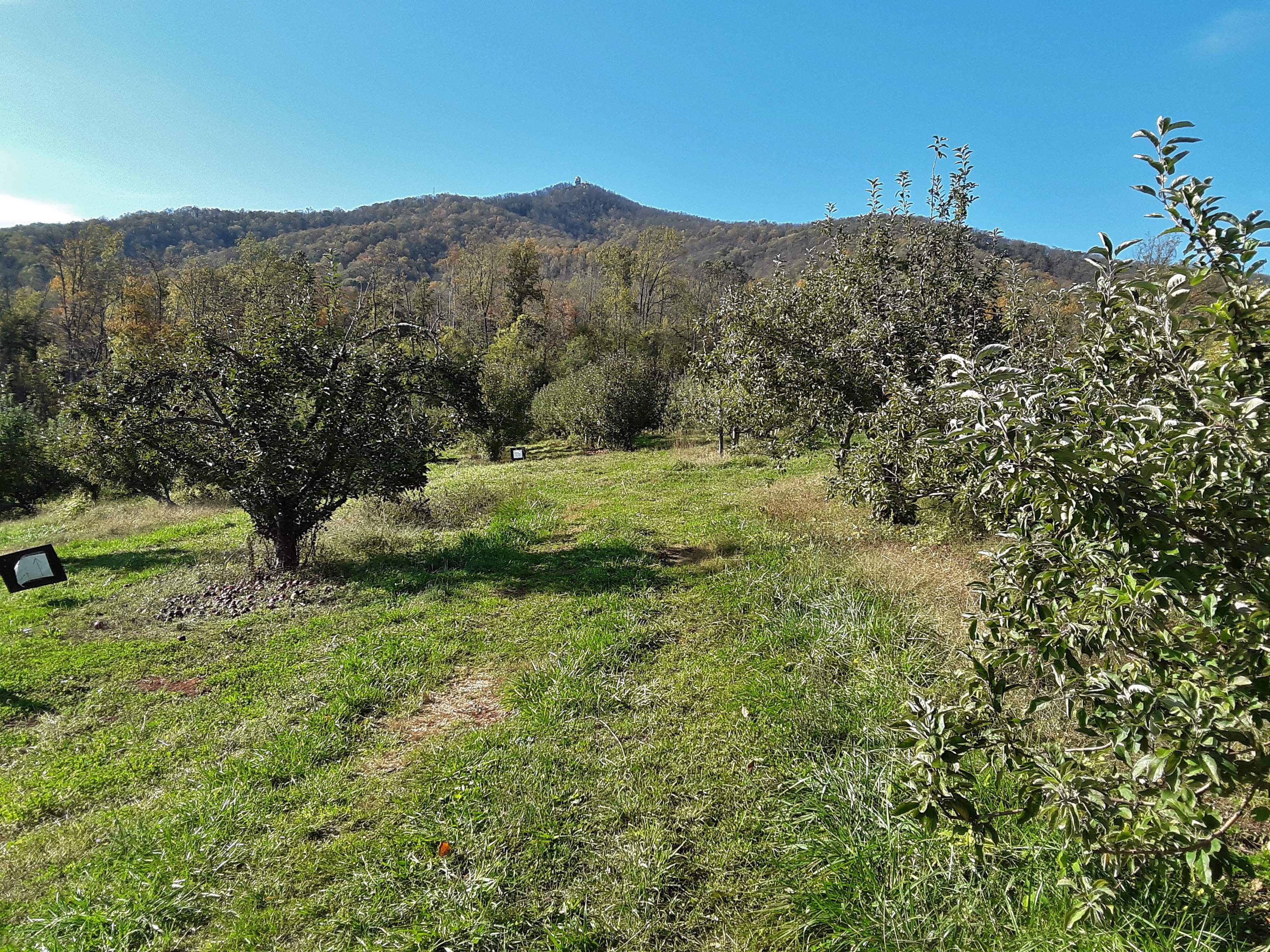
The rolling hills of the Virginia landscape are fertile soil for an orchard.

Pruned apple trees produce larger and more fruit. The orchard is picturesque because of the views in both directions.

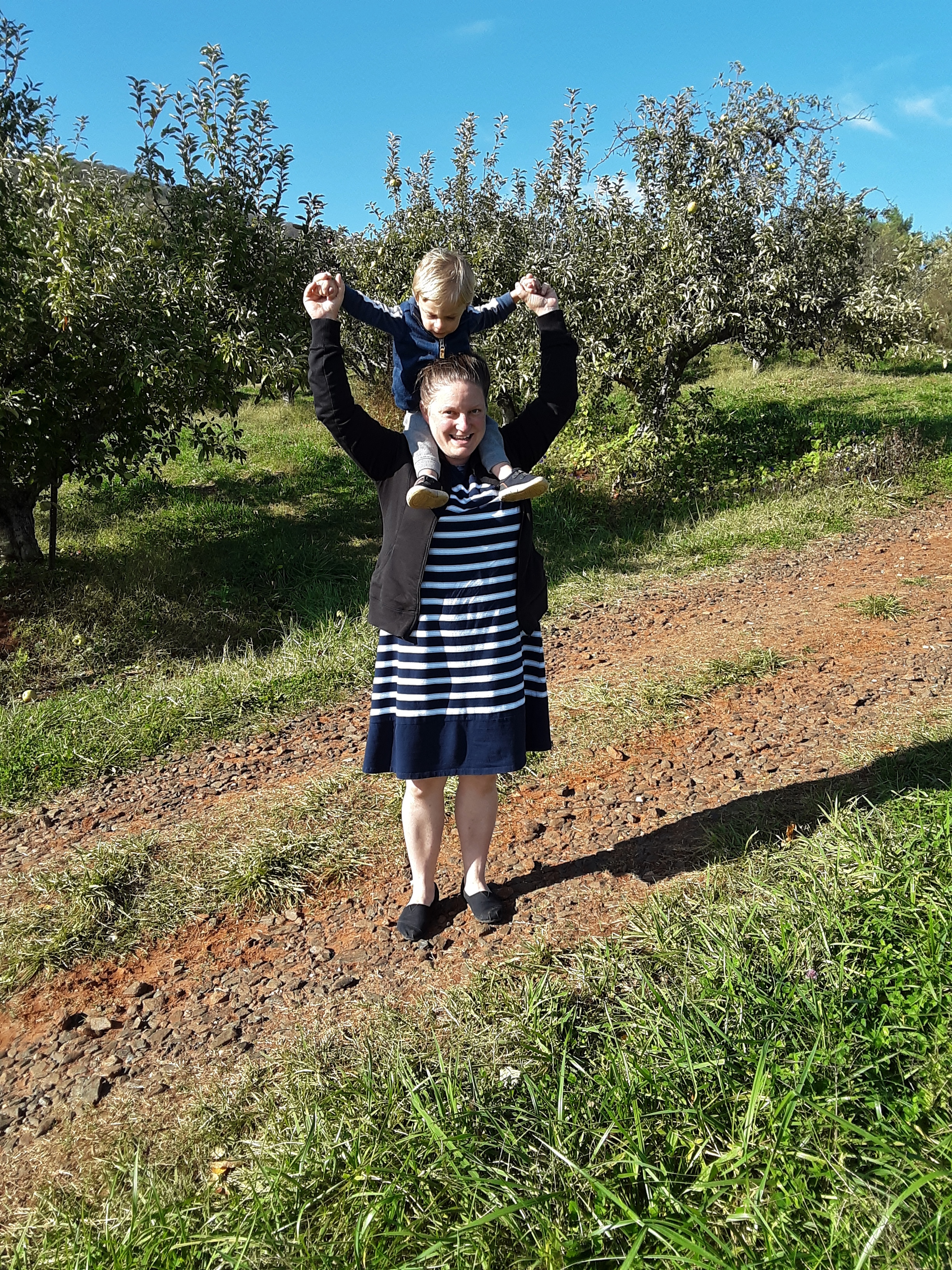
The Little Man is riding on his mama.

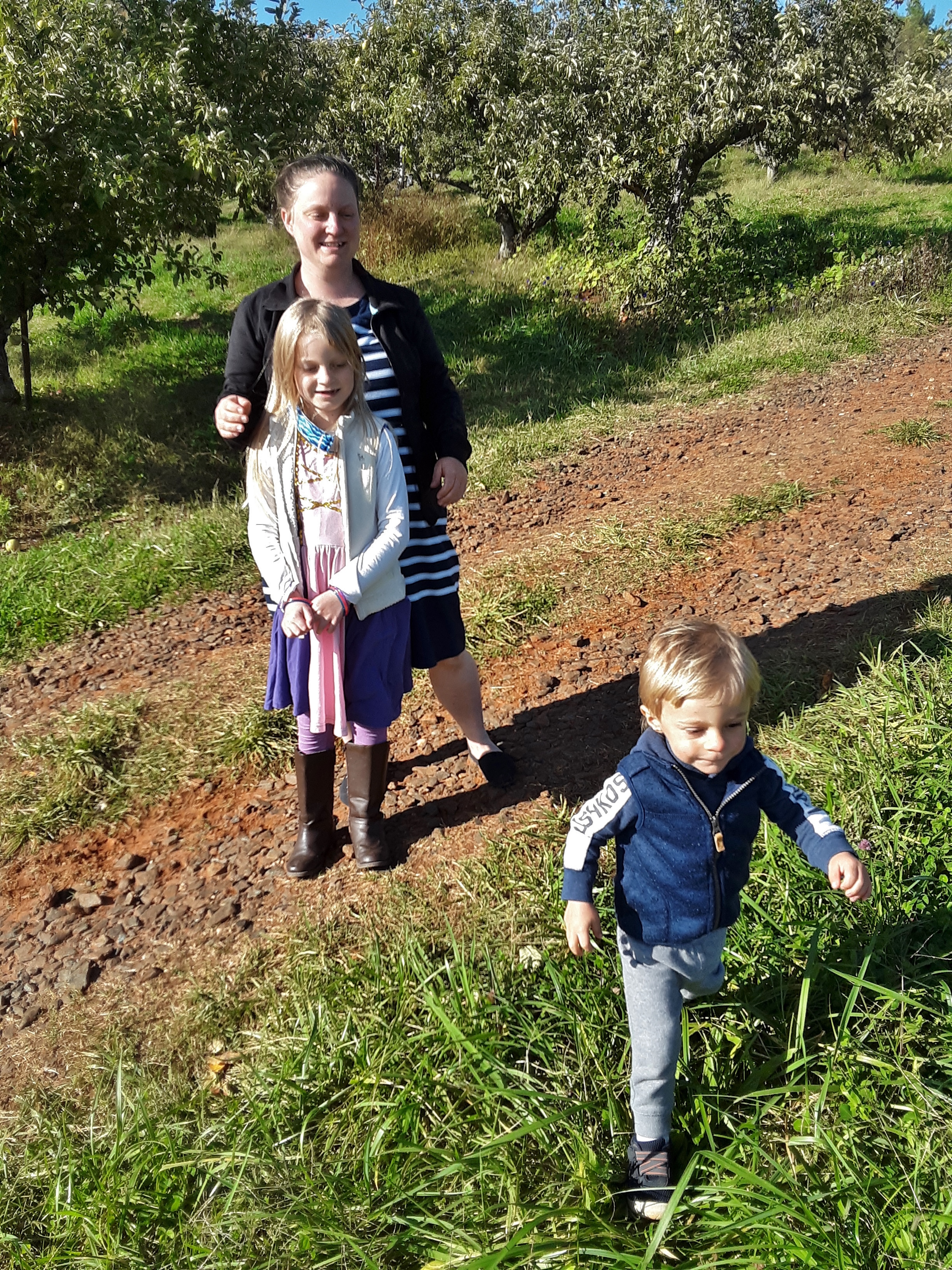
His big sister is not so little anymore and in the 3rd grade this year.

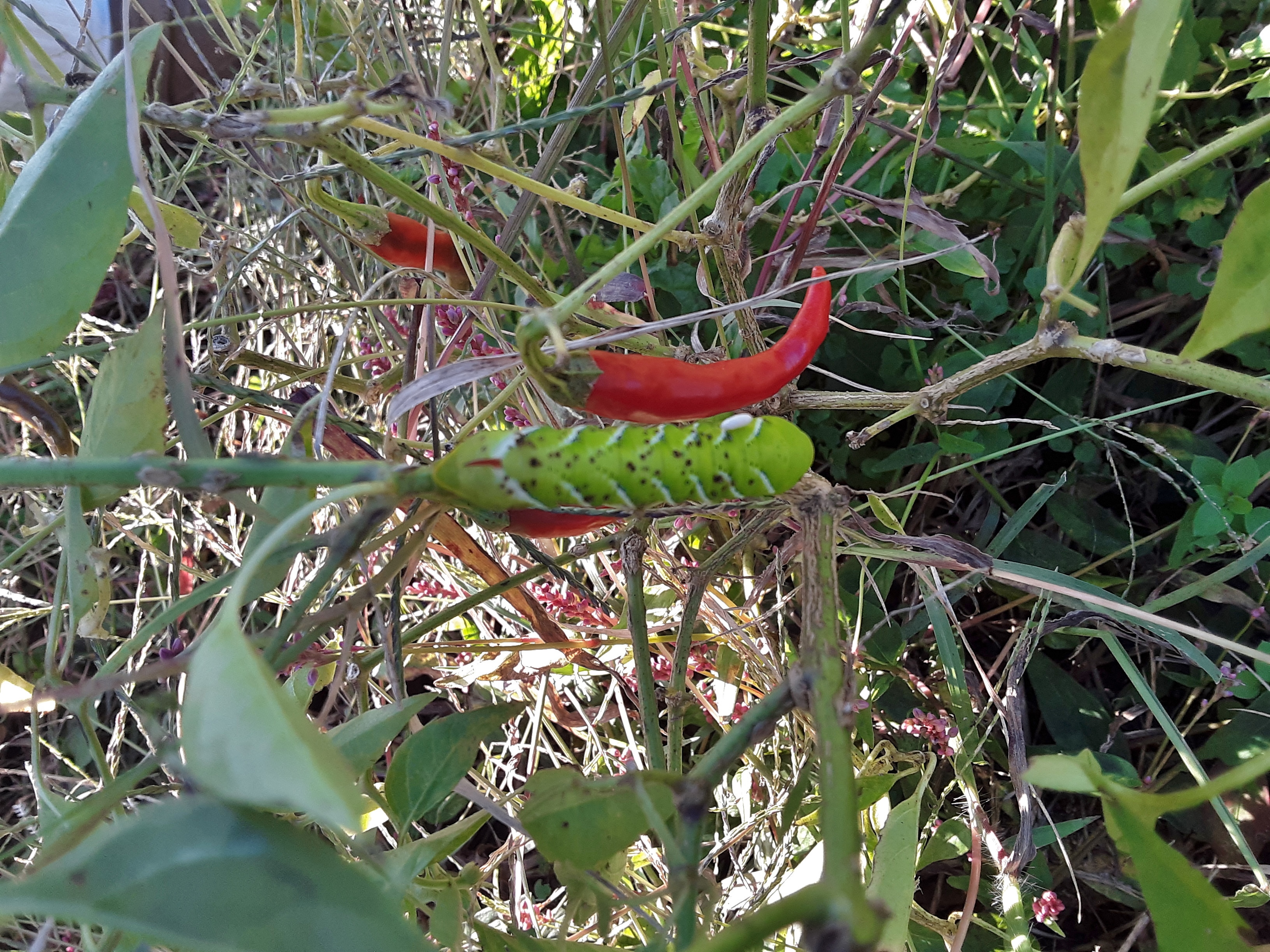
Who knew that anything ate Cayenne peppers. Tobacco Hornworms do. (My daughter looked it up first.) The seven white V-shaped markings and red horn confirm the ID.

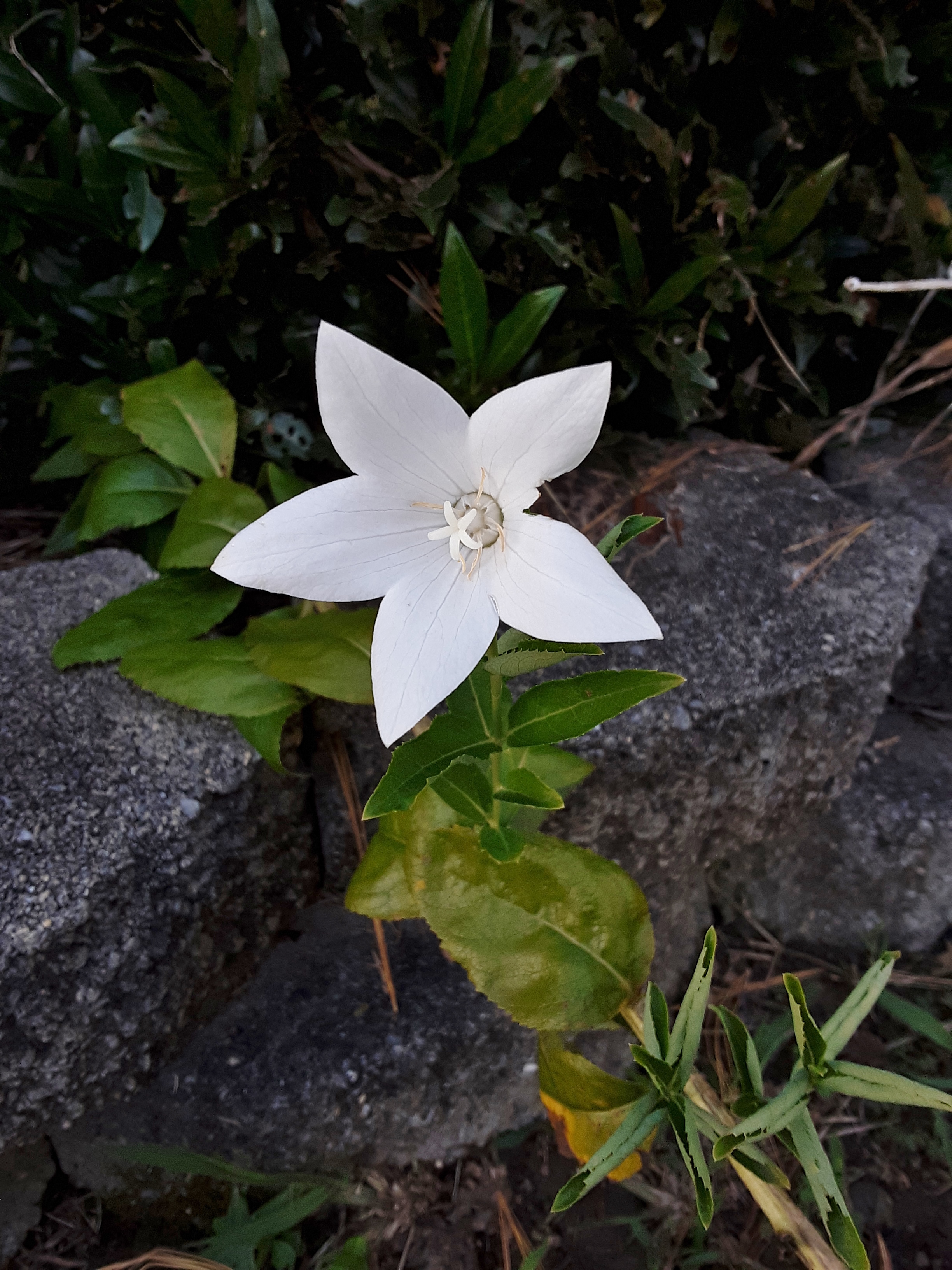
Yet another small flower exhibiting its beauty. It is some variety of Balloon Flower, because that is its appearance before the bloom opens. The flowers were confused. I have an azalea still in bloom this 6th day of November, the third time it has bloomed this season.

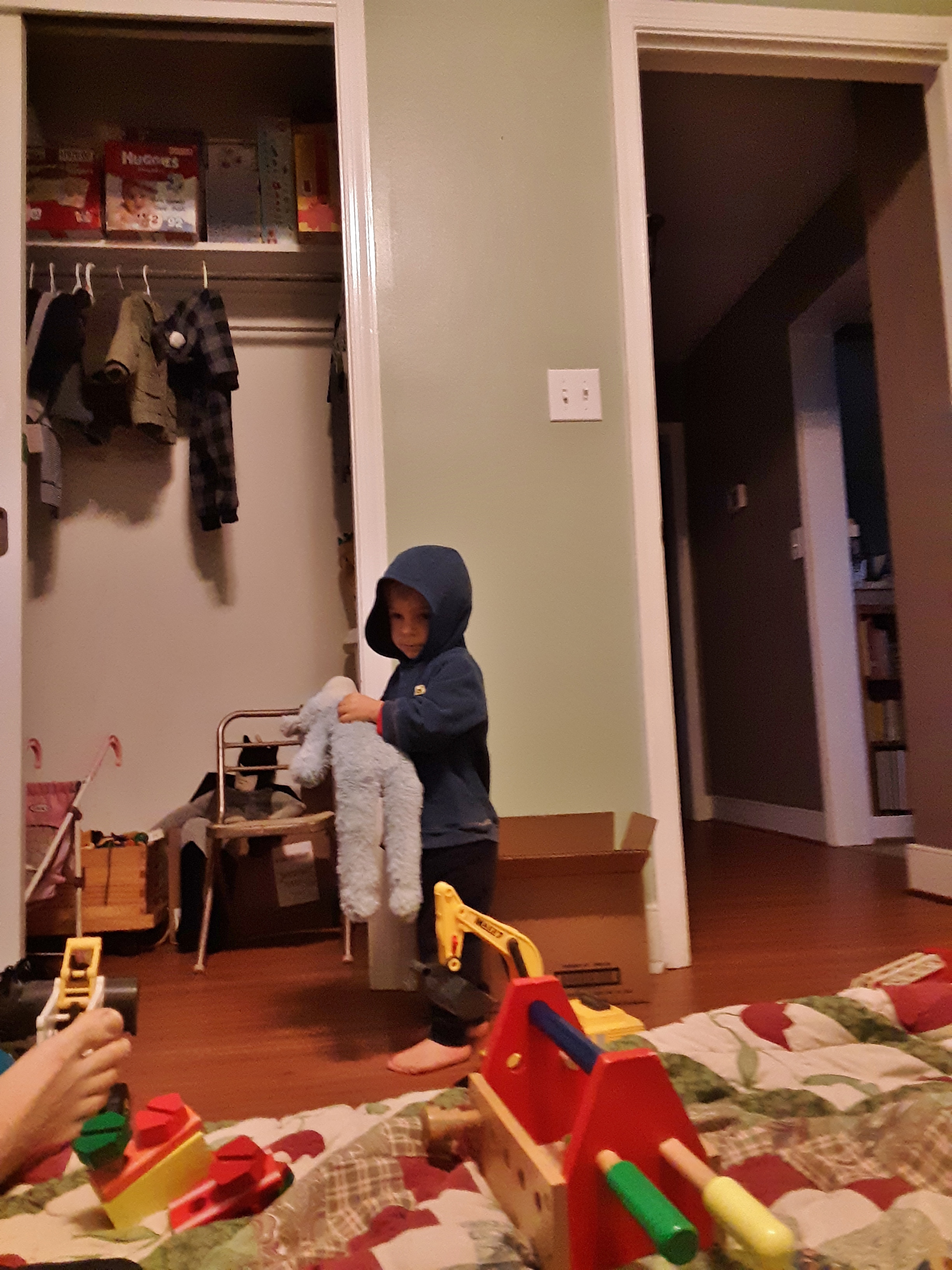
I guess the hood warms his head and the bear warms his heart. But what warms his feet?

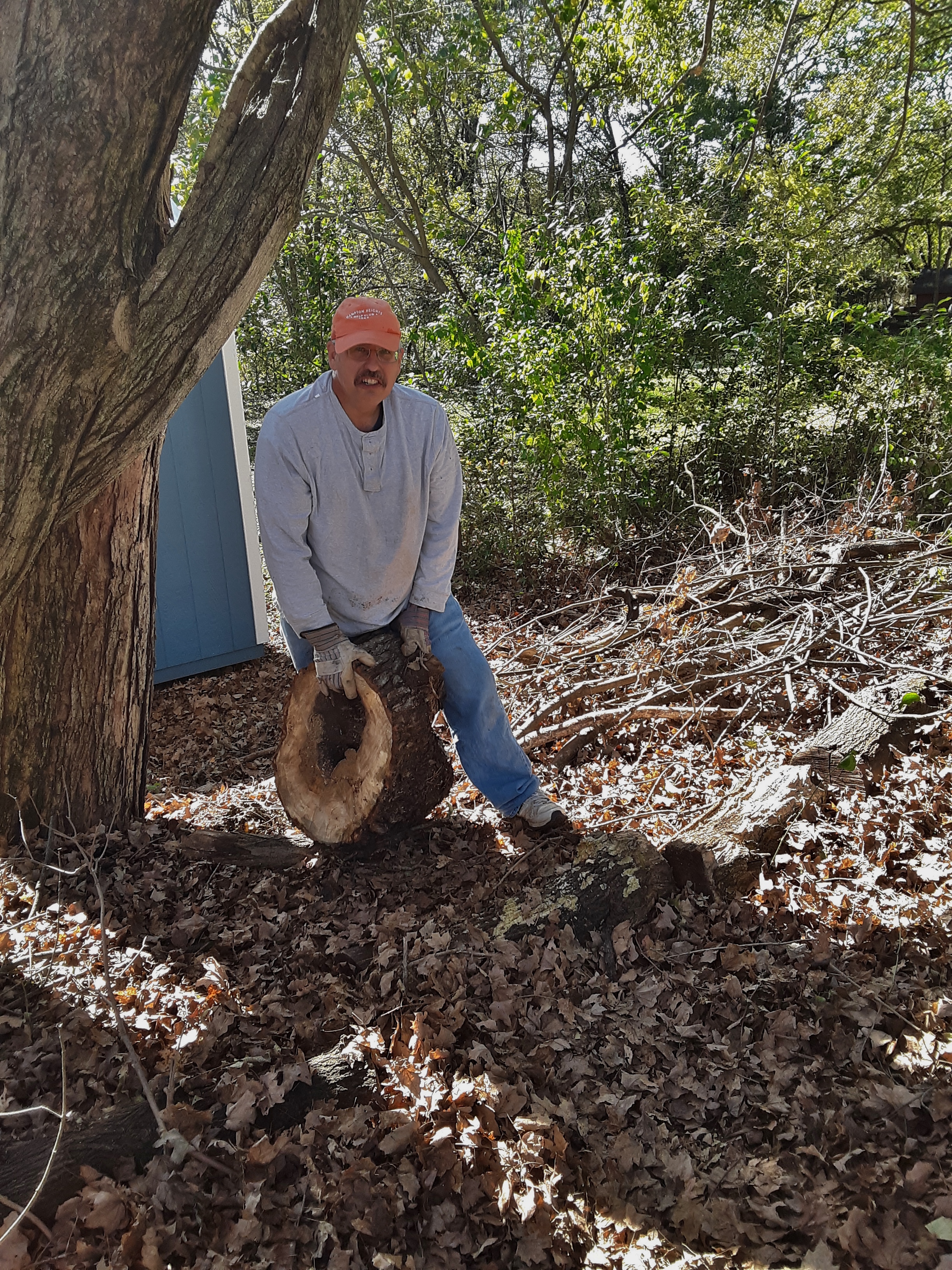
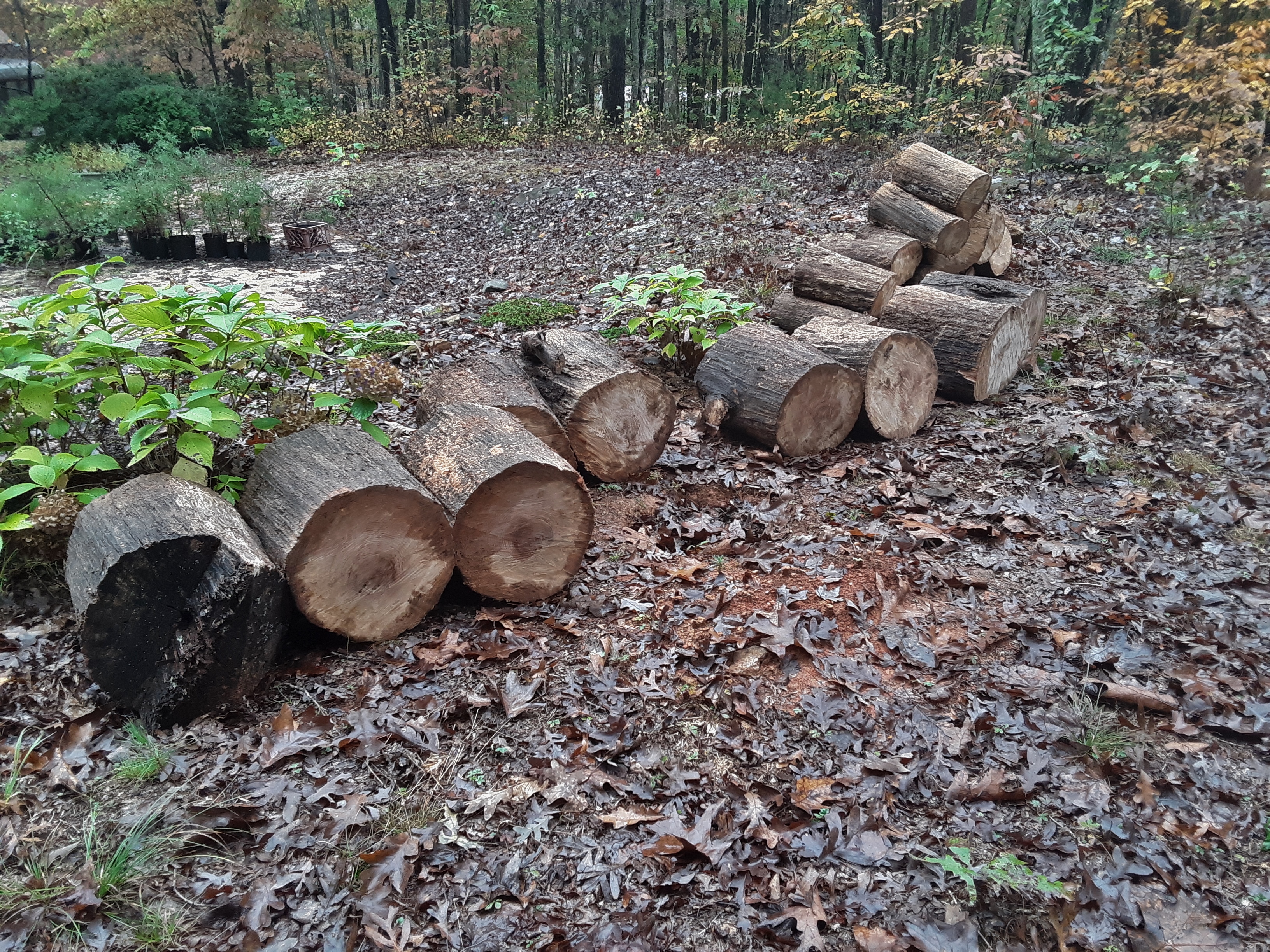
While I am talking about little things that are big, I thought I’d add a few more thoughts. One of my pastors offered me some firewood that he had no need of. I cut and began loading. In a few minutes he came out with his son saying, “I brought reinforcements”, and helped me load the wood. Kindness can be a word of encouragement, but an act of encouragement is even better.

Today I did small repairs on a house. I sealed the leaking skylight on the roof. I re-nailed a soffit board that had warped and pulled loose. I caulked around windows that were leaking air and allowing Lady Bugs entrance. Such a little crack can allow so much to transverse a barrier. Do maintenance on the little cracks that can allow rain and cold and insects into your living space. And I don’t just mean your house.

Read Full Post »

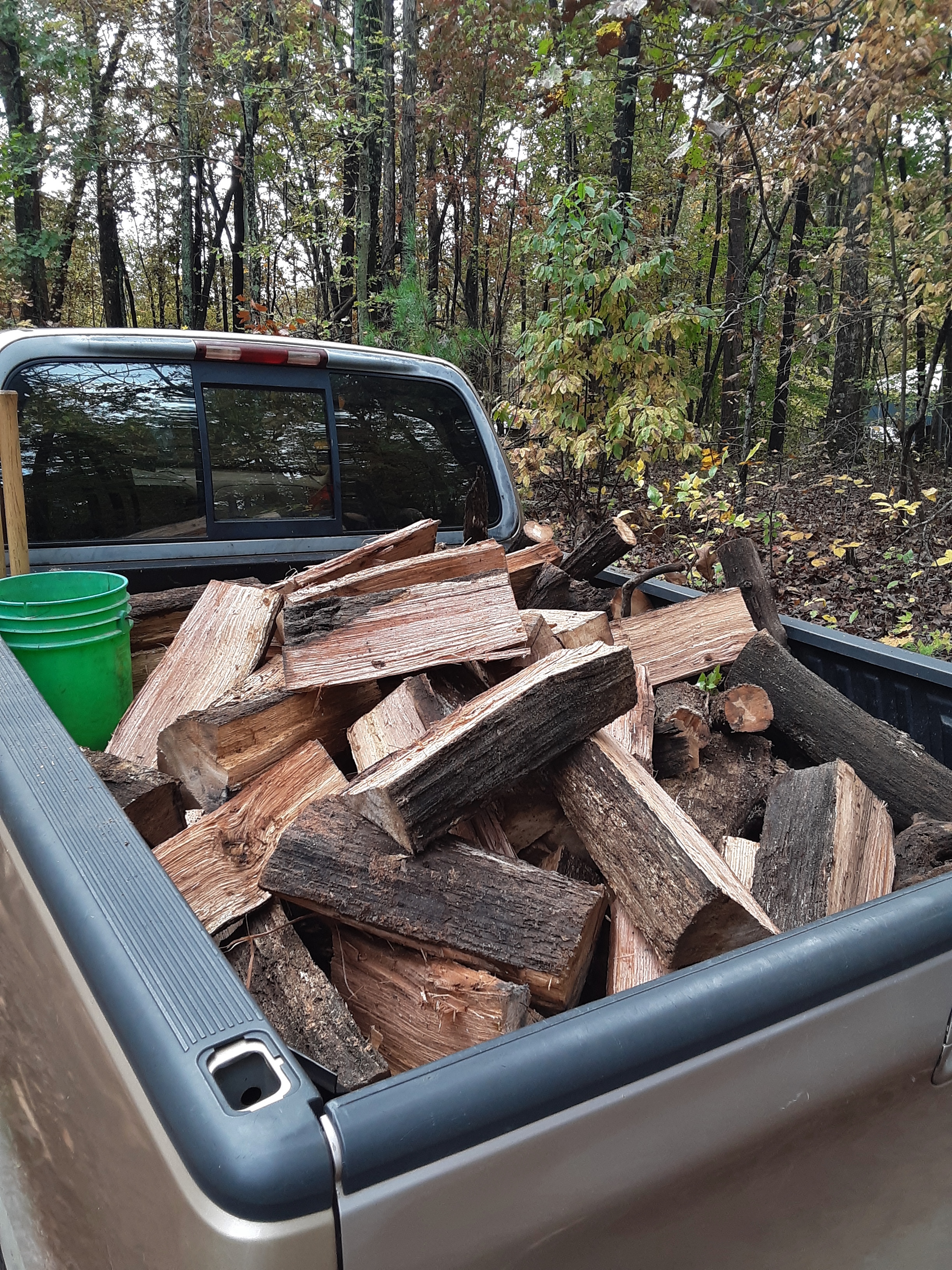
I am one tired 60 year old this evening*. It rained relentlessly yesterday and last night. The weather forecast suggested cloudy in the morning and sunshine in the afternoon. It was drizzling heavily when I left home this morning. The job I had intended to do was postponed until drier, so I shifted gears to get firewood. I cannot remember a year in the past 37 winters of heating with wood that I began the year with so little firewood. A job estimate I did turned into an opportunity to get wood. The oak tree in question had been down about a year, having died and been cut. It was elevated off of the ground by branches, which allowed it to dry without rotting, and it was about 18 to 20″ in diameter at the base. The wood was sound, sap dried**, and fairly straight grained***. The drizzle quit, the saw was cutting well, and the distance from truck to tree was short. The landowner had even said that I could borrow his hydraulic splitter. After reminding him of this kindness several times, it never materialized. So, after rolling the larger pieces up beside the truck and throwing all of the smaller pieces into the truck, I began to split with my trusty 10-pound sledge hammer and wedges and double bladed axe. I might need to buy some new wedges some time since I have pounded the old ones to about 2/3 their original length over the past 37 years. I split 15 of the 18+/- diameter logs and all of the pile of medium sized logs in the picture. Then I loaded it, hauled it home, and after a large, late lunch, stacked it in the firewood shed. It is time for a sit.

Time for business
Only nine logs at this time; 15 when I rolled them all up.
About halfway there
Not totally volumetrically full, but weight full with trailer attached
Ready to haul
Recycling a stump

Rats, I didn’t have time to workout today. Do you reckon I’m OK skipping a day?

*I asked myself a question you may have asked about my blog writing. Why does he write about everyday events? Who cares and who wants to know? My answer is that my twofold reason for writing this blog is to glorify God and record what I am thinking and doing. I think it does the former by showing His work and provision in the mundane as well as exceptional, and it does in the latter by showing I’m just a common joe going about life.

**Wood may be soaked by rain and still be “dry”. Green wood does not burn well, needing a year for the sap to dry out.

***Straight grained wood is easy to split. Oak is generally so except where there are knots. Some tree species, for example sycamore, twist as they grow and can be difficult to split.

Read Full Post »

Geometrically, a cascade is a type of waterfall that drops along the contour of a slope rather than freefalls over a precipice. Catawba Falls is a massive cascade at the base of Black Mountain near Old Fort, NC. A group of 22 from my church made the relaxed walk to the base today. In the group were people from about 4 years old to nearly 70. Some children waded and swam, others held hands. There was much enjoyable talk and enjoyment of God’s creation. It has been very wet lately, so the cascade was flowing well. Muddy spots and rivulets cross the trail frequently. There are a few places to rock hop or wade tributaries. There are two large bridges to cross rougher stream crossings. Even in mid-September the leaves are all still green and mushrooms abound. The day was cloudy and cool, but this nor the cold water prevented most of us getting some part of our bodies wet from feet to head.
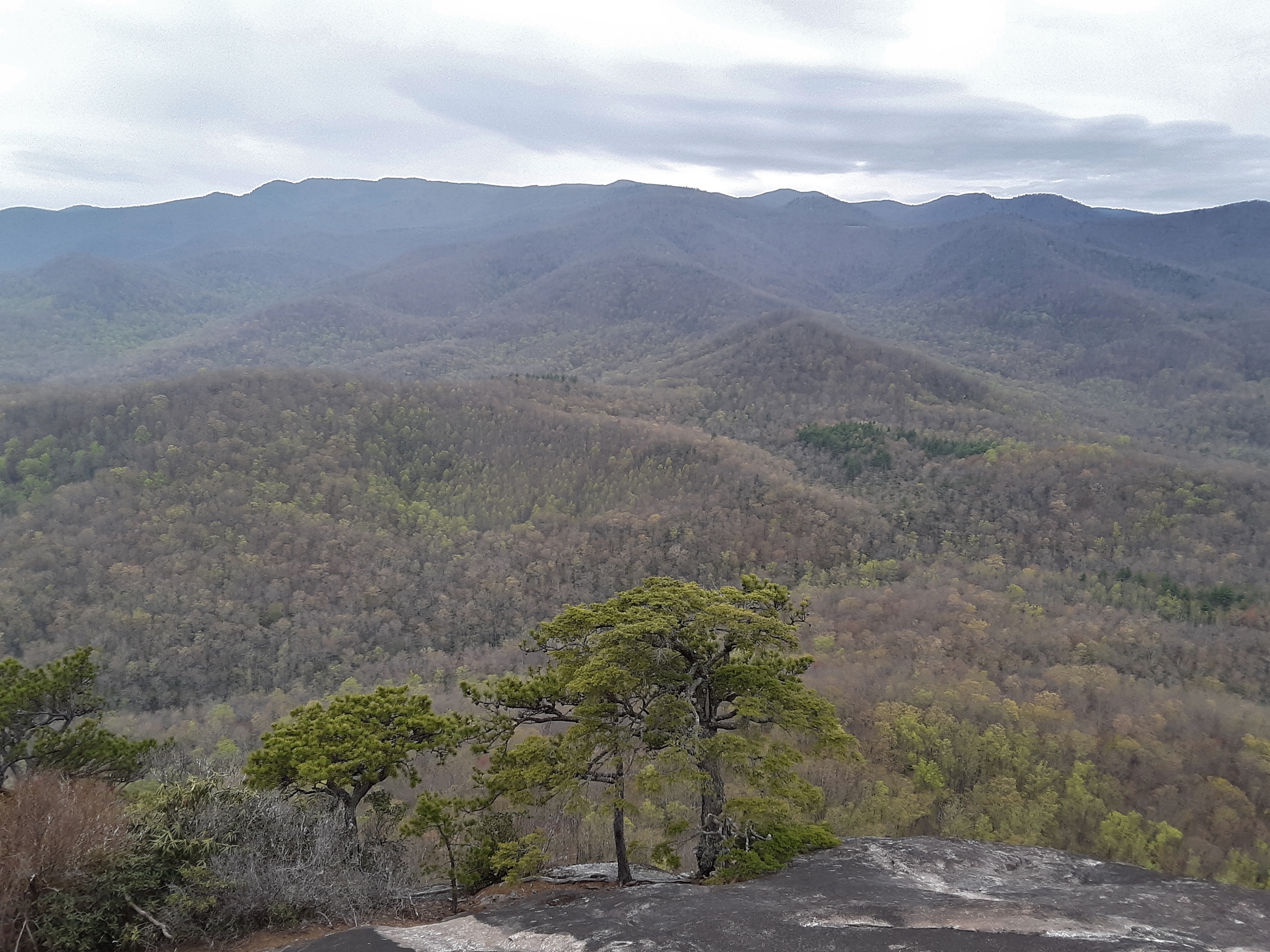
A Start
A 1920’s hydroelectric generation structure near the first bridge
Tributary cascade above the trail
Well graded trail on steep ground
A small tributary falls below the trail
At the old hydroelectric dam upstream of the powerhouse
Second Bridge
A little friend I helped near the cascade
Catawba Falls
From a rock about 1/3 up the cascade
Food is anything you can digest
Yes, it is cold!

While the group was proceeding back down at a leisurely pace, I decided to bushwhack a little. See what I found.

Where do all of the helium balloons come down?
Mosses and Club Mosses
In September this valued plant gives its location away by exhibiting its red berries. But I won’t give away its location.

Read Full Post »

« Newer Posts - Older Posts »

Myrela

Art, health, civilizations, photography, nature, books, recipes, etc.
Overflows from the Heart

"But the things that proceed out of the mouth come from the heart…" Matthew 15:18

CreatorWorship

Pointing to the One who made, saved, and sustains