Feeds:
Posts
Comments

Archive for the ‘Sanctification’ Category

“In whatever he does, he prospers.” (Psalm 1:3)

But of course, his “whatever” is formed, informed, directed and constrained by his delight and meditation upon Bod’s law. As in Psalm 37:4-5,

“Delight yourself in the Lord;
And He will give you the desires of your heart.
Commit your way to the Lord,
Trust also in Him, and He will do it.”

The desires of my heart and God’s accomplishing of it proceeds from my delighting in Him and committing my way to Him. We are on the same page, or far more accurately, I am on His page, and He is pleased to delight His child.

Read Full Post »

The righteous one “does not walk…stand…sit.” Deuteronomy 6:7: “You shall teach them diligently to your sons and shall talk of them when you sit in your house and when you walk by the way and when you lie down and when you rise up.” In the way you act in your personal life will train your children. You add words by teaching and talking in order to explain how and why you “sit…walk…lie down…rise up.” God’s commands should be on your heart and your lips rather than the “counsel…path…seat” of the wicked (Psalm 1:1)

Read Full Post »

“In whatever he does, he prospers.” verse 3

What do the righteous do? They delight in and meditate on God’s law, His Word. What one delights in he spends time with, thus day and night. There is not an ounce of passiveness in this pursuit but all intentionality and passion as with a first love.

Read Full Post »

Day 1 Evening reflection:   Preliminary Contrasts:

tree vs. chaff; firmly planted vs. blown away;  blessed vs. not so; 

nor stand in the path of sinners vs. nor sinner [stand] in the assembly of the righteous

LORD knows the vs. way will perish;  yields fruit vs. [worthless] chaff

prosper vs. perish

Read Full Post »

The radio preacher challenged his listeners to read Psalm 1 twice each day for 21 days and journal impressions, adding, “It will change your life.” As best I could, I took him up on that. I began reading the psalm on December 1st and completed my 21 days in the 25th. As, you will see, I also failed to record impressions or read twice each day on four occasions. I was curious to see if non- repeating insight would come 42 separate times (38 in reality since I missed 4 times). I hand wrote my journal which I intend to copy to here with only minor corrections and clarifications. I will be labeling the entries along the following scheme: D1M means Day 1 Morning, etc., and here it is:

v.1-3: does not, does, is

v.4-5: not so the wicked

v.6: both their ways

Read Full Post »

The elder preached from Nehemiah 8 last Sunday. Ezra read the book of the Law to all Israel. They and we need it regularly read and preached to us because we dismiss or diminish its authority and efficaciousness (1) in our lives. He further pointed out that this passage is very frequently used to promote and instruct on expositional preaching. To read, explain, and exhort with the Word is the pattern for expository preaching. The passage also speaks of God’s people’s 1) need of the Word, 2) requiring the leadership to read the Word, 3) requirement to obey the Word, 4) need to speak with a unified voice from preachers, teachers, to all church members and parents on the truth of the Word, 5) need to understand the Word, and 6) response to the Word.

It was on the sixth point that my mind started musing as he unpacked it. In good preacher language, he proceeded to alliterate the process of God returning His people to Himself in “r’s”. The “r’s” caught my attention for two reasons. Firstly, I have been ruminating on the very idea for quite some time. Secondly, he said one minor thing that I disagreed with based on that rumination, namely that rejoicing is the endpoint. To be fair, when I asked him about it afterwards, he agreed with me, saying that it was effectively an intermediate endpoint since he could not preach the whole of Nehemiah in one sermon. So, his sermon helped me to complete the following diagram which had a few holes beforehand.

A continuing reverence for God and His Word will not prevent the need for repentance but it will reduce the depth of repentance needed as you keep short accounts and avoid presumptuous, chronic, and devastating sins. Also, as regular disclaimer for my diagrams, this is not the only way God may draw you back to Himself. It may be in a different order with additional or less steps. These are merely major signposts of restoration (2). Without spoiling the diagram by over-explanation, I offer this one clarification. One, saved or unsaved, may recognize (3) the message of revelation to their heart but not repent. He/she may never or just delay repentance as he/she resists the work of the Holy Spirit. So with all of the steps, the time across the arrows may vary greatly. May God bless us as we seek to draw nearer to the burning center (4) of His presence.

  1. efficaciousness- successful in producing a desired or intended result; effectiveness- the degree to which something is successful in producing a desired result; success
  2. That could have been the title!
  3. We call it conviction (of sin).
  4. Allusion to “The Burning Center” by John Piper

Read Full Post »

One of the most practical results of good theology is a strong sense of hope and assurance. With these one may have peace, joy, and concern for others. I have not always had these, not because my stated theology was bad, but because my practical theology was. Let me explain. I can affirm what the Bible says, but if for whatever deep or hidden reasons I do not believe it so as to affect my feelings and actions, my stated theology is not my practical (aka: real) theology. The place where theology frequently shows itself awry is in the area of hope for eternity and assurance of salvation. Without confidence in where you will be in the afterlife, you have not confidence for living.

Does God exist? What is He like? What is the fundamental nature of man? Does man need to be rescued from sin? Is there an afterlife? Is there a heaven and a hell? Is there only one way to salvation? What is the way to salvation? These are fundamental questions of life. The Bible clearly speaks about all of these and more. It says that the above yes/no questions are all answered, “Yes!” Two of three of the other above questions may most simply be answered, “Jesus” (John 1:18, 14:6), and the third one, “in God’s image but broken.” (Genesis 1:26-27, Romans 3:23)

With that basic foundation, can a person be confident that they are saved and will remain so into eternity? Clearly, I John 5:13 says you may know. The remainder of this article is to explain from Scripture how I know that I will remain in this condition of “saved”, headed to heaven, and why I have confidence. I have been considering this blog entry for several months now, but I could not bring myself to complete it because the task seems so daunting. I have now written because I realized that I don’t have to nor can I write an exhaustive or even complete treatise on the subject. That is OK. I want to encourage others and myself, not write a book on theology.

Romans 8:28-39 says, “And we know that God causes all things to work together for good to those who love God, to those who are called according to His purpose. For those whom He foreknew, He also predestined to become conformed to the image of His Son, so that He would be the firstborn among many brethren; and these whom He predestined, He also called; and these whom He called, He also justified; and these whom He justified, He also glorified. What then shall we say to these things? If God is for us, who is against us? He who did not spare His own Son, but delivered Him over for us all, how will He not also with Him freely give us all things? Who will bring a charge against God’s elect? God is the one who justifies; who is the one who condemns? Christ Jesus is He who died, yes, rather who was raised, who is at the right hand of God, who also intercedes for us. Who will separate us from the love of Christ? Will tribulation, or distress, or persecution, or famine, or nakedness, or peril, or sword? Just as it is written, “For Your sake we are being put to death all day long; We were considered as sheep to be slaughtered.” But in all these things we overwhelmingly conquer through Him who loved us. For I am convinced that neither death, nor life, nor angels, nor principalities, nor things present, nor things to come, nor powers, nor height, nor depth, nor any other created thing, will be able to separate us from the love of God, which is in Christ Jesus our Lord.”

But what if I quit loving God? If you belong to Him, you will not do that. How do I know? Read the passage. Second on the list of those whom “God causes all things to work together for good” are those “who are called according to His purpose.” In reference to Israel, Paul says, “The gifts and calling of God are irrevocable.” (Romans 11:29), but the idea may be applied to all who fall under His purpose. Notice the progression following, listed in past tense. “He foreknew.” As it says in Romans 9:11-13, “for though the twins were not yet born and had not done anything good or bad, so that God’s purpose according to His choice would stand, not because of works but because of Him who calls, it was said to her, “The older will serve the younger.” Just as it is written, “Jacob I loved, but Esau I hated.” It was not by anything that Esau or Jacob did but by God’s choice, which is a part of foreknowledge in that it involves predestinating, the next on the list. The next part of the sequence was calling. He then justified and finally glorified. In our time limited existence, glorified has not yet happened, but in God’s time scale it is a done deal. So how do you undo by your unbelief what God has already done and declared completed? You don’t! Those who turn back could not have ever been saved and were self-deceived, because “He who began a good work in you will perfect it until the day of Christ Jesus.” (Philippians 1:6)

Then God has Paul solidify the assurance by declaring that nothing can separate us from the love of God. The logical progression of the argument ensures that you know that no one or nothing physical or spiritual can rob God of you and therefore you of God. I find it most satisfying and interesting that He ends the list of things that cannot separate us from Him with “nor any other created thing.” (v.39) Are you, dear reader, a “created thing”? Can you separate yourself from God? I think not. Those whom God has chosen are confirmed. Those who separate themselves from the things of God were never His to start with. I am so thankful that I am His and that I am held firmly in the grasp of His mercy and grace.

A word of caution to those who feel self-satisfied with their assurance but show little or no evidence of a change in living. You are deceived. If I tell you that I have a red Lexus in the parking lot and you go out and do not find a red car nor a Lexus, then I have deceived you. Red and Lexus do not make them my car, but are mere evidences that the car is mine. So, if I say that I am a Christian, though I am not nor could I be saved by good works, then I must exhibit good works as evidence that God has gotten a hold of me and saved me. Am I being changed into a trajectory toward God and His ways, even with fits and starts and setbacks? Then I may have assurance that God has worked His work in my heart and I will persist in believing and persevere in salvation, already seen as glorified by God. Am I lacking in these evidences? Then I had better be crying out for God’s mercy and grace in my life so that I may see this sanctifying change, even if ever so slowly.

Read Full Post »

A colleague and I were discussing some of the challenges and emotional oscillations of our lives and work. She pointed out that we as Christians focus on our sin far too much and that we should focus on the victory we have in Jesus. I agreed and referenced a number of verses in support of focusing on overcoming sin.

Later I reflected on the conversation, finding nothing amiss, but still having some small discomfort over what was not said. You see, we live in a culture at large and Christian with many voices.

I read Puritan prayers, fully concurring with their attributing to themselves, and by extension me, actions, thoughts, intentions, and omissions no better than a worm. I am a sinner by nature and a sinner by practice. Job’s false comforter, Bildad the Shuhite, says truly, ““How then can a man be just with God? Or how can he be clean who is born of woman? If even the moon has no brightness and the stars are not pure in His sight, how much less man, that maggot,
and the son of man, that worm!” (Job 25:4-6) We are promised that we will be made perfect in heaven (Hebrews 12:23), but we fall far short, as it says in Romans 7:18-19, “I know that nothing good dwells in me, that is, in my flesh; for the willing is present in me, but the doing of the good is not. For the good that I want, I do not do, but I practice the very evil that I do not want.” I have this fallen nature, but that is not who I am in Christ. I am a new creation, the old things passed away. (II Corinthians 5:17) I have the mind of Christ. (I Corinthians 2:16)

But more prevalent in our society than the worm mentality are voices that proclaim either overtly or by implication that each person is or can be perfect or powerful or in control, being or having god within us. These voices, though many proclaim to be, are not Christian. They are Humanist and counter to the Scriptures, attributing to man god-like qualities. Power of positive thinking gurus hawk self-improvement books and faith healer-prosperity gospel preachers tickle ears (2 Timothy 4:3). Whereas the Scripture teaches that “The heart is deceitful above all things, and desperately wicked: Who can know it?” (Jeremiah 17:9, KJV) Therefore “Thus says the Lord, “Cursed is the man who trusts in mankind and makes flesh his strength, and whose heart turns away from the Lord.” (Jeremiah 17:5, NASB*) And we struggle, as it says in Romans 7:18-19: “For I know that nothing good dwells in me, that is, in my flesh; for the willing is present in me, but the doing of the good is not. For the good that I want, I do not do, but I practice the very evil that I do not want.”

Being neither worthless and unable to respond nor godlike and supremely powerful, “your body is a temple of the Holy Spirit who is in you, whom you have from God, and that you are not your own? For you have been bought with a price, therefore, glorify God in your body. (I Corinthians 6:19-20) We are “called as saints” (Romans 1:7), that is, sanctified or made holy. We called beloved: “Therefore, having these promises, beloved, let us cleanse ourselves from all defilement of flesh and spirit, perfecting holiness in the fear of God.” (II Corinthians 7:1) Because we are loved by God, we are both motivated and enabled (II Peter 1:3) to cleanse ourselves. That means avoiding sin (I Corinthians 10:13), quickly confessing sin (I John 1:9), and perfecting holiness are top among our duties. Don’t focus on your sinful tendencies; focus on your ability in Christ to daily overcome those tendencies. In balance, pursue victory, but take heed lest you fall (I Corinthians 10:12, KJV), informed by the Word of God and led by the Spirit of God.

*NASB is what I almost always quote from, but I use other versions on occasions for emphasis.

Read Full Post »

Some things that we say and believe are not what we presently experience in full,
but are what is true about us in our new nature, is becoming true about us through
sanctification, and will be totally true in heaven.

Never lonely when He is near
Never overcome by any fear
Always hopeful though life be drear
Always at peace even when not all is clear

Momentarily disturbed, oh sure
Momentarily give in, not pure
Eternally made right, the cure
Eternally held tight, secure

Daily the struggle goes on
Daily His Spirit I must don
Slowly sinful tendencies gone
Slowly His righteous ways in me dawn

Fearfully and wonderfully made
Fearfully work out my salvation I am bade
Joyfully go forth with His aid
Joyfully with His Spirit arrayed

Nevermore sorrow overcomes
Nevermore to sin succumbs
Forever peace until and when He comes
Forever glorious gracious outcomes

Read Full Post »

In Sunday School we have been studying Romans chapter 6. Some weeks we don’t even get through one verse. We were looking at verse 13: “Do not present your members to sin as instruments for unrighteousness, but present yourselves to God as those who have been brought from death to life, and your members to God as instruments for righteousness.” The word translated “instruments” is frequently translated “weapons”, so Paul is using a metaphor that has the parts of your body likened to weapons of warfare. One of the drills in military procedures, particularly since the inception of the firearm, is “Present arms!”. The soldier is displaying his weapon for inspection, drill, and show of allegiance. Also, there is a significant parallelism here, and I find it easier to see if I diagram it. My pastor pointed out that presentation of your members to God is not doing good deeds, which leads to a self-righteous moralism, as opposed to sinning. Rather, we present our members to God, which means sin is everything that is not God and counter to Him. This verse is very practical when it comes to growing in sanctification. This idea is why we must put on the armor of God described in Ephesians 6:10ff. We are at war with the world, the flesh, and the devil, but “His divine power has granted to us everything pertaining to life and godliness” (2 Peter 1:3).

Read Full Post »

Jesus said, “Sanctify them in the truth; Your word is truth.” (John 17:17)

Reading in the Proverbs lately, the sanctifying role of God’s Word to bring understanding and wisdom has captured my notice.

The confused understand; the despondent move toward hope; the fearful find security; the naive accept knowledge; the conflicted settle into peace; the foolish walk in wisdom; the sad perk up with joy; the timid boldly tell of the Savior; the persecuted receive comfort; the sinners dodge wrath and bask in blessing; the righteous are clothed in discernment and eternal riches.

Our God through communicating to man imparts life and godliness (2 Peter 1:3). “For the Lord God is a sun and shield; The Lord gives grace and glory; No good thing does He withhold from those who walk uprightly.” (Psalm 84:11) “I wait for the Lord, my sol does wait, and in His word do I hope.” (Psalm 130:5)

May you discover more of His grace and glory, and may His blessing overtake you in His light and protection that surround you, as you seek to walk uprightly before Him in 2022.

Read Full Post »

While the Papists and Heathen celebrate All Hallows Eve, many believers across the world remember Reformation Day when a struggling monk was seeking the truth and setoff a firestorm of changed hearts and minds.

We must all as believers relive times of revival and reformation, for as the nailing of the Ninety-five Theses to the Wittenberg Church door was only a beginning, so our day of salvation and moments of rededication are only beginnings. It is usually at this moment that we quote II Chronicles 7:14 about the the people of God humbling themselves and calling on God’s name or Hosea 6:1 in which we are admonished to return to God. These are worthy of deepest consideration, as we are so often self-deceived about the depth of our walk before God.

But today I call to your attention the words of Daniel 9:3-5: “So I gave my attention to the Lord God to seek Him by prayer and supplications, with fasting, sackcloth and ashes. I prayed to the Lord my God and confessed and said, “Alas, O Lord, the great and awesome God, who keeps His covenant and lovingkindness for those who love Him and keep His commandments, we have sinned, committed iniquity, acted wickedly and rebelled, even turning aside from Your commandments and ordinances.” The church in America and our church specifically has seen a period of barrenness and declension in numbers and depth of spiritual life. We need revival. We need restoration. We need reformation.

It is appropriate that we should sing “A Mighty Fortress Is Our God” by Martin Luther on this day. Not only is it appropriate to remember the work of God through a humble monk, but even more so to recall that God can and will overcome the forces of Satan, the world system, and our sinfulness. We need to call on Him to be gracious to work it powerfully in us now, in this day, in our church, in our country, in our hearts.

Read Full Post »

Over a period of time I was talking to a friend about her need of Jesus. During this time I had a loved one who was sick, bills were piling up, responsibilities seemed endless and overwhelming. One day in the presence of my friend I opened up about my fears and difficulties. On the one hand I guess it made me seem like a more real person, but the next time the subject of Jesus came up I quite honestly said, “I am asking you to trust Jesus when I sometimes struggle to trust Him myself.” She was quite understanding about my struggles, but I had a moment of deep conviction. If we are going to point a skeptical and dying world to the Savior, we must learn ourselves to react in faith rather than fear.

Just as “courage”, according to a quote by Franklin D. Roosevelt, “is not the absence of fear, but rather the assessment that something else is more important than fear,” so faith is not the lack of fear, discouragement, loneliness, temptation, confusion, or any other difficulty, but the firm conviction that God is greater and able and willing to give us peace and patience in the midst of the difficulty and regardless of the physical outcome.

I had a moment of fear the other day as I crawled into a tight crawl space to jack up a floor supported by rotten floor joists, which I needed to replace. It was so tight that I could not turn on my side until later when I dug out a space for my hips and shoulders. The fear was momentarily paralyzing, but then I took a deep breath and prayed that God would give me calmness. A peace washed over me in seconds. I had to pray again later when it happened again. I ended up working in this situation for eight hours, only crawling the 20 feet to the tight exit when I needed to cut a board or get an additional tool.

Many fears and difficulties are not so obvious as these two examples I have given. Because of their subtlety, many fears and doubts can creep up on us almost unbeknownst to us. We are tied up in a web of fear we never saw being wrapped around us. We learned it as a child. We think it the natural reaction of any sane person. We hardly give it heed, but are nonetheless confined by its stifling cords.

And that thought directs my mind immediately to Hebrews 12:1-2: “Therefore, since we have so great a cloud of witnesses surrounding us, let us also lay aside every encumbrance and the sin which so easily entangles us, and let us run with endurance the race that is set before us, fixing our eyes on Jesus, the author and perfecter of faith, who for the joy set before Him endured the cross, despising the shame, and has sat down at the right hand of the throne of God.” The great antidote for fear encumbrance is “fixing our eyes on Jesus”. It was the same for us at salvation when the fiery serpent of sin had bitten us and we were destined for death. “And Moses made a bronze serpent and set it on the standard; and it came about, that if a serpent bit any man, when he looked to the bronze serpent, he lived.” (Numbers 21:9) Looking was equivalent to believing and had an immediate positive effect for John 3:14-15 says, “As Moses lifted up the serpent in the wilderness, even so must the Son of Man be lifted up; so that whoever believes will in Him have eternal life.” So, salvation was just a look, or glance, trusting God in Christ to overcome temptation, including fears; faith walk is a “fixing” of our gaze on Jesus. Every moment we are tempted to fear or go our own way, we must fix our gaze on Jesus. The result is that “no temptation has overtaken you but such as is common to man, and God is willing, who will not allow you to be tempted beyond what you are able, but with the temptation will give you the way of escape also, that you may be able to endure it.” (I Corinthians 10:13) And when you are tempted to have a worrying fear, “be anxious for nothing, but in everything by prayer and supplication, let your request be made known unto God, and the peace of God will guard your hearts and minds in Christ Jesus.” (Philippians 4:6-7)

The Hebrews passage begins with “Therefore”, which points you back to the “chapter of faith”, Hebrews 11. This “great cloud of witnesses” fortifies our gaze on Jesus. We are not in this alone. Others have had worse difficulties and still fixed their eyes on Jesus. As the Holy Spirit enabled them to overcome Satan, temptation, and death by the blood of the Lamb (Revelation 12:11), so we are encouraged to do the same. Practicing this “fixing” brings endurance and the realization that Jesus suffered far more and had a victorious end.

I want to react in faith, not fear. It is a more peaceful way to live and a strong testimony for the truth of God being in my life. The realization that garden variety fear was stifling my walk and my witness has brought focus to my reaction in the last few weeks. I hope it is a focus that causes me to more frequently fix my eyes on Jesus in faith rather the circumstances in fear.

Read Full Post »

It’s not enough that you know
Or have had a Jesus moment
Life in Him will make you grow
Sanctifying development

If you are not really sure
Receive the gift He does proffer
Then you will surely endure
No better or lasting offer

I would fall away from Him
By doubt or outright rebellion
Going out upon a limb
Cast away to oblivion

Nothing can me separate
Or plunge me headlong into hell
Nor peace with God confiscate
Of these with joy I do tell

I may walk by the Spirit
And not according to the flesh
Trust His words in Holy Writ
My joy and resolve intermesh

After the trials of this life
One day I will look on His face
When forgotten all the strife
With success completed the race

Some of my poetry is straight up how I feel and what I believe. Other parts are aspiration based on what I believe can be and should be and will be. This poem is a combination. Life is complicated and messy, but God is faithful and enables me more as the years go along and I submit to Him more. May He and the the grace He provides be glorified in my turning to Him in every difficulty and disappointment.

Also see “Response to Troubles and Trials

Read Full Post »

We need hope, but from whence does it come?

Certainly a sense of purpose or destiny or family and friends bring hope, but what about when these fail or seem distant? Hear what source of hope the Scriptures give us:

“For whatever was written in earlier times was written for our instruction, so that through perseverance and the encouragement of the Scriptures we might have hope. Now may the God who gives perseverance and encouragement grant you to be of the same mind with one another according to Christ Jesus, so that with one accord you may with one voice glorify the God and Father of our Lord Jesus Christ.” Romans 15:4-6

Given that this was written before any of the four Gospels and the book of Acts, it must refer to the Old Testament from which Jesus had “opened their minds to understand the Scriptures, and He said to them, “Thus it is written, that the Christ would suffer and rise again from the dead the third day, and that repentance for forgiveness of sins would be proclaimed in His name to all the nations, beginning from Jerusalem.”” Luke 24:45-47 Now, I am not excluding the great encouragement and instruction given by the New Testament, but I magnify the value of reading and studying the Old, especially for those many of you who don’t spend much time there or see much value in it, thinking I’m “not under law but under grace” Romans 6:14 (1) It was written for our instruction, so read the instruction manual before assembly.

Now we get to the meat of our source of hope. The passage reveals a two-fold instruction on hope from God with an ancillary instruction on hope from fellow believers.

Those who are blood bought, Holy Spirit sealed believers (2) increase in hope of their relationship to God and future rescue through persisting in faith in the midst of difficulty- perseverance. In fact, the teaching of perseverance of the saints is pointing out how believers persist in belief to the end while “the Spirit explicitly says” of those who do not truly belonging to God through belief in Jesus “that in later times some will fall away from the faith.” I Timothy 4:1

How does this strange occurrence of hardship increasing trust in God work? As the believer comes to understand that he or she does not deserve anything and yet God is carrying him or her through difficulty and revealing Himself in the process, the believer trusts more. The unbeliever begins to doubt that God cares and pulls further away. Many a believer will also struggle with doubts and be estranged, but it will not persist. In the end faith will persist. The believer perseveres.

The greatest help to perseverance is the Word of God. For this reason, Open Doors, a ministry to persecuted believers all over the world, frequently reports how believers ask for Scriptures over security, food, or shelter. The Bible brings hope and especially when we are paying attention during difficulty. The passage says “the encouragement of the Scriptures”. As we read of others who struggled but found God’s grace to persevere, we find strength. Promises of God impart strength. Ultimately, the excellency of the character of God imparts strength. Strength comes in the form of hope. When we are hopeless, then we are weak. When we are full of hope, then we are strong, strong in the Lord.

But God gives yet another avenue for increasing hope- fellowship. The passage speaks of “same mind”, that is, unity of belief and purpose. Then it says “with one voice glorify”, which is unified worship. When we worship together in unity and convey how God has increased our faith in difficulty and have comforted others in their difficulty with the hope of God and shared Scriptures of encouragement and instruction, then true fellowship and encouragement has occurred and hope is increased. For this reason “let us consider how to stimulate one another to love and good deeds, not forsaking our own assembling together, as is the habit of some, but encouraging one another; and all the more as you see the day drawing near.” Hebrews 10:24-25

The other disciplines of the faith like prayer, witness, fasting, service, and so forth, are all a part of this perseverance-Scripture-fellowship encouragement that strengthens faith leading to hope. What a good God we have who for His glory and our good by “His divine power has granted to us everything pertaining to life and godliness, through the true knowledge of Him who called us by His own glory and excellence.” 2 Peter 1:3

And one day we will be removed from all difficulty and spend eternity in His presence. That will be glory!

  1. In context, this verse has nothing to do with the value or truth of the Old Testament. Rather, it refers to the source and power for overcoming sin, grace applied by the Holy Spirit and not striving to fulfill the requirement of the law. Why? Well it is because “a man is not justified by the works of the Law but through faith in Christ Jesus.” Galatians 2:16
  2. These are not a special breed or dispensation of believers, just plain believers. I use these adjectives to exclude those who have mental assent to the things of God and are spectators in the church, but not saved.

Read Full Post »

We don’t enjoy harsh teachers, but we can learn from them nonetheless. “But it isn’t fair”, “such a teacher shouldn’t be allowed”, and “we must do everything in our power to rid the system of such teachers”. Unless of course the teacher has tenure with no intention of retiring any time soon.

Pain is just such a teacher. Now I’ve lost some of you. We want the fun, picture filled blog entries. But life has not been so fun lately, and that is not the goal of life anyway. So I decided to share a little of the less pleasant side of life, not for pity or running readers off, but because it is part of life and part of my life at present. And there are lessons to be learned from this less than favorite teacher.

I started having mild back pains about three weeks ago. I have had back problems all of my life and I think there is evidence of it being genetic since my three brothers have and father had back problems. I do exercises to keep my core strong and avoid extreme motions.* However, this time I didn’t do anything that I could have avoided to prevent the problem. I guess if I had been able to see the future and its ramifications, I could have worked around it, but I don’t have that ability. Sometimes it is just small things that trip us up.

Anyway, I have these down periods with back maintenance, but this was a perfect storm. The two most painful things were getting in and out of bed and putting shoes and socks on. Function and activity came to a standstill.

In the midst of this particular storm**, my attention was riveted by the frequent bolts of lightning running along my lower back. The teacher had my attention. When in pain, you pray more. Certainly a prime topic is relief, but I found myself praying for others I know who experience constant pain and wondering how they cope. And what of people who have reduced functionality because of pain? Couldn’t I be more compassionate and helpful? And the thought occurred to me several times that at my age, when a significant regression in health occurs, is this the downturn from which there will not be recovery or serious reduction in functionality? And if it is, what is my new focus? What would be my purpose? What new goals do I set? In short, I found this bout with pain highlighting (throwing a shadow on?) my mortality. Life is short and the end is coming, sooner perhaps rather than later. Don’t think so darkly you may say, but in the midst of the pain, lighter thoughts are hard to come by, and they may be no more than whistling in the wind anyway.

So here are the deeper and brighter, not lighter, thoughts that resulted from what I am going through. Life is good, because God is good. I have purpose and meaning because He has assigned those to me. Even if my body wears out or continues in pain, I can pray for others, for my family, the infirm, this sick nation, my lost friends, and my church. I have peace with God even in the midst of turmoil within and without. I am more content when I am thankful, even in the midst of difficulty. Even though I knew all of this beforehand, I know it at a deeper level now. I suspect the lessons are not done since the holidays (the second advent) have not come, but I will have to focus on these and like thoughts as soon as the next lesson starts rather than days into it.

That should make the teacher and lesson seem less harsh, even though still uninvited and unwanted.

.

I should report that my back has shown some improvement in the last few days, though I don’t know what that means for work and play just now. I am privileged to be able to start again, but wary of the fact that physically that is not sustainable in the long-term. Life is full of ups and downs, but I don’t have to pin my hopes on the ups nor dread the downs. I belong to God.

*I hear some of you snickering (LD and BF, for instance).

**See “Midst the Storm”.

Read Full Post »

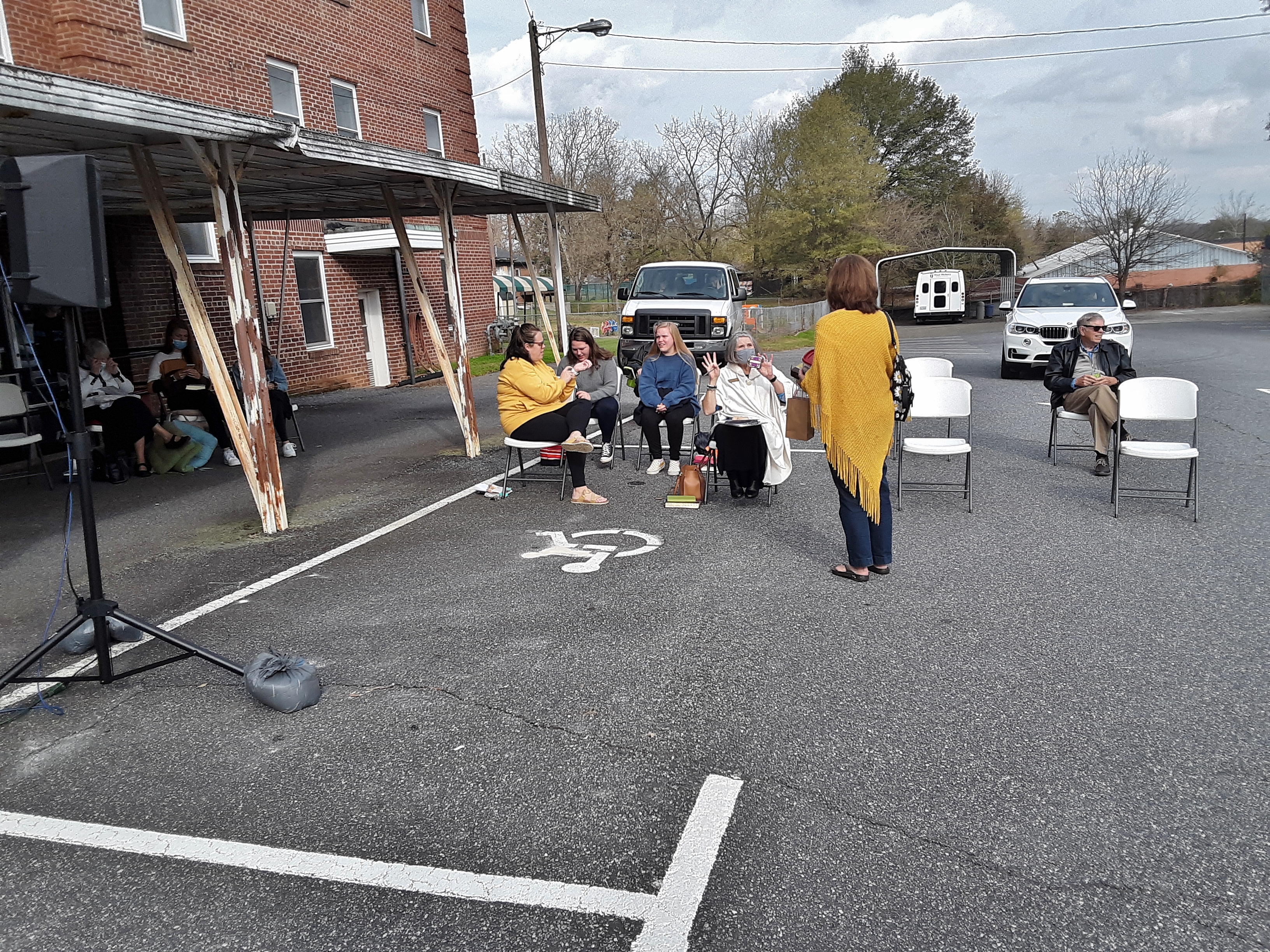
I have a desire to write my blog to give glory to God by relating everyday events, intermittent musings, scriptural insights, and special privileges/opportunities in my life. There are, of course, some things too private to share, but there are others that I am not sure if I should share. Consider pictures of a worship service, for instance. Video, if done discreetly, for the purpose of conveying a sermon or song to encourage or instruct someone not in attendance seems appropriate to me. But I simply took pictures during church which could have distracted others and certainly my own worship. Actually, only three of the following images were taken during the service, at the very beginning of the speakers’ comments. The rest were captured before or after church.

And I did know what the sermon was about. Our pastor finished a series on Second Peter with the last five verses of the third chapter. He reiterated that the theme of Peter’s second epistle is godly living in an ungodly world. No more apropos subject could be addressed in these times. In these closing verses, Peter gives four closing commands to his Christian readers. Firstly, be diligent to be found in peace and live godly. Secondly, account or regard the patience of God for salvation for the lost. Thirdly, beware of false teachers. Fourthly, grow in grace and knowledge of Jesus Christ. I take Peter’s words to mean that sanctification is a work of God but not a passive pursuit on our part. We cannot work apart from God but God most usually does not work apart from our participation. He is not restrained by us but He does frequently choose to work through us. He receives all of the glory; we receive the benefit.

I especially find the third chapter of Second Peter challenging and satisfying. It delivers much fodder for thought about godly living and about apologetics of the faith. Verses about the true history of the world and the canon of Scripture are very instructive.*

Congregants arriving
Fellowshipping before service in the seating area
Front row seating
Soundman, Music Leader, and Pianist

You can see several people visiting around to various cars. Church is not just about hearing a sermon. It involves fellowship, which is the sharing of Christ’s life lived out in the individual’s life with others of like mind and belief. That includes but is not limited to songs, sermons, prayer, sharing, giving, and serving others. You can’t do that in front of a screen.

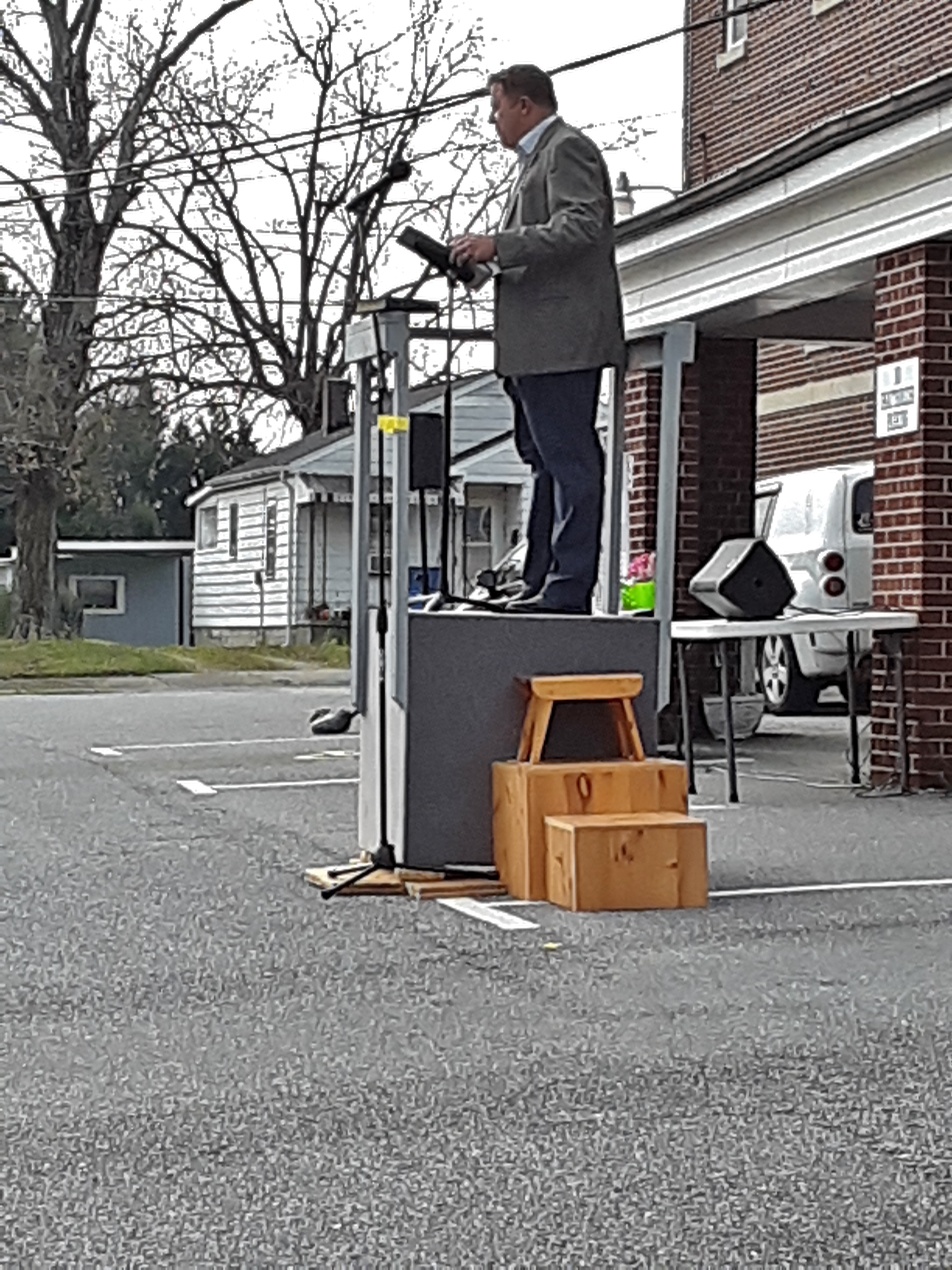
The podium is a tad bit scary to mount. Take note of the tall green tree over the rooftop.

Behind the podium
One pastor welcomes with Scripture
The director of the local Preganancy Care Center encourages the church because of God’s work there and the church’s generosity.
The pastor concludes Second Peter.

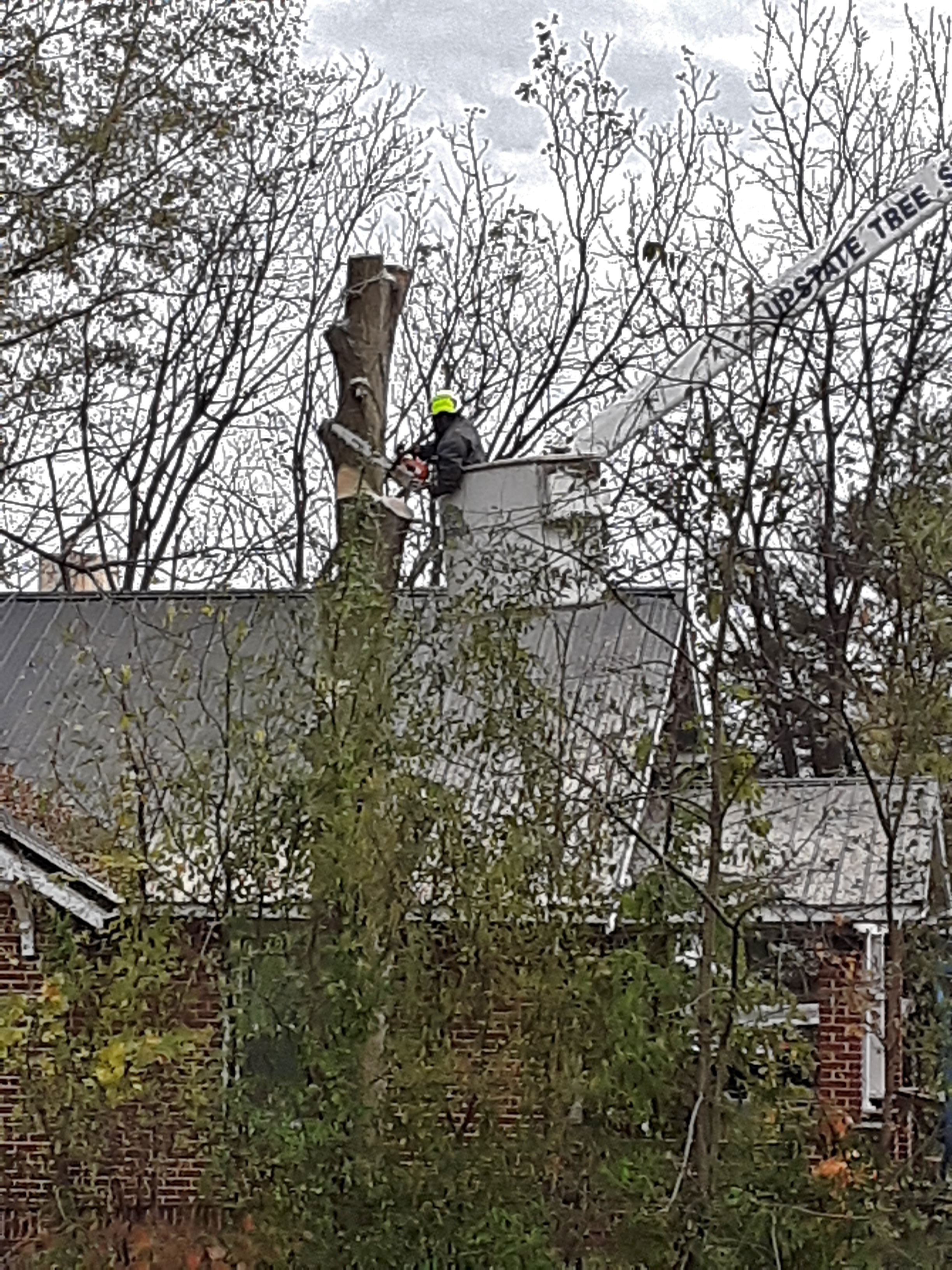
All during the service, a tree removal service was taking down a tall tree just beyond the first house from the church property. The tree at the far left is the one pictured earlier. Once upon a time in our culture, such loud work on Sunday would not have been dreamt of, especially on Sunday morning, and during a church service. The whole of the culture is responsible to acknowledge God. I couldn’t help thinking that the enemy of mankind did not want someone in the neighborhood to hear the service. Thankfully, apart from momentary cut-outs of the microphone, the communication came through loud an clear.

We were also thankful that the chipper did not begin until the benediction. It was truly loud.

It was quite a tall tree, probably a yellow poplar, before the service.

Pastor standing with Pregnancy Care Center Director

Be aware that the culture in subtle and not so subtle ways is trying to discourage and prevent worship of God. The difficulties so far are mild, but God may well be preparing us for much more difficult times. We belong to God. We must worship Him corporately because He commands it, because we need it, and because our culture needs it. As our church motto says, “”Loving God, loving one another, serving the world”. It is a tall order and our aspiration in knowing and serving God.

*2 Peter 3:5-7,10,15-16

Read Full Post »

Happy is fun. Happy is cheery. Happy makes friends. Happy is temporary. Happy is situational. Happy is temporal. I want to pursue joy, the kind given by the Spirit of God. Joy draws from things unseen. Joy exists in times of stress. Joy exists in confidence and repose of spirit. Joy heals the spirit and encourages others. Joy gives testimony to the presence and work of God.

But I experience joy in fits and starts at best. How do I get from here to there?

Peace with God, no condemnation in Christ Jesus, and sealed with the Holy Spirit of promise am I. If ever a person had reason for joy in the midst of the added relative safety and security, then it would be me. But the nagging struggles and regrets with strained relationships, slipping health, tenuous finances, and undesired direction draw my attention.

I must plead for the grace of discipline to focus on those truths of excellence and good repute (Philippians 4:8).

“The joy of the Lord is my strength” Nehemiah 8:10) is a command which begins “Do not be grieved,…”. I need to take up this weapon of strength. It seems to me that joy, a fruit of the Spirit, is an ancillary accessory to the girding belt of truth in the armor of God (Ephesians 6:14). To state the case more plainly, focus on truth brings joy despite circumstances. And though commanded, joy cannot be manufactured as happiness may occasional be.

This command to be joyous must be placed in the context of the other commands like it. The command was given during a feast to God in which God commanded rejoicing (Deuteronomy 16:14-15). There were other required assemblies (e.g. Deuteronomy 16:8) in which God called the people to solemn assemblies and holy convocations in which they were commanded to humble themselves (Leviticus 23:26-32). Sorrow and grieving over sin are necessary emotions and attitudes as a part of repentance.

But joy springs up from doing what is right after repentance (e.g. Nehemiah 8:17-18) or in gratitude for blessings (Deuteronomy 16:15). Paul, in a passage about upholding his ministry, lists many hardships contrasted with blessings. Among them is “sorrowful yet always rejoicing” (II Corinthians 6:10). And in the next chapter he says that he is “overflowing with joy in all our affliction.” (7:4) And Paul commands, “Rejoice in the Lord always, again I will say rejoice.” (Philippians 4:4) There is no contradiction in hardship and repentance for sin being mixed in with joy.

Why then do I still have fits and starts of joy? I think that a verse of the hymn, “Trust and Obey”, helps me here:

“But we never can prove
The delights of His love
Until all on the altar we lay
For the favor He shows
For the joy He bestows
Are for them who will trust and obey”*

When I seek my own way for whatever reason- fear, neglect, pride- I grieve the Holy Spirit who indwells me. He does not leave me, but He does allow me to feel the pain of distance from Him. And certainly His fruits are not being manifest in me going about my own way. I, we, are so self-oriented, that I fear we don’t even realize how much we proceed apart from Him.

So, joy is the fruit of the Spirit, a gift, a perspective on circumstances, a discipline, a strong weapon against temptation, a reaction to truth, and a strong testimony to God’s work in the midst of difficulty. May you and I pursue it by choosing God’s way over our own.**

*Written by John Henry Sammis, 1887.

**I have mulled over the subject of this blog entry for nearly a month. I feel that it is woefully incomplete and that I fall far short of what it says, but I feel a real need to encourage the pursuit of joy in God for the furtherance of my own spiritual life and yours, dear reader.

Read Full Post »

I am participating in a Ligonier Connect Bible Study online with my pastor and six or more other believers at my church. After answering questions and listening to a short lecture online, we have a Zoom meeting on Saturday evening to discuss the content. Fellowship with the saints over the Word of God, Christ, and our walk with God is always invigorating, encouraging and raising one’s spirit. Our topic is particularly encouraging since it is on assurance of saving faith. It can and should be sought after by the believer, because assurance strengthens faith, which in turn develops godliness and a desire for godliness.

In this last week’s lecture, Dr. Joel Beke mentions the key passages on assurance: I John, Galatians 5, Matthew 5, and II Peter 1:6-10. John states his theme toward the end of his book: “These things I have written to you who believe in the name of the Son of God, so that you may know that you have eternal life.” (I John 5:13). Galatians 5:22-24 lists the fruits of the Spirit. Matthew 5-7 is the “Sermon on the Mount”, which Jesus begins by stating the “Beatitudes”, characteristics of those who are kingdom citizens. Peter is exhorting the believers to exercise “His [God’s] precious and magnificent promises, so that by them you may become partakers of the divine nature, having escaped the corruption that is in the world by lust” (v.4) by “applying all diligence” (v.5) in your faith. There is not a contradiction between what God gives and our proper utilization of it.

Dr. Beke’s lecture was very good, emphasizing the need to both trust the promises of God and “test yourselves to see if you are in the faith” (II Corinthians 13:5). I appreciated most that he dealt with the nuances of testing your faith to be sure you neither deceive yourself into thinking you have saving faith when you have none nor deceive yourself into despairing of faith. I wanted him to provide a list of the assurances, the external and internal (“practical and mystic evidences” as he said it). Since he did not, I have attempted to list and organize them for my benefit and yours. Dr. Beke said there are about 30 evidences in these passages. I came up with the number 37. I combined some because they seemed to be saying the same thing, but I am sure I combine differently than he does. For example, I speculate that he may have clumped all beliefs about who Jesus is into one evidence, whereas I kept them as four separate items. Also, I expanded the II Peter passage by three verses, adding one more evidence.

I further tried to organize the evidences into categories. This is where I ran into problems. At first I had a catch all category that was titled “Emotions/Intentions/Actions”, but I quickly realized that would include everything on the list. So, I separated out “Practice of Righteousness”, but that is still too vague. On that point of vagueness, John lists “practicing righteousness” as a way to know you know God, but that seemed to be a summary of all that he meant and not merely a concrete evidence. I say all of this to say, the process of delineating every single evidence of saving faith is not easy, but the testing of yourself to see that you have saving faith is encouraging and faith building, joy producing, and useful and advisable. I hope that you are encouraged as you read the Scriptures from the list that I have provided. Don’t hesitate to suggest ways that I may better organize my list.

Evidence for Assurance

Or click here to see a clearer Word document version.

Read Full Post »

I read the book of Titus recently and came away reflecting on the contrasts of our sinful past, our God altered present, and our glory bound future. Paul speaks some ugly things about Cretans but makes it clear that all we sinners share the same ground. The difference for believers is that Christ, “to rescue me from danger, interposed His precious blood.”* Paul wanted Titus to silence the “empty talkers” and “liars” who “deny Him”, so that they will not “upset whole families” on the one hand, and “be sound in the faith” on the other. This reminds me that we must stop soft peddling the Gospel because it is not true to God or His Word and because sinners need to hear the truth of the desperation of their condition in order to be saved. The following poem came slowly with much labor, but I think the result communicates the essence of the passage (Titus 1:10-16, 2:11-14).

Lazy and rebellious
You know the kind
Hateful and pugnacious
A good one hard to find

Foolish, godless, enslaved
And such were we
Deceivers and deceived
Who truth refused to see

Defiled, unbelieving
Claim to know God
Worthless for well-doing
Perverse things get the nod

God’s grace has now appeared
Salvation come
Ungodliness denied
We more righteous become

For blessed hope looking
Glory of Christ
Savior and God stooping
His redemption sufficed

From every lawless deed
To purify
For Himself His own breed
Ardent good works thereby

*from the hymn “Come Thou Fount of Every Blessing”

Read Full Post »

« Newer Posts - Older Posts »

Myrela

Art, health, civilizations, photography, nature, books, recipes, etc.

Overflows from the Heart

"But the things that proceed out of the mouth come from the heart…" Matthew 15:18

CreatorWorship

Pointing to the One who made, saved, and sustains