“’For My thoughts are not your thoughts, Nor are your ways My ways,’ declares the Lord.” Isaiah 55:8
Consequently, don’t be surprised when God accomplishes His will in what seems like to you a totally novel and unexpected way. Consider the following description of what God accomplished through Paul:
“Now I want you to know, brethren, that my circumstances have turned out for the greater progress of the gospel, so that my imprisonment in the cause of Christ has become well known throughout the whole praetorian guard and to everyone else, and that most of the brethren, trusting in the Lord because of my imprisonment, have far more courage to speak the word of God without fear. Some, to be sure, are preaching Christ even from envy and strife, but some also from good will; the latter do it out of love, knowing that I am appointed for the defense of the gospel; the former proclaim Christ out of selfish ambition rather than from pure motives, thinking to cause me distress in my imprisonment. What then? Only that in every way, whether in pretense or in truth, Christ is proclaimed; and in this I rejoice.” Philippians 1:12-18
So, you see, a seeming hindrance to the Gospel God used as an advancement of the Gospel. And Paul “want[s] them to know” (v.12), not because He is bragging, but always because he wants them to be encouraged about God’s glory in His character and works (provision, guidance, enabling, etc). The result for the hearers would be faith rather than fear.
Paul’s “circumstances turned out” (v.12) is not an admission of fortune (luck) or coincidence but a declaration of providence, which is “divine guidance or care” (Merriam-Webster). God carries out what He designs to do according to His Word (Isaiah 55:8-11) and for His people: “And we know that God causes all things to work together for good to those who love God, to those who are called according to His purpose.” Romans 8:28
The enemies of God tried to silence Paul by false accusations concerning desecrating the temple by bring Gentiles inside and inciting riots (Acts 24:5-9: Tertullus before Felix). The result for Paul when he wrote Philippians was house arrest in Rome for two years, always chained to a Roman soldier. The result that God brought about for the Gospel and the people of God was two-fold. Firstly, Paul had a captive audience with the chained soldiers and others who could come and go. This situation exposed the Praetorian Guard assigned to guard him and Caesar’s household (Philippians 4:22) to the Gospel which may not have happened otherwise. Secondly, believers who heard of God’s protection of Paul, Paul’s boldness, and people being saved, were encouraged and emboldened to share the Gospel in the face of difficulty. Paul later said in 2 Timothy 2:8-9, “Remember Jesus Christ, risen from the dead, descendant of David, according to my gospel, for which I suffer hardship even to imprisonment as a criminal; but the word of God is not imprisoned.” The Gospel cannot be stopped, even if Christians are silenced, imprisoned, or killed.
We think that God saves in a certain way, but He is sovereign in salvation and may accomplish an individual’s salvation by many, varied, and frequently unexpected means. “Some, to be sure, are preaching Christ even from envy and strife” (v.15). What these people meant as a distressing situation for Paul, he instead saw as assistance in spreading the Gospel. It reminds me of the Proverbs: “The plans of the heart belong to man, but the answer of the tongue is from the Lord.” (16:1), “The mind of man plans his way, but the Lord directs his steps.” (16:9), and “Many plans are in a man’s heart, but the counsel of the Lord will stand.” (19:21) God’s counsel overcomes men’s plans in order to accomplish His will. Jesus confirmed a similar situation to His disciples: “John answered and said, “Master, we saw someone casting out demons in Your name; and we tried to prevent him because he does not follow along with us.” But Jesus said to him, “Do not hinder him; for he who is not against you is for you.” Even the best of preaching is a form of foolishness for Paul says, “For since in the wisdom of God the world through its wisdom did not come to know God, God was well-pleased through the foolishness of the message preached to save those who believe.” (I Corinthians 1:21) That does not mean that well-studied, well-intentioned, and well-delivered preaching of the Gospel is not valuable and not used of God, but only that man’s best is far short of God’s glory.
I glean two encouragements from this passage: 1) Even when everything seems to not go well and even appears to be a failure, God is not hindered from accomplishing His purposes, and 2) I am humbled because God is gracious to use me and pleased when I obey, but He does not need me and my best efforts do not impress Him.
Some people cherish the opportunity to hang out, lay around, not do much. I do when I am incredibly tired, but otherwise I prefer to be active. Lately that has been difficult because of my lower back. However, firstly, it is getting better, and secondly, though any lifting, twisting, fast movements, or long strides are out, walking actually makes it better. Today my youngest son ask me to go canoeing. Nope! that involves lifting a canoe and twisting to paddle. How about a hike? Yes, I can do that. So while he was on his way to pick me up, I went to pick up two ladders I had loaned out and pick up a few things at the grocery store next door. I had loaned the ladders out to the local climbing gym (Bigfoot Climbing Gym) for a route setting clinic While there I saw a very interesting climbing hold (Click on link below for pictures.).
My son likes to hike for solitude. Today it was not to be. We hiked down a section of the Mountain to Sea Trail on a gravel road and then down into the woods. We passed 15 mountain bikers and then a refreshment station for a 50k race. Soon afterwards we began passing runners/walkers both coming up to the station turn around and back away from it. When we cut down the trail, it was part of the race course, too. Oh well, everyone was polite and busy.
At one point I spied a possible cascade through the underbrush. I asked my son if he’d like to check it out. Being on Ginger Cake Creek, I suggested the name Ginger Snap Cascade. My son said he might come and camp there sometime where there was a campsite across the creek. There was a decent little swimming hole at the base of the rock and a nice place to lie down in the water at the top. The woods and underbrush were thick and there was only a little sky visible overhead. And that began to get dark and a breeze kicked up. So, we decided to turn back before the afternoon thunderstorm arrived. We probably hiked less than 5 miles, but it was a good leg stretcher with a nice little reward at the turn around point and good conversation throughout. The temperature and humidity hearkened to more Autumnly feel. It was good to get out again. I am once again thankful to be able to come back from health difficulties. Sometimes it is hard to do so, but the rewards in health, being able to stay active, and well-being make the effort worth it. God has been good to me in my health even through the downturns.
My oldest brother sent out a family email with a link (Major DW Whittle) and a “hope they will encourage you…” concerning the last words penned by D.W. Whittle, who wrote some 200 hymns. Well they did indeed encourage me for reasons of knowing at present a minor bit of the pain from which he must have written these faith filled words and his focus on heaven and God’s presence then and now. But I was also challenged by the words, “The last words he wrote have never been set to music.” I determined the meter to be 6, 6, 8, 6. I looked in one of my hymnbooks and did not find a tune that fit the words. There was not an exact match of the meter to this this poem, but even if there had been, tunes don’t always fit the syllable emphases. So, foolish neophyte songwriter that I am, I wrote my own tune. Singing it through, I realized that the first line needed an eighth note couplet for differing phrasing in different verses. Then I realized that in three of the lines Mr. Whittle had not been so exact in his number of syllables. In one of these the eighth note couplet took care of it, but in verse 4 I could find no other way to fit the words to the tune than to eliminate two words and add two tied eighth notes that are used in this verse. The deletions I made don’t significantly change the meaning and are shown in parentheses below. Still, line 3 has 9 syllables so “cre-a” in “creation’s” is divided into the two eighth notes.
“Not every night is thus; Some nights with pain are drear. (Then) I join my moan with creation’s groan (And) the chimes I do not hear.”
If somehow my tune might introduce this encouraging poem to singing it for some number of Christians, it would have been well worth the effort. It was worth it anyway as I reflected on God’s goodness to me communicated through the words and sang about it.
My Lord Draws Nigh tune is a link to the melody written and a short mp3 file of me singing the second verse. Enjoy and be encouraged by considering the goodness and nearness of our God.
On this Labor Day, after chores were done and the moderate heat of afternoon had come, I decided to take a walk. Having focused too much on circumstances and societal ills recently, I was reminded by hymns and prayer and preaching of the Word and reading of the Scriptures and fellowship with brothers and sisters yesterday that I needed to once again renew my perspective in things that are “true, …honorable, …right, …pure, …lovely, …of good repute, …any excellence and …worthy of praise” (Philippians 4:8). As I began my walk, parts of my body aching, the sun heating*, and my thoughts melancholy, I told God that I wanted His peace and joy. In fact, I pleaded, “I need Your peace; I need Your joy.” As I thought about why, the following words began to come:
I need Your peace; I need Your joy Though trials come and storms destroy Forever on this hope depend That I am Yours; You will defend**
This world with sorrows ever bent To rob our joy to full extent Broken relationships and plans Beg for a healing from Your hand
Your purposes are hard to see Sense of security can flee I on this confidence rely My soul will to You upward fly
My health and body will decay Unless suddenly in a day And some loved ones before me go We saints ever with You, I know
So frequently with sin beset With worries frequently I fret Temptations against me array Through Your Word and Spirit I pray
And by these means I overcome And more like Jesus I become More victory through You I win And peace and joy in You begin
I am so apt to be drawn to the difficulties of any situation and must constantly place before my mind, my eyes, my ears, and my heart the eternal truths of God’s grace in salvation, past, present, and future. I am thankful that “He Himself knows our frame; He is mindful that we are but dust.” (Psalm 103:14) And even more so that “His divine power has granted to us everything pertaining to life and godliness, through the true knowledge of Him who called us by His own glory and excellence.” (2 Peter 1:3) My hope, our hope, is in Him.
A writing note about the order of the verses. If you number the verses as seen, 1 – 6, the original order as written was 1,2,,3,5,6,4. I cannot decide if the beginning of peace and joy should be the end or if the order would better be 1,2,4,5,3,6 so that heaven is last. If you care to think about it, I would appreciate some feedback.
.
*for which I had come out for a “therapeutic sweat”
**”I am Yours whom You will defend” was how I originally wrote the line, and I think it may more clearly communicate the intent, but “That I am Yours; You will defend” seems to fit the meter and flow better.
Adventure Climbing was until recently an odd term to me. What climbing is not adventuresome?
My last day out changed my mind about that a bit. If you go to a crag where the climbs have a well worn and relatively short approaches, are bolted, well chalked, cataloged, described, and frequented, that is not adventure climbing. Conversely, if you lose the approach trail multiple times because it is fully grown over, the way is steep and sketchy, the climb you intended to do is flowing with water and you select another climb with little description and no familiarity, one pitch’s crux is wet and another requires going around extensive wet rock, the heat is challenging, and you are not sure if you will find placements for protection or your stashed packs at the top, that seems more like adventure climbing.
Well, I am generally up for a challenge and an adventure, so we had a good day. I am thankful to God for affording us good weather, safety, and good challenge.
If you want to see some pictures of the adventure, click on Dirty Corner.
Recently I wrote an entry entitled of “Fear or Faith?” I had seen a picture of one of the boards that I needed to replace which was rotten and cracked. At the moment I stepped down into the hole that was the entrance to the crawl space, I had a sudden jolt of panic. I have worked in very tight crawl spaces in the past, and when I was young I used to spelunk.
At the moment of panic, the man I was working for was surprised and reminded me of a long past adventure that I had told him about years ago. On an underground adventure I explored a set of side passages off of the main entrance room of the cave. My partner, in years to come a MAF pilot, decided that the entrance to the passage looked too small. It turned out that was not the problem. Unlike the rest of the cave which was mostly one room about the size of a three car garage, these small passages were a labyrinth of parallel and perpendicular passages. After a time, I had exhausted the directions I seemed to be able to go and my interest in them. I began to attempt to retrace my course to the exit, but could not remember the route or gain the entrance. I periodically had been conversing with my friend about what I was finding. Now I told him that I was confused and that he should keep talking so that I could come to his voice. One or two turns of crawling and I could see the light of his headlamp. It was at this moment that we both realized that there was more than one entrance to this labyrinth and that I had come to a different one. The second discovery was more disconcerting. The opening looked too small for my slight 150 lbs to shinny through. He told me to go to the other entrance. I replied that I had no idea how to get there. So, I put my arms above my head and acted like a worm. I discovered something else about myself. At this juncture in my life, my hips were a larger circumference than my chest. My hips became stuck. In this position I could neither move forward nor backwards. I began to breathe faster. My friend and I both knew that panic would only cause my body to swell. He talked me down and began pulling the pants and my flesh through the hole. It was for me a tense several minutes. The entrance was only feet away and sunlight never seemed so warm and inviting.*
So, my recent below floor crawl fest was not exceptional in some respects, but it was tight and there was potential for harm. I had to dig out a place for my shoulders and hips so that I could turn on my side to work. I successfully corrected the floor problem and was able to jack it to within 1/4″ on 4′ from level. The floor resisted any further leveling and closing of the gap between counter and tile on the wall. I think that it was because the wall was rising with the floor. Being a two story house, that quickly maxed out the two car jacks I was using. To see how tight the space was click on “Tight“.
I am so, so thankful for God’s mercies in various kinds of tight places. He gives me peace in the midst of panic, security in shocking situations, and direction in desperate need.
There, I told you. I have told very few people that story in full until now.
Beauty in Science. The American Physicist Richard Feynman wrote, “You can recognize truth by its beauty and simplicity.” But what is a serious scientist doing writing about cold, objective facts and emotionally compelling beauty in the same sentence? Is there beauty beyond sight, sound and smell? Is there beauty in a simple mathematical equation or a profound idea? And if so, does that beauty communicate anything deeper? At the end of his video essay, “Change”, MIT Physicist Phillip Morrison is discussing the significance of Einstein’s equation E = mc2. He asks what it means and then becomes animated and declares, “What it means is wonderful.” He goes on to explain what it means and because the equation is so simple and profound he marvels at its beauty. So wonder at beauty comes in many ways and at many levels.
More Questions That Beauty Raises. But what is beauty? Is it “in the eye of the beholder”, that is, subjective, or is it an objective fact about an object or process? Does it have any purpose or is it only random? What is the source of beauty?
Beauty Defined. In his book “The Evidential Power of Beauty”, Thomas Dubay writes, “The objective evidence for the truth of the tulip flows from its form and not simply from the fact it satisfies a person’s needs or desires.” The tulip is beautiful whether anyone is there to see it or not and even if anyone who sees it is incapable of recognizing its beauty. The eye of the beholder neither makes the tulip beautiful nor denies it of its beauty. Beauty is objective.
Beauty Elicits Response. But I do not want to rob the beholder of beauty or of his or her pleasure in beholding it. Beauty is compelling; it “elicits a response.” It affects us. Why? John Piper responds to the question this way, “Why do we get near bigness and beauty and magnificence and excellence? It’s because that is what we were made for. We were not made for mirrors. We were made for standing in front of what is infinitely beautiful and having it so satisfy us…” Hans Urs von Balthasar says, that in fact, “every experience of beauty points to infinity.” King David knew this, for he said, “One thing I have asked from the Lord, that I shall seek; that I may dwell in the house of the Lord all the days of my life, to behold the beauty of the Lord and to meditate in His temple.” Psalm 27:4.
Answer to the skeptic. As a student of science have I not jumped to conclusions by attributing beauty to God as implied by these quotes? Could not beauty be merely the product of a happy convergence of random processes as demanded by the Naturalist’s evolution? Dubay points out that we know better. “People know that chance can explain neither beauty nor intricate complexity.” Chance and time result in chaos. Therefore, “beauty is a powerful pointer to truth because common sense immediately perceives design and intellect.” So then, God has made His creation so that “The heavens are telling of the glory of God” (Psalm 19:1) and in every detail there was beauty for “God saw all that He had made, and behold, it was very good.” (Genesis 1:31)
Beautiful Conclusion. So the purpose of beauty is to point us to God and His work. For that reason I will not be embarrassed to tell you that one of my favorite moments of relaxation is to lie under a tree and observe all of the various ways that it exhibits beautiful form. My knowledge of xylem and phloem, photosynthesis, forces and equilibrium, symmetry, wood grain and heat content of firewood only increase my enjoyment of tree beauty. On the part of the tree, its beauty points to heaven in a greater way than by the simple fact of standing upright with upturned branches. And Creation is only a dim reflection compared to the sight every believer will see one day. They “will see the King in His beauty” (Isaiah 33:17), and “splendor and majesty are before Him, strength and beauty are in His sanctuary” (Psalm 96:6), because He is there.
Merciful Heavenly Father, prepare us for worship by calling to mind those sins of the past week that we need to confess and give us repentant hearts in this moment. Prepare us for worship by focusing our minds on Your glorious character and excellent provision. Prepare us for worship by giving us attention to the truth of Your Word with a desire to heed its life-giving counsel. Prepare us for worship by opening our hearts to true fellowship and unity with our brothers and sisters in Christ. Prepare us for worship by raising our voices in praise of our good and glorious God and His all sufficient grace toward us. We pray for the sake of Your praise and the furtherance of Your Kingdom in the world and in our hearts. Amen.
Over a period of time I was talking to a friend about her need of Jesus. During this time I had a loved one who was sick, bills were piling up, responsibilities seemed endless and overwhelming. One day in the presence of my friend I opened up about my fears and difficulties. On the one hand I guess it made me seem like a more real person, but the next time the subject of Jesus came up I quite honestly said, “I am asking you to trust Jesus when I sometimes struggle to trust Him myself.” She was quite understanding about my struggles, but I had a moment of deep conviction. If we are going to point a skeptical and dying world to the Savior, we must learn ourselves to react in faith rather than fear.
Just as “courage”, according to a quote by Franklin D. Roosevelt, “is not the absence of fear, but rather the assessment that something else is more important than fear,” so faith is not the lack of fear, discouragement, loneliness, temptation, confusion, or any other difficulty, but the firm conviction that God is greater and able and willing to give us peace and patience in the midst of the difficulty and regardless of the physical outcome.
I had a moment of fear the other day as I crawled into a tight crawl space to jack up a floor supported by rotten floor joists, which I needed to replace. It was so tight that I could not turn on my side until later when I dug out a space for my hips and shoulders. The fear was momentarily paralyzing, but then I took a deep breath and prayed that God would give me calmness. A peace washed over me in seconds. I had to pray again later when it happened again. I ended up working in this situation for eight hours, only crawling the 20 feet to the tight exit when I needed to cut a board or get an additional tool.
Many fears and difficulties are not so obvious as these two examples I have given. Because of their subtlety, many fears and doubts can creep up on us almost unbeknownst to us. We are tied up in a web of fear we never saw being wrapped around us. We learned it as a child. We think it the natural reaction of any sane person. We hardly give it heed, but are nonetheless confined by its stifling cords.
And that thought directs my mind immediately to Hebrews 12:1-2: “Therefore, since we have so great a cloud of witnesses surrounding us, let us also lay aside every encumbrance and the sin which so easily entangles us, and let us run with endurance the race that is set before us, fixing our eyes on Jesus, the author and perfecter of faith, who for the joy set before Him endured the cross, despising the shame, and has sat down at the right hand of the throne of God.” The great antidote for fear encumbrance is “fixing our eyes on Jesus”. It was the same for us at salvation when the fiery serpent of sin had bitten us and we were destined for death. “And Moses made a bronze serpent and set it on the standard; and it came about, that if a serpent bit any man, when he looked to the bronze serpent, he lived.” (Numbers 21:9) Looking was equivalent to believing and had an immediate positive effect for John 3:14-15 says, “As Moses lifted up the serpent in the wilderness, even so must the Son of Man be lifted up; so that whoever believes will in Him have eternal life.” So, salvation was just a look, or glance, trusting God in Christ to overcome temptation, including fears; faith walk is a “fixing” of our gaze on Jesus. Every moment we are tempted to fear or go our own way, we must fix our gaze on Jesus. The result is that “no temptation has overtaken you but such as is common to man, and God is willing, who will not allow you to be tempted beyond what you are able, but with the temptation will give you the way of escape also, that you may be able to endure it.” (I Corinthians 10:13) And when you are tempted to have a worrying fear, “be anxious for nothing, but in everything by prayer and supplication, let your request be made known unto God, and the peace of God will guard your hearts and minds in Christ Jesus.” (Philippians 4:6-7)
The Hebrews passage begins with “Therefore”, which points you back to the “chapter of faith”, Hebrews 11. This “great cloud of witnesses” fortifies our gaze on Jesus. We are not in this alone. Others have had worse difficulties and still fixed their eyes on Jesus. As the Holy Spirit enabled them to overcome Satan, temptation, and death by the blood of the Lamb (Revelation 12:11), so we are encouraged to do the same. Practicing this “fixing” brings endurance and the realization that Jesus suffered far more and had a victorious end.
I want to react in faith, not fear. It is a more peaceful way to live and a strong testimony for the truth of God being in my life. The realization that garden variety fear was stifling my walk and my witness has brought focus to my reaction in the last few weeks. I hope it is a focus that causes me to more frequently fix my eyes on Jesus in faith rather the circumstances in fear.
Following is the fourth in a series of Scriptural Science Segues. You can find the others at “GUT”, “Sustainer”, and “Made of”.
Human Designed Information System. Computers operate off of a binary (base 2) number system which we designate as 0 and 1. The actual workings within the computer chip are tiny transistor junctions (switches) that are either on, 1, or off, 0. This one piece of information is called a bit. Eight bits constitute a byte which is the amount of information used to code for numbers, letters, and symbols on the keyboard (example: 00111010 = Z). The computer binary system is a simple information system that can control complex operations. This information system and functioning code requires much intelligence to design.
Biological Information. The biological world has a more complex quaternary (base 4) information system of four molecules within the large molecule, DNA. We designate these four options for coding by the first letter of the molecules’ names: A, T, G, and C. Any combination of three of these letters constitute a triplet which codes for an amino acid. In the human body, specific combinations of anywhere from 234 up to 34,350 amino acids in very specific orders make up the thousands of functioning proteins which do the work of the cell. The DNA molecule stores information, is copied, read, and self-correcting for the purpose of directing all biological processes. The biochemical mechanisms within the cell that accomplish all of these functions are more complicated than a computer and frequently likened to the workings of a large city, though far more complex.
Intelligence Is Behind Information. Since a computer needs an intelligent designer to program it and maintain it, the far more complex biological systems must also have had an Intelligent Designer. We know of no information system that exists that does not have its origin in intelligence. That God is the Intelligent Designer is not only a reasonable scientific hypothesis, it is the only idea that fits the evidence.
Continuity of Information. David said about his own origin, “For You created my innermost parts; You wove me in my mother’s womb. I will give thanks to You, because I am awesomely and wonderfully made; Wonderful are Your works, and my soul knows it very well. My frame was not hidden from You when I was made in secret, and skillfully formed in the depths of the earth; Your eyes have seen my formless substance; and in Your book were written all the days that were ordained for me, when as yet there was not one of them.” (Psalm 139:13-16) God had already created the DNA code system from which He formed David and all living things. “God said, ‘Let the earth sprout vegetation, plants yielding seed, and fruit trees on the earth bearing fruit after their kind with seed in them’; and it was so” [day 3], “God created the great sea monsters and every living creature that moves, with which the waters swarmed after their kind, and every winged bird after its kind” [day 5], and “God made the beasts of the earth after their kind, and the cattle after their kind, and everything that creeps on the ground after its kind” [day 6] (Genesis 1:11,21,25). Take note of the fact that these did not progress from one to another in any evolutionary scenario. God created them within their kind to then reproduce according to the DNA code of their kind.
Derived from the Source. “Who has put wisdom in the innermost being or given understanding to the mind?” (Job 38:36) Our systems of information are all derived from existing systems. We did not create binary code or language, but discovered and used them. They are gifts of God from “Christ Himself, in whom are hidden all the treasures of wisdom and knowledge.” (Colossians 2:3) Language came from the fact of “God said, ‘Let Us make man in Our image, according to Our likeness’” (Genesis 1:26). There must be an intelligent source of information, making it hard to logically deny that He is the Source of all things.
My daughter’s youngest child turned 3 years old on August 2nd. We were not able to get to their house until the 3rd because of a doctor’s appointment, but any excuse to see the grandchildren will do. We arrived 1/2 hour before dark after 5 hours at the doctor’s office and a total of 4 1/2 hours of driving. We so want to build relationships with the grandchildren, but distance, health, responsibilities, and flexibility conspire against us. I decided to use the smartphone app for this purpose and am reading the Chronicles of Narnia 2 or 3 evenings a week to my grand-daughter. Even then other activities cause rescheduling, but here flexibility is my friend. We are on the third book, “The Voyage of the Dawn Treader”.
We picked blackberries at the neighbor’s house across the road, because they asked my daughter to since they were away. As we picked my daughter reflected on why she did not want to move from their present house. “We have the best neighbors. And no one else can build here because the soil percolates so poorly that septic drain fields are expensive and difficult” with the new regulations. It is a very beautiful spot and the neighbors are helpful and friendly. The neighbor behind them allows my daughter’s family to walk on the trails in their woods on about 40 acres. The next night the grandchildren, their father, and I walked to this neighbor’s house down their long driveway. The man who lives there was glad for someone to talk to and allowed the children to watch the Koi while he told how much old Koi can cost and his plans to add a deeper pond for overwintering.
The morning of the next day, the grandchildren and I were dropped off at a playground park while my wife and daughter went shopping. We tried out the various slides and swings and crawled up onto the old caboose. I think that the little ones liked the trail that I found across the creek best. They had to take their mother and mamaw to see it when they returned from gathering sale items. Every once in a while you get a good picture of several people together. What most usually prevents it is the movement and moods of the subjects. I got two good shots in a few minutes. Check here to see the pictures.
I am so thankful to God that my wife was feeling strong enough to make this trip and that we had time with this part of the family. It seems to get harder to have family time as time and distance increase.
Some of you will probably say so, but we are proceeding with adequate care, and more so as we learn the plausible situations.
Last weekend my youngest son, climbing partner, and I started at the Sitting Bear parking area, hiked to Hawksbill, climbed the two easier pitches of Lost in Space and Star Trekin, hiked to Devil’s Cellar at Table Rock, climbed again on Helmet Buttress, and walked down to the Table Rock parking area. See the pictures at HB and TR.
That was the overview. We are continuing our training for the Linville Crusher. We are most slowed down by transitions: butterfly wrapping rope, organizing protection gear, changing shoes, putting harness on and off. These preparation outings are good to see where the slowdowns are. At Hawksbill we talked to a man who had done the Crusher. I asked him how long it took them. He was reluctant to say but I insisted since I wanted to have an idea what I am getting into. He admitted that it took them over 16 hours. I was shocked. The descriptions on Mountain Project say you should aim for 10 hours and expect 12. Something isn’t adding up here. So, hiking will take the longest time and be the second least efficient part I figure, while transitions have the potential to zap our time. My partner says we have to hope for the best and plan for the worst. If it gets light at 6 AM in late August and dark at 8 PM, that means we will need to start hiking to Sitting Bear before light to prevent climbing in the dark at Shortoff. It would be way cooler if we were driving home at supper time, but “plan for the worst.”
August would not be my chosen time to do this adventure given the heat, but we are balancing two limitations: 1) climbing closures for Falcon nesting until August 15, and 2) length of daylight hours. We even have to wait to do several preparation climbs until after August 15.
The hike from Sitting Bear to Hawksbill is the second shortest and definitely the easiest. We may even jog part of that. The Hawksbill climb is the hardest technically, but we both did it clean, and that was my first try on it. The hike from Hawksbill to Table Rock is not the longest, but it is definitely hardest. Getting around Hawksbill, we missed a turn because the trail is vague at places. Hopefully, we know the route now. There is a steep uphill section going up to the base of cliffs at Table Rock. I will be glad for a rest at the belay station. We will be doing the easiest climb of the trip at TR, North Ridge.
This day we decided to do something else rather than North Ridge. My wife had mentioned that FB friends were reporting encounters with bees in the mountains. I alerted my son who is allergic but I forgot to stock my first-aid kit with Benadryl. I was so thankful that my son went up through Devil’s Cellar to hang out on top while we climbed. Soon after passing North Ridge, on a steep downhill, I walked over a Yellowjacket’s nest. At first I thought it was the buzzing of flies and was about to tell my partner that there must be something dead about because of the flies. Before the words left my mouth, I received the first of five stings. I yelled and started running. My partner ran back to see what my cry of pain meant and received a sting. He turned and ran, too, but was there just long enough to break my fall on the steep terrain. I made a mad rush downhill, swatting and grabbing for tree trunks. We recovered at the base of our chosen climb. After starting it we backed off and decided on an easier climb for carrying packs, Helmet Buttress, which with My Route above, is 5 pitches. We reduced it to 3. Still my son waited two and a half hours for us rather than an hour or less. Oops on several levels. Thankfully we can do North Ridge in one pitch with a 70 m rope.
All of this causes me to reflect on the planning and moxie needed to pull off a major expedition. We are just planning a day trip. I am thankful to God for the safety and health we have experienced during this preparation time. Even the bee sting swelling diminished when I sweated and climbed some more. It seems like a worthy challenge and adventure for this old guy, but I want to continue to increase the safety factor. Also, I decided that if I want to see a bear, I should hike with my son. We saw two this day when I hadn’t seen one on the trail in over a year. Several weeks ago he was in the Gorge with a friend and saw a Bobcat and a mother bear with two cubs in a standoff- a once in a lifetime view, I’d guess.
We are made of stardust. It is a hugely popular saying in our culture. In one form or another it has been repeated numerous times in recent years by such people as singer Joni Mitchell (August, 1969), Carl Sagan (book, 1973; “Cosmos”, 1980), and most recently and sophisticatedly by physicist, Neil deGrasse Tyson (2017). It is not a new idea, showing up in an ancient Serbian Proverb and probably being first stated in modern times in a speech by Albert Durrant Watson, then president of the Royal Astronomical Society of Canada: “Our bodies are made of star stuff.”
What are we to make of it? As Christians we evaluate all truth claims in the light of Scripture. The Bible says, “In the beginning God created the heavens and the earth (Genesis 1:1), and not until day four that “God said, ‘Let there be lights in the expanse of the heavens’” (1:14). Since “the Lord God formed man of the dust from the ground” (2:7), the dust out of which man was made existed before the stars were created. It is reasonable that we have many of the same elements as we measure to be present in stars through spectral light analysis. Those elements were present in both the heavens and earth formed in the beginning. But a straightforward reading of the text gives no indication that earth was derived from this substance and there were certainly no stars. Therefore, we are not made of stardust.
The Substance behind the Material. Earth, and therefore people, derived from stardust is a construct to fit Big Bang cosmology, and it fits well with our self-importance in God-denying Humanism. As Bible believing Christians, we must be very careful not to be drawn in by seemingly innocuous ideas that are false and dangerous.
The Real Source. Our real value and source is not derived from “stardust brought to life, then empowered by the universe to figure itself out” (Tyson), but from God “breathed into his nostrils the breath of life, and man became a living being.” (2:7) Man is impressed by the dust because it is self-glorifying, but the believer is impressed by the breath of life because it and the dust are God-glorifying. Our value comes from being made in God’s image. (1:27)
Implications. This greater value of man means capital punishment is right(Genesis 9:6) and abortion is wrong (Exodus 21:22-25), children are a blessing (Psalm 127:3-5), and “you shall love your neighbor as yourself” (Leviticus 19:18, Matthew 22:39, Romans 13:9).
And we have known this value and source of mankind since ancient times as well: ““The Spirit of God has made me, and the breath of the Almighty gives me life.” (Job 33:4) These ideas are not just about theological or scientific perspectives. It is about who receives glory and praise and allegiance:
“Thus says God the Lord, Who created the heavens and stretched them out, Who spread out the earth and its offspring, Who gives breath to the people on it And spirit to those who walk in it, “I am the Lord, I have called you in righteousness, I will also hold you by the hand and watch over you, And I will appoint you as a covenant to the people, As a light to the nations, To open blind eyes, To bring out prisoners from the dungeon And those who dwell in darkness from the prison. I am the Lord, that is My name; I will not give My glory to another, Nor My praise to graven images. Behold, the former things have come to pass, Now I declare new things; Before they spring forth I proclaim them to you.” Isaiah 42:5-9
Many a parent will recognize the title of this blog as a title of a children’s book. I think that I should write one titled “Real, Pretend, Alive, and Inanimate”. Yeah, I know, I would have to say “Not Alive” for a children’s book title, but the idea is that young, concrete-thinking children have difficulty differentiating these concepts, and I’m not really sure I could help them, so it’s just an idea. That is not t he purpose of my entry, so I regress.
While my daughter and family were in town one weekend recently, all of us were in the kitchen at one moment. This little family gathering got turned upside down when a critter that belongs outside came inside. I was talking to my wife while we stood at the counter when she shrieked and said that a critter, possibly a possum had just run past her and under the hutch. Now she reminded me that a few moments later that I should not doubt my wife, but I was as surprised by the idea as she was by the critter. I bent down and peered under the hutch to see a baby o’possum frightened and then running over under the dining table. I ran downstairs for a container, and thankfully for the purposes of observation, grabbed a clear bowl. The next time that I saw it moving I clamped the bowl over it. Everyone was fascinated for a look and curious how in the world it got into the house. A few days later while in the basement, I observed that the dryer vent line was knocked off of the exit point through the external wall. I went outside to find the plastic grating over the end of the vent pipe fallen off. Evidently, the little varmit had run into the pipe and somehow dislodged the pipe from the wall, probably when he fell the down the ~7 vertical feet of the pipe. He was happy to be outside, inside his own habitat, right-side up.
Still in training for a late summer climbing bonanza, my partner and I headed out on Friday to do a few of the routes on Shortoff in Linville Gorge. The hike up from the parking area is about a mile and a half through recovering forest after forest fires about a dozen or so years ago. There is some shade beginning to form, but most of it today was the partly cloudy haze out of a super-humid July day. When you reach the top there are breathtaking views of Gorge and Foothills region. The difficulty of access to these climbs is the topography, the whole reason we are here of course. You have to drop down a very steep gully about 150′ vertical and then rappel another 100′ to the bottom. Getting to the rappel station was the scariest part of the whole day.
When I lead The Nose at Looking Glass Rock, it was the first 4 pitch, trad route I had ever done. But it felt pretty chill because the belay stations were bolted and the overall climb is in the neighborhood of 75 degrees positive (15 degrees off of vertical if you prefer), so there was no exposure and you couldn’t see the base after 50′ or so. The first climb at Shortoff, Dopey Duck, was different. On the second pitch it has sustained 5.9 climbing with little rest. I thought I was going to flame out until a reached a rest just below a small roof. I told my partner that I was glad he lead because I would not have had enough endurance to place protection and climb. It is, in fact, a little past vertical. I read a quote online afterwards by longtime climber in the area who said, “If it was any more 5.9, it would be 5.11.” That is an intended exaggeration, I’m sure, but the point is that it gets tiring. My partner, having a 70 meter rope, decided we should do the 3 pitches in one. In order to do that we would have to simul-climb for a short distance. Both tied in with numerous pieces of pro between you, you both climb together. He reminded me, “don’t climb into the slack”, just before he left the ground, so a fall would not drop us far. It turned out that we only did this for about 20′ before he reached the top and set up a belay- a day of firsts for me.
Next, I lead an easier route, Maginot Line, 5.7. I am sometimes amazed at the knowledge base of climbers naming some of these climbs. They weren’t just laying out of class to go climbing. You trot up a juggy corner almost the whole way. At one point there were some chock blocks you have to navigate around which got me out on the face and a hanging belay for one pitch. Over all it was 250′ of pretty mellow climbing. If you would like to see a few pictures of the process, click on “Dopey and Maginot“.* Even humid, sticky July days can be glorious with a little breeze and occasional shade and a good challenge. I try to get out climbing 2 or 3 times a month, though it doesn’t always happen. I am so thankful to God for the health and opportunity to try new things and enjoy nature.
*Until I figure out a good alternative, most of my pictures will be loaded onto another site.
Following is the second in a series of Scriptural Science Segues. It highlights God’s infinite ability to design and care for Creation:
Biosphere 2. In the 1972 movie, “Silent Running” a spacecraft carries the last ecosystems from Earth in biochambers, which sustain life with no outside input but sunlight. Scientists have attempted a terrarium on Earth in which people lived called Biosphere 2. The experiment was run twice, once for two years and two months beginning in 1991, and then again for seven months in 1994. The sealed enclosures included sophisticated designs for self-sufficient living. Filters, recyclers, and energy manipulators of every sort were necessary. The design closely copied many things we know about nutrient, waste and energy cycles of Biosphere 1, that is, Earth. For all of the inputs of design, energy, and monthly corrective supplies, the experiment was shut down because cockroaches proliferated, soil bacteria robbed the air of oxygen, which had to be supplied, and birds and bees died so that there were no longer any pollinators.
Biosphere 1. God’s design for the self-sustaining life zone of Earth is wonderful by comparison. It has cycled nutrients (food, gases, and water), wastes, and energy for centuries without failure. When catastrophes occur in various locales, it regenerates to a steady state of tremendous diversity, multi-function, and beauty. Even when poisoned by our pollution, it isolates and purifies the pollutants and adjusts. It may have limits which we seem determined to push, but its ability to renew is phenomenal and without parallel.
He Is Able. When God answers Job’s challenge to His justice in Job’s suffering, God asks Job a series of questions to test Job’s knowledge of Creation. God is pointing Job to His superior and infinite knowledge and power so that Job can know that his suffering has not slipped by God’s notice nor overcome His control. God is an Intelligent and Powerful Designer, Creator far beyond anything we may hope to know or do. As it says in Romans 1:20, “since the creation of the world His invisible attributes, His eternal power and divine nature, have been clearly seen, being understood through what has been made, so that they are without excuse.”
The Downfall of Our Understanding. Herein is a danger of modern science. God has enabled us to understand many things about His Creation. We certainly know the gestational period of the Mountain Goat and Deer (Job 39:1-2) and many of the laws governing the heavens (38:33). But we cannot command the morning (38:12) and were certainly not present when God created it all (38:4). There is much we still do not know, cannot control, and were not present to observe. In the case of many modern scientists, it is similar to the plight of Edom who felt secure in their rock refuges: “The arrogance of your heart has deceived you.” Obadiah 1:3
Humility, Acknowledgement, Praise. We cannot even copy what God has done in nature to set-up a self-sustaining biosphere, let alone explain how God brought it into existence and sustains it on any meaningful level. We need to be humble in our knowledge. Believe God’s Word; He knows but we do not. And we should render praise and be forever fascinated by God’s creative and sustaining ability. He provides seed and bread (2 Corinthians 9:10), food for the birds (Luke 12:24) and beasts (Psalm 147:9), grass and trees (Psalms 104:14,16), refuge for animals (104:17,18,21), the Moon for marking seasons and the Sun for day and night (104:19), and so much more. “Oh Lord, how many are Your works! In wisdom You have made them all; The earth is full of Your possessions.” Psalm 104:24
“I am sitting at the Yellow Mountain Gap Shelter [a barn long ago converted for this purpose], having come up the Overmountain Victory Trail along Hampton Creek [on the Tennessee side]. It is my [son’s] 31st birthday… Two deer, probably just having lost their spots recently, hopped around in the meadow above me. Five or six varieties of birds sing and insects buzz beneath a low overcast with a slight breeze carrying occasional sprinkles of rain. Despite the clouds, it is fairly bright, and a profusion of summer wildflowers surround the mowed clearing and adorn the seeps of the forest. The grass is indeed a yellowish green on Yellow Mountain before me and every direction speaks of summer lushness and humidity. I want to praise His holy name and forget none of His benefits, as Psalm 103 says, but I am in need just now of His joy and His guidance. I desire to want Him more than His benefits,” I wrote at the picnic table after a strenuous hike up the ridge for about 3 1/2 miles. I had need of going over the mountain by road to get some things and decided to make use of the outing to get out into the mountains.
This way of getting to Yellow Mountain Gap did not exist 25 years ago when I was asking permission to cross private property, which I was allowed to do on two occasions back then.
If you don’t know the history of this game changer of the American Revolution, then you should check it out. Backwoodsmen streamed across the mountains in search of Major Patrick Ferguson who had threatened them. They caught up with him at King’s Mountain, SC. Reenactors make the trek yearly, stopping at key points to explain the significance of the battle to school children and anyone who will listen. I used to live near Sycamore Shoals and now live near Quaker Meadows, two significant staging and meeting points for the pioneer combatants.
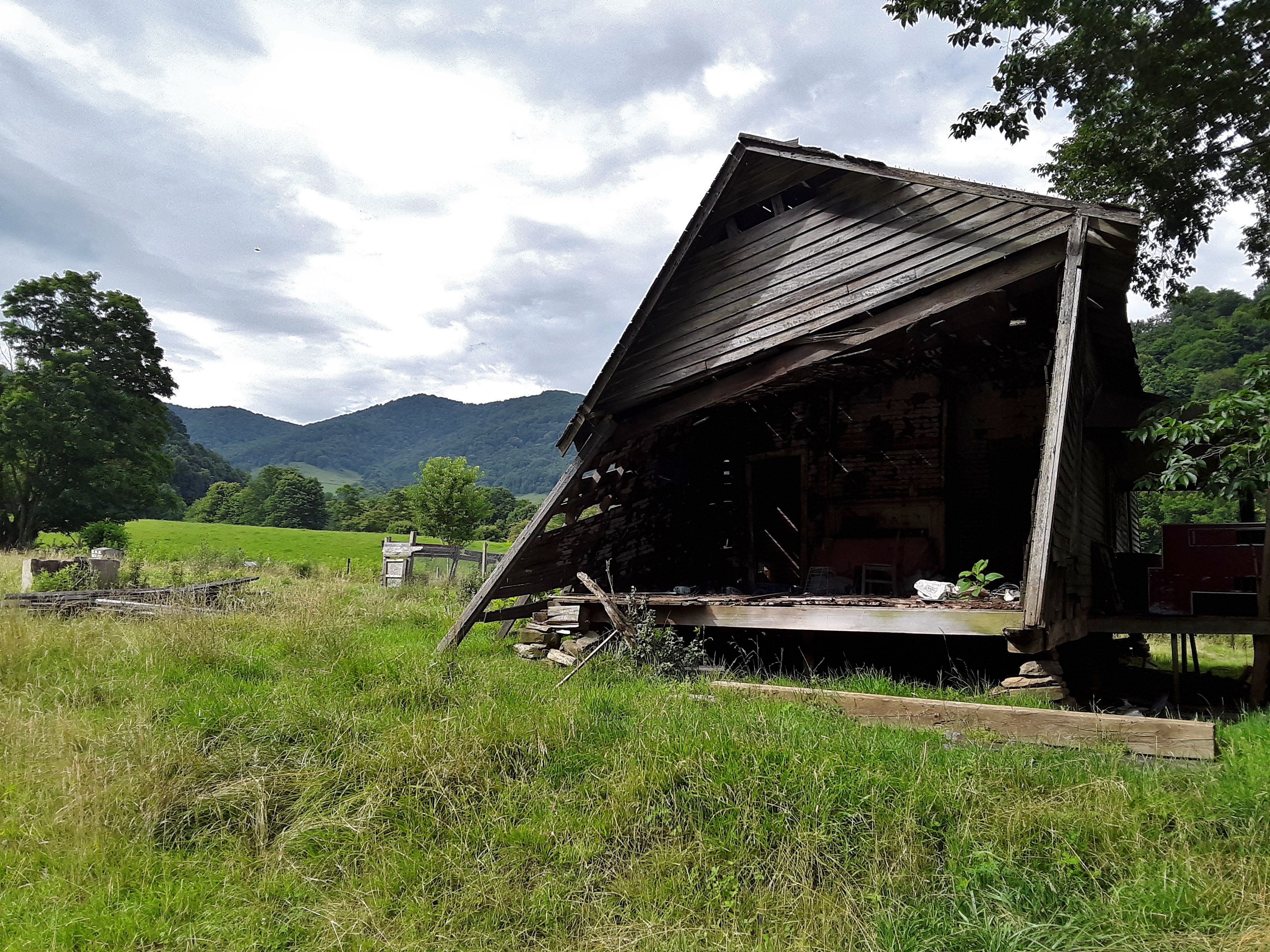
A little more recent cultural icon of the mountain draw, the decaying clapboard house.
The fields get narrower and steeper as you climb up the draw and the gates keep in the wondering cattle on the hillsides.
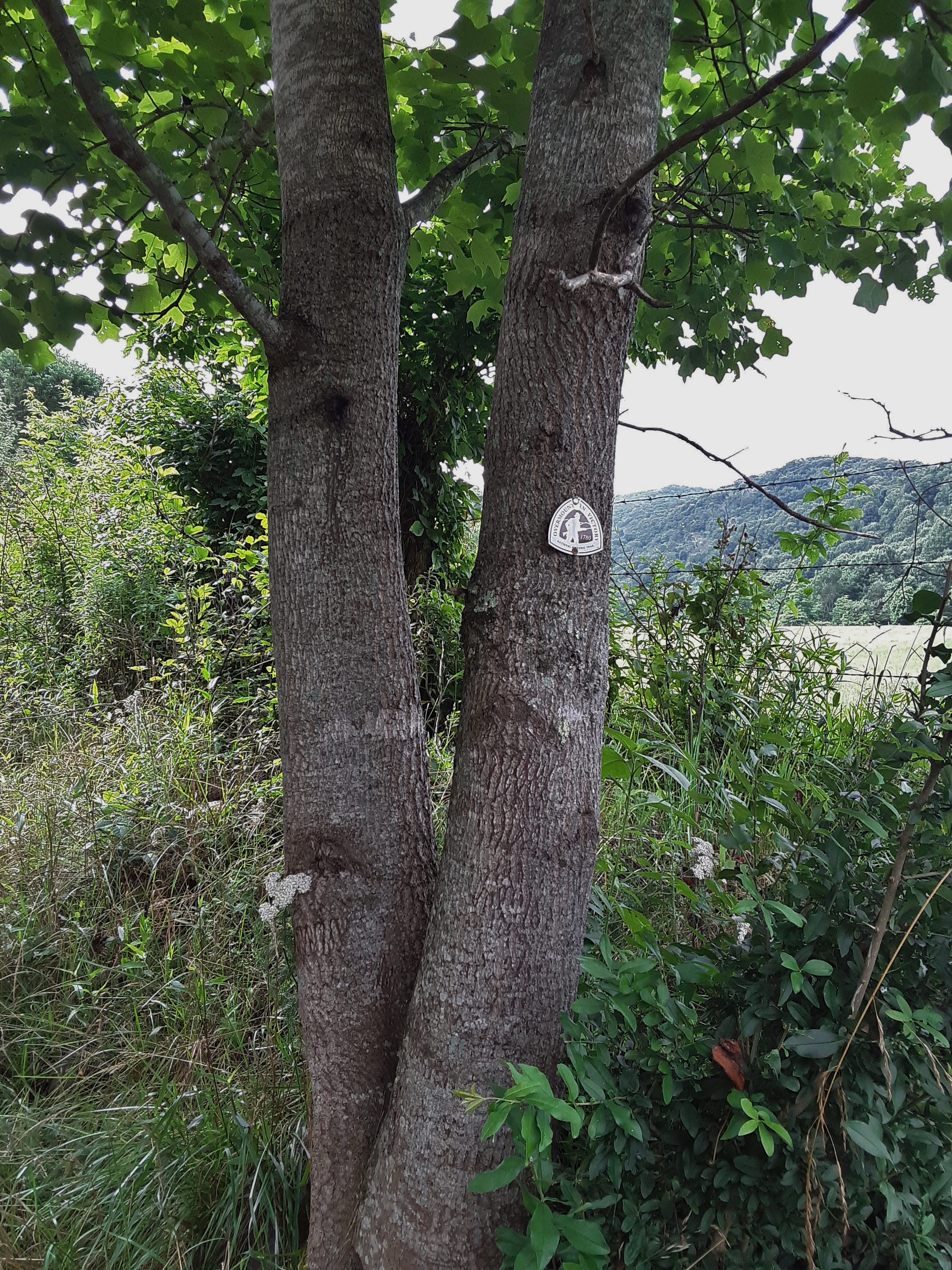
Multiple tractor tracks, cattle ruts, and trails made the little symbols a guidance comfort for this first time hiker on this particular trail.
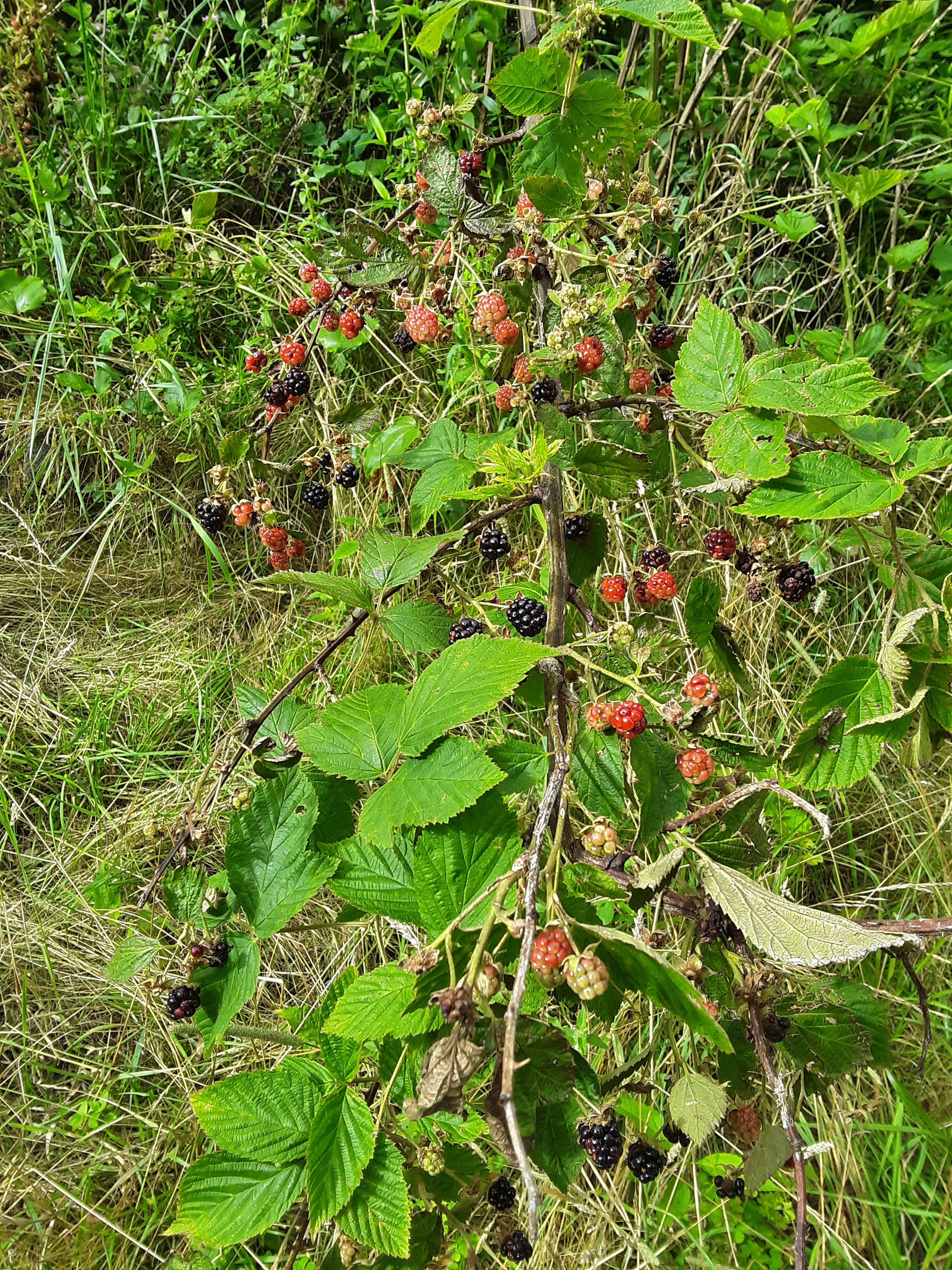
It is the season for sweet treats along the trail of which I availed myself.
Mullein (Verbascum thapsus L.) is said to be an invasive, but it is definitely useful to dry up runny sinuses, using the leaf or the flower. I just learned that the reason it is usually found along highways, which are frequently sprayed with herbicides preventing me from collecting it there, is because it needs bare ground for the seeds to germinate.
Though I paralleled Hampton Creek and Left Prong of Hampton Creek, I saw the creek very few times. I was in the fields but it was in the woods in a narrow draw most of the time. I knew it was there because I heard it for all but the last 1/2 mile before the gap.
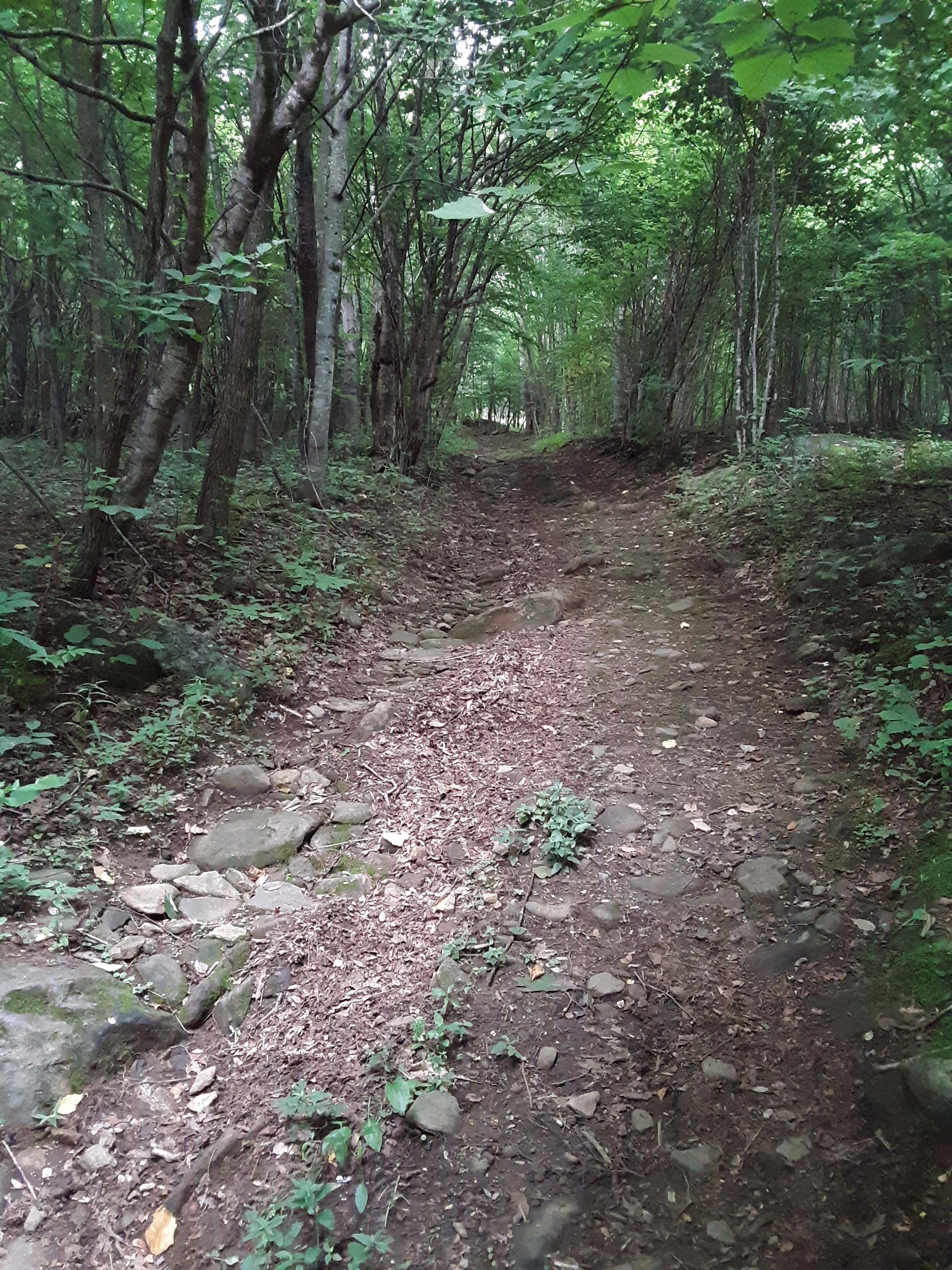
Further up and further in:
Woods and shade at last:
Literally at field’s edge and overlooking the barbed wire, I saw this beautiful stretch of creek.
There were many beautiful wildflowers, some of which you can see at Hampton Creek Reserve Wildflowers. I did not see one other person in the five hours of hiking. I enjoy conversing with people, even strangers, but I also enjoy time for reflection, prayer, observation, and praise. Frequently I find that strenuous exercise keeps my body occupied so that when I take a few moments of rest my mind and spirit can converse with God better. The surroundings were certainly beautiful in the big and the small. And I was enabled to visit a spot I had not been to for more than 15 years.
When I reveal that I am a retired teacher, many folks will begin a discussion about the challenges of being a teacher and the problems with education. After 28 years in the classroom, I could profundicate and philosophize all the day long on the subject. A few days ago the subject came up and several well worn paths were traversed until the other party referred to a story I told about students really learning as “incidental learning”. That got me fired up because the term means that the learning was “accidental / indirect / additional / unplanned”. (1) The learning that I described was quite intentional, direct, central, and planned. What was actually different about it was that it was intended to solicit interest and passion for the learning process and the subject matter. I referred to these lessons as Affective Biology.
I will not be able to pronounce the solution for all educational woes in this short article, and many of them are moral rather than educational anyway, but one thing that my experience assures me of is that students only learn well what they are interested in. Teach them what they want to learn about, what they are curious about. Teach them concepts relevant to their life and useful to their pursuits. Entice them to learn about things they don’t think they are interested in by showing them the need of it to understand and do they things they are interested in.
Now those who develop and command curriculum will wring their hands at this point because “the student needs a well rounded education” and besides, they don’t know what they are interested in. Both of these ideas are true, but “because I said so” or “it looks good on your college resume” or “we want you to be a well rounded individual” do not cut it with the blissfully or belligerently ignorant.
Instead, explore and promote curiosity. Answer seemingly random questions and facilitate research of interests and unexplored rabbit trails. Go deep enough that the students have to want the seemingly “boring” rote learning to have the tools to understand. Make deals with them so that they can explore while agreeing to give you full attention on developing tools for their tool box that they don’t think they even need. Be honest enough to tell the student that not every moment or concept of learning is exciting, but much is needful to understand the real interests of the learner.
Be a passionate learner yourself and your students will catch the fire of passionate learning. Tell them stories of how you learned and what interests you have and how learning deepens their experience of life as it has deepened yours.
By the way, none of this will work with straight jacket curriculum and mind numbing standard testing. I’m done. I’ll put that back in the box. I’m a retired teacher. (2)
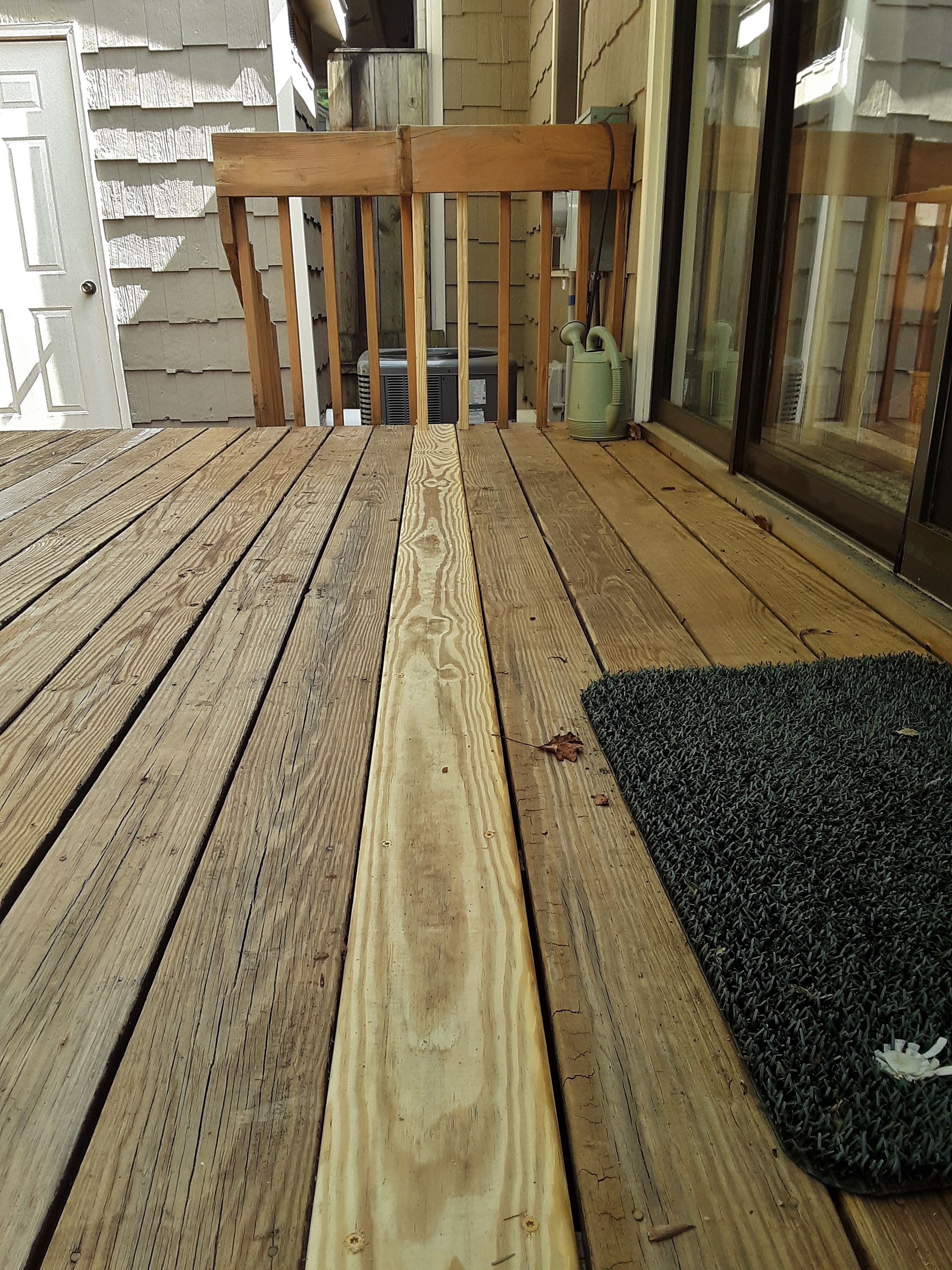
Rarely do I complete a deck repair in one day, but this job was that small. There were two decks, the main 12 x 12, and smaller 4 1/2 x 10. The larger one had three boards with developing rot, a quick fix. I also replaced three balusters there.
The smaller one had an end rail that was fencing (??), almost an afterthought put up shabbily. Because of the position the back post and the proximity of the tree, I had to put the balusters on the inside.
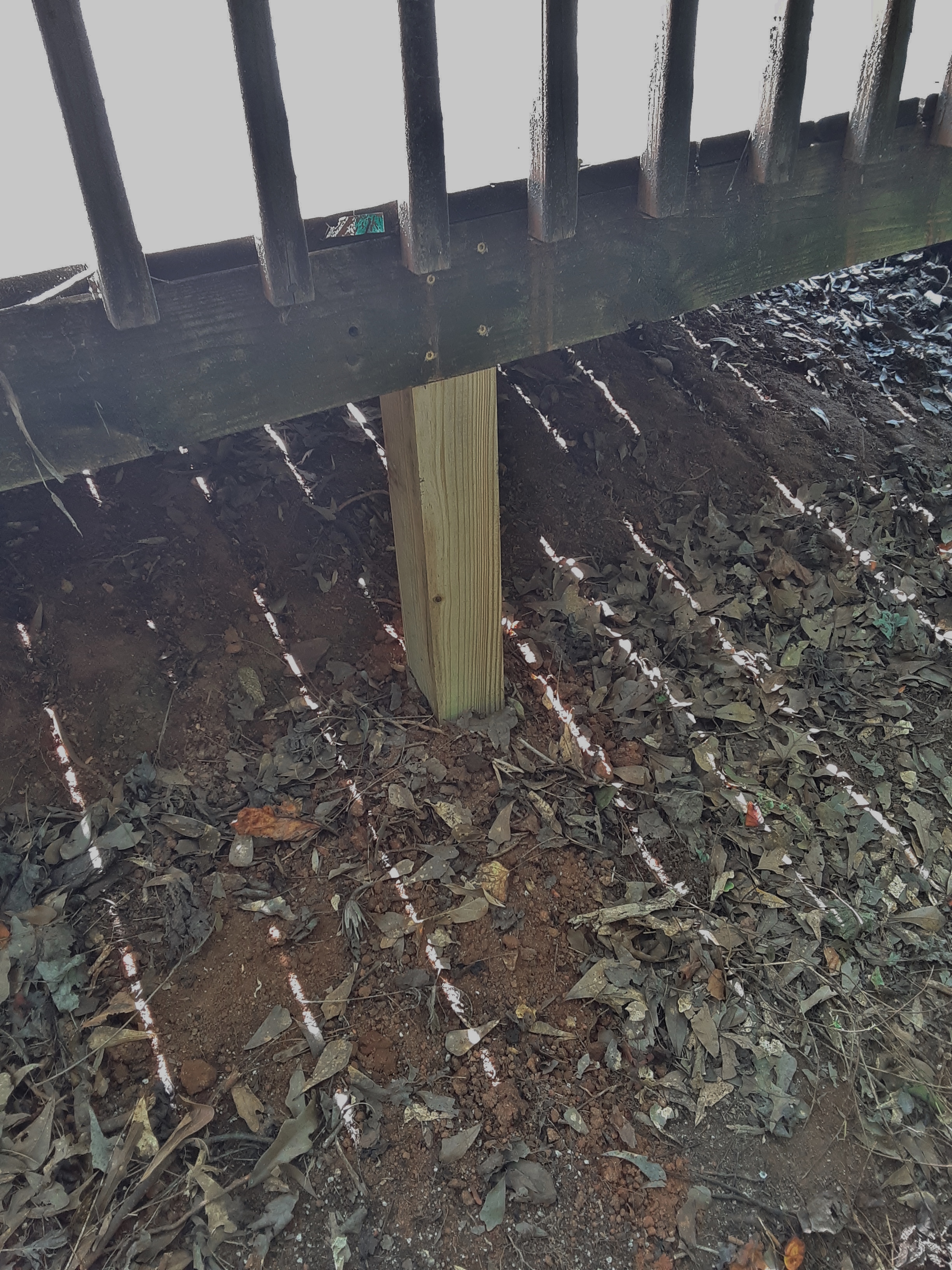
The lower deck was also made with 2 x 6 joists. I would not use those on anything more than four foot spans. So, I installed a post in the middle to strengthen the span.
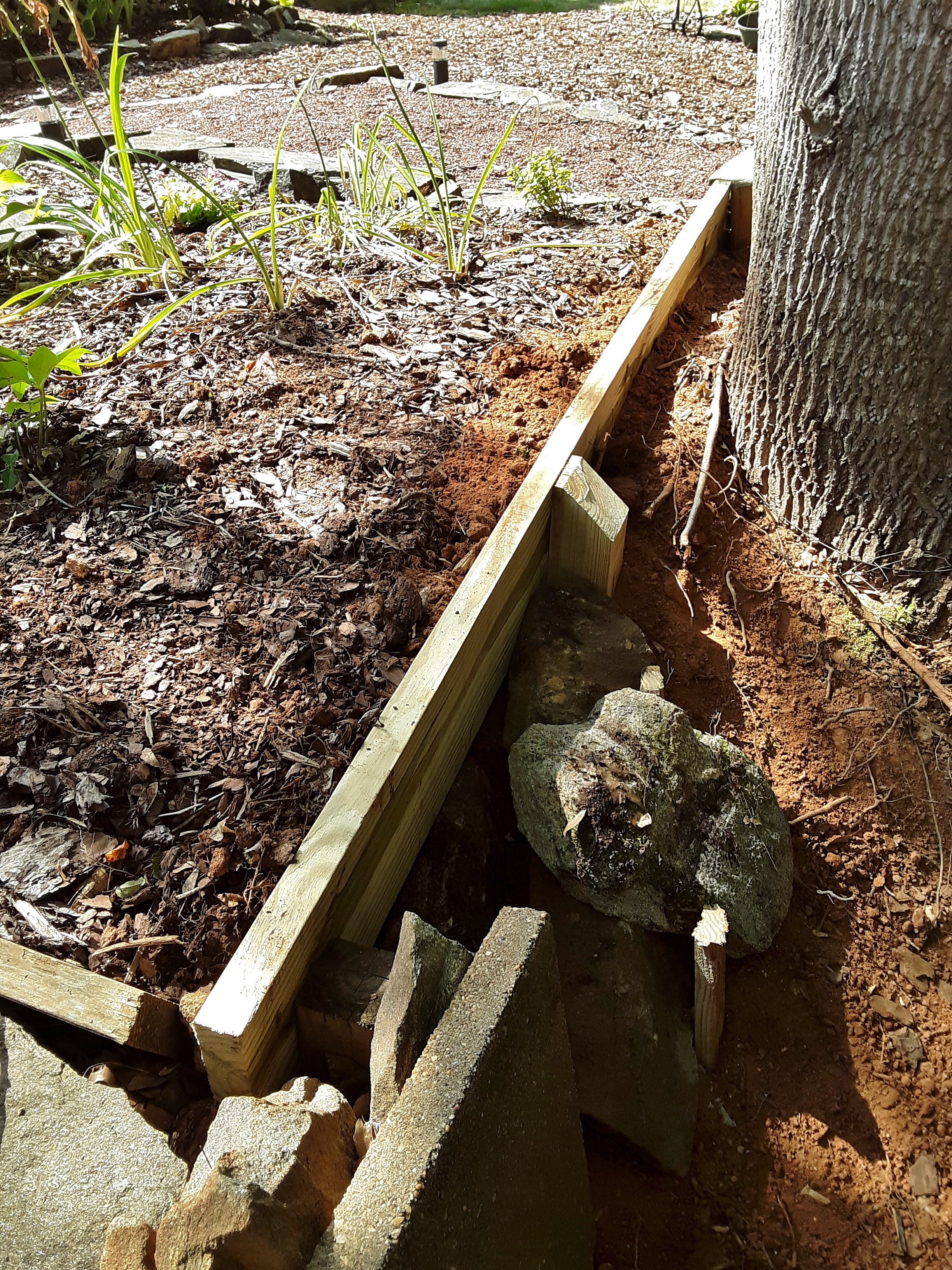
Off to one side of the smaller deck was an eroding flower garden. I installed a little barrier and back filled it to preserve the level space.
Small jobs are good. I get the satisfaction of quick completion. Also, most companies won’t mess with a job this small, but a day’s work is a day’s work. God has continued to provide work right along to pay our accelerated bills. I am constantly reminded that I can and should trust Him and must continue to do so, and that this demonstration of His faithfulness and provision means that I can trust in other areas as well. My faith has moments of faltering, but I have not seen Him unable or unwilling to provide as I am diligent to ask and walk into the opportunities which He provides.
Unity of All Knowledge. There is no dichotomy between Christianity and true science. Truth is truth wherever you meet it, and God’s Word is the root of all truth. This unity of knowledge extends to all things spiritual and physical. It is my intention to communicate the unity of knowledge through examples of where Science meets Scripture. I will call these short essays Scriptural Science Segues.
Four Fundamental Forces. In our present understanding there are four fundamental forces that hold the universe together. In order from strongest to weakest these are 1) Strong Nuclear, 2) Electromagnetic, 3) Weak Nuclear, and 4) Gravitational. The Strong Nuclear force is attractive, holding protons and neutrons together in the nucleus and the Weak Nuclear Force is repulsive and causes radioactive decay. Both work over distances of a fraction of an atomic nucleus. The Electromagnetic Force is attractive and repulsive, working over distances of up to a few miles. It controls interactions of static and flow electricity, magnetism, chemical bonding, as well as clinging interactions like cohesion, adhesion, and friction.
The Outlier. Scientists have come close to unifying the first three forces through one explanation, but gravity resists explanation. The first three forces can be explained by force particles that travel between interacting bodies. The theoretical particle for gravity, the graviton, has never been observed. Gravity is one septillion (1 x 1024) times weaker than the Weak Nuclear Force, but operates over distances the size of the universe. How would a graviton work anyway? What particle could travel across the universe fast enough to prevent stars from drifting apart? We know in great detail what gravity does to the extent that we can send space probes across the solar system for decades and they will arrive exactly when and where we calculated. However, we still cannot explain why gravity works. It continues to be the force that prevents scientists from formulating a Grand Unified Theory (GUT), one explanation for all interactions in the universe.
The Fundamental Force. The Scripture supplies an explanation of the one force that holds everything together, the very GUT of the matter. Colossians 1:16-17 says, “All things have been created through Him…He is before all things, and in Him all things hold together.” There is the fundamental force in the universe, as it says in Hebrews 1:3, “He… upholds all things by the word of His power.”
The Skeptics’ Reply. At this point the proponents of Naturalism, that religion of science which attributes all that exists to physical phenomena alone to the exclusion of any spiritual source, will say, “You are explaining what we do not yet understand by your superstitions about God just like medieval man did in his ignorance about disease.”
A Christian Answer. We disagree because we know of God’s interaction with His Creation through His Word, through our salvation and life in Him which includes answered prayer and provision, through fellowship with believers, and through the world around us that testifies to His power and attributes. As it says in Psalm 33:8-9, “Let all the earth fear the Lord; let all the inhabitants of the world stand in awe of Him. For He spoke, and it was done. He commanded, and it stood fast. Specifically, the fundamental force holding the world together is His Word.
Retraction of His Sustaining Word. In the future “by His word the present heavens and earth are being reserved for fire.” (2 Peter 3:7) When He speaks again concerning the created order “the heavens will pass away with a roar and the elements will be destroyed with intense hear, and the earth and its works will be burned up.” (2 Peter 3:10)












Passionate Learning
July 16, 2021 by creatorworship
When I reveal that I am a retired teacher, many folks will begin a discussion about the challenges of being a teacher and the problems with education. After 28 years in the classroom, I could profundicate and philosophize all the day long on the subject. A few days ago the subject came up and several well worn paths were traversed until the other party referred to a story I told about students really learning as “incidental learning”. That got me fired up because the term means that the learning was “accidental / indirect / additional / unplanned”. (1) The learning that I described was quite intentional, direct, central, and planned. What was actually different about it was that it was intended to solicit interest and passion for the learning process and the subject matter. I referred to these lessons as Affective Biology.
I will not be able to pronounce the solution for all educational woes in this short article, and many of them are moral rather than educational anyway, but one thing that my experience assures me of is that students only learn well what they are interested in. Teach them what they want to learn about, what they are curious about. Teach them concepts relevant to their life and useful to their pursuits. Entice them to learn about things they don’t think they are interested in by showing them the need of it to understand and do they things they are interested in.
Now those who develop and command curriculum will wring their hands at this point because “the student needs a well rounded education” and besides, they don’t know what they are interested in. Both of these ideas are true, but “because I said so” or “it looks good on your college resume” or “we want you to be a well rounded individual” do not cut it with the blissfully or belligerently ignorant.
Instead, explore and promote curiosity. Answer seemingly random questions and facilitate research of interests and unexplored rabbit trails. Go deep enough that the students have to want the seemingly “boring” rote learning to have the tools to understand. Make deals with them so that they can explore while agreeing to give you full attention on developing tools for their tool box that they don’t think they even need. Be honest enough to tell the student that not every moment or concept of learning is exciting, but much is needful to understand the real interests of the learner.
Be a passionate learner yourself and your students will catch the fire of passionate learning. Tell them stories of how you learned and what interests you have and how learning deepens their experience of life as it has deepened yours.
By the way, none of this will work with straight jacket curriculum and mind numbing standard testing. I’m done. I’ll put that back in the box. I’m a retired teacher. (2)
Posted in Cultural commentary, Education, Experience, General, Influence, Learning, Teachers | Tagged Curiosity, Education, Interests, Learning, Relevance, Teaching | Leave a Comment »