Mundane and tedious blights the soul
Clips the wings and dulls life's sheen
Off to the digs, the life of a mole
Outwardly lulled, inwardly lean

Nothing big but challenges galore
Wanting to rise to the top
But daily life pins you to the floor
While pleading that troubles would stop

Why do difficulties continue?
Why do my troubles persist?
Where's a fresh start and a new venue?
Does purpose in problems exist?

If you would be faithful in little
Later entrusted with much
The trials will test your faith and mettle
Spirit's power revealed as such

Hold on and trust in the daily tasks
Find His help in every trial
Cling to Him, doing all that He asks
Don't doubt, turning to denial

Embracing your God ordained story
Bear up under every test
Then to God will go all the glory
And your soul will find joy and rest
Posted in Faith, General, God Thoughts, Grace, Poem, Strength | Tagged Faith, God Thoughts, Grace, Poems, Random thoughts, Strength | Leave a Comment »
The time of year to attend graduations, send cards and well wishes for the future, and give advice to the bright-faced graduates is upon us. I have no better advice for the graduate entering the workforce than that which I heard from the commencement speaker at my son’s graduation just over a year ago at LeTourneau University in Longview, Texas. The commencement speaker was former Secretary of the U.S. Mint, Edmund C. Moy. The seven points of advice that he gave are appropriate for the graduate or any Christian in the workplace who desires to live for God. Following is my interpretation of what he said.
Seek a mentor. Find someone who has been there and done that. The emphasis is on a spiritual mentor who can help you to navigate and balance the demands of working and stresses of interacting with people with your desire and need to grow spiritually and demonstrate God’s love to those around you. This mentoring relationship requires time and scheduling. Start right away seeking such a person you may trust in this role. At my stage in life I have offered and mentored younger employees and students.
Find or form a like-minded group with whom to pray and fellowship and witness. Certainly a church may fulfill this need but a sub-group within the organization of your employment is an added help to you and your colleagues. Seek out other Christians; there is strength in numbers. These groups change over time and my present one is outside my workplace.
Be trustworthy with the small things. As Jesus said, “He who is faithful in a very little thing is faithful also in much; and he who is unrighteous in a very little thing is unrighteous also in much. Therefore if you have not been faithful in the use of unrighteous wealth, who will entrust the true riches to you? And if you have not been faithful in the use of that which is another’s, who will give you that which is your own? (Luke 16:10-12) Integrity matters. Certainly this is good workplace ethic, but even more to the point, how can you expect people to entrust to you to talk to them about eternal things, the Gospel, if you are not trustworthy with material things? Don’t shame Christ’s name for trivial pursuits.
Do good work; it praises God. Are you a team player? On time for work? Meet deadlines? Do quality work so that someone else does not have to come behind you and fix it? Stay positive and refrain from complaining? “Whether, then, you eat or drink or whatever you do, do all to the glory of God. Give no offense either to Jews or to Greeks or to the church of God; just as I also please all men in all things, not seeking my own profit but the profit of the many, so that they may be saved.” (I Corinthians 10:31-33). If you would live openly as a believer, then let your words be kind and truthful and your actions sound and pure. I will add that you should not pursue the easy way out by hiding your faith. It may show you don’t have any.
Make a “to be list” to become spiritually mature. “To do lists” are everyday business that we must do to complete each day’s tasks. God is most concerned with us coming to understand who we are in Christ, which will most profoundly affect what we do. Set goals for becoming more of who you are. This is not works religion. This is spiritual discipline.
Consider public service. The private sector is good, but we need honest, hardworking, honorable, high-order thinking individuals in the public sphere as well. Your skill set is needed to set things right.
Many resumes have a zig-zag path. That’s OK: God is behind it. God is sovereign in His providential care and direction. Rather than get frustrated and ask why, pray harder instead, and enjoy the ride. My personal route has certainly been circuitous. God is good.
May the truth and application of this advice assist you as you enter the workforce, college, or the military.
Posted in General, God Thoughts, Strength, Sustaining, Witness | Tagged Random thoughts, Strength, Witness | Leave a Comment »
Grammar is fascinating and frustrating. A wordsmith must surely play with it sometimes to see what change in perspective it gives a sentence or idea or story. All people who try to thoughtfully put ideas down on paper or screen must surely have faltered in how to follow the rules while conveying the thought and feeling. As a teacher and sometime writer, I deal in a fair amount of grammar though I am by no means a wordsmith.
So it was today that I warmed to the prayer of my pastor as he requested of God that He make our indicatives into our imperatives. I believe I knew what he meant, that we should take those statements of fact that God declares about who we are and what we have in Him and make them bold statements of faith by acting on them as though commanded by the very statement of them. I lost most of the rest of his prayer as I requested that God would indeed do that in my life in areas that I knew were not fully under His Lordship.
It was only later in the day that I again reflected on the thought, this time to consider if I had really understood it. Then my mind went all bonkers on details. For instance, what is the term for different types of statements? Oh yeah, mood? When he made that request, being a man who frequently studies the Scriptures, was he thinking English or Greek verb moods? What are the English and Greek verb moods, what do they mean, and how are they expressed? How might I use conscious awareness of them to benefit my writing and deepen the content of what I convey?
It feels good after so many months of tight schedule and stressful deadlines to be sufficiently unencumbered of the mind to have random thoughts and have a few minutes to put them down. Here is an attempt at sharing a good mood:
I desire while still living who I am in Christ shall command me to obey.
That is a mood worth having!
Posted in General, God Thoughts, Random thoughts | Tagged Faith, God Thoughts, Random thoughts | Leave a Comment »
Lord, You give us all good things
To enjoy and praise Your Name
Thanks for Your benefits rings
Always gracious, always the same

Difficulty You allow
Confusion part of what's planned
Hardship brings sweat to the brow
Some gifts are hard to understand

Trusting Your goodness the plan
Resist confusion and pain
Cling to God, unbelief ban
Let His rule and direction reign

Halt all you're not called to do
Do well what He's given you
Make it first Him to pursue
God will work well to see you through

Then peace will reign in your heart
Problems will not overwhelm
Each new day a brand new start
Your joy when God is at the helm
Posted in Faith, General, God Thoughts, Grace, Poem | Tagged Faith, faithfulness, God Thoughts, Grace, Poems, Remembering | Leave a Comment »
Evidently, last night a spider had laid three lines of silk down the windshield of my truck squarely in the line of my vision for driving. The Sun shining in from just south of my predominantly easterly direction on the way to church down the interstate produced little repeating rainbows in the silk. From bottom to top they gleamed: red, orange, yellow, green, blue, and the last two just looked like black gaps before the next red. The colors were brilliant and made the silk appear much wider than it did when the Sun was obscured once or twice by tree branches. I noticed that when I moved my head left or right the colors changed. When I moved to the right the color transitioned to longer red beads up and down the silk. When I moved my head left the color transitioned toward blue. Just before I exited the interstate the roadbed trends slightly more North and I finally began seeing violet when I leaned left.** I was thankful for light traffic on the interstate since I was focusing on 5 lines, one solid white, one dashed, and three multicolored. I thought of lunar eclipses, when the Moon is blood red or orange. Light from the Sun is refracted by the atmosphere onto the surface of the Moon which is moving through the shadow of the Earth. The shorter wavelength colors bend more evidently, careening off into space between Moon and Earth. I also reflected on the refraction that occurs in a droplet of water on a leaf producing and fisheye view of flowers or landscapes behind. The Sun was also pleasantly warm on me. I praised God for beauty He instilled into Creation which points to His superior beauty and His goodness that allows me to be aware of and see it and experience warm Sun and have a truck to travel in, and so on. I went to a corporate worship service later, which I would always recommend, but I got started early with three lines of evidence for God’s beauty and love of beauty.
**I don’t think that I ever see indigo, or is it violet I don’t see? That is, I don’t discern two colors, indigo and violet. I had the thought for the first time today that perhaps I don’t see violet. When I get in discussions with my family about a transition color between green and blue, they always say it looks blue and I most usually say it looks green. Does that mean that I see colors differently than most people, seeing what normal (whatever that means in this situation) eyes discern as blue as green or that I just name them differently? If it is the former, then perhaps I also see indigo as blue and violet as indigo and don’t see a separate violet color. If this is true it in no way changes reality, but only casts a shadow of doubt on my perception of reality. Afterall, certain people certainly hear more or most frequently less than 20 to 20,000 Hz frequency of sound.
Posted in Beauty, Creation Articles, General, God Thoughts, Random thoughts, Science | Tagged Beauty, God Thoughts, Random thoughts, Science, Worship | 1 Comment »
In my Earth Science class we are learning about Meteorology. Today I was discussing cumulonimbus clouds, how they form, and the results of their violent action. Maybe you can guess where this is going. Given my particular Southern accent, there is not a dime’s worth of difference between the pronunciation of hail and hell. (And yes, I can pronounce them differently and correctly, and yes, there is a difference in Southern accents. (That was for my Northern brothers and more British speaking acquaintances.)) So, a student immediately seizes upon the opportunity to ask which one I meant. I replied, as the snickers increased, that we could talk about either one. I then proceeded to compare and contrast the two by way of modeling proper separation of homonyms (as they appeared), prefacing my comments by saying that I take both seriously, since I believe both are real. Encouraged on by several students, I re-pronounced the words, “hale” (long a) and “hel” (short e) and said one is cold and one is hot. One is a thing and the other is a place.
Had I had more time to think, I believe that after re-pronouncing them that I would have said something more along the lines of, “One is a thing; one is a place. Both are real and dangerous. One is hot and one is cold. One can ruin your day and one can ruin your eternity. One can injure your head and one can injure your soul. Both are avoidable if you retreat to an ‘umbrella’ of protection from the wrath they entail.” Hopefully the little I did actually say communicated much of what I would intend to say if it were not a spur of the moment reaction.
Posted in General, Random thoughts, Witness | Tagged Random thoughts, Witness | Leave a Comment »
I was asked, as one of the guests requested by the Eagle Scout candidate, if I would like to speak during the ceremony. I asked if I would be allowed to share Scripture. The response was, “That would be good because the pastor had a conflict and can’t come.” Following is an approximation of what I said then:
Eagle Scout Candidate (ESC- I used his name where this appears), congratulations on your accomplishment. I am here to give you a challenge. Your Scout Oath speaks of duty to God, Family, Country, Others, and Self. Life is about relationships. I add family to the list because, even though it is not included directly in your oath, it is the most fundamental unit of society, even above government, and is surely included in “others”. The Scout Promise and Path is about fulfilling these duties within these relationships.
My challenge today, ESC, pertains to the question, What is our duty to God?
Micah 6:8 says, “He has told you, O man, what is good; and what does the Lord require of you but to do justice, to love kindness, and to walk humbly with your God?” In the context before and after this verse the prophet points out that this requirement is not being fulfilled. Is it an unreasonable requirement? Paul quotes King David, the prophet (Psalm 36) when he says,“There is none righteous, not even one; there is none who understands,there is none who seeks for God; all have turned aside, together they have become useless; there is none who does good, there is not even one.” (Romans 3:10-12) Paul summarizes the problem just a few verses later: “for all have sinned and fall short of the glory of God.” (v.23) Is God being unreasonable to require what we cannot do? What is the solution? The solution is relationship with God. Hear what Ephesians 2:8-9 says: “For by grace you have been saved through faith; and that not of yourselves, it is the gift of God; not as a result of works, so that no one may boast.” The first step in duty to God is to know God through His Son, Jesus. The next step is to live for God. These two steps cannot be reversed. You cannot simply serve God and be a nice person. You must know God through Jesus first, then He gives power to those who know Him by providing everything they need for life and godliness (2 Peter 1:2-3).
ESC, my challenge to you is this: Know God through Jesus, not know about God. Know God by receiving Jesus as your Savior. Secondly, know God regularly through His Word and through worship. Thirdly, serve family, country, and all people through the power God gives, giving Him the credit. This is your duty to God.
Posted in Faith, General, God Thoughts, Grace, Work of Jesus | Tagged Faith, faithfulness, God Thoughts, Grace, Relationship | 1 Comment »
Last week I was asked to film some running and interviews and be interviewed about exercising. After challenging students to come out for a set of couch to 5K training sessions to be sponsored by the track team, I gave them my challenge: “I have been exercising for over 40 years and here is what I’ve learned: Start now, start small, and start again.” Start now, because if you don’t you probably won’t. Start small and progress slowly or you will probably be overwhelmed and give up. Life is challenging. You get injured or sick or you have responsibilities that prevent you or old habits overtake you and you just sit. Don’t give up; start again. And the next time it happens start again and again until the habit makes it hard to quit.
When I walked away from being interviewed I realized that what I said could readily be applied to many areas of life. The spiritual application is one of perseverance and diligence in the pursuit of relationship with God. Our life with God begins and continues by grace through faith, but we are also urged to “work out your salvation with fear and trembling; for it is God who is at work in you, both to will and to work for His good pleasure”. (Philippians 2:12-13) God’s work in us results in us working. Our salvation is secure in Him but our sanctification is progressive. If it is reading the Bible regularly or studying it, or praying, or witnessing, or going to church for worship and fellowship: Start now, start small, start again. You’ve given in again to that sinful urge. Your old self wants it and that’s why you did it, but your new life in Christ wants to please Him and wants to break the slavery to sin. It is not just a matter of stop. You need to replace the sinful urge with a godly urge. Practice righteousness. Start now. Start small. Start again. You neglect the best for the alright and easy. Set your priorities in order which includes the best and down time to recuperate from intense activities. Start now. Start small. Start again. Getting in shape spiritually is not so different than getting in shape physically, though really it is because “…discipline yourself for the purpose of godliness; for bodily discipline is only of little profit, but godliness is profitable for all things, since it holds promise for the present life and also for the life to come.” (I Timothy 4:7-8) And furthermore, though you should “work out your salvation with fear and trembling;” simultaneously “…it is God who is at work in you, both to will and to work for His good pleasure.” (Philippians 2:13-14) And “our struggle is not against flesh and blood, but against the rulers, against the powers, against the world forces of this darkness, against the spiritual forces of wickedness in the heavenly places.” (Ephesians 6:12) Other than that (haha!) they are the same, so start now, start small, and start again. Coupled with the many promises that we “can do all things through Him who strengthens me” (Philippians 4:13) and “No temptation has overtaken you but such as is common to man; and God is faithful, who will not allow you to be tempted beyond what you are able, but with the temptation will provide the way of escape also, so that you will be able to endure it.” (I Corinthians 10:13) and “if anyone sins, we have an Advocate with the Father, Jesus Christ the righteous” (I John 2:1) and “His divine power has granted to us everything pertaining to life and godliness, through the true knowledge of Him who called us by His own glory and excellence,” (2 Peter 1:3), and more, then the least we can do is start now, start small, and start again.
Posted in Blogroll, Faith, General, God Thoughts, Grace, Remembering, Strength | Tagged Faith, faithfulness, God Thoughts, Grace, Remembering, Strength | Leave a Comment »
Oh Father, my heart is heavy
My past failures and troubles, too
Exact from me a stiff levy
Brokenness, regrets not a few

There is now no condemnation
Help me believe that it is true
Act so without reservation
Participate in life anew

Communicate life to loved one
Keep what is best for him in view
Remembering victories won
Repent, reconcile, and renew

May my life show to all others
That forgiveness makes all things new
Humble in success and failures
Belief in Christ is what is due

Make my heart light with joy and peace
Paint my life with a brighter hue
Christ's life in me a brand new lease
May be seen by all to be true
Posted in Faith, General, God Thoughts, Poem, Remembering | Tagged God Thoughts, Grace, Poems, Remembering | Leave a Comment »
Few things that I really need
Many that I want
Separating them indeed
Seems to be a taunt

This exercise brings freedom
I don't have to grasp
Holding both these in tandem
Frays nerves like a rasp

Now I am not a Buddhist
Wants I don't deny
More likely increases the list
Better not to try

But wants don't have to control me
I can walk away
He has met my needs, I'm free
In peace each new day

Out of breath and lost my way
Cling for my supply
Gratification delay
He will soon reply

(Luke 10:40-42; Matthew 6:25-34)
Posted in General, God Thoughts, Poem, Sustaining | Tagged God Thoughts, Poems, Random thoughts | Leave a Comment »
In Isaiah 11:1-10 the rule of the Messiah is gloriously summarized. The first and tenth verses suggest the lineage of this ruler by a plant metaphor. But at first glance it appears to be a mixed metaphor. Verse one reads, “Then a shoot will spring from the stem of Jesse, and a branch from his roots will bear fruit”, and verse ten in part reads, “Then in that day the nations will resort to the root of Jesse…” So which is he, a shoot and therefore a branch or a root? Is it a poorly played metaphor or a profound mystery?
The best place from which to better understand Scripture is Scripture. Isaiah 53:1-2 introduces the the chapter on the Suffering Servant: “Who has believed our message And to whom has the arm of the Lord been revealed? For He grew up before Him like a tender shoot, and like a root out of parched ground”. Here we see again that He is both shoot and root, and seemingly fragile and stressed. In this chapter the horrors of his demise are chronicled with such detail as to cause even the casual observer to think it must refer to Jesus on the cross. Jeremiah 23:5 states, ““Behold, the days are coming,” declares the Lord, “When I will raise up for David a righteous Branch; and He will reign as king and act wisely and do justice and righteousness in the land.” On trees trunks (or stems) shoots become branches. Now Jesse was the father of King David, so both passages imply the promises given to David in 2 Samuel 7 concerning “I will establish the throne of his kingdom forever.” (verse 13) In context the “his” of this verse is the descendant (branch) of David who will rule. Messiah will also be a priest: “Now listen, Joshua the high priest, you and your friends who are sitting in front of you—indeed they are men who are a symbol, for behold, I am going to bring in My servant the Branch.” (Zechariah 3:8) Priests symbolizing the Priest who will come, the Branch. In Revelation 5:1-5 His authority is shown: “I saw in the right hand of Him who sat on the throne a book written inside and on the back, sealed up with seven seals. And I saw a strong angel proclaiming with a loud voice, “Who is worthy to open the book and to break its seals?” And no one in heaven or on the earth or under the earth was able to open the book or to look into it. Then I began to weep greatly because no one was found worthy to open the book or to look into it; and one of the elders said to me, “Stop weeping; behold, the Lion that is from the tribe of Judah, the Root of David, has overcome so as to open the book and its seven seals.” God, the Father, sits in majesty upon His throne holding a sealed scroll. John weeps because it seems that no one may open it. But the Root of David, Jesus, has that authority and power because He has overcome sin and death and hell according to the command of His Father. But why is He characterized as a Root here? The final verse I would like to share clears up this dichotomy: “I, Jesus, have sent My angel to testify to you these things for the churches. I am the root and the descendant of David, the bright morning star.” Jesus declares He is the root and shoot (descendant). I believe that the meaning of Him being declared both Root and Branch is as follows: As God He is the Root or origin of David’s line and all things; as Man He is the Branch or descendant of David who would save His people and rule righteously forever. Messiah Jesus is the perfect God-Man, both Root and Branch.
Posted in General, God Thoughts, Work of Jesus | Tagged God Thoughts, theology, work of christ | Leave a Comment »
The hymn by this name has become one of my favorites over the years because it conveys the holiness and glory of God by transporting the mind to the mercy seat both in the tabernacle and in heaven. The version I have has 5 verses. The original, written by Frederick Faber, has 8 verses: (for a choir rendition, albeit too slow for my liking, click here: https://www.youtube.com/watch?v=t4VtpEu3CDQ)
My God, how wonderful Thou art,
Thy majesty, how bright;
How beautiful Thy mercy seat
In depths of burning light!
How dread are Thy eternal years,
O everlasting Lord,
By prostrate spirits day and night
Incessantly adored!
How wonderful, how beautiful,
The sight of Thee must be;
Thy endless wisdom, boundless power,
And glorious purity!
O how I fear Thee, living God,
With deep and tender fear;
And worship Thee with trembling hope,
And penitential tears!
Yet, I may love Thee, too, O Lord,
Almighty as Thou art;
For Thou hast stooped to ask of me
The love of my poor heart!
No earthly father loves like Thee,
No mother, e’er so mild,
Bears and forbears as Thou hast done,
With me, Thy sinful child.
Only to sit and think of God,
Oh, what a joy it is!
To think the thought, to breathe the Name,
Earth has no higher bliss.
Father of Jesus, love’s Reward!
What rapture it will be
Prostrate before Thy throne to lie,
And gaze, and gaze on Thee!
As I sang this wonderful hymn, and others, and mused on Psalm 103, more verses came to me. They are not of a quality of the original but I do intend them as worship to God:
He righteous deeds each day performs
Judgments for the oppressed
Compassionate and gracious He
With love for the distressed

As high as heaven above earth
So great His steadfast love
Is toward all those who fear their God
The God who dwells above

As far as east is from the west
Transgressions He removes
A Father who compassion on
A child who his God fears

For all is peace, my soul at rest
Submitted to His will
Our God is good and great and kind
To know Him is a thrill

One day in heaven we will be
Adoring face to face
But now we see His glory great
Through His redeeming grace
Posted in Beauty, General, God Thoughts, Grace, Poem, Song, Work of Jesus | Tagged Beauty, God Thoughts, Grace, Poems, Songs, Worship | Leave a Comment »
The book of Daniel and the character Daniel have been my favorite since seriously reading the Bible as a pre-teen. By God’s grace he, along with his three friends, overcame the temptations of this world and exhibited God’s character to amazed, pagan, hostile, and adoring onlookers. As I was studying the first chapter recently to teach it, the scene struck me a different and modern way. What I write below will sound ‘tongue in cheek’ but my intent is to convey how relevant this story is.
When Dan arrived on campus with his three buds Hank, Mish, and Azar they were tied in knots with anticipation. As Freshmen they thought themselves royalty but they were just another set of pretty faces with some brains thrown in, pretty much like all the other neophytes with persuasive scholarship from the Founder of BU. This same Founder and President was also the biggest donor to the university and had influence at every level and insisted that the Dean of Men put these new recruits through their paces in liberal arts coursework with a major in Chaldean Studies. The President had deep pockets and provided the Dean with everything to make the college experience compelling. It was a real party school with all the best food and wine provided by the school. But Deep Pockets expected a payback in studies and potential service in the future, so everybody had to hit the books hard in the accelerated 3-year course. To complete the whole college experience, the Dean of Men even assigned each of the freshman in the fraternity and floor name, kinda Baby. U’s version of Greek life. So the guys became Belt, Shad, Messy, and Abed. There were certain things in the frat house where guys were expected to go all in. One was eating the party food. But these boys had been cut from a different cloth, raised by fathers and mothers who taught them to be respectful and honor God in all that they did (I Corinthians 10:31). Dan petitioned the Dean to forego the party food for what the fraternity brothers called ‘rabbit food’ and water. The Dean was not so sure about this scheme, fearing that Sugar Daddy might give him the axe. But Dan kept his wits about him and requested a little use of the scientific method to test how the new eateries would fare. The Dean agreed, and after a 10-day free trial he was sold and kept bringing on the veggies and spring water. The boys were relieved and set about studying hard. In fact when the Dean presented them to the President on Founder’s Day, they were top of their class with exponential growth ahead of the other frat bro.’s. They had studied the deeper meaning of life itself and were rewarded with careers serving in the President’s office, Dan even seeing many changes in administration through the subsequent years.
Posted in Cultural commentary, General, Strength, Sustaining | Tagged Pressures of Life | Leave a Comment »
“But In these last days He has spoken to us by His Son.” (Hebrews 1:2) When one spoke for God in times past He was considered a prophet. Jesus taught about God. Jesus revealed hidden things about God. Jesus spoke miracles into existence. For the people who observed these things “Fear gripped them all, and they began glorifying God, saying, ‘A great prophet has arisen among us!’ and, ‘God has visited His people!’” (Luke 7:16) By late in His ministry they were convinced: “And the crowds were saying, ‘This is the prophet Jesus, from Nazareth in Galilee.’” (Matthew 21:11) It was certainly true that they were anticipating a prophet. Messianic fever had been rife for many years. When a Roman commander and his cohort seized Paul the Apostle he wanted to know the cause of the riot forming. Knowing the tendency of Jewish people to look for prophets and messiahs he responds to Paul’s request to speak in Greek: “Then you are not the Egyptian who some time ago stirred up a revolt and led the four thousand men of the Assassins out into the wilderness?” (Acts 21:38) This question also suggests that the people were perhaps looking for a revolutionary, political savior rather than a spiritual one. The spiritual leaders participated in this anticipation and probably incited it, even if not intentionally. When they asked John the Baptizer about who he was, “They asked him, ‘What then? Are you Elijah?’ And he said, ‘I am not.’ ‘Are you the Prophet?’ And he answered, No.’” (John 1:21) (underline mine) This phrase, ‘the’ Prophet, arises again: “Therefore when the people saw the sign which He had performed, they said, ‘This is truly the Prophet who is to come into the world.’” (John 6:14) They were most definitely looking for one certain prophet who would come for a specific purpose. The crowds were evidently weighing the evidence for this being the one: “Some of the people therefore, when they heard these words, were saying, ‘This certainly is the Prophet.’” (John 7:40)
But what specific prophet were they anticipating and for what reason would he be special? Moses was a one of kind prophet, as the Scripture says: “Since that time no prophet has risen in Israel like Moses, whom the Lord knew face to face, for all the signs and wonders which the Lord sent him to perform in the land of Egypt against Pharaoh, all his servants, and all his land, and for all the mighty power and for all the great terror which Moses performed in the sight of all Israel.” (Deuteronomy 34:10-12) But Moses looked forward to an even greater prophet than himself when he said: “The Lord your God will raise up for you a prophet like me from among you, from your countrymen, you shall listen to him. This is according to all that you asked of the Lord your God in Horeb on the day of the assembly, saying, ‘Let me not hear again the voice of the Lord my God, let me not see this great fire anymore, or I will die.’ The Lord said to me, ‘They have spoken well. I will raise up a prophet from among their countrymen like you, and I will put My words in his mouth, and he shall speak to them all that I command him. It shall come about that whoever will not listen to My words which he shall speak in My name, I Myself will require it of him.” (Deuteronomy 18:15-19) The Prophet would be similar to Moses but superior in that refusal on the part of anyone to listen to him would be fatal. The people of Jesus’ time were anticipating The Prophet, the great Prophet, who Moses said would come.
Jesus fit the description. He claimed to be the one: “The woman said to Him, ‘I know that Messiah is coming (He who is called Christ); when that One comes, He will declare all things to us. Jesus said to her, ‘I who speak to you am He.’” (John 4:25-26) Jesus did miracles of provision and healing and raising from the dead. He revealed the mystery that He was in fact God and had authority to explain who God is. He had the authority to condemn though He says that He was not the one who would do it: “And Jesus cried out and said, ‘He who believes in Me, does not believe in Me but in Him who sent Me. He who sees Me sees the One who sent Me. I have come as Light into the world, so that everyone who believes in Me will not remain in darkness. If anyone hears My sayings and does not keep them, I do not judge him; for I did not come to judge the world, but to save the world. He who rejects Me and does not receive My sayings, has one who judges him; the word I spoke is what will judge him at the last day. For I did not speak on My own initiative, but the Father Himself who sent Me has given Me a commandment as to what to say and what to speak. I know that His commandment is eternal life; therefore the things I speak, I speak just as the Father has told Me.’” (John 12:44-50) God said that the one who refused this prophet He would require it of him. Jesus says that the result will be judgment at the last day for not receiving words He pronounced from God the Father. The Prophet has come about 2020 years ago. A mere 30+ years later He died so that we may live and rose so we might rise. This Christmas season receive His words from the Father so that God may require your disobedience in the sacrifice of Jesus on the cross rather require it of you for eternity.
Posted in General, God Thoughts, Grace, Remembering, Work of Jesus | Tagged Faith, God Thoughts, Grace, Salvation, work of christ | Leave a Comment »
I have always struggled to get a handle on the essential essence of integrity. It is far more than honesty and deeper than mere examples. While studying Daniel 6 I was struck with new force by Daniel’s faithfulness, trustworthiness, moral uprightness, whole and undivided spirit that resulted in him being the same in public as he was in private. That is to say, Daniel exhibited godly integrity. What is the source of integrity and what does it produce? As I searched for answers in the passage and on the internet I came across an interesting statement by Larry Sternberg that says,
“In common conversation the word “integrity” is most often associated with honesty. But that’s a very narrow understanding of the concept. In addition to honesty, integrity is about being whole and unimpaired. We can speak about the integrity of a roof or a ship’s hull. When a structure can remain unimpaired in the face of pressure, assaults or stressors, that structure has strong integrity.
When it comes to a person, integrity involves the ability to remain true to one’s values in the face of pressure, assaults or stressors. We know little about the strength of a person’s integrity when life is easy. What if it will cost you your job? What if you’ll lose some friends? What if you’ll go to jail? What if you’ll get beat up — or worse? We only learn about the strength of a person’s integrity when things get tough, when adhering to those values involves a high cost.” (reference)
Though not stated directly, the take away I gained from this short article was ‘Integrity produces courage and courage reveals integrity.’
And even though the wicked can be ‘true to himself’ (a phrase I’ve heard a number of times), it is godly integrity that is admirable. It is unselfish and gives glory to God, its source. It frustrates the wicked as with the satraps (provincial governors) and counselors who envied Daniel, but impresses those who see its purity and simplicity as with Darius the king. Daniel is not called upon to state his refusal to obey the edict as his friends Shadrach, Meshach, and Abednego were in chapter 3: “King Nebuchadnezzar, we do not need to defend ourselves before you in this matter. If we are thrown into the blazing furnace, the God we serve is able to deliver us from it, and he will deliver us from Your Majesty’s hand. But even if he does not, we want you to know, Your Majesty, that we will not serve your gods or worship the image of gold you have set up.” (Daniel 3:16-18) He does state his innocence after the fact: “My God sent his angel, and he shut the mouths of the lions. They have not hurt me, because I was found innocent in his sight. Nor have I ever done any wrong before you, Your Majesty.” (Daniel 6:22) Daniel’s unstated trust in God points to God’s trustworthiness. So Darius gives glory to God because he recognizes the miracle that God did for Daniel:
“I issue a decree that in every part of my kingdom people must fear and reverence the God of Daniel.
“For he is the living God
and he endures forever;
his kingdom will not be destroyed,
his dominion will never end.
27 He rescues and he saves;
he performs signs and wonders
in the heavens and on the earth.
He has rescued Daniel
from the power of the lions.” (Daniel 6:26-27)
Darius also recognizes that Daniel’s integrity points to God: “Daniel, servant of the living God, has your God, whom you serve continually, been able to rescue you from the lions?…The king was overjoyed.” (Daniel 6:20,23)
And this has long been my desire, that I would have the integrity of Daniel and that my life would point to God. I have not been so faithful as Daniel but God has been faithful to work wondrously in my life so that I pursue the goal of integrity each day so that I might give glory to Him and hear one day, “Well done thou good and faithful servant.” (Matthew 25:21)
Posted in Faith, General, God's Word, Strength, Sustaining | Tagged Faith, Strength, Worship | Leave a Comment »
I have long known from the second law of thermodynamics that all systems involving energy are less than 100% efficient. As I would say to students, “The good news is that you can’t get something for nothing [1st law of thermodynamics or law of conservation of energy], but the bad news is that you can’t even break even [2nd law of thermodynamics]” Emotionally that only discourages people with an engineering turn of mind. To show you just how little the idea penetrates many people’s thoughts, I almost always get a “How about a machine that produces energy that it can use to run…[perpetual motion machine]?” question from one or more students immediately after explaining the laws and sharing the good news/bad news. We have come so far that some have a blind faith in the ability of human ingenuity and technology to overcome the most formidable barriers to progress, even laws of Physics.
Evolutionists have a similar resiliency in their emotional attachment to what Dr. John C. Sanford calls the Primary Axiom: “man is merely the product of random mutations plus natural selection”. Dr. Sanford, retired plant geneticist of Cornell University, presents an altogether formidable opposition to the Axiom: genetic entropy. Robert Carter simply defines genetic entropy as “…mutations (spelling mistakes in DNA) are accumulating so quickly in some creatures (particularly people) that natural selection cannot stop the functional degradation of the genome—let alone drive an evolutionary process that can turn apes into people.” Dr. Sanford says that useful information in DNA is degenerating; living organisms are degenerating; populations of organisms are degenerating. He referred to Darwinian believers as those who think that populations are getting better by natural selection, but based on his research, they are not. He said that he once also believed that natural variation (arising from mutations in DNA) plus natural selection (of the fittest through conflict resulting in death and survival) equals all that we see biologically. I believe that evolutionists are asking the wrong question based on their false presuppositions: How are species progressing from simpler to more complex? Instead, they we should be asking how species are able to resist extinction in light of genetic deterioration.
In a recent Facebook discussion one person claimed to have observed modern examples of evolution through bacterial mutation. I pointed out that these adaptations are not species-changing evolution. But Dr. Sanford presents a more damaging argument of the devolving of species by viral and bacterial mutation. One of his examples is the flu pandemic from 1918 to 1920 that killed about 3% of the world’s population. When the frozen body of a soldier who died from that flu was exhumed for research purposes several years ago there was fear of the accidental release of the virus and a return of the epidemic, because it was known that the older strains were stronger. The newer strains of H1N1 are weaker due to genetic entropy. “A key point is that because of the high reproductive rate and the documented phenomenon of genetic entropy, the influenza virus is degenerating rapidly by accumulating 14.4 new mutations per year… It seems that when they leave their proper winged hosts and infect humans, they run out of control and go downhill rapidly because of mutation accumulation, which will lead to their extinction.”
But doesn’t high mutation rate mean that natural selection has more material for driving evolution forward? This idea could only be true if there were sufficiently more beneficial mutations to increase an organisms’ long-term (mutli-generational) survival than destructive mutations. “Far more mutations are deleterious than advantageous,” says Dr. Sanford. These bad mutations degrade the genome at a much faster rate than good ones could possibly benefit the organism.
The genetic conclusion of this discussion is that species are definitely not evolving and could certainly not have been around for millions of years at the rate their genome is deteriorating. The belief that “the creation was subjected to futility” and “we know that the whole creation groans and suffers the pains of childbirth together until now” (Romans 8:20,22) because of the sin of man fits with the evidence far better than the belief that natural selection through mutation is evolving species.
Posted in Creation Articles, General, Science | Tagged Creation Articles, Science | Leave a Comment »
He said, “Do your best and let God take care of the rest.” I had heard this and similar phrases many times, but I went off on a mental tangent of evaluating it in the light of Scripture. I think that I understand the intent of the saying, namely that we have an active part to play in growing righteousness in our life and God completes what is lacking in us. Thus far I have no problem, but I think we may do better in our understanding and representation of the interplay of our effort and God’s empowerment. Toward a theology of effort and empowerment consider the following diagrams with their perspectives on the topic:
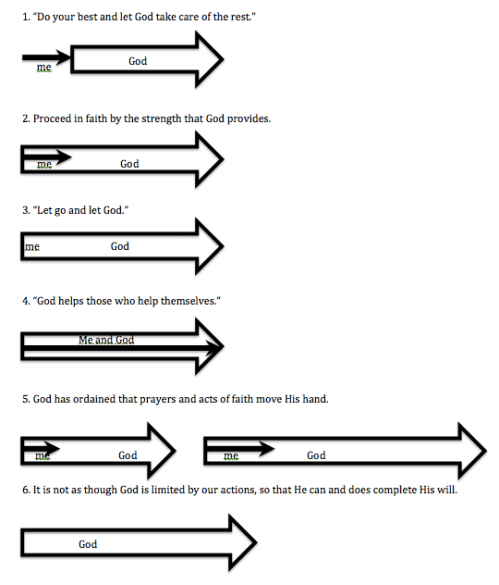
The arrows are somewhat self-explanatory, but I want to clarify them for my own benefit and yours. Though, as I said, the #1 was stated with right intentions, I believe that at face value it is really saying that I exert effort to the extent of my ability and then God kicks in for the rest. But the Scripture says,“for in Him we live and move and exist” (Acts 17:28), and “I am the vine, you are the branches; he who abides in Me and I in him, he bears much fruit, for apart from Me you can do nothing.” (John 15:5) We cannot even breathe apart from the grace He provides, but the “nothing” here seems to me to be ‘nothing of eternal significance’. As Paul teaches in I Corinthians 3:11-15, “For no man can lay a foundation other than the one which is laid, which is Jesus Christ. Now if any man builds on the foundation with gold, silver, precious stones, wood, hay, straw, each man’s work will become evident; for the day will show it because it is to be revealed with fire, and the fire itself will test the quality of each man’s work. If any man’s work which he has built on it remains, he will receive a reward. If any man’s work is burned up, he will suffer loss; but he himself will be saved, yet so as through fire.”
I think that #2 is closer to the right perspective. God wants us to be involved and tells us through Paul to “work out your salvation with fear and trembling; for it is God who is at work in you, both to will and to work for His good pleasure.” (Philippians 2:12b-13) Our part is working with God by faith that He provides all we need to obey Him. He is actually the one willing and working and He receives all the glory as only He should. We receive no glory for effort, “seeing that His divine power has granted to us everything pertaining to life and godliness, through the true knowledge of Him who called us by His own glory and excellence. For by these He has granted to us His precious and magnificent promises, so that by them you may become partakers of the divine nature, having escaped the corruption that is in the world by lust.” (II Peter 1:3-4) The “magnificent promises” and “divine nature” afforded believers far exceed our efforts. For this reason I have the ‘me’ arrow inside the ‘God’ arrow. God is in, through, and around all that we do and amplifies it to a magnificent and divine level, “abundantly beyond all that we ask or think, according to the power that works within us” (Ephesians 3:20).The result is that “Christ is all, and in all” (Colossians 3:11) and “to Him be the glory in the church and in Christ Jesus to all generations forever and ever. Amen.” (Ephesians 3:21)
#3 is not only lazy but detracts from the glory of God by not proving His purpose and plan as revealed in such passages as Ephesians 2:10: “For we are His workmanship, created in Christ Jesus for good works, which God prepared beforehand so that we would walk in them.” We are not to be idle. Our flesh will consume us the moment we stop clinging to God and moving forward in the strength He provides, for “the heart is more deceitful than all else And is desperately sick; Who can understand it?” (Jeremiah 17:9) Conversely, “I can do all things through Him who strengthens me.” (Philippians 4:13)
#4 may seem like a statement of working with God, but I have seen consistently that the people who use this phrase are just trying to be good in their own right and have little concern for godliness or God’s glory. He intends and expects of those whom He is saving and the whole world as well that they acknowledge Him in all things: ““Fear God, and give Him glory, because the hour of His judgment has come; worship Him who made the heaven and the earth and sea and springs of waters.” (Revelation 14:7)
Our hearts tend to be lazy when it comes to spiritual disciplines, but I believe that God has ordained that His will is frequently accomplished and His kingdom built by enabling the efforts He orchestrates within us (#5), as we said above from Philippians 2:12-13. So we work hard and bring God glory as you see Paul and the Thessalonians did: “For you recall, brethren, our labor and hardship, how working night and day so as not to be a burden to any of you, we proclaimed to you the gospel of God. You are witnesses, and so is God, how devoutly and uprightly and blamelessly we behaved toward you believers; just as you know how we were exhorting and encouraging and imploring each one of you as a father would his own children, so that you would walk in a manner worthy of the God who calls you into His own kingdom and glory.” (I Thessalonians 2:9-12) It is right and proper that we should work hard at spiritual progress in the strength God provides in order that others might be drawn to God and God be glorified.
And with all of this effort, remember that God needs nothing from us and can accomplish His will without us whenever and however He pleases (#6). “Behold, I am the Lord, the God of all flesh; is anything too difficult for Me?” (Jeremiah 32:27) But He has made us involved in so much of what He is doing, “for this reason I bow my knees before the Father, from whom every family in heaven and on earth derives its name, that He would grant you, according to the riches of His glory, to be strengthened with power through His Spirit in the inner man, so that Christ may dwell in your hearts through faith; and that you, being rooted and grounded in love, may be able to comprehend with all the saints what is the breadth and length and height and depth, and to know the love of Christ which surpasses knowledge, that you may be filled up to all the fullness of God.” (Ephesians 3:14-19) For “I have been crucified with Christ; and it is no longer I who live, but Christ lives in me; and the life which I now live in the flesh I live by faith in the Son of God, who loved me and gave Himself up for me.” (Galatians 2:20)
Posted in Faith, General, Grace, Strength, Work of the Holy Spirit | Tagged Faith, Grace, Strength, theology | 1 Comment »
Yeah, man, my life motto, “Life is Good”, “livin’ the dream!” Good vibes, positive outlook, need plenty of that, right? Not so fast. What about when you are sick and you just lost your job and the dog got run over and taxes went up and there is another war and…you get the idea. So, does that mean life is bad then? Is that what I’m saying? Let’s take a closer look. If the phrase, “Life is Good” was the end of the thought, it has limited utility to help us along in life perhaps, but as used in our society at this time it has modifying thought that follows. This implied extension of the thought is also explicitly stated in places like the “Life is Good” Facebook page. It goes something like this: Life is good because I’m doing what I like and liking what I do. The implication is a totally self focused or humanist view of life and it doesn’t work on several levels. First of all, you can’t always do what you want to. Secondly, in a more narrow sense, if doing what you want to do refers to your vocation, it is an economic impossibility for everyone to have the job of their dreams. And as just pointed out, many times life is hard. The idea may well turn into life is good for some subset of the population for whom everything is falling into place, but that must surely imply that I don’t care what happens to the other half or I think they just need to get their life together, think positive, and make it happen. Or maybe we are being urged to follow blind optimism: Let’s pretend life is good and that will somehow make it better. All of these possibilities seem a bit depressing unless you happen to be riding the wave, and even then it probably won’t last.
Rather than just burst your bubble and leave you hanging, I would like to suggest a more meaningful and purposeful phrase and explain why it is not just wishful thinking: “Life is good because God is good.” Stated this way the fact that life is also at times hard is not ignored or denied. God is working blessings deeper and more lasting. In the midst of hardship God is training us to trust Him (Proverbs 3:5-6,12) and look for what is honorable, pure, and good (Philippians 4:8). He is building, reserving, and guaranteeing future blessings (1 Corinthians 2:9) that outweigh these present difficulties (Romans 8:18). Through His gifts of goodness to us and as we praise Him we are given value, comfort, and provision (Psalm 34). Our lives are filled with meaning (Romans 8:28) and purpose (Psalm 67:7); He is given glory (John 15:8). These reasons that life is good will seem foolish to those who do not know Him (1 Corinthians 1:18), but I invite you to find the peace, joy, and purpose in serving God through the knowledge of His Son, Jesus (Psalm 34:8; Colossians 1:9-13), for He is the way to God (John 14:6). “Life is good because God is good”, which means that all of life is life gained from God and lived unto God (2 Peter 1:2-4), to His glory and for our benefit.
Posted in General, God Thoughts, Grace, Strength, Sustaining, Work of Jesus | Tagged Faith, God Thoughts, Grace, Random thoughts, Strength, theology, Worship | Leave a Comment »
Hebrews 1:3 is a deeply insightful verse about our God: “And He is the radiance of His glory and the exact representation of His nature, and upholds all things by the word of His power. When He had made purification of sins, He sat down at the right hand of the Majesty on high.” I have long been fascinated by the phrase “radiance of His glory” and have written about it once upon a time here (Radiance Check out the poem, too.). “Radiance” is translated “brightness” in several versions but seems to fall short of conveying what Jesus accomplishes by revelation to us of His Father. He shines forth His glory, that is, we could not know of God without seeing His glory in Jesus’ representation of Him. You only see the sun because of the light radiating from it. Analogies can be taken too far, in this case to make Jesus out to be something or someone separate from the Father. That is heresy and not at all my intention in explaining radiance. Rather, hear what Jesus said, “Don’t you know me, Philip, even after I have been among you such a long time? Anyone who has seen me has seen the Father. How can you say, ‘Show us the Father’?” (John 14:9) That verse, of course, bears on the phrase “exact representation” also. In the ESV it reads, “exact imprint”. As an illustration I pressed my truck key into Play-Doh. I pointed out that plastic could be poured into the imprint, harden and used to open my truck door. Again, you could get into positive/negative imprint or representation being a facsimile rather than the original but that is not what the Scripture is saying. These analogies fall short because of the mystery of the Trinity, meaning our inability to understand the essential nature of God, but He gives us insight to extend our understanding even though we fall short of full understanding.
The next phrase is the one that has caught my attention most recently. I am now going to indulge in some manifest musing (or “thinking out loud” as we usually say if I were talking to you). He “upholds all things by the word of His power.” “Word of His power” is an odd construction in English. NASB, KJV, NKJV, and ESV use this phrase. NIV, HCSB, and NRSV say, “His powerful word”, and the RSV says, “his word of power”, both phrases which seem to me to have a different meaning from “word of His power”. I suspect the three newer translations (NIV, HCSB, and NRSV) made interpretative decisions for the purpose of clarity. Is this change justified? The Greek Interlinear Bible (http://www.scripture4all.org/OnlineInterlinear/NTpdf/heb1.pdf) has the literal English word order as “declaration [word] of the ability (power) of Him” (“[]” being my addition and “()” being theirs). Not claiming to know more than the slightest inkling of Greek grammar, I can at least say that the majority translations are going with the more literal wording. The interlinear translation and Strong’s help us with what the particular words mean. “Word” here is not logos, the expression of God, but rhema, a declaration. And “power” is dynamis, which means ability or potential for power or action.
The “of” is important. It denotes possession. If I say, “son of mine” I mean the same thing as “my son”. The shade of difference is the emphasis on son in the first phrase. So the reason I don’t think “word of His power” and “His powerful word” mean the same thing is that “powerful” is not possessive, but a descriptive modifier. It says His word is powerful. “Word of His power” says His power’s word. The power is expressed in a declaration (word). Rather than saying His word has power, it seems to be saying that His power has word. His power proceeds forth as that which communicates what will be (be that static (“upholds”) or dynamic (“created” Isaiah 40:26)). Word modifies power rather than power modifying word. If we had the word it could read, ‘His wordful power’. The emphasis is on declaration (word) that upholds all things but the source of that word is His power. From His power proceeds forth a word which upholds. The way his power is being exhibited is through efficacious declaration.
Posted in General, God Thoughts, God's Word, Strength, Sustaining, Work of Jesus | Tagged God Thoughts, God's Word, Strength, Sustaining, theology, work of christ | Leave a Comment »
 CreatorWorship
Another year of school
June 7, 2017 by creatorworship
Many the comment that comes from students the last few days for school. Many are gracious, wanting to end on a friendly note. It shows a measure of decency on the part of the majority of students. Others are harshly truthful and others contrived, far from truthful, out of some need to right a never done wrong. “I can’t wait until this class is over. Friends told me that I wouldn’t be able to wait to get out of here, but that I would miss you afterward. I don’t see that happening.” It seemed like a complement to me, if not from the student in front of me, then certainly from the ‘friends’. Dealing constantly with people is not easy business. It wears on the emotions, particularly if you care even a little bit. It doesn’t help that you always know that you have failed in some small way with every person you interact with, even though you know you did your best overall and intended the best for your students. It is for all of this difficulty in the midst of trying that the occasional word of genuine encouragement lifts the weary soul. At the end of the last assignment to be graded for one class there was the following statement: “Mr. __, I’m so glad you were my teacher! I learned alot from you! Science and life choices.” That is the way that I want to be remembered as a teacher- passionate about teaching Science and life. Many of my years of teaching have been stressful for reasons inside the class and out. This past year was not the worst for stress, but it did rank. At the same time it was a year of spiritual benefit in my own life and in opportunity to talk to students about eternal things. It sometimes amazes me how often students will bring up the subject of where we came from, or do I believe in God, or how do you solve life’s difficult problems, or what is the meaning of life. Some of the questions relate directly to the subject at hand and others seem random, though I am sure that the underlying thought process that brought them forward was not. I hope that I taught many students science and life this past year and that God will take what I offered for His glory and their good.
Posted in General, Random thoughts, Remembering, Sustaining, Witness | Tagged Cultural commentary, Pressures of Life, purpose in life, Random thoughts, Remembering, Sustaining, Witness | Leave a Comment »