Feeds:
Posts
Comments

Posts Tagged ‘Faith’

My son and his wife hosted a Reformation 500th Anniversary Conference back in April. The website for the conference has history of the various states in Europe that were effected by the Reformation. They wrote and edited summaries of these histories. The website also has links to all of the conference speakers’ talks. Soon the site will have legible pictures of the 40 story boards (trifold boards) he and his wife made for the conference. All of these resources may be accessed at www.reformation500pa.com

Happy 500th and happy researching!

Read Full Post »

Having taught for 25 years, I have indeed seen many changes in public school. Some represent major cultural shifts while others reflect minor cycles of fad and fashion. One very curious change I have witnessed is a loss of faith in Science. Students used to almost universally confess that science and technology would eventually solve all of man’s problems. Disease will be defeated, genetic difficulties overcome, hunger eradicated, environmental problems will be historical artifacts of developing technologies, mysteries solved, a perpetual motion machine created that would solve all energy problemss, the galaxy traversed. Older minds may have written this off as so much blissful, youthful optimism and ignorance. Instead, I think that it was a product of a worldview that viewed science as the source and conduit of all truth. There were, of course, the rare skeptic that did not trust science or its message.

I see the opposite trend to be generally true today. It is the rare student that has an unflinching faith in Science, or anything for that matter, other than himself. Science and Technology have not solved all of our problems. Epidemics continue, hunger persists, climate change threatens, nuclear proliferation has rebooted, natural disasters terrorize, and people still don’t get along with each other. Unfulfilled expectations and personal discontent are on the rise. Science and technology are frequently viewed as the cause of environmental problems and stressed out living styles.

There could well be many sociological, cultural, and economic reasons for this shift, but I think that in a narrower sense of views about science as a human endeavor, both the blind faith in science and the skepticism of its merits arise from a basic misunderstanding of what the limits of science are. Science is neither the source and conduit of all truth nor the cause of the world’s most pressing problems. Science is a tool. As such it has limits. When I use my large ratchet as a hammer, I damage the tool and very poorly drive the pin I am trying to remove. In a similar way Science used in the wrong way brings harm to its prestige and to the understanding and application it is meant to drive. Science has at least 4 related limits.

Science may only be applied to things which are observable. This observation includes our 5 senses and any other remote sensing we may devise: camera, thermometer, radiation detector, ultrasound, etc. If only time, space, material, and energy exist as many insist, then this observability is not a limit. There is, however, evidence of more than the physical world (the source of beauty, information, purpose, emotions and will) and observability does not automatically exclude the spiritual realm. Scientists use inference (drawing conclusions) as a powerful tool, but it must be based on observation (quantitative data or measurement enable the observation to be unambiguous).

Science is also limited by the requirement of being testable. Scientists test hypotheses with controlled experiments to acquire a deeper understanding of the physical world. There are things that an experiment cannot test which nonetheless exist and effect our lives.

Scientific experiments must be repeatable. Other scientists must be able to use clearly set forth procedures and obtain the same results. If the results are different, some variable has not been controlled for or the experimenters were not careful enough in their observations. Therefore, scientists ask for procedures, data, and analyses from colleagues in order to determine if the conclusions are valid. The best way to do this is to repeat the experiment.

Finally, conclusions resulting from observations must be falsifiable. This does not mean that all evidence or conclusions will be falsified, but rather there must be the possibility of demonstrating that a conclusion is wrong. The essential function of Science is not to reveal truth but to eliminate falsehood. Based upon observation alone, one may never know for sure if something is true. But the ability to falsify wrong ideas narrows down what science accepts as true sufficiently to act upon it. This does not mean that there is no truth. It means that science does not have the ability to state truth in any absolute way. That must be done from other pursuits.

Many ideas are parading around, claiming to be scientific theories when they do not rise to the level of even a hypothesis, let alone a well substantiated hypothesis, that is, a theory. As an example, consider the issue of origins. How did we get here and how did it all begin? Can anyone who is living or has lived observe the beginning of the world? Since they cannot, can they possibly do an experiment on beginning a world? Is that experiment repeatable? If no experiment or observation by scientists may be done directly on the beginning of the world, then it is not a falsifiable idea. Therefore, though evidence may be given from subsequent events as to which version of origins is most likely, presuppositions are inevitably required in any discussion of origins. Another name for presuppositions, those assumptions made in order to begin a discussion or make inquiry, is beliefs. Any discussion of origins by definition is based on a worldview or belief system. It may be labeled religion or science, it does not matter, but it is essentially based on belief.

What this means for any discussion of origins is matching present evidence to the best presuppositional explanation. Does your belief about origins fit the evidence?

What this means about faith in or loss of faith in Science is a need to reconsider its value. Science is a valuable tool wielded by mechanics of varying training and skill, operating from differing worldviews. Retain a healthy skepticism that desires to understand what has been discovered and understood. Don’t throw the baby out with the bathe water. That is, don’t throw out the valuable tool of Science or the useful evidence it provides when you have to wade through false claims, poorly substantiated ‘theories’, intentionally falsified conclusions, or presuppositions that don’t match up with what you know to be true. Science is a useful tool.

Read Full Post »

Sigh and Faith

One sentence from a comment on my last entry keeps coming back to me:

“A man was meant to be doubtful about himself, but undoubting about the truth; this has been exactly reversed.”        (G.K. Chesterton)

When I came across a small poem that I had written about a year ago and considered my daily struggles, it seemed an example of how I must doubt my sinful self and cling evermore so firmly to the saving truth that brings joy and confidence. This salvation is not a past tense thing, it is a continuous present tense thing:

A deep heavy sigh

To realize I’ve failed again

How can I reply

Other than repent of sin

Only live by faith

Letting God’s grace to shine through

Jesus first of all

In all life that I pursue

Read Full Post »

Even If

God has and does give more than enough evidence of His existence and work in the world (Psalm 19), but not for mere curiosity seekers or those looking for excuses (Matthew 12:38-39). He does give sufficient evidence (John 10:37-38). The true element preventing so many from believing is faith.  And faith is in fact given to an individual by God (John 6:44).  If you sense the slightest inkling of desire to know God or find truth or know if there is a God and if the Bible is true, pursue it and plead with God to open Himself to you (Mark 9:24, Matthew 7:7).

Even if evidence is as clear as can be
Without faith we will choose to not see
All that God has done in the world and in our lives
Until He comes again or death arrives

Even if great blessings light the way that we go
Without faith thanks will fail to overflow
All to luck, fate, karma will be attributed
Until no praise to Him is presented

Even if intricate design is discovered
Without faith the true meaning is covered
All is said from nature uniformly evolved
Until not one thing is from Him derived

Read Full Post »

Following after Jesus has its many rewards and challenges. The challenges all originate from our sin nature, and “seeing that His divine power has granted to us everything pertaining to life and godliness, through the true knowledge of Him who called us by His own glory and excellence,” (2 Peter 1:3) we really have no excuse. This enabling power given to us through the agency of the Holy Spirit helps us to “enter through the narrow gate; for the gate is wide and the way is broad that leads to destruction, and there are many who enter through it. For the gate is small and the way is narrow that leads to life, and there are few who find it.” (Matthew 7:13-14)

God is at work in us for our sanctification, but He also commands us to be diligently about increasing our sanctification: “Work out your salvation with fear and trembling; for it is God who is at work in you, both to will and to work for His good pleasure.” (Philippians 2:12-13) Because of the lie of Satan that induced the original sin of Adam, “you will be like God, knowing good and evil” (Genesis 3:5), we now have a sin nature. As a result “death reigned from Adam until Moses, even over those who had not sinned in the likeness of the offense of Adam” (Romans 5:14), and there is still “nothing good dwells in me, that is, in my flesh; for the willing is present in me, but the doing of the good is not. For the good that I want, I do not do, but I practice the very evil that I do not want.” (Romans 7:18-19) To put it plainly, the lie of Satan was that you can do it on your own, that is, be good enough, be like God. Every religion is a way to work your way to heaven or attempt to please God. True Christianity is not this way, that is, works oriented, but grace oriented, because God has and is accomplishing all that is needed to please Him and secure for us a place in heaven. But we sinners by nature and by practice are hooked on the Lie and must throughout this lifetime be diligent to believe what God has said and done in and for us.

I love analogies and metaphors and thought of this situation today as I was describing a friend’s need to find a church where grace is preached. We should seek a church where truth is preached, the Gospel is preached, and the whole counsel of God is preached, right? Most definitely we should, but we are like an old pick-up truck that has a badly mis-aligned front end that constantly wants to steer us into the left ditch which we must persistently fight by holding the steering wheel to the right so that we may track straight. The mis-alignment is our works oriented sin nature; steering to the right is a constant placing of God’s grace before our eyes and in our thinking; the straight track is the narrow way that God is guiding us along toward Himself.

Or we are setting a course of the narrow way by turning the tiller of grace that has us tacking into the wind of the world, the flesh, and the devil. We are always empowered by God, but He frequently accomplishes that through the effort of faith we put forth. This “steering” or “tack” is not a new level of works, but a clinging to God, the only source of life and godliness, joy and heaven.

Read Full Post »

Mundane and tedious blights the soul
Clips the wings and dulls life's sheen
Off to the digs, the life of a mole
Outwardly lulled, inwardly lean

Nothing big but challenges galore
Wanting to rise to the top
But daily life pins you to the floor
While pleading that troubles would stop

Why do difficulties continue?
Why do my troubles persist?
Where's a fresh start and a new venue?
Does purpose in problems exist?

If you would be faithful in little
Later entrusted with much
The trials will test your faith and mettle
Spirit's power revealed as such

Hold on and trust in the daily tasks
Find His help in every trial
Cling to Him, doing all that He asks
Don't doubt, turning to denial

Embracing your God ordained story
Bear up under every test
Then to God will go all the glory
And your soul will find joy and rest

Read Full Post »

Grammar is fascinating and frustrating. A wordsmith must surely play with it sometimes to see what change in perspective it gives a sentence or idea or story. All people who try to thoughtfully put ideas down on paper or screen must surely have faltered in how to follow the rules while conveying the thought and feeling. As a teacher and sometime writer, I deal in a fair amount of grammar though I am by no means a wordsmith.

So it was today that I warmed to the prayer of my pastor as he requested of God that He make our indicatives into our imperatives. I believe I knew what he meant, that we should take those statements of fact that God declares about who we are and what we have in Him and make them bold statements of faith by acting on them as though commanded by the very statement of them. I lost most of the rest of his prayer as I requested that God would indeed do that in my life in areas that I knew were not fully under His Lordship.

It was only later in the day that I again reflected on the thought, this time to consider if I had really understood it. Then my mind went all bonkers on details. For instance, what is the term for different types of statements? Oh yeah, mood? When he made that request, being a man who frequently studies the Scriptures, was he thinking English or Greek verb moods? What are the English and Greek verb moods, what do they mean, and how are they expressed? How might I use conscious awareness of them to benefit my writing and deepen the content of what I convey?

It feels good after so many months of tight schedule and stressful deadlines to be sufficiently unencumbered of the mind to have random thoughts and have a few minutes to put them down. Here is an attempt at sharing a good mood:

I desire while still living who I am in Christ shall command me to obey.

That is a mood worth having!

Read Full Post »

Lord, You give us all good things
To enjoy and praise Your Name
Thanks for Your benefits rings
Always gracious, always the same

Difficulty You allow
Confusion part of what's planned
Hardship brings sweat to the brow
Some gifts are hard to understand

Trusting Your goodness the plan
Resist confusion and pain
Cling to God, unbelief ban
Let His rule and direction reign

Halt all you're not called to do
Do well what He's given you
Make it first Him to pursue
God will work well to see you through

Then peace will reign in your heart
Problems will not overwhelm
Each new day a brand new start
Your joy when God is at the helm


Read Full Post »

I was asked, as one of the guests requested by the Eagle Scout candidate, if I would like to speak during the ceremony. I asked if I would be allowed to share Scripture. The response was, “That would be good because the pastor had a conflict and can’t come.” Following is an approximation of what I said then:

Eagle Scout Candidate (ESC- I used his name where this appears), congratulations on your accomplishment. I am here to give you a challenge. Your Scout Oath speaks of duty to God, Family, Country, Others, and Self. Life is about relationships. I add family to the list because, even though it is not included directly in your oath, it is the most fundamental unit of society, even above government, and is surely included in “others”. The Scout Promise and Path is about fulfilling these duties within these relationships.

My challenge today, ESC, pertains to the question, What is our duty to God?

Micah 6:8 says, He has told you, O man, what is good; and what does the Lord require of you but to do justice, to love kindness, and to walk humbly with your God?” In the context before and after this verse the prophet points out that this requirement is not being fulfilled. Is it an unreasonable requirement? Paul quotes King David, the prophet (Psalm 36) when he says,There is none righteous, not even one; there is none who understands,there is none who seeks for God; all have turned aside, together they have become useless; there is none who does goodthere is not even one.” (Romans 3:10-12) Paul summarizes the problem just a few verses later: “for all have sinned and fall short of the glory of God.” (v.23) Is God being unreasonable to require what we cannot do? What is the solution? The solution is relationship with God. Hear what Ephesians 2:8-9 says: For by grace you have been saved through faith; and that not of yourselves, it is the gift of God; not as a result of works, so that no one may boast.” The first step in duty to God is to know God through His Son, Jesus.  The next step is to live for God. These two steps cannot be reversed. You cannot simply serve God and be a nice person. You must know God through Jesus first, then He gives power to those who know Him by providing everything they need for life and godliness (2 Peter 1:2-3).

ESC, my challenge to you is this: Know God through Jesus, not know about God. Know God by receiving Jesus as your Savior. Secondly, know God regularly through His Word and through worship. Thirdly, serve family, country, and all people through the power God gives, giving Him the credit. This is your duty to God.

Read Full Post »

Last week I was asked to film some running and interviews and be interviewed about exercising. After challenging students to come out for a set of couch to 5K training sessions to be sponsored by the track team, I gave them my challenge: “I have been exercising for over 40 years and here is what I’ve learned: Start now, start small, and start again.” Start now, because if you don’t you probably won’t. Start small and progress slowly or you will probably be overwhelmed and give up. Life is challenging. You get injured or sick or you have responsibilities that prevent you or old habits overtake you and you just sit. Don’t give up; start again. And the next time it happens start again and again until the habit makes it hard to quit.

When I walked away from being interviewed I realized that what I said could readily be applied to many areas of life. The spiritual application is one of perseverance and diligence in the pursuit of relationship with God. Our life with God begins and continues by grace through faith, but we are also urged to “work out your salvation with fear and trembling; for it is God who is at work in you, both to will and to work for His good pleasure”. (Philippians 2:12-13) God’s work in us results in us working. Our salvation is secure in Him but our sanctification is progressive. If it is reading the Bible regularly or studying it, or praying, or witnessing, or going to church for worship and fellowship: Start now, start small, start again. You’ve given in again to that sinful urge. Your old self wants it and that’s why you did it, but your new life in Christ wants to please Him and wants to break the slavery to sin. It is not just a matter of stop. You need to replace the sinful urge with a godly urge. Practice righteousness. Start now. Start small. Start again. You neglect the best for the alright and easy. Set your priorities in order which includes the best and down time to recuperate from intense activities. Start now. Start small. Start again. Getting in shape spiritually is not so different than getting in shape physically, though really it is because “…discipline yourself for the purpose of godliness;  for bodily discipline is only of little profit, but godliness is profitable for all things, since it holds promise for the present life and also for the life to come.” (I Timothy 4:7-8) And furthermore, though you should “work out your salvation with fear and trembling;” simultaneously “…it is God who is at work in you, both to will and to work for His good pleasure.” (Philippians 2:13-14) And “our struggle is not against flesh and blood, but against the rulers, against the powers, against the world forces of this darkness, against the spiritual forces of wickedness in the heavenly places.” (Ephesians 6:12) Other than that (haha!) they are the same, so start now, start small, and start again. Coupled with the many promises that we “can do all things through Him who strengthens me” (Philippians 4:13) and “No temptation has overtaken you but such as is common to man; and God is faithful, who will not allow you to be tempted beyond what you are able, but with the temptation will provide the way of escape also, so that you will be able to endure it.” (I Corinthians 10:13) and “if anyone sins, we have an Advocate with the Father, Jesus Christ the righteous” (I John 2:1) and “His divine power has granted to us everything pertaining to life and godliness, through the true knowledge of Him who called us by His own glory and excellence,” (2 Peter 1:3), and more, then the least we can do is start now, start small, and start again.

Read Full Post »
“But In these last days He has spoken to us by His Son.” (Hebrews 1:2) When one spoke for God in times past He was considered a prophet. Jesus taught about God. Jesus revealed hidden things about God. Jesus spoke miracles into existence. For the people who observed these things “Fear gripped them all, and they began glorifying God, saying, ‘A great prophet has arisen among us!’ and, ‘God has visited His people!’” (Luke 7:16) By late in His ministry they were convinced: “And the crowds were saying, ‘This is the prophet Jesus, from Nazareth in Galilee.’” (Matthew 21:11) It was certainly true that they were anticipating a prophet. Messianic fever had been rife for many years. When a Roman commander and his cohort seized Paul the Apostle he wanted to know the cause of the riot forming. Knowing the tendency of Jewish people to look for prophets and messiahs he responds to Paul’s request to speak in Greek: “Then you are not the Egyptian who some time ago stirred up a revolt and led the four thousand men of the Assassins out into the wilderness?” (Acts 21:38) This question also suggests that the people were perhaps looking for a revolutionary, political savior rather than a spiritual one. The spiritual leaders participated in this anticipation and probably incited it, even if not intentionally. When they asked John the Baptizer about who he was, “They asked him, ‘What then? Are you Elijah?’ And he said, ‘I am not.’ ‘Are you the Prophet?’ And he answered, No.’” (John 1:21) (underline mine) This phrase, ‘the’ Prophet, arises again: “Therefore when the people saw the sign which He had performed, they said, ‘This is truly the Prophet who is to come into the world.’” (John 6:14) They were most definitely looking for one certain prophet who would come for a specific purpose. The crowds were evidently weighing the evidence for this being the one: “Some of the people therefore, when they heard these words, were saying, ‘This certainly is the Prophet.’” (John 7:40)

But what specific prophet were they anticipating and for what reason would he be special? Moses was a one of kind prophet, as the Scripture says: Since that time no prophet has risen in Israel like Moses, whom the Lord knew face to face, for all the signs and wonders which the Lord sent him to perform in the land of Egypt against Pharaoh, all his servants, and all his land, and for all the mighty power and for all the great terror which Moses performed in the sight of all Israel.” (Deuteronomy 34:10-12) But Moses looked forward to an even greater prophet than himself when he said: “The Lord your God will raise up for you a prophet like me from among you, from your countrymen, you shall listen to him. This is according to all that you asked of the Lord your God in Horeb on the day of the assembly, saying, ‘Let me not hear again the voice of the Lord my God, let me not see this great fire anymore, or I will die.’ The Lord said to me, ‘They have spoken well. I will raise up a prophet from among their countrymen like you, and I will put My words in his mouth, and he shall speak to them all that I command him. It shall come about that whoever will not listen to My words which he shall speak in My name, I Myself will require it of him.” (Deuteronomy 18:15-19) The Prophet would be similar to Moses but superior in that refusal on the part of anyone to listen to him would be fatal. The people of Jesus’ time were anticipating The Prophet, the great Prophet, who Moses said would come.

Jesus fit the description. He claimed to be the one: The woman said to Him, ‘I know that Messiah is coming (He who is called Christ); when that One comes, He will declare all things to us. Jesus said to her, ‘I who speak to you am He.’” (John 4:25-26) Jesus did miracles of provision and healing and raising from the dead. He revealed the mystery that He was in fact God and had authority to explain who God is. He had the authority to condemn though He says that He was not the one who would do it: And Jesus cried out and said, ‘He who believes in Me, does not believe in Me but in Him who sent Me. He who sees Me sees the One who sent Me. I have come as Light into the world, so that everyone who believes in Me will not remain in darkness. If anyone hears My sayings and does not keep them, I do not judge him; for I did not come to judge the world, but to save the world. He who rejects Me and does not receive My sayings, has one who judges him; the word I spoke is what will judge him at the last day. For I did not speak on My own initiative, but the Father Himself who sent Me has given Me a commandment as to what to say and what to speak. I know that His commandment is eternal life; therefore the things I speak, I speak just as the Father has told Me.’” (John 12:44-50) God said that the one who refused this prophet He would require it of him. Jesus says that the result will be judgment at the last day for not receiving words He pronounced from God the Father. The Prophet has come about 2020 years ago. A mere 30+ years later He died so that we may live and rose so we might rise. This Christmas season receive His words from the Father so that God may require your disobedience in the sacrifice of Jesus on the cross rather require it of you for eternity.

Read Full Post »

I have always struggled to get a handle on the essential essence of integrity. It is far more than honesty and deeper than mere examples. While studying Daniel 6 I was struck with new force by Daniel’s faithfulness, trustworthiness, moral uprightness, whole and undivided spirit that resulted in him being the same in public as he was in private. That is to say, Daniel exhibited godly integrity. What is the source of integrity and what does it produce? As I searched for answers in the passage and on the internet I came across an interesting statement by  Larry Sternberg that says,

“In common conversation the word “integrity” is most often associated with honesty. But that’s a very narrow understanding of the concept. In addition to honesty, integrity is about being whole and unimpaired. We can speak about the integrity of a roof or a ship’s hull. When a structure can remain unimpaired in the face of pressure, assaults or stressors, that structure has strong integrity.

When it comes to a person, integrity involves the ability to remain true to one’s values in the face of pressure, assaults or stressors. We know little about the strength of a person’s integrity when life is easy. What if it will cost you your job? What if you’ll lose some friends? What if you’ll go to jail? What if you’ll get beat up — or worse? We only learn about the strength of a person’s integrity when things get tough, when adhering to those values involves a high cost.” (reference

Though not stated directly, the take away I gained from this short article was ‘Integrity produces courage and courage reveals integrity.’

And even though the wicked can be ‘true to himself’ (a phrase I’ve heard a number of times), it is godly integrity that is admirable. It is unselfish and gives glory to God, its source. It frustrates the wicked as with the satraps (provincial governors) and counselors who envied Daniel, but impresses those who see its purity and simplicity as with Darius the king. Daniel is not called upon to state his refusal to obey the edict as his friends Shadrach, Meshach, and Abednego were in chapter 3: “King Nebuchadnezzar, we do not need to defend ourselves before you in this matter. If we are thrown into the blazing furnace, the God we serve is able to deliver us from it, and he will deliver us from Your Majesty’s hand. But even if he does not, we want you to know, Your Majesty, that we will not serve your gods or worship the image of gold you have set up.” (Daniel 3:16-18) He does state his innocence after the fact: “My God sent his angel, and he shut the mouths of the lions. They have not hurt me, because I was found innocent in his sight. Nor have I ever done any wrong before you, Your Majesty.” (Daniel 6:22) Daniel’s unstated trust in God points to God’s trustworthiness. So Darius gives glory to God because he recognizes the miracle that God did for Daniel:

“I issue a decree that in every part of my kingdom people must fear and reverence the God of Daniel.

“For he is the living God
    and he endures forever;
his kingdom will not be destroyed,
    his dominion will never end.
27 He rescues and he saves;
    he performs signs and wonders
    in the heavens and on the earth.
He has rescued Daniel
    from the power of the lions.” (Daniel 6:26-27)

Darius also recognizes that Daniel’s integrity points to God: “Daniel, servant of the living God, has your God, whom you serve continually, been able to rescue you from the lions?…The king was overjoyed.” (Daniel 6:20,23)

And this has long been my desire, that I would have the integrity of Daniel and that my life would point to God. I have not been so faithful as Daniel but God has been faithful to work wondrously in my life so that I pursue the goal of integrity each day so that I might give glory to Him and hear one day, “Well done thou good and faithful servant.” (Matthew 25:21)

Read Full Post »

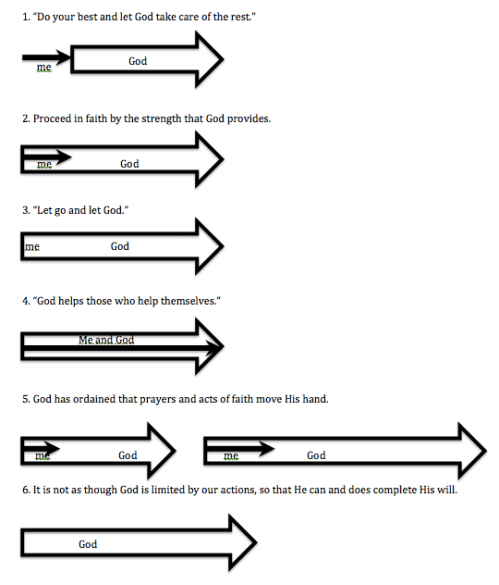
He said, “Do your best and let God take care of the rest.” I had heard this and similar phrases many times, but I went off on a mental tangent of evaluating it in the light of Scripture. I think that I understand the intent of the saying, namely that we have an active part to play in growing righteousness in our life and God completes what is lacking in us. Thus far I have no problem, but I think we may do better in our understanding and representation of the interplay of our effort and God’s empowerment. Toward a theology of effort and empowerment consider the following diagrams with their perspectives on the topic:

effort-empowerment-arrows

The arrows are somewhat self-explanatory, but I want to clarify them for my own benefit and yours. Though, as I said, the #1 was stated with right intentions, I believe that at face value it is really saying that I exert effort to the extent of my ability and then God kicks in for the rest. But the Scripture says,“for in Him we live and move and exist” (Acts 17:28), and “I am the vine, you are the branches; he who abides in Me and I in him, he bears much fruit, for apart from Me you can do nothing.” (John 15:5) We cannot even breathe apart from the grace He provides, but the “nothing” here seems to me to be ‘nothing of eternal significance’. As Paul teaches in I Corinthians 3:11-15, For no man can lay a foundation other than the one which is laid, which is Jesus Christ.  Now if any man builds on the foundation with gold, silver, precious stones, wood, hay, straw, each man’s work will become evident; for the day will show it because it is to be revealed with fire, and the fire itself will test the quality of each man’s work. If any man’s work which he has built on it remains, he will receive a reward. If any man’s work is burned up, he will suffer loss; but he himself will be saved, yet so as through fire.” 

I think that #2 is closer to the right perspective. God wants us to be involved and tells us through Paul to work out your salvation with fear and trembling; for it is God who is at work in you, both to will and to work for His good pleasure.” (Philippians 2:12b-13) Our part is working with God by faith that He provides all we need to obey Him. He is actually the one willing and working and He receives all the glory as only He should. We receive no glory for effort, seeing that His divine power has granted to us everything pertaining to life and godliness, through the true knowledge of Him who called us by His own glory and excellence. For by these He has granted to us His precious and magnificent promises, so that by them you may become partakers of the divine nature, having escaped the corruption that is in the world by lust.” (II Peter 1:3-4) The “magnificent promises” and “divine nature” afforded believers far exceed our efforts. For this reason I have the ‘me’ arrow inside the ‘God’ arrow. God is in, through, and around all that we do and amplifies it to a magnificent and divine level, “abundantly beyond all that we ask or think, according to the power that works within us” (Ephesians 3:20).The result is that “Christ is all, and in all” (Colossians 3:11) and “to Him be the glory in the church and in Christ Jesus to all generations forever and ever. Amen.” (Ephesians 3:21)

#3 is not only lazy but detracts from the glory of God by not proving His purpose and plan as revealed in such passages as Ephesians 2:10: For we are His workmanship, created in Christ Jesus for good works, which God prepared beforehand so that we would walk in them.” We are not to be idle. Our flesh will consume us the moment we stop clinging to God and moving forward in the strength He provides, for “the heart is more deceitful than all else And is desperately sick; Who can understand it?” (Jeremiah 17:9) Conversely, “I can do all things through Him who strengthens me.” (Philippians 4:13)

#4 may seem like a statement of working with God, but I have seen consistently that the people who use this phrase are just trying to be good in their own right and have little concern for godliness or God’s glory. He intends and expects of those whom He is saving and the whole world as well that they acknowledge Him in all things: ““Fear God, and give Him glory, because the hour of His judgment has come; worship Him who made the heaven and the earth and sea and springs of waters.” (Revelation 14:7) 

Our hearts tend to be lazy when it comes to spiritual disciplines, but I believe that God has ordained that His will is frequently accomplished and His kingdom built by enabling the efforts He orchestrates within us (#5), as we said above from Philippians 2:12-13. So we work hard and bring God glory as you see Paul and the Thessalonians did: For you recall, brethren, our labor and hardship, how working night and day so as not to be a burden to any of you, we proclaimed to you the gospel of God. You are witnesses, and so is God, how devoutly and uprightly and blamelessly we behaved toward you believers; just as you know how we were exhorting and encouraging and imploring each one of you as a father would his own children, so that you would walk in a manner worthy of the God who calls you into His own kingdom and glory.” (I Thessalonians 2:9-12) It is right and proper that we should work hard at spiritual progress in the strength God provides in order that others might be drawn to God and God be glorified.

And with all of this effort, remember that God needs nothing from us and can accomplish His will without us whenever and however He pleases (#6). “Behold, I am the Lord, the God of all flesh; is anything too difficult for Me?” (Jeremiah 32:27) But He has made us involved in so much of what He is doing, “for this reason I bow my knees before the Father, from whom every family in heaven and on earth derives its name, that He would grant you, according to the riches of His glory, to be strengthened with power through His Spirit in the inner man, so that Christ may dwell in your hearts through faith; and that you, being rooted and grounded in love, may be able to comprehend with all the saints what is the breadth and length and height and depth, and to know the love of Christ which surpasses knowledge, that you may be filled up to all the fullness of God.” (Ephesians 3:14-19) For  “I have been crucified with Christ; and it is no longer I who live, but Christ lives in me; and the life which I now live in the flesh I live by faith in the Son of God, who loved me and gave Himself up for me.” (Galatians 2:20)

Read Full Post »

Yeah, man, my life motto, “Life is Good”, “livin’ the dream!” Good vibes, positive outlook, need plenty of that, right? Not so fast. What about when you are sick and you just lost your job and the dog got run over and taxes went up and there is another war and…you get the idea. So, does that mean life is bad then? Is that what I’m saying? Let’s take a closer look. If the phrase, “Life is Good” was the end of the thought, it has limited utility to help us along in life perhaps, but as used in our society at this time it has modifying thought that follows. This implied extension of the thought is also explicitly stated in places like the “Life is Good” Facebook page. It goes something like this: Life is good because I’m doing what I like and liking what I do. The implication is a totally self focused or humanist view of life and it doesn’t work on several levels. First of all, you can’t always do what you want to. Secondly, in a more narrow sense, if doing what you want to do refers to your vocation, it is an economic impossibility for everyone to have the job of their dreams. And as just pointed out, many times life is hard. The idea may well turn into life is good for some subset of the population for whom everything is falling into place, but that must surely imply that I don’t care what happens to the other half or I think they just need to get their life together, think positive, and make it happen. Or maybe we are being urged to follow blind optimism: Let’s pretend life is good and that will somehow make it better. All of these possibilities seem a bit depressing unless you happen to be riding the wave, and even then it probably won’t last.

Rather than just burst your bubble and leave you hanging, I would like to suggest a more meaningful and purposeful phrase and explain why it is not just wishful thinking: “Life is good because God is good.” Stated this way the fact that life is also at times hard is not ignored or denied. God is working blessings deeper and more lasting. In the midst of hardship God is training us to trust Him (Proverbs 3:5-6,12) and look for what is honorable, pure, and good (Philippians 4:8). He is building, reserving, and guaranteeing future blessings (1 Corinthians 2:9) that outweigh these present difficulties (Romans 8:18). Through His gifts of goodness to us and as we praise Him we are given value, comfort, and provision (Psalm 34). Our lives are filled with meaning (Romans 8:28) and purpose (Psalm 67:7); He is given glory (John 15:8). These reasons that life is good will seem foolish to those who do not know Him (1 Corinthians 1:18), but I invite you to find the peace, joy, and purpose in serving God through the knowledge of His Son, Jesus (Psalm 34:8; Colossians 1:9-13), for He is the way to God (John 14:6). “Life is good because God is good”, which means that all of life is life gained from God and lived unto God (2 Peter 1:2-4), to His glory and for our benefit.

Read Full Post »

How could I not be thinking about testing with the situation I was in. But my thoughts went to a different, more significant and substantial type of test- the test of faith. Some days I am trusting fairly well but others I am failing miserably. The thoroughly up side of this type of test though is the guaranteed perfect grade at the end of the term for those enrolled in the class.

Mark it well, this is only a test
Heaven comes after, eternal rest
Now prove the metal of who you are
It's faith in God will carry you far

It's not by works you enter the rest
Nor by your goodness you pass the test
Your goodness comes by God's work in you
Obtained by faith in the Savior true

Not one temptation can overwhelm
When you cling to God who's at the helm
Storms, wind, and hail will batter your boat
The trusted Master keeps you afloat

Saved by grace through faith in Christ alone
Scripture instructs, by this you are grown
God receives praise as only He should          (Solae Quinque)
For God passed your test, He only could

Read Full Post »

« Newer Posts

Myrela

Exploring nature, ancient civilizations, art, photography, and written reflections through stories, visuals, and cultural inspiration.

Overflows from the Heart

"But the things that proceed out of the mouth come from the heart…" Matthew 15:18

CreatorWorship

Pointing to the One who made, saved, and sustains