Feeds:
Posts
Comments

Archive for the ‘General’ Category

With what are you struggling? Struggling with temptation is a matter of replacing it with something good and godly. I find that Romans 6:11 helps me to focus in times of temptation. Philippians 4:8 helps it to be less of a problem in the first place and less burdensome when happening. But what if the struggle is not a temptation but concerning a desire that you have thought to be a godly ambition? You pursue it, but thus far, to no avail. Patience and acquiescence to God’s will are certainly needed, but as platitudes they do not answer questions about how to proceed. So, here is how I am struggling:

My senses all say no
As do comments and circumstances
Whence comes this great desire
When all else says there are thin chances

To prayer I did devote
This ambition of which I now speak
Much counsel, plans I wrote
And God’s will in this matter I seek

How do I now proceed?
Exercise patience and longer wait?
More scrutiny it need?
Oh my mind and emotional state?

Is it time to give up?
To admit it was not in God’s will?
Accept this empty cup
As good providence rather than ill?

This I know above all
God is good and His will is the best
May stumble but not fall
Be bewildered but finally blest

I will continue on
Trusting God and in His guidance rest
Listening I will hone
Find His direction and pass the test


Read Full Post »

In my years of teaching Earth Science, I have discovered that one concept seems to tie more physical phenomena together than any other. Frequently it is the cause of what is observed and often it is the connecting thread between interactions of matter and energy. So I thought to give a few examples of why it is so often the correct answer to questions in Earth Science:

Earth Science is all about density
What will go up and what will come down
That convective cell propensity

Uneven heating of the atmosphere
Solar gain and wind and pressure change
Forced aloft forms clouds, sinking air clear

Heat, salt, and wind stir up the oceans
Many upwellings from the great deep
Gyres and thermohalocline motions

Far below the roots of the mountains
Plates form rifts, volcanoes, and trenches
Float on plastic and magma fountains

In the stars war gravity and fusion
Caldera of rarified plasma
Spots and flares in boiling confusion

Thus mass divided by volume seen
In many small and grandiose ways
And from its study much knowledge glean


Read Full Post »

My pastor asked me if I would share about my writing and how it has benefited me spiritually. I have been writing for many years by many means. I have journaled with pen to paper and fingers to keyboard in order to capture my thoughts. I have written newspaper articles and research papers supporting God’s view of Creation and salvation. I have written poetry and songs and short stories about struggles and joys of everyday life. I have written about family, friends, and colleagues. I have designed diagrams to explain ideas. Writing has been a long-term blessing in my life.

But why writing? Speaking to friends is easy. It’s real time, interactive, and engaging. You clarify and correct as you go. Facial expressions and voice intonations make understanding easier. Writing is harder. It has to make sense without the opportunity to correct misunderstandings. Writing speaks long after you are gone, for posterity or ridicule. Therefore, writing forces the writer to be more careful with words.

Why do I write? I write to focus, organize, and deepen my thoughts. I write in order to understand better and to make myself better understood by others. I write to hone arguments for truth and simplify complex ideas. I write to remember what I thought when God imparted understanding and wisdom to me. I write to quiet fretful, fearful, and frantic thoughts, to put my mind at rest by musing on truth. I write to plead with God, praise God, and thank God.

Psalm 139: 17-18a says, “How precious also are Your thoughts to me, O God! How vast is the sum of them! If I should count them, they would outnumber the sand.” His thoughts are indeed precious and numerous. The more I consider His thoughts, His works, His beauty, and His person as seen in Scripture, in Creation, and in my experience of Him, the more I realize the truth of Johannes Kepler’s words: “I was merely thinking God’s thoughts after Him. Since we astronomers are priests of the highest God in regard to the book of nature, it benefits us to be thoughtful, not of the glory of our minds, but rather, above all else, of the glory of God.” So, I write to record and mull over observations I have made of God and His work in His Word, the world, and my life.

Writing may help you to think more biblically, more deeply, and more clearly. I would urge you to give it a try. If writing seems distasteful to you, it may be because it is difficult for you to do. I don’t claim to be a very good writer, but I have considered what has caused me to improve. Following are my tips for writing. (“P” is such a handy letter for the the tautograms and alliterations of poets and preachers. I went a little wild.)

1) Practice. Focused attempts to write will bring improvement.

2) Write with a purpose. Writing simply to record information is useful, but there are better reasons to write. Tell a story. Organize thinking. Simplify complex concepts with new analogies. Pursue your interests.

3) Pretend you have an audience. This procedure forces you to make yourself understood and tends to induce you to put more effort into delivery.

4) Be precise. Choose words and turns of phrase that convey what you intend. It takes effort.

5) Prune your writing. Concise thought is more organized, better understood, and better remembered.

6) Proof-read your writing several times and have others proof-read it. Make at least one pass for grammar and spelling, one pass for clarity, and one pass for readability.

7) Make your writing personal. Even if you are explaining difficult theological or scientific concepts, tell how it matters to you, why you want to know, what prompted your search, and how it will effect you.

8) Give praise to God for His providence in pleasant and problematic circumstances so that His goodness and power will be seen as active in the present as it was in the past.

Read Full Post »

Why Me? There are generally two ways to answer that question.

Why me? Why is this happening to me? What did I do wrong?

         Or…

Why me? What is God trying to teach me? How is He using these circumstances to guide me?

On a very pleasant, sunny afternoon my wife and I were preparing to go for a walk on our local Greenway. We were talking and enjoying conversation and she was understanding well. You see, she is a stroke victim and most days communication is poor and ponderous. We went to the car, talking away as we went. I distinctly remember enjoying the moment.

I pulled out of the driveway, looking both ways. In my blind spot a car had pulled up on the opposite curb. I looked in my rear side mirror and reacted just soon enough to dent his passenger door no more than about four inches. Two inches less and a toilet plunger would have fixed the problem, but the main beam was damaged and irrepairable. It was an expensive mistake.

Now two months later I was at the body shop paying for the repair. I had planned other business nearby. When I came out of the shop, my truck would not start. After a half hour cleaning the battery cable, I was underway, too late to do the other business I thought so important.

Why had all of this happened? Why was I prevented and redirected? What chain of events is God orchestrating for His glory and my benefit through these less than pleasant events?

I may never know, but I do know that the Scripture says, “The mind of man plans his way, but the Lord directs his steps.” (Proverbs 16:9) I lived a good portion of my life frustrated by annoying sidetracks and roadblocks, but I have come to understand what the Psalmist means when he says, “It is vain to rise up early, to retire late, to eat the bread of painful labors; for He gives to His beloved even in his sleep.” (Psalm 127:2) I want to end my days trusting God, as the Psalmist says, “The Lord also will be a stronghold for the oppressed, a stronghold in times of trouble; and those who know Your name will put their trust in You. For You, O Lord, have not forsaken those who seek You.” (Psalm 9:9-10)

Read Full Post »

On the drive to church this morning,
I wrote the first verse of the following poem.
Hands free communication (as with a cellphone) disallowed me
to write it down, so the beginning of the second verse was lost
to me before I could write it down. But the direction in which
I was thinking remained for the rest of the poem to come this afternoon. God’s grace and goodness are so great, especially in contrast to our inability to comply to His commands and wishes.

So much wickedness in my heart
Made in God’s image, tarnished art
Frequent failings, falling away
To often straying from the way

Desire to follow ever grows
Distracted by pleasures and woes
Many small failings of the heart
Who will give me a brand new start?

Jesus only, beginning, end
Power to enable, transcend
All my failings and weakness
Distracted thoughts and selfishness

All by grace He has given me
From Him any good that you see
This fragile glass His strengths reveal
Demonstrates His goodness is real

One day my faulty service gone
Perfect obedience will dawn
In good time I will be steadfast
Then I will see God at long last

Read Full Post »

Man is a tool making animal (I only say in jest, since he is made in God’s image, and animal only by way of bodily similarity.). For repetitive, dangerous, or difficult jobs there is nothing like the right tool. I have been blessed with the use of many good tools and frustrated by the use of many inadequate and wrongly purposed tools. One item that I own and use that many people would not readily see as tool is my car. My 2007 Hyundai Elantra is not fancy, but it is nice, functional, easy and fun to drive, and dependable. It reached a milestone a few nights ago appropriately at the end of a trip over the mountains that we take frequently. In fact, we have probably taken this trip for more miles on this car than all the rest put together. Check out what happened.

Odo200K

Coming of Age.

I hope this tool will function without major repair for another 50,000 miles. But how do you know when to trade it in? Will it go 500 more miles without major repairs needing to be done, or 5000, or 50,000? The engine runs very well and blows by no more oil than it did 100,000 miles ago. The front end will need reworked soon, but how soon? The clutch shows wear but no sense is it near an end.

I have had a tendency to drive vehicles until someone has to tow them to a junkyard (It has happened at least 4 times.) Is that frugality or poor timing? One was catastrophic engine failure that could not have reasonably been foreseen, but others were death by degrees and dollars. For all of the roadside or shade tree repairs I have had a number of dependable and useful vehicles. I don’t say cars, because pick-up trucks figured among 4 of the vehicles, along with 8 cars, that God has provided over my 41 years of owning vehicles.

I married into one, bought two from family and two from friends, and one was gifted new from my father. I had one repainted, which I also replaced the the differential for a higher torque, lower gear, 1 1/2 ton version. One I replaced the bed (or box, and the Canadian’s called it) with a wooden bed that carried twice as much firewood. On one I had the transmission rebuilt, another I helped a mechanic rebuild the transmission in his personal shop, and another I junked because rebuilding transmissions was expensive and odious to me by then.

I hauled children, luggage, firewood, gravel, trash, and trailers with cars, dirt, brush, wood, more trash, etc. I’ve hauled pianos, an enlarging camera, furniture, building materials of amazing variety, hay and straw, manure, for recycling household and oil products. I shouldn’t have started that list because I can’t finish it and it is already too long to be of any interest to anyone.

My experiences, needs, and personality drive me to prefer pick-up trucks and small cars with clutches. I don’t like the inside of my vehicles to be trashy or dirty nor the outside particularly ugly, but necessity above presentation and function above beauty.

All in all, I have been blessed by God with many useful tools of transportation for which I am thankful. In moments of repair frustration or roadside delay, I have not been emotionally up to this thanksgiving, but I know it is true. 200K on the newest one was an apt reminder of God’s goodness and provision.


Read Full Post »

After two months of rain and conflicting responsibilities, I got to go climbing yesterday. It was an exceptionally beautiful day, 20 degrees initially, but lower 30’s by the time we began climbing. Besides full sunshine on the south facing wall, the breeze was minimal and most of the climbs were dry except for one or two springs (yeah, not oozes, but springs, but hey, a record rainfall year just ended). In consideration of temperatures we chose a low elevation, south facing crag, Rocky Face Mountain Recreational Park (website) in the Brushy Mountains of Alexander County, North Carolina. Some forward looking people (community members and public servants, no doubt) planned and executed this transformation of a rock quarry into a park the whole family can use, and they do. The company my climbing partner works for designed and executed the parking, picnic, and climbing areas. Where else can you park, walk less than 100 yards across a mulched picnic area to 60 bolted sport climbs. Signs show topo pictures and ratings. My climbing partner suggested that we try to get in 10 pitches before park closing time at 5 PM. We warmed up on a 5.4, then progressed up to a 5.10. I only fell on the 5.10, but on the second try found the right foot placement to utilize the slopey, crimper sidepull for my right hand (Climbing Terminology). I actually figured it out by watching my partner do it between my two tries. Visual beta is the best when you can get it. It occurred to me that visual beta (seeing how it is done) is analogous to fellowship in the church. You can see the path forward as you watch and collaborate with fellow believers. I actually have a few pictures of me climbing in the park a former time I was there three years ago (Playing at 56). The day was particularly satisfying since my mind had been distracted by many difficulties and restraints. You can’t think about concerns when you are concentrating on climbing (Or at least, bears of little brain cannot so multi-task.) I was refreshed by the day, the conversation, the challenge, and the small accomplishments after so long a time away from climbing, and I am thankful to God for it.

Note: This blog post will be very dull indeed if you do not utilize the hyperlinks.

Read Full Post »

While sitting quietly the other day, I noticed once again a print of an ink stippling on my wall. It was given to me by the artist, Paul S., over 35 years ago. I offer my students the opportunity to interpret its meaning each semester. They have little context for understanding what the picture could mean. As you read the poem by which I tried to interpret it, consider three details: when it was drawn, over 40 years ago; the fact that the wind up key was not in the original drawing (added to soften the message); the driver is a self-portrait of the artist:

Business on parade
Corporate charade
Self-importance stance
Condescending glance

All dressed to impress
Picture of success
Lean and hungry look
Sales castling rook

Off to war we go
Corporate G.I. Joe
Competition war
Watch our profits soar

Take seriously
Capitalist free
Make a better place
Of our world and race

Bosses all are we
We work for a fee
All cogs in the wheel
We stagger and reel

Get on the bus
That’s left even us
Once to camp and play
Now late at work stay

Thus we bid adieu
Commitments renew
Now hard on the track
Taking business flak

business on parade crop

Read Full Post »

My students were preparing to take their big semester test. Besides trying to calm some of their nerves and instill confidence, I also wanted to persuade them to not rush either for reasons of nerves or apathy. After my little speech, this poem began to come to me.

Take your time
Please don’t hurry
Do it right
Don’t end in a flurry

Patience now
‘Tis a virtue
Hand to plow
Follow through

Carefully
Wisely proceed
Clearly see
Then the deed

Measure twice
Cut but once
Planned it thrice
Prevention’s ounce

When you’re done
As you should
Quite the run
It was good

Read Full Post »

It shall not grow if the soil is not prepared. It shall not be caught if there is no net in the air. No reason, no logic based in truth will occur without the moral component.

What is not caught is not taught
So they say
Lead them to water add salt
Make it play

But how do you break the hard pan
Unfriable soil
Minds for which learning is ban
Refuse slightest toil

Closed to logic and reason
Parroting thought
Flocks of birds out of season
Nothing new sought

Where are those seeking learning
Knowledge sponge
Understanding discerning
For truth lunge

True wisdom comes from above
Two-sided gift
Truth one side, the flip side love
Between no rift

Read Full Post »

As I have mentioned several times recently, and as anyone in my area will attest, there have been more than usual number of days with gray skies and fewer of sunshine than normally. On just such a day yesterday, I began to consider.

Snow on the mountain
Wind in the trees
Frost on the pasture
Chilled by degrees

Gray sky overcast
Sun seldom guest
Trees in dark profile
Season of rest

All is damp and cold
The days are short
Food scarce for creatures
Few birds report

In this bleak season
Emotions wane
Foreboding reason
Given to pain

Now the time for faith
Let the truth ring
After these dark days
Then will come Spring

Even wintertime
Has its beauty
Seek out what is good
Fulfill duty

Embrace these gray days
Count it all joy
Draws you to Jesus
And sins destroy

Read Full Post »

The first advent we celebrate
As babe in flesh we can relate
Without a sin He lived His life
Through all temptation, pain, and strife

Miracles He performed with ease
Controlling nature as He please
To His deity these pointed
And with the Spirit anointed

Taught us of the Father’s kindness
Of religious leader’s blindness
God’s kingdom come in hearts of men
Of wrath to come, the cost of sin

His most amazing, gracious toil
His death that sin and death did foil
For those who believe and submit
Eternal life He will commit

He rose from the grave on day three
From sin’s power He set us free
Now we serve Him with joy and peace
Seeking for others sweet release

He returns that glorious day
His mighty power on display
The dead are raised to life anew
Trailing the Master in full view

So with Him forever to reign
His was the price, ours is the gain
With joyful hearts we’ll worship Him
The saints singing eternal hymn

In His life and death is our hope
Eternal in extent and scope
What assurance it is to know
The One from Whom all blessings flow

Read Full Post »

Frances Havergal wrote the following poem for New Year greeting cards in 1874, which later became a hymn:

Another year is dawning, dear Father, let it be
In working or in waiting, another year with Thee.
Another year of progress, another year of praise,
Another year of proving Thy presence all the days.

Another year of mercies, of faithfulness and grace,
Another year of gladness in the shining of Thy face;
Another year of leaning upon Thy loving breast;
Another year of trusting, of quiet, happy rest.

Another year of service, of witness for Thy love,
Another year of training for holier work above.
Another year is dawning, dear Father, let it be
On earth, or else in Heaven, another year for Thee.

It is a time to reflect on the past, take stock of the present, and aspire to a better future. Much if not most of life is beyond our control, but she clearly pleads God’s provision, not for an easy time, but for a fruitful time in belief and service to God. I ask that my Christian brothers and sisters be blessed with just what this poem requests, “another year for Thee”.

There are others of my friends and readers who do not yet know God through His Son, Jesus Christ. I plead with God to choose you in this new year to be His child. Though He is the one who chooses, in some mysterious and yet simple way we must choose Him as He enables us to. The offer is there; knowledge of God and life eternal awaits. Trust Jesus to take away the guilt of your offenses against God by the sacrifice He made on the cross. It is not a complex choice, but it is a definite one. Do not reject Him for some misguided sense of fairness:

“Give us fairness,” said many voices.
“You don’t want fair,” he said,
“For then we would all be dead.”

Grace that will set you free,
Mercy to pardon, can’t you see?
You have no other choices.

And why would we all be dead? “For all have sinned and come short of the glory of God.” (Romans 3:23) “For the wages of sin is death but the gift of God is eternal life through Jesus Christ, Our Lord.” (Romans 6:23) There in the same sentence with the bad news and death, is the good news and eternal life. 

May your New Year be blessed with the knowledge of God and joy in serving Him.

Read Full Post »

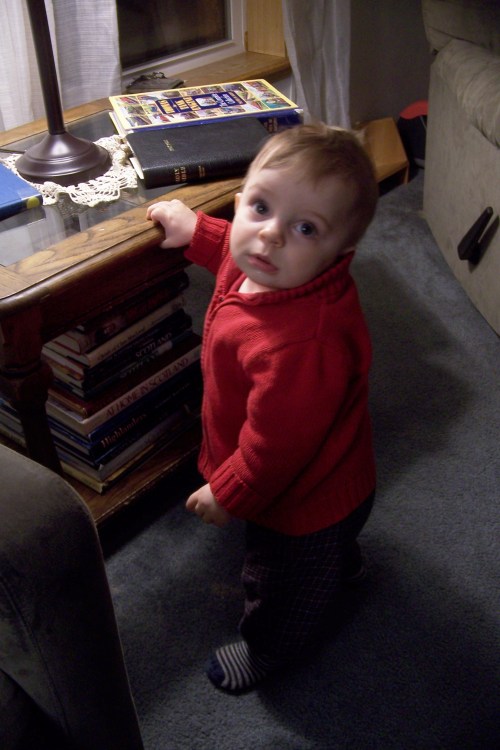
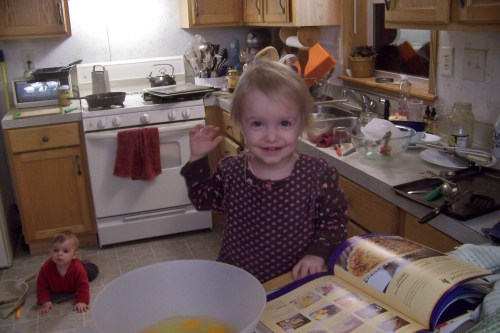
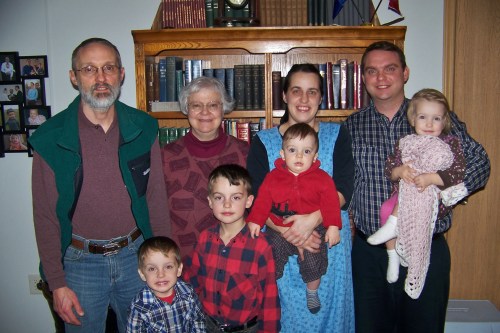
It has been a year and a half since we visited our son in Pennsylvania. I felt like I made more connection this time with the grandchildren than previously. We have forgotten how much energy young children expend and parents expend on their behalf. We sword fought, colored, cooked, ate, cleaned and organized, worshipped, ran around in two different yards, shopped, read, ate, recalled, sang, ate, talked, watched film, prayed, ate, played croquet, and cleaned some more.

Two of my younger sons were there for the first evening dinner. I would so like to get the whole clan together in one place, at one time. It is good to see the young ones healthy and happy. I think that their parents are tired. Many changes are coming.

101_1661

A Stance and Grip on Life Ready for Growth

101_1665
101_1659

My Kitchen Is My Happy Place

101_1667


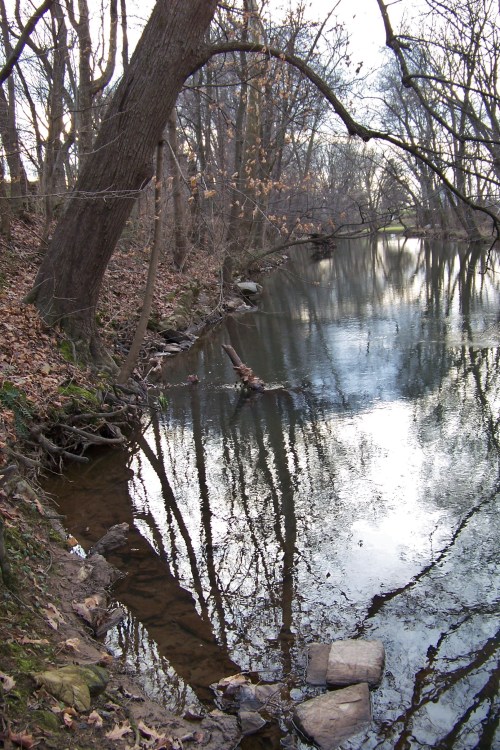
I took two walks and a run while I was there. A walk down by the nearby creek occurred when all seven of the other people were napping. I wonder if the woods, creeks, and fields have always felt so lonely in the winter, or did we eliminate so many mammals as to make it so. I don’t mind alone, because it gives me time to process, meditate, consider, and request. I also observe much better when I have un-rushed time alone.

101_1679

The Quiet, Melancholy of a Winter Riparian Scene

101_1676

Natural Impressionism

101_1686

Late Evening Winter Scene

We stayed in an airbnb all four nights. I discovered them this year because of increased travel and motels being a bit expensive for what you get. In someone’s home you have the option to cook, which both saves money and allows for eating what you want to eat. The first night we stayed in a very nice home, beautifully decorated with an inquisitive couple who would have talked into the wee hours if I had allowed it. The next three nights we stayed in a clean but very sparsely decorated older home. We hardly saw the host and had the two story house to ourselves for the little time we spent there. It was from this second home that I took a walk at dusk on the second night. I had to include the poor picture of the falcon sitting on the fence post. It was not more than 30 yards away. The small towns there are surprisingly compact. There were probably not more than 20 houses with a volunteer fire station, an auto repair shop, and a few small business warehouses. You could walk 200 yards from the middle of town in any direction and be in a farmer’s field.

I’m sure locals could tell at a glance, but just because you see a buggy doesn’t mean the occupants are Amish. Many are Joe Wenger, 35er, or Piker Mennonites. What is generally conservative in religious circles elsewhere is moderate to liberal in Lancaster County. 

101_1673

Bad Picture, Amazing Sight

101_1669

Mastersonville, PA

101_1671

They do have running lights and headlights

We came home tired and satisfied. Time with family and time in a new place are refreshing to the spirit and mind, even if not so much to the body. God has so blessed us with children who seek Him and occasional opportunities to break up the mundane with new experiences. Life is good, because God is good.

Read Full Post »

There is so much stirring in my heart and mind.

Before prayer time the pastor read about the two houses, one built on the rock and the other on sand. Having a good foundation in God and in His Word is important. But pastor pointed out that the foundation in no way determined what was thrown at the house. Both houses experienced severe storms. Christians and devoted Christians do not get an easier life. In fact, “all who desire to live godly in Christ Jesus will be persecuted.” ( II Timothy 3:12) The house cemented to God lasts.

My class’s Sunday School lesson was on David and Goliath. I liked the fact that the lesson emphasized that this was not a boy fighting a giant, but a young man described as a “valiant warrior” (I Samuel 16:18). Nonetheless, any thought of him defeating this giant on his own was beyond anyone’s imagination. All of the army of Israel fled from his presence and were terrified. When David told Saul that he had defeated the lion and the bear, he was insistent that “The Lord who delivered me from the paw of the lion and from the paw of the bear, He will deliver me from the hand of this Philistine.” (I Samuel 17:37) The rest of Israel was afraid while David trusted God. My concluding point was that “You overcome giants like [I had the students fill in the blank and then I added only a few more] fear, bullies, my worst subject in school, pain, disease, conflict with family or friends or enemies, death, the devil, my sinfulness, embarrassment, weakness by trusting in God.”

Then my pastor preached on prayer in the book of Acts. He surveyed the occurrences of prayer and their results. If my notes record correctly, he numbered 19 instances of prayer. There were many kinds of prayer: worship, praise, petition, devoted, focussed, decision, pleading, requests, commissioning, singing, committing, exhorting, meditating, seeking, fasting. These prayers had many results: divine guidance, many saved, miracles, healings, provision, rescue, preaching, Holy Spirit empowerment, conflict and its resolution, persecution, rebuke, dead raised, blind given sight, understanding, discernment, calling missionaries, elders chosen and confirmed, church planted, priests saved, testifying, praise, earthquake, jailer saved, commitment, strengthening of the church, supplied. Then the pastor asked, “Will you give yourself to prayer?” He concluded by saying, “A life of prayer doesn’t mean that we do nothing, but that we do nothing apart from prayer.”

The devotion and lesson and sermon reminded me of a thought I had many times before about the work of a Christian. “The only true work of a Christian should be prayer; all else is rest.” I don’t mean by this that muscles and sweat and planning and thought aren’t involved in many activities for the kingdom of God. Rather, we plead and travail and petition and worship and fast and cling to God in prayer and then go out confidently to the battle to meet the giants, expectantly and confidently looking for how God will work. The upshot of this day of thought on God and His ways is that I have much work to do. I would describe my prayer life as sporadic. I do fervently pray even when things are going well, but I get distracted by many pursuits and cares rather than resting in God from a position of having requested His power in prayer. Will you come along with me to renewed commitment to prayer? Ourselves, our families, our churches, our communities and businesses, our nation, and our world need prayer.

Read Full Post »

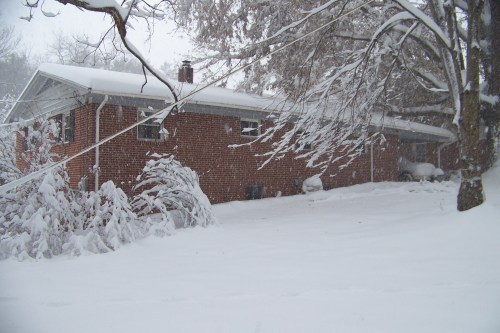
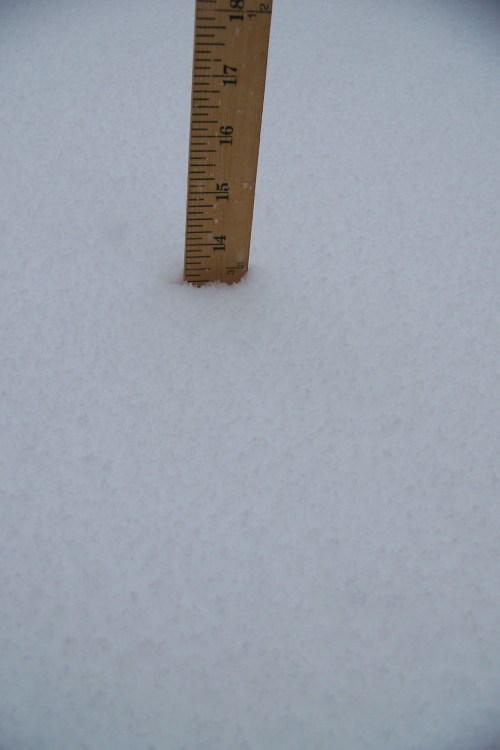
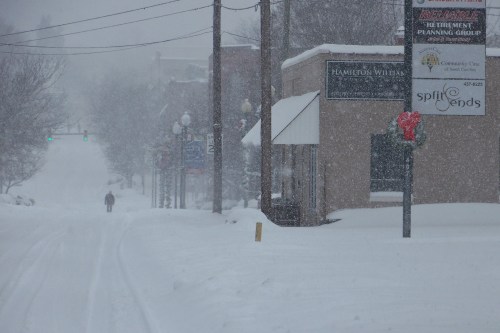
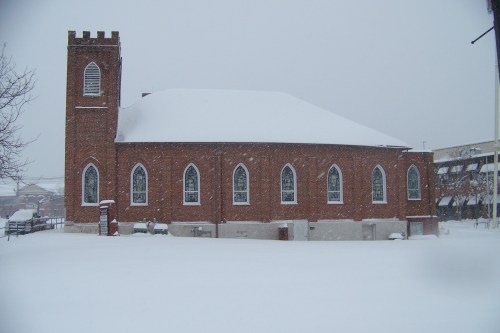
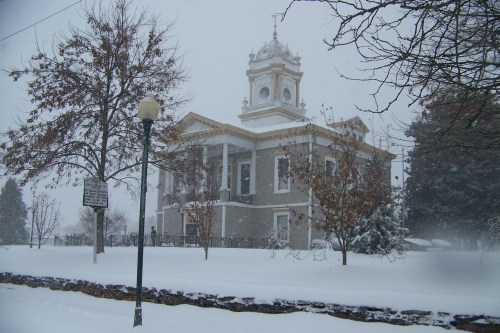
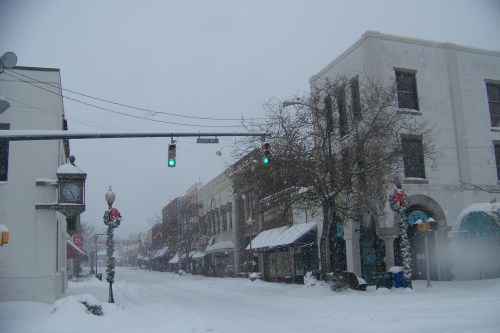
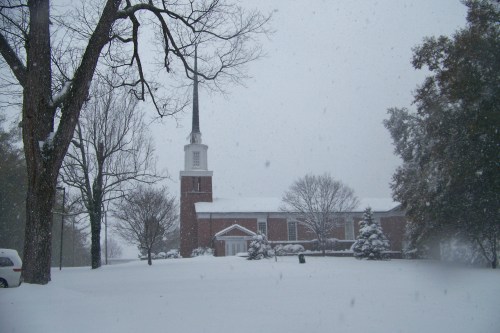
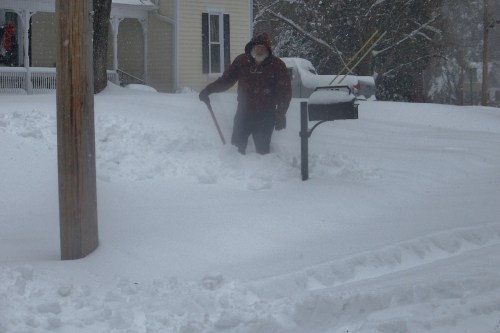
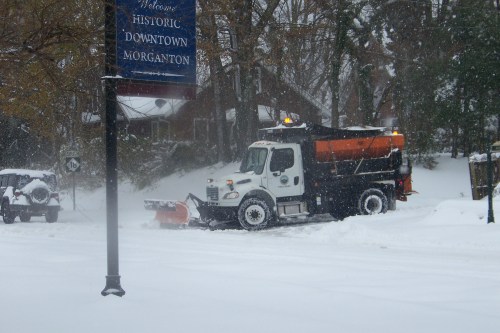
It was not a record snow. Those seem to be more in the neighborhood of 18″ in 1993, the 1960’s, 1925, 1911, or something, depending on whether you mean 24 hour total, storm total, and where exactly. Tracing such records is dizzying and hard to do. But a solid 14″ on the hard surface of my yard where there is gravel and scant, short grass is good enough for me.  I have a picture of it when it was 13″, because the 14″ measurement picture was blurred by condensation on the lens.

I think that one of the changes with age is my way of enjoying the snow. Some people don’t really seem to enjoy it unless they are sliding on it. I, too, used to love to do that on anything slick: sled, shovel, skis, shoes (boots really, but I couldn’t resist 5 s’s in a row).

But now I like most of all to take a long walk to the point of fatigue and take pictures of anything that looks beautiful or unique. I find much peace and exhilaration mixed together when it is snowing. It is quiet and yet screams at the senses, bright and yet darkly overcast, beautifully sculpting and yet messy, sanguine and yet melancholy. The wind, flakes, and sound absorption isolate you and yet your neighbors come out to greet you and lend a hand if you are stuck.

I apologize to my friend whose picture I took, twice. It seems that the snow flake that I did not see and obscures part of the clock was inconveniently on his face moments later. I walked 2 miles over to his apartment and then we walked a mile back up into town. We are both school teachers and don’t have anywhere we have to be at the moment.

I am thankful to God for hearing my prayer for it to not rain last night, since that would have certainly caused significant flooding. It melts away slowly today, running down the gutter at the bottom of my driveway. It was a beautiful, big snow.

101_1605

The Homeplace draped in liquid lace

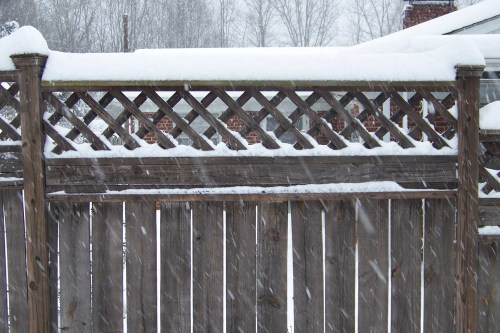
101_1606

It’s hard to keep firewood dry.

101_1609

I had a better picture of this, but the flash reflecting off of the snowflakes was a pleasant surprise.

101_1614

It really was 14, later.

101_1616

Wind Sculpting

101_1619

Nice contrasts

101_1620

Working hard for a day off!

101_1623

Companionship is always good.

101_1625

It looks intense.

101_1627

Good architecture shines even when covered.

101_1629

In a small town near you

101_1632

Iconic, Historic Courthouse

101_1634

Go, but not too fast

101_1637

No one in attendance this week

101_1640

I forgot to tell him to turn off the flash.

101_1642

Snowtime

101_1647

“I moved down from Wisconsin to get away from this.”

101_1649

We have a few pieces of snow equipment in our small, Southern town.

Decorated Snowy Lightpole

Pass Go, collect $200, and have a Merry, White Christmas.


Read Full Post »

Heat acts like an invisible fluid that washes over and penetrates through any barrier. The reason I thought about it this morning was the temperature in the house, the difference in temperature from outside, and the feel (comfort level) in the house.

The thermometer, placed on the counter in the center of the house, said 68 degrees, which is a reasonable indoor temperature. But should I start a fire in the stove? Ultimately, for most people, the answer to that question depends on comfort level. Ignoring the real psychological components of comfort level, comfort level depends on heat flow rate.

Heat flow rate is the reason for heat index and chill factor in weather reporting of temperature. An inanimate object feels neither extra hot when it is humid nor extra cold when the wind is blowing. The temperature at which it settles is determined solely by the average rate of vibration of its molecules (i.e. temperature). 

But when an object like a thermostated heater or warm blooded mammal or human is warmer than its surroundings and produces heat to maintain that difference, heat flow rate is crucial to comfort and even survival.

For a fuller understanding of this concept. let us posit two facts:

  1. Heat always flows from warmer to cooler.

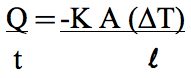
  2. Heat Flow Rate is     Screen Shot 2018-12-08 at 6.05.10 PM,

where Q is heat, t is time, K is conductivity, dT is change in temperature, and l is length (distance or thickness) of heat flow, and the combination of dT/l is the temperature gradient.

Since in winter I heat with wood for the purpose of keeping us warm and feeling warm, I will consider the situation of heat flowing out of our bodies. Unless I am sitting by the woodstove, I am warmer than the room and heat is leaving me.

The greater the area (A) of my skin exposed to the surroundings, the faster I cool off. For this reason, you don’t expose flesh to the air on an extremely cold day because the heat flow rate is so great from any area of  your body that it can’t provide enough heat to prevent your flesh from freezing.

The greater the temperature difference (dT) between me and the environment cooling me, the faster I cool off. Our bodies are constantly radiating heat to the cooler surroundings. If you have ever worked in an unheated building with a concrete floor, you know that it is very hard to keep warm. You can feel the concrete zapping heat out of you (you radiating to it, in fact).

The shorter the distance (l) for the heat to flow to reach the cooler temperature, the faster I cool off. The thickness is the reason thicker insulation works better. More thickness of a substance that slows heat flow rate slows it more. Insulation, be it pink or down or quilt is really just a function of how much non-convecting air is trapped in the insulating layer. Air is an excellent insulator, which brings us to the next component.

And the better the material is at conducting heat (thermal conductivity (K)) off of me, the faster I cool off. Conversely, the reason air is poor conductor of heat is the distance between molecules. On the other hand, since it is a fluid, it is a decent convector (heat transfer by flow of a fluid), and it provides little resistance to radiation, since there is less matter than most materials to absorb or radiate back the heat. When you put a warm hand on a cold, wooden table it won’t feel very cold, but on a cold, metal appliance it will. This increased flow happens because the metal has a far greater thermal conductivity than an insulator like wood.

Soooooo, back to my question. Should I start a fire when the core of the house is 68 degrees? Considering this situation, I ask myself several questions. What is the temperature outside? Is there a strong wind cooling the house? Is there cloud cover to prevent cooling at night or prevent warming during the day? Is there a temperature trend up or down from the present reading of 68 degrees because of internal or external changes to the house? About this time, those of you who have thermostats that do all of this “thinking” for you should stop taking it for granted. It is a relatively old technology, but not an altogether simple or trivial one.

In terms of comfort level, it can be 68 degrees in the core of the house and feel quite chilly because the outside is removing heat rapidly. This situation will result in the peripheral (near the outside walls) temperature being several degrees cooler.  I used to have my indoor/outdoor thermometer on a window sill. It consistently read cooler than the one I have now. My new thermometer wouldn’t fit on the sill. It would probably be easier to not think about it if I had a thermometer in the center of the house and on the window sill. Then I would have an approximation of the heat flow rate out of the house, but that would make me less truly aware of my surroundings. I have to walk past the central thermometer and past the window to get to the refrigerator and the stove to make my breakfast anyway, so I feel the temperature difference from core to periphery. I do not, however, usually think much about the various components of heat flow rate, because I am only barely awake at 5:15 in the morning.

101_1604

Not time for a fire, yet (I need to reset the clock.)

P.S. If you read this far, I surmise that you are either a science geek or a particular friend. Either way, thanks for reading, and glory to God for His ordered universe and minds to make sense out of it.

Read Full Post »

I was out of town last week, so I hadn’t gotten the new Sunday School curriculum. I decided to piggyback off of the lesson my pastor had taught the children last week about God choosing David as king. What else did he choose David for? Prophet, Warrior, Psalmist. All of these are true but His choice of David as progenitor of an eternal dynasty  is most important.

Here is how it played out. I had the students do a Bible drill and read passages about 4 covenants of God. God made other covenants not mentioned here, most notably the Adamic and Noahic, but these four represent much of the focus of the Old and New Testament (i.e. Covenant) passages. The table and preliminaries don’t copy over quite the same as they appear on the student’s worksheet, but you get the idea:

Four Great Covenants of God

God chose _______________ to be _________, in place of ____________.

There are two points: 1) He was a man ___________________________ (Acts 13:22)

2) God desires from us ______________ and _______________ and _______________

(I Sam 15:22; I Cor. 1:27)

Screen Shot 2018-12-02 at 3.59.24 PM

From last week’s lesson, God chose David to be king, in place of Saul.

The two points of the previous lesson were 1) He [David] was a man after God’s own heart.  2) God desires from us obedience and humility and integrity.

Following is a picture of how I outlined the Covenants as the students read through them:

1202181026

Read Full Post »

My son and I had a conversation nearly 2 months ago now about the most influential people in the world. I do not remember what precipitated the discussion, but it was not in a vacuum. When he was young our family had watched an A&E program named “The 100 Most Influential People of the Millennium”. It began with #100 and built up as they approached their #1 pick for the years 1000 to 2000 A.D. (If you want to see the list, click here. And if you are not really interested in my commentary but want to look at my list, scroll to the bottom.) After much discussion, my son suggested that we challenge the extended family, with whom we would be gathering in a little over a month for Thanksgiving, to make their own lists so we could discuss it after dinner. The A&E list is ranked and we said that each person could decide if they wanted to do that. Additionally, we purposely stated that each person should interpret what kind of influence, who was influenced, and when they were influenced, in making his/her list. I wrote these things in an e-mail to the family e-mail group, not mentioning the A&E list but admonishing participants to not confer with others so that the lists would be more varied and produce more discussion. When I saw the good-hearted discussion on the e-mail replies, I took the additional step of asking two colleagues at my work, who I knew to have different worldviews than my family, to make their lists for the purpose of contrast.

I am happy to say that the whole scheme brought about significant discussion. It was interesting to watch the phases of interaction. After a brief explanation on my part as to how the challenge had occurred, with inclusion of the A&E list, family members began comparing who was on most lists. Next there was a discussion of the rationale behind various member’s lists (more about that in a moment). Then we progressed into names we supposed to be possibly unique to our own lists, asking others if they included them, and if not, why not. It occurred to me that in order to make a really good list you would need a plethora of perspectives. I made the mistake of mentioning that this procedure would work best in a committee. There were some of the strongest opinions about the pitfalls of committees, like slow and argumentative, but they also have the advantage of collaboration and consensus. Since the whole of this blog entry is commentary, I would also add that collaboration is an overused buzz-word and politically correct requirement of public interaction these days. Frequently, isolated, deep contemplation, followed by sharing is more efficient and brings better results, but woe be unto the educational ‘facilitator’ who broaches that perspective.

The rationales for selecting candidates for the 100 lists varied with as many people as participated. My oldest son, who completed his list mostly in his head while working, stated that he did not know enough about the East and confined his list to people who influenced Western Culture. He also said that most lists would not sufficiently include the influence of Christians for now and eternity, so his list is heavy (not meant to imply too heavy necessarily) on Christians. He also said that he had trouble limiting his list to 100 people so his first list had 211. Actually it had more than that because in certain listings he put multiple names, for example the founding fathers of the U.S. His brother added accomplishments onto his list, persuaded him to reduce his list to 200, but then added 25 he thought his brother had left out. It was a collaboration within the individual lists.

I also found mulitple listing unavoidable on some subjects so that I have Watson and Crick for DNA, and Wilbur and Orville for the airplane. But I opted to try to find one revolutionary idea or execution of an idea as representative of a thought or influence, for example, Philo Farnsworth invented the scanning television. His was not the very first or the exact one that number in the millions by the time I was a child, but he broke ground toward a practical, modern TV. I also tried to include significant people from the East. I too am largely ignorant of the East, but I think that it helps tremendously that we were limited to 1000 to 2000 A.D., because many of the formative, significant names in the East are more ancient. For all of this, it is curious that we chose to emphasize what affected our culture, our time, and ourselves the most. Compared to the A&E list, I think we were more far-reaching and inclusive than they were. Some of their picks were simply politically correct, narrowly influencing idealogues and icons of cultural fad. It is good to realize that you are being narrowly focussed on what surrounds you, but be more inclusive tends to adding people that were not really influential, just an influence on some small group you don’t want to leave out.

The chore of ranking these people was the hardest part, and I gave up after #31, because it began to seem ridiculous to me. The whole exercise of ranking may be equally so. I did find it much easier to rank within groupings of types of influencers, for example, spiritual, inventors, scientists, leaders and politicians, literature and the arts, and philosophers. And this is the list I have included below.

I found the whole process stretching, challenging, and enjoyable, with the discussion with family particularly so. If you have a few minutes, peruse my list and give some feedback on why you think certain people should or should not be on my list. Happy listing.

Leon’s Most Influential People of the 1000-2000 AD  (ranked within Groupings)

Spiritual Leaders

  1. Martin Luther (started the Reformation)
  2. John Calvin (Reformer and Theologian)
  3. William Tyndale (English Bible)
  4. Hudson Taylor (Missionary to China)
  5. Billy Graham (Worldwide Evangelist)
  6. George Whitfield (Early American Evangelist)
  7. Charles Spurgeon (Prince of Preachers)
  8. Luis Palau (Latin American Evangelist)
  9. John Wyclif (English Reformer)
  10. Mahatma Gandhi (Indian Holy Man)
  11. Ignatius Loyola (Jesuit founder)
  12. Mother Teresa (Nun to poor of India)

Inventors

  1. Johannes Gutenberg (Moveable Type Printing Press)
  2. James Watt (Inventor of the Steam Engine)
  3. Thomas Edison (Inventor)
  4. Guglielmo Marconi (Wireless)
  5. Jean Joseph Etienne Lenoir (Internal Combustion Engine)
  6. Orville and Wilbur Wright (Airplane)
  7. Henry Ford (Assembly Line, affordable car)
  8. Werner von Braun (modern rockets)
  9. Henry Bessemer (economical steel process)
  10. Charles Goodyear (Vulcanized Rubber)
  11. Alfred Nobel (High Explosives; Nobel Prize)
  12. G. LeTourneau (Earth Moving Equipment)
  13. Christiaan Huygens (Pendulum Clock)
  14. Bartolomeo Cristofori (Piano)
  15. Jacques Cousteau (Aqualung, ocean preservation)
  16. John Bardeen, Walter Brattain, and William Shockley (Transistor)
  17. Alexander Graham Bell (Telephone)
  18. William Cullen (Refrigeration)
  19. Theodore H. Maiman (LASER)
  20. Philo Farnsworth (Scanning TV)
  21. Bill Gates (Software Developer)
  22. Alexander Parkes (Thermoset Plastic)
  23. Daguerre (Photography)
  24. George Washington Carver (Agriculture)

Scientists

  1. Isaac Newton (Laws of Motion and Gravity)
  2. Michael Faraday (Electromagnetism: motor)
  3. Albert Einstein (Relativity)
  4. Charles Darwin (Evolution)
  5. Louis Pasteur (Germ Theory and Vaccination)
  6. Gregor Mendel (Genetics)
  7. James Watson/Francis Crick (DNA)
  8. James Clerk Maxwell (Electromagnetic Equations)
  9. Galileo Galilee (Motion and Astronomy)
  10. Johannes Kepler (Elliptical Orbits)
  11. Nicolaus Copernicus (Heliocentric Solar Sys)
  12. Rene Descartes (Philosopher, Mathematician, Scientist)
  13. Roger Bacon (Sci.Method, gunpowder to West)
  14. Dmitri Mendeleev (Periodic Table of Elements)
  15. Niels Bohr (Atomic Model/Quantum Mech)
  16. Edward Jenner (vaccination)
  17. Alexander Fleming (Penicillin)
  18. Pierre and Marie Curie (Radioactivity)
  19. William Harvey (blood circulation)

Government/Political Leaders

  1. William the Conqueror (Conquered Britain)
  2. Mao Zedong (Chinese Communist Revolution)
  3. Suleiman The Magnificent (peak of Ottoman) 
  4. Gustav II Adolf (Supported Protestant States)
  5. George Washington (General/President)
  6. Genghis Khan (Mongol Empire)
  7. Adolf Hitler (Nazi Germany)
  8. Simon Bolivar (Liberator of South America)
  9. Pol Pot (Mass murder in Cambodia)
  10. Queen Elizabeth I (Queen of England)
  11. William Wilberforce (Ended Slavery in Britain)
  12. Napoleon Bonaparte (Defeated Europe)
  13. Vladimir Lenin (Russian Revolution)
  14. Peter the Great (Modernized Russia)
  15. Thomas Jefferson (Declaration of Independence)
  16. Fredrick the Great of Prussia (Peak of Prussia)
  17. Mustafa Ataturk (Liberalization of Turkey)
  18. Abraham Lincoln (Civil War)
  19. Martin Luther King Jr. (Civil Rights Movement)

Explorers

  1. Christopher Columbus (rediscovery of New World)
  2. Marco Polo (European trade with China)
  3. Ferdinand Magellan (Explorer)
  4. Hernan Cortes (Conqueror of Aztec Mexico)
  5. James Cook (Explorer)

Literature, Music and the Arts

  1. William Shakespeare (Playwright, Writer)
  2. John Bunyan (Pilgrim’s Progress)
  3. John Milton (Paradise Lost, Writer)
  4. Johann Sebastian Bach (Baroque Composer)
  5. Dante Alighieri (Divine Comedy)
  6. Leonardo da Vinci (Inventor, Sculptor, Painter)
  7. Charles Dickens (Novelist)
  8. Michelangelo (Painter/Sculptor)
  9. Wolfgang Mozart (Composer)
  10. Ludwig van Beethoven (Composer)
  11. Fyodor Dostoyevsky (Writer)
  12. Leo Tolstoy (Novelist)

Philosophers

  1. Thomas Aquinas (Christianity &Greek thought)
  2. Carl Marx (Marxism)
  3. John Locke (Social Contract)
  4. Sigmund Freud (Psychoanalysis)
  5. William Blackstone (Law)
  6. Immanuel Kant (Transcendentalism)
  7. Soren Kierkegaard (Existentialism)
  8. Jean-Jacques Rousseau (Political)
  9. Friedrich Nietzsche (Nihilism)

Read Full Post »

Keeping the Thanksgiving tradition alive on a day after hike is one of the enjoyable ways of renewing our family relationships. I find that the quieter, slower pace and distance between hikers perpetuates more personal conversation. It’s when I really catch up with where family members are at. And I met one new extended family member, too.

The best time to see waterfalls and cascades is when there is plenty of water. This must have been a record rainfall year. Chuck said the area is 10 inches above normal so far. And there had been a big storm just two days before.

The hike we took was on Rhododendron Creek in Greenbriar. I’m told it is not an official trail, but given the traffic, it might as well be. Toward the end of the 2.6 mile stroll we came to cemetery that had numerous Whaley’s in it. There was a curious story about how two distant cousins in my family meet, genealogically speaking.

When we got back to the road, my niece and I ran about 1.3 miles down the gravel to retrieve the cars. I am so happy that I can begin to run again. It was a pleasant hike all around.

101_1552

Ready for a hike even on a damp day

101_1554

Every little stream full to overflowing

101_1555

Hi-ho, hi-ho!

101_1558

I like to slow it down a little

101_1559

Plenty of water

101_1561

The crew at a destination

101_1564101_1566

101_1573

A very bushy lichen (Anyone help with the ID?)

101_1574

101_1579

Leon and Chuck

101_1590

To read and see my brother’s description of this and another hike, click on Chuck’s Description of the Hike 

While at one of the seven cascades, my niece decided to take a selfie. As she described it in her e-mail with the attached picture, this is the picture with my ‘crazy uncle’. That crazy uncle was trying to go see the next cascade up that was hidden in the rhododendron above. My nephew followed and you can see the site below.


Emily with me in background

My Niece’s Photo Bombed Selfie

101_1575

‘Crazy Uncle’ Cascade

Some people reading this blog may say that Leon (aka ‘crazy uncle’) seems to think that he has to tag on a thanksgiving or praise to God at the end of a blog entry. I don’t always, but if you look at the title and subtitle of this blog, you will see that it reminds me that He is the one worthy of praise and thanksgiving for our existence, provision, and salvation. I intend never to stop praising His glorious name, and enjoying and thanking Him for His provision of all things good and beautiful. Among those provisions are good health, the beauty of creation, and the warmth of family.


Read Full Post »

« Newer Posts - Older Posts »

Myrela

Exploring nature, ancient civilizations, art, photography, and written reflections through stories, visuals, and cultural inspiration.

Overflows from the Heart

"But the things that proceed out of the mouth come from the heart…" Matthew 15:18

CreatorWorship

Pointing to the One who made, saved, and sustains