Feeds:
Posts
Comments

Archive for the ‘Connotations’ Category

Consider the mystery of Christ’s nature. Theologians refer to the hypostatic union of His divine and human nature. Hypostatic is a fancy word composed of “hypo”, underneath, and “stasis”, position. It means what is underneath all else, essential, or foundational, and by extension, unchanging.

I remind you that a catechism is an abbreviation of the a confession, just as a confession is an abbreviation and condensation of the essential truths of the Scriptures. In chapter 8.2 of the 1689 London Baptist Confession it says, “that two whole, perfect and distinct natures were inseparably joined together in one person.” How mysterious and wonderful it is that eternal, divine nature eternally takes on a second human nature, now equally essential to the divine. By this act, Jesus has exalted redeemed mankind far above all other created things, angels included. He cares about us more than we can imagine.

In this description of Christ’s human nature, the writer of the catechism included the following explanation: “Christ, the Son of God became man by taking to himself a true body and a reasonable soul.” This explanation was added to refute heresy that claimed Christ only appeared to have a body (1). “A true body” is not ethereal or substance of a spirit; it is flesh and bone. “A reasonable soul” means He had normal reasoning abilities of the mental, emotional capacity of His being.
So, being Spirit conceived and virgin born are not mere niceties for telling the story of Christ’s arrival. They are essential doctrines for our salvation. By reason of Spirit conception, He is divine without having Adam’s sin nature passed down through an earthly father. His divine nature enabled Him to bear the wrath of God on our behalf. By reason of His virgin birth, again the lack of sin nature, but also gave Him the judicial right to pay the penalty for our sins in our place.
Our security rests in the very double nature of our Savior. The grace of our loving Lord is all sufficient because He was and is all sufficient for the task of saving and sustaining all those He bought and brought to Himself. Praise be to the God-man, Jesus the Christ, our Savior and Lord.

Question 26: How did Christ, being the Son of God, become man?

Answer: Christ, the Son of God became man by taking to himself a true body and a reasonable soul. He was conceived by the power of the Holy Spirit in the womb of the Virgin Mary, and was born of her, yet without sin.

Hebrew 2:14, 4:14, 7:26; Matthew 26:38; Luke 2:52; John 1:14, 12:27; Luke 1:31,35; Colossians 2:9

  1. This heresy is called Docetism which many Gnostics held to.

Read Full Post »

While reading an article on the need for lineman to build, maintain, and repair our electrical grid infrastructure, I did a double take at a quote from a lineman for a need for confidence and humility while being a lineman. All sorts of questions arose in my mind.

Is it possible to have both confidence and humility? If so, is it desirable or useful? Why do we think them antithetical?

Oxford Languages:

Confidence- the feeling or belief that one can rely on someone or something, firm trust; the state of feeling certain about the truth of something; a feeling of self-assurance arising from one’s appreciation of one’s own abilities or qualities

Humility- a modest or low view of one’s own importance; humbleness

If you are paying attention, you immediately see the assumed antithesis between these two concepts. On the one hand, “a feeling of self-assurance…”, while on the other hand, “a modest or low view of one’s own importance.” It seems that we have our answer: These concepts are mutually exclusive.

Not so fast! There is another contradiction, or at least variance, that must be reckoned with. In dictionary definitions, there are different entries (1,2,3… and so forth) representing different uses and connotations of the word. I have clumped the three main entries for confidence into one definition, separated by semi-colons (2). In all three entries for confidence, there is “someone”, “something”, or “self” trusted or believed. If that someone trusted is self, then it is hard to be simultaneously humble. Though the two words aim for different goals, namely “abilities or qualities” as opposed to “one’s own importance”, a high view of abilities and qualities does not particularly co-exist with a low view of one’s own importance.

However, if the something or someone being relied upon, trusted or believed, is outside of oneself, confidence and humility may co-exist and thrive. The best, most reliable object of trust is God the Creator and Savior.

Paul, in comparing believers with false teachers, contrasts the two by saying that believers “put no confidence in the flesh” (Philippians 3:3). Or least ways we should not, because when we do it means we are trusting self rather than God. By denying God, we are denying that “Every good thing given and every perfect gift is from above, coming down from the Father of lights, with whom there is no variation or shifting shadow.” (James 1:17) We should be humble, “so that no one of you will become arrogant in behalf of one against the other. For who regards you as superior? What do you have that you did not receive? And if you did receive it, why do you boast as if you had not received it?” (1 Corinthians 4:6b-7) Our abilities and qualities are all gifts from God. There is no place for us to be self-confident. However, we may be confident in God’s gifting and enabling while being humble since none of it comes from us.

In fact, our confidence in our God-given abilities is an acknowledgement of the greatness of the Giver. Acknowledgement of His gifts may also be a demonstration of humility, as we continually point to His gracious gifting and enabling. From the lineman’s point of view, the humility can keep us safe, while the confidence can enable us to complete our tasks well. Before God, that is how I want to live my life and fulfill my purpose.

  1. https://www.bing.com/search?q=confidence+definition&form=ANNTH1&refig=08ac3596b2d0443f8e9270eb877d7249&pc=HCTS&pqlth=10&assgl=21&sgcn=confidence+definition&smvpcn=0&swbcn=10&cvid=08ac3596b2d0443f8e9270eb877d7249&kpratsg=1&hsmssg=0
  2. The words are quoted accurately but not in the exact framework of numbered bulleting.

Read Full Post »

A sermon on Matthew 5:5 that I heard this morning strongly confirmed an idea that I have been mulling over for several months: “Blessed are the meek [humble, lowly, gentle], for they shall inherit the earth.”

As the preacher said, “meekness is not weakness… but strength under control.”

So, what is lack of meekness? Irritability, anger, or domineering attitude? And why does our sin nature push us in this direction?

How about complaining? Why do we engage in it? Or fretting? Why do so many of us find it to be our go to at the first sign of difficulty?

I have come to conclude that these sins have a common denominator. Consider the following Scripture passages:

Numbers 11:1: “Now the people became like those who complain of adversity in the hearing of the Lord; and when the Lord heard it, His anger was kindled, and the fire of the Lord burned among them and consumed some of the outskirts of the camp.” Why was God angry?

1 Samuel 15:23: “For rebellion is as the sin of divination, And insubordination is as iniquity and idolatry. Because you have rejected the word of the Lord, He has also rejected you from being king.” Why did God reject Saul?

Luke 12:29-31: “And do not seek what you will eat and what you will drink, and do not keep worrying. For all these things the nations of the world eagerly seek; but your Father knows that you need these things. But seek His kingdom, and these things will be added to you.” Why is worrying counter to seeking Jesus’ Father’s kingdom?

Ecclesiastes 7:8: “The end of a matter is better than its beginning; Patience of spirit is better than haughtiness of spirit.” Why is patience so much of a better end than haughtiness?

Ephesians 4:26-27: “Be angry, and yet do not sin; do not let the sun go down on your anger, and do not give the devil an opportunity.” Why does anger give the devil opportunity?

Complaint, rebellion, worry, irritation, and anger are various forms of blasphemy, because they communicate that we believe that God is not sufficient for our needs and wants.

Why do I say “blasphemy”? It is “the act of insulting or showing contempt or lack of reverence for God” (1) We usually think of words, but acts can show contempt or lack of reverence for God. When I don’t trust God, I am communicating that He is not willing or able to care for me and not worthy of my trust. I am declaring God to be less than God. For me, as I have contemplated this idea, it razor focuses the sinfulness of even common every day, garden-variety complaining, fretting, and reacting irritably. By the power and grace of the Holy Spirit, I want no more of it.

  1. https://www.merriam-webster.com/dictionary/blasphemy

Read Full Post »

I was talking with a man who I had just met at church today. While sharing various things about each other, we agreed that we like mountains. I mentioned that I like hiking in the mountains. He responded, “Why do you like hiking?”

I paused, not because I had to think why, but because as I momentarily replied, “How don’t I like it?” I could go on and on. The list that I gave him was brief but suggested the deep variety of my reasons for liking to be in the woods. It was fun to make and a to z list of why I like to hike:

-availability: usually at no cost other than the gas to get there and ready whenever I

          have the opportunity to avail myself

-challenge: pushing myself, exercise, distance, steepness, bushwhacking,

negotiating difficult terrain

-colors: leaves of early Spring, deep greens of Summer; Fall’s polychrome; the

          bronze buds and hues of grays and browns of winter bark; the many faces of

          sky and water per season, weather, and time of day

-conversation: with God and with a hiking partner

-exploration: finding new, rarely visited, unique, beautiful spots

-flora: trees in every season and species and shape and maturity; shrubs

          from Flaming Azalea to Doghobble to Rhododendron to Sweetbush;

          herbaceous varieties in bloom and sprouting and full foliage; fungi, lichen,

          mosses, and liverworts

-geology: types; landforms in rock and soil, especially cliffs; random rocks- shiny,

          unique, unexpected

-glory: Due and seen for the infinite, beauty-loving, intelligent, personal Creator

-growing: alive, flourishing, productive, resilient, reproducing

-health: to body, mind, and spirit or trying hard and resting in emotion

-invigorating: Am I beginning to be synonymously redundant?

-memories: of more than 50 years of consistently being on the trail

-promoting: curiosity, knowledge, scientific and Creationist thinking

-sharing: seeing one or two others’, only rarely with groups, pleasure at things I

          show them

-solitude: alone (I do like to hike alone sometimes.), quiet, space for thinking, lack

          of people, distance and exclusion from development

-topography: Folded mountains particularly, I guess since that is what I grew up seeing.

-trails: smooth, rough, steep, flat, lightly traveled, leading somewhere or to the

          known goal

-variety: Just look at this list!

-water: streams flowing and falling and frozen, ponds, sloughs and bogs, rain,

          clouds, humidity and fog, snow and sleet and ice

-weather: anticipation, arrival, artistry, animating

-zoological: mammals from bears to bats to mountain boomers, deer

          birds- song, raptors, water, gliders, woodpeckers owls; reptiles- lizards,

snakes (I don’t seek out the poisonous ones but they do bring and adrenaline

rush.); spiders and other arachnids, insects (not mosquitoes or gnats),

millipedes and centipedes; fish in the streams; crustaceans- snail and crayfish (We call them

crawdads.); amphibians- frogs, toads, salamanders

I wonder what I left off. I am so blessed and thankful to God for the opportunity and love of the mountains. They so speak of His loveliness and power and creativity and sustaining hand.

Read Full Post »

To say that I am an open book is simply true. Why do I want to be? Communicating what I am confused about, worried about, am interested in, passionate about, and struggle with helps me process and affirm good thinking and conduct and eliminate bad thinking and conduct by acknowledging it, understanding it, figuring out the best way to deal with it, and confirming or repenting of it.

For reasons of upbringing, I have long struggled with being content. I always want more (money, know-how, security, tools, skills, back-ups), frequently not because I want it for self-gratification or pride, but because I feel as though I must have it to assure worth or security. Ultimately, I have concluded that the drive for worth or security when God in Christ has already provided it in salvation is a flaw in my understanding or trust in God. I am thoroughly convinced that He is able to supply all of my needs, but I am not always thoroughly convinced that He is willing. I related to a brother in Christ* that I was convinced that God would supply my needs because He did during a prolonged period of variable under-employment. But recently I have been cast upon a commission form of employment in need of building clientele. The result is that God has brought me full circle to revisit this issue of trust at a deeper level.

The issue resurfaced as a continuance and intensification of discontent. The Bible commands us to be content (Luke 3:14, Philippians 4:6-8,11-13, I Timothy 6:6-10, Hebrews 13:5-6). As I began to pray about God making me more content with who He is and what He has done and provided, I wondered what part of my discontentment resulted from dissatisfaction and is all dissatisfaction wrong or bad. As I fed my mind with the Word of God and reminders of His provisions past and present, my contentment increased. But I was still not satisfied.

That is the moment when I realized that contentment and satisfaction are not the same thing. It is not OK (i.e. allowable) for me to be discontent as a Christian because that is paramount to complaining to God. And all of the dead bodies in the wilderness should tell you that you don’t want to do that (Hebrews 3:12-19, Numbers 11:1, 14:26-35). Depending on the source of dissatisfaction, it is not necessarily bad. I should not be satisfied with my sinfulness in any form, but I may be dissatisfied with circumstances, even while content. It is possible to be content but not satisfied.

On the subject of money, for example, I can be content with what I have but want more. I want to help people. I want to do projects that will help me and others. I want to own things that will enable me to secure my situation, support my family, help my neighbors, and promote change in my world. The minimum ambition should be to supply for your own needs and that of your family (I Thessalonians 4:10b-12, I Timothy 5:8). It is not wrong to ask for more. Jabez did (I Chronicles 4:10). I do not mean name it and claim it. God is sovereign and knows what is best for me, therefore, I will be and must be content. No, I am saying I may ask because “It is the blessing of the Lord that makes rich, and He adds no sorrow to it.” (Proverbs 10:22) I may ask because God is a loving Father who knows what I need (Matthew 6:7-8, Philippians 4:19). I may ask because He pours out blessings upon those He loves, who obey Him (Malachi 3:10, Isaiah 30:18, Romans 8:28). I may ask because He is good (Psalm 65). What is for my good is not automatically counter to His glory. Perspective and intention matter. May I be content whether He provides more, the same, or less, but may I also be striving for more of Him, more purity, more resources to enjoy, share, and give glory to God. And if my perspective is wrong, may He show me that too so that I may make progress in sanctification and joy of living.

*As brothers and sisters in Christ often do, he helped me to think through and clarify many of the thoughts that are here.

Read Full Post »

Not being an expert in my language and far less so in any other language, I am fascinated by multiple definitions of many words. Many times the different definitions share a focus, but other times you have to wonder what mental gymnastics occurred in order to bring about such a definition.

Topographic features have a multitude of names, sometimes with technical differences and other times with only regional usage differences. For example, terms for flowing water in English are many: river, stream, creek, branch, brook, tributary, estuary, course, rivulet, run, rill, and flow to name several. Many of these terms have specific definitions that differentiate them from the others. For instance, an estuary, which you might confuse for a bay, is actually a flooded riverbed. It gives evidence from the erosional pattern on its bed that the ocean was once shallower and the river flowed across the land there.

Other terms for flowing water are vaguer. Consider, what is the difference in a brook and a stream? A less used term, at least in my neck of the woods, is a run. It seems to be more commonly used for upscale subdivision names than actual watercourses. In my mind (opinion?) a run is a small stream that has more or less continuous flow.*

There is a run, Laurel Run, near where I live. I wonder who named it, or more specifically, where they were from that they used the word run rather than crick, a more popular slang in our parts.

The really amazing part of this musing is that the subject of this blog, a hike with a friend, was an excuse to go off on a language tangent about flowing water. Well, at least my mind is not stagnant. If you want to get to the pictures of our hike, click on “Laurel Run and Pretty Ridge.”

*That reminds me. Is a wash a dry watercourse or a stream that is frequently dry? One is a landform whereas the other is the flow across that landform.

Read Full Post »

Pastor continued his exposition of Philippians today. He explained with references that the dual themes of the book are joy and humility. Paul presents himself as a bondservant, equal to Timothy, and the Philippians as saints, that is, sanctified slaves. The scriptural bondservant or slave is not a compelled or degraded slave of our understanding, but a voluntary servant to a great and glorious master who makes us kings and priests.

I heard the whole sermon, but I had a moment of mental wondering when he said the following: “I am content to be a third-row galley slave pushing the kingdom of God forward. I am not the captain of the ship.”

My mind went immediately to the scene in the movie, “Ben Hur”, in which Judah Ben-Hur (Charleton Heston) is being punished unjustly by being a Roman galley slave. The general admires him and has his chains undone before the battle begins. Judah in his mid-ship starboard placement rows defiantly with anger. Later, when the ship is sunk by a portside ramming, he rescues the drowning but victorious general to be adopted as his son and victorious companion in the parade before the emperor in Rome.

All of this flashed through my mind but is not where my focus alighted. The pastor was talking about humility that is not recognized, not angry pride that is rewarded. I visualized a third-row port-side galley slave rowing for all he is worth going down with the ship. Am I willing to stay in my voluntary bonds to further the kingdom of God when this ship called America goes down? Oh, yes, I will receive reward in heaven, but I may never see any praise or reward or even the results of my efforts on this side of heaven. One day soon persecution is coming and the cause of Christ will be a punishable crime, even a capital offense. How many will stay at their post and keep rowing then? Who among us will continue “fixing our eyes on Jesus, the author and perfecter of faith, who for the joy set before Him endured the cross, despising the shame, and has sat down at the right hand of the throne of God.”? (Hebrews 12:2) And who among us will “consider Him who has endured such hostility by sinners against Himself, so that you will not grow weary and lose heart.” (v.3)? Will we be able to continue to the point of shedding blood though we “have not yet resisted to the point of shedding blood in your striving against sin.”? (v.4) God is so very gracious to call his bondservants to do hard things but with abundant reward with joy now and into eternity. “Therefore, we do not lose heart, but though our outer man is decaying, yet our inner man is being renewed day by day. For momentary, light affliction is producing for us an eternal weight of glory far beyond all comparison, while we look not at the things which are seen, but at the things which are not seen; for the things which are seen are temporal, but the things which are not seen are eternal.” (2 Corinthians 4:16-18) Let us focus on these things, brothers and sisters. Unbelievers seek this path of salvation, purpose, and reward “while it is said, “Today if you hear His voice, do not harden your hearts, as when they provoked Me.”” (Hebrews 3:15) Repent, believe, and serve our great and glorious Master, Jesus Christ.

Read Full Post »

Partial obedience precipitates lasting consequences.

Do you remember Saul’s debacle with Amalek (1)? In First Samuel 15:1-3 the Lord spoke to Saul through His prophet: “Then Samuel said to Saul, “The Lord sent me to anoint you as king over His people, over Israel; now therefore, listen to the words of the Lord. Thus says the Lord of hosts, ‘I will punish Amalek for what he did to Israel, how he set himself against him on the way while he was coming up from Egypt. Now go and strike Amalek and utterly destroy all that he has, and do not spare him; but put to death both man and woman, child and infant, ox and sheep, camel and donkey.’”

He did not kill all the people of Amalek nor their livestock. It came back to haunt him and all Israel.

My pastor was teaching from I Samuel 30 and 31. Amalekites burned Ziklag and took David’s and his men’s possessions and women and children. David attempted to kill every Amalekite (2), for it says he fought from twilight until dusk of the next day. But 400 young men escaped on camels. Now there must have been at least some Amalek women and children at home and other men, too, but this band of young men could certainly repopulate Amalek in time.

Then comes I Samuel 31 and II Samuel 1. Saul and Jonathan are killed in battle by horrible means and their bodies hung from the walls of Beth-shan. When a messenger tells David what has happened, David has him cut down for killing God’s Anointed, Saul (3). The messenger, euthanizer was an Amalekite. So, Saul’s failure to fully obey God in the beginning came back to cause him problem in the end.

And the difficulty did not end there. One Amalekite, Haman the Agagite (4) set out to destroy all Jews in the time of Esther. His designs were foiled by Mordecai and Esther (Esther 9), but he came close to succeeding.

Partial obedience seems like full obedience to the half-hearted disciple. This word is hard. Sinner that I am, I have been there working my half-hearted obedience. And God says, “Has the Lord as much delight in burnt offerings and sacrifices as in obeying the voice of the Lord? Behold, to obey is better than sacrifice, and to heed than the fat of rams. For rebellion is as the sin of divination, and insubordination is as iniquity and idolatry. Because you have rejected the word of the Lord, He has also rejected you from being king.” (I Samuel 15:22-23) Oh, God give me a whole heart like David’s, so that I may be as him, a man after God’s heart. (Acts 13:22)

  1. Amalek was the grandson of Esau, so Amalekites were Edomites. (I Chronicles 1:36)
  2. Amalek was stubborn in resistance to God and His people. God hardened their hearts and, “Then the Lord said to Moses, “Write this in a book as a memorial and recite it to Joshua, that I will utterly blot out the memory of Amalek from under heaven.” Moses built an altar and named it The Lord is My Banner; and he said, “The Lord has sworn; the Lord will have war against Amalek from generation to generation.”” (Exodus 17:14-16) When Balaam prophesied the final time before Balak, he repeated the idea of Moses’ prophecy, “And he looked at Amalek and took up his discourse and said, “Amalek was the first of the nations, but his end shall be destruction.”” (Numbers 24:20)
  3. Neither the Philistines’ arrows nor Saul’s own sword, but the Amalekite at Saul’s request killed him.
  4. Agagites were descendants of Agag, king of Amalek, at the time of Samuel and Saul. Saul foolishly spared him but Samuel cut him down. (I Samuel 15:8,33)

Read Full Post »

I only visit with my brother about once or twice a year. He is kind to let my wife and I stay in his house when we come to town for family functions. It was Thanksgiving week and we sat reading in the living room, and my daily reading was Psalm 116. When I read verse 13, “I shall lift up the cup of salvation and call upon the name of the Lord,” I mused that I did not know what the psalmist was referring to. Up to this point in the psalm there is not the least context hint of what the psalmist is doing or where he is. The rest of the psalm does give hints but could be taken several ways. So, I asked my brother if the cup of salvation was a celebratory cup at a feast or a cup of oblation before the altar. He whipped out his laptop and went commentary hunting on his Bible software. A number of commentators offered both possibilities as explanation, but there began to be a weight of evidence from the cross-references to other Scripture passages that leaned heavily toward cup of oblation. Scripture is always the best way to interpret Scripture, because it never contradicts and always tells the truth. Psalm 16:4-5 says, “

“The sorrows of those who have bartered for another god will be multiplied;
I shall not pour out their drink offerings of blood, nor will I take their names upon my lips.

The Lord is the portion of my inheritance and my cup; You support my lot.
The lines have fallen to me in pleasant places; Indeed, my heritage is beautiful to me.”

David gives hint at two types of cup here, both the drink offering of idols he will not sacrifice and the cup of abundant supply he has been allotted by God. A quick survey of the uses of cup throughout the Bible reveals that cup is a symbol for God’s provision. The majority of its uses are for the provision of wrath and judgement for the wicked. Other uses include drink offerings of idols, abundant provision of health and supplies for living, and soul salvation.

In Leviticus 17:11 it says, “For the life of the flesh is in the blood, and I have given it to you on the altar to make atonement for your souls; for it is the blood by reason of the life that makes atonement.” Here God is explaining why the blood is drained out of a sacrifice and why He commands that blood be drained out of a slaughtered animal before cooking and eating it. The priest would lift up the cup of blood collected from the sacrificed animal, sprinkle some of it on the sacrifice on the altar, and pour most of it at the base of the altar. (ex. Leviticus 4:7,18,25; 5:9) Some small amounts were used for various ceremonies of sanctifying (setting apart) by sprinkling or rubbing some the blood on the the person or object (ex. Leviticus 1:5, 9:12, 14:14, 16:14). This cup of blood is very significant to the understanding of the sacrifice and its symbolic nature. God clearly explains why a sacrifice is accepted in place of the death of the sinner: “to make atonement for your souls” (v.11). God is accepting a life sacrifice in place of the life of a guilty sinner.

But, “Accordingly both gifts and sacrifices are offered which cannot make the worshiper perfect in conscience, since they relate only to food and drink and various washings, regulations for the body imposed until a time of reformation.” (Hebrew 9:9-10) Old Testament sacrifices were temporary “sweeping sins under the carpet” as it were. A better sacrifice was needed.

David mentions the context of the cup. He is fulfilling a vow in a certain place and way, in the temple:

“in the presence of all His people,
In the courts of the Lord’s house,
In the midst of you, O Jerusalem.” (Psalm 119:18-19)

It seems that His vow is to publicly thank and worship God as David raises the “cup of salvation”, the blood to be sprinkled by the priest on the offering.

And this cup of salvation has its fulfillment in Christ, who “not through the blood of goats and calves, but through His own blood, He entered the holy place once for all, having obtained eternal redemption.”(Hebrews 9:12) The blood of Christ is an abundant supply that satisfies the wrath of God for everyone who believes. At the Passover meal, the Last Supper, Jesus “took the cup after they had eaten, saying, “This cup which is poured out for you is the new covenant in My blood.” Jesus raised the cup of salvation which He explains symbolizes His blood.

Our worship is a raising of the cup of salvation in thanksgiving for what He has accomplished. David raised it before the fact. Jesus raised it just before the fact, then raised it by His own sacrifice. We raise it in memoriam of what Christ did for us.

Read Full Post »

Adorable may be defined as

“1: extremely charming or appealing” [examples:] an adorable child, an adorable cottage
2: worthy of adoration or veneration” (1,2)

Notice that the charming definition comes before the adoration one. I assume that this preference is based on the amount of usage in the English language. Interestingly, the etymology (3) of adorable and its base word, adore, is based entirely in worship of God. To find one’s spouse or child or anything adorable is secondary and found arising in language 3 centuries later. So, it makes sense that the definition of adore reflects this origin:

“1: to worship or honor as a deity or as divine
2: to regard with loving admiration and devotion [example:] He adored his wife.
3: to be very fond of [example:] adores pecan pie” (4)

More than likely this order of definition is also based on usage. In present culture, I dare say that you have heard the word adorable in its primary use more than adore in its primary use. With this in mind, consider that it is reasonable that I was struck anew with the following phrase from the hymn, “Immortal, Invisible, God Only Wise”:

“Great Father of glory, pure Father of light,

Thine angels adore Thee, all veiling their sight.”

Now you may wonder what the purpose of my introduction is. Obviously, this sentence is talking about God. But I didn’t have the definitions and preferences of use in mind at the time, just the cultural tendency to think of adorable, for example, adorable grandchildren (5).

But then I thought, “Wait, these angels believe God is adorable, that is, lovable, beautiful, worthy of veneration and devotion.” And they do not worship Him out of compulsion or duty, afterall 1/3 refused to and became demons (6). No, they veil their sight, for though they are powerful and beautiful and pure beings among whom humans faint and tremble, their power and beauty and purity is trivial compared to God’s. Are they ashamed to look upon Him? Probably not, since they are pure. But He is so holy, so other, and so glorious, so heavy, and so pure, so full of light. They adore Him because He is worthy and they want to, are privileged to. That will be heaven, worshiping before Him because He has enabled me to and with a pure heart I will want to and it will be blissful.

  1. Adorable | Definition of Adorable by Merriam-Webster
  2. It may surprise you to know it is an adjective only. In the sentence, “The puppy is adorable.” it is still an adjective.
  3. Etymology- the history of a word or linguistic form
  4. Adore | Definition of Adore by Merriam-Webster
  5. I have eight grandchildren, so it is natural for that to come to mind immediately.
  6. Revelation 12:3-4

Read Full Post »

I recently completed the book, “Visual Theology”, by Tim Challies and Josh Byers. I can recommend the book as a good overview of practical theology and encouragement in godly thinking and living. The book has colorful, well explained diagrams, infographics as the author calls them in keeping with the latest buzzword. A friend at church gave me the book because she knew that I like to teach using diagrams. I pursue diagram making to organize, simplify, help memory, and give insight into complex or voluminous concepts. I think my diagrams and tables have insight and are useful, realizing they may not communicate to all minds. A few examples include “Effort and Empowerment“, “Spiritual Growth“, “God’s Word and Community“.

A number of the diagrams in “Visual Theology” are instructive, convicting, and sufficiently deep to draw you into figuring them out. The one I found most useful and convicting was the one on pages 96-97 that is a flowchart about “How to put sin to death” by biblical thought and action. It rightly does not let one get off the hook with excuses. It does this by directing you to see that either you aren’t a Christian, you aren’t believing what God says about His power to overcome sin, or you don’t believe in the seriousness of sin. The flowchart then cycles back around to how to confront these problems.

Also, the summary diagram on pages 104-105 that shows the spiritual disciplines enabling movement from “putting sin to death” to “putting on the new” is beneficial. The color scheme of red to green speaks death to life. I only wished the diagram had started low with “putting…to death” and come up to “putting on…new”, instead of the other way around.

Perhaps the best infographic is the very simple one on page 108, “True Life Change”. It features two arrows cycling around amongst four major spiritual changes continuously going on in the believer’s life: “spiritual awakening”, “true repentance”, “new behavior”, and “receiving forgiveness”.

I am disappointed with the scope and depth of many of the other infographics in the book for three reasons. First of all, as my son-in-law commented after a cursory glance through the book, “It has too many words and not enough diagrams.” After reading the book, I saw the words were indeed good explanations of the points, but they did make the diagrams seem less useful. Perhaps the diagrams should have spoken for themselves and then minimal explanation given for the purpose of preventing misunderstanding.

Secondly, I feel as though several opportunities to deepen the diagrams’ messages by multiple levels interaction between the parts rendered many of the diagrams monochromatic or merely one-dimensional. For example, in the last section on vocation, the authors have a diagram called “The Work Of A Christ Follower” (page 122) that diagrams the three areas of vocation, “being”, “calling”, and “passions”. These are connected by lines to various vocations of the Christian like artist, father, husband, neighbor, athlete, etc. These vocations are placed randomly on a circle around a center circle labeled “You have many vocations”. Why not rather make the center circle say something like “What God has given you to do.” Then each concentric circle could be a priority list of vocations. In my case I would diagram what God has given me to do presently in this order from the center outward: Christian, husband, father, grandfather, church member, citizen, neighbor, carpenter, rock climber, writer, etc. Then connect the three areas of vocation to these. The only real difference I have made to the diagram is priority ordering the vocations rather than randomly listing them. To me that gives the diagram more depth.

Thirdly, I reflect that many of the infographics were merely pretty bulleted lists. They did not in themselves communicate or extend the concepts they presented. An example of this is the diagram in chapter 5 titled “Doctrine Leads To” on pages 82-83. These words form the center of the circular diagram with the words “Love”, “Humility”, ” Obedience”, ” Unity”, and “Healthy Growth” surrounding the title. On the adjacent page the words are bulleted with explanation. On the pages before and after this diagram explanation is given for how each of these words proceeds from doctrine. The explanation suggests a much more in-depth diagram that shows progression.

Following is my attempt at making a diagram that represents the author’s own explanation of the benefits of doctrine in the life of the believer and the church. Notice that “Knowledge”, “Assent”, “Affection”, and “Trust” are not in the above list of items on his diagram. But these words do appear in his explanation and I think are the key to the sequence of changes that begin to take place in the believer that result in actions. Notice also that I do not say that this process is one-dimensional, always following this single pathway. “Doctrine” results in an acceleration of “Growth” in many areas at once. I also began to see that doctrine changed the will which changes the emotions which results in right actions. The penciled in “trust?” and “humility” are suggestions of friends as to possible changes to the diagram. And that is the benefit of more extensive diagrams of ideas: thought, discussion, musing, critical thinking, deepening.

The husband of the lady who gave me the book reflected that the book was “ground-breaking” in the area of communicating theology using graphics, and it would lead others to do more and better efforts at diagramming theology because the idea had been initiated and because we have become such a visual, quick information acquisition society. He urged me to write a follow-up book, which I said I would call “Theology Diagrammed”. The main problems with that are lack of time and a lack of completeness and coherence to the diagrams I have made. But perhaps with time, encouragement, and help, it might happen.

Read Full Post »

“The uncontested absurdities of today are the accepted slogans of tomorrow. They come to be accepted by degrees, by precedent, by implication, by erosion, by default, by dent of constant pressure on one side and constant retreat on the other- until the day when they are suddenly declared to be the country’s official ideology.” Ayn Rand

Wow! You want to have a worthwhile history/social studies lesson? Have students write a short interpretation of this and the following quote: “If you tell a big enough lie and tell it frequently enough, it will be believed.” Adolf Hitler.* Then have them discuss the following proposition: Propaganda and ignorance are happy partners that ravage the land.

It occurs to me that by quoting these two individuals, I could be wholly dismissed by anyone who knows their philosophies. Many Empiricists and Naturalists would applaud Ayn Rand for clear-headed objectivity, but she dismissed faith and religion out of hand. So much for logic and fair-mindedness. Her nearsightedness blinded her to evidences of God. We all have blind spots. I wholeheartedly disagree with her perspective in order to point out that we may learn truth from many people in many places, even opponents, if we are open to it. Her quote here is apropos to our present situation. We have a phrase yelled at us, proclaimed and assumed to be true, day after day, scouring away any right or level-headed thinking by demand and insinuation. So it’s true, right?

And the Third Reich demonstrated that persistent and horrendous lies will be taken as truth. It need not even be believable at first, nor crafty, nor partially true, only persistently and passionately told. We are experiencing these repetitions in several arenas at this time. 

The question is, “Will we allow the lies to drown out the truth by our deafening silence?” All of the loud protestations of lies as truth are the propaganda. Silence is the willful ignorance that partners with it to promote destruction of our freedoms. And yet silence is the passive willfulness.

Our ignorance runs deeper and more active: “‘They bend their tongue like their bow; lies and not truth prevail in the land; for they proceed from evil to evil, and they do not know Me,’ declares the Lord.” Isaiah 9:3 We repeat lies by meme and manifest, little caring that our “causes” promote evil.

Go to the source of truth (John 17:17, Psalm 119:60) and ask the Author of Truth (Psalm 86:15) to strain out all of the man-made lies that have seemed as truth to you.

Lord, have mercy on us, and draw Your people and many lost people to Yourself. Cause us to stand for truth as surely as men of valor in battle and saints in the fire. Thank You for the God-ordained institutions of the family, church, and government that give us order, peace, and joy. Strengthen us to defend them against subtle and outspoken lies that seek to destroy Your gifts to us.

*probably originating from Joseph Goebbels

Read Full Post »

20200713_155431

Blue Ridge Parkway Milestone

I enjoy the occasional foray into the realm of etymology. Word origin provides insight into the many and varied meanings and connotations of words and metaphors. There is a humorous twist on the origin of the terms mile and milestone. I assumed that since mile is a thoroughly English measurement of distance that the word, though perhaps not the concept, came from bloody ole England. Afterall, the U.S. is the only major country in the world to still be using the English system. But no, when traced back, mile comes from the Latin mil, or one thousand, which is quite base ten, or metric. Milestones then were stone markers called mille passus, meaning one thousand paces (1), along Roman roads. They were first placed every one thousand steps along the Apian Way out of Rome. Even then they would not have actually paced off the distance, but would have used a standard chain or rope length, the stade (eight stades to a mile). (2)

Etymology was only a small part of why I’m writing this blog entry, but it is fascinating. Metaphorically, milestones are visual, emotional, mental, or group markers for significant events or changes. Milestones typically include salvation, graduations from educational institutions, marriage, arrival of children, job changes or promotions, retirement, lifestyle changes, or significant personal goals reached like weight loss or the first marathon. The term can be overused, particularly in the business and education worlds it seems to me, and there is definitely a difference in significance levels from eternal to trivial. Nonetheless, the idea is solid and shows up in Scripture, even promoted by God (Joshua 4:1-7), and used by prophets (I Kings 18:31, I Samuel 7:10-12).

I have been privileged to have many profitable and enjoyable  milestones in my life, and a few significant ones of late. All five of my children are now married and I have just recently retired.

I passed a small milestone in blogging, which I only inadvertently realized while rereading a few blog entries. This very entry is my 500th blog entry. Having written in this blog since July of 2007, it is quite an accomplishment for me to have continued with only a few months in all of that time of not publishing at least one entry. In fact, the average number of blog entries per month over the that period of 13 years has been just over three entries. It causes me to muse upon why I would be so consistent for so long. The obvious answer is a love and a need of the this forum. I need an outlet for my thoughts and love this particular one that is potentially interactive (3). It gives me a voice, an influence, if ever so small, and a sense of not forgetting what experiences and insights God has so graciously given to me, that is, an online journal. It may hopefully be part of my intellectual inheritance to my children and grandchildren.

But a question arose in my mind: Would a milestone be a milestone if we were unaware of it? I don’t think that this is the existentialist argument about a tree falling in the forest (4), because we are talking about a metaphor for the perception rather than a physical mile marker. When I consider this idea, it reveals to me how dull and fickle our perceptions are. They are dull because we do not perceive significant events that have eternal consequences for good or for ill (John 3:7-8), and they are fickle in that we may see them as significant in one situation and for one group or person but not for another or not at another time. What revealing of missed opportunities and privileges may be ours when our lives are reviewed in eternity. I am thankful for God’s grace to test all things by fire and reveal those works which were by and for Him (I Corinthians 3:10-15, 21-13), for I will come forth as gold (Job 23:10).

So, I conclude this 500th mille passus of sorts with one further testimony to God’s goodness in my life. He has been and will be at work in my life to bring it to a good and completed conclusion (Philippians 1:6), not because I am deserving or always willing or cooperative or able, but because He is good and powerful and has attached me to His riches by His grace. To Him be all praise.


1) How our mile got to be such an odd number, 5280 feet, is more complicated, though the origin of the whole measurement seems to have been the Roman’s copying of the distance around a Greek stadium track for running events, and thus the unit stade.

2) I wonder if they had workers who held signs for travelers to avoid collisions in construction zones?

3) Oh, that it were more so, that I had to moderate multiple comments, questions, reprimands, and encouragements on each entry. Alas, life is busy.

4) If a tree falls in the forest and no one is there to hear it does it make a sound? Being a Christian and a student of Science but not an Existentialist, I would retort that of course it makes a sound. It vibrates air particles, following God’s physical laws.

Read Full Post »

You know a metaphor to be a word picture, that is, words that bring to mind certain scenes or ideas. I was looking for a word whose definition is a picture that suggests words. Perhaps some of you wizened wordsmiths could help me out here and come up with the word. Unless and until that happens, I’m going to attempt to coin my second(1) word. Pictometaphor(2,3)- a picture or other visible art meant to suggest words. Now, you know we see these all of the time, but I don’t know if anyone has given it a name. And we say a picture is worth a thousand words, to which I say, of course, pictometaphor.

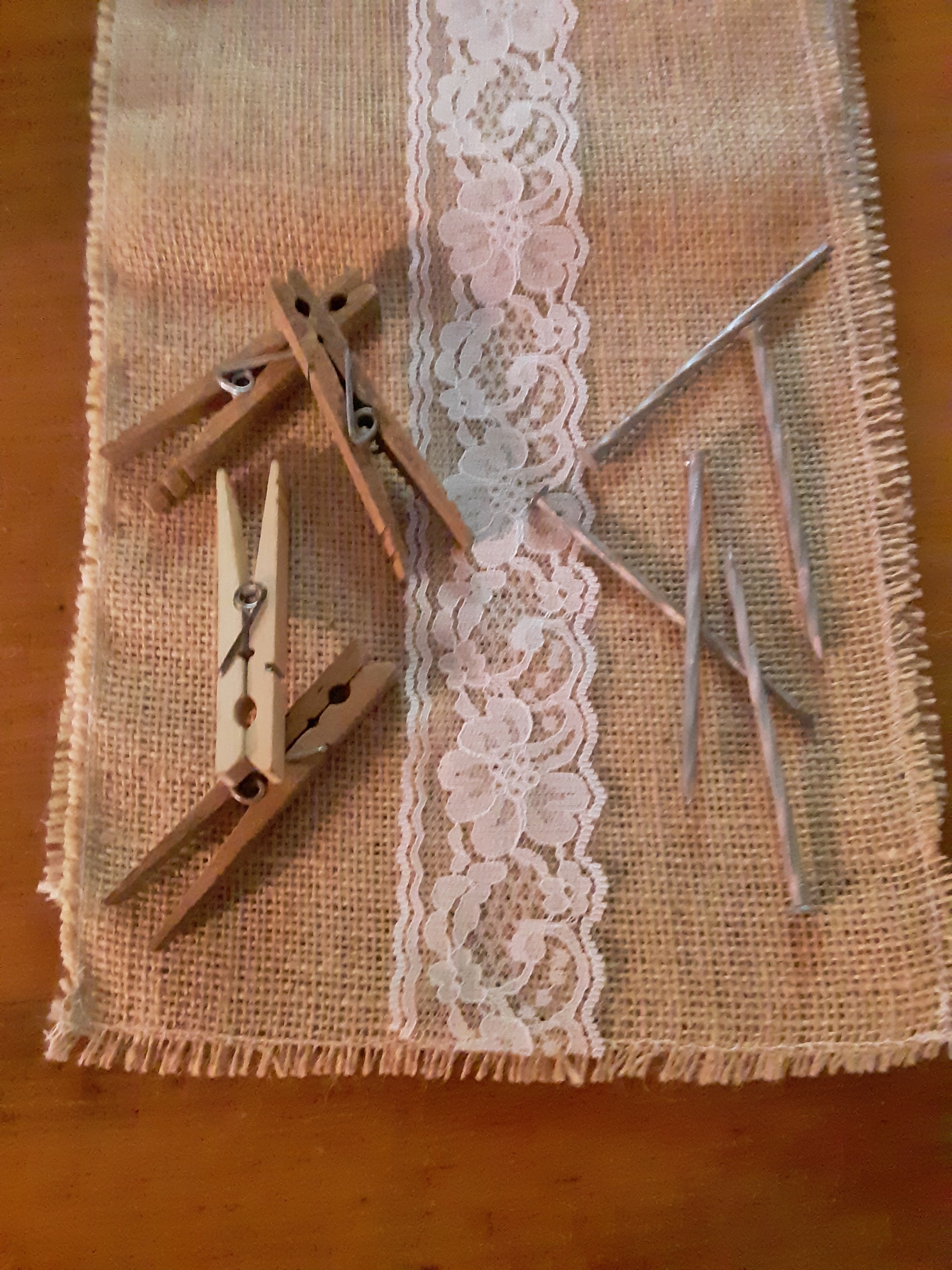
So, I want to try out my new word on you. I am making wedding rehearsal dinner decorations (That was a mouthful.). I am not really creative in this realm, so that the contrivance of my wife and I is a modified copy of things we liked online. It is in some respects simpler, and by me making it, much cheaper. But all that is not the point here, and I can’t give away too much before the dinner, so the pictures are limited. My point is for you to look at the following picture and write down pairs (in this case) of words that immediately come to mind. To see the quality of my pictometaphor, please don’t look at my answers until you have written down several pairs. It is totally fair and desirable to consider that this pictometaphor is in the context of an upcoming wedding. It needs context.

20190805_134150

Before I give my answers, let me further comment on the quality of a pictometaphor. The picture, sewn cloth (in this case), statue, etc, should universally suggest the same words to all people. This might be too much to expect given different cultures, so perhaps, it should at least be universal within a given culture. Or perhaps it becomes a code word (code picture?), a sort of jargon joke for the initiated.

When I look at the picture above in the context of marriage, I immediately think male/female, strength/beauty, utility/luxury, mundane/special (plano/fancy?), daily/special event. How do your pairs fare? Do they align with mine, mean the same thing with different words, contradict at points? Share by commenting.

Now, I like extended metaphors, as long as they don’t verge on the ridiculous. So I have added some possible additional accoutrements to the decoration. (This is somewhat tongue in cheek, and my wife said that was not happening when I suggested it.) Make your list of pairs again and let me know how you did.

20190805_134235

The selection of additional items colors(4) the connotations of the pictometaphor. Because I have selected two items that involve work or chores, the suggestion is not work versus play, but what kind of work. Probably for many of us, they suggest traditional gender roles. I am not going to apologize for that. I have hung up many clothes, particularly as a child, and my wife has helped me by hauling lumber and bags of concrete, but there are differences in our roles as male and female, and those have quite naturally and thankfully expressed themselves in our culture in nurturing and supporting ways. Much that is wrong with our society at present revolves around the abandonment of God ordained, given, and declared gender roles within the family, church, and society. Therefore, the first pair that came to my mind when seeing the nails and clothes pins was male/female. Also, I think home/job.

I could have directed the pictometaphor in a completely different direction by some simple change like replacing either the clothes pins or the nails with a few Lego bricks or a small doll. Then I would be driving the picture toward work/play, responsibility/privilege, chore/leisure, or even childhood/maturity depending on the exact toy I select.

I hope that you have enjoyed reading my comments and selecting your word pairs for the pictometaphor. The connotations of the pictometaphor need not be pairs, but the ideas must be ones that are widely understood. That is where culture and history and language come in. Language and art are at least partially an archive for culture and history. We should not revel in language and art changing so fast, because that blurs and eradicates much that can be learned and shared between generations. For instance, Western Culture has a rich language and art based on a biblical understanding. Many pieces of literature and art can not be understood in isolation from an understanding of the Bible. Of course, some want to rush the change, obliterate the references and understanding for the Bible given by language and art, and wholeheartedly reinterpret both, but that is a pictometaphor for another day.

1- The first word I tried to coin is “momentaneously”- circa 1995- used in response to impatient inquiry to mean you are high on my priority list and I will get to you with all speed as circumstances allow. Used in a sentence: “I will answer you momentaneously, but you are interrupting Jane at the moment.” For evidence of my coinage I site numerous classrooms full of students. Please spread the word since this may be my best possibility at fame. And, oh, by the way, don’t take me too seriously.

2- I considered iconometaphor, photometaphor, or imagometaphor, but each of these suggest connotations not in line with my definition, so I settled on pictometaphor.

3- “Hey, George.” What, Frank?” “How about photaphor or imaphor (or imagaphor) or iconaphor.” “Oh, Frank, that last one sounds good, but do you think people will understand what it means?” “George, the sound of a word can help the availability of its meaning, but ultimately, there is nothing like a clear and consistently used definition. ‘Is’ means ‘is’ even if some people say it ‘ain’t’.”

4- I am also partial to puns.

Read Full Post »

Myrela

Art, health, civilizations, photography, nature, books, recipes, etc.

Overflows from the Heart

"But the things that proceed out of the mouth come from the heart…" Matthew 15:18

CreatorWorship

Pointing to the One who made, saved, and sustains