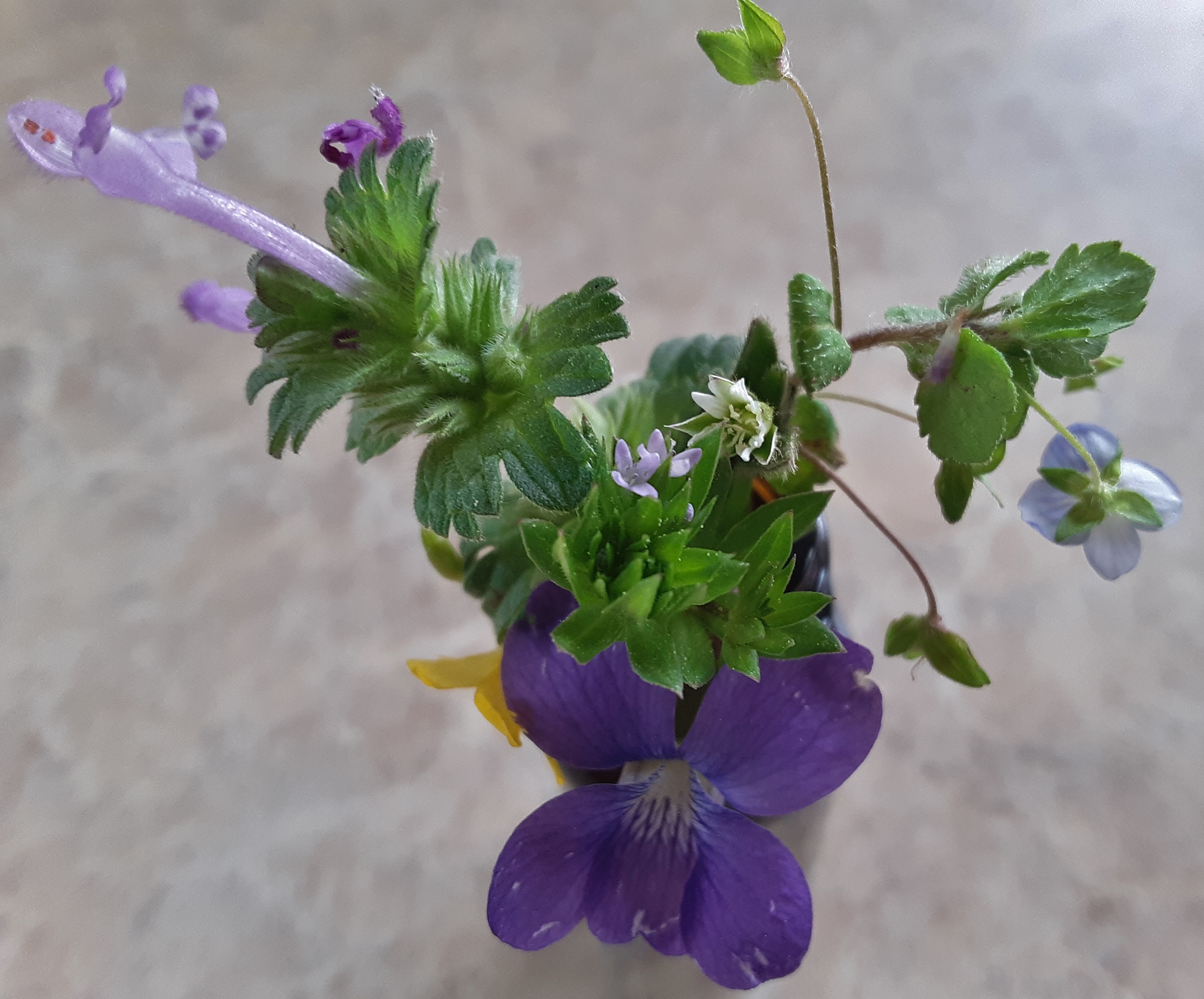
One sunny day not long ago I was resting and reading for a short period of time. After I completed the passage, a deep essay on theology, I looked up and called my wife’s name. The house sounded empty. I cruised through the rooms and she was not to be found. Then I looked out the window and there she was wandering around in the yard with her head down. I went out and made a comment about the beautiful day and asked her what she was doing. She raised up a hand grasping small flowers, most people would call weeds, and said, “They cover the yard, and they are so beautiful.” She had three different flowers. I began the search, and we found seven different types of flowers, some hardly as big as the head of a pin, but covering the yard with blues, yellows, violets, and wee little whites. All the detail for male and female flower parts and nectar production and beautiful little petals. How much of God’s beauty goes unnoticed because we are looking but not perceiving, looking inward and not around us, looking to find fault rather than encouragement, or looking to show off rather than being shown to? So small, frequently unnoticed, but declaring God’s glory anyway, quietly turning heavenward.
Many years ago I watched a program about the exploration and mapping of the cave Lechuguilla that is in Carlsbad Caverns National Park. At the very back of the cave is a room with intricate gypsum stalactites, one 20 feet long. The majority of the cave was not discovered until 1986 when cavers broke through an extensive breakdown blocking the main passage. The Cave of the Crystals in northern Mexico features selenite crystals up to 37 feet long and 4 feet in diameter. The conditions are harsh in terms of temperature, humidity, and vaporous sulfuric acid. The cave was discovered in 2000 by two miners after extensive pumping cleared the room of water.
Many other examples of once hidden beauties and wonders could be paraded before you, but these several examples demonstrate to me that God has many hidden beauties in His Creation, quietly giving glory to Him, and how many may never be discovered? Secondly, I believe it gives new meaning to why we explore at all. We don’t just climb a mountain because it is there, we seek something, something wonderful or beautiful or hidden. Our desire to discover and explore reveals God’s glory. Many explorers and exploration societies give glory to the explorers or the less than scientific explanations of what is found, but pieces of God’s character in power and design and goodness and wisdom are revealed in what we find. That is a worthy reason to explore and discover, reveal and describe.
The seventh type of flower is hidden around back and several are facing away, but they decorated our window sill for few days.
I was somehow more attentive and engaged in Resurrection celebration today than I remember being in years past. God was at work in my heart and those of my brothers and sisters at church. The sunrise service, breakfast and fellowship, cantata, and sermon warmed my heart and encouraged my faith. This evening, full of many thoughts and thanksgivings, I desired to write a poem. The first verse began to come as my summary of my pastor’s thoughts on Resurrection Sunday rolled around in my mind.
Christ is risen and now I know His blessings to me will forever flow My past is covered My future secured My present empowered So that I may grow
Christ is risen the church must go To tell the nations and the Gospel sew Its command rendered Its purpose is clear Its victory sure That God’s glory show
Christ is risen who once was low In pain and death to save sinners who owe He ascended high He reigns from there now He will come again In great glory to His saints all aglow
Christ is risen, do not say no To His call of salvation don’t be slow You are a sinner You can’t save yourself You need His mercy Or you are headed for woe
“Low in the grave He lay Jesus my Savior! Waiting the coming day Jesus my Lord!
Death cannot keep his prey Jesus, my Savior! He tore the bars away Jesus my Lord!
Vainly they watch His bed Jesus, my Savior! Vainly they seal the dead Jesus my Lord!” (1)
What was He doing? He had suffered but was now at rest, but He was not idle. The Bible says, “But to each one of us grace was given according to the measure of Christ’s gift. Therefore it says, “When He ascended on high, He led captive a host of captives, and He gave gifts to men.” (Now this expression, “H e ascended,” what does it mean except that He also had descended into the lower parts of the earth? He who descended is Himself also He who ascended far above all the heavens, so that He might fill all things.)” Ephesians 4:7-10 “made alive in the spirit, in which also He went and made proclamation to the spirits now in prison, who once were disobedient, when the patience of God kept waiting in the days of Noah, during the construction of the ark” I Peter 3:18-19 I don’t fully know what this means, that He “led captive” and “made proclamation”, but it certainly did and will bring glory to Him for His power over death and grace toward sinful man. The next verse may or may not relate to this scene in The Grave where He descended. It may mean that they had the Gospel preached to them during their lifetime, but it may also mean they were preached to in The Grave. “For the gospel has for this purpose been preached even to those who are dead, that though they are judged in the flesh as men, they may live in the spirit according to the will of God.” I Peter 4:6
Back on the top side, “Pilate said to them, “You have a guard; go, make it as secure as you know how.” And they went and made the grave secure, and along with the guard they set a seal on the stone.” Matthew 27:65-66 But it was in vain, for He arose, the stone was rolled back, and the guards were as dead, fully fainted away. Death could not hold its prey, nor could the government seal and secure His grave, nor could the religious leaders lie Him out of existence and influence, nor could the crowd crying, “Crucify, crucify Him!” thwart His purpose to rescue His people. The mystery of the crucifixion, burial, and resurrection, how God died, how sinners were rescued, the timing, the scope, the suffering, and the victory were a mystery to all, even prophets and angels:
“It was revealed to them that they were not serving themselves, but you, in these things which now have been announced to you through those who preached the gospel to you by the Holy Spirit sent from heaven—things into which angels long to look.” I Peter 1:12
His victory was not merely His and our joy, but our assurance and proof to anyone willing to look that He is who He says He is and accomplished what He says He accomplished.
“Up from the grave He arose With a mighty triumph o’er His foes He arose a Victor from the dark domain And He lives forever with His saints to reign He arose! (He arose) He arose! (He arose) Hallelujah! Christ arose!” (1)
Spring has sprung, and along the Catawba River Greenway, it is in full bloom. The years pass and I have seen every season multiple times on this 6 miles of trail by the river. To long time watchers of this blog (1), this entry might be a bit boring, but there are a few new twists and turns and the beauty of God’s Creation never grows old. I am especially drawn to its ability to regenerate and renew. I didn’t take a picture, but I observed several large Mayapple patches blooming in the middle of a died out Kudzu patch. Of course, as the weather gets warmer, the Kudzu will take over and completely shade and choke out the Mayapple for the remainder of the season. But the plants persist because they sprout, leaf, bloom, and fruit by mid-May before the Kudzu has done much more than sprout.
I found a wildflower new to me. I took two pictures and immediately sent them to sister-in-law, the family resident wildflower expert (2). Within two minutes she replied with the name and inquiries as to the presence of crossbred varieties with different color centers to their flowers. A short distance down the trail I spied a curiously marked songbird, and the two of us stared each other down for a few minutes. I made a cautious one step for a better view, and the bird flipped around on the branch preparing to fly, allowing me to see the backside coloring. After another good look I cautiously moved away, leaving the bird on his branch. I feel quite confident, after looking it up, that I was viewing an Ovenbird, a larger songbird but smaller Warbler. I haven’t the camera to even have bothered to try to take a picture, but the breast markings, eye ring, back and tail feathers were distinctive enough.
To think that this walk had come about because every effort to secure work for the day had fallen through. So, what do you do when you can’t make your best laid plans A, B, and C happen? Take a walk, pray, and look intently around at the beauty of God’s world. For a few of the pictures I did manage to take, click on “Greenway Flowers“.
It was a bit cooler than we anticipated last Saturday for climbing. My climbing partner arrived at the house just after 8 AM and it was still about 30 degrees Fahrenheit. We decided to go to a south facing, low elevation crag. From what we observed and others said later on, it was a good thing. One friend at church said, “I could swear that when I looked up at the mountains it was snowing.” I replied, “I can swear it was snowing.” We had snow showers with sunshine and wind alternating with just sunshine or then dark clouds and wind. Just as we were hiking out a fierce sleet flurry rushed down the draw. It was laying before we could get out of the woods. On our first climb the rock was quite cold resulting in cold fingers, but after that the sun warmed the rock just often enough to make it good climbing. We had lively talk, good climbing, brisk hiking in and out, bracing weather, Spring just breaking in blooms, and Winter trying to hold on for one more hurrah. It was a good day. Check out the pictures at Crag Day.
I previously proclaimed my proclivity for and prowess with lists. You can check that out at Lists.
The other day I stepped up my list using a notch. I now live outside of the town I lived in for 22 years. There and back that is now 50 minutes of driving. There are frequently multiple chores to do when in town. I have recently felt a mild frustration at the inefficiency of getting things done in town, increased by the price of gas. One worried little about either when things were a 3- 5 minute drive from the house. So, I thought, what would be the most efficient route for getting the chores done. I decided to sketch a map, labelling all of the places I needed to go and then mark an order of visiting various venues. It turned out to be a circle. As you can see, I have labelled highway numbers and initials of places to visit.
The oval represents the town, which reminded me of a small developmental art lesson I had one time. An artist had observed many children drawing. In the video children were shown drawing. He points out to the commentator, ‘See, she puts a circle around it.’ Then he explains that at a certain developmental stage, children circle their scribble and call it an object, a person, a thing. Before that they just scribble. After that they are trying to draw an object they hold in their mind.
In the middle of the circuit, we decided that we needed to make an additional stop. I just added it to the circuit without any backtracking or inefficiency. I wondered how few of stops need a map. Is it how many stops I can easily hold in my mind with all of the other details running around in my head and without forgetting a stop? Or is complexity of the route? Or is it the amount time between planning the trip and executing it? Is the number 2 or 3 or 5? Certainly this list of 6 was enough for me to not immediately see the most efficient route without mapping it out.
It saved time, gas, and frustration trying to figure out where I should go next. And given that I don’t just walk or drive a few minutes to this store or that business and come back home, it may become a more regular habit to map-list where to go…”Next!”
My wife and I had a long weekend with family, the first since Thanksgiving because of sickness, finances, and business. We interacted with 8 our of our 10 grandchildren, two of our children, three of my brothers, one of her sisters, nephews and nieces, grandnephews and grandnieces, and in-laws at meals, on hikes, sitting around, and in church. Click here are some pictures of a few of the activities.
I found the following reflection from 2011 that I never published. It still the way my wife and I do life.
One of the choices our family has made over the years is to live materially conservative lives. Obviously, if a family has financial limitations then their life must be lived frugally to maintain stability. That has been our allotment for which we are thankful to God. As I have said in times past, “Though we don’t always know how, the bills are always paid.” However, it is possible even within this forced frugality framework to choose convenience overr conservation. For instance, three of our babies wore exclusively cloth diapers and the fourth wore them until continuous diaper rash persuaded us otherwise. It began as a clear way to save money but continued as a mindset on how to conserve resources.
Another attempt at conserving resources is the compost pile. We began our marriage with two gardens and continued maintaining one for most of our first fifteen years of marriage. We miss our gardens but our present plot is very poorly drained with very heavy soil that doesn’t grow garden vegetables well. But even now without a garden we deliver our ‘wet’ garbage to a covered compost bin that is about 3’ x 5’ x 2 ½ ‘ high. The compost pile helps return nutrients to the ground, reduces the number of times a month trash must be delivered by the rural resident to the dump, and reduces the amount of landfill usage.
For me personally the compost has had another benefit. Though life is busy and I send one of the children out or my wife frequently took it out in times past, I actually enjoy taking out the small bucket full of scraps. In winter I most often carry it out after dark in anything but the hardest rain and never minding the cold. The smell of the air may suggest a coming snow or rain. The wind chills the nose and ears and shoulders and tells of fast changes to warmer or colder. But the best times are the clear, quiet cold nights when the stars are at full brightness. That is a time to reflect on the celestial light peering down through the bare twigs onto the detrital refuse of Earth below, and everything in between- a quiet moment to consider God and His most excellent Creation.
I had a peculiar feeling today (1). Two people were talking about an animal that had to be put down for attacking the owner and in the past other people. The owner cried during the conversation and the other person empathized and then turned and asked if I had a dog. I do not. Because of a poor experience (2) with a dog as a child, I don’t really enjoy pets that much.
Some people have pet dogs or cats. Some people have pet hamsters or gerbils. Some people have pet fish. Some have pet rocks. Later in the day I received a strange text with a picture (click here). I had a sinking feeling when I saw the picture. I lived under that plant for 22 years. I cleaned up after it. I trimmed it. I looked up at it during various seasons and variable weather. I enjoyed its shade, its shape, and it size. The new owners had ever right to cut it down, but I was still a little upset. It was, as my wife reminded me, the largest tree in the neighborhood, and it was probably 150+ years old. I have long known that I like trees, but today I realized that I must hold some similar emotions to other pet owners of dogs or cats or gerbils. I felt a sense of loss over an old companion. (3) I responded in a quite non-committal way to the text with the picture, “Make a alot of good firewood.”
Let me tell it in the present tense even though a week has slipped away since it happened.
I wasn’t attacked. I just didn’t like the dog because I had to train it and feed it but couldn’t really play with it because it would always run over you when you went into the backyard.
Far older than me, perhaps 120+ years old based on other oak trees of similar girth on which I have counted the rings.
In Sunday School we have been studying Romans chapter 6. Some weeks we don’t even get through one verse. We were looking at verse 13: “Do not present your members to sin as instruments for unrighteousness, but present yourselves to God as those who have been brought from death to life, and your members to God as instruments for righteousness.” The word translated “instruments” is frequently translated “weapons”, so Paul is using a metaphor that has the parts of your body likened to weapons of warfare. One of the drills in military procedures, particularly since the inception of the firearm, is “Present arms!”. The soldier is displaying his weapon for inspection, drill, and show of allegiance. Also, there is a significant parallelism here, and I find it easier to see if I diagram it. My pastor pointed out that presentation of your members to God is not doing good deeds, which leads to a self-righteous moralism, as opposed to sinning. Rather, we present our members to God, which means sin is everything that is not God and counter to Him. This verse is very practical when it comes to growing in sanctification. This idea is why we must put on the armor of God described in Ephesians 6:10ff. We are at war with the world, the flesh, and the devil, but “His divine power has granted to us everything pertaining to life and godliness” (2 Peter 1:3).
I have been privileged to work on various types of projects since I began Decks And Such (see https://www.facebook.com/decksandsuch). Friends at church asked me to repair the porch on their house that was built in 1875. They built houses differently back then. Likely, the beams and boards were milled on the property. The beams in the porch were treated with tar that smelled like creosote. I can imagine a crew of workers cutting, milling, cooking tar and applying it, building the foundation and floor joists all from materials found close about. Check out the progression of my repair work at This Old Porch
Wow, time flies whether you are having fun or not. So many challenges and unknowns have come our way in the last 3 months, but God is faithful and His providential care and guidance is unerring even when we can’t see it. We are thankful that our house sold, but we don’t know where we are going next. Houses are hard to get in this rarefied real estate market, and direction for where we should be is even harder at the moment. I am by no means a control freak, but I like a little predictability and consistency in my life, and that is all out the window at the moment. My climbing partner said just today that I seem to handle uncertainty (“the unknowns” as we called it) pretty well. I testified to God’s work in my life to make that so. If I say that I trust God, then I need to prove it by not fretting and by waiting for His guidance.
Having said all of that, I am also thankful for decompression times like hiking hard on an approach to a cliff and climbing hard on climbs that are very challenging for me. That was today. Last week was more chill (or was it?) on a bright sunny day and friends trying hard at the boulder field. Check out a few pictures of that trip at Bouldering with Friends.
Girls are becoming more common in the Francis Clan. Our 10th grandchild was born on 2/23/22. We met her on the Greenway the other day, all bundled up and sleeping as we strolled along. As I held her, I said, “God bless you little girl.” And, as is my custom, I wrote a poem intended for the purpose of saying a blessing over this young one who are our posterity.
May God bless you little girl With early knowledge of Him Seek out the greatly priced Pearl In this evil world that’s grim
Heidi be of noble kin Who serve God, a priestly race Quell temptation, quiet din In the home with love and grace
Louise a famed warrior be This world is no friend to you Pray hard and live righteously Know and teach the Word as true
May God grant that you live free All your children’s children hold All following God you see None to unbelief may fold
As I stood praying with several brothers and sisters after service, a young sister prayed with fervor and striking wisdom for one so young. The latter is largely the result of her good Christian heritage, parents and grandparents. The former is because she “owned her faith”, as her grandmother said. It was not just her parents’ faith, it is hers.
Suddenly, an analogy flashed across my mind.
Young Christians (specifically, I mean young in Christ, young in the faith) are like Igneous rocks, newly formed and fiery, that is, passionate about their faith and progress in it.
Mature Christians are more to be likened to Metamorphic rocks, who through heat and pressure of this life are become purifying factors making the believer hardened and weather resistant to the wiles of the devil, the world, and the flesh.
Carnal and Disobedient Christians are similar to Sedimentary rocks, who once were living stones, but now have retreated to being mere history lessons of past events recorded in layers of deposition or fossils of mineralized bones of past failures of belief.
The analogy can quickly breakdown (erode) if pushed too far, particularly with inclusion of rock cycle transition. However, I think one transition in the rock cycle that should encourage us in this analogy is that even Sedimentary rocks can be metamorphised into more stable forms, just as Carnal and Disobedient Christians may repent and pursue maturity. Then the history lesson of their sediments is both a precautionary tale and a picture of God’s grace in bringing us to completion.
As I listened to the pastor preaching on the parable of the Lamp in Luke 8, my heart was stirred to further consider the truths of the passage. In the Gospels, Jesus is constantly urging His listeners to hear Him or else affirming the value of doing so. Following are two examples where He does the latter, revealing the relationship to God and blessing that comes from listening to His Word.
“But He answered and said to them, “My mother and My brothers are these who hear the word of God and do it.” Luke 8:21
“But He said, “On the contrary, blessed are those who hear the word of God and observe it.” Luke 11:28
What does Jesus mean by hearing? Certainly He does not mean merely receiving vibrations of air into one’s ears or even registering their reception or even focus on the communication. Jesus warns against this type of hearing in the preceding parable in Luke 8. “His disciples began questioning Him as to what this parable meant. And He said, “To you it has been granted to know the mysteries of the kingdom of God, but to the rest it is in parables, ‘so that seeing they may not see, and hearing they may not understand. [Isaiah 6:9]'”” (Luke 8:9-10) Jesus is defining ‘hearing’ as understanding and acting on what you understand. In the continuation of Isaiah call in chapter 6 of that book, God continues with what Jesus has quoted above (v.10):
“Render the hearts of this people insensitive, Their ears dull, and their eyes dim, Otherwise they might see with their eyes, Hear with their ears, Understand with their hearts, And return and be healed.”
‘Return’ is an action of faith. Jesus makes a hard connection between hearing and heeding in the Word, His Word, God’s Word. You “hear…and do it” (Luke 8:21) and you “hear… and observe it.” (Luke 11:28) When you hear and heed, then you will highlight the goodness and power of God to change your life. You will be His “mother” and “brother” and “by this all men will know that you are My disciples, if you have love for one another.” (John 13:35) In John 15:7-9, Jesus calls this hearing, heeding “abid[ing”, which then results in highlighting the Father (glorified by this”) by “bear[ing] much fruit”.
Of course, this brings much blessing (Proverbs 4:4, John 14:21) to the one who truly hears, faithfully heeds, and graciously highlights the goodness of God.
Soon after my last blog entry (Transitions), I had a realization about my thinking processes. See if this assertion rings true for you. I frequently think more clearly and find more insight into a subject if I am not directly focused on it. It seems that when I set to determine a course of action, develop and idea or conviction, or gain deeper understanding, I get bogged down in my thinking processes or research when I concentrate on it. If I, instead, look at it as if with peripheral vision, listening to others discuss the idea, having previously considered the subject, allowing rather than pushing my mental wheels to spin and weave a coherent answer or summary, I think and formulate more clearly. If you carefully read, I do not mean haphazardly blab opinionated platitudes, but rather having previously considered the subject and raised it to the light of Scripture. In fact, it is at the moment of so raising it by myself or others to the light of Scripture that I seem to make connections. And connections are the stuff of analysis leading to synthesis.
When I was an educator by vocation, one of the frequent comments in meetings was “Change is your friend; get used to it because it’s here to stay.” I am here to say that change is no friend of mine and never was. Change is a sometime enemy that stalks my peace, effectiveness, efficiency, stability, and progress as a teacher (1) and person. It cannot be avoided but it should not be applauded, lauded, and promoted. In education, I think change is probably an excuse for never settling on a good and meaningful curriculum and pedagogy. Good teachers who are allowed to teach the same subject will reflect on their craft and better it in delivery, content, and relevance. Bad teachers will not be jolted by change to better their approach, but will find loopholes to continue their poor delivery. (2) I am not quite sure where all of that came from. It must have been latently hovering below the surface for a while.
The real subject of this post is change that really is unavoidable if more beneficial outcomes await. Change, just because it is or because we refuse to resist its eroding influence, is frequently contemptible, but change resulting from a transition which leads to a better place may be hard, but good. (3)
So, my wife and I are in a major transition. At our age, 60’s, these are usually to be avoided for settling and security. In our case health, finances, and pursuits are driving change. The basement of our home of 22 years was growing in water content and mold. Given my wife’s health and blood tests identifying mold as a partial culprit of her symptoms, we decided to sell our house. Some of the pictures (click on “Parting Shots“) reveal the good, the bad, and the ugly. We could have spent the rest of our days in this house, given its wooded yard, quiet neighborhood, familiar surroundings, and good community facilities. (4)
Financially, it may not be reasonable or possible for us to live at our accustomed and desired standard of living in terms of housing in this town. Anyone at all aware of real estate at present is aware that it is flat out crazy. Pandemic paranoia and panic has doubled the price of houses in our town. The only house we were able to get as far as bidding on was gone by the next day. We cannot compete. But God’s providence, rather than more direct means, very frequently guides those who are trusting Him to where He wants them. To where might this lead?
That brings us to the last transition driving point, pursuits. In this context, I mean what I (we) desire to do with a part of the remainder of our days. For that you must wait until we discern where and how God is leading us, be it down the block or across state lines.
Fill in the blank with your profession.
Certainly opinion but one gathered from 28 years of being in the trenches.
Many of the educational elite would say that this is what they are after. I do not beg to differ; I insist upon it. If transition to a better place was what was sought after (aka reform) then education would be better, but much of “educational reform” is a smoke screen for covering incompetence and wrong presuppositions. Leave the good teachers alone to settle in and improve their craft. Help the bad teachers to see they may need to find other work. Maybe this should have been a post about educational reform (or lack thereof).
We agreed and I said, “I think that perhaps what I like best about this town is the [6 mile] wooded trail by the river”. I have run, walked, biked, explored, photographed, read, disc golfed, played with grandchildren and friends, picnicked, and talked on this greenway for 15+ years. I have not yet seen another one of equal beauty or variety.
I have not written here for just over a month, but it seems longer. My wife and I have gone through a period of difficulty and transition. Just after Thanksgiving we both had COVID. Then our house, sold, we moved into a rental house, and the closing on our house was delayed by a failed structural inspection. During the process of moving, I borrowed a trailer from a friend of mine. We met at dusk about halfway between our houses, so I needed the trailer lights. The problem was my truck’s plug did not mesh with his trailer’s plug. How was I to get it home without him spending an extra hour of driving to deliver it to my house?
When your ship is floundering in the swells because of storm damaged rigging and masts, you put up a jury-rig, an improvised, temporary sail that gets you into port. You use what you have. Check out what I had that worked at Trailer-rig.
Do you remember Saul’s debacle with Amalek (1)? In First Samuel 15:1-3 the Lord spoke to Saul through His prophet: “Then Samuel said to Saul, “The Lord sent me to anoint you as king over His people, over Israel; now therefore, listen to the words of the Lord. Thus says the Lord of hosts, ‘I will punish Amalek for what he did to Israel, how he set himself against him on the way while he was coming up from Egypt. Now go and strike Amalek and utterly destroy all that he has, and do not spare him; but put to death both man and woman, child and infant, ox and sheep, camel and donkey.’”
He did not kill all the people of Amalek nor their livestock. It came back to haunt him and all Israel.
My pastor was teaching from I Samuel 30 and 31. Amalekites burned Ziklag and took David’s and his men’s possessions and women and children. David attempted to kill every Amalekite (2), for it says he fought from twilight until dusk of the next day. But 400 young men escaped on camels. Now there must have been at least some Amalek women and children at home and other men, too, but this band of young men could certainly repopulate Amalek in time.
Then comes I Samuel 31 and II Samuel 1. Saul and Jonathan are killed in battle by horrible means and their bodies hung from the walls of Beth-shan. When a messenger tells David what has happened, David has him cut down for killing God’s Anointed, Saul (3). The messenger, euthanizer was an Amalekite. So, Saul’s failure to fully obey God in the beginning came back to cause him problem in the end.
And the difficulty did not end there. One Amalekite, Haman the Agagite (4) set out to destroy all Jews in the time of Esther. His designs were foiled by Mordecai and Esther (Esther 9), but he came close to succeeding.
Partial obedience seems like full obedience to the half-hearted disciple. This word is hard. Sinner that I am, I have been there working my half-hearted obedience. And God says, “Has the Lord as much delight in burnt offerings and sacrifices as in obeying the voice of the Lord? Behold, to obey is better than sacrifice, and to heed than the fat of rams. For rebellion is as the sin of divination, and insubordination is as iniquity and idolatry. Because you have rejected the word of the Lord, He has also rejected you from being king.” (I Samuel 15:22-23) Oh, God give me a whole heart like David’s, so that I may be as him, a man after God’s heart. (Acts 13:22)
Amalek was the grandson of Esau, so Amalekites were Edomites. (I Chronicles 1:36)
Amalek was stubborn in resistance to God and His people. God hardened their hearts and, “Then the Lord said to Moses, “Write this in a book as a memorial and recite it to Joshua, that I will utterly blot out the memory of Amalek from under heaven.” Moses built an altar and named it The Lord is My Banner; and he said, “The Lord has sworn; the Lord will have war against Amalek from generation to generation.”” (Exodus 17:14-16) When Balaam prophesied the final time before Balak, he repeated the idea of Moses’ prophecy, “And he looked at Amalek and took up his discourse and said, “Amalek was the first of the nations, but his end shall be destruction.”” (Numbers 24:20)
Neither the Philistines’ arrows nor Saul’s own sword, but the Amalekite at Saul’s request killed him.
Agagites were descendants of Agag, king of Amalek, at the time of Samuel and Saul. Saul foolishly spared him but Samuel cut him down. (I Samuel 15:8,33)
The owner built his own house with many days of sweat equity for him and his wife and subcontractors for various major steps. The house is 98% done inside but needs some work and finishing touches on the exterior. The couple enjoyed their deck so much and love to entertain that they decided to add onto their deck, or outdoor living space as he called it. Being from farther north, they were amazed at the fierceness of the summer sun. So, they decided that they would use a covered deck more. For that reason, the most recent deck that I worked on might better be called a porch, because we put a roof over it. The outdoor living space changed the character of the house, giving it a more homey and inviting look and feel. The owner, with whom I have worked, has appreciated my attention to detail. He says most everyone who sees it comments on the quality. Check out a few of those details at “Outdoor Living Space“.